
Note: This article contains affiliate links. If you click on these links and make a purchase, we may earn a small commission at no extra cost to you. This helps support our research and content. Read our full affiliate disclosure here.
If you make espresso on a stovetop brewer, grind quality has an outsized effect on extraction and flavor. A grinder tuned for stovetop espresso helps you dial in particle size and dose accurately so shots are neither under- nor over-extracted. This guide highlights a short list of the best coffee grinders for stovetop espresso, covering options that prioritize consistent grind size, reliable dosing, and repeatable adjustments. Each shortlisted grinder was chosen for features that matter for stovetop brewing, and we evaluate them using practical criteria home baristas care about. Read on to find the style and features that fit your routine and stove-top setup.
Top Picks at a Glance
| Best Overall The best all-around choice for most situations | Cusinice Conical Burr Coffee Grinder CG-182 |  |
| Best Quality Built to a higher standard if you want something more solid | Baratza Encore ESP ZCG495 |  |
| Best Value The sweet spot between price and what you get | Hamilton Beach Fresh Grind 80335R |  |
| Best Budget The cheapest option that still gets the job done reliably | Amazon Basics Electric Coffee Grinder CG9402-UL |  |
| Top Rated A top-rated pick with lots of positive feedback | Breville Smart Grinder Pro BCG820BSS | 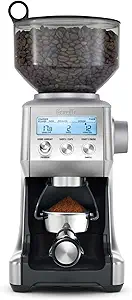 |
| Most Popular A crowd favorite that many people choose with confidence | BLACK+DECKER Coffee Grinder CBG110S |  |
| Best Seller A high-volume bestseller chosen again and again | OXO Brew Compact Conical Burr Grinder |  |
Cusinice Conical Burr Coffee Grinder CG-182

| Burr size | 40mm |
|---|---|
| Grind settings | 34 |
| Power source | AC adapter |
| Capacity | 11.3 ounces |
The Cusinice CG-182 is a home-focused conical burr grinder built to support espresso and a range of manual brew methods. It uses a 40mm stainless steel conical burr and 34 grind settings to move from fine espresso to coarser pours such as French press, while a 0.1s electronic timer and smart memory let you repeat precise doses quickly. Two dosing modes, touchscreen controls, and a portafilter holder make direct-to-portafilter grinding convenient for stovetop espresso workflows, and the anti-static design plus included dosing cup and brush reduce mess at the counter. The 150W motor is sized for daily home use and the removable components simplify cleanup, but it will still make typical grinder noise and is not intended for grinding spices or wet ingredients. For a balanced home user who wants espresso-capable grind control without pro-level complexity, this grinder provides an effective, tidy workflow with repeatable dosing and a compact footprint.
Best for: Home brewers who want a single grinder that can reliably produce espresso-level fines and coarser grinds for other methods while offering quick, repeatable dosing and a cleaner workflow.
Less Ideal for: People seeking a commercial-grade, ultra-quiet professional grinder or those who need a grinder that can process non-coffee ingredients.
- 40mm stainless steel conical burr for more consistent grounds than blade grinders
- 34 grind settings cover espresso through French press
- 0.1s electronic timer with smart memory for repeatable dosing
- Anti-static design and included accessories reduce mess and simplify cleanup
- Touchscreen controls and portafilter holder support direct-to-portafilter grinding
- Not silent; motor noise varies with grind size and beans
- Not suitable for spices, nuts, or wet ingredients which can damage the burr
Verdict: A compact, espresso-capable home grinder that prioritizes repeatable dosing and a tidy, direct-to-portafilter workflow for stovetop espresso enthusiasts.
Baratza Encore ESP ZCG495

| Wattage | 150 watts |
|---|---|
| Capacity | 120 g |
| Voltage | 120 volts |
The Baratza Encore ESP is a purpose-built burr grinder that gives home baristas fine control over grind size for stovetop espresso and other brewing methods. It uses 40mm conical steel burrs and a dual-range adjustment system that provides micro-steps for espresso (settings 1–20) and macro-steps for filter coffee (21–40), so you can dial in a consistent grind without complicated programming. Operation is simple: a front-mounted pulse button and an on/off switch make short dosing and single-serve grinding straightforward, and the quick-release burr design makes routine cleaning easier. The DC motor and hardened burrs are aimed at durability and steady performance, though the unit is compact so it holds a modest 120 g capacity and is meant for home use rather than high-volume shops. If you need ultra-fine, pressurized espresso dosing you may prefer a doser or stepless commercial grinder, but for stovetop espresso lovers seeking repeatable, high-quality grounds in a small footprint, the Encore ESP balances precision and everyday practicality.
Best for: Home baristas focused on stovetop espresso who want precise, repeatable grind control in a compact, user-friendly machine.
Less Ideal for: People who need high-volume or continuous commercial grinding or those seeking a stepless professional grinder for advanced espresso techniques.
- 40mm conical steel burrs provide consistent, durable grinding
- Dual-range adjustment with micro-steps ideal for dialing in espresso
- Quick-release burr system simplifies cleaning and maintenance
- Simple front-mounted controls make short doses and pulses easy
- 120 g hopper capacity is modest for users who grind large batches
- Not a commercial-grade, high-volume grinder
Verdict: A compact grinder that gives stovetop espresso enthusiasts reliable, adjustable burr performance for consistent home extraction.
Hamilton Beach Fresh Grind 80335R

| Capacity | 4.5 ounces |
|---|---|
| Wattage | 125 watts |
| Voltage | 110 |
| Power Source | AC |
The Hamilton Beach Fresh Grind is a simple, no-frills electric blade grinder built for everyday use. It grinds coffee beans, spices, and seeds using stainless steel blades in a removable grinding bowl that makes filling, pouring, and cleanup straightforward — the bowl and lid are dishwasher-safe. Its single-button press-and-release operation is intuitive: press to grind and release when you reach the desired consistency. The unit can process enough beans for a 12-cup pot, and cord storage under the base keeps counters tidy. Because it is a blade grinder, grind size is best suited to coarse or medium uses; it does not produce the consistent fine grind espresso machines require. The grinder is compact and relatively quiet for its class, making it convenient on small counters, but users wanting precise, uniform espresso grinds should choose a burr grinder instead.
Best for: Buyers who prioritize a compact, easy-to-clean grinder for daily drip or French press coffee and occasional spice or seed grinding will appreciate this unit.
Less Ideal for: People seeking a grinder that delivers the consistent, fine grind required for stovetop espresso or precision home espresso should consider a burr grinder instead.
- Removable stainless steel grinding bowl for easy filling, pouring, and dishwasher cleaning
- Simple one-button operation makes it quick and easy to use
- Cord storage under base keeps countertop clutter to a minimum
- Stainless steel blades handle coffee, spices, and seeds for multi-purpose kitchen use
- Blade-style grinding yields uneven particle sizes and is not ideal for fine espresso grinds
- Limited capacity suited to batch brewing rather than single-dose espresso preparation
Verdict: Choose this compact, easy-to-clean blade grinder if you want a practical, multi-use machine for everyday drip or French press coffee rather than precision espresso grinding.
Amazon Basics Electric Coffee Grinder CG9402-UL

| Capacity | 2.1 ounces |
|---|---|
| Voltage | 120 volts |
This Amazon Basics electric coffee grinder is a simple, compact blade grinder meant for quick home use and small batches. It grinds about 30 grams (1 ounce) of beans in roughly 10 seconds, which is convenient for a single cup or small stovetop espresso doses. The unit uses a heavy-duty stainless steel blade and a clear safety lid so you can watch grind progress, and it handles coffee beans plus spices, grains, and nuts. Its small 2.1 ounce capacity and quick cycle make it best for daily single-serve grinding rather than large batches, and blade grinders produce less consistent particle size than burr machines, which affects extraction for espresso. The grinder is lightweight and easy to store, and the simple one-button operation keeps use and cleanup straightforward. For someone on a budget who needs fast, occasional grinding for stovetop espresso or moka pot use, it delivers basic performance; users seeking the finest, most uniform espresso grind should consider a burr grinder instead.
Best for: Buyers prioritizing a low-cost, no-frills grinder for quick single-dose preparation for stovetop espresso or moka pot brewing who value speed and small size over absolute grind uniformity.
Less Ideal for: Users who make large daily batches, need very fine and uniform espresso grinds, or want adjustable, repeatable grind settings should choose a dedicated burr grinder instead.
- Very compact footprint that stores easily on crowded counters
- Fast grind time—about 10 seconds for ~1 ounce of beans
- Stainless steel blade and clear lid let you monitor progress
- Multi-use for coffee, spices, grains, and nuts
- Small 2.1 ounce capacity requires multiple batches for more than one cup
- Blade grinder yields uneven particle sizes compared with burr grinders
Verdict: A cheap, compact grinder that gives fast single-dose grinds for budget-minded stovetop espresso brewers who accept the limits of a blade grinder.
Breville Smart Grinder Pro BCG820BSS

| Wattage | 165 |
|---|---|
| Voltage | 120 |
| Capacity | 1.1 pounds |
| Bean Hopper Capacity | 18oz |
The Breville Smart Grinder Pro is a countertop conical burr grinder built for repeatable, precise doses from espresso to French press. It grinds directly into a portafilter, airtight container, or filter and uses a digital timer that adjusts in 0.2 second increments so you can reproduce the same dose shot after shot. The clear LCD shows grind setting, grind time, and selected cups or shots, while 60 stepped grind settings cover very fine to coarse profiles. Included portafilter cradles and a sealed grinds container make it convenient for stovetop espresso workflows that need consistent, small doses. At 165 watts with an 18 oz hopper it handles daily home use without high-end commercial speed, and the stainless-steel body feels stable on the counter. Limitations include its relatively moderate throughput for heavy multitasking and the learning curve to find the exact setting for some beans, but for a home setup focused on reliable, repeatable dosing it is a practical choice.
Best for: Home baristas who prioritize consistent, repeatable dosing for stovetop espresso and want a robust, programmable grinder that grinds directly to a portafilter.
Less Ideal for: People who need very high-volume or near-instant grinding for continuous service or who prefer fully hands-off, single-button dosing systems.
- Precise digital dosing with 0.2 second increments for repeatable shots
- Wide 60-step grind range to dial in espresso and coarser brews
- Grinds directly into a portafilter or sealed container for stovetop espresso convenience
- Clear LCD that displays grind setting, time, and shot/cup selection
- Sturdy stainless-steel construction and included portafilter cradles
- Not as fast as commercial machines when grinding large quantities
- Takes some experimentation to find the exact step for each bean and roast
Verdict: If you want a reliable, programmable grinder that delivers repeatable doses for stovetop espresso, the Breville Smart Grinder Pro is a practical and durable choice.
BLACK+DECKER Coffee Grinder CBG110S

| Capacity | 56.6 g |
|---|---|
| Wattage | 130 |
| Voltage | 110 volts |
| Power Source | Electric |
The BLACK+DECKER CBG110S is a small, no-frills electric blade grinder that turns whole beans, spices, and grains into a usable grind with a single push-button operation. It uses stainless steel blades and a matching stainless bowl for durability and easy cleaning, and a lid-locking safety feature prevents the motor from running unless the lid is secured. Typical use is short pulses for coarse stovetop espresso pre-grind or longer runs for finer grounds, though blade grinders do not produce the uniform particle size of burr grinders. The 56.6 g capacity suits one to two servings at a time, making it convenient for daily stovetop espresso prep or occasional spice grinding. At 130 watts the motor is adequate for quick jobs but can heat beans if overrun, so brief pulses are best. The unit is compact and simple to operate, but users seeking precise, consistent grind size for competitive espresso extraction should consider a burr grinder instead.
Best for: Buyers who want an inexpensive, easy-to-use grinder for quick stovetop espresso prep or occasional spice grinding and who prioritize reliable safety features and compact design backed by strong customer feedback.
Less Ideal for: Serious espresso enthusiasts who need precise, uniform grind size for consistent extraction should choose a dedicated burr grinder instead.
- Stainless steel blades and bowl offer durability and easy cleaning
- One-touch push-button with lid-locking safety makes operation simple and secure
- Compact footprint fits small kitchens and is easy to store
- Suitable for multiple uses: coffee beans, herbs, spices, and grains
- Blade design yields less consistent particle size compared with burr grinders
Verdict: A simple, compact electric blade grinder that reliably handles single-serve stovetop espresso prep and occasional spice grinding with easy one-touch operation.
OXO Brew Compact Conical Burr Grinder

| Capacity | 50 g |
|---|---|
| Voltage | 120 volts_of_alternating_current |
| Power Source | AC adapter |
The OXO Brew Compact Conical Burr Grinder brings café-style grinding to a small countertop footprint, making it a practical choice for home brewers who need consistent results without a bulky machine. It uses stainless steel conical burrs and offers 15 main settings with 29 micro-adjustments to dial in grind size from fine to coarse, which helps achieve a repeatable grind for stovetop espresso or other brew methods. The 50 g hopper is sized for single to small multi-cup batches, and a chute-less grounds container with an integrated spout makes transfer into a portafilter or filter tidy. Removable upper and lower burrs simplify cleaning, and the compact, cord-wrap design stores neatly when not in use. Expect a compact-capacity limitation if you routinely grind large amounts, and while the grinder is targeted at home use, it is not a commercial-grade motor for continuous heavy-duty runs. For careful users who value consistent grind and easy maintenance in a small footprint, this grinder performs well for stovetop espresso routines with modest daily dosing.
Best for: Buyers who prioritize predictable, repeatable grind size and easy maintenance in a small, countertop-friendly grinder for stovetop espresso and other home brewing methods.
Less Ideal for: Those who need to grind large daily volumes or want a heavy-duty commercial motor for continuous back-to-back grinding.
- Conical stainless steel burrs for consistent grind quality
- 15 settings plus 29 micro-adjustments for precise grind control
- Compact footprint and cord-wrap for easy countertop storage
- Removable upper and lower burrs for straightforward cleaning
- Integrated spout on grounds container for neater transfer
- 50 g hopper holds only small batches, requiring repeats for multiple servings
- Not intended for continuous commercial-style grinding sessions
Verdict: A compact, easy-to-clean conical burr grinder that gives precise, repeatable grinds ideal for cautious home brewers dialing in stovetop espresso.
Choosing the Right Coffee Grinder for Stovetop Espresso: Key Factors to Consider
Grind Consistency and Particle Distribution
A narrow particle-size distribution is essential for stovetop espresso because these brewers are sensitive to flow resistance. Inconsistent grinds will produce channeling, uneven extraction, and astringent flavors. Look for burr grinders with geometry suited to fine settings rather than blade or low-quality burr designs. Consistent grinds let you adjust dose and tamp with confidence and produce more repeatable shots.
When assessing consistency, consider the visible uniformity of grounds at your target setting and whether small adjustments produce predictable changes. Even modest improvements in distribution can noticeably affect crema, body, and perceived sweetness in stovetop extraction.
Adjustment Range and Repeatability
Stovetop espresso requires a finer-than-average grind and small incremental changes. A good grinder offers a wide adjustment range that includes fine settings and a reliable indexing system so you can return to a previous setting. Stepping mechanisms, numbered dials, or micrometric knobs improve control compared with vague clickless systems.
Repeatability matters because you will be dialing in grind every few days as beans age or roast profiles vary. If the grinder does not hold its setting or the adjustment is too coarse, you will waste beans chasing consistency. Seek models that clearly mark steps or provide micro-adjustment capability.
Dosing Control and Grounds Transfer
How you dose and transfer grounds impacts mess, extraction consistency, and workflow. Built-in dosing compartments, timed dosers, or grounds containers with minimal retention reduce waste and make single-dose routines easier. For stovetop users who grind directly into the brewer or a small portafilter, the chute design and exit geometry should permit clean transfer with low retention.
Consider whether the grinder allows single-dosing without a large hopper, or if the hopper is easy to remove. Low-retention paths and removable catch bins simplify cleanup and help when you switch beans frequently.
Build Quality, Materials, and Serviceability
Durable components preserve grind geometry and long-term performance. Metal burrs last longer and stay sharp, while robust housing and reliable motors reduce inconsistent torque at fine settings. Equally important is how easy it is to clean and service the grinder. Accessible burrs, removable hoppers, and straightforward disassembly make it easier to remove oils and particle buildup that will otherwise affect grind consistency.
Check whether consumable parts are replaceable and whether the design minimizes ground retention. A grinder that is easy to maintain will deliver steadier results over months and years of use.
Footprint, Noise, and Countertop Fit
Kitchen space and noise tolerance influence which grinder is practical. Some grinders are compact and quieter, fitting small counters and apartments, while others are larger and louder but offer superior burr sets. Consider where you will store or operate the grinder and how often you will use it in the morning routine.
Noise level affects household comfort, and footprint affects where you can keep the unit. If you have limited counter space, a compact grinder with a removable hopper or a slim profile will be easier to accommodate.
Why Finer Grinds Matter for Stovetop Espresso
Stovetop brewers rely on pressure generated by steam and user-applied heat, so flow rate and resistance are tightly linked to grind size. Finer grinds increase extraction surface area and slow down the flow just enough to develop body and sweetness without becoming harsh. If the grind is too coarse, you get thin, under-extracted cups. Too fine and the brew can become bitter or clogged.
Understanding this relationship helps explain why grinders built for drip or French press often underperform for stovetop espresso. You want control at the fine end of the spectrum and a grinder that preserves a tight distribution at those settings.
- Finer particles increase contact time and extraction.
- Consistent fines and middles produce balanced flavors.
- Excess fines can cause over-extraction or clogging.
Single-Dose Workflow Versus Hopper-Based Routines
Many home baristas prefer single-dosing to preserve freshness and reduce waste. Single-dose workflows require a grinder that is easy to load, with minimal retention and a chute that allows direct transfer into a small brewer or dosing cup. This approach is ideal for people who switch beans frequently or who brew a single serving at a time.
Hopper-based grinders suit households that brew multiple servings or want to minimize daily setup. A removable hopper that is simple to empty and install gives you flexibility between bulk grinding and single-dosing without introducing extra mess.
- Single-dosing emphasizes low retention and precise dosing.
- Hoppers are convenient for repeated brewing but add retention.
- Choose the workflow that matches how often and how much you brew.
Cleaning and Maintenance Tips for Long-Term Performance
Regular cleaning preserves burr sharpness and prevents oil buildup that can alter flavor and grind behavior. Use manufacturer-recommended brushes and periodic deeper cleanings to remove trapped fines. If the grinder permits burr removal, perform a thorough cleaning every few months depending on usage.
Be mindful of static that can make grounds cling to the chute. Wiping contact points and using a short blow or gentle tap can reduce retention. Replace worn burrs as needed to maintain consistent particle distribution.
- Brush out hopper and chute after each grinding session.
- Deep clean by removing burrs according to the manual every few months.
- Watch for worn burr edges and plan for replacement to retain consistency.
Adapting Grind to Bean Roast and Age
Roast level and bean age affect extraction speed. Darker roasts often extract faster, so they may require a slightly coarser setting to avoid bitterness. Fresher beans produce more degassing and can tamp differently, so expect to make small adjustments during the first few days after opening a bag. Your grinder should let you make those micro-adjustments cleanly.
Keeping a log of settings for each bean and roast level helps reproduce results. Because stovetop espresso is sensitive to small variances, consistent grind adjustments are one of the most effective ways to stabilize flavor across different beans.
- Coarser for darker roasts, finer for lighter roasts depending on taste.
- Adjust settings as beans age and degas over the first week.
- Record settings to reproduce a preferred cup with the same bean.
Portability and Charging Considerations for Compact Grinders
Some users want a compact grinder for travel or small kitchens. Battery-operated or hand-crank options offer portability but trade off some consistency and convenience compared with powered burr grinders. If you plan to travel with a stovetop brewer, check whether the grinder's size and power source fit your routine.
For countertop use, prioritize a stable power connection and sufficient motor torque to maintain speed at fine settings. If you choose a portable unit, expect to compensate with more careful technique to achieve consistent results.
- Portable grinders can fit travel but may lack fine-range repeatability.
- Check battery life and motor torque for powered compact models.
- Hand grinders offer control but require more effort for fine settings.
How We Chose the Best Coffee Grinder for Stovetop Espresso
We focused on attributes that directly affect stovetop espresso extraction and daily usability. Our selection emphasized grind consistency at fine settings, since stovetop brewers are sensitive to particle-size distribution. We also prioritized adjustment range and repeatability so you can reliably return to a preferred setting. Dosing control and hopper/portafilter fit matter for convenient, low-mess operation, so we favored grinders with precise dose measures or easy grounds transfer. Build durability and maintenance were included because metal-on-metal or sticky parts degrade the grind profile over time. Finally, noise and footprint were considered for countertop comfort and storage. Excluded items were grinders designed solely for coarse brewing methods or models without fine-setting capability. We did not include grinders that lack clear adjustment indexing or that have single-purpose blades unsuited for espresso-level fineness. The filters applied were: measurable grind range to fine espresso, consistent burr geometry or proven sharpness, user-adjustable dosing or a stable grounds chute, accessible cleaning and part replacement, and a stable grind-to-grind repeatability. These criteria align with the scoring dimensions used in our reviews.
Our full evaluation process is outlined in our review methodology.
FAQ
What grind size should I aim for with stovetop espresso?
Aim for a fine grind similar to table salt but slightly more variable depending on your brewer and heat. Dial in by watching extraction time and adjusting in small increments until you achieve a balanced shot without rapid channeling or clogging.
Can I use a blade grinder for stovetop espresso?
Blade grinders generally produce wide particle-size distributions and are not ideal for stovetop espresso. They can create inconsistent extraction and unpredictable flavor. A burr grinder with fine adjustment is recommended for repeatable results.
How often should I clean the grinder if I use it daily?
For daily use, brush out the hopper and chute after each session and perform a deeper cleaning with burr removal every one to three months depending on oil buildup and bean type. Regular maintenance preserves consistent grind performance.
Does grind retention affect single-dose brewing?
Yes. High retention means old grounds remain in the chute and can contaminate new doses. Low-retention designs or removable catch cups are preferable for single-dosing because they reduce waste and help maintain flavor purity between beans.
Will different roast levels require different settings?
Often. Darker roasts usually extract faster and may need a slightly coarser setting to avoid bitterness. Lighter roasts may require finer settings to develop sweetness and body. Expect to adjust as you switch roast profiles.
Final Verdict
Choosing the right grinder for stovetop espresso means prioritizing grind consistency at fine settings, precise adjustment, and a dosing workflow that fits your routine. Balance the need for durable burrs and easy maintenance with the countertop footprint and noise you can live with. If you focus on repeatable adjustments, low retention, and straightforward cleaning, you will be able to dial in stovetop shots more quickly and keep results steady over time.