
Note: This article contains affiliate links. If you click on these links and make a purchase, we may earn a small commission at no extra cost to you. This helps support our research and content. Read our full affiliate disclosure here.
Picking the right coffee grinder matters more than many home brewers realize. Grind uniformity, adjustable settings, and how easy the unit is to maintain all have tangible effects on extraction and the taste of your cup. That is especially true when working with a budget under $100, where choices vary widely in features and long-term durability. This guide shortlists the top options in the sub-$100 range and explains the practical pros and cons of each choice. Below we cover the core evaluation criteria used to select these grinders and what to expect from each style. Read on to find a grinder that matches your brewing method, counter space, and maintenance preferences.
Top Picks at a Glance
| Best Overall The best all-around choice for most situations | KitchenAid Blade Coffee Grinder BCG111OB |  |
| Best Quality Built to a higher standard if you want something more solid | Cuisinart Supreme Grind DBM-8P1 | 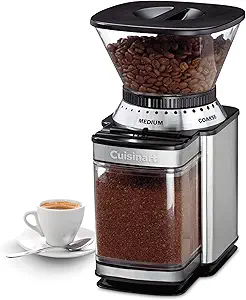 |
| Best Value The sweet spot between price and what you get | KRUPS Silent Vortex Grinder |  |
| Best Budget The cheapest option that still gets the job done reliably | Amazon Basics Electric Coffee Grinder |  |
| Top Rated A top-rated pick with lots of positive feedback | BLACK+DECKER Coffee Grinder CBG110S |  |
| Most Popular A crowd favorite that many people choose with confidence | Hamilton Beach Fresh Grind 80335R |  |
| Best Seller A high-volume bestseller chosen again and again | OXO Brew Conical Burr Grinder | 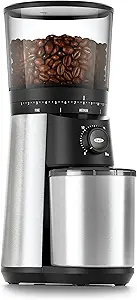 |
KitchenAid Blade Coffee Grinder BCG111OB

| Capacity | 4 ounces |
|---|---|
| Wattage | 160 watts |
| Voltage | 120 volts |
The KitchenAid BCG111OB is a simple, no-frills blade grinder that uses a one-touch press-and-hold control and a stainless steel blade to grind whole beans for up to about 12 cups of coffee. It is typically used by pressing down on the clear lid to start grinding and releasing it to stop, with measurement markings on the removable 4 oz bowl to portion beans for 4, 8, 10 or 12 cups. The clear cover makes it easy to check grind consistency, and the compact polycarbonate body keeps it small enough for crowded countertops or cupboards. Because it is a blade grinder, particle size is less uniform than with burr models, so it is best for drip coffee makers, French press when coarsely pulsed, or casual daily use rather than precision espresso. Practical benefits include fast grinding, an easy-to-clean removable bowl, and a modest 160-watt motor that handles everyday home quantities. If you want precise, consistent grinds for specialty brewing or frequent large batches, a burr grinder would be a better match, but for straightforward home grinding under $100 this KitchenAid is a durable, user-friendly option.
Best for: Buyers wanting an affordable, compact grinder for everyday home brewing who prioritize speed and simplicity over precise grind uniformity.
Less Ideal for: Users who need consistent, adjustable grind settings for espresso or specialty pour-over brewing should choose a burr grinder instead.
- One-touch press-and-hold operation is intuitive and simple to use
- Removable 4 oz stainless steel bowl with cup markings makes portioning beans easy
- Clear lid lets you monitor grind consistency while grinding
- Compact footprint fits small kitchens and stores easily
- Blade grinding produces less uniform particle size compared with burr grinders
- Limited capacity best suited to small home batches rather than heavy daily use
Verdict: A compact, easy-to-use blade grinder that delivers quick daily grinds for casual home brewing under $100.
Cuisinart Supreme Grind DBM-8P1

| Wattage | 500 |
|---|---|
| Capacity | 0.23 kg |
| Voltage | 110 volts |
The Cuisinart Supreme Grind DBM-8P1 is a countertop flat-burr grinder aimed at delivering consistent grounds across a wide range of brew methods. It uses a 500W motor and an 18-position selector to produce grinds from ultra-fine to extra-coarse, and an internal timer with a one-touch power bar stops the grinder automatically when the cycle is done. The removable 8 oz bean hopper and grind chamber make dosing and cleanup straightforward, and cord storage plus a scoop and brush keep the counter tidy. In practice it grinds reliably for drip, pour-over, and French press; the multiple settings let you dial in fineness for espresso-adjacent grinds though it is not a dedicated commercial espresso grinder. The metal construction feels durable, and the automatic stop helps avoid overgrinding for everyday home use. Noise and some fines at the very finest settings are noticeable, and users seeking absolute café-level uniformity or stepless micro-adjustments may want a higher-end machine, but for under $100 it is a strong performer for most home brewing needs.
Best for: Buyers who prioritize reliable, repeatable grind performance for a range of home brew methods and want a durable, easy-to-clean burr grinder under $100.
Less Ideal for: Users seeking a professional-level espresso grinder with stepless adjustments or the quietest possible operation should consider higher-end models.
- 18-position grind selector for a wide range of grind sizes
- Flat burrs and automatic timer produce consistent, repeatable batches
- Removable 8 oz hopper and grind chamber for easy filling and cleaning
- Durable stainless steel construction and cord storage for tidy countertop use
- Not a stepless grinder so micro-adjustments for espresso are limited
- Can be relatively noisy during operation
Verdict: A solid, durable flat-burr grinder that delivers dependable, adjustable grinds across brew methods for home users looking for performance under $100.
KRUPS Silent Vortex Grinder

| Wattage | 200 watts |
|---|---|
| Voltage | 120 volts |
| Capacity | 12 cups |
The KRUPS Silent Vortex is a small, easy-to-use blade grinder built for quick daily grinding of coffee beans and spices. It uses KRUPS Silent Vortex technology and a 175–200W motor to cut noise compared with typical blade grinders, and one-touch operation makes it simple to pulse the bowl to the desired fineness. The removable stainless-steel grinding bowl and lid are dishwasher-safe, which speeds cleanup and doubles as sealed storage for ground coffee. Its roughly 3 oz bowl yields enough grounds for multiple cups, making it convenient for households that brew several servings at once. Because it is a blade grinder, grind consistency will vary more than with a burr grinder and it relies on timing rather than set grind settings for precision, so it is best for drip, French press, and occasional pour-over rather than strict espresso preparation. Compact footprint and quiet operation make it practical for small kitchens and shared living spaces, while the multifunction use for spices adds kitchen value beyond coffee.
Best for: Buyers who want a compact, low-noise grinder for everyday coffee and occasional spice grinding and prioritize easy cleanup and simple operation.
Less Ideal for: Those who need highly consistent, adjustable grind sizes for espresso or precision specialty brewing should consider a burr grinder instead.
- Significantly quieter operation thanks to Silent Vortex technology
- Removable stainless-steel bowl and lid are dishwasher-safe for easy cleaning and storage
- One-touch operation for quick, straightforward grinding
- Versatile enough to grind coffee, spices, and dry herbs
- Blade grinder design gives less uniform grind size compared with burr grinders
- No precise grind settings; grind fineness depends on timing and user technique
Verdict: A quiet, easy-to-clean blade grinder that delivers fast everyday grounds and doubles as a spice grinder, ideal for practical buyers seeking low fuss performance under $100.
Amazon Basics Electric Coffee Grinder

| Capacity | 2.1 ounces |
|---|---|
| Voltage | 120 volts |
This Amazon Basics electric coffee grinder is a small, no-frills blade grinder designed for everyday home use. It handles single-cup portions quickly, grinding about 30 grams (1 ounce) of beans in roughly 10 seconds with a heavy-duty stainless steel blade and a clear safety lid so you can monitor the result. It is also useful for herbs, spices, grains, and nuts, making it a versatile countertop tool beyond coffee. The unit is compact and simple to operate with a single-button style action, which makes it easy to store and clean, though blade grinders do not deliver the uniform particle size of burr grinders and are best for drip or French press rather than precision espresso. The small 2.1 ounce bowl limits batch size, so plan to grind in multiple rounds for larger servings. For buyers prioritizing a low-cost, fast grinder for daily brewed coffee and occasional spice grinding, this model provides solid performance and durability for its price point.
Best for: Shoppers on a budget who want a reliable, compact grinder for daily brewed coffee and occasional spice or nut grinding without paying for a burr machine.
Less Ideal for: People who need ultra-fine, consistent grinds for espresso or who regularly brew large batches and prefer a single-pass grind.
- Fast single-cup grinding—about 1 ounce in 10 seconds
- Heavy-duty stainless steel blade for durable cutting
- Clear safety lid lets you watch grind progress
- Compact footprint that stores easily on cramped counters
- Versatile for beans, spices, nuts, and grains
- Blade grinder yields less consistent particle size than burr grinders
- Small 2.1 ounce capacity requires multiple batches for larger servings
Verdict: A fast, compact, and affordable blade grinder that delivers good everyday performance for brewed coffee and light kitchen grinding tasks.
BLACK+DECKER Coffee Grinder CBG110S

| Capacity | 56.6 g |
|---|---|
| Wattage | 130 |
| Voltage | 110 volts |
| Material Type | Stainless Steel |
The BLACK+DECKER CBG110S is a small, straightforward blade grinder designed for everyday kitchen use. It uses stainless steel blades and a stainless steel grinding bowl to quickly pulverize coffee beans, spices, herbs, and grains; capacity is roughly 56.6 g so it handles enough beans for several cups at once. Operation is simple: press the one-touch push-button to grind and rely on the lid-lock safety that prevents the blades from running unless the lid is secured. The unit runs on 110V electrical power and the 130W motor delivers rapid results, though blade grinders cannot match burr models for precise, uniform grind size. The compact footprint makes it easy to store or keep on a countertop, and the metal bowl plus blade construction improves durability versus plastic alternatives. If you want a no-frills, reliable grinder for occasional brewing and spice prep, this model is a sensible budget choice; expect less consistency for espresso or fine specialty brewing where burr grinders excel.
Best for: Buyers who prioritize a dependable, easy-to-use grinder for daily drip or French press brewing and occasional spice grinding will appreciate its no-fuss reliability and durable metal construction.
Less Ideal for: Those seeking precise, repeatable grind settings for espresso or specialty brewing should consider a burr grinder instead.
- Stainless steel blades and bowl for durability and easier cleaning
- One-touch push-button control for quick, simple operation
- Lid-lock safety feature prevents accidental operation
- Compact size that is easy to store or keep on a countertop
- Blade grinder yields less uniform grind size than burr grinders
- Small capacity limits batch size for larger households
Verdict: A simple, durable blade grinder that delivers reliable everyday grinding for drip and French press drinkers on a budget.
Hamilton Beach Fresh Grind 80335R

| Capacity | 4.5 ounces |
|---|---|
| Wattage | 125 watts |
| Voltage | 110 |
| Power Source | AC |
The Hamilton Beach Fresh Grind is a small, no-frills electric blade grinder built for everyday kitchen use. It uses stainless steel blades and a removable grinding bowl so you can grind coffee beans, peppercorns, seeds, and other spices, then rinse or load the bowl in the dishwasher for cleanup. Operation is simple: press the lid to grind and release to stop, which makes it intuitive for quick morning use. The unit hides its power cord under the base to keep counters tidy and its 4.5 ounce capacity grinds enough beans for a full 12-cup pot. Because it is a blade grinder you get fast, coarse-to-fine results by controlling grind time rather than precise, uniform particle sizes, so it is best for drip coffee and general kitchen grinding rather than pour-over or espresso where consistency matters most. Its plastic exterior keeps the price and weight down but also means it lacks premium insulation or sound dampening found on pricier models.
Best for: Buyers who want a reliable, easy-to-clean grinder for drip coffee and occasional spice or seed grinding and who prioritize straightforward operation and social-proof reliability over precise grind uniformity.
Less Ideal for: Users seeking café-level grind consistency for pour-over or espresso or those who prefer a heavy-duty metal housing and refined noise control should consider a burr grinder instead.
- Removable stainless steel grinding bowl for easy filling, pouring, and dishwasher cleaning.
- Compact footprint with built-in cord storage keeps countertops neat.
- Powerful 125 watt motor and stainless blades can handle coffee, spices, and seeds.
- Sufficient capacity to grind beans for up to a 12-cup pot in one batch.
- Blade design produces less uniform grind size compared with burr grinders.
- Plastic exterior and basic noise control make it louder and less premium-feeling than higher-end models.
Verdict: A simple, easy-to-clean blade grinder that reliably handles daily drip-coffee and kitchen spice grinding while staying compact and user-friendly.
OXO Brew Conical Burr Grinder
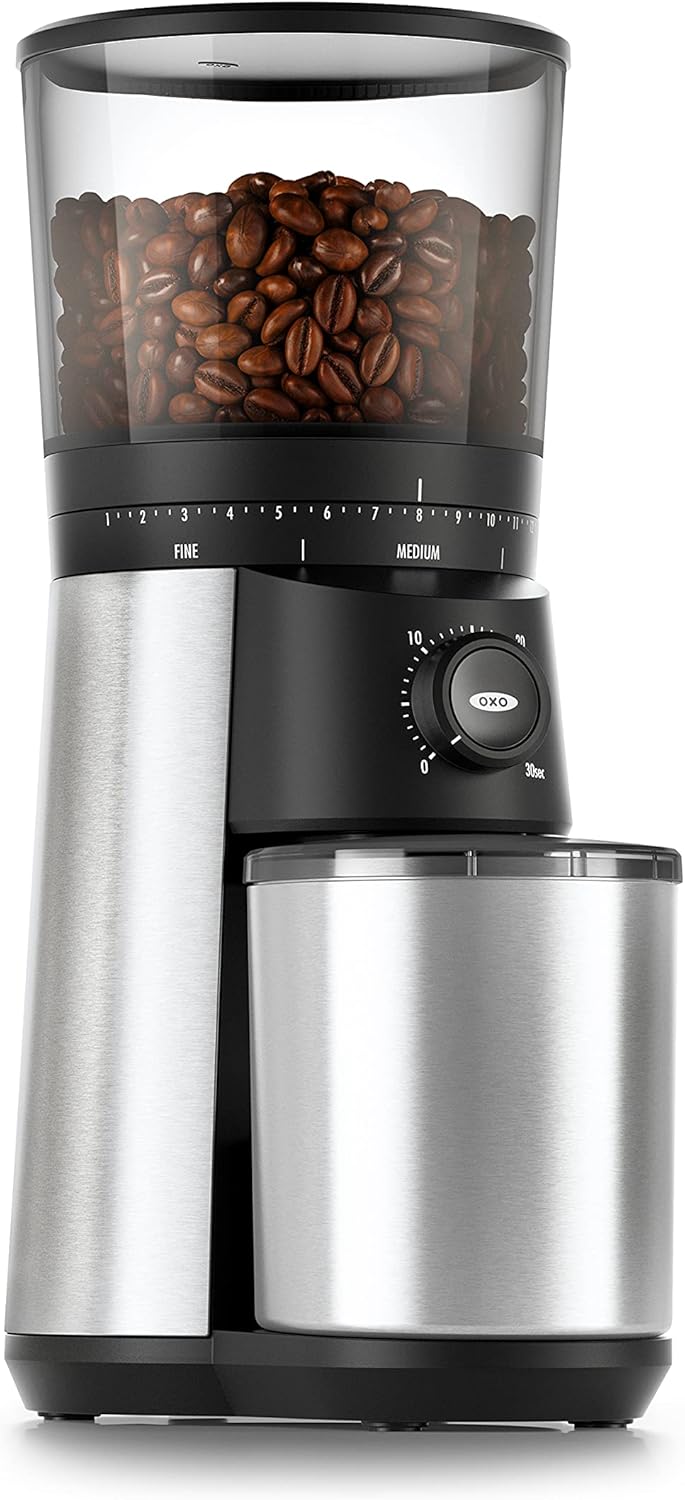
| Burr Type | Stainless steel conical |
|---|---|
| Burr Size | 40 mm |
| Grind Settings | 15 plus micro-adjustments |
| Hopper Capacity | 12 oz |
| Wattage | 100 watts |
The OXO Brew Conical Burr Grinder is a countertop electric grinder built around 40 mm stainless steel conical burrs that produce consistent grounds for a wide range of brew methods. You use the front dial to choose one of 15 grind sizes and then fine-tune with micro-adjustments; a one-touch start and programmable timer remembers the last setting so repeat grinding is quick and predictable. The removable 12-ounce hopper has a UV tint to protect beans in sunny kitchens, and the motor is engineered to run with low vibration and reasonably quiet operation for early mornings. Practical benefits include uniform extraction across drip, pour-over, French press, and coarse cold brew grinds, plus a stable build and stainless-steel exterior that cleans easily. Limitations: it is not a commercial machine so very heavy daily use may wear components faster, and the 15 settings (with micro steps) are less granular than some premium specialty grinders aimed at dedicated espresso dialed users.
Best for: Buyers who want reliable, easy-to-use home grinding that delivers consistent results for multiple brew styles and prefer a straightforward, low-maintenance machine.
Less Ideal for: If you need an ultra-high-precision grinder for competitive espresso or plan continuous commercial use, a more specialized, higher-end model is a better choice.
- Stainless steel 40 mm conical burrs for consistent, uniform grounds
- 15 grind settings with micro-adjustments for a broad range of brew methods
- One-touch timer that remembers your last setting for repeatable results
- Large removable 12 oz hopper with UV tint to help preserve bean freshness
- Quiet, low-vibration motor suitable for early-morning use
- Not designed for heavy commercial use so component wear may increase under constant daily operation
- Grind adjustment range is broad but less precise than high-end specialty grinders
Verdict: A dependable, user-friendly conical-burr grinder that delivers consistent, everyday results for home brewers looking for low-friction setup and repeatable performance.
Choosing the Right Coffee Grinder: Key Factors to Consider
Grind Consistency
Uniform particle size matters because uneven grinds produce overextracted and underextracted flavors in the same brew. For drip and pour-over, medium consistency helps deliver balanced extraction. For espresso and press, narrower distributions and reliable fine settings are critical.
When shopping under $100, look for burr designs or mechanisms that minimize fines and large fragments. Expect some tradeoffs versus premium models, but prioritize grinders that demonstrate repeatable settings and visibly uniform output for your preferred brew methods.
Adjustment Range and Repeatability
A useful grinder covers the grind sizes you need, from coarse for French press to fine for espresso or Moka pot. Equally important is repeatability: can you consistently dial back to a setting that produced the results you liked previously? Clear, indexed adjustments or stepped clicks are easier to reproduce than vague, unmarked dials.
Consider whether you plan to brew multiple methods. If so, choose a grinder with a wide and reliable adjustment range. If you use a single method most days, a simpler but stable adjustment mechanism can be a better value under the budget limit.
Ease of Cleaning and Maintenance
Coffee oils and fines accumulate quickly and affect flavor if not cleaned. Grinders that allow fast access to the burrs or internal chamber make regular maintenance practical. Removable hoppers, simple funneling to portafilter or container, and parts that rinse or brush easily reduce friction to routine cleaning.
Also consider how much coffee retention the grinder has. Low retention saves time and minimizes flavor carryover between different beans. Under $100, expect more manual cleaning but prioritize designs that minimize trapped grounds and make disassembly straightforward.
Capacity and Hopper Design
Hopper capacity affects how often you need to refill and whether you can store multiple bean types. For single-cup users, a smaller hopper reduces stale beans; for households, a larger hopper is convenient. Hopper shape influences how beans feed into the burrs and whether static or bridging occurs.
Choose a capacity that matches your typical batch size and storage habits. Transparent or easily sealed hoppers help maintain freshness and let you monitor bean levels without opening the unit frequently.
Build Quality and Materials
Materials and construction drive both durability and grind performance. Metal or hardened-steel burrs typically outlast low-cost alternatives, while the housing material affects stability during operation. A stable chassis reduces vibration and helps consistent grinding.
Under $100, some compromises are expected, but look for solid assembly, minimal wobble in the burr shaft, and durable parts where coffee contacts the device. These elements reduce long-term maintenance and keep grind quality steady over time.
Noise Level and Motor Duty Cycle
Noise matters for early-morning routines or shared living spaces. Lower-speed motors and brushed steel burrs tend to run quieter, though size and design also influence audible levels. Motor duty cycle indicates how long the grinder can operate before needing a cool-down period.
If you prepare multiple doses in succession, prefer grinders with higher duty cycles and cooling-friendly designs. For occasional single servings, quieter compact units may be preferable despite shorter continuous run recommendations.
Blade Vs Burr: What to Expect Under $100
Budget grinders under $100 commonly use either blade or burr mechanisms, each with predictable tradeoffs. Blade grinders chop beans quickly but tend to produce a wide particle-size distribution. They are compact and inexpensive but require careful pulse grinding and more frequent filtering to avoid uneven extraction.
Burr grinders, when available at this price, often use conical or flat steel burrs in simpler assemblies. Even entry-level burrs deliver noticeably better uniformity than blades, especially for drip and coarse brewing. Expect fewer grind size steps and more plastic components in value burr models, but the improvement in consistency is usually worth the extra investment.
- Blade: inexpensive, compact, less uniform grind
- Burr: better consistency, adjustable settings, often larger footprint
- Consider the primary brew method when choosing mechanism type
Matching Grinder Choice to Brewing Method
Choose a grinder based first on your main brewing method. For French press, coarse, chunky grind capability and low retention are key. For drip and pour-over, aim for consistent medium grinds and steady dosing. For espresso or stovetop Moka, fine and repeatable settings are essential and harder to achieve at lower price points.
If you switch methods frequently, prioritize a grinder that advertises a broad adjustment range with clear indexing. If you brew one way most days, a simpler machine tuned for that range will often provide the best practical results within the budget.
- French press: coarse grind and low retention
- Drip/pour-over: medium uniformity and steady dosing
- Espresso/Moka: fine, repeatable settings needed
Maintenance Tips to Keep a Budget Grinder Performing
Regular cleaning preserves flavor and grinder function. Empty and brush the hopper and burr area weekly for moderate use, and perform a deeper disassembly monthly depending on oil buildup. Use a stiff brush and avoid water on metal burrs unless the manufacturer permits drying and reassembly.
Replaceable parts and spare burr availability are less common in budget models, so preventing premature wear through gentle cleaning and avoiding noncoffee items in the hopper extends service life. Also, allow the motor to cool between long sessions to avoid overheating.
- Brush grounds from burrs after each use
- Avoid washing metal burrs; dry fully if washed
- Run short cooling intervals for consecutive batches
How Hopper and Dosing Design Affect Workflow
A well-designed hopper and dosing interface speeds your morning routine. Funnels or removable grounds containers that align with portafilters or carafes minimize spills. Anti-static finishes or metal dosing funnels reduce cling and waste when transferring grounds.
For households that swap beans often, hoppers with easy removal and small capacities reduce stale beans and simplify switching. Single-serving users benefit from small hoppers and minimal retention to keep each dose fresh and isolated.
- Removable hoppers aid quick bean swaps
- Anti-static features reduce cling and waste
- Consider portafilter compatibility if you use one
Common Tradeoffs at the Sub-$100 Price Point
Expect compromises in materials, motor longevity, and the fineness range compared with higher-end grinders. Entry models may use more plastic parts, have fewer indexed settings, and show greater particle variance at the extremes of the range. Understanding these limitations helps set realistic expectations.
That said, many sub-$100 grinders deliver excellent daily performance for drip, pour-over, and press methods. Buyers who prioritize consistent medium to coarse grinds, easy cleaning, and a stable build will find several practical options without overspending.
- More plastic components are common
- Fineness for espresso may be limited
- Good maintenance extends useful life
How We Chose the Best Coffee Grinder
We focused on objective, user-facing features that determine everyday performance and longevity for grinders priced under $100. Key evaluation criteria included grind consistency across common settings, the range and repeatability of grind size adjustments, and the grinder s ease of cleaning and maintenance. We also weighed build quality and parts that contact coffee, noise level during operation, and hopper/capacity suitable for typical household use. Products were excluded if they lacked adjustable grind settings, relied on proprietary single-use components, or had documented reliability issues that would undermine daily use. We favored units that offer clear, repeatable adjustments for espresso, drip, and French press ranges, and that allow straightforward access to burrs or blades for cleaning. Noise and motor duty cycle were considered because they affect usability in small kitchens. Finally, we prioritized practical user experience: how easy the grinder is to load, dose, and transfer ground coffee with minimal retention.
Our full evaluation process is outlined in our review methodology.
FAQ
Can I get espresso-quality grounds from a grinder under $100?
Often the finest, most consistent espresso settings are difficult to achieve at this price. Some budget burr grinders approach acceptable espresso performance, but results usually require careful dosing and may not match higher-end grinders in repeatability.
How often should I clean a coffee grinder?
For daily users, light brushing of the hopper and burr area once a week is typical, with a deeper disassembly and cleaning monthly. Frequency depends on roast oiliness and how often you change beans.
Is a burr grinder worth the extra cost over a blade grinder?
Yes for most brewing methods. Burr grinders produce a more uniform particle size and give better extraction control. Under $100, a burr unit usually offers a meaningful improvement for drip and press brewing versus a blade machine.
Will transferring grounds to a portafilter or carafe cause a lot of mess?
Mess depends on the dosing design. Look for grinders with a removable grounds container, a narrow funnel, or anti-static finishes to minimize spills and cling. Proper technique and a steady hand also reduce transfer waste.
How long do grinders under $100 usually last?
Lifespan varies widely based on build quality and maintenance. With regular cleaning and moderate use, many budget grinders last several years. Heavy daily use or poor maintenance shortens usable life.
Final Verdict
When choosing a coffee grinder under $100, focus on the features that most directly affect your daily brewing: grind consistency for your preferred method, repeatable adjustment, and ease of cleaning. Accept that some tradeoffs in materials and extreme fineness are likely at this price, but prioritize models with solid burr geometry, low retention, and straightforward maintenance. Decide which brew method you use most and choose a grinder that reliably covers that grind range. With careful selection and regular upkeep, a sub-$100 grinder can deliver consistently good cups and excellent value for home brewing.