
Note: This article contains affiliate links. If you click on these links and make a purchase, we may earn a small commission at no extra cost to you. This helps support our research and content. Read our full affiliate disclosure here.
Picking the right coffee grinder under $200 matters because grind consistency and user experience directly affect extraction, flavor, and how often you will actually grind at home. Whether you brew pour-over, espresso-style shots, or a more forgiving drip method, the grinder you choose determines how evenly coffee brews and how easy it is to maintain equipment over time. This guide shortlists the top options available under $200 and explains the practical tradeoffs you should expect. Below you will find our top picks for this price range, plus the core criteria we used to evaluate them and advice on choosing the best grinder for your brewing routine.
Top Picks at a Glance
| Best Overall The best all-around choice for most situations | Breville Smart Grinder Pro BCG820BSS | 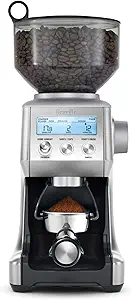 |
| Best Quality Built to a higher standard if you want something more solid | Baratza Encore Grinder |  |
| Best Value The sweet spot between price and what you get | OXO Brew Compact Conical Burr Grinder |  |
| Best Budget The cheapest option that still gets the job done reliably | BLACK+DECKER Coffee Grinder CBG110S |  |
| Top Rated A top-rated pick with lots of positive feedback | KitchenAid Burr Coffee Grinder KCG8433 |  |
| Most Popular A crowd favorite that many people choose with confidence | Hamilton Beach Fresh Grind 80335 |  |
| Best Seller A high-volume bestseller chosen again and again | OXO Brew Conical Burr Grinder | 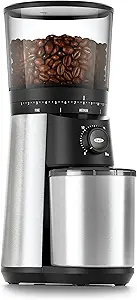 |
Breville Smart Grinder Pro BCG820BSS

| Wattage | 165 |
|---|---|
| Voltage | 120 |
| Capacity | 1.1 pounds |
The Breville Smart Grinder Pro is a countertop conical burr grinder designed to give repeatable, adjustable grinds for everything from espresso to French press. It is typically used to grind beans directly into a portafilter, airtight container, or filter basket using one of 60 stepped grind settings, and dosing is controlled digitally in 0.2 second increments via the LCD. The grinder includes dosing IQ, preprogrammed cup and shot modes, two portafilter cradles, a grounds container with lid, and a cleaning brush, which makes switching routines and maintaining the unit straightforward. In real use it produces consistent particle size for most brew methods and the clear display makes short work of programming doses. Limitations include a relatively large footprint for small counters and a moderately loud motor during operation, and while 60 settings cover almost every brew, very fine tuning beyond the steps may require dialing in time per bean type. For a balanced buyer seeking precision without moving to prosumer pricing, this grinder hits the right mix of features and control.
Best for: Buyers who want a versatile, accurate home grinder that balances programmatic dosing and a wide grind range for daily espresso and filter brewing.
Less Ideal for: If you need an ultra-compact, whisper-quiet grinder for tiny kitchens or you require commercial-level throughput, look at other options.
- Extensive 60-step grind range suitable for espresso through French press
- Digital dosing with 0.2 second increments for repeatable doses
- Clear LCD that displays grind setting, time, and shot/cup counts
- Includes portafilter cradles and a sealed grounds container for flexible use
- Relatively large footprint for small kitchens
- Motor noise is noticeable during grinding
Verdict: A feature-rich, programmable burr grinder that delivers precise, repeatable dosing and a wide grind range for balanced home brewing under $200.
Baratza Encore Grinder

| Capacity | 5 ounces |
|---|---|
| Wattage | 70 watts |
| Voltage | 120 volts |
| Included Components | Conical Burr Coffee Grinder |
The Baratza Encore is a user-friendly burr grinder built for consistent daily use by home coffee enthusiasts. It uses 40mm conical steel burrs and a 70-watt DC motor to deliver uniform grounds across a wide range of settings, making it suitable for methods from AeroPress and pour-over to French press. Controls are simple: an on/off switch and a front-mounted pulse button let you dose by time with minimal fuss. The small footprint and 5 ounce hopper capacity fit typical household routines, and hardened alloy burrs paired with Baratza support mean the grinder is serviceable over time. It is not designed for high-volume commercial use and the plastic exterior is utilitarian rather than premium, but for under $200 it focuses on grind consistency and reliable performance rather than bells and whistles.
Best for: Home brewers who prioritize consistent, café-quality grind performance and straightforward operation for daily use.
Less Ideal for: People who need to grind large volumes quickly or want a premium metal-bodied appliance for heavy commercial use.
- 40 grind settings cover espresso through French press for versatile brewing
- 40mm hardened conical steel burrs provide consistent grind quality
- Compact footprint fits small kitchens and home setups
- Simple, user-friendly controls with pulse button for easy dosing
- 5 ounce hopper limits capacity for households that grind large batches
- Plastic housing is practical but not premium in feel
Verdict: Choose the Baratza Encore for reliable, versatile grind consistency under $200 that covers most at-home brewing methods.
OXO Brew Compact Conical Burr Grinder

| Capacity | 50 g |
|---|---|
| Voltage | 120 volts_of_alternating_current |
| Included Components | Grinder |
| Power Source | AC adapter |
The OXO Brew Compact Conical Burr Grinder brings stainless steel conical burrs and a relatively small footprint to countertop coffee prep. It offers 15 coarse-to-fine settings plus 29 micro-adjustments so you can dial grind size for drip, pour-over, or French press in daily home use. The 50 g hopper is sized for up to six cups, and the grounds container has an integrated spout for tidy transfer into a filter or portafilter. Removable upper and lower burrs make it easier to clean than fixed designs, and the compact body and cord-wrap help with storage in small kitchens. Because it uses 120V AC power and durable plastic construction with some Tritan Renew parts, it balances performance and space savings rather than matching larger, pro-level mills in throughput or ultra-fine espresso precision. For buyers who want consistent, low-static grounds for brewed coffee without a large machine, this grinder is a sensible countertop choice under $200.
Best for: Buyers who want a space-saving, reliable grinder that produces consistent grounds for brewed coffee and prioritizes precise grind adjustment over large capacity.
Less Ideal for: People who need high-capacity grinding for large households or those seeking a heavy-duty, all-metal commercial grinder for constant daily use.
- Stainless steel conical burrs for consistent grind quality
- 15 settings plus 29 micro-adjustments for precise grind control
- Compact footprint and cord-wrap for easy countertop storage
- Removable upper and lower burrs simplify cleaning
- Tritan Renew hopper and grounds container use recycled-content plastic
- 50 g hopper limits batch size for larger households or frequent entertaining
- Plastic body and components are less robust than all-metal commercial grinders
Verdict: A compact, accurate conical-burr grinder that delivers consistent brewed-coffee grinds for kitchens where space and precise adjustment matter.
BLACK+DECKER Coffee Grinder CBG110S

| Capacity | 56.6 g |
|---|---|
| Wattage | 130 |
| Voltage | 110 volts |
| Material Type | Stainless Steel |
| Power Source | Electric |
The BLACK+DECKER CBG110S is a straightforward one-touch electric blade grinder built for quick small-batch grinding. It uses stainless steel blades and a stainless steel bowl to chop coffee beans, spices, herbs, and grains with a single push-button control and a lid-locking safety interlock so the blades only run when the lid is secure. In typical use you add beans up to the 56.6 g capacity, pulse or run briefly for coarse or finer grinds, then pour and wipe the bowl clean; the compact footprint makes it easy to store in a cabinet. Practical benefits include durable metal contact parts and a simple safety feature that reduces spills and accidental starts, while the 130 W motor delivers quick results for single-cup to small-pot batches. Limitations are the small capacity and the inherent inconsistency of blade grinders compared with burr models, so it is best for casual brew methods and spice grinding rather than precision espresso dosing.
Best for: Buyers who want an inexpensive, no-frills grinder for occasional coffee, spice, or grain grinding and who prioritize speed, simplicity, and compact storage.
Less Ideal for: Serious home baristas seeking precise, consistent grinds for espresso or larger households that need to grind multiple cups at once should consider a burr grinder or a larger-capacity model.
- Stainless steel blades and bowl for durability and easy cleaning
- One-touch push-button makes operation quick and simple
- Lid-locking safety feature prevents operation unless closed
- Compact size stores easily in small kitchens
- Small 56.6 g capacity limits it to single-cup or small-batch grinding
- Blade grinder design yields less uniform grind compared with burr grinders
Verdict: A compact, budget-friendly blade grinder that delivers fast, durable performance for casual coffee and spice grinding.
KitchenAid Burr Coffee Grinder KCG8433

| Wattage | 150 watts |
|---|---|
| Capacity | 10 ounces |
| Voltage | 120 volts |
The KitchenAid Burr Coffee Grinder KCG8433 is a user-friendly bench grinder built to deliver consistent, repeatable grounds for everything from French press to espresso. It uses commercial-grade stainless steel conical burrs and 70 precise settings so you can dial in grind size, while Automatic Smart Dosing Technology times grind cycles to deliver a consistent dose without manual counting. The removable hopper and built-in portafilter holder make switching beans or filling an espresso basket straightforward, and anti-static technology helps keep grounds from spraying across the counter. At 150 watts and a compact footprint that fits under most cabinets, it is designed for daily home use. The machine is mainly mechanical and straightforward to operate, so maintenance is simple, but the plastic exterior and 10-ounce capacity mean it is optimized for household rather than heavy commercial use. If you want reliable, consistent grinding and easy dosing in a durable home-focused package, this model is a solid pick under $200.
Best for: Home coffee enthusiasts who prioritize consistent, reliable grind quality and easy, repeatable dosing for daily brewing across multiple methods.
Less Ideal for: People who need a commercial-grade grinder for high-volume or continuous cafe use should look for heavier-duty, high-capacity models instead.
- 70 grind settings let you dial in sizes for all brew methods from coarse to fine
- Smart Dosing Technology automatically produces consistent dose volumes
- Commercial-grade stainless steel conical burrs deliver uniform grind particle size
- Removable hopper and built-in portafilter holder simplify bean changes and dosing
- Anti-static technology reduces grounds mess on the counter
- Plastic exterior and 10-ounce hopper limit durability and capacity for heavy use
- Not intended for commercial or very high-volume grinding sessions
Verdict: Choose this grinder if you want a dependable, easy-to-use home burr grinder that consistently delivers accurate grinds and automatic dosing under $200.
Hamilton Beach Fresh Grind 80335

| Wattage | 125 watts |
|---|---|
| Capacity | 4.5 ounces |
| Voltage | 110 |
| Power Source | AC |
The Hamilton Beach Fresh Grind is a simple, compact blade grinder intended for everyday home use. It uses 125 watts and stainless steel blades to grind coffee beans, spices, and seeds, and its removable grinding bowl makes filling, pouring, and cleanup straightforward—the bowl and lid are dishwasher-safe. The unit can grind enough beans for up to a 12-cup pot, and built-in cord storage keeps counters tidy when the grinder is not in use. Operation is basic: press to grind and release to stop, which provides fine control but no preset grind settings or timers. As a blade-style grinder it is best for coarse to medium grinds and quick tasks rather than precision espresso-level grinding. The small footprint and quiet motor make it a good counter or cupboard appliance, though frequent heavy use may heat beans faster than burr grinders. Overall it offers reliable, no-frills grinding and easy maintenance for home brewers who do not need high-precision grinds.
Best for: Buyers who want an affordable, easy-to-use grinder for daily drip or French press coffee and occasional spice or seed grinding, with simple cleanup and compact storage.
Less Ideal for: Users seeking precise, consistent grind sizes for espresso or advanced brewing techniques should consider a burr grinder instead.
- Removable stainless steel grinding bowl that is dishwasher-safe for easy cleanup
- Compact design with hidden cord storage to save counter space
- Can grind enough beans for up to a 12-cup pot
- Durable stainless steel blades handle coffee, spices, and seeds
- Blade grinder design does not provide the consistent, precision grind of a burr grinder
- No grind settings or timed presets for repeatable grind sizes
Verdict: A straightforward, compact blade grinder that delivers easy cleanup and enough ground beans for a 12-cup pot, ideal for budget-minded home brewers who value simplicity.
OXO Brew Conical Burr Grinder
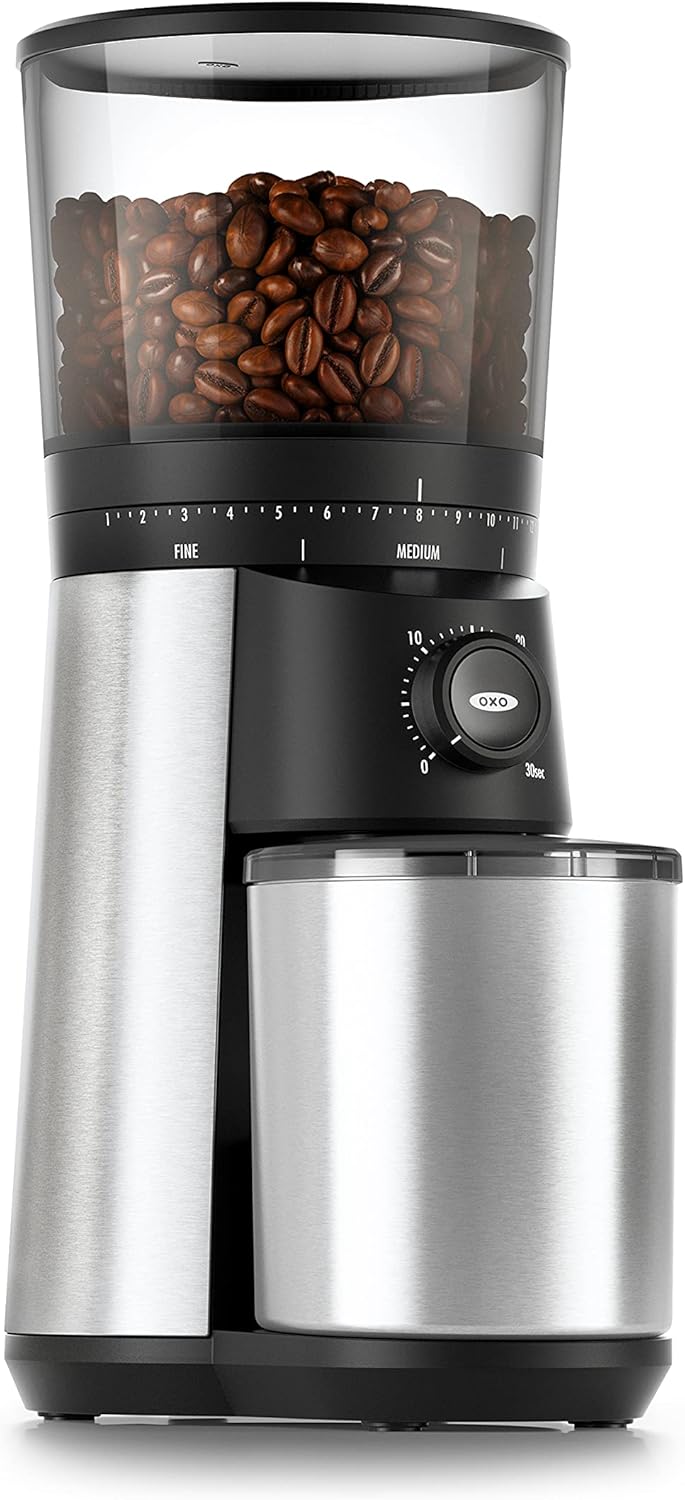
| Burr type | 40 mm stainless steel conical burrs |
|---|---|
| Grind settings | 15 settings + micro-adjustments |
| Hopper capacity | 12 oz (0.34 kg) |
| Power | 100 watts |
| Voltage | 120 volts |
The OXO Brew Conical Burr Grinder is a compact electric burr grinder built to deliver consistent, uniform grounds for a range of brewing methods. It uses 40 mm stainless steel conical burrs and a stepped dial with 15 grind settings plus micro adjustments so you can shift from fine for espresso to coarse for French press or cold brew. A one-touch start and a timer that remembers your last setting make daily use fast and repeatable, and the removable 12-ounce hopper has a UV tint to help protect beans in sunny kitchens. The motor is engineered for low vibration and relatively quiet operation for early-morning grinding, and stainless-steel construction gives the unit a solid, durable feel. Limitations to consider are that grind adjustments are stepped rather than fully stepless, so extreme micro-tuning for espresso lovers is limited, and the unit is sized for home use rather than commercial throughput. For mainstream home brewers looking for consistent, low-maintenance performance, it is a sensible, reliable choice under $200.
Best for: Buyers who want a reliable, easy-to-use home burr grinder that delivers consistent results with minimal fuss and predictable performance day to day.
Less Ideal for: Users seeking a stepless, pro-level espresso grinder for precise micro-tuning or those who need a high-volume commercial grinder should look elsewhere.
- 40 mm stainless steel conical burrs for uniform grounds and even extraction
- 15 grind settings plus micro-adjustments for a wide range of brew methods
- One-touch timer that remembers last setting for repeatable daily use
- Large removable 12 oz hopper with UV tint to help preserve bean freshness
- Stainless steel build and low-vibration motor for quieter, durable operation
- Stepped grind settings limit infinite micro-adjustment for advanced espresso dialing
- Designed for home volumes only, not suitable for heavy commercial use
Verdict: A durable, user-friendly home burr grinder that delivers consistent, repeatable grinds across brewing styles, making it a safe choice under $200.
Choosing the Right Coffee Grinder: Key Factors to Consider
Grind Consistency and Particle Distribution
Consistent particle size is the single biggest factor influencing extraction and flavor clarity. Even if a grinder offers many settings, what matters is how evenly it produces particles at the setting you use most. A grinder that yields a narrow particle distribution reduces under- and over-extracted pockets in the cup, producing more predictable results.
When shopping under $200, look for true burr systems rather than blades. Conical and flat burrs both can produce good results in this price range, but burr quality, sharpness, and alignment determine the real-world consistency you will see.
Adjustment Range and Repeatability
The available grind range and how repeatable a chosen setting is will determine how easily you can switch between brew methods. If you brew espresso-style shots and pour-over on the same grinder, you need a wide, well-indexed adjustment system so you can return to previous settings precisely.
Pay attention to whether the grinder uses stepped or stepless adjustments. Stepped systems give repeatable detents that are easier for casual users, while stepless systems allow micro-adjustments for fine-tuning. For many home brewers under $200, a well-engineered stepped system provides the best balance of control and usability.
Burr Material and Durability
Burr material and construction affect longevity and how often you will need replacements. Hardened steel burrs are common in this price bracket and deliver reliable life for regular home use. Ceramic burrs resist heat but can be more brittle and less common in lower price points.
Consider whether replacement burrs are available and affordable. A grinder that allows easy burr replacement and alignment will extend usable life and protect your investment.
Dosing Convenience and Hopper Capacity
How you dose affects daily workflow. Larger hoppers reduce the need to refill for multiple cups but can expose beans to air and staling. If you prefer single-dose grinding for freshest flavor, look for a hopper that is easy to remove and a bean path that supports small batches without excessive retention.
Also evaluate whether the grinder offers timed dosing, weight-based dosing, or manual grind-on-demand. Under $200, timed dosing is common and convenient, but check how consistent the timed doses are, especially for coarse versus fine settings.
Speed, Heat Generation, and Motor Performance
Motor speed influences grind throughput but also heat buildup. Fast grinders grind quickly but may heat beans and affect volatile flavor compounds. Slower, high-torque motors often generate less heat and produce more consistent particles for delicate brew styles.
Look for grinders with thoughtfully matched motor and burr geometry. Vendors that specify RPM ranges or emphasize low-heat design are often better choices for preserving bean flavor in this price class.
Ease of Cleaning and Maintenance
Regular cleaning removes trapped fines and oils that cause rancid flavors and inconsistent dosing. A grinder that disassembles easily and has accessible burrs will reduce the friction of routine maintenance.
Check whether the hopper, dosing chamber, and burr set can be removed without tools and whether the manufacturer provides cleaning tools or clear instructions. Under-$200 grinders that simplify cleaning save time and keep cups tasting fresher over months of use.
Choosing the Right Grind for Your Brew Method
Different brew methods demand different particle sizes and distributions. Coarse, uniform particles suit immersion methods like French press, while fine, narrowly distributed particles are required for pressurized extraction. Identify the grind range you will use most and prioritize a grinder that excels in that zone.
If you primarily make pour-over or drip coffee, look for consistent medium to medium-fine settings and easy adjustment between those steps. For home espresso or stovetop espresso, pay attention to the grinder's ability to hold a steady fine setting without excessive heat or retention.
- Pour-over: Even medium grind with low fines.
- French press: Coarse, uniform particles to reduce sediment.
- Espresso-style: Very fine, narrowly distributed particles and repeatable settings.
Single Dose Vs Bulk Grinding Habits
Decide whether you will grind a single dose per brew or keep a hopper filled for several cups. Single dosing reduces staling and maximizes freshness but benefits from a grinder with minimal retention and a stable dosing mechanism. Bulk grinding is convenient for households that brew frequently but requires a grinder with a larger hopper and consistent timed doses.
- Single dosing favors low retention and easy access to the burr chamber.
- Bulk dosing requires stable timed doses and larger hoppers with secure lids.
Quiet Operation and Home Use Considerations
Noise level can be a meaningful factor if you grind in small kitchens, early mornings, or in an apartment. Some grinders balance torque and RPM to operate more quietly, while high-RPM models are louder but faster.
If noise matters, seek user feedback on sound levels or look for grinders marketed with noise-reduction features. Remember that added insulation or enclosures can reduce sound but may add cost or maintenance complexity.
- Low-RPM, high-torque motors tend to be quieter.
- Plastic housings can muffle sound but check for vibration and build quality.
Practical Maintenance Tips to Keep Performance High
Routine cleaning prevents buildup of oils and fine particles that alter taste and dosing. Brush the burrs and clear the chute weekly for regular home use, and perform a deeper disassembly and clean every few months depending on roast and grinding frequency.
Store beans in a sealed container and only fill the hopper with what you will use in a short period. This preserves flavor and reduces the need for frequent deep cleans caused by oil buildup from darker roasts.
- Brush burrs and chute weekly.
- Remove hopper for a quick wipe between uses.
- Deep clean and inspect burrs every few months.
Troubleshooting Common Grinding Issues
Inconsistent grind size, clumping, or motor stalling are common issues in daily use. Clumping often results from oily beans or static; adjusting roast selection and humidity or using a grounds container that reduces static can help. If the motor stalls or struggles at fine settings, check for clogging and inspect the burr alignment.
Retention and uneven dosing can also come from burr wear or improper assembly after cleaning. Regular inspection for burr wear and confirming that parts are seated correctly will prevent many problems.
- Clumping: Try drier beans or anti-static techniques.
- Motor stalls: Inspect for clogs and clear the grind path.
- Uneven dosing: Check burr alignment and wear.
How We Chose the Best Coffee Grinder
We focused on features and performance that matter most for home coffee grind quality within the under-$200 price constraint. Our evaluation prioritized grind consistency across multiple settings, because uniform particle size is the primary driver of predictable extraction for most brew methods. We also rated hopper capacity and dosing control to reflect how well each grinder supports single-dose use or brewing for several cups. Speed and heat generation were considered since fast burrs can heat beans and alter flavor; grinders that balance speed with low heat scored higher. Build quality and serviceability were included to gauge long-term durability and ease of parts replacement. Finally, ease of cleaning and maintenance was assessed because trapped grounds and oils degrade flavor and increase upkeep time. We excluded specialty commercial machines and consumer grinders priced above the $200 threshold. Units that only offered blade grinding were not considered because they cannot deliver the consistent particle distribution required for controlled brewing. Our selections reflect usable, durable grinders that meet real home-brewing needs across common methods while staying within the budget cap.
Our full evaluation process is outlined in our review methodology.
FAQ
Does a more expensive grinder always produce noticeably better coffee?
Not always. Above a certain threshold, improvements become subtler and depend on your brewing method and palate. Within the under-$200 range you can find grinders that deliver meaningful gains in consistency for most home brews.
Are conical burrs better than flat burrs at this price point?
Both can perform well. Conical burrs often produce less heat and can be quieter, while flat burrs sometimes offer slightly tighter distributions. The actual outcome depends on burr quality and machine design rather than burr shape alone.
How often should I clean my grinder?
Light cleaning with a brush is recommended weekly for normal home use, and a more thorough disassembly and cleaning every few months. Frequency increases with heavier use or very oily beans.
Can a grinder under $200 do espresso and drip coffee adequately?
Many grinders in this price bracket can cover both methods, but expect tradeoffs. Achieving steady, very fine espresso settings may require careful adjustment and patience. If you alternate methods frequently, prioritize a model with repeatable settings.
What causes static cling and how do I reduce it?
Static is caused by electrostatic charge during grinding and is more noticeable with lighter roasts and dry conditions. Reducing static can be achieved by slightly increasing humidity, using anti-static catch cups, or tapping the grounds container to settle fines.
Final Verdict
When choosing a coffee grinder under $200, prioritize grind consistency in the range you use most, a durable burr set, and a dosing system that fits your routine. Expect tradeoffs between speed, heat generation, and noise; decide which matters most for your daily brewing. Focus on grinders that are easy to clean and maintain and whose adjustment system lets you return to preferred settings reliably. With those priorities, you can confidently pick a grinder in this price bracket that delivers a noticeable improvement to home-brewed coffee.