
Note: This article contains affiliate links. If you click on these links and make a purchase, we may earn a small commission at no extra cost to you. This helps support our research and content. Read our full affiliate disclosure here.
Picking the right coffee maker for business matters because workplace coffee is both a morale driver and an operational need. You want a brewer that can produce consistent pots or single-serve cups throughout a busy day without frequent refills, long waits, or complicated upkeep. This guide highlights seven shortlisted coffee makers that suit different office sizes and service styles, from high-volume carafes to fast single-cup systems. We evaluate each option on practical attributes that affect daily use, including output capacity, brew speed, consistency, and ease of maintenance. Read on to find a model that fits your office flow and keeps coffee service smooth.
Top Picks at a Glance
| Best Overall The best all-around choice for most situations | BUNN VPR-2GD 12-Cup Pourover Brewer |  |
| Best Quality Built to a higher standard if you want something more solid | Breville Barista Express BES870XL |  |
| Best Value The sweet spot between price and what you get | Hamilton Beach 45-Cup Coffee Urn |  |
| Best Budget The cheapest option that still gets the job done reliably | Elite Gourmet 4-Cup Coffee Maker EHC4128 |  |
| Top Rated A top-rated pick with lots of positive feedback | Ninja Hot & Iced XL CM371 |  |
| Most Popular A crowd favorite that many people choose with confidence | Keurig K-Elite Coffee Maker |  |
| Best Seller A high-volume bestseller chosen again and again | BLACK+DECKER 12-Cup Digital Coffee Maker |  |
BUNN VPR-2GD 12-Cup Pourover Brewer

| Wattage | 1575 watts |
|---|---|
| Voltage | 110 |
| Capacity | 3.8 gallons |
| Coffee Input Type | ground coffee |
| Filter Type | Paper |
The BUNN VPR-2GD is a heavy-duty pourover brewer built for small offices and light commercial settings. You pour cold water into the top reservoir and the machine brews immediately, producing up to 3.8 gallons before refilling; the two included glass decanters sit on separate warmers so brewed coffee stays hot and ready to serve. Stainless steel internal components and a SplashGard funnel reduce drips and improve durability in busy environments, and simple button controls make operation straightforward for staff with varying skill levels. It uses paper filters and ground coffee, so you get predictable results without proprietary pods, but it does require a dedicated counter spot and draws substantial power. The brewer is portable and does not need plumbing, which keeps installation simple, though the glass decanters and warmers mean it is best used where frequent monitoring or occasional decanter changes are acceptable. For workplaces that need reliable, fast brew cycles and easy daily operation, this BUNN handles steady demand well.
Best for: Managers or staffers who need a dependable, no-frills brewer that delivers hot coffee quickly for a small office or break room and value durability and ease of use.
Less Ideal for: Households or locations seeking a compact, low-power single-serve solution or fully automatic machines that require minimal monitoring should look elsewhere.
- Immediate brew-on-demand pourover design eliminates long heat-up or warm-up cycles
- Two decanters with separate warmers keep larger volumes of coffee hot and accessible
- Stainless steel internal construction and SplashGard funnel improve durability and safety
- Simple button controls and paper-filter operation are easy for staff to use and maintain
- Glass decanters require careful handling and regular replacement if broken
- High wattage and sizeable footprint mean it needs a dedicated counter space and power circuit
Verdict: Choose this BUNN brewer when you need a rugged, fast pourover coffee maker that keeps larger quantities hot and is simple for staff to operate in an office or break room.
Breville Barista Express BES870XL

| Wattage | 1600 watts |
|---|---|
| Voltage | 120 |
| Coffee Input Type | whole_beans |
| Filter Type | Reusable |
| Capacity | 1 cups |
The Breville Barista Express is a performance-focused semi-automatic espresso machine that grinds, doses, extracts, and steams milk in one compact unit. Its integrated conical burr grinder with 16 grind settings and dose control lets you grind fresh beans directly into the 54mm portafilter, which helps deliver consistent shots without a separate grinder. The Thermocoil heating system and PID temperature control keep brew temperature stable for balanced extraction, and the powerful steam wand produces true microfoam for latte art. Typical use pairs short grind-and-pull workflows with manual tamping and milk texturing, so it rewards users who learn basic barista technique. Practical benefits include faster from-bean-to-cup times than buying a grinder and espresso machine separately, a durable stainless steel build, and included tools like a razor dosing tool and tamper. Important limitations are its manual operation that requires practice to dial in shots and the single-boiler-style heating arrangement that means you may wait briefly between steaming and brewing during heavy back-to-back use.
Best for: Performance-minded buyers who want café-quality control in a single countertop machine and are willing to learn basic barista skills to optimize grind, dose, and milk texture.
Less Ideal for: Busy offices or businesses needing continuous high-volume service should consider prosumer machines with dual boilers or commercial steam capability instead.
- Built-in conical burr grinder with 16 grind settings for fresh, controllable dosing
- PID temperature control and Thermocoil heating for consistent extraction
- Powerful steam wand capable of producing microfoam for latte art
- Solid stainless steel construction and a 54mm portafilter for commercial-style handling
- Manual workflow requires practice to consistently dial in shots
- Single-machine workflow can slow down when extracting and steaming back-to-back in high-volume settings
Verdict: Buy this if you want a single compact machine that delivers café-level control and fresh-ground espresso for performance-focused coffee preparation.
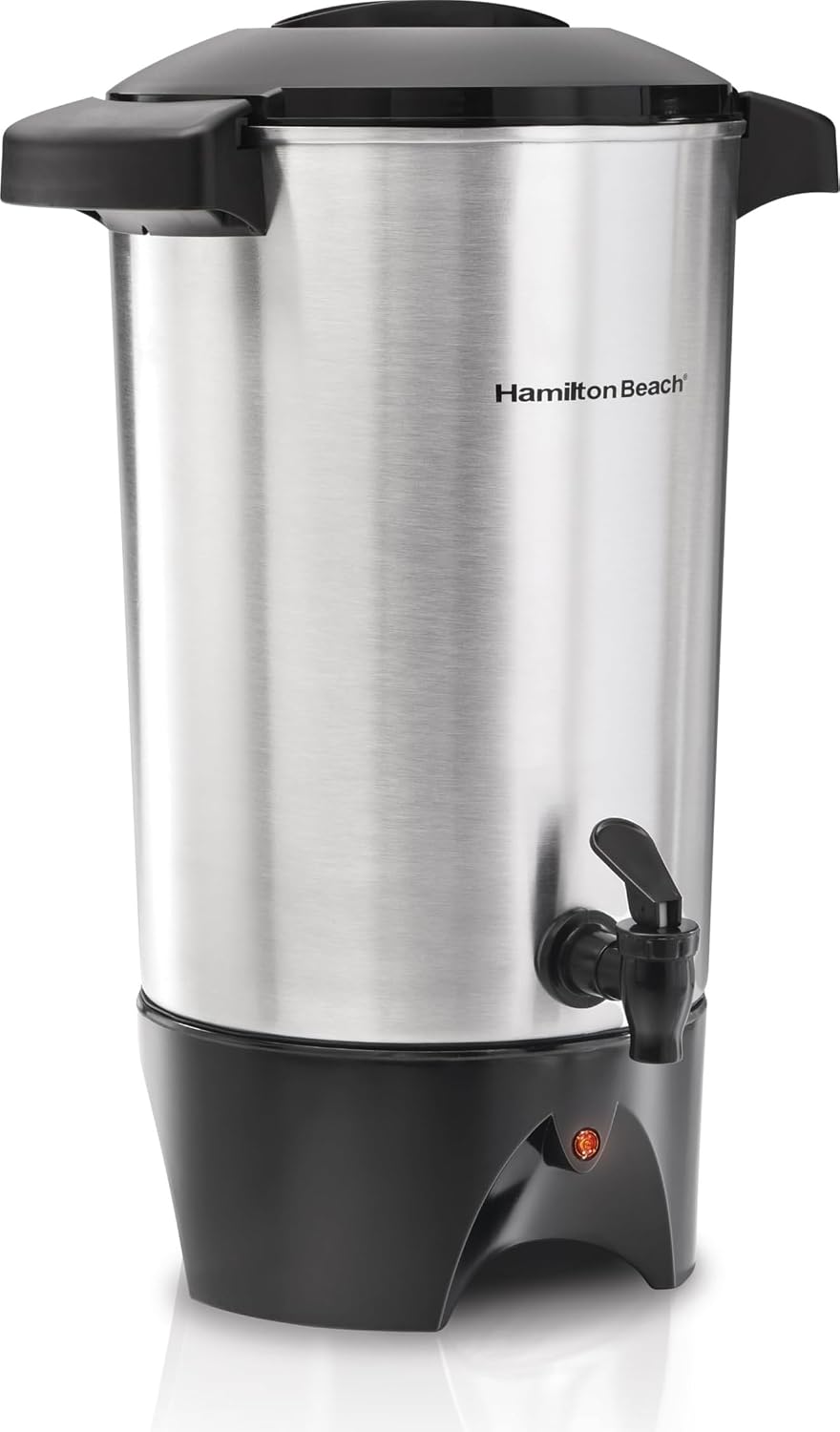
Hamilton Beach 45-Cup Coffee Urn
| Capacity | 42 cups |
|---|---|
| Material Type | Aluminum |
| Included Components | Coffee Urn |
The Hamilton Beach 45-Cup Coffee Urn is a simple, heavy-duty beverage dispenser built for serving large groups. It brews at roughly one cup per minute and holds 15 to 45 cups, with clear internal water-level marks to simplify filling. The unit offers a two-way lever so you can dispense a single cup or engage continuous flow for filling multiple cups or carafes, and a ready light that indicates when brewing is complete while keeping coffee hot without overheating. Practical touches include a twist-lock lid, large carrying handles, removable power cord, and dishwasher-safe twist-lock lid and brew basket for easier cleanup. Because it is aluminum and designed for volume rather than specialty coffee features, it does not include programmability, a built-in grinder, or temperature adjustment options, and it will produce straightforward hot brewed coffee rather than cafe-style beverages. For offices, event hosts, or break rooms that need reliable, fast hot coffee for many people, this urn is a low-fuss solution that prioritizes capacity and ease of use.
Best for: Buyers who need a straightforward, high-capacity coffee solution for offices, events, or frequent large gatherings and value speed, durability, and easy cleanup.
Less Ideal for: People seeking precision brewing, specialty coffee features, or a compact single-serve machine for home use should look elsewhere.
- Brews quickly at about one cup per minute, useful for busy events
- Large capacity (15–45 cups) suitable for meetings and parties
- Two-way lever lets you choose single-cup or continuous dispensing
- Ready light and water-level indicators make brewing and monitoring simple
- Twist-lock lid, removable cord, and dishwasher-safe parts speed cleanup and storage
- No programmability or temperature control for customized brewing
- Aluminum construction is utilitarian and lacks insulated or premium finishes
- Produces basic brewed coffee, not specialized espresso or milk-based drinks
Verdict: A no-nonsense, fast-brewing urn for businesses and events that need reliable hot coffee service for large groups.
Elite Gourmet 4-Cup Coffee Maker EHC4128

| Capacity | 4 cups |
|---|---|
| Wattage | 650 |
| Power Source | AC adapter |
| Filter Type | Reusable |
The Elite Gourmet EHC4128 is a straightforward small-capacity drip brewer aimed at simple daily use in compact work settings. It fills a semi-transparent reservoir and brews into a 4-cup glass carafe using ground coffee and the included reusable filter, so you can skip paper cones. Controls are basic push buttons with an on/off switch and a programmable feature for scheduled brewing, and the pause-and-serve lets you pour mid-cycle. The keep-warm plate maintains serving temperature after brewing. At 650 watts it heats quickly and the removable parts are dishwasher-safe for easy cleanup. Limitations are its small capacity and basic feature set compared with larger office units: it is best for a few people rather than a busy break room, and the glass carafe and lightweight construction mean it is not built for heavy commercial use. For small offices, dorms, or RVs that need an affordable, no-frills brewer that is easy to operate and maintain, this unit works well.
Best for: Buyers looking for an inexpensive, easy-to-use brewer for a small office, break area, or single-person workspaces who prioritize low cost and simple operation.
Less Ideal for: Busy offices or teams that need frequent large-volume brewing should consider larger, more durable commercial coffee makers instead.
- Compact footprint fits small counters and tight office kitchens
- Reusable filter reduces waste and eliminates need for paper cones
- Pause-and-serve lets you grab a cup before brewing finishes
- Keep-warm plate preserves brewed coffee temperature after brewing
- Dishwasher-safe removable parts simplify cleanup
- Only brews up to 4 cups, too small for larger office demand
- Lightweight construction and glass carafe are less durable for heavy daily commercial use
Verdict: A budget-friendly, no-frills 4-cup brewer that delivers hot coffee and easy cleanup for small office or single-user environments.
Ninja Hot & Iced XL CM371

| Capacity | 12 cups |
|---|---|
| Wattage | 1550 watts |
| Filter Type | Reusable |
| Operation Mode | Fully Automatic |
The Ninja Hot & Iced XL CM371 is a versatile drip brewer built to handle everything from a single cup to a full 12-cup carafe without pods. It offers four brew modes—Classic, Rich, Over Ice, and Rapid Cold Brew—and eight size settings so you can make a small cup, a travel mug, or a quarter, half, or full carafe. Practical touches include a removable water reservoir with auto-metering, a permanent reusable filter, a keep-warm function, and a 24-hour delay brew timer for scheduled starts. Thermal Flavor Extraction and 1550-watt power aim to deliver consistent temperature and saturation for repeatable flavor. In a small office or business setting the foldaway platform and single-serve to carafe flexibility mean fewer machines are needed to satisfy mixed preferences. Limitations to note are the glass carafe and reliance on a single built-in brewer mechanism, which may slow service during back-to-back large orders compared with dedicated commercial brewers.
Best for: Small offices or business hosts that need one reliable, flexible countertop machine to serve varied coffee preferences throughout the day and prefer scheduled, consistent brewing.
Less Ideal for: High-traffic commercial environments that require continuous, high-volume dispensing or fully insulated thermal carafes for long hold times.
- Multiple brew styles for hot, iced, and cold brew to suit varied preferences
- Removable water reservoir with auto-metering for easy refills and consistent fills
- Reusable permanent filter reduces ongoing filter purchases
- Eight brew size settings from single cup to full carafe for flexible service
- 24-hour delay and keep-warm functions enable scheduled brewing and holding
- Glass carafe is fragile and does not offer the insulation of a thermal carafe
- Single brewer can be a bottleneck during continuous high-volume use
Verdict: A versatile, reliable countertop brewer that handles single-serve to carafe needs and multiple coffee styles, making it a strong choice for small business use.
Keurig K-Elite Coffee Maker

| Wattage | 1500 watts |
|---|---|
| Power Source | AC adapter |
| Coffee Input Type | K-Cup Pods |
| Other Special Features | Programmable, Removable Tank, Water Filter |
The Keurig K-Elite is a single-serve K-Cup brewer built for quick, customizable coffee at home or in a small office. It lets you choose from five cup sizes (4 to 12 oz), a Strong Brew option for bolder flavor, and an Iced setting that brews hot over ice for a fuller iced coffee. The large removable 75 oz water reservoir reduces refill frequency and the hot-water button is useful for instant drinks or soup. Programmable features include temperature control and auto-on, while quiet-brew technology keeps noise low in shared spaces. It accepts K-Cup pods and can work with a reusable My K-Cup filter for grounds. Practical limitations include reliance on pods for most users, and it does not include features aimed at high-volume breakrooms such as multiple brew heads or commercial-grade internals. For daily single-serve needs it balances speed, convenience, and basic customization, but it is best suited to light to moderate office use rather than heavy continuous brewing.
Best for: Buyers who want a reliable, low-noise single-serve brewer for a small office or business break area where convenience, predictable performance, and positive user feedback matter.
Less Ideal for: Facilities that need high-volume, continuous brewing or a commercial-grade machine for large teams should consider more robust multi-serve equipment.
- Multiple brew sizes (4–12 oz) for flexible serving portions.
- Strong Brew and Iced settings add straightforward flavor and iced-coffee options.
- Large removable 75 oz water reservoir reduces refill frequency.
- Programmable temperature control, auto-on, and hot-water on demand increase convenience.
- Quiet-brew design suitable for shared workspaces.
- Designed for single-serve use so it is not ideal for sustained high-volume brewing.
- Primarily uses K-Cup pods unless a reusable filter is purchased separately.
- Not a commercial-grade machine; internal components are consumer-focused.
Verdict: A convenient, customizable single-serve brewer that reliably delivers quick, low-noise coffee for small office or business break areas.
BLACK+DECKER 12-Cup Digital Coffee Maker

| Capacity | 12 cups |
|---|---|
| Wattage | 975 watts |
| Power Source | AC adapter |
| Coffee Input Type | ground |
The BLACK+DECKER 12-Cup Digital Coffee Maker is a straightforward drip machine designed for making multiple cups on a predictable schedule. It uses a Duralife glass carafe and a front water window so you can see reservoir level at a glance, and the Sneak-A-Cup feature temporarily pauses flow so you can grab a cup mid-brew. Large rubberized QuickTouch buttons and a 24-hour programmable auto-brew with 2-hour auto shutoff make it easy to set and forget, while the washable brew basket and included permanent filter option reduce ongoing filter costs. At 975 watts it brews quickly for a full carafe and is intended for steady daily use in a small office or shared kitchen. Limitations include a basic feature set with no thermal carafe for extended heat retention and a plastic exterior that can feel budget-oriented, so it will not keep coffee hot as long as higher-end commercial machines. For buyers who prioritize dependable, no-frills brewing and simple scheduling, this model covers the essentials reliably.
Best for: Buyers who want a dependable, easy-to-use coffeemaker that reliably brews full carafes on a set schedule for small office or shared-kitchen use.
Less Ideal for: Those who need long-term heat retention, high-volume commercial brewing, or advanced customization features should consider more heavy-duty or thermal-carafe machines.
- Programmable 24-hour auto-brew with large, easy-to-use controls for predictable scheduling
- Sneak-A-Cup feature lets you pour a cup mid-brew without drips
- Washable brew basket and option for a permanent filter reduce recurring filter purchases
- Clear front water window and measurement markings simplify filling and brewing a full carafe
- Glass carafe and single-walled design do not retain heat as long as thermal-carafe models
- Basic plastic exterior and limited advanced features compared with commercial-grade brewers
Verdict: A simple, programmable 12-cup drip brewer that delivers reliable, scheduled coffee for small offices and shared workspaces.
Choosing the Right Coffee Maker for Business: Key Factors to Consider
Brew Speed and Throughput
How quickly a coffee maker can produce a full pot or a succession of single servings determines whether it meets business demand. In a busy office you need machines that can make multiple liters per hour or continuous single-serve production without long recovery times.
Faster throughput reduces lines and downtime, but extremely rapid brews can sometimes sacrifice extraction quality. For business buyers, balance raw speed with consistent extraction and a hot-holding strategy so coffee stays at drinkable temperature between brews.
Capacity and Hot Holding
Capacity refers both to the size of carafes or reservoirs and to how many servings the unit can produce before a refill. Hot holding matters because freshly brewed coffee cools quickly; good thermal carafes or integrated hot plates preserve temperature without burning the brew.
Consider the typical number of daily cups and whether staggered brewing or a continuous dispenser fits your workflow. For larger teams, multiple carafe capacity or urn-style machines reduce refill frequency, while smaller offices may prefer single-serve systems with respectable reservoir sizes.
Ease of Cleaning and Maintenance
Business machines see heavy daily use, so simple cleaning routines and accessible service points are critical. Removable brew baskets, dishwasher-safe parts, clear water reservoirs, and straightforward descaling procedures cut time spent on upkeep.
Also evaluate how often routine maintenance is required and whether common wear items are easy to access and replace. A model that is quicker to clean will minimize interrupted service and lower the chance of flavor deterioration from buildup.
Durability and Build Quality
Materials, component quality, and internal plumbing design affect how long a coffee maker holds up under frequent cycles. Stainless steel boilers, reinforced pumps, and sturdy housing tend to last longer than thin plastics in commercial use.
Durability reduces total downtime and the need for frequent repairs. When choosing for business, favor machines with proven heavy-duty components and simple mechanical designs that technicians can service quickly.
Controls, Scheduling, and User Interface
Controls determine how easy it is to start a brew, schedule automatic cycles, and set batch sizes. Intuitive interfaces reduce user error in a shared environment, and programmable timers help ensure coffee is ready at peak times without constant monitoring.
Look for clear indicators for water level, maintenance alerts, and flexible batch or cup-size options. For managed breakrooms, networked or remotely controllable units can simplify operations, but simplicity can be preferable for high-turnover staff.
Consumables and Operating Cost
Operating costs include filter cartridges, single-serve pods if used, and the frequency of descaling or part replacement. Even small per-cup consumable differences add up in a business setting with high daily volume.
Assess whether a unit uses standard paper filters, permanent mesh filters, or proprietary pods. Standard consumables are generally easier and cheaper to source and help keep ongoing costs predictable.
Sizing Your Coffee Setup to Office Demand
Estimate peak simultaneous users and daily cup volume before selecting equipment. A small team of four to six people may be well served by a single high-capacity carafe brewer or a medium-sized single-serve machine with a large reservoir. Larger teams often need dedicated high-throughput brewers or multiple units to avoid bottlenecks.
Also think about service pattern. If most employees grab coffee throughout the morning, a hot-holding carafe system reduces the need for continuous brewing. If demand comes in concentrated windows, prioritize rapid recovery and quick brewing cycles.
- Track realistic cup counts over several workdays to identify peak demand.
- Choose a machine whose hourly throughput exceeds peak 30-minute demand.
- Consider multiple smaller units instead of one oversized machine for distributed access.
Placement, Plumbed Vs. Reservoir Models, and Installation
Decide whether a plumbed-in machine that draws directly from a water line or a reservoir unit better fits your space and budget. Plumbed models reduce manual refilling but may require professional installation and occasional line servicing. Reservoir units are portable and simpler to maintain but need regular refilling during heavy use.
Placement affects traffic flow and noise. Put machines in locations that minimize queueing and where access to power and drainage is convenient. Clear signage for basic operation can reduce user confusion and spillage.
- Plumbed models are ideal for high-volume areas with a fixed location.
- Reservoir models allow flexible placement and are easier to replace or service.
- Allow sufficient ventilation and clearance for service access.
Cleaning Routines That Keep Coffee Tasting Good
Establish a short daily cleaning checklist and a monthly deeper maintenance schedule. Daily tasks should include emptying, rinsing carafes, wiping the brew area, and checking water quality. Weekly or monthly tasks involve descaling, deep filter cleaning, and inspecting seals or common wear parts.
Standardize responsibilities and post instructions near the machine. Consistent cleaning preserves flavor, prevents bacterial growth, and extends equipment life.
- Daily: rinse carafes and wipe external surfaces.
- Weekly: clean or replace paper and mesh filters as recommended.
- Monthly: run descaling cycles according to water hardness and usage.
Power, Energy Use, and Heat Management
Commercial coffee makers can draw significant power during brew cycles and when maintaining hot-hold temperatures. Verify that circuit capacity and power outlets suit the machine's rating to avoid tripping breakers or requiring electrical upgrades.
Energy-saving features such as programmable on/off schedules or efficient hot-holding systems can reduce operating costs. Additionally, proper ventilation reduces heat build-up in compact breakrooms and protects nearby equipment.
- Check the unit's electrical requirements against your facility's circuits.
- Use timers to avoid leaving hot plates on outside business hours.
- Position machines away from sensitive electronics or heat-sensitive surfaces.
Training Staff and Managing Shared Use
Simple, clear operating instructions reduce mistakes and interruptions. Train regular users on refill points, basic troubleshooting, and the cleaning schedule. For larger workplaces, identify one or two staff members responsible for routine checks and ordering consumables.
Label common controls and water lines. A small investment in user training and a maintenance plan will significantly reduce service calls and keep the coffee program running smoothly.
- Create a one-page cheat sheet for users with step-by-step brew instructions.
- Assign responsibility for routine cleaning and consumable ordering.
- Document common fixes for simple issues like jammed funnels or misaligned filters.
How We Chose the Best Coffee Maker for Business
We prioritized attributes that matter most to business users and commercial breakrooms rather than home-oriented features. Selection began with machines designed for repeated daily cycles, then filtered for reliability signals, user-facing maintenance design, and capacity configurations suitable for small teams up to larger offices. Key evaluation criteria included brew throughput, thermal retention or hot-holding capability, ease of cleaning and service access, and parts durability under frequent use. We also considered programmability and control for predictable scheduling and consistent results across operators. We excluded home-only single-use hobby models and any units clearly intended for light domestic duty. Models that required specialized proprietary consumables were deprioritized unless they offered clear throughput or reliability advantages for business settings. The final shortlist favors equipment that reduces downtime, simplifies upkeep, and delivers steady temperature and flavor across multiple cycles.
Our full evaluation process is outlined in our review methodology.
FAQ
How many cups per hour should a business coffee maker handle?
It depends on your peak demand window. For small teams, 20 to 40 cups per hour is often sufficient. Larger breakrooms should look for machines or combined setups that can consistently produce 60 to 120 cups hourly without long recovery delays.
Is a plumbed-in coffee maker worth it for an office?
Plumbed units reduce manual refilling and are convenient for high-volume sites. They typically require professional installation and occasional line maintenance, so they are most worthwhile when daily demand justifies the plumbing effort.
How often should a business machine be descaled?
Frequency depends on water hardness and usage. Heavy daily use in hard water areas can require monthly descaling, while softer water and lighter use may allow quarterly cycles. Monitor flow rates and taste to adjust intervals.
Are single-serve systems practical for offices?
Single-serve systems can be practical for offices prioritizing variety and minimal waste, especially with a large staff who want different beverages. For very high throughput needs, single-serve models may struggle unless paired with generous reservoirs and rapid recovery features.
What maintenance tasks reduce long-term repair risk?
Regular cleaning of brew baskets, timely descaling, replacing worn gaskets, and checking water lines for buildup all reduce repair risk. Proactive replacement of commonly worn parts and following a simple maintenance schedule prevent small issues from becoming failures.
Final Verdict
Choose a coffee maker for business based on expected daily volume, preferred service style, and how much time you can dedicate to upkeep. Prioritize throughput and reliable hot-holding for high-demand settings, and favor simple cleaning and durable components to minimize downtime. Smaller teams can prioritize convenience and variety, while larger operations should focus on capacity, ease of maintenance, and installation type. Balance the tradeoffs between speed, extraction quality, and operating cost to arrive at a practical choice for your office. With clear usage estimates and a maintenance plan, you can pick a brewer that keeps staff satisfied and service interruptions to a minimum.