
Note: This article contains affiliate links. If you click on these links and make a purchase, we may earn a small commission at no extra cost to you. This helps support our research and content. Read our full affiliate disclosure here.
If you want café-style espresso shots and velvety cappuccinos at home, choosing the right coffee maker matters. The right machine affects shot quality, steam performance, and how much hands-on work you need. This guide covers seven top coffee makers shortlisted for their extraction consistency, steam capability, and overall usability. We evaluate ease of use, milk-texturing performance, and maintenance needs so you can pick a machine that matches your skill level and daily routine. Read on for a clear breakdown of the features that matter and which setups suit different home barista priorities.
Top Picks at a Glance
| Best Overall The best all-around choice for most situations | Breville Bambino BES450BSS | 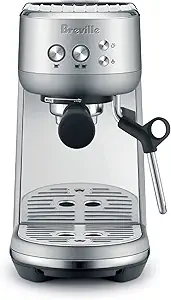 |
| Best Quality Built to a higher standard if you want something more solid | Breville Barista Express BES870XL |  |
| Best Value The sweet spot between price and what you get | Gevi 20 Bar Espresso Machine ECMG0 | 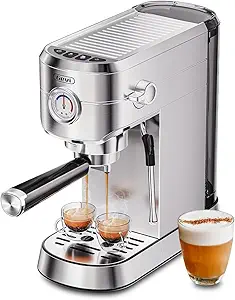 |
| Best Budget The cheapest option that still gets the job done reliably | Imusa 4-Cup Espresso Maker |  |
| Top Rated A top-rated pick with lots of positive feedback | CASABREWS Ultra Espresso Machine |  |
| Most Popular A crowd favorite that many people choose with confidence | Hamilton Beach 2-Way 12-Cup Coffee Maker |  |
| Best Seller A high-volume bestseller chosen again and again | Ninja Luxe Café Premier ES601 |  |
Breville Bambino BES450BSS

| Operation Mode | Semi-Automatic |
|---|---|
| Wattage | 1560 watts |
| Power Source | AC adapter |
| Coffee Input Type | Ground |
| Capacity | 47 fluid ounces |
The Breville Bambino is a compact semi-automatic espresso machine built to make café-style espresso drinks in a small footprint. It uses a ThermoJet heating system with PID temperature control to reach extraction temperature in about three seconds, and a 54mm portafilter with single and dual-wall filter baskets to pull concentrated shots. The machine includes an automatic steam wand that textures milk into microfoam for lattes and cappuccinos, plus basic controls for single- or double-shot extraction and steam/hot water. In real-world use the Bambino is fast to heat and straightforward to operate, making it easy to move from grinding and tamping to steaming without long waits. Its compact size fits small kitchens, though the manual workflow still requires a separate grinder and some learning to dial in dose and tamp. Accessories like a tamper, milk jug, and cleaning tools are included, but those seeking built-in grinding or fully automated routines will find the Bambino intentionally simple. For buyers wanting reliable temperature control, quick start-up, and quality milk texture in a countertop-friendly package, it is an excellent mid-level choice.
Best for: Buyers who want café-quality espresso and milk-based drinks from a compact, reliable machine and who are willing to use a separate grinder and learn basic shot prep.
Less Ideal for: People who want a fully automatic, all-in-one machine with an integrated grinder or those who prefer a zero-learning, push-button experience.
- Very fast ThermoJet heat-up with PID temperature control for consistent extraction
- 54mm portafilter with single and dual-wall baskets supports full-flavor shots
- Automatic steam wand produces smooth microfoam for latte art and milk drinks
- Compact footprint fits small countertops and home kitchens
- Includes essential accessories (tamper, milk jug, filter baskets, cleaning tool)
- No built-in grinder so a separate grinder is required for fresh beans
- Semi-automatic workflow requires manual dosing and tamping which has a learning curve
- Limited programmability compared with higher-end or super-automatic machines
Verdict: Choose the Bambino if you want fast heat-up, precise temperature control, and barista-grade milk texturing in a compact home espresso machine.
Breville Barista Express BES870XL

| Wattage | 1600 watts |
|---|---|
| Voltage | 120 |
| Coffee Input Type | whole_beans |
| Filter Type | Reusable |
| Capacity | 1 cups |
The Breville Barista Express BES870XL combines a built‑in conical burr grinder, 54mm portafilter, and thermocoil heating system to let you go from whole beans to espresso shots in under a minute. You grind directly into the portafilter with 16 grind settings and dose control, then use low pressure pre‑infusion and PID temperature control to help extract balanced flavors. The steam wand delivers strong steam for manual microfoam so you can texture milk for lattes and cappuccinos and practice latte art. Included accessories such as a razor dose trimming tool, tamper, and stainless steel milk jug make setup and routine use straightforward. Expect hands‑on operation: it is a manual workflow that rewards practice, not a push‑button, one‑touch system. It requires regular cleaning, occasional dosing adjustments, and some learning to hit consistent shots, but delivers café‑grade control and flavor once dialed in. For performance‑focused home brewers it offers precise temperature and grind control without needing separate devices.
Best for: Serious home brewers who prioritize shot quality and control and are willing to learn manual dosing and steaming to get café‑level espresso and milk texture.
Less Ideal for: Buyers who want fully automated, one‑button espresso or minimal maintenance machines should consider simpler automatic models instead.
- Integrated conical burr grinder with 16 grind settings for fresh dosing
- PID temperature control and thermocoil heating for stable extraction
- Powerful steam wand for manual microfoam and latte art
- 54mm stainless steel portafilter and dual/single wall filter baskets support precise shots
- Comes with practical accessories like razor dose tool, tamper, and milk jug
- Manual operation has a learning curve and needs regular maintenance
- Not a one‑touch automatic machine for fully hands‑off cappuccinos
- Water tank and hopper require frequent refilling with regular use
Verdict: If you want café‑quality espresso and manual milk texturing at home, the Barista Express delivers high performance control in an all‑in‑one semi‑automatic package.
Gevi 20 Bar Espresso Machine ECMG0
| Output Pressure | 20 bar |
|---|---|
| Operation Mode | Semi-Automatic |
| Wattage | 1350 watts |
| Capacity | 1 liters |
| Filter Type | Reusable |
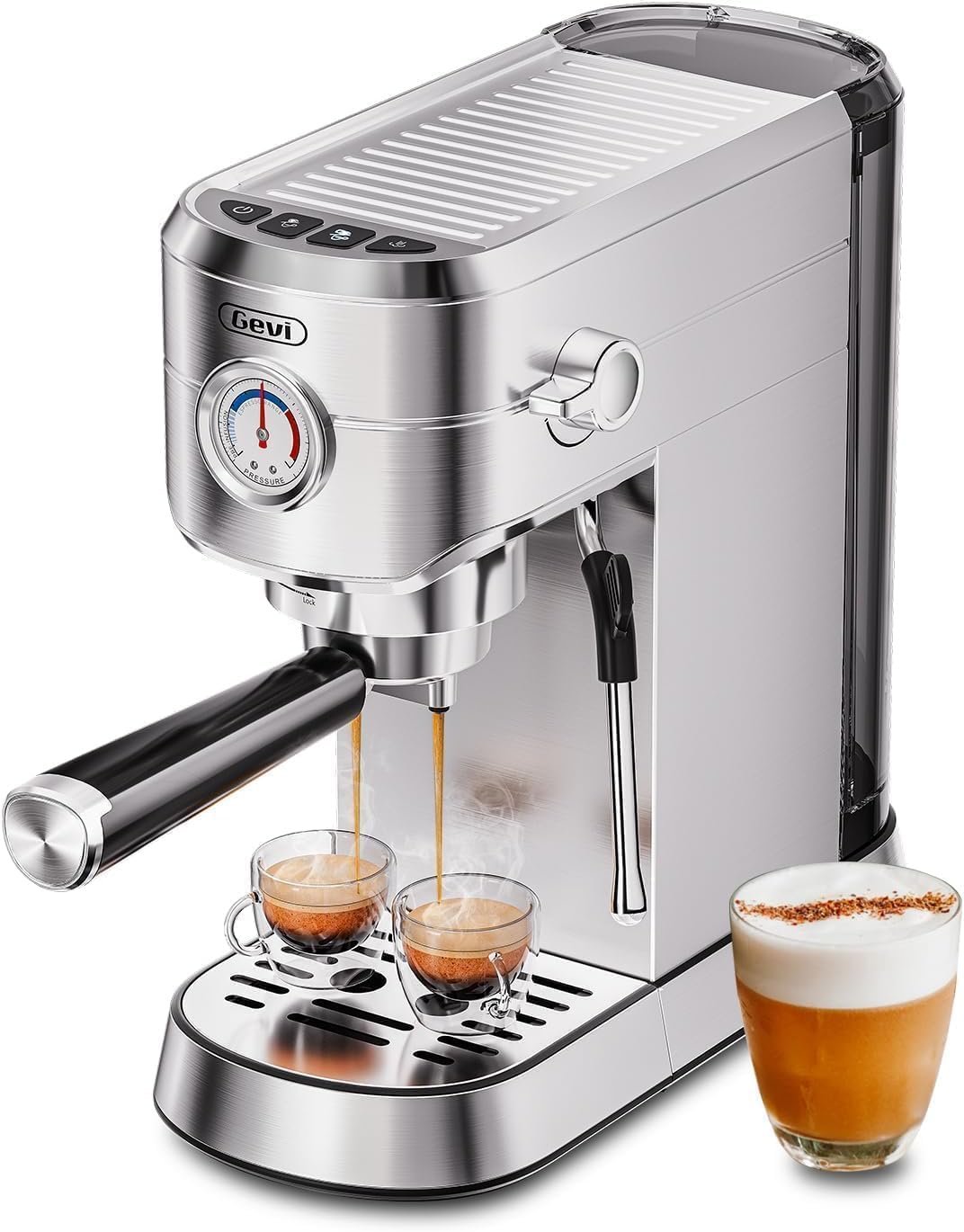
The Gevi 20 Bar Espresso Machine is a countertop semi-automatic unit aimed at making espresso-based drinks and Americanos with a handful of barista-style controls. It uses a 20-bar pump, NTC temperature control, pre-infusion, and a built-in pressure gauge to help deliver consistent extractions, and a steam wand plus removable froth nozzle for milk-based drinks. Daily use is straightforward: fill the 34 oz removable water tank, tamp ground coffee into the 51 mm portafilter, adjust shot volume, and steam milk with the wand. The stainless steel housing feels durable and the cup warmer and removable drip tray simplify routine use and cleaning. Expect some pump noise and mild vibration during extraction, and the machine does not include an integrated grinder so you will need a separate grinder for best results. For users prioritizing compact size and control over extraction, this machine offers solid features at this level, while buyers wanting an all-in-one grinder-plus-espresso solution or quieter commercial-grade performance should look elsewhere.
Best for: A practical buyer who wants a compact, durable home espresso machine with controls that improve shot consistency and a capable steam wand for regular cappuccinos and lattes.
Less Ideal for: Not a great fit for someone who needs an all-in-one grinder-and-brewer or who requires near-silent, commercial-grade extraction in a busy cafe setting.
- 20-bar pump with pressure gauge and pre-infusion for more consistent extractions
- Powerful steam wand and removable froth nozzle for silky microfoam
- Removable 34 oz water tank and drip tray make filling and cleaning easier
- Stainless steel body and cup warmer add durability and useful countertop features
- No built-in grinder so a separate grinder is required for optimal coffee quality
- High-pressure pump produces noticeable vibration and noise during extraction
Verdict: A compact, feature-rich semi-automatic espresso machine that gives practical control over extraction and strong steaming performance for home cappuccinos and lattes.
Imusa 4-Cup Espresso Maker

| Capacity | 4 cups |
|---|---|
| Wattage | 800 watts |
| Operation Mode | Semi-Automatic |
| Filter Type | Permanent |
The Imusa 4-Cup Espresso Maker is a compact countertop machine designed to brew espresso and produce frothed milk for cappuccinos and lattes. It uses a permanent filter and a 3-position selector knob to deliver espresso directly into the included glass carafe, while the steam nozzle creates thick froth for milk-based drinks. At 800 watts and with a 5-bar pressure rating, it targets everyday home use rather than commercial-grade extraction. The removable drip tray and cool-touch carafe handle make cleanup and pouring straightforward, and the matte black finish keeps it low-profile on the counter. Practical benefits include the ability to prepare multiple small servings without single-serve pods and a built-in frother so you can make cappuccinos at home. Limitations are its modest pressure relative to higher-end machines and a plastic exterior that feels less durable than metal-bodied alternatives, so expect good value for casual home brewing rather than professional cafe results.
Best for: Buyers on a tight budget who want a simple machine to make espresso-style shots and frothed milk at home without relying on pods or expensive equipment.
Less Ideal for: Serious espresso enthusiasts seeking café-quality extraction, high pressure performance, or a heavy-duty metal machine should consider higher-end models instead.
- Compact four-cup capacity suitable for small households or multiple small servings
- Built-in steam nozzle milk frother for cappuccinos and lattes
- Permanent filter and included carafe reduce ongoing consumable costs
- Removable drip tray and cool-touch carafe handle simplify cleaning and pouring
- 5-bar pressure is lower than prosumer espresso machines, which limits extraction intensity
- Plastic exterior may feel less robust than metal-bodied units
Verdict: A budget-friendly, compact espresso maker that delivers basic espresso and milk-frothed cappuccinos for home use.
CASABREWS Ultra Espresso Machine

| Wattage | 1350 watts |
|---|---|
| Voltage | 120 volts |
| Operation Mode | Semi-Automatic |
| Coffee Input Type | ground_coffee |
| Filter Type | 58mm Portafilter & One Cup Brewing Filters & Two Cup Brewing Filters |
The CASABREWS Ultra is a semi-automatic espresso machine aimed at home baristas who want consistent, café-style shots and reliable milk steaming. It uses a 20-bar Italian pump and a 1350W heating system with PID-style temperature control offering four setpoints to stabilize brew temperature, plus pre-infusion and an automatic pressure-release valve to help produce steady extractions and dryer pucks. The included 58mm portafilter, removable 73 oz water tank, and a commercial-style 10mm steam wand make pulling double shots and texturing milk straightforward for lattes and cappuccinos. The clear LCD and simple button controls reduce guesswork during routine use, and the machine ships with a full accessories kit including multiple filters and a tamper. Expect a learning curve for dialing grind, dose, and tamp to get the best crema, and the single-boiler design means you will wait a short time when switching between brewing and steaming. For everyday home use the Ultra balances performance and usability while focusing on consistent, repeatable results.
Best for: Home drinkers who prioritize steady, cafe-quality espresso and reliable milk steaming for daily lattes and cappuccinos and want a machine that emphasizes repeatable results over gimmicks.
Less Ideal for: Users who need simultaneous brewing and steaming for high-volume service or who want a fully automatic, push-button single-serve experience.
- 20-bar Italian pump with pre-infusion and automatic pressure release for stable extraction and good crema
- PID-style four-level temperature control for consistent brewing temperature
- Commercial-size 58mm portafilter and full accessory kit included
- Powerful steam wand capable of creating fine microfoam for lattes and cappuccinos
- Removable 73 oz water tank and cup warmer simplify daily use and maintenance
- Single-boiler design requires waiting between brewing and steaming
- Learning curve to dial in grind, dose, and tamp for best results
Verdict: Choose the Ultra if you want a dependable home espresso machine that delivers consistent shots and professional-grade steam for reliable daily cappuccinos and lattes.
Hamilton Beach 2-Way 12-Cup Coffee Maker

| Capacity | 12 cups |
|---|---|
| Wattage | 950 watts |
| Power Source | AC adapter |
| Filter Type | Reusable |
| Coffee Input Type | Ground |
This Hamilton Beach 2-way unit combines a single-serve side and a 12-cup glass carafe into one programmable drip coffee maker, making it convenient for mixed household use. Use the single-serve side to brew up to 14 oz directly into a cup or travel mug by scooping ground coffee into the mesh holder, or switch to the carafe side to brew a full pot for multiple people. Notable features include programmable 24-hour delay brew, bold/regular strength selection, two easy-fill water reservoirs with windows, AutoPause to pour mid-brew, and a 2-hour keep-warm with automatic shutoff. Practical benefits are reduced pod waste since it uses ground coffee, straightforward controls, and the flexibility to make one cup quickly or a larger pot for guests. Trade-offs are that it is a drip brewer rather than an espresso machine so it cannot produce true espresso or milk-textured cappuccino, and it requires a separate grinder or preground coffee for best flavor. The reusable filter and simple button interface make everyday use low-friction, and the glass carafe is familiar and easy to clean.
Best for: Buyers who want a reliable, low-maintenance machine that covers both solo cups and full pots and value straightforward controls and proven user feedback.
Less Ideal for: Those seeking an actual espresso or milk-steaming machine for lattes and cappuccinos should choose a dedicated espresso maker with a steam wand or integrated milk frother.
- Two brewing modes: single-serve up to 14 oz or full 12-cup carafe.
- Programmable 24-hour delay and brew-strength selection for morning scheduling.
- Reusable mesh filter reduces waste and eliminates pod costs.
- AutoPause lets you pour before the full pot finishes without a mess.
- Separate easy-fill reservoirs with water windows for clear fill levels.
- Not capable of brewing true espresso or producing textured milk for cappuccinos.
- Glass carafe and plastic body are more fragile than all-metal alternatives.
Verdict: Choose this if you want a dependable dual-function drip brewer that reliably makes single cups or full carafes without pod waste.
Ninja Luxe Café Premier ES601

| Operation Mode | Fully Automatic |
|---|---|
| Wattage | 1650 watts |
| Coffee Input Type | Ground, Whole Bean |
| Filter Type | Reusable |
The Ninja Luxe Café Premier ES601 combines an integrated conical burr grinder, guided Barista Assist workflow, and an automated dual-froth system to deliver a wide range of café-style drinks from espresso shots to drip coffee and rapid cold brew. Typical use is straightforward: fill the 70 oz removable reservoir, choose a drink style and size, load beans or grounds, and the machine grinds, doses by weight, tamps with an assisted tamper, and brews while the self-cleaning steam wand handles frothing. Notable features include 25 grind settings, weight-based automatic dosing, multiple preset drink sizes and strengths, hands-free frothing with four froth presets, and dishwasher-safe parts. Practical benefits are consistent extraction without deep barista skill, quick cold-pressed espresso for iced drinks, and built-in accessory storage that keeps the counter tidy. Important limitations are the unit's large footprint and weight compared with single-function machines, and the complexity of features that may require some learning for occasional users. The machine also draws substantial power when operating at full function.
Best for: Buyers who want a guided, low-risk path to café-quality drinks at home and value consistent, repeatable results without needing barista experience.
Less Ideal for: People with very limited counter space or those who only want a simple single-purpose drip brewer or basic pod machine.
- All-in-one 3-in-1 capability for espresso, drip, and rapid cold brew
- Built-in conical burr grinder with 25 settings for precise grind control
- Barista Assist with weight-based dosing and assisted tamper for consistent shots
- Hands-free dual froth system with self-cleaning steam wand for easy milk texture
- Large removable water reservoir and built-in accessory storage for everyday convenience
- Relatively heavy and takes substantial counter space compared with single-purpose units
- Feature-rich interface can feel complex for users wanting a simple drip or basic espresso maker
Verdict: Choose the Ninja Luxe Café Premier ES601 if you want a guided, all-in-one home machine that reliably produces café-style espresso, drip, and cold brew without needing advanced barista skills.
Choosing the Right Coffee Maker for Espresso and Cappuccino: Key Factors to Consider
Extraction Consistency
Reliable extraction produces balanced espresso shots with proper crema and flavor. Look for machines with stable pressure delivery, a quality portafilter, and temperature control. These attributes reduce shot-to-shot variation so you waste fewer beans learning the machine.
Extraction consistency matters because espresso is sensitive to small changes in dose, grind, and temperature. A machine that holds brew temperature and pressure steady makes it easier to dial in the grind and get repeatable results, which is essential for both straight espresso and milk-based drinks.
Steam Power and Milk Texturing
Milk-based drinks require steam that can heat quickly and create fine microfoam. Check whether the machine has a separate steam boiler or a sufficiently powerful single boiler, and whether the steam wand offers good angle and tip control. Automated milk systems save time but may limit technique; manual wands give more control for latte art.
The strength and controllability of steam affect how fast you can prepare multiple drinks and how creamy the final cappuccino will be. Stronger steam shortens frothing time and helps create stable foam, but poorly designed wands can make texturing inconsistent.
Workspace and Size
Home kitchens have varying counter space and water access. Consider the machine footprint, water reservoir location and capacity, and whether a removable tank fits your setup. Taller machines may also impact where you can fit a milk pitcher under the wand or grouphead.
Size affects how convenient daily use will be. A compact unit can work in small kitchens but may trade off reservoir size or serviceability. Larger machines often offer better boilers and more consistent performance but require dedicated space.
Ease of Use and Programming
Controls, programmable dosing, and pre-infusion options determine how approachable a machine is. Beginners benefit from straightforward interfaces and consistent automation, while experienced users may prefer manual controls and temperature adjustment. Consider switch-on time and how many steps it takes to pull a shot and texture milk.
A machine that is intuitive reduces the learning curve and makes it more likely you will use it daily. Programmability helps replicate favorite recipes and saves time when making multiple drinks.
Cleaning and Maintenance
Regular cleaning affects flavor and longevity. Look for removable drip trays, accessible brew groups or portafilters, and clear rinse or descaling procedures. Automatic cleaning cycles and easy access to water filters reduce maintenance friction.
Neglecting routine maintenance can degrade extraction and steam performance. Machines that make cleaning straightforward will stay reliable longer and offer better taste consistency over time.
Durability and Serviceability
A well-built machine withstands daily thermal cycles and mechanical wear. Metal boilers and robust groupheads typically outperform fragile plastics. Also consider how easy it is to get routine service or replacement parts when needed, and whether the design allows for owner-level repairs like replacing seals or cleaning internal components.
Long-term ownership costs and downtime depend on durability. Choosing a machine built for frequent use will deliver more consistent performance and lower repair frequency.
Manual Versus Automatic Milk Systems
Manual steam wands give you full control of the frothing process, allowing for finer microfoam and more technique-driven results. They require practice to master but are preferred by enthusiasts who want to shape texture and temperature precisely.
Automatic or closed milk systems simplify cappuccino preparation and reduce the learning curve. They are faster and cleaner for daily use, but may not produce the same quality of microfoam that a skilled user can achieve with a manual wand.
- Manual wand: greater control, requires skill and time
- Automatic system: consistent results, less hands-on maintenance
- Consider how much you value speed versus craft when choosing
Grind and Dose: Partnering the Right Grinder
Espresso extraction depends heavily on grind size and consistent dosing. Even the best machines will underperform if the grinder produces uneven particles or the dose varies widely. Investing in a reliable grinder or ensuring your existing grinder can be dialed in is essential.
Smaller home machines are often paired with finer adjustments on grinders; check that your workflow allows for quick grind changes when testing new beans. Some users prefer a stepped grinder for repeatability, while others choose stepless models for micro-adjustments.
- Consistent particle size improves extraction balance
- Dosing accuracy reduces wasted coffee and inconsistent shots
- Match the machine's extraction characteristics with appropriate grind settings
Routine Maintenance Workflow
Create a simple daily and monthly maintenance routine to protect flavor and function. Daily tasks include flushing the grouphead or running a quick rinse, wiping the steam wand after every use, and emptying the drip tray. Monthly or weekly tasks include backflushing if supported, descaling according to water hardness, and inspecting seals.
Keeping a predictable maintenance workflow minimizes surprises and helps the machine perform consistently. Note where consumables like water filters sit and how often they need replacement so you do not lose performance over time.
- Daily: wipe wand, flush grouphead, empty drip tray
- Weekly: deep clean portafilter and baskets, inspect gaskets
- Monthly: descale as needed, check water filter and replace
How Noise, Power, and Kitchen Integration Matter
Consider the machine's noise level for your household, especially if you make coffee early in the morning. Pump-driven machines create characteristic hum and occasional louder pump cycles. Steam generation can also add noise during frothing.
Power requirements and where you place the machine affect kitchen usability. Ensure you have the correct outlet capacity and that the machine's location allows comfortable access to water and milk. Some units benefit from being near a sink for easier cleaning and refilling.
- Pump and boiler noise can be noticeable during operation
- Plan power and placement for easy access to water and cleaning
- Think about where used milk pitchers and drip trays will live
Water Quality and Its Effect on Taste and Longevity
Water hardness influences scale buildup and extraction flavor. Using filtered or softened water where recommended reduces mineral deposits and extends service intervals. Many machines perform best within a specified range of water hardness.
Beyond maintenance, water composition affects extraction and perceived sweetness. If your local water is very hard, consider add-on filtration or a regular descaling schedule to maintain performance and flavor clarity.
- Use recommended water quality to reduce scaling
- Consider inline or internal filtration where supported
- Adjust maintenance frequency based on local water hardness
How We Chose the Best Coffee Maker for Espresso and Cappuccino
We focused on features and real-world usability that most directly affect espresso and cappuccino performance at home. Primary evaluation criteria included extraction consistency, measured by portafilter quality and pressure stability; steam power and frothing control, to produce dense microfoam for cappuccinos; build and component quality, including boiler type and wand or automatic milk systems; ease of use and programming, covering switch-to-shot time and dose control; and maintenance complexity, such as descaling access, removable brew groups, and cleaning cycles. We excluded machines that lack sufficient steam capacity for milk drinks or that do not deliver stable extraction pressure. We also filtered out units that required uncommon accessories to function as intended. The final list prioritizes machines that balance reliable espresso extraction with practical milk steaming options, while varying across skill levels and kitchen spaces. Each shortlisted model meets minimum standards for durability and serviceability, and represents a realistic choice for home cappuccino and espresso preparation.
Our full evaluation process is outlined in our review methodology.
FAQ
Do I need a separate grinder to make good espresso and cappuccino?
Often yes. A consistent grinder that can produce fine, uniform particles is critical for stable extraction. Many users find the biggest improvements in shot quality come from upgrading the grinder rather than the machine.
Can I make cappuccinos if the machine has a weak steam wand?
You can make milk drinks, but a weak wand will take longer and produce less stable microfoam, making silky cappuccinos harder to achieve. For consistently good froth, prioritize machines with stronger steam performance.
How often should I descale and clean the machine?
It depends on water hardness and usage. Daily rinses and wand wipes are standard, with monthly or quarterly descaling recommended for harder water. Follow the machine's service guidance and increase frequency if you notice steam or extraction issues.
Is a dual-boiler system necessary for home cappuccinos?
Not always. Dual boilers allow simultaneous steaming and brewing, which speeds up workflow and improves temperature stability, but single-boiler or heat-exchange machines can also produce excellent results if you accept a bit more wait time between brewing and steaming.
What maintenance steps preserve steam performance?
Regular wand cleaning, purging after each use, and descaling on schedule preserve steam output. Inspect steam tips and seals periodically and replace worn gaskets to maintain pressure and prevent leaks.
Final Verdict
Prioritize extraction stability and steam capability when choosing a coffee maker for espresso and cappuccino. Decide whether you want hands-on control with a manual wand or convenience with an automatic milk system, and match that choice to your kitchen space and daily routine. Factor in grinder quality, water treatment, and an achievable maintenance regimen before committing. By focusing on these tradeoffs you can confidently pick a machine that consistently produces the espresso shots and the creamy cappuccinos you prefer.