
Note: This article contains affiliate links. If you click on these links and make a purchase, we may earn a small commission at no extra cost to you. This helps support our research and content. Read our full affiliate disclosure here.
Running a small cafe means every cup, minute, and ingredient matters. The right coffee maker keeps service moving, delivers repeatable flavor to customers, and reduces downtime during rushes. This guide narrows the field to seven shortlisted coffee makers that fit a small-cafe workflow, balancing throughput, reliability, and cup quality. Below we summarize what to expect from each type and the evaluation criteria used. Use the quick list to match a machine to your menu and service style before diving into detailed product entries.
Top Picks at a Glance
| Best Overall The best all-around choice for most situations | BUNN Speed Brew CSB3T 10-Cup |  |
| Best Quality Built to a higher standard if you want something more solid | Breville Barista Express BES870XL |  |
| Best Value The sweet spot between price and what you get | Hamilton Beach 2-Way Brewer 49980R |  |
| Best Budget The cheapest option that still gets the job done reliably | Mr. Coffee Mini Brew Switch |  |
| Top Rated A top-rated pick with lots of positive feedback | Ninja Specialty Coffee Maker CM401 |  |
| Most Popular A crowd favorite that many people choose with confidence | Cuisinart Perfectemp DCC-3200 |  |
| Best Seller A high-volume bestseller chosen again and again | Keurig K-1550 Single Serve |  |
BUNN Speed Brew CSB3T 10-Cup

| Capacity | 10 cups |
|---|---|
| Wattage | 850 |
| Power Source | AC adapter |
| Filter Type | Paper |
The BUNN Speed Brew CSB3T is a home-format drip brewer built with commercial brewing ideas: a stainless steel internal tank keeps water hot so the machine can brew a full 10-cup thermal carafe in about four minutes and a travel mug in roughly two. It uses a multi-stream sprayhead and a taller funnel designed for BUNN paper filters to produce even extraction and reduce overflow, and the vacuum-insulated stainless steel carafe holds serving temperature for hours without a hot plate. Controls are simple button-operated and the pour-in water bowl has a level indicator, so operation is straightforward in a busy small-cafe environment or high-traffic home kitchen. Because the unit stores hot water continuously it consumes standby power and is always plugged in, and it does not offer programmable brew scheduling or built-in grinder functionality. For buyers wanting fast, repeatable filter coffee with café-style extraction and a thermal carafe, this model prioritizes speed and consistency over automation or integrated bean-to-cup features.
Best for: Buyers who need fast, consistent filter coffee service with a focus on extraction quality and quick turnarounds in a small cafe or busy countertop setting.
Less Ideal for: Those who want a fully automated bean-to-cup machine, programmable scheduling, or who need to minimize standby power consumption should consider other types of brewers.
- Commercial-grade hot water tank for fast on-demand brewing
- Multi-stream sprayhead and taller funnel for even extraction
- Vacuum-insulated stainless steel carafe keeps coffee hot without a warming plate
- Simple controls and pour-in bowl with water level indicator for quick operation
- Continuous heated tank uses standby power since the unit stays hot and plugged in
- No programmable timer or automatic scheduling features
Verdict: Choose the BUNN Speed Brew CSB3T when you need fast, café-style drip coffee and a thermal carafe that holds temperature for service.
Breville Barista Express BES870XL

| Wattage | 1600 watts |
|---|---|
| Voltage | 120 |
| Coffee Input Type | whole_beans |
| Filter Type | Reusable |
| Capacity | 1 cups |
The Breville Barista Express BES870XL combines a built-in conical burr grinder, 54mm portafilter, and a thermocoil PID temperature system to let a single operator go from whole beans to espresso quickly. You grind directly into the portafilter with 16 grind settings and dose control, then use low-pressure pre-infusion and controlled water temperature to extract balanced shots. The steam wand gives strong steam power for manual microfoam, so you can texture milk for lattes and cappuccinos and practice latte art. Daily use suits a single-barista environment or a busy home/kitchen counter where consistent shots and milk drinks matter. Important limits are its manual workflow and single-boiler-style heating, which means there is a short wait when switching between brew and steam compared with dual boiler machines, and learning proper dosing and tamping takes practice. The machine is well suited for someone who prioritizes shot quality and grinder control without moving to commercial-sized equipment.
Best for: A performance-focused buyer who wants café-quality shots and full control over grind and milk texturing in a compact, counter-level machine.
Less Ideal for: Those needing fully automatic, hands-off brewing or rapid continuous service for high-volume commercial cafe settings.
- Integrated conical burr grinder with dose control and 16 grind settings for fresh grounds
- Thermocoil PID temperature control for consistent extraction
- 54mm stainless steel portafilter and dual/single-wall filter baskets for flexible shot preparation
- Powerful steam wand capable of producing microfoam for latte art
- Manual operation requires practice to dial in dose, grind, and tamp for repeatable results
- Single boiler/thermocoil design can slow back-to-back steam and brew cycles compared with dual-boiler units
Verdict: Choose this machine if you want a compact, performance-oriented espresso setup with an integrated grinder and strong steam wand for cafe-style drinks without stepping up to commercial equipment.
Hamilton Beach 2-Way Brewer 49980R

| Wattage | 950 watts |
|---|---|
| Operation Mode | Fully Automatic |
| Coffee Input Type | Ground |
| Filter Type | Reusable |
| Capacity | 14 ounces / 12 cups |
The Hamilton Beach 2-Way Brewer is a versatile drip machine that offers two independent brewing paths: a single-serve side that fills up to 14 ounces and a 12-cup glass carafe for larger batches. It uses ground coffee (no pods), a reusable filter, and separate easy-fill reservoirs so you can keep one side ready while using the other. Programmable controls let you set a 24-hour timer and choose bold or regular strength, and the Auto Pause & Pour feature lets you grab a cup mid-brew without a mess. In practice it is a good fit for a small cafe counter or backroom where staff need both quick single cups and full pots: the single-serve scoop speeds short runs and the carafe handles group orders. Expect a straightforward, no-frills operation and stainless steel accents that clean easily, but note it is not compatible with K-Cup pods and the carafe is glass rather than thermal, so held coffee will cool faster. The machine balances flexibility and simplicity for busy, cost-conscious service environments.
Best for: Small cafe operators or managers who need a practical, low-cost brewer that can handle occasional single cups and routine multi-cup pots while minimizing consumable costs.
Less Ideal for: High-volume cafes that require rapid pod-based service or long-hold thermal dispensing should consider a different commercial-grade brewer.
- Two independent brewing options let you make a single travel-cup or a full 12-cup carafe without switching machines
- Programmable 24-hour timer and strength settings for ready-made pots and customizable flavor
- Reusable filter reduces waste and eliminates the need for paper filters or disposable pods
- Separate easy-fill water reservoirs with windows make refilling clear and convenient
- Glass carafe does not keep coffee hot for long compared with thermal carafes
- Not compatible with K-Cup style pods, limiting quick pod-based service options
Verdict: Choose this brewer if you want one compact, programmable machine that reliably makes either single servings or full carafes while avoiding pod waste.
Mr. Coffee Mini Brew Switch

| Capacity | 25 fluid ounces |
|---|---|
| Wattage | 650 watts |
| Power Source | AC adapter |
| Filter Type | Reusable |
The Mr. Coffee Mini Brew Switch brews up to 25 ounces (about two 12-ounce cups) using ground coffee and a reusable #4 filter, making it a straightforward choice for tight workspaces or a small cafe counter where occasional single-serve pours are needed. It operates with a single on/off button, a visible water window for easy filling, and a Grab-a-Cup Auto Pause that lets you pour mid-cycle without a mess. The glass carafe has ounce markings for accurate serving and the lift-and-clean filter basket simplifies cleanup. At 650 watts it heats quickly but is intentionally basic: there is no programmable timer, temperature control, or thermal carafe, so brewed coffee will cool faster than on higher-end models. Its compact footprint and 2-hour auto-shutoff add safety and convenience, but heavy daily commercial use or high-volume shifts will outpace its 5-cup capacity. For low-volume cafe counters or break areas that need reliable, simple drip coffee, it delivers dependable results without complexity.
Best for: Buyers needing an affordable, no-frills drip machine for low-volume service or a small cafe counter that prioritizes compact size and ease of use.
Less Ideal for: Operators who require continuous high-volume brewing, programmable scheduling, or long-term heat retention during busy service periods should look at larger commercial or thermal-carafe models.
- Compact footprint fits small counters and limited prep areas
- Grab-a-Cup Auto Pause lets you pour a cup mid-brew
- Reusable #4 filter reduces ongoing cost of paper filters
- Simple one-button operation and visible water window make it easy to use
- Small 25 oz capacity is unsuitable for sustained high-volume brewing
- Glass carafe does not keep coffee hot as long as a thermal carafe
Verdict: A budget-friendly, compact drip brewer that delivers simple, reliable coffee for low-volume cafe counters and small-service settings.
Ninja Specialty Coffee Maker CM401
| Wattage | 1550 watts |
|---|---|
| Power Source | Corded Electric |
| Filter Type | Reusable |
| Coffee Input Type | Ground |
| Included Components | 50-oz glass carafe, fold-away frother, removable water reservoir |
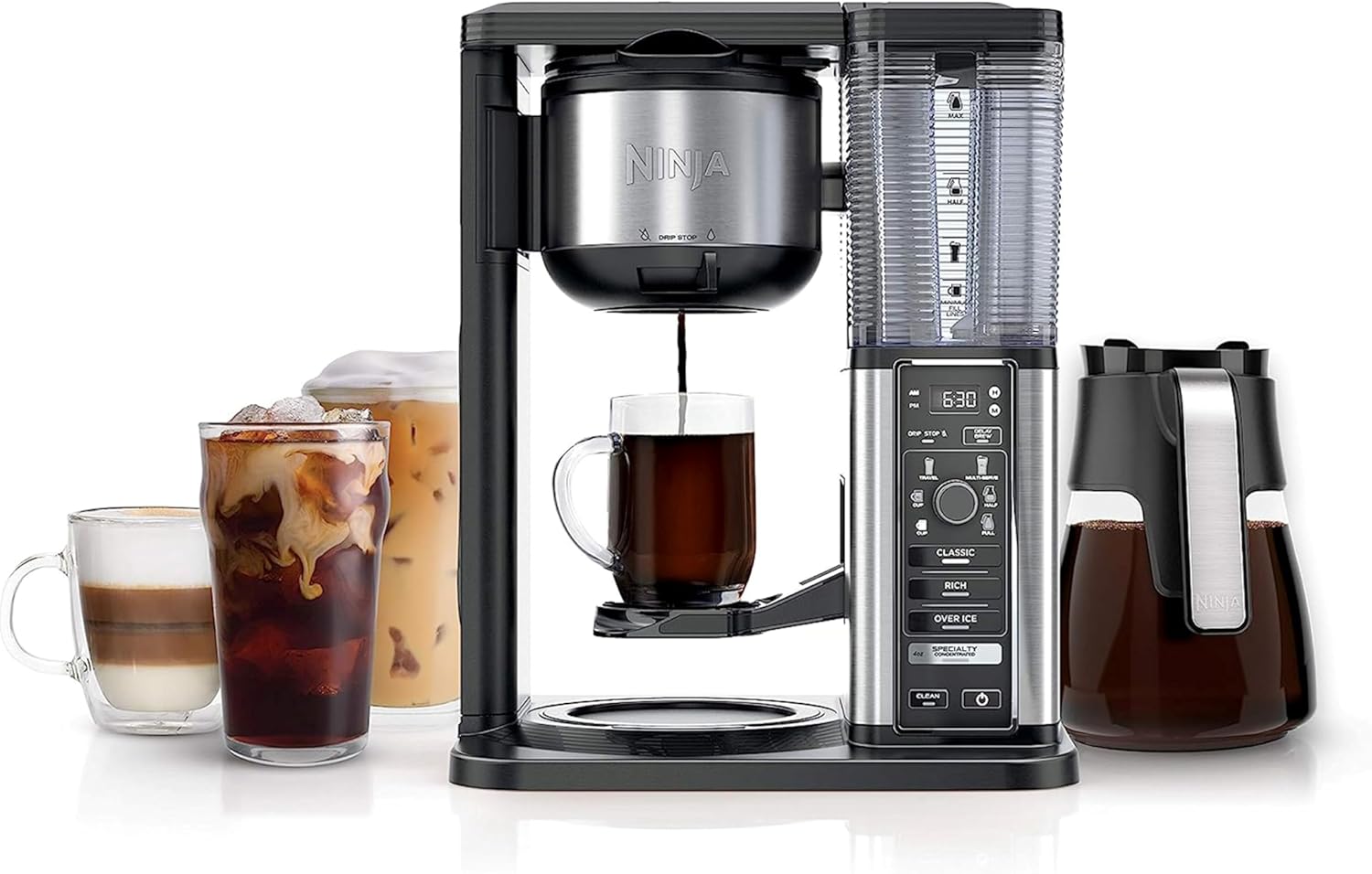
The Ninja CM401 is a versatile drip coffee maker that aims to deliver coffeehouse-style drinks from a countertop machine. It offers four brew styles — Classic, Rich, Over Ice, and Specialty — and six serving sizes ranging from a single cup up to a 50-oz (10-cup) glass carafe, so you can make everything from a travel mug to a full pot. The Specialty Brew setting makes a concentrated extraction useful for lattes and similar drinks, and the built-in fold-away frother handles hot or cold milk and milk alternatives for quick microfoam without a separate tool. Practical touches include a removable 40-oz water reservoir for easy filling, a gold-tone permanent filter and dishwasher-safe parts for straightforward cleaning, and an automatic one-hour shutoff. At 1550 watts it heats quickly but requires standard countertop space. The CM401 is not a commercial-grade espresso machine, so it will not produce the same pressure-based crema or the throughput of a small cafe espresso setup, but it reliably produces consistent drip and specialty-brewed concentrates for varied menus.
Best for: Someone running a small cafe or countertop operation who needs a reliable, multifunction drip brewer that can make both full pots and specialty milk drinks without a separate espresso machine.
Less Ideal for: Businesses that require true espresso shots, heavy continuous commercial throughput, or integrated commercial grinders should consider dedicated commercial espresso equipment instead.
- Multiple brew styles and six size options let you serve single cups to full carafes from one machine
- Specialty Brew produces a concentrated extraction suited to lattes and milk-based drinks
- Built-in fold-away frother creates hot or cold milk froth without extra equipment
- Removable 40-oz water reservoir and many dishwasher-safe parts simplify daily use and cleaning
- Not a pressure espresso machine so it cannot make true espresso or high-volume shots
- Glass carafe and countertop footprint limit placement in very tight or high-traffic back-of-house cafe spaces
Verdict: A dependable countertop brewer that expands a small cafe's menu by producing consistent drip coffee and concentrated specialty brews with built-in frothing in one compact unit.
Cuisinart Perfectemp DCC-3200

| Wattage | 1100 watts |
|---|---|
| Voltage | 120 volts |
| Operation Mode | Fully Automatic |
| Coffee Input Type | Ground Coffee |
| Other Special Features of the Product | Auto Shut-Off, Programmable, Water Filter |
The Cuisinart Perfectemp DCC-3200 is a countertop drip brewer designed to produce hotter, customizable large-batch coffee for everyday use. It offers 24-hour programmability so you can set the brew time in advance, and a strength control to choose regular or bold flavor. The adjustable keep-warm plate lets you select Low, Medium, or High to hold a full glass carafe at a preferred serving temperature, and the included commercial-style gold-tone permanent filter removes the need for paper filters. The backlit LCD, ready tone, and descaling indicator add convenience for regular operation. Practical benefits include simple push-button controls, a large 14-cup capacity for serving multiple customers, and a durable stainless-steel exterior that fits a busy countertop. Limitations are that it is a drip brewer rather than a commercial espresso or high-volume commercial brewer, so it cannot match specialty extraction or very high throughput, and the warming plate can alter flavor if coffee sits too long. For small cafe settings focused on consistent brewed coffee by the cup, it provides reliable, programmable performance with easy maintenance.
Best for: Small cafe operators or managers who need a reliable, programmable large-batch drip brewer that delivers consistent hot coffee with minimal fuss and routine maintenance.
Less Ideal for: Shops that require espresso, milk steaming, or very high throughput should choose commercial espresso machines or dedicated high-volume brewers instead.
- Programmable 24-hour timer for ready-to-serve brewing
- Brew strength control lets you choose regular or bold flavor
- Adjustable warming plate temperature to keep carafe at preferred heat
- Reusable gold-tone permanent filter reduces ongoing consumable costs
- Backlit LCD and descaling indicator simplify daily operation and maintenance
- Not designed for espresso or specialty coffee extraction
- Warming plate can degrade flavor if brewed coffee is held for long periods
Verdict: A dependable programmable 14-cup drip brewer that delivers hot, consistent brewed coffee for small cafe service without complex maintenance.
Keurig K-1550 Single Serve

| Water reservoir | 96 oz |
|---|---|
| Cup sizes | 6, 8, 10, 12 oz |
| Wattage | 1500 watts |
| Compatible pods | K-Cup |
| Operation mode | Fully Automatic |
The Keurig K-1550 is a compact commercial single-serve brewer built for small office or cafe use where convenience and consistency matter. It uses K-Cup pods and offers four preset cup sizes (6, 8, 10, 12 oz.), a STRONG button for bolder flavor, and a Brew Over Ice option for cold beverages. The machine's extra-large 96 oz removable water reservoir reduces refill frequency and the Quiet Brew Technology keeps noise low in shared spaces. Controls are button-based for simple operation and the reusable filter helps lower waste compared with disposable filters. Practical benefits include fast single-cup brewing in under a minute and programmable auto-off to save energy between uses. Limitations to consider are dependence on K-Cup pods rather than ground beans, which affects long-term cost and waste, and a plastic exterior that is serviceable but not premium. The K-1550 suits scenarios that prioritize speed, predictable cups, and minimal training, though buyers wanting full bean grinding or more artisanal extraction should look elsewhere.
Best for: Small cafe or office operators who want a dependable, easy-to-use single-serve brewer that delivers consistent cups quickly with minimal staff training.
Less Ideal for: Specialty coffee shops or baristas who need bean-to-cup brewing, manual control over extraction, or the lowest possible cost per cup.
- Large 96 oz removable water reservoir reduces refill frequency for small commercial use
- Four cup sizes plus STRONG and Brew Over Ice for flexible beverage options
- Button controls and programmable auto-off make operation simple and energy-conscious
- Quiet Brew Technology keeps noise low in shared or customer-facing spaces
- Requires K-Cup pods which raises ongoing cost and produces more single-use waste than ground-bean systems
- Plastic construction is functional but less durable-feeling than metal-bodied commercial brewers
Verdict: Choose the K-1550 when you need a fast, low-effort single-serve commercial brewer that delivers consistent cups and minimizes refills for a small cafe or office.
Choosing the Right Coffee Maker for Small Cafe: Key Factors to Consider
Brew Capacity and Throughput
How many cups or carafes the machine can produce per hour directly affects whether it can handle your typical rushes. A small cafe with several morning peak hours needs a unit that can refill quickly and sustain continuous operation without long cooldowns.
Assess both single-brew batch size and how fast consecutive batches can be produced. Machines with larger boilers or multi-brew heads typically handle higher throughput, while single-group or home-style models may slow staff and create lines.
Consistency and Extraction Control
Consistent extraction is essential for repeatable flavor across dozens of cups each day. Look for devices that offer reliable temperature stability, programmable dose or brew time settings, and even water distribution.
Precision controls let you dial in the taste profile and keep it stable when different staff members operate the machine. Inconsistent temperature or uneven flow leads to variable cups that erode customer trust and increase waste.
Durability and Maintenance Needs
Cafes run machines for many hours daily, so durability and ease of maintenance are key. Consider build materials, warranty and service access, and the frequency of recommended routine tasks like backflushing, descaling, and gasket replacement.
Choose machines with accessible service points and commonly available replacement parts. A model that minimizes daily maintenance time reduces labor overhead and helps avoid service interruptions during busy periods.
Ease of Use and Staff Training
Staff turnover in cafes can be high, so a machine that is intuitive and forgiving shortens training and reduces errors. Look for clear controls, simple cleaning steps, and features that prevent common mistakes such as burn risk or spillage.
Some machines offer programmable presets or automatic sequences that produce consistent results even when an inexperienced team member operates them. Prioritizing usability preserves speed and consistency during peak service.
Footprint and Workflow Integration
Counter space is often limited in small cafes, so the physical footprint and how the machine integrates with workflow matters. Consider where grinders, tamping stations, and pitchers will sit relative to the brewer and how staff will move during peak times.
A compact machine that places controls and ports on the front can reduce unnecessary movement. Ensure the machine's water, drain, and electrical requirements fit your backbar layout without extensive remodeling.
Operating Cost and Consumables
Daily cost includes water, energy use, and consumables such as filters and seals. Machines with higher energy draw or specialty consumables can increase operating expenses over time.
Factor in local utility rates and the expected daily service volume when estimating long-term cost. Also check whether routine parts are industry-standard or proprietary, since proprietary items can raise replacement lead times and expense.
Single-Group Vs Multi-Group Machines
Single-group machines are often more compact and less expensive to run, making them attractive for very small cafes or low-volume counters. They can produce excellent espresso and are easier to maintain, but they limit simultaneous drink preparation when several orders arrive at once.
Multi-group machines add simultaneous brewing capacity, which scales better during peak hours. They require more counter space and power, and typically need more frequent maintenance. Choose based on peak-hour volume and available staff.
- Single-group: smaller footprint, lower energy, limited parallel output
- Multi-group: higher throughput, more space and maintenance needs
Integration With Commercial Grinders and Workflow
A coffee maker is only as fast as the grinder and barista workflow allow. Plan for grinder placement, tamping area, and cup staging. A well-matched grinder with consistent dosing reduces extraction variability and speeds service.
If space is tight, consider whether a compact grinder or a dosing funnel can conserve counter area without slowing output. Also think about how staff will move during rushes to avoid bottlenecks.
- Place grinders adjacent to the machine to minimize movement
- Use dosing and tamping tools that fit your counter layout
Water Quality and Filtration
Water chemistry affects flavor, equipment longevity, and maintenance frequency. Implementing a proper filtration and softening system prevents scale buildup and protects internal components while maintaining desirable extraction.
Work with local water test results to select filtration targets. Better water reduces descaling frequency and preserves consistent cup profiles across the day.
- Test local water hardness before finalizing filtration
- Choose filtration systems sized for daily volume
Cleaning Routines That Fit Shift Schedules
Daily cleaning is nonnegotiable in a foodservice environment, but it must fit into shift rhythms. Establish short, frequent cleaning tasks and a deeper end-of-day regimen so machines remain sanitary without interrupting service.
Standardize steps and document them where staff can follow quickly. Regular light cleaning prevents the need for lengthy shutdowns and reduces the risk of flavor contamination.
- Schedule quick mid-shift wipes and portafilter rinses
- Reserve descaling and gasket checks for quieter periods
Scaling Up: When to Consider Commercial Service Plans
As volume grows, a service plan can be a practical safeguard against downtime. Routine professional maintenance catches wear early and keeps machines operating at peak efficiency.
Evaluate service offerings for response time, availability of common spare parts, and recommended maintenance intervals. A predictable maintenance schedule helps budget for upkeep and avoids surprise closures.
- Look for plans that include preventive maintenance visits
- Confirm availability of commonly replaced parts locally
How We Chose the Best Coffee Maker for Small Cafe
We focused on features and real-world attributes that directly affect a small-cafe operation. Key evaluation criteria included brewing capacity and throughput to match expected customer volume, consistency and extraction control to protect flavor across back-to-back brews, durability and serviceability for long shifts and daily wear, and ease of use and training to speed staff onboarding. We also considered energy efficiency and daily operating cost, plus compatibility with commercial filtration and water-treatment best practices. Units that required specialized or rare consumables were deprioritized. We excluded machines designed only for home use or single-cup novelty units that cannot sustain repeated commercial cycles. Entries that made the list demonstrate a balance of speed, consistent brew quality, and manageable maintenance requirements for small cafes.
Our full evaluation process is outlined in our review methodology.
FAQ
How much daily output should I expect from a small-cafe coffee maker?
Expect widely varying output depending on the machine type. Smaller single-group brewers can handle steady moderate demand, while multi-group or commercial brewers produce many more shots per hour. Match expected peak-hour orders to a machine's stated throughput.
How often should I descale or service a cafe machine?
Frequency depends on water hardness and daily volume. In hard-water conditions, descaling may be needed every few months. Regular daily cleaning plus a scheduled preventive maintenance check every 6 to 12 months helps avoid major failures.
Can I use a home-style coffee maker in a small cafe?
Home-style machines are generally not designed for continuous commercial cycles and may fail prematurely under cafe-level use. They can work in very low-volume setups, but prioritize commercial-rated equipment for sustained daily service.
What role does water filtration play in cafe espresso quality?
Water filtration is critical. Properly treated water preserves flavor clarity and protects internal components from scale. Filtration that balances mineral content helps achieve consistent extraction and reduces maintenance needs.
How do I choose the right machine if my menu includes both brewed coffee and espresso?
Decide which product will drive peak demand. If brewed coffee dominates, prioritize high-capacity brewers or batch systems. If espresso-based drinks are primary, invest in a machine with the throughput and control to handle back-to-back espresso orders while coordinating grinder capacity.
Final Verdict
Prioritize throughput, consistency, and serviceability when selecting a coffee maker for a small cafe. Align the machine's capacity with your peak-hour demand, and choose controls that deliver repeatable extraction with minimal staff training. Factor in water treatment and routine maintenance to protect investment and flavor. Balancing these tradeoffs will help you select a machine that keeps lines moving, preserves cup quality, and minimizes unexpected downtime. Focus on the criteria that match your service model and staffing to make a confident choice.