
Note: This article contains affiliate links. If you click on these links and make a purchase, we may earn a small commission at no extra cost to you. This helps support our research and content. Read our full affiliate disclosure here.
If you prefer coffee without plastic touching the water path, picking the right coffee maker matters for both flavor and peace of mind. Appliances labeled or designed to minimize plastic contact reduce the risk of taste transfer and exposure to heat-related plastic compounds. This guide highlights seven shortlisted coffee makers that prioritize no-plastic contact where it matters most: the water reservoir, brew basket, and carafe interface. Below we summarize how each option performs on material quality, brew consistency, and upkeep so you can pick the machine that fits your routine. Read on for the evaluation criteria and practical buying advice before the product list.
Top Picks at a Glance
| Best Overall The best all-around choice for most situations | Chemex Glass Handle 6-Cup |  |
| Best Quality Built to a higher standard if you want something more solid | Simply Good Coffee The Brewer |  |
| Best Value The sweet spot between price and what you get | APOXCON Electric Coffee Percolator GM-2 |  |
| Best Budget The cheapest option that still gets the job done reliably | KingCamp Percolator Coffee Pot |  |
| Top Rated A top-rated pick with lots of positive feedback | Ziruma Stainless Steel French Press |  |
| Most Popular A crowd favorite that many people choose with confidence | COLETTI Bozeman Percolator 9-Cup |  |
| Best Seller A high-volume bestseller chosen again and again | Veken French Press 34oz |  |
Chemex Glass Handle 6-Cup

| Capacity | 6 cups |
|---|---|
| Material | Borosilicate Glass |
| Filter Type | Reusable/Compatible with Chemex bonded filters |
| Operation Mode | Manual |
The Chemex Glass Handle 6-Cup is a simple, manual pour-over brewer built from non-porous borosilicate glass that produces clean, sediment-free coffee when used with Chemex bonded paper filters. You brew by placing a folded filter in the top cone, adding medium-coarse grounds, pouring hot water in controlled pulses, and letting the carafe collect brewed coffee below. Its all-glass construction and glass handle keep the brew free of plastic contact points and preserve delicate flavors, and the wide mouth lets you pour and clean easily; the carafe is dishwasher-safe for periodic cleanup. Because it is manual, the Chemex puts extraction control in your hands but requires a kettle and some technique to hit consistent results, and the proprietary bonded filters (not included) are recommended to get the trademark bright, low-oil cup. The 6-cup size suits couples or small households, but if you need single-cup convenience or very large batch brewing you will want a different format. For buyers focused on pure flavor and a plastic-free brew path, this is a straightforward, durable option.
Best for: A buyer who values a plastic-free brewing path and clean, clarified coffee and is willing to brew manually for flavor control and ritual.
Less Ideal for: People who want one-touch convenience, automatic temperature control, or very fast single-cup brewing should consider other formats.
- All-borosilicate glass construction keeps coffee free of plastic contact
- Uses bonded paper filters that reduce oils and sediment for a clean cup
- Dishwasher-safe glass simplifies occasional deep cleaning
- Glass handle provides a seamless, plastic-free grip and pouring control
- Requires a separate kettle and manual pouring skill for consistent results
- Filters are not included and specific Chemex filter shapes are recommended
Verdict: Choose this all-glass Chemex if you want a plastic-free, manual pour-over that delivers a clean, flavorful cup and stands up to long-term use.
Simply Good Coffee The Brewer

| Capacity | 8 cups |
|---|---|
| Wattage | 1560 watts |
| Coffee Input Type | Ground |
| Operation Mode | Fully Automatic |
The Brewer is a plugged-in automatic pour-over brewer that avoids plastic contact with water and focuses on brewing at gold‑cup temperatures to extract richer flavor. It heats water to the 195°F–205°F range and produces up to 8 cups in about six minutes, using a glass carafe and stainless steel body with a hot plate to keep coffee warm. Operation is simple: one-button brewing plus an optional Bloom mode to pre-wet grounds for improved saturation and taste. Removable parts and a glass carafe make cleanup straightforward, and the unit includes a #4 cone filter size and an auto shutoff for safety. Downsides are modest: the machine is not intended for single-serve convenience and takes counter space typical of 8-cup makers, and the hot plate can gradually darken flavor if coffee is left for long periods. For buyers prioritizing extraction quality without any plastic touching the brew path, this brewer delivers a near pour-over profile with easy operation.
Best for: Buyers who want better extraction and a true pour-over style cup without any plastic touching the brew, and who prioritize flavor and consistent temperature control over single-serve convenience.
Less Ideal for: If you need a portable or single-cup machine or want very rapid, on-demand single servings, this full-size 8-cup brewer is not the best choice.
- Plastic-free water path and stainless steel exterior reduce off-flavors and contact with plastics.
- Heats to 195°F–205°F for optimal extraction and offers a Bloom option for better saturation.
- Brews up to 8 cups in about six minutes, suitable for households or small offices.
- Simple one-button operation and removable parts make brewing and cleaning easy.
- Includes a hot plate to keep brewed coffee warm and an auto shut-off for safety.
- Not optimized for single-cup or travel use since it brews a full 8-cup carafe.
- Keeping coffee on the hot plate for extended periods may affect taste.
- Larger footprint compared with compact single-serve brewers.
Verdict: If you want a plastic-free automatic brewer that prioritizes correct brewing temperature and pour-over style extraction for fuller flavor, this is a top pick.
APOXCON Electric Coffee Percolator GM-2

| Capacity | 12 cups |
|---|---|
| Wattage | 950 watts |
| Power Source | Electric |
| Filter Type | Permanent |
| Voltage | 120 volts |
The APOXCON GM-2 is a stainless steel electric percolator designed to make robust, full-bodied coffee for groups or long mornings. You add ground coffee to the basket, fill the pot with water, flip the simple on/off switch and watch extraction through the clear glass knob as hot water cycles through the grounds. It finishes automatically and drops to a keep-warm mode so coffee stays drinkable without reheating. The interior is entirely stainless steel so no aluminum or plastic contacts the brew, and the permanent filter removes the need for disposable paper filters if you prefer. The detachable base lets you pour cord-free, and the cool-touch handle and indicator lights make tabletop service straightforward. Expect percolated coffee to be stronger than drip and slightly more astringent if over-brewed, and the unit lacks programmable timers or temperature controls found on higher-end machines. Its strengths are durability and no-plastic contact with beverage, while its simplicity means fewer automation features.
Best for: Buyers who prioritize durable, low-maintenance coffee gear that avoids plastic contact and want a simple, visible brewing process for making multiple cups.
Less Ideal for: If you want precise temperature control, a programmable schedule, or drip-style milder coffee you should consider other coffeemaker types.
- All interior surfaces are stainless steel so coffee does not touch aluminum or plastic
- Clear glass brew knob lets you monitor extraction to adjust strength
- Automatic keep-warm mode preserves temperature after brewing
- Detachable cordless base and cool-touch handle for easy pouring and serving
- No programmable timer, adjustable temperature, or brew strength settings
- Percolator-style brewing tends to produce stronger, sometimes more astringent coffee compared with drip
Verdict: A solid no-plastic percolator that delivers large-batch, stainless-steel brewing with a visible brew knob and simple keep-warm convenience.
KingCamp Percolator Coffee Pot

| Coffee Maker Type | Percolator |
|---|---|
| Capacity | 2 liters |
| Material | Stainless Steel |
| Recommended Uses For Product | Camping, Hiking, Backpacking, Picnic |
| Operation Mode | Manual |
The KingCamp Percolator Coffee Pot is a simple, all-stainless-steel camp coffee maker that brews by percolation over a camp stove or open flame. You fill the lower chamber with water, add ground coffee to the internal filter basket, and heat until the water cycles through the grounds to make coffee for up to about three people. Notable features include 304 stainless steel construction for corrosion resistance, a wood handle and insulated glass knob that stay comfortable to grip, and a hanging hook that lets you suspend the pot over a fire. The internal stainless filter holder helps keep fine grounds out of the cup without needing disposable paper filters. Because it is manual and metal-only, it heats quickly and is easy to clean, but it requires attention while brewing to avoid over-extraction and can be splashy when pouring from the pointed spout. This is a straightforward, durable option for outdoor use when you want a plastic-free brewing solution and do not need electric or automatic features.
Best for: Buyers who prioritize an affordable, plastic-free camp coffee maker that is rugged and simple to use for small-group outdoor trips.
Less Ideal for: Those who want automatic, temperature-controlled, or single-cup home brewing should look at electric or drip options instead.
- 304 stainless steel construction resists rust and speeds heating
- Includes internal stainless filter holder to reduce grounds without paper filters
- Wood handle and insulated glass knob improve handling when hot
- Hanging hook lets you suspend the pot over open flames or campfires
- 2 liter (9-cup) capacity serves multiple people on a trip
- Manual percolator requires active monitoring to avoid bitter over-extraction
- No electric or automatic controls for precise temperature or timing
- May let small grounds through if very finely ground coffee is used
Verdict: A durable, no-plastic stainless steel percolator that delivers simple, camp-ready coffee for budget-conscious outdoor cooks.
Ziruma Stainless Steel French Press
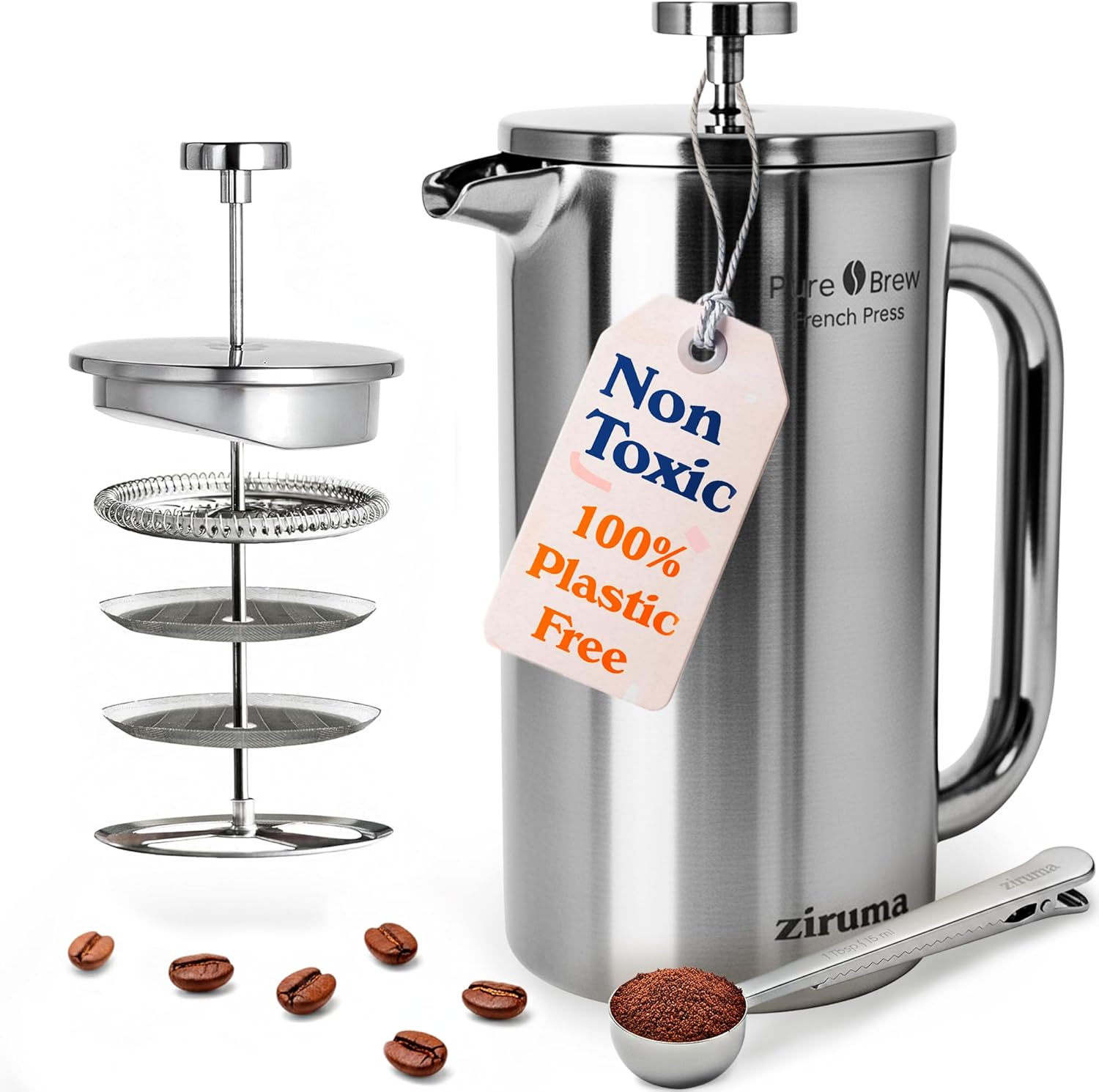
| Capacity | 1000 ml |
|---|---|
| Material | Stainless Steel |
| Filter Type | Reusable |
| Operation Mode | Manual |
The Ziruma Stainless Steel French Press is a fully metal, 34 oz manual brewer aimed at buyers who want a durable, non-plastic way to make French-press coffee. It brews by steeping grounds and pressing with a precision 4-layer filter that reduces fine grit, producing a cleaner cup than single-screen presses. The double-wall insulated body keeps coffee hot longer while staying cool to the touch, and built-in measurement marks plus a supplied spoon make dosing straightforward. Because it uses 316 surgical-grade stainless steel throughout, there are no plastic lids or components that can degrade with heat, which also makes it rugged for camping or travel. It is dishwasher safe for easy cleanup, though the metal construction means it is heavier than glass/plastic options and the plunger assembly may need occasional disassembly to clean between filter layers. This press favors long-term reliability and cleaner extraction over compactness or ultra-light travel performance.
Best for: Buyers prioritizing long-term reliability and a plastic-free brewing setup who want a robust, travel-capable French press that keeps coffee hot.
Less Ideal for: Those who need the lightest possible camping gear or a budget glass press for occasional home use should consider simpler, lighter alternatives.
- Fully stainless steel construction with no plastic parts for reduced chemical exposure and improved durability
- Double-wall insulation maintains beverage temperature while keeping exterior cool
- Four-layer reusable filter reduces fine grounds for a smoother cup
- Dishwasher safe for easier cleaning and maintenance
- Heavier than glass or plastic presses, which may be noticeable for ultralight travel
- Multi-layer filter assembly can require more careful cleaning to avoid trapped grounds
Verdict: Choose this press if you want a durable, fully plastic-free stainless steel brewer that delivers hotter, cleaner French-press coffee over the long run.
COLETTI Bozeman Percolator 9-Cup

| Coffee Maker Type | Percolator |
|---|---|
| Capacity | 9 cups |
| Filter Type | Reusable |
| Power Source | manual |
| Operation Mode | Manual |
The COLETTI Bozeman is a rugged stainless steel percolator built for stovetop and camping use that brews up to nine cups of coffee via manual percolation. You fill the chamber with water, add grounds to the reusable filter basket, and place it on a camp stove or standard gas/electric burner to watch coffee collect under the glass view top. Its all-stainless construction and included glass top avoid plastic contact with hot liquid, and the reusable filter plus dishwasher-safe parts make cleanup straightforward at home or on the trail. The design emphasizes simple, bold coffee rather than precision control, so expect a full-bodied, sometimes stronger cup compared with drip machines. It does not work on induction cooktops, and metal parts become hot during brewing, so a handle or mitt is required. For buyers prioritizing durable, plastic-free brewing for travel or outdoor use, this percolator delivers reliable performance, though it lacks the finer temperature control and convenience of electric brewers or induction-ready models.
Best for: Buyers who value durable, plastic-free brewing for camping, travel, or simple stovetop use and who prefer gear with strong social proof and a proven track record.
Less Ideal for: People who need induction compatibility, precise temperature control, or automated brewing and scheduling features.
- All-stainless-steel construction with no plastic or aluminum in contact with brew
- Glass view top lets you monitor percolation and extraction
- Dishwasher-safe components for easier cleaning after camping
- Includes reusable filter and extra filter pack to reduce waste
- Stovetop-ready design made for outdoor and off-grid use
- Not compatible with induction cooktops
- Manual percolation gives less temperature control than electric brewers
Verdict: If you want a rugged, plastic-free stovetop percolator that reliably produces bold coffee for camping or home use, the COLETTI Bozeman is a solid choice.
Veken French Press 34oz

| Capacity | 34 Ounce/1 Liter |
|---|---|
| Material | Borosilicate Glass; Stainless Steel; Silicone |
| Filter Type | Reusable 4-Level Stainless Steel |
| Included Components | French Press, Measuring Scoop, User Manual |
The Veken French Press is a manual 34oz coffee brewer built to avoid plastic contact with your coffee by using 304 stainless steel and food-grade silicone where needed and a thick borosilicate glass carafe that tolerates thermal shock. It brews with a four-level stainless steel filtration system—spiral plate, cross plate and two fine meshes—so you get a clearer, less gritty cup compared with single-screen presses. Use it for hot coffee, cold brew or loose-leaf tea; ounce markings and the included scoop make consistent dosing straightforward for beginners. The carafe disassembles for cleaning and many parts are easy to rinse, though the glass body is breakable and requires careful handling and storage. The design is compact enough for travel or the office and the copper finish gives it a modern look, but if you want something virtually indestructible or dishwasher-only convenience you may prefer an all-stainless or fully dishwasher-safe model.
Best for: Buyers who prioritize avoiding plastic in contact with their coffee and want a reliable manual brewer that makes cleaner French-press cups without complicated controls.
Less Ideal for: Those who need an indestructible travel mug-style brewer or want a fully dishwasher-safe, carefree appliance for frequent automatic cleaning.
- No plastic touching brewing surfaces thanks to 304 stainless steel and food-grade silicone components
- Four-layer stainless steel filtration reduces fine sediment for a cleaner cup
- Thick borosilicate glass carafe resists thermal shock and shows brew level markings
- Includes measuring scoop and is straightforward to disassemble for cleaning
- Glass carafe can break if dropped or knocked
- Not all components may be dishwasher friendly despite marketing claims depending on dishwasher layout
Verdict: A plastic-free, well-filtering 34oz French press for buyers who want clearer, chemical-free brewed coffee with simple manual operation.
Choosing the Right Coffee Maker No Plastic: Key Factors to Consider
Material of the Water Path
The material that contacts hot water during brewing has the biggest effect on both flavor and potential chemical exposure. Stainless steel, glass, and ceramic are preferred because they are inert, do not leach flavors, and tolerate repeated heating. Food-grade silicone is acceptable for seals and gaskets, but avoid machines where hot water flows through molded, non-food-grade plastics.
When assessing a machine, look for manufacturer statements about unlined metal boilers or glass-lined reservoirs. If those details are unavailable, consider machines with simple, user-serviceable parts so you can inspect and replace questionable components.
Brew Temperature and Stability
Consistent brew temperature is critical for extraction and flavor. Machines that hold water and deliver it at an appropriate range produce more balanced cups regardless of materials. The presence of metal components in the heating and delivery system generally helps stabilize temperature compared with thin plastic parts that lose heat quickly.
Check for features that promote thermal stability such as insulated metal boilers, thermal carafes with glass-lined pour-through paths, or pre-infusion steps that stabilize water temperature before contact with grounds.
Contact Points and User Safety
Even if the water path is mostly metal or glass, there are often small contact points like lids, drip stops, or filter baskets that touch hot liquid. Prioritize machines where those interfaces are metal, glass, or replaceable food-grade silicone. Consider how easy it is to access and inspect those parts to ensure seals and gaskets remain intact and safe over time.
Also think about ergonomics and heat management. Metal handles, insulated carafes, or heat-shielded surfaces reduce the temptation to touch hot plastic and lower burn risk.
Ease of Maintenance and Cleaning
Machines with fewer hidden channels and removable components are easier to keep free of scale, residue, and bacterial buildup. Glass carafes and stainless-steel reservoirs are straightforward to clean and inspect, whereas integrated, sealed plastic tanks can hide deposits.
Regular descaling frequency depends on water hardness and machine design. Choose a unit with clear service instructions, accessible internal parts, and replacement components so long-term upkeep does not introduce plastic compromises when repairs are needed.
Extraction Performance and Brew Volume Flexibility
No-plastic construction should not come at the cost of brewing performance. The ability to extract evenly across different brew volumes matters if you switch between single cups and larger pots. Look for machines with adjustable flow rates, even pour distribution, or manual brew controls that maintain extraction quality.
For households that brew multiple pot sizes, ensure the machine maintains temperature and flow across its range without resorting to plastic bypasses or shortcut channels.
Long-Term Durability and Serviceability
Metal and glass components typically resist wear better than many plastics, but longevity depends on design quality and availability of replacement parts. Machines designed with replaceable gaskets, user-serviceable heating elements, and straightforward disassembly give you options to maintain a no-plastic water path over time.
Avoid designs that require entire sealed module replacement when a single gasket fails. A product that is easy to repair helps preserve material integrity and reduces the risk that you will end up using plastic-repaired workarounds.
Why No-Plastic Brewing Changes Flavor
Plastic exposed to hot water can impart off-notes or a faint plastic aroma, especially when new or when heated repeatedly. By eliminating plastic contact in the water path you reduce the risk of these sensory defects and get a cleaner expression of the coffee beans.
Materials such as stainless steel, glass, and ceramic do not react with water or coffee compounds, so acids and aromatics remain unaltered. That is particularly noticeable with light roasts and single-origin beans where subtle flavors matter more.
- Inert materials preserve volatile aromatics
- Less temperature fluctuation from metal or glass components
- Fewer off-flavors from new or degraded plastics
Practical Upkeep for No-Plastic Machines
A no-plastic machine still needs routine care. Descale according to local water hardness and follow manufacturer instructions for cleaning removable parts. Glass carafes and stainless-steel reservoirs are easier to inspect and scrub than enclosed plastic tanks.
Keep spare gaskets and seals on hand if they are made from silicone; they are wear items and inexpensive to replace. Regular maintenance preserves both material safety and brew quality.
- Descale frequency depends on water hardness
- Inspect seals and gaskets every few months
- Use non-abrasive cleaners for glass and stainless steel
How to Verify Manufacturer Material Claims
Look for explicit statements about unlined metal boilers, glass-lined reservoirs, or food-grade materials in the water path. Product literature, spec sheets, and exploded-part diagrams often reveal which components contact hot water.
If documentation is vague, prioritize machines with visible, removable reservoirs or serviceable parts you can inspect. Contacting customer support for clarification on specific components can help when the specs are unclear.
- Check technical drawings or part lists for material callouts
- Prefer user-removable parts for visual inspection
- Ask about food-grade certifications for seals and gaskets
Balancing Speed, Noise, and Material Goals
Faster brew cycles and quiet operation often come from design choices that may or may not involve plastic. Metal boilers and glass-lined paths can be slightly slower to heat but tend to hold temperature better. Decide which tradeoff matters more for your routine.
If you brew multiple times per day, a machine with an insulated metal thermal system will reduce temperature swings even if it requires a short initial heat-up period.
- Metal-lined systems provide thermal inertia
- Quiet pumps can exist in metal-bodied machines
- Consider heat-up time versus steady-state performance
Accessory Choices and Avoiding Hidden Plastic
Accessories such as water pitchers, measuring scoops, and replacement filters can reintroduce plastic contact if not chosen carefully. Opt for glass or stainless accessories when possible, and inspect replacement parts for material details.
If a filter holder or basket is plastic, check whether it contacts hot water directly. Some machines use plastic baskets only for cold-fill functions, which may be less of a concern but still worth noting for a fully no-plastic setup.
- Use glass or stainless water jugs for refills
- Choose metal or ceramic filters when available
- Keep documentation for replacement part materials
How We Chose the Best Coffee Maker No Plastic
Our shortlist focused on machines that minimize or eliminate plastic in the water path and key user-contact areas while still delivering consistent extraction and reasonable upkeep. We prioritized construction materials, such as stainless steel, glass, ceramic, and food-safe silicone as acceptable alternatives. Performance metrics included measured brew temperature stability, extraction consistency across brew sizes, and the ability to hold brew temperature without plastic-lined components. We also evaluated ease of cleaning and routine maintenance requirements, including access to internal water channels and how straightforward it is to descale or remove parts. Durability and build quality were next-level filters: we preferred designs with replaceable gaskets and accessible service points over sealed, disposable assemblies. Noise and speed were considered but weighted lower than material safety and brew fidelity. We excluded machines that relied on internal plastic-lined boilers or had unavoidable plastic contact with hot water. Also excluded were single-use capsule systems where the water contacts plastic or aluminum capsules. The final picks balance material safety, consistent brewing, and practical upkeep for daily use.
Our full evaluation process is outlined in our review methodology.
FAQ
Is completely plastic-free brewing realistic for home coffee makers?
Completely plastic-free setups are possible but uncommon. Many machines eliminate plastic in the water path and replace it with stainless steel or glass, while still using small silicone seals. Fully mechanical pour-over or all-glass systems are the most straightforward way to avoid plastic entirely.
Do metal boilers affect coffee taste compared with plastic-lined systems?
Metal boilers are inert and do not impart plastic-like off-flavors. They also help stabilize temperature, which can improve extraction and flavor clarity. Taste differences are usually positive when plastic contact is removed, especially for delicate beans.
How often should I descale a no-plastic coffee maker?
Descale frequency depends on local water hardness and usage, but a typical interval is every 2 to 3 months for moderate use. Machines with visible reservoirs and removable parts are easier to descale thoroughly, which helps preserve material integrity and extract quality.
Are silicone seals safe in hot water systems?
Food-grade silicone is widely used for seals and gaskets because it tolerates heat without leaching noticeable flavors. When possible, verify that seals are specified as food-grade silicone and replace them at signs of wear to maintain a safe water path.
Can I retrofit my current machine to reduce plastic contact?
In some cases you can replace plastic carafes with glass or use external stainless reservoirs for refill water. However, internal plastic-lined boilers and concealed channels are difficult to modify, so retrofits are most feasible for machines with removable components.
Final Verdict
Prioritize the material of the water path and the machine's serviceability when choosing a coffee maker with minimal plastic contact. Stainless steel, glass, and ceramic parts reduce flavor transfer and chemical exposure while supporting stable temperatures for better extraction. Balance those material priorities with ease of cleaning and repairability so the machine remains safe and consistent over years of use. Ultimately, decide which tradeoffs you accept around heat-up time, accessories, and routine maintenance. A well-chosen no-plastic coffee maker delivers cleaner cups and a more durable appliance experience when you focus on materials, temperature control, and serviceability.