
Note: This article contains affiliate links. If you click on these links and make a purchase, we may earn a small commission at no extra cost to you. This helps support our research and content. Read our full affiliate disclosure here.
If you want café-style drinks without the counter circus, a coffee maker that pairs an integrated bean grinder with a built-in milk frother can save time and space. These combination machines grind fresh beans, brew at the right temperatures, and texture milk for lattes, cappuccinos, and milk-forward coffees so you get richer flavor and better crema than preground machines. This guide shortlists the top options for home kitchens and evaluates them on key practical criteria like grind quality, brew consistency, milk froth performance, ease of cleaning, and daily reliability. Read on to find the features that matter for your routine and which configurations fit different morning habits and kitchen footprints.
Top Picks at a Glance
| Best Overall The best all-around choice for most situations | Breville Barista Express BES870XL |  |
| Best Quality Built to a higher standard if you want something more solid | Philips 3300 Series EP3326/90 |  |
| Best Value The sweet spot between price and what you get | Gevi Espresso Machine with Grinder |  |
| Best Budget The cheapest option that still gets the job done reliably | Garvee CM5020B Espresso Machine |  |
| Top Rated A top-rated pick with lots of positive feedback | Gevi Espresso Machine ECMI0-SS0A1 |  |
| Most Popular A crowd favorite that many people choose with confidence | Philips 3200 Series EP3241/54 |  |
| Best Seller A high-volume bestseller chosen again and again | Ninja Luxe Café Premier ES601 |  |
Breville Barista Express BES870XL

| Wattage | 1600 watts |
|---|---|
| Voltage | 120 |
| Coffee Input Type | whole_beans |
| Filter Type | Reusable |
| Capacity | 1 cups |
The Breville Barista Express BES870XL combines a built‑in conical burr grinder and a 54mm portafilter to take whole beans to espresso in one unit, with low‑pressure preinfusion and PID temperature control to help extract balanced shots. Typical use is hands‑on: you grind directly into the portafilter, tamp (an integrated tamper is included), pull single or double shots, then texture milk with the steam wand for lattes or cappuccinos. Notable features include 16 grind settings, single and dual wall filter baskets for dosing flexibility, and a thermocoil heating system that keeps water temperature stable. Practical benefits are fresher flavor from on‑demand grinding and the ability to learn manual barista skills while still getting consistent results thanks to dose control and temperature regulation. Trade‑offs are that it requires some user technique and routine cleaning, and it is not a fully automatic or touchscreen model so it demands manual tamping and milk texturing for best results.
Best for: Home coffee lovers who want café-quality espresso and milk drinks and are willing to learn hands‑on techniques to control grind, dose, and milk texture.
Less Ideal for: People who prefer fully automatic one‑touch drink programs or a completely hands‑off experience should consider automatic machines instead.
- Integrated conical burr grinder with 16 grind settings for fresh, dose-controlled grinding
- Thermocoil PID temperature control for more consistent extraction
- Powerful steam wand for manual milk texturing and latte art
- Includes useful accessories such as tamper, razor dose trimming tool, and multiple filter baskets
- Requires manual tamping and practice to achieve optimal shots and microfoam
- Needs regular cleaning and maintenance to keep grinder and group head performing well
Verdict: Buy this if you want a single machine that grinds, doses, and steams so you can craft café-quality espresso and milk drinks at home while learning barista techniques.
Philips 3300 Series EP3326/90
| Operation Mode | Fully Automatic |
|---|---|
| Output Pressure | 15 bar |
| Wattage | 1500 watts |
| Coffee Input Type | coffee_beans |
| Filter Type | AquaClean |
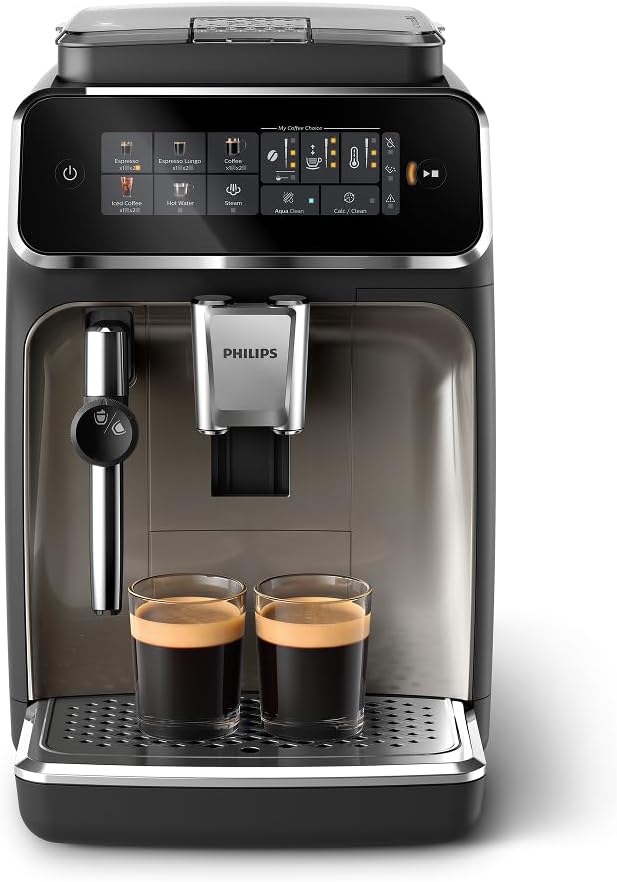
The Philips 3300 Series EP3326/90 is a fully automatic bean-to-cup espresso machine that grinds, tamps and brews at the touch of the display and adds milk via a classic milk frother for lattes and cappuccinos. It offers five hot and iced presets so you can make espresso, regular coffee, lungo, iced coffee or hot water without manual programming, and the touchscreen lets you adjust strength and volume for repeatable results. Practical features for daily use include an integrated grinder, a removable brew group for cleaning, an AquaClean water filter that stretches time between descaling cycles, and SilentBrew technology that cuts brew noise compared with older models. The machine runs at 15 bar output pressure and 1500 watts, so extraction and heat-up are quick, but it is a countertop appliance with a mid-size water tank so it works best for households rather than heavy commercial use. If you want hands-off, cafe-style drinks with easy milk steaming and predictable one-touch routines, this model delivers; if you need a machine for very high-volume or fully automatic milk texturing, a prosumer unit might be a better fit.
Best for: Buyers who prioritize café-style drinks at home and want a mostly hands-off bean-to-cup workflow with reliable extraction and simple milk steaming.
Less Ideal for: People who need a heavy-duty, commercial-capacity machine or fully automated milk texturing for high volumes or advanced latte art.
- Integrated grinder and one-touch brewing for true bean-to-cup convenience
- Classic milk frother that steams and froths milk and plant-based alternatives
- AquaClean filter reduces the need for frequent descaling
- Touchscreen controls and adjustable strength/volume for repeatable recipes
- SilentBrew technology lowers operating noise during grinding and brewing
- Not designed for very high-volume commercial use due to mid-size tank and home-oriented capacity
- Milk frother is a classic steam wand rather than an automated milk carafe for latte art consistency
Verdict: A convenient fully automatic bean-to-cup espresso machine that delivers one-touch hot and iced coffee with built-in grinding and easy milk frothing for home users seeking café-quality drinks.
Gevi Espresso Machine with Grinder

| Output Pressure | 20 bar |
|---|---|
| Wattage | 1350 watts |
| Operation Mode | Fully Automatic |
| Coffee Input Type | whole_beans |
| Capacity | 1 liters |
This Gevi combo brings a 20-bar semi-automatic espresso machine together with a conical burr grinder, letting you grind whole beans and pull espresso in one compact unit. It is typically used to make single or double shots and milk-based drinks like cappuccinos and lattes, using the touchscreen controls, removable water tank, and included 51mm portafilter and filters. Notable features include a built-in grinder with 35 grind settings for fine-tuning extraction, a steam wand and removable froth nozzle for microfoam, a cup warming plate, and a removable drip tray for taller cups. Practical benefits are convenience and reduced counter clutter since the grinder and brewer are paired, plus easy cleaning of the tank and drip tray. Limitations are that it is a semi-automatic machine so some puck preparation and tamping are needed, the 1 liter water capacity means frequent refills for heavier use, and advanced users may prefer larger commercial portafilters and more precise temperature control. The unit is a solid choice for daily home espresso and steamed milk drinks when space and convenience matter.
Best for: A practical buyer who wants an all-in-one countertop espresso setup that saves space and combines grinder plus milk frothing for everyday café-style drinks.
Less Ideal for: Not suited for users wanting fully automatic one-touch specialty drinks or commercial-scale brewing for large households or offices.
- Integrated conical burr grinder with 35 grind settings for customization
- 20 bar pump pressure for consistent extraction
- Steam wand and removable froth nozzle for cappuccinos and lattes
- Removable water tank and drip tray for easier refills and cleaning
- Includes portafilter, filters, tamper, and basic accessories to start brewing immediately
- 1 liter water tank requires frequent refills for several daily drinks
- Semi-automatic workflow requires manual tamping and some user skill
Verdict: A space-efficient grinder-plus-espresso machine that lets practical home users grind, pull, and froth café-style drinks without separate equipment.
Garvee CM5020B Espresso Machine

| Capacity | 2.8 liters |
|---|---|
| Power | 1450W |
| Pump Pressure | 20 BAR |
| Grind Settings | 0–30 coarseness levels |
The Garvee CM5020B combines an integrated cone grinder, 20-bar Italian pump, and a steam wand into one countertop unit aimed at home baristas. You grind beans straight into the portafilter using 30 coarseness settings, set single or double shot volumes, and extract espresso with adjustable strength; the 1450W motor and high-pressure pump help produce visible crema. A removable 2.8L water tank and detachable drip tray simplify refills and cleaning, while the steam wand steams and froths milk for lattes and cappuccinos. Practical benefits include fresh-ground shots without a separate grinder and broad grind control that lets you experiment with extraction. Important limitations are typical for combo machines: learning the right grind/volume combos takes time, the built-in grinder and pump are not at professional café grade, and build quality is average compared with higher-end machines. For someone trading up from pods or basic drip coffee, it delivers far more control at a modest price, but users seeking café-level durability or ultra-quiet grinding should consider pricier alternatives.
Best for: Buyers who want a single, budget-friendly machine that grinds beans and froths milk so they can make espresso-based drinks at home without buying separate appliances.
Less Ideal for: People who need café-grade reliability, near-silent operation, or a premium commercial grinder should look at higher-tier machines instead.
- Integrated 30-step grinder lets you grind directly into the portafilter for fresh shots
- 20-bar pump and 1450W motor that produce consistent pressure and visible crema
- Removable 2.8L water tank and detachable drip tray make refilling and cleaning easier
- Steam wand included for milk frothing and classic espresso-based drinks
- Built-in grinder and pump are functional but not as durable or quiet as higher-end commercial components
- Requires tuning of grind and shot volume to achieve optimal results, which has a learning curve
Verdict: A budget-oriented all-in-one that delivers fresh-ground espresso and milk frothing in a single unit, making it a strong value pick for home baristas upgrading from basic brewers.
Gevi Espresso Machine ECMI0-SS0A1

| Output Pressure | 20 bar |
|---|---|
| Wattage | 1450 watts |
| Operation Mode | Semi-Automatic |
| Coffee Input Type | GROUND_COFFEE |
| Capacity | 2.3 liters |
The Gevi Espresso Machine combines a built-in conical burr grinder with a 20-bar pump and a steam wand to produce espresso-based drinks at home. You grind directly into the portafilter using one of 0–30 grind settings, choose single or double-shot volumes, and the machine maintains brew and steam temperatures with NTC and PID control for consistent extraction and milk texture. Practical touches include a removable 2.3 L water tank, cup warmer, and a 58 mm commercial-style portafilter that accepts the included single- and dual-wall filters. At 1,450 watts the heater brings machines up quickly, and the control panel centralizes grind, shot, and steam operations. Expect a learning curve dialing grind and dose for best crema, and the grinder adds extra cleaning steps compared with a grinderless machine. The unit is compact stainless steel but not lightweight, so plan for a dedicated countertop spot and routine descaling and grinder maintenance to keep performance reliable over time.
Best for: Buyers who prioritize reliable, repeatable home espresso with integrated grinding and milk steaming and who are willing to perform routine maintenance to preserve consistency.
Less Ideal for: If you want a truly hands-off pod-style machine or need a tiny travel/portable brewer, this countertop semi-automatic with an integrated grinder is not the best choice.
- Integrated conical burr grinder with 0–30 settings for fresher extraction
- 20-bar pump and PID/NTC temperature control for consistent brew and steam performance
- Commercial-style 58 mm portafilter with single and dual-wall filters included
- Steam wand and milk frother able to produce microfoam for lattes and cappuccinos
- Removable 2.3 L water tank and cup warmer make daily use convenient
- Built-in grinder increases cleaning and maintenance compared with separate grinder setups
- Semi-automatic operation requires some dialing in of grind, dose, and technique to reach best results
Verdict: Choose this Gevi if you want an all-in-one home espresso machine that grinds, doses, and steams to deliver consistent, café-style drinks with factory-quality temperature and pressure control.
Philips 3200 Series EP3241/54

| Operation Mode | Fully Automatic |
|---|---|
| Coffee Input Type | whole_beans |
| Wattage | 1500 watts |
| Human Interface Input | Buttons |
| Filter Type | Reusable |
The Philips 3200 Series EP3241/54 is a fully automatic espresso machine designed to grind beans and deliver five coffee varieties at the touch of a button. It uses a 100% ceramic grinder for consistent particle size and an Aroma Extract system to balance brewing temperature and flavor, and the intuitive touch display makes selecting espresso, coffee, americano, cappuccino or latte macchiato straightforward. The LatteGo milk system is a two-part, tube-free module that produces smooth froth and is quick to rinse or place in the dishwasher, reducing daily cleanup. The removable brew group and AquaClean filter lower maintenance by simplifying rinsing and extending time between descaling for many users. Trade-offs include a plastic exterior and limited manual control compared with prosumer machines, so users who want advanced pressure or temperature tuning may find it basic. The machine is best for households that want high convenience, fresh-bean flavor, and easy milk-based drinks without complex technician-style upkeep.
Best for: Buyers who prioritize convenience and reliable fresh-bean coffee with easy milk frothing and low maintenance will appreciate this machine.
Less Ideal for: If you want a heavy-duty metal-bodied machine or deep manual control over pressure and temperature settings, choose a different model aimed at advanced users.
- Integrated ceramic grinder for consistent grinding from whole beans
- LatteGo two-part milk system is quick to clean and produces smooth froth
- Intuitive touch display lets you choose common coffee drinks easily
- Removable brew group and AquaClean filter reduce descaling and simplify maintenance
- Plastic exterior instead of metal may feel less premium
- Limited manual tuning for brewing pressure and advanced customization
Verdict: Choose the Philips 3200 Series when you want effortless, fresh-bean espresso and milk drinks with simple controls and low maintenance.
Ninja Luxe Café Premier ES601

| Operation Mode | Fully Automatic |
|---|---|
| Wattage | 1650 watts |
| Coffee Input Type | Ground, Whole Bean |
| Filter Type | Reusable |
The Ninja Luxe Café Premier ES601 is a guided, fully automatic coffee system aimed at delivering café-style drinks at home with minimal guesswork. It grinds whole beans with a 25-setting conical burr grinder, uses weight-based dosing and an assisted tamper for consistent espresso pucks, and offers two espresso shot sizes plus multiple drip and cold brew options. The hands-free dual-froth system produces several froth textures automatically and the steam wand self-cleans after each use, which reduces routine maintenance. Practical touches include a 70 oz removable water reservoir, built-in accessory storage, and a long accessory list for initial setup. Because it is a complex, feature-rich machine it occupies counter space and has a learning curve for advanced tweaking, and its 1650W power draw means it needs a dedicated outlet for heavy use. For buyers who want reliable, repeatable café drinks without manual tamping or external grinders, the ES601 makes the process straightforward and largely automated.
Best for: Buyers who prioritize consistent, café-quality espresso drinks at home but want the machine to guide most steps and minimize manual technique.
Less Ideal for: People who want a compact, ultra-simple single-button brewer or those who rarely make milk-based drinks and do not need an integrated grinder.
- Built-in conical burr grinder with 25 grind settings for precise dosing
- Assisted tamper and weight-based dosing improve shot consistency
- Hands-free dual froth system with multiple froth presets and self-cleaning wand
- Three-in-one functionality: espresso, drip coffee, and rapid cold brew in one unit
- Large removable water reservoir and integrated accessory storage for convenience
- Relatively large and heavy for a countertop machine
- High wattage requires an appropriate kitchen circuit for sustained use
- Feature complexity may be more than needed for users who prefer simple one-touch brewers
Verdict: If you want a guided, all-in-one home machine that grinds, doses, tamps, and froths for consistent café-style drinks, the Ninja Luxe Café Premier ES601 delivers that with minimal fuss.
Choosing the Right Coffee Maker with Bean Grinder and Milk Frother: Key Factors to Consider
Grind Settings and Burr Type
Freshly ground beans are the first step toward better taste. Machines with adjustable grind size let you dial in coarser settings for filter-style brews or fine settings for espresso-style extraction. Conical or flat burrs tend to produce more uniform particle size than blade grinders, which helps with consistent extraction and crema.
Also consider grind chamber capacity and how easy the hopper is to refill and clean. Smaller hoppers reduce stale-bean risk for infrequent drinkers, while larger hoppers suit multi-cup households.
Brew Temperature and Extraction Controls
The ideal extraction temperature range is critical for balanced flavor. Models that stabilize water temperature during brewing reduce sour or bitter notes and improve repeatability from shot to shot. Look for machines that advertise temperature control or have adjustable strength settings that influence brew time and pressure profiles.
Consistent extraction is especially important when the grinder is part of the same machine because grind changes directly impact how the water interacts with coffee.
Milk Frother Type and Performance
Milk texture makes or breaks milk-based drinks. Steam wands, automatic frothers, and blended milk systems each produce different textures. A manual steam wand gives the most control for experienced users, allowing microfoam for latte art. Automatic frothers are convenient and repeatable but may produce less silky foam.
Consider the range of milk types you use. Non-dairy milks often require different steaming temperatures and techniques. A versatile frother that can handle varying viscosities will save time and reduce frustration.
Ease Of Cleaning And Maintenance
Integrated grinders and milk systems add maintenance steps. Removable brew groups, dishwasher-safe drip trays, and dismantlable frothing components make daily and weekly cleaning faster. Machines that provide clear descaling and cleaning alerts or simple rinse cycles help keep flavor consistent over time.
Neglecting cleaning leads to off-flavors and mechanical issues, so factor the expected upkeep into your buying decision.
Footprint, Reservoir Capacity, And Daily Use
Counter space and water capacity matter for daily convenience. A compact machine is better for tight kitchens but may have smaller water tanks that require frequent refilling. Larger reservoirs are convenient for entertaining or busy mornings but need more counter real estate.
Also think about how many drinks you make each day. Machines rated for occasional use can suffer under heavy daily demand, so choose a model whose intended capacity matches your routine.
Programmability And User Interface
Clear controls and programmable profiles speed up your morning routine. Machines with one-touch recipes, adjustable shot volumes, and memory settings let you save preferred drink parameters. A responsive display and intuitive menus reduce setup time and lower the learning curve.
Programmability is especially valuable in households with multiple users who prefer different drink strengths or milk textures.
How Integrated Grinders Affect Flavor
Integrating the grinder into the machine reduces the gap between grinding and extraction, which preserves volatile aromatics for a fresher cup. That immediate transition can noticeably improve crema and brightness compared with preground coffee.
However, built-in grinders are typically optimized for general home use. While they can produce excellent results, they may not match a separate high-end grinder in long-term consistency or fine-tuned particle distribution. For most home users, an integrated grinder is a practical compromise between taste and convenience.
- Better aroma retention from immediate grinding
- Convenience of a single-touch workflow
- Potential tradeoffs in ultra-fine grind uniformity
Steam Wands Versus Automatic Frothers
Steam wands let you manually texture milk, enabling precise control over microfoam and temperature. They require more technique and practice, but you can achieve café-standard textures and latte art once you learn proper positioning and steaming technique.
Automatic frothers are easier for beginners and produce consistent results with minimal input. They are ideal for users who prioritize convenience and repeatability over the hands-on control a steam wand provides.
- Steam wand: high control, steeper learning curve
- Automatic frother: user-friendly, repeatable textures
- Consider which fits your skill level and desired drink variety
Cleaning Routines To Preserve Taste
Regular cleaning of the grinder chamber, brew path, and milk system keeps flavors crisp and prevents bacterial buildup. A daily milk purge or rinse and a weekly deeper clean are common practices that extend the machine's life and maintain beverage quality.
Look for machines with removable parts and clear cleaning prompts. Those features reduce friction around upkeep and make it easier to follow the required routines without skipping steps.
- Daily quick rinses for milk circuits
- Weekly disassembly of accessible parts
- Periodic descaling per water hardness
Matching Capacity To Household Habits
Think about your typical morning pattern. If multiple people need drinks simultaneously, choose a machine with a larger boiler or that supports back-to-back extractions without long cool-downs. Single-serve households can prioritize compact designs and faster heat-up times.
Also consider how often you entertain or host guests. A model with programmable drink volumes and larger water/bean capacities reduces interruptions during social occasions.
- Large capacity for families and entertaining
- Compact units for solo users or small kitchens
- Check heat recovery and brew cycle speed for multiple drinks
Milk Alternatives And Texturing Tips
Different milk alternatives foam and heat differently. Barista-specific oat and soy milks usually produce better foam than some lower-fat or nut-based options. Adjust steam time and position to get the best texture for the milk you prefer.
If you regularly use non-dairy milks, test a few brands and adjust temperature targets. Some machines offer temperature presets or adjustable steam strength that help when working with varying milk viscosities.
- Barista-formulated non-dairy milks perform best
- Adjust steam time for thicker or thinner milk
- Rinse milk circuits after each use to avoid buildup
How We Chose the Best Coffee Maker with Bean Grinder and Milk Frother
We prioritized features and real-world usability for coffee makers that include both an integrated bean grinder and a milk frother. Our selection filtered for machines that offer adjustable grind size and dose controls, stable brew temperatures, and a frothing system capable of producing consistent microfoam for espresso-based drinks. We also considered water reservoir capacity and brew volume flexibility for households that vary between single cups and multiple servings. Cleaning and maintenance were weighted heavily because integrated grinders and milk systems require routine care to preserve flavor and function. Build quality and footprint were part of the criteria to ensure options suit typical kitchen counters. Excluded from the shortlist were single-function pod machines, open-hopper commercial grinders, and units that require separate external grinders or milk steamers to perform. We avoided models lacking user-adjustable grind settings or any formal milk-texturing capability. The criteria we used reflect what matters most to home buyers seeking an all-in-one breakfast machine: grind control, extraction temperature stability, milk-texture consistency, ease of cleaning, and durable everyday operation.
Our full evaluation process is outlined in our review methodology.
FAQ
Do integrated grinders produce better coffee than preground beans?
Often they do because grinding immediately before brewing preserves volatile oils and aromas. The benefit depends on grind quality and consistency, but for most home users the flavor improvement is noticeable.
How often should I clean the milk frother?
Usually a quick rinse or purge after each use is recommended, with a thorough weekly cleaning for removable parts. Regular maintenance prevents off-flavors and keeps the system hygienic.
Can I use non-dairy milk in these machines?
Yes, most machines can texture non-dairy milks, but results vary. Barista-style non-dairy formulas typically foam better, and you may need to adjust steam time and technique for best texture.
Is an integrated grinder sufficient for espresso-level extraction?
It depends on the model's grind control and burr quality. Many integrated grinders reach espresso-ready fineness, but the most demanding users may still prefer a dedicated grinder for maximum precision.
How do I prevent stale beans in the hopper?
Buy amounts that match your consumption rate and store extra beans in an airtight container away from heat and light. Some users refill smaller hoppers more frequently to keep beans fresh.
Final Verdict
Balancing grind quality, milk-texturing capability, and ease of cleaning will guide you toward the right coffee maker with bean grinder and milk frother. Prioritize grind control and temperature stability if flavor is your main goal. If convenience and consistency matter more, choose a model with a reliable automatic frother and simple cleaning cycles. Weigh the tradeoffs between countertop footprint and reservoir capacity based on how many drinks you prepare daily. With the right priorities, you can get café-style drinks at home that fit your routine and skill level.