
Note: This article contains affiliate links. If you click on these links and make a purchase, we may earn a small commission at no extra cost to you. This helps support our research and content. Read our full affiliate disclosure here.
If you want café-style drinks at home without a separate handheld frother, a coffee maker with built in milk frother streamlines morning prep and saves counter space. The right model delivers consistent brew strength, reliable steam or automatic frothing, and easy cleanup so you actually use the frother daily. This guide shortlists seven top picks across common use cases, from quick single-serve lattes to machines that handle milk for multiple drinks. We evaluated brewing consistency, froth performance, ease of cleaning, and user controls to help you pick the best fit. Read on for what matters and practical tips for getting the most from these machines.
Top Picks at a Glance
| Best Overall The best all-around choice for most situations | Chefman CaféMaster Pro RJ54 |  |
| Best Quality Built to a higher standard if you want something more solid | Philips 3200 Series EP3241/54 |  |
| Best Value The sweet spot between price and what you get | Tastyle K330MF Coffee Maker |  |
| Best Budget The cheapest option that still gets the job done reliably | KEENSTAR 3.5Bar Espresso Machine BCM2201 |  |
| Top Rated A top-rated pick with lots of positive feedback | Ninja Specialty Coffee Maker CM401 |  |
| Most Popular A crowd favorite that many people choose with confidence | Keurig K-Café SMART |  |
| Best Seller A high-volume bestseller chosen again and again | Ninja Luxe Café ES601 |  |
Chefman CaféMaster Pro RJ54

| Output Pressure | 15 bar |
|---|---|
| Capacity | 1.8 liters |
| Operation Mode | Semi-Automatic |
| Wattage | 1350 watts |
| Human Interface Input | Touchscreen |
The Chefman CaféMaster Pro is a countertop semi-automatic espresso machine aimed at bringing café-style drinks to home kitchens. It uses a 15‑bar pump and ground coffee in single or double-shot baskets and offers one-touch touchscreen controls for brewing and milk steaming. The integrated automatic milk frother dispenses steamed milk directly into your cup, making cappuccinos and lattes quick without a separate pitcher, and the sizable 1.8 liter removable reservoir reduces refill frequency for multi-cup sessions. Practical touches include a reusable filter, an included tamper and scoop, a drip tray, and an internal cleaning function to simplify maintenance. On the downside the machine is a midsize appliance that requires countertop space and uses a manual portafilter workflow so extraction skill affects results; advanced users seeking full programmability or a commercial steam wand may find the features basic. For most home users who want convenient milk-based espresso drinks with minimal steps, it balances capability and convenience well.
Best for: Buyers who want easy, café-style milk drinks at home and prioritize simple one-touch brewing and an integrated frother over pro-level control.
Less Ideal for: Users who demand full shot programmability, commercial-grade steam wands, or a very compact travel-friendly espresso unit should look elsewhere.
- 15‑bar pump for consistent extraction pressure
- Built-in automatic milk frother that dispenses steamed milk into the cup
- 1.8 liter removable water reservoir reduces refills for multiple drinks
- Touchscreen one-touch controls simplify brewing and frothing
- Includes reusable filter and basic barista tools (tamper, scoop, shot baskets)
- Not fully programmable for custom shot profiles or temperature control
- Manual portafilter technique influences shot quality so there is a learning curve
- Larger footprint that needs dedicated counter space
Verdict: Choose the CaféMaster Pro if you want a home espresso machine that makes consistent milk-based drinks quickly with an easy built-in frother.
Philips 3200 Series EP3241/54

| Operation Mode | Fully Automatic |
|---|---|
| Wattage | 1500 watts |
| Coffee Input Type | whole_beans |
| Filter Type | Reusable |
The Philips 3200 Series EP3241/54 is a fully automatic espresso machine that grinds whole beans and prepares five coffee styles with one-touch controls. It uses a 100% ceramic grinder for consistent particle size and an Aroma Extract system to balance temperature and flavor, while the LatteGo two-piece milk system produces smooth froth without tubes and is quick to rinse or place in the dishwasher. The removable brew group and AquaClean filter simplify maintenance and can extend time between descaling, making daily use less hands-on. Typical use is single-touch brewing of espresso, coffee, americano, cappuccino or latte macchiato from fresh beans, with simple personalization via the touch display. Practical benefits include fast, consistent extraction, easy milk cleanup, and reduced descaling thanks to the water filter. Limitations are that customization beyond basic strength and size is modest compared with prosumer machines, and the plastic exterior and user interface feel more consumer-focused than high-end commercial models.
Best for: Buyers who prioritize reliable, repeatable coffee performance with minimal fuss and easy milk-based drinks for daily home use.
Less Ideal for: Users seeking deep manual control, barista-level tuning, or a metal-heavy commercial build should consider higher-end or semi-automatic alternatives.
- One-touch preparation for five coffee types including cappuccino and latte macchiato
- Ceramic integrated grinder for consistent grinding and flavor extraction
- LatteGo two-piece milk system that is quick to clean and dishwasher-safe
- AquaClean filter reduces the need for descaling up to 5,000 cups
- Removable brew group for easy rinsing and maintenance
- Limited advanced customization compared with prosumer or manual espresso machines
- Plastic exterior and consumer-grade interface may feel less premium to some users
Verdict: A convenient fully automatic machine with a quick-clean LatteGo milk system that delivers consistent, café-style milk drinks with minimal maintenance.
Tastyle K330MF Coffee Maker

| Wattage | 1000 watts |
|---|---|
| Voltage | 120 volts |
| Coffee Input Type | Capsule, Ground, Pod |
| Compatible Coffee Pods | K-Cup |
| Water Reservoir Capacity | 40 oz |
The Tastyle K330MF is a versatile single‑serve brewer designed to handle pods or grounds and to make hot or iced drinks with a built‑in detachable milk frother. It offers six cup sizes and four brew styles, so you can pull everything from a quick 8‑oz cup to a frothy cappuccino or an iced coffee. The 40‑oz removable water tank and two adjustable drip trays make refills and cleanup straightforward, and the machine remembers your last cup size and has an auto shutoff for convenience. Practical extras include a reusable filter, dishwasher‑safe parts, descaling reminders, and a 1000 W heater that reaches brew temperature quickly. Limitations are typical for compact single‑serve units: frother capacity is small compared with standalone milk steamers, and brew strength and temperature control are basic compared with dedicated espresso machines. Still, for countertop use where space and simplicity matter, it combines multiple drink options in one affordable package.
Best for: Buyers who want a single compact machine that covers pods, grounds, hot and iced drinks, and makes simple frothed milk without adding separate appliances.
Less Ideal for: If you need professional‑grade espresso or large‑volume milk steaming for frequent entertaining, a more powerful standalone espresso machine is a better choice.
- Brews from K‑Cups or ground coffee with a reusable filter for flexibility.
- Detachable milk frother produces quick froth for lattes and cappuccinos.
- Large 40‑oz removable water reservoir reduces refill frequency and is easy to see and clean.
- Six cup sizes and four brew styles let you customize strength and make iced or hot drinks.
- Multiple removable, dishwasher‑safe parts and descaling reminder simplify maintenance.
- Milk frother is compact and not as powerful as a dedicated milk steamer.
- No advanced temperature or pressure control for true espresso-level extraction.
Verdict: A space-saving all‑in‑one single‑serve brewer that reliably makes pods or grounds plus quick frothed milk for everyday café-style drinks at home.
KEENSTAR 3.5Bar Espresso Machine BCM2201

| Wattage | 800 |
|---|---|
| Voltage | 120 |
| Output Pressure | 3.5 bar |
| Capacity | 240 ml |
| Coffee Input Type | ground_coffee |
The KEENSTAR 3.5Bar Espresso Machine is a small, manual semi-automatic unit intended to brew 1–4 cups (240 ml) quickly and add steamed milk for cappuccinos or lattes. It uses an 800W heater and claims 3.5 bar output pressure, with a reusable filter and a steam wand that produces micro-foam for milk-based drinks; the unit includes a glass carafe and a milk frother. Operation is straightforward with a single control knob, fast heat-up, and a pause function to stop extraction when needed, which is helpful for beginners. The machine is compact and relatively lightweight, so it fits small counters and dorms, but its 3.5 bar pressure and manual controls mean it will not match the consistency or extraction control of higher-end 9–15 bar machines. Maintenance requires regular cleaning of the steam wand and attention to filter locking and grind size recommendations to avoid leaks. For buyers prioritizing low cost and an integrated frothing wand, this machine delivers basic espresso and frothing capability in a space-saving package.
Best for: Buyers on a tight budget who want a compact espresso maker with an integrated steam wand for occasional cappuccinos or lattes without investing in a larger machine.
Less Ideal for: Users seeking café-level extraction, programmable shot control, or heavy daily use should consider a higher-pressure or prosumer machine instead.
- Compact footprint fits small kitchens or limited counter space
- Built-in steam wand for making cappuccinos and lattes
- Reusable filter reduces ongoing paper filter costs
- Fast heat-up and simple single-knob operation suited to beginners
- Includes carafe, filter, and milk frother in the box
- 3.5 bar output is lower than commercial-style machines, limiting extraction consistency
- Manual controls require attention to grind size and technique for best results
Verdict: A very affordable, space-saving espresso maker with a built-in steam wand that gets you basic espressos and frothed milk without a big investment.
Ninja Specialty Coffee Maker CM401
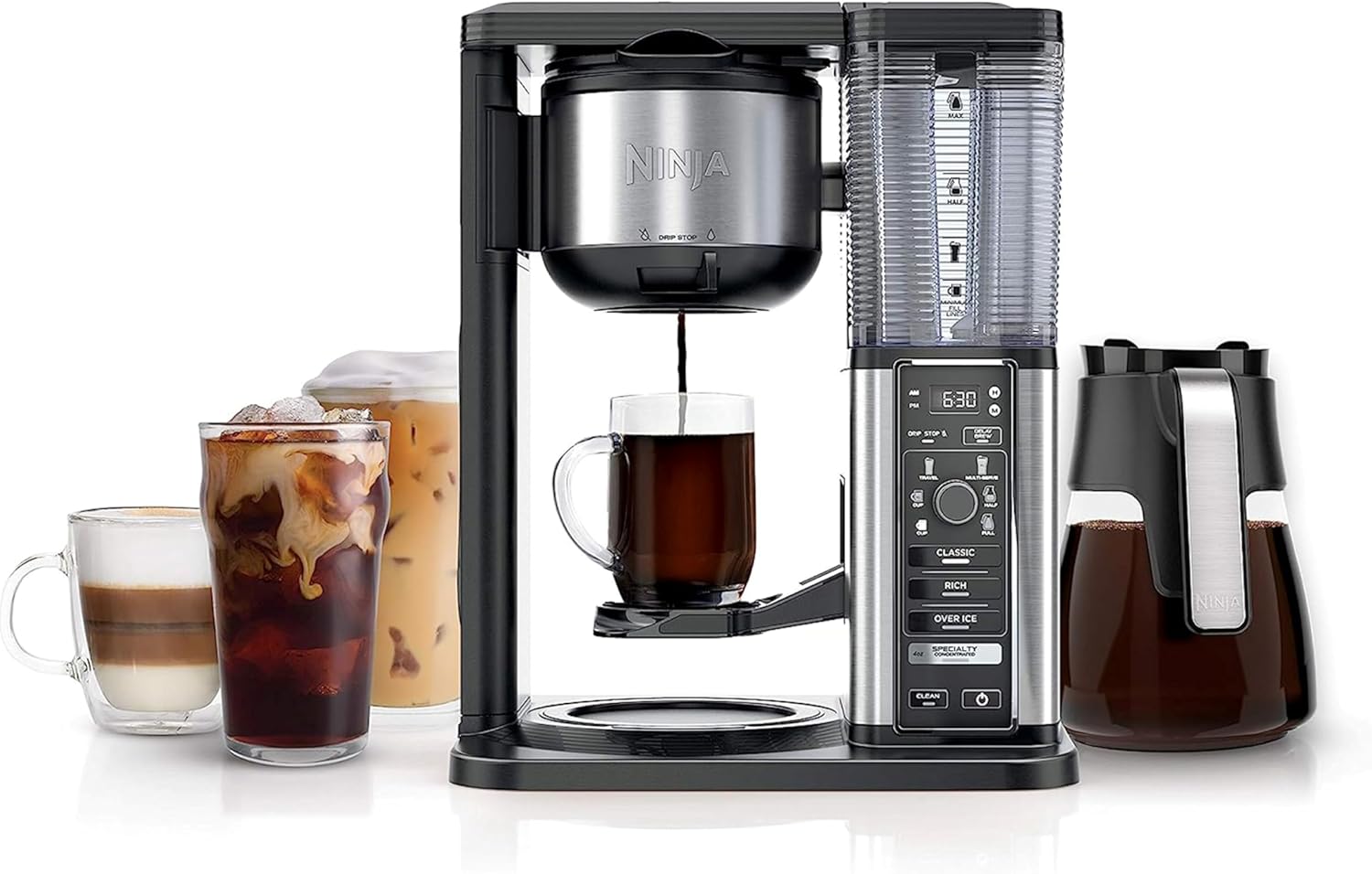
| Brew styles | Classic, Rich, Over Ice, Specialty |
|---|---|
| Brew sizes | 6 sizes (Cup to Full Carafe) |
| Carafe capacity | 50 oz (10-cup) |
| Water reservoir | 40 oz removable |
| Wattage | 1550 watts |
The Ninja CM401 is a versatile drip coffee maker designed to reproduce coffeehouse-style drinks at home. It offers four brew styles — Classic, Rich, Over Ice, and Specialty — and six brew sizes so you can make anything from a single cup to a full 50‑oz carafe. The Specialty setting brews a concentrated extraction that pairs with the built-in fold-away frother to create lattes, cappuccinos, and other milk-based drinks using dairy or plant milks. Practical touches include a 40‑oz removable water reservoir for easy sink filling, a gold-tone permanent filter and dishwasher-safe components for straightforward cleanup, and an automatic shutoff after one hour. With 1550 watts of power the machine reaches brewing temperatures quickly. The machine is manual in operation with button controls, so it lacks app control but keeps operation simple and reliable. If you want a pod-free, all-in-one unit that consistently produces strong coffee and frothed milk without extra gadgets, this unit does that well; it is less suited to users wanting fully automated or smart-home features.
Best for: Buyers who prioritize a dependable, straightforward machine that consistently makes both brewed coffee and milk-based specialty drinks at home without pods or complex tech.
Less Ideal for: If you want smart-home connectivity, customizable automatic schedules, or a thermal carafe for extended heat retention, consider other models that focus on those features.
- Built-in fold-away frother for hot or cold milk drinks
- Specialty Brew produces rich concentrate suitable for lattes and macchiatos
- Removable 40‑oz water reservoir for easy filling
- Dishwasher-safe carafe, frother whisk, filter, and reservoir for simpler cleanup
- No Wi-Fi or app control for remote programming
- Automatic shutoff is fixed at one hour rather than customizable
Verdict: A reliable, pod-free coffee maker that combines concentrated specialty brewing with a built-in frother for café-style milk drinks at home.
Keurig K-Café SMART

| Wattage | 1200 watts |
|---|---|
| Power Source | AC adapter |
| Coffee Input Type | K-Cup Pod |
| Capacity | 1100 ml |
| Filter Type | Reusable |
The Keurig K-Café SMART pairs single-serve convenience with an integrated frother and app-driven controls so you can make espresso-style shots, hot or iced coffee, lattes, and cappuccinos at home. It uses K-Cup pods and offers six brew sizes plus two espresso-style shot sizes, along with five strength and six temperature settings to fine-tune each cup. The built-in frother has multiple speeds and a cold setting, making it easy to froth dairy or plant-based milks for café-style drinks without extra equipment. Wi‑Fi and the Keurig app add BrewID recommendations, Barista Mode step-by-step recipes, remote scheduling, and the ability to save favorite settings. Practical benefits include quick pod brewing, consistent MultiStream extraction, and simplified specialty-drink prep via the app. Important limitations are that it only accepts K-Cup format pods rather than ground coffee, and smart features require app setup and Wi‑Fi to unlock their full functionality. For buyers who value guided recipes and frothing built in, this is a convenient, reliable countertop option.
Best for: Buyers who want café-style drinks at home without a separate espresso machine and who value app guidance and social proof from popular, well-reviewed smart brewers.
Less Ideal for: People who prefer using loose coffee grounds, want a traditional espresso machine, or who do not want to rely on app-based features for daily use.
- Built-in hot and cold milk frother with multiple speed settings for lattes and cappuccinos
- Wi‑Fi and Keurig app with BrewID and Barista Mode for guided recipes and saved preferences
- Five strength and six temperature settings for precise customization
- Supports six brew sizes plus two shot sizes and can brew over ice
- MultiStream Technology for more even saturation and fuller extraction
- Accepts only K-Cup pods, so you cannot brew loose grounds without an adapter
- Smart app features require Wi‑Fi setup and an account to access advanced functions
Verdict: Choose this Keurig if you want a single-serve brewer with an integrated frother and smart app guidance to make consistent café-style lattes and cappuccinos at home.
Ninja Luxe Café ES601

| Operation Mode | Fully Automatic |
|---|---|
| Wattage | 1650 watts |
| Coffee Input Type | Ground, Whole Bean |
| Filter Type | Reusable |
The Ninja Luxe Café ES601 combines an integrated conical burr grinder, assisted tamper, and dual froth system to deliver espresso, drip coffee, and rapid cold brew from one machine. It is designed to guide users through each step with Barista Assist Technology, weight-based dosing, and 25 grind settings so even beginners can get consistent shots without manual dialing. The hands-free frother pairs an automated steam wand with a magnetic whisk for preset steamed milk, thin or thick froth, and cold foam, which makes lattes and cappuccinos simple to produce. Practical touches include a large removable water reservoir, built-in accessory storage, and several cleaning aids including a self-purging steam wand and cleaning tools. At 1650 watts it has the power to heat quickly, but the machine is sizable and uses more counter space than single-function brewers. Users who prefer fully manual espresso control or who need a compact travel-friendly unit may find it heavier and more complex than necessary. For buyers who want an all-in-one, guided home café with a reliable automatic frother, this machine covers most bases well.
Best for: Buyers who want a risk-averse, turn-key home café setup that reliably produces espresso drinks and frothed milk without needing barista skills.
Less Ideal for: People who need a compact, travelable brewer or who prefer full manual control over every espresso parameter.
- Built-in conical burr grinder with 25 grind settings for precise dosing
- Dual froth system with automated steamer and magnetic whisk for hands-free milk texture
- Barista Assist guides, weight-based dosing, and assisted tamper for consistent shots
- Self-cleaning steam wand and included cleaning accessories simplify maintenance
- Relatively large and heavy for countertop use
- More complex than single-purpose machines, with a learning curve for advanced adjustments
Verdict: If you want a guided, all-in-one home machine that consistently produces espresso, drip coffee, and café-quality frothed milk with minimal fuss, this is a strong choice.
Choosing the Right Coffee Maker with Built in Milk Frother: Key Factors to Consider
Froth Method and Foam Texture
How the machine creates foam affects drink quality. Steam wands give experienced users direct control over microfoam and temperature, which matters for latte art and a silkier mouthfeel. Automatic frothing systems and whisk-style frothers deliver consistent results with less technique but can vary in the density and longevity of the foam.
Also consider how different milk types froth. Whole milk produces denser, creamier foam, while skim and plant-based milks behave differently. A machine that includes adjustable froth settings or temperature control makes it easier to get repeatable results across milk varieties.
Brew Strength, Temperature, and Extraction Consistency
The coffee-brewing side must produce stable temperature and extraction to balance with the milk. Machines that under-extract or run too cool will make milk-heavy drinks taste weak or sour. Look for reliable brewing temperatures, pump pressure consistency for espresso-style shots, or well-regulated drip extraction when the device focuses on brewed coffee.
Consistent extraction also reduces the need to overcompensate with more milk or syrups, so the final drink tastes balanced and showcases the espresso or brewed coffee base rather than masking flaws.
Ease of Cleaning and Maintenance
Milk residues spoil quickly and harbor bacteria, so cleaning matters for safety and taste. Detachable milk containers, dishwasher-safe parts, or simple rinse cycles reduce the time and friction of upkeep. Machines that require frequent disassembly or have small hard-to-reach channels are more likely to be neglected, which harms performance over time.
Also check how simple descaling and brew-group maintenance are. A frother that is easy to maintain preserves foam quality longer and prevents off-flavors.
User Controls and Customization
Different buyers want different levels of control. If you want one-touch lattes, look for preset drink programs and automatic frothing cycles. If you prefer to tailor milk temperature and foam density, choose a model with manual steam control or adjustable froth settings.
Clear, intuitive controls reduce mistakes and speed up routine use. Programmability that remembers cup sizes or preferred froth levels can make daily routines simpler and more consistent.
Capacity and Throughput for Household Needs
Consider how many milk-based drinks you make at once. A larger integrated milk reservoir or a fast-recovery steam system matters for families or when entertaining. Smaller single-serve designs suit solo users but can slow down if you try to serve multiple lattes in a row.
Also evaluate bean hopper and water tank sizes if the machine handles both grinding and frothing. More frequent refills add friction to busy mornings.
Durability and Serviceability
A built-in frother adds mechanical complexity, so reliability and the ability to service or replace wear parts are important. Look for robust internal components, easy-access service points, and straightforward replacement procedures for gaskets or seals.
Machines that advertise durable materials for steam wands, robust motor design, and user-serviceable filters or milk containers typically maintain froth and brew quality longer, reducing the total time and money you spend on repairs or replacements.
Automatic Frothers Vs Steam Wands
Automatic frothers offer one-button convenience and are ideal if you want consistent milk texture without learning steaming technique. They usually have dedicated milk containers or internal whisk assemblies that cycle air and heat to produce foam automatically.
Steam wands require more technique but give greater control over temperature and microfoam. If you value latte art or want to dial in microfoam for specialty drinks, a steam wand-equipped machine is worth considering despite the steeper learning curve.
- Automatic frother: easy, consistent, low skill required
- Steam wand: manual control, better microfoam potential
- Consider how much time you want to spend learning steaming technique
How Milk Type Affects Results
Whole milk, reduced-fat milk, and plant-based alternatives behave differently when frothed. Whole milk produces richer foam with smaller bubbles, while low-fat and many plant milks yield lighter, airier foam. Some plant-based milks are formulated to froth better; others separate or produce large bubbles.
If you mainly use non-dairy milk, choose a machine with adjustable froth intensity or a whisk-style automatic system that handles a wider range of viscosities. Testing a small amount first helps you understand how a given machine interacts with your preferred milk.
- Whole milk: creamier, more stable foam
- Low-fat milk: lighter foam, less creaminess
- Plant milks: performance varies by formulation
Cleaning Routines That Keep Froth Fresh
Daily rinses of milk paths and quick wipes of removable parts prevent buildup and off-flavors. Machines with self-rinse or cleaning cycles lower the maintenance burden but still need periodic manual cleaning.
Look for accessible milk reservoirs and components rated dishwasher-safe if you want minimal hands-on cleaning. Also factor in how easy it is to descale the brew system; mineral buildup affects temperature and can subtly degrade both espresso extraction and frothing.
- Rinse milk components after every use
- Run manufacturer-recommended cleaning cycles weekly
- Descale according to water hardness to preserve performance
Customization Tips for Better Milk-Based Drinks
Start by dialing in the coffee dose and grind, or the appropriate brew strength setting, before adjusting froth. A well-extracted shot pairs better with milk than an over- or under-extracted coffee.
Use temperature and froth-intensity settings if available. Lower milk temperatures preserve sweetness in some milks, while higher temperatures can produce creamier mouthfeel but risk scalding. For one-touch machines, run a trial cup to save a default setting that matches your taste.
- Adjust brew strength first, then froth level
- Save favorite settings when possible to speed routines
- Experiment with milk temperature to find preferred balance
Space, Footprint, and Kitchen Integration
Built-in frothers can add height, depth, or side clearance to a machine. Measure available counter space, the clearance under cabinets, and consider where milk containers will be stored and cleaned.
Also think about water and waste access. Machines with internal reservoirs are more flexible in placement than those that require a direct water line. If counter space is tight, prioritize compact designs with effective frothers rather than larger combined units.
- Measure clearance under cabinets for taller steam wands
- Consider detachable milk containers for fridge storage
- Check water tank access for easy refilling
How We Chose the Best Coffee Maker with Built in Milk Frother
We focused on products that integrate milk frothing into the coffee-making workflow so buyers get a one-device solution rather than an add-on tool. Selection began with models that offer both brewed espresso-style coffee or robust drip extraction and a built-in frothing system, whether automatic whisk-style, steam wand, or internal milk container with automated froth cycles. Key evaluation criteria included: the quality and texture of the milk foam across milk types, consistency and temperature control of the brewing system, ease of cleaning the frother components, user interface and programmability for drink customization, and overall reliability and durability based on documented design features. We also considered capacity and throughput for households that make multiple milk-based drinks in quick succession. We excluded single-use novelty gadgets without durable milk systems and machines that require constant disassembly to froth. We prioritized models whose specifications and user-centered design indicate practical, repeatable performance rather than features that look good on paper but add complexity without benefit.
Our full evaluation process is outlined in our review methodology.
FAQ
How often should I clean the built-in milk frother?
You should rinse milk paths and removable parts after every use to prevent residue buildup and bacterial growth. Run any manufacturer-recommended automatic cleaning cycles weekly and deep-clean or descale the system according to your water hardness and usage frequency.
Will a built-in frother work with plant-based milks?
Many built-in frothers handle plant-based milks, but results vary. Barista-style formulations and soy typically froth better than almond or oat blends that are not designed for steaming. Look for adjustable froth settings or whisk-based systems if you primarily use non-dairy milks.
Can I make multiple milk drinks back to back?
It depends on capacity and recovery rate. Machines with larger milk reservoirs or rapid steam recovery handle consecutive drinks better. Smaller single-serve machines may require a short cooldown or refilling between rounds.
Is a steam wand better than an automatic frother?
A steam wand offers more control and better potential for microfoam, but it requires technique and cleanup. Automatic frothers are more consistent for casual users and reduce user error, though they may not match the finest microfoam a skilled barista can produce.
How do I prevent burnt or scalded milk when frothing?
Avoid overheating by watching temperature indicators or using preset temperature settings when available. Start with cold milk, use a thermometer if needed, and stop steaming when milk reaches the desired warmth. Regular cleaning also prevents hot spots that can unevenly heat milk.
Final Verdict
Prioritize the frothing method and brew consistency that match how you use milk-based drinks. If you want quick, repeatable lattes with minimal technique, an automatic integrated frother with adjustable settings is a sensible choice. If you value control and superior microfoam for specialty drinks, choose a machine with a capable steam wand and be prepared to learn basic steaming technique. Also weigh upkeep and capacity against convenience. Easier cleaning and adequate milk capacity reduce friction and make you more likely to use the frother regularly. Use the decision criteria above to balance taste, effort, and household needs so you pick a machine you enjoy every day.