
Note: This article contains affiliate links. If you click on these links and make a purchase, we may earn a small commission at no extra cost to you. This helps support our research and content. Read our full affiliate disclosure here.
When you manage high-traffic areas, the right commercial carpet cleaner makes daily maintenance faster and extends the life of your floorcoverings. You need machines that extract soil deeply, stand up to frequent use, and minimize downtime during busy shifts. This guide covers our five shortlisted commercial carpet cleaners chosen for their cleaning power, durability, and serviceability. We evaluate each option on concrete criteria buyers care about so you can pick the machine that fits your facility's workload and maintenance plan. Read on for the factors that matter and what to expect from a professional-grade cleaner.
Top Picks at a Glance
| Best Overall The best all-around choice for most situations | Sanitaire RESTORE SC6100A | 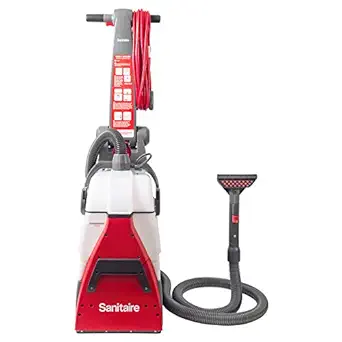 |
| Best Quality Built to a higher standard if you want something more solid | Rug Doctor Mighty Pro X3 |  |
| Best Value The sweet spot between price and what you get | MOCHAG LC-40SC Commercial Carpet Cleaner |  |
| Top Rated A top-rated pick with lots of positive feedback | Bissell Commercial BG10 |  |
| Most Popular A crowd favorite that many people choose with confidence | BISSELL Big Green 86T3 |  |
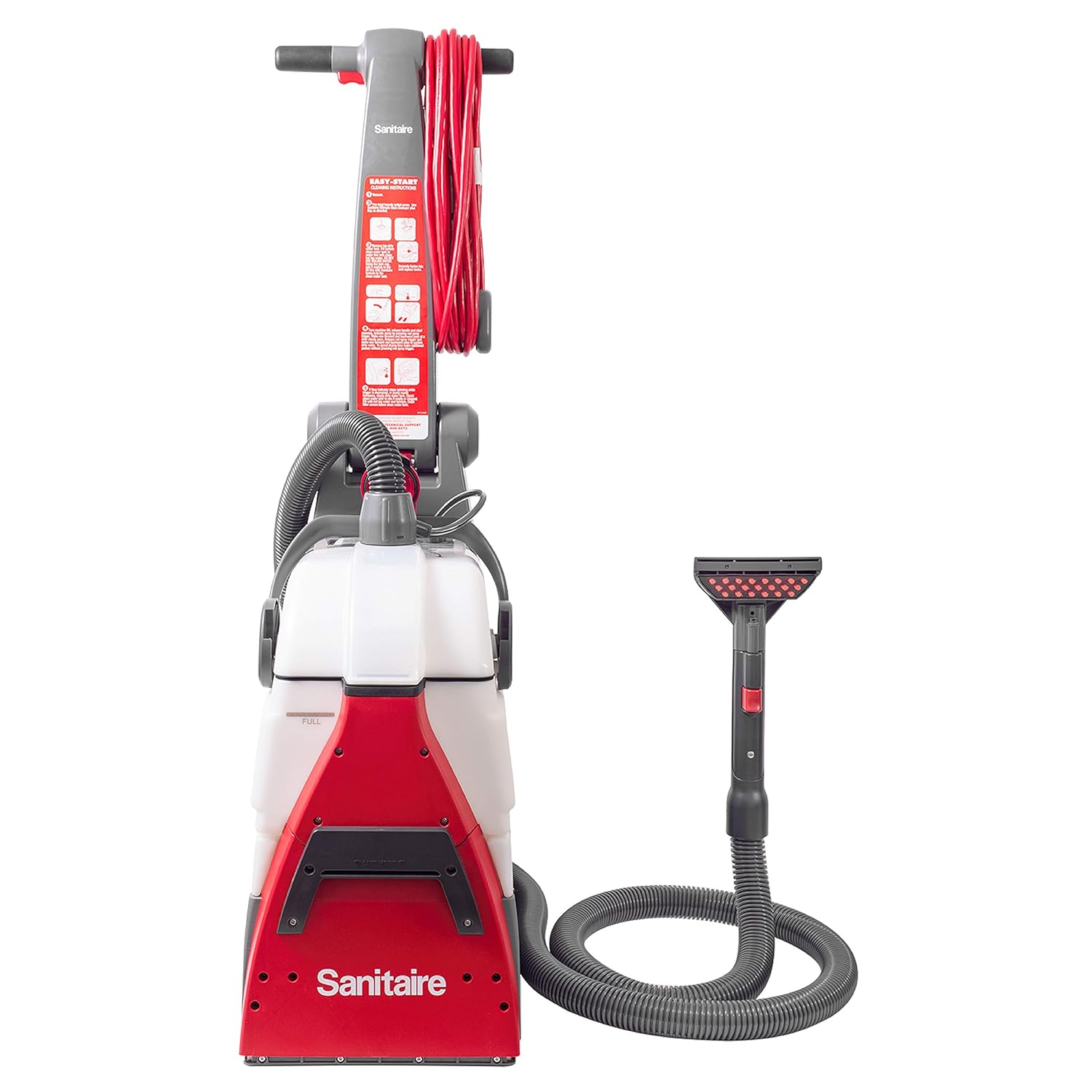
Sanitaire RESTORE SC6100A
| Capacity | 1.75 gallons |
|---|---|
| Item Weight | 42 pounds |
| Included Components | Two 8-oz. bottles of Ultimate Carpet Cleaner with OXY |
| Power Source | Hand |
The Sanitaire RESTORE SC6100A is a commercial upright carpet extractor built to strip deep soil from carpet fibers and move moisture quickly with strong suction. It uses a two-motor design with a large rotating brush that cleans in both forward and backward passes for faster coverage, and a powerful vacuum motor that provides edge-to-edge pickup. The machine has large removable clean and dirty water tanks and a long 35-foot detachable cord plus a 9-foot hose with a 6-inch hand tool for above-floor and tight-area work. In practice this model is durable and straightforward to service, and the forward/backward cleaning action improves productivity compared with single-pass units. Expect a heavier, professional-sized machine that trades portability for commercial cleaning power, and plan for storage space and occasional maintenance of brushes and tanks like any extractor used frequently in business settings.
Best for: Facilities managers and small cleaning businesses that need a durable, productive extractor for regular commercial carpet cleaning jobs.
Less Ideal for: Homeowners who need a lightweight or compact cleaner for occasional spot cleaning should consider consumer-grade carpet cleaners instead.
- Two-motor system with large rotating brush for deep fiber agitation and extracting embedded dirt
- Cleans on both forward and backward passes to increase productivity
- Removable clean and dirty water tanks for easy filling and emptying
- Long detachable 35 ft cord and 9 ft hose with 6-inch hand tool for extended reach and above-floor cleaning
- Heavier, commercial-sized unit that requires storage space and is less convenient for home-only use
- May need routine maintenance of brush roll and tanks under heavy professional use
Verdict: Choose the RESTORE SC6100A when you need a rugged, two-motor commercial extractor that delivers faster, deeper cleaning and easy maintenance for frequent professional use.
Rug Doctor Mighty Pro X3

| Capacity | 2 gallons |
|---|---|
| Power Source | Corded Electric |
| Included Cleaning Solution | 48 oz Oxy Carpet Cleaner |
The Rug Doctor Mighty Pro X3 is a heavy‑duty carpet cleaner built to deliver commercial one‑pass results at home or in light commercial settings. It combines deep‑inject spray jets, a triple‑action vibrating brush and strong suction to break up and extract embedded dirt, grime and stains in a single pass, making it suitable for high‑traffic areas and full‑home cleaning sessions. Large solution and dirty water tanks reduce how often you stop to refill or empty, and the adjustable handle and large wheels make moving and storing the unit easier for busy cleaning jobs. The included 48 oz Oxy carpet cleaner targets difficult stains and adds a stain‑protect finish. Tradeoffs are its substantial weight and corded design, which make it less convenient for small quick touchups or frequent transport between distant job sites, and upholstery tools are sold separately.
Best for: Buyers who prioritize performance and need a machine that delivers commercial‑grade deep cleaning for whole homes or high‑traffic spaces rather than a lightweight spot cleaner.
Less Ideal for: People who need a lightweight, highly portable cleaner for quick spot treatments or frequent car‑to‑home transport should consider smaller, more compact models.
- Commercial‑grade one‑pass system sprays, scrubs, and extracts for deep cleaning
- Triple Action vibrating brush and deep‑inject jets loosen embedded dirt other machines miss
- Large solution and dirty water tanks reduce refill and empty cycles during big jobs
- Includes 48 oz Oxy carpet cleaner formulated to remove tough stains and deodorize
- Heavy and bulky, which limits portability and frequent transport
- Upholstery tool is not included and must be purchased separately
Verdict: Choose the Rug Doctor Mighty Pro X3 when you need commercial‑level deep cleaning power for large areas and stubborn stains.
MOCHAG LC-40SC Commercial Carpet Cleaner

| Capacity | 40 liters |
|---|---|
| Input Voltage | 110 volts |
| Motor Power | 1034W |
| Suction | 230 mbar |
The MOCHAG LC-40SC is a commercial-grade carpet extractor built to handle large cleaning jobs in businesses or busy homes. It combines a 1034W motor with reported 230 mbar suction and a dual-tank design so operators can spray, scrub, and extract without frequent refills. The unit ships with six attachments for carpets, upholstery, tile grout, corners, and large-surface work, and a long power cord and hose extend reach for larger rooms. Stainless steel construction and washable filters aim to protect the motor for longer service life, and 360 degree wheels make it reasonably easy to move between areas. Expect solid cleaning performance on soiled carpets and upholstered surfaces, but be mindful that this is a sizable, professional machine that needs storage space and occasional maintenance of tanks and filters. For operators focused on efficient, repeatable extraction rather than lightweight portability, it delivers the core features you need.
Best for: Buyers who prioritize efficient, repeatable deep-cleaning for commercial spaces or frequent heavy-duty use and want a robust extractor that reduces downtime between jobs.
Less Ideal for: Customers who need a compact, easily storable household spot cleaner or who rarely perform large cleaning sessions should consider smaller consumer machines instead.
- Large 40 liter capacity with separate clean and wastewater tanks reduces refill frequency
- 1034W motor and strong suction for effective extraction on carpets and upholstery
- Includes six specialized attachments for versatile cleaning tasks
- Stainless steel body and washable filter help protect the motor and extend lifespan
- Long power cord, extended hose, and swivel wheels improve reach and maneuverability
- Large, heavy footprint requires storage space and is less convenient for casual users
- Not intended as a lightweight or handheld cleaner for quick spot jobs
Verdict: A workhorse extractor built for frequent commercial deep-cleaning jobs that need powerful suction, large tanks, and versatile attachments.
Bissell Commercial BG10
| Capacity | 3.5 gallons |
|---|---|
| Power Source | Corded 16 Gauge OSHA Pigtail Cord |
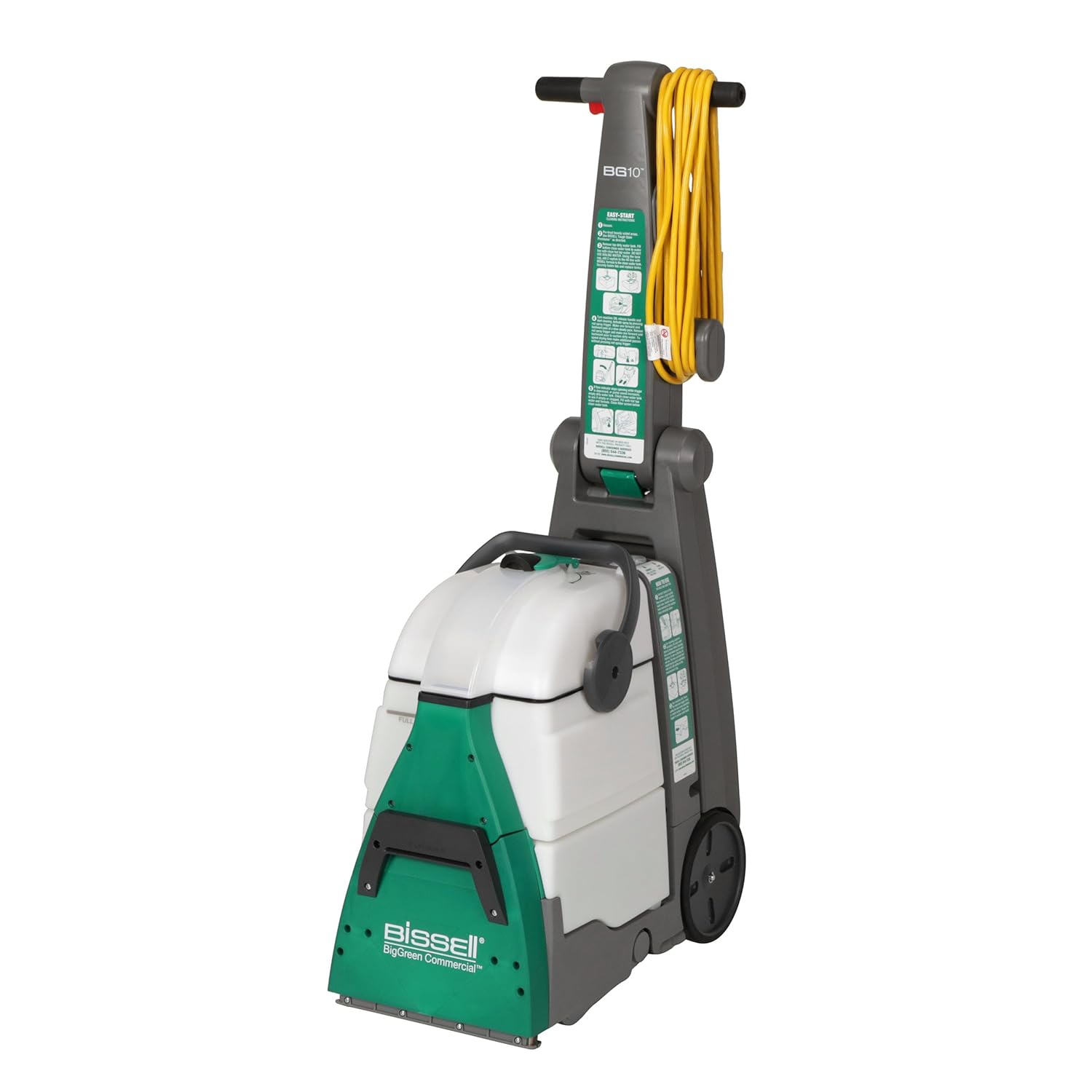
The Bissell Commercial BG10 is a two-motor carpet extractor built for demanding, high-traffic environments. It combines strong suction with a large clean-water and recovery tank system so operators can clean long runs of carpet without frequent refills or emptying. The integrated flow indicator makes it easy to monitor solution and water levels while working, and the machine's rugged frame and simple controls are geared toward daily commercial use. Typical uses include office buildings, hospitality spaces, and rental cleaning jobs where durability and uptime matter. Practical benefits include edge-to-edge suction for thorough cleaning, removable tanks for faster refills, and a corded OSHA pigtail for reliable power connection. Trade-offs are its substantial weight and industrial footprint, which make it best handled by trained staff rather than for casual or infrequent home use.
Best for: Facilities managers and professional cleaners who prioritize durability and continuous runtime for frequent, heavy-duty carpet cleaning.
Less Ideal for: Homeowners or light-use buyers seeking a lightweight, portable carpet cleaner for occasional spot cleaning.
- Dual-motor design for strong suction and effective extraction
- Large 3.5-gallon tank system reduces downtime between refills
- Integrated flow indicator lets operators monitor water and solution levels
- Rugged construction designed for frequent commercial use
- Heavy and bulky, requiring effort or equipment to move between jobs
- Designed for commercial operators rather than occasional residential users
Verdict: Choose the BG10 when you need a robust, reliable extractor built to handle regular commercial carpet cleaning with minimal downtime.
BISSELL Big Green 86T3
| Capacity | 1.75 gallons |
|---|---|
| Power Source | Corded Electric |
| Hose Length | 9' |
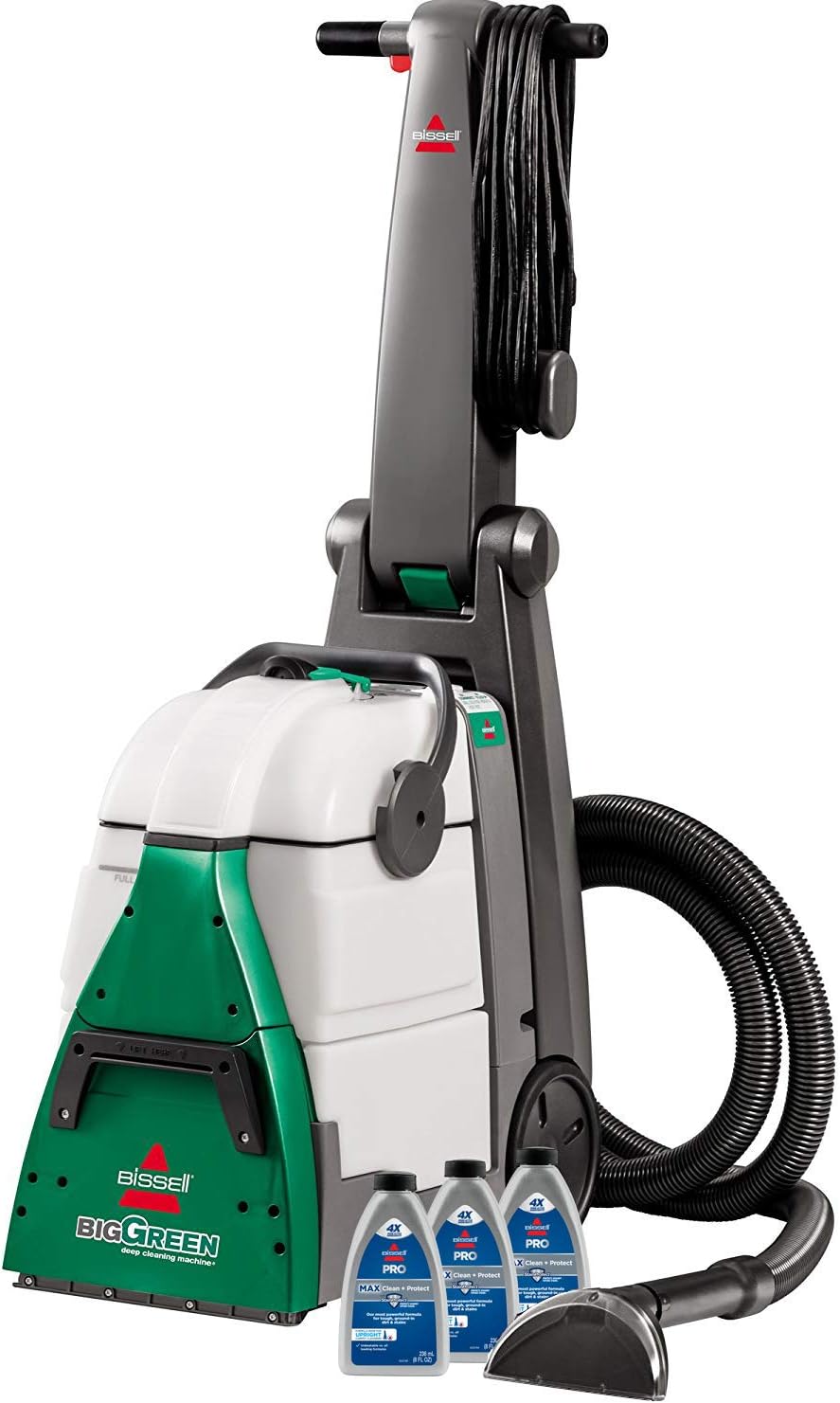
The BISSELL Big Green 86T3 is a heavy-duty carpet cleaner built for deep extraction on soiled carpets and upholstery. It sprays a cleaning solution, scrubs with an extra-large rotating DirtLifter brush, and suctions the loosened soil into a separate dirty-water tank so you get a true deep wash on a forward and backward pass. Practical features for regular deep cleaning include a 1.75 gallon clean tank, a large dirty water tank to reduce refill trips, a 9 foot hose and a 6-inch tough stain tool for stairs and upholstery, plus BISSELL trial formulas included for initial use. The machine is corded for continuous power and claims robust, anti-tip construction that stands up to frequent use. Downsides are its weight and bulk which make it less convenient for quick spot-cleaning or carrying between levels, and it lacks express-clean or heated-dry modes found on some competing models. For heavy-duty, reliability-focused deep cleaning this machine emphasizes performance over portability.
Best for: Buyers who prioritize dependable, professional-level deep cleaning and durability for frequent, whole-room carpet maintenance.
Less Ideal for: If you need a lightweight spot-cleaner or a compact unit for quick touch-ups and frequent transport, this is not the best choice.
- Powerful rotating DirtLifter brush for deep soil removal
- Large 1.75 gallon clean tank and sizable dirty tank reduce refill trips
- Includes 9' hose and 6" tough stain tool for stairs and upholstery
- Built from durable materials with anti-tip design for frequent use
- Heavy and bulky which makes it hard to carry or store
- No express-clean or built-in heating feature for faster drying
Verdict: Choose the BISSELL Big Green if you want a rugged, professional carpet cleaner built to deliver reliable deep-extraction results on heavily soiled carpets.
Choosing the Right Commercial Carpet Cleaner: Key Factors to Consider
Extraction Efficiency and Water Recovery
How thoroughly a machine extracts dirty water and soil determines cleaning outcomes and dry times. Higher extraction efficiency reduces residue left in carpet fibers and shortens drying time, which is critical in commercial settings where areas must return to service quickly.
Look for machines with strong suction, high pump pressure when applicable, and a recovery tank design that prevents recontamination. Efficient recovery lowers the number of passes required and reduces labor minutes per room, which matters for high-volume cleaning schedules.
Durability and Duty Cycle
Commercial machines operate far more often than residential units, so materials and assembly quality directly affect lifecycle costs and downtime. Durable frames, heavy-gauge plastics or metal components, and sealed bearings extend service intervals and resist damage from frequent transport and handling.
Check for clearly stated duty cycles or continuous-use ratings. Components like motors, pumps, and belts designed for commercial duty are more expensive upfront but save money by avoiding premature failures and extended service disruptions.
Serviceability and Parts Access
Quick access to wear items and fluids reduces downtime and labor costs. Machines that let technicians change brushes, clear clogs, or replace filters without specialized tools keep fleets running and simplify preventive maintenance routines.
Consider how tanks open for cleaning, whether hoses and wands detach easily, and whether common spare parts are user-replaceable. Good serviceability also includes clear diagnostic indicators and modular components to speed repairs.
Runtime, Cooling, and Thermal Protection
Long runs between pauses are essential for large spaces. Thermal management keeps motors and pumps operating within safe temperatures, reducing the risk of thermal shutdowns during heavy use. Cooling vents, fan-assisted airflow, and thermal cutouts help machines tolerate extended operation.
Evaluate tank capacities versus expected coverage to balance refill frequency with runtime. Machines that overheat easily or require long cool-down periods reduce productivity and can increase labor costs.
Operator Ergonomics and Manoeuvrability
Comfortable controls, adjustable handles, and manageable weight make crews more efficient and reduce injury risk. Manoeuvrable designs that navigate tight corridors, stairs, and padded furniture let operators clean more effectively without strain.
Also consider storage footprint for transport vehicles and whether accessories stow securely. Better ergonomics shorten task time and lower the chance of operator fatigue during long shifts.
Types of Commercial Carpet Cleaners and When to Use Them
Commercial carpet cleaners fall into distinct operational styles, each suited for different tasks. Truck-mounted extraction systems provide high-powered extraction for large-scale restoration and deep cleaning projects but require vehicle support. Portable extractors are more flexible for scheduled maintenance, spot cleaning, and multi-floor buildings where vehicle access is limited. Rotary bonnet or encapsulation machines are efficient for surface cleaning and quick maintenance cycles but do not extract deeply like hot-water extractors.
Matching the machine style to your facility's needs helps control labor and downtime. For routine daily maintenance in retail or office settings, portable extractors with good recovery work well. For periodic deep clean or hospitality turnarounds, higher-extraction systems minimize soil and odor build-up.
- Portable extractors: good for multi-floor and stair access
- Truck-mounted systems: best for heavy-duty restoration
- Bonnet and encapsulation: efficient for surface maintenance
Maintenance Routines That Keep Machines Reliable
Establish a simple daily and weekly checklist to extend equipment life. Daily tasks should include emptying and rinsing recovery tanks, flushing solution lines, and inspecting hoses for clogs or wear. Weekly checks can cover brush condition, belt tension, and filter inspection.
Documenting service intervals and tracking hours of use helps plan preventive replacements before failures occur. Training operators to perform basic checks reduces emergency repairs and keeps cleaning schedules on track.
- Daily: rinse recovery tanks, check for clogs
- Weekly: inspect brushes and belts, verify seals
- Monthly: test suction, inspect motor mounts
Choosing Chemical and Water Settings for Best Results
Cleaning effectiveness depends as much on correct chemical dosing and water temperature as on machine power. Use manufacturer-recommended detergents at the right concentration to avoid residue and fiber damage. For most commercial cleaning, warm water boosts cleaning action, but very hot water can harm some fibers or finishes.
Calibrate solution flow to match carpet soil levels and extraction capability. Overapplying solution can extend dry times and promote re-soiling. When possible, do a small test area to confirm settings before large-area work.
- Pre-test chemicals on inconspicuous areas
- Adjust solution flow to soil level
- Avoid over-wetting to reduce drying time
Noise and Building Use Considerations
In occupied commercial spaces, noise limits when cleaning can determine schedule and equipment choices. Lower-noise machines may have reduced suction or power, so balance noise objectives with the level of soil removal you require. Consider night or off-hour cleaning for deeply soiled areas to allow for stronger extraction without disruption.
Check building access and transport constraints. Compact, quieter units simplify daytime cleanings in retail or healthcare environments where disturbance must be minimized.
- Assess noise levels if cleaning during business hours
- Plan routes to minimize disruption
- Use quieter machines for occupied areas when possible
Storage, Transport, and Fleet Management
How you store and move machines affects their availability and service life. Secure, dry storage prevents corrosion and keeps electrical components safe. When transporting by van, secure machines to avoid damage to hoses, tanks, and control panels. Keep a basic spare-parts kit with hoses, belts, and common fittings to reduce downtime in the field.
Track machine hours and maintenance history across your fleet. Regularly replacing wear items on a schedule reduces emergency repairs and keeps performance consistent across crews.
- Store machines in dry, ventilated areas
- Secure units during transport to prevent damage
- Maintain a spare-parts kit for common wear items
How We Chose the Best Commercial Carpet Cleaner
We focused on attributes that matter to facilities managers, janitorial teams, and contractors who run commercial cleaning programs. Our selection prioritized machines with proven cleaning performance on heavily soiled carpets, measured by extraction efficiency and water recovery. We weighed durability and build quality, looking for robust components, serviceable parts, and materials rated for continuous or frequent operation. Runtime and thermal management were included to ensure machines can complete typical cleaning runs without frequent stops or overheating. We also considered ergonomics and ease of maintenance so crews can swap brushes, access tanks, and perform routine service quickly. Noise output and transportability were factored for buildings where disruption and access matter. Exclusions: we did not consider machines designed strictly for residential use or units intended only for spot treatment. Machines that lack clear specifications for recovery rate, motor duty cycle, or serviceability were excluded. The result is a set of commercial carpet cleaners that meet operational expectations for heavy use and straightforward upkeep.
Our full evaluation process is outlined in our review methodology.
FAQ
How often should commercial carpets be deep cleaned with an extractor?
It depends on foot traffic and soil levels, but many high-traffic commercial areas benefit from extraction every 3 to 6 months. Low-traffic spaces can extend that interval. Spot cleaning and regular vacuuming will prolong the time between deep-extraction cycles.
Can I use hot water in all commercial carpet cleaners?
Many commercial extractors accept warm or hot water, but maximum temperature limits vary. Using water hotter than a machine's rating can damage seals and pumps, so check the equipment's thermal specifications before use.
What maintenance tasks do operators need to perform daily?
Daily tasks usually include emptying and rinsing the recovery tank, flushing solution lines, checking for hose blockages, and a quick inspection of brushes or heads. These simple steps reduce odors, prevent clogs, and keep suction consistent.
How important is brush type for cleaning effectiveness?
Brush type affects agitation and fiber contact. Stiffer brushes are better for heavy soil and low-pile carpets, while softer brushes are suitable for delicate fibers. Matching brush style to carpet type improves cleaning without damaging fibers.
What should I keep in a field service kit for commercial machines?
A practical kit includes spare hoses and clamps, extra belts, basic hand tools, a replacement filter, and manufacturer-recommended sealant or lubricants. Having common spares on hand reduces downtime during routine work.
Final Verdict
When selecting a commercial carpet cleaner, prioritize extraction efficiency, durability, and easy serviceability to keep cleaning operations productive and predictable. Balance tank capacity and runtime against the size of areas you clean and schedule maintenance to prevent unexpected downtime. Focus on operator ergonomics and thermal management where long runs and heavy soils are common. With those priorities in mind, choose the machine that matches your facility workload and maintenance capabilities so you can maintain appearance and reduce long-term cost.