
Note: This article contains affiliate links. If you click on these links and make a purchase, we may earn a small commission at no extra cost to you. This helps support our research and content. Read our full affiliate disclosure here.
When your kitchen handles large volumes, the right Commercial Food Chopper can cut prep time and deliver consistent results dish after dish. You need equipment that stands up to repeated use, handles varying batch sizes, and is simple for staff to operate and maintain. This guide collects the top shortlisted commercial food choppers available for professional kitchens and evaluates them on practical factors that matter to chefs and kitchen managers. We'll look at capacity, motor endurance, blade design, sanitation and safety features to help you pick a chopper that fits your workflow and production targets. Read on for the top picks and the decision criteria we used.
Top Picks at a Glance
| Best Overall The best all-around choice for most situations | TERUISI Vegetable Chopper GJ817 |  |
| Best Quality Built to a higher standard if you want something more solid | TK Tartle Kitchen Vegetable Chopper 750W |  |
| Best Budget The cheapest option that still gets the job done reliably | VEVOR Commercial Vegetable Chopper |  |
| Top Rated A top-rated pick with lots of positive feedback | New Star Foodservice French Fry Cutter |  |
| Most Popular A crowd favorite that many people choose with confidence | VEVOR Commercial French Fry Cutter |  |
TERUISI Vegetable Chopper GJ817
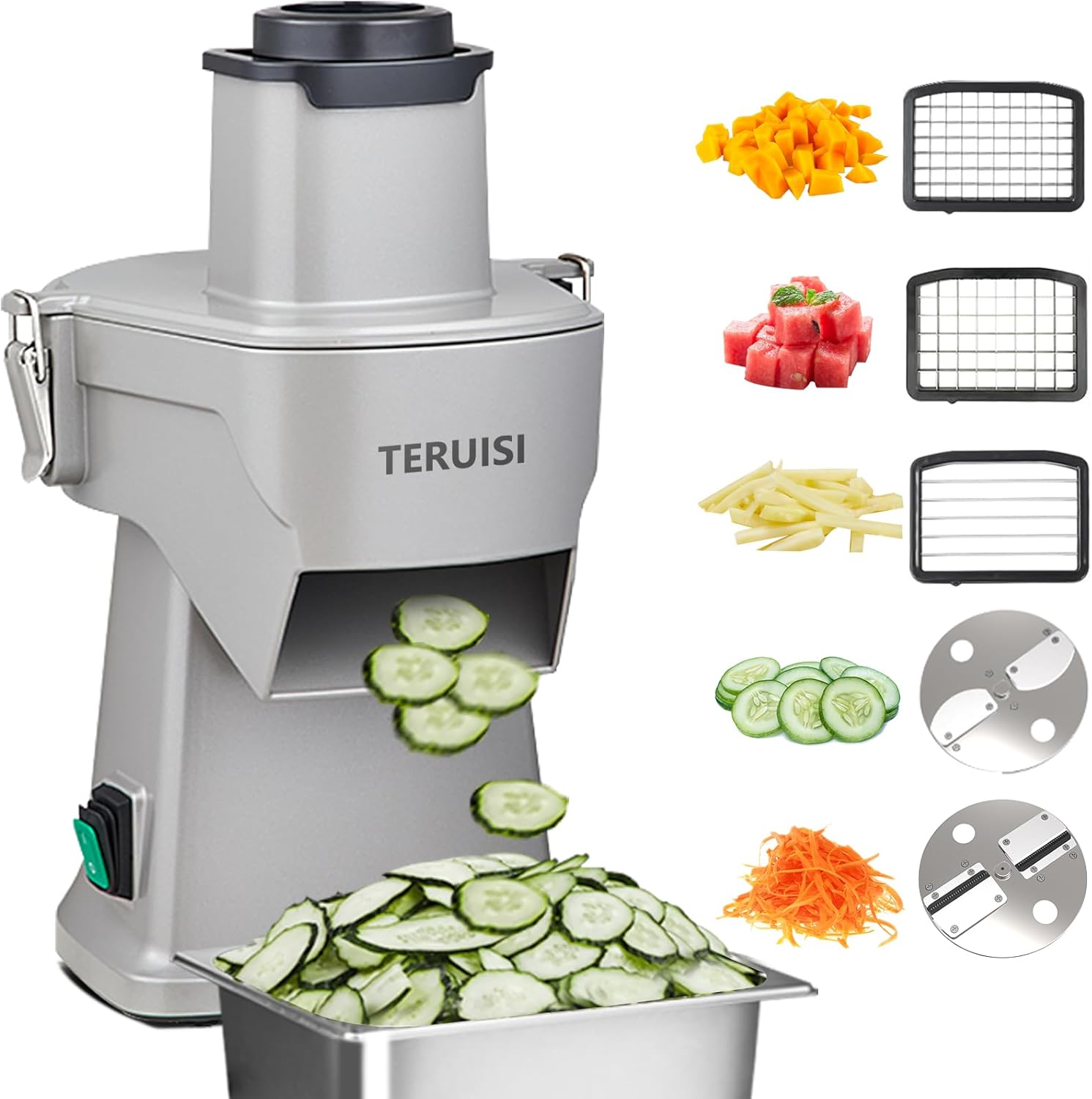
| Motor power | 200W |
|---|---|
| Cutting materials | 420 stainless steel blades |
| Body material | Cast aluminum |
| Operation mode | Automatic |
The TERUISI GJ817 is a compact commercial-style vegetable chopper built around a 200W copper motor and a cast aluminum body that is intended for repeated use in both home and light commercial kitchens. It includes three stainless steel discs and three blade nets that deliver adjustable slicing (1–5 mm), two shredding thicknesses, two dicing sizes, and a fixed striping size, so it can quickly process whole vegetables and larger pieces without pre-cutting. Practical touches include a large feeding mouth, non-slip suction feet, a waterproof one-touch switch, and removable blades for easier cleaning. The motor is rated for extended runs with claimed heat dissipation allowing up to about two hours of operation, which suits batch prep. Expect solid, factory-style construction and consistent cuts, but this is a focused veg cutter rather than a full food-processor replacement: it does not list bowl capacities or extra attachments for wet mixing, and cleaning interior crevices still requires wiping. For balanced buyers who need fast, uniform vegetable prep for small commercial or heavy home use, it offers a useful mix of speed, build quality, and adjustable cut styles.
Best for: Buyers who want a robust, commercial-style vegetable cutter for fast, repeatable prep of vegetables and fruits in kitchens that do moderate batch work.
Less Ideal for: People seeking a full food processor for pureeing, dough work, or wet mixing should consider a different appliance tailored for those tasks.
- Four cutting functions (slice, shred, dice, stripe) with adjustable thicknesses and two dicing sizes
- Cast aluminum body and 420 stainless steel blades and shaft for durable, commercial-style construction
- 200W pure copper motor designed for low noise, good heat dissipation, and extended run times
- Large feed mouth accepts whole vegetables to reduce prep time and friction
- Removable blades and discs plus suction feet and waterproof switch for safer, easier use
- Not a multi-purpose food processor—lacks mixing or wet-processing attachments
- Interior cleaning requires wiping; some crevices are not fully washable
Verdict: A durable, adjustable 4-in-1 vegetable chopper built for consistent, efficient prep in small commercial or busy home kitchens.
TK Tartle Kitchen Vegetable Chopper 750W

| Wattage | 750 watts |
|---|---|
| Voltage | 120 volts |
| Power Source | Electric |
| Blade Material | Stainless Steel |
The TK Tartle Kitchen Vegetable Chopper is built for high-volume commercial prep, using a 750W copper-core motor to deliver steady torque for continuous operation. It accepts both a large hopper and a small feed tube, so you can quickly process bulky items like cabbage or potatoes and switch to narrow produce such as carrots or celery without slowing the line. The unit ships with five stainless steel discs (two slicers and three shredders) and can expand to a 13-disc system for julienne, dicing, and french fry cuts. Safety features include a safety interlock, overload protection, and non-slip feet, and the replaceable stainless discs are dishwasher-safe for faster cleaning. Practical benefits are reliable throughput—advertised around 360 lb/hr—durable metal construction, and serviceable parts for long commercial use. Limitations are its footprint and weight, which make it more suitable for a dedicated prep station than a small mobile setup, and additional cutting options require buying extra discs separately.
Best for: Buyers running busy restaurant, catering, or commissary prep lines who need reliable, continuous vegetable processing and value serviceable, heavy-duty equipment.
Less Ideal for: Home cooks, occasional users, or operators with very limited counter space who need a compact or portable solution should look elsewhere.
- Commercial 750W copper-core motor designed for continuous high-throughput operation
- Dual feed openings for handling both bulk and narrow produce without extra tooling
- Includes five stainless steel discs and supports expansion to 13 discs for varied cuts
- NSF and ETL certifications plus safety interlock and overload protection for professional kitchens
- Heavy and sizable, better suited to a permanent prep station than tight or mobile kitchens
- Additional cutting discs for specialized cuts are sold separately
Verdict: Choose this commercial chopper when you need a durable, high-throughput vegetable cutter that handles continuous prep and expands to many cutting styles.
VEVOR Commercial Vegetable Chopper

| Included Components | 1/4" Blade |
|---|---|
| Material Type | Aluminum, Stainless Steel |
| Blade Material Type | Stainless Steel |
| Operation Mode | Manual |
This manual commercial chopper is built for frequent use in small restaurants or busy home kitchens that need consistent 1/4-inch dicing. The cast aluminum body and 420J2 stainless steel blades give it a sturdy, corrosion-resistant feel, and the ergonomic pull-down handle uses leverage to cut through potatoes, onions, peppers, and more with minimal effort. Blade assembly and cutter head disassemble for cleaning, and four rubber-footed supports help keep the unit stable during operation. Practical extras include two spare blades and removable push blocks so maintenance is straightforward, but hand-wash-only care and the manual operation mean it is best for shops that can tolerate some labor rather than fully automated lines. The chopper is compact enough to fit on a prep counter while still handling restaurant volumes, and its simple mechanical design reduces service complexity compared with electric models.
Best for: Buyers who need a durable, no-frills dicer for steady commercial or heavy home use and prioritize build quality and consistent cuts on a tight budget.
Less Ideal for: Large kitchens that require high-speed automated processing or teams that need fully electric, hands-free operation should consider powered commercial cutters instead.
- Heavy-duty aluminum and stainless steel construction resists corrosion for long service life
- Sharp food-grade 420J2 stainless blades deliver uniform 1/4-inch dices
- Ergonomic pull-down handle provides leverage to reduce user effort
- Removable blade assembly and push block simplify cleaning and maintenance
- Manual operation requires physical effort and is slower than powered choppers
- Hand wash only care may increase cleaning time in high-volume kitchens
Verdict: A rugged, budget-friendly manual chopper that delivers consistent 1/4-inch dices for restaurants and heavy-use home kitchens.
New Star Foodservice French Fry Cutter

| Material Type | Stainless Steel |
|---|---|
| Blade Material Type | Stainless Steel |
| Operation Mode | Manual |
| Included Components | French fry cutter |
This New Star Foodservice cutter is a heavy-duty, manual french fry and vegetable chopper built for commercial kitchens. It ships as a complete combo with 1/4, 3/8, and 1/2 inch square blades plus 6- and 8-wedge blades and matching push plates so you can switch cuts for fries or wedges without buying extras. The long ergonomic handle and V-shaped trough take potatoes up to about 6 inches and give strong leverage for single-stroke cuts, while the cast iron body and 18/8 stainless steel components resist corrosion and hold alignment under frequent use. Mounting options include wall brackets, pre-drilled leg holes, or suction feet for temporary countertop use, which helps stabilize the unit in busy prep stations. It is hand-wash only and is a manual tool, so expect some physical effort for large-volume jobs and more cleanup than a sealed electric unit. For kitchens that need fast, repeatable cuts and factory-quality durability, this cutter delivers consistent results with straightforward maintenance.
Best for: Kitchens that prioritize durable, reliable equipment and need repeatable, professional-quality cuts for fries and vegetables during heavy daily use.
Less Ideal for: Home cooks who want a low-effort, dishwasher-safe, or electric solution for occasional use should consider a different style of cutter.
- Commercial-grade cast iron body and 18/8 stainless steel parts for long-term durability
- Complete set of blades (1/4, 3/8, 1/2, 6-wedge, 8-wedge) for versatile cut options
- Long ergonomic handle provides strong leverage for quick single-stroke cuts
- Multiple mounting methods (wall, countertop suction feet, pre-drilled legs) for stable installation
- Manual operation requires physical effort for high-volume output
- Hand wash only which increases cleaning time compared with dishwashable alternatives
Verdict: Buy this cutter if you need a factory-quality, commercial manual cutter that gives consistent, versatile cuts and holds up to heavy kitchen use.
VEVOR Commercial French Fry Cutter

| Included Components | 4 x Cutting Blades; 1 x Food Pan |
|---|---|
| Material Type | Aluminum, Stainless Steel |
| Blade Material Type | Alloy Steel, Stainless Steel |
| Operation Mode | Manual |
The VEVOR Commercial French Fry Cutter is a manual, cast-aluminum vegetable dicer designed for high-volume kitchens and food-prep stations. It uses an extended leverage handle and a removable blade assembly to push produce through one of four blade options — 1/4" and 3/8" fry-cut blades plus two 6-wedge slicers (one with a corer). A stainless steel food pan sits under the cutter to catch dice and keep prep tidy, and rubber-covered feet improve stability on uneven surfaces. Construction combines cast-aluminum body components with stainless or alloy-steel blades for durability and corrosion resistance, and blades are user-replaceable for different cuts. In practice it speeds repetitive chopping tasks and produces uniform strips or wedges much faster than knives, which is useful for restaurants, cafeterias, and catering. It is manual, so it needs physical force and countertop space, and fine or unusual cuts beyond the supplied blades will require a different tool. There is also routine cleaning and safe blade handling to consider in a busy kitchen.
Best for: Buyers who want a rugged, low-tech commercial cutter that delivers consistent, high-volume fries or wedges and values proven construction and user feedback when choosing equipment.
Less Ideal for: Shops that need fully automated or variable-thickness electric slicing for continuous nonstop service should consider powered slicers instead.
- Four interchangeable blades for fries, wedges, and coring provide flexible prep options.
- Cast-aluminum body with stainless/alloy steel blades offers commercial-grade durability and corrosion resistance.
- Extended leverage handle reduces effort for repeated cuts compared with short-handled placers.
- Included stainless steel food pan collects dice and keeps work area cleaner.
- Rubber-covered feet add stability on uneven countertops.
- Manual operation requires physical effort for large batches compared with electric choppers.
- Limited to the preset blade sizes so non-standard cuts need separate tools.
Verdict: A tough, no-frills manual cutter that reliably turns bulk potatoes and fruit into uniform fries or wedges for commercial kitchens.
Choosing the Right Commercial Food Chopper: Key Factors to Consider
Chopping Capacity and Duty Cycle
Commercial kitchens have very different volume needs than home cooks. Capacity describes how much food a machine can process in one batch and how many batches it can handle per hour. A higher-capacity hopper or bowl means fewer refills and less operator time, but capacity also ties into the machine's duty cycle. Duty cycle indicates whether the motor can run continuously or needs rest periods. For high-volume prep, prioritize choppers rated for continuous or long-duty operation and that have proven motor cooling systems. Machines with under-specified duty cycles may overheat or require frequent downtime, which undermines kitchen throughput and staffing efficiency.
Motor Power and Cooling
Motor rating is a core determinant of a chopper's ability to handle dense or fibrous ingredients without bogging down. Look beyond nominal horsepower to the design features that preserve motor life such as thermal protection, sealed bearings, and fan or liquid cooling where applicable. Robust motors paired with adequate cooling maintain consistent blade speed under load, so cut quality stays predictable across batches. For busy kitchens, a chopper that can sustain higher loads without tripping thermal cutouts saves time and reduces unscheduled maintenance.
Blade Geometry, Material, and Serviceability
Blade shape and the steel used affect how cleanly ingredients are cut and how long edges stay sharp. Tungsten-alloy or hardened stainless steels hold an edge longer, which means less frequent sharpening or replacement. Blade geometry determines whether cuts are bruising or clean, which can impact texture-sensitive menu items. Serviceability matters too. Removable, replaceable blades and simple sharpening or swap procedures reduce downtime and maintenance costs. In a commercial setting, easy access for blade replacement without specialized tools is a practical advantage.
Sanitation and Food-Safety Design
Commercial equipment must meet strict sanitation expectations because cross-contamination and bacterial buildup are real risks. Choose choppers with smooth, crevice-free surfaces, stainless-steel contact parts, and designs that allow quick disassembly for cleaning. Sealed motor housings prevent ingress of food or moisture into mechanical components, and components that are dishwasher-safe or easily rinsed cut cleaning time. Consider machines with fewer hidden cavities and with clear instructions for cleaning intervals to keep your operation compliant with food-safety protocols.
Controls, Safety, and Ergonomics
Operator safety and ease of use affect both efficiency and staff satisfaction. Safety interlocks that prevent the unit from running when lids are open, emergency stop buttons, and guarded blade covers reduce accident risk. Intuitive controls such as single-speed toggles, pulse modes, and clear status indicators shorten training time and reduce mistakes. Ergonomic design that minimizes bending, reaching, or heavy lifting when loading and unloading helps prevent strain injuries and speeds repeated tasks during service prep.
Parts Availability and Service Support
Even the toughest machines need maintenance. Parts availability for wear items like seals, bearings, and blades determines how quickly you can restore service after a failure. Units with documented service manuals and common spare parts reduce downtime and simplify vendor interactions. Consider whether the manufacturer or distributor provides technical support, replacement part kits, or local technicians who understand commercial service intervals. A machine that is hard to repair or lacks spare part transparency can increase total cost of ownership over its life.
Sizing Your Chopper to Kitchen Production
Estimate average batch volumes and peak hourly throughput before choosing a unit. Small commercial choppers may handle prep for a cafe or small catering operation, while larger commissary kitchens need machines designed for continuous batching.
Match the bowl or hopper size to typical prep tasks to avoid under- or overloading. Consider whether multiple smaller units or a single larger unit fits your workflow better when factoring labor and space.
- Measure typical ingredient volume per batch in liters or pounds.
- Factor in peak-hour demands, not just average daily usage.
- Account for walk-in space and counter footprint when placing larger units.
Operation and Training Tips for Staff
Standardize operating procedures so staff use the correct batch sizes and run times to preserve blade life and avoid motor stress. Create clear signage near the machine outlining allowed ingredient types, maximum load, and safe disassembly steps.
Train more than one employee on safe cleaning and troubleshooting procedures to avoid single-person dependencies that can delay service during staff turnover or absence.
- Use pulse mode for coarse chops and short bursts to reduce over-processing.
- Avoid processing hard bones or frozen blocks unless the unit is specified for those tasks.
Common Maintenance Tasks and Schedules
Routine maintenance keeps performance predictable and extends service life. Daily tasks often include wiping down non-electrical surfaces, disassembling and sanitizing food-contact parts, and checking seals. Weekly or monthly checks might include verifying blade sharpness, inspecting bearings, and testing motor temperature under load.
Keep a small inventory of critical wear parts and document service intervals. Proactive maintenance reduces emergency downtime and keeps the machine within safe operating parameters.
- Log run hours and incidents of overload to inform preventive maintenance.
- Replace or recondition blades before they noticeably dull to maintain cut quality.
Adapting Choppers for Different Menu Items
Different ingredients require different approaches. Leafy herbs need short pulses to avoid bruising, while dense root vegetables may require longer runs with intermittent pauses. Understanding ingredient behavior helps you protect both the machine and the final product.
Some operations benefit from accessory attachments or alternate blade sets that broaden a chopper's capabilities. Where possible, choose equipment that supports additional toolsets to increase flexibility without sacrificing sanitation or safety.
- Use separate cleaning protocols for allergen-prone ingredients to prevent cross-contact.
- Test new recipes at small scale to determine ideal batch size and run-time before scaling production.
Energy Use and Operational Costs
Although motor power is important for performance, energy efficiency affects operating cost over time. Compare rated power consumption and consider machines with efficient motor designs or standby modes that reduce draw when inactive. Lower long-term energy use can offset higher upfront costs in high-use environments.
Consider the tradeoff between faster cycles and electricity consumption. Machines that finish jobs quickly may use more power briefly but reduce staff time and operating hours, which can be more economical in busy kitchens.
- Track electricity usage as part of total cost of ownership analysis.
- Look for motors with thermal protection that prevent costly failures.
How We Chose the Best Commercial Food Chopper
We prioritized machines built for professional kitchens with components and designs intended for high-frequency use. Selection focused on real-world durability, measurable throughput, and features that reduce operator time and safety risks. Key evaluation points included chopping capacity per batch and continuous-run capability, motor power and cooling to avoid overheating during long shifts, blade geometry and material affecting cut quality and edge life, sanitation-friendly design that simplifies cleaning and reduces cross-contamination risk, and user controls that improve speed and reduce training time. We excluded light-duty or countertop consumer mixers not rated for commercial workloads and any units lacking basic safety interlocks or serviceable replacement parts. We also filtered out machines with poor documented parts availability or unclear sanitation access. The final shortlist balances throughput, reliability, ease of cleaning, and operational safety to reflect what professional kitchens need day to day.
Our full evaluation process is outlined in our review methodology.
FAQ
How often should I sharpen or replace chopper blades in a commercial kitchen?
Blade life depends on ingredients and workload. In heavy use environments, blades may need attention every few weeks to months. Inspect blades for burrs and dulling regularly and replace or have them professionally sharpened before performance drops noticeably.
Can a commercial food chopper process frozen or partially frozen ingredients?
It depends on the machine's specifications. Many commercial choppers are not designed for hard frozen blocks and attempting that can damage blades or motor. Check the unit's rated use cases and, if suitable, process frozen items in smaller increments to reduce stress.
What sanitation features should I prioritize for allergen control?
Choose units with easily removable food-contact parts and smooth surfaces that can be fully disassembled and sanitized between allergen batches. Dedicated utensils and documented cleaning checklists further reduce cross-contact risks.
How do I know if a chopper is rated for continuous use?
Look for explicit duty-cycle ratings or specifications that state continuous operation. Also review motor cooling features and manufacturer guidance on run times and required rest periods. Equipment designed for continuous use will include thermal protection and robust cooling.
What should I do if the chopper trips thermal protection during service?
Stop using the unit and allow it to cool according to the manufacturer's guidance. Investigate likely causes such as overloading, prolonged runs beyond duty cycle, or blocked ventilation. If tripping persists under normal loads, consult a technician to prevent damage.
Final Verdict
Choosing the right Commercial Food Chopper is about matching capacity and durability to your kitchen's production profile. Prioritize machines with duty cycles and motor designs built for your peak hours, blade systems that maintain sharpness with serviceable parts, and sanitary designs that simplify daily cleaning. Balance throughput needs against maintenance and energy use to find the best long-term fit for your operation. With a clear sense of expected volume and the maintenance plan you can support, you will be able to select a chopper that delivers reliable performance for years.