
Note: This article contains affiliate links. If you click on these links and make a purchase, we may earn a small commission at no extra cost to you. This helps support our research and content. Read our full affiliate disclosure here.
If you run a busy shop or cater events, the right Commercial Hard-Ice-Cream Ice Cream Maker determines whether you hit service windows and maintain consistent product quality. Commercial machines differ from home units in freezing capacity, cycle speed, and durability, and those differences matter when every minute of peak service counts. This guide shortlists the top commercial hard-ice-cream ice cream makers built for frequent use and compares the attributes that affect output, texture, and uptime. We evaluate freeze speed, batch consistency, build quality, sanitation, and serviceability to help you pick a machine that fits your production needs and workflow.
Top Picks at a Glance
| Best Quality Built to a higher standard if you want something more solid | Kolice Commercial Gelato Hard Ice Cream Machine ICM-48S |  |
| Best Value The sweet spot between price and what you get | VEVOR Commercial Hard Ice Cream Machine |  |
| Best Budget The cheapest option that still gets the job done reliably | FSKEKU Commercial Hard Ice Cream Maker YKF-116 |  |
| Top Rated A top-rated pick with lots of positive feedback | AnyDoor Commercial Hard Ice Cream Maker |  |
| Most Popular A crowd favorite that many people choose with confidence | FOHERE Commercial Ice Cream Machine 116Y |  |
Kolice Commercial Gelato Hard Ice Cream Machine ICM-48S

| Capacity | 8.2 gallons |
|---|---|
| Cylinder volume | 31 liters |
| Production | 23-27 gallons/hour |
| Power | 5.8KW, 220V 60Hz |
This Kolice ICM-48S is a commercial-grade gelato and hard ice cream maker built for continuous, high-volume use. It houses a 31 L (8.2 gallon) cylinder and dual compressors that the manufacturer rates at roughly 23 to 27 gallons per hour, making it suitable for busy shops, cafes, or catering operations. Controls are via a 4.3" touch display that provides timer control, automatic constant temperature and a one-key auto wash for the cylinder, which speeds cleaning between batches. The machine accepts mix-ins through vertical feeding so you can add small chocolate pieces, biscuits or fruit while it runs, and it supports making Italian water ice and sorbetto as well as dense hard ice cream. Built from food-grade stainless steel with commercial compressors, it is engineered for durability and continuous cycles, but it is large, heavy and requires a 220V/60Hz 5.8 kW electrical supply and commercial-strength installation. Expect professional performance and high throughput if you have the space, power, and workflow to support it.
Best for: Operators who prioritize high throughput and consistent, professional-quality gelato or hard ice cream production for shops, cafes, or catering where robust performance is the main purchasing criterion.
Less Ideal for: Small home users or low-volume vendors who lack industrial power supply, installation capacity, or the floor space required for a heavy commercial machine.
- High production capacity rated at about 23–27 gallons per hour for heavy-duty commercial use
- Dual commercial compressors for sustained cooling and consistent product texture
- 4.3" touch control with timer, automatic temperature control and one-key auto wash for faster turnaround
- Vertical feeding system allows adding small mix-ins while the machine is running
- Requires a 220V/60Hz 5.8 kW power connection and professional installation
- Large and very heavy, demanding substantial floor space and handling during setup
Verdict: Choose the Kolice ICM-48S when you need a rugged, high-throughput commercial machine that delivers consistent gelato and hard ice cream for professional service environments.
VEVOR Commercial Hard Ice Cream Machine

| Capacity | 4.2 liters |
|---|---|
| Production | 4.2-5.3 Gal per Hour |
| Power | 1400 W |
| Material | Stainless Steel |
| Operation Mode | Automatic |
This VEVOR commercial hard ice cream machine is a countertop unit built for small foodservice operations that need steady hourly output. It uses a 1.1 gallon (4.2 L) refrigeration cylinder and a rapidly rotating triple beater to churn dense, creamy hard-serve ice cream at roughly 4.2–5.3 gallons per hour, making it useful for cafés, snack bars, and dessert counters. The stainless-steel exterior and thick foaming insulation help hold cold and make the exterior easy to wipe down, while the sloped intelligent LCD panel gives simple controls for auto refrigeration, timed runs, and a one-click cleaning mode. A built-in copper-tube condenser and brand compressor aim to deliver fast refrigeration and consistent temperatures during continuous use. Expect a heavy, industrial-feel appliance that requires hand-washing of some parts and adequate ventilation and service space; at about 132 pounds it is not intended for frequent relocation. This model focuses on reliable output and basic automation rather than compact portability or lightweight design, so it fits operations that value production capacity and straightforward controls.
Best for: Operators who need steady, commercial hourly output on a countertop machine and prioritize reliable freezing performance and simple automated controls over portability.
Less Ideal for: Home users looking for a lightweight, portable ice cream maker or businesses that need frequent equipment relocation or fully dishwasher-safe parts.
- Commercial-grade stainless-steel shell for durability and easy surface cleaning
- Built-in 1.1 gal (4.2 L) cylinder and triple beater for consistent, creamy texture
- Intelligent sloped LCD panel with auto refrigeration, timer, and one-click cleaning
- High-efficiency cooling system with copper-tube condenser for faster freezing
- Countertop design suited for small shops and dessert counters
- Heavy unit at about 132 pounds, not easy to move or store
- Requires hand washing for some parts rather than full dishwasher-safe convenience
- Additional logistics charges may apply for special delivery locations
Verdict: Buy this machine if you want a robust countertop commercial hard-ice-cream maker that delivers consistent, high hourly output with simple digital controls.
FSKEKU Commercial Hard Ice Cream Maker YKF-116

| Power | 1400W |
|---|---|
| Output | 16–20 L/hour |
| Hopper Capacity | 4.3 L stainless steel mix hopper |
| Noise | <50 dB |
The FSKEKU YKF-116 is a compact commercial hard ice cream machine built to deliver continuous output for small foodservice operations. It uses a 1400W compressor and high-speed dasher to freeze and whip mixes quickly, producing gelato, sorbet, frozen yogurt, or firm ice cream in roughly 15–30 minutes per batch and up to about 16–20 liters per hour. Controls are simple: an LED touch panel with one-touch AUTO and a CLEAN cycle for fast rinsing, while removable dasher parts and a discharge door simplify hand washing. The unit is designed for frequent use, with a stainless steel housing, built-in compressor, anti-vibration feet, and an R410A refrigerant system that keeps noise low and cooling fast. Important practical limits are its heavy commercial construction and implied installation needs; it is a professional appliance that will require stable placement, adequate power, and routine maintenance. For budget-focused buyers it offers commercial capacity at a relatively modest footprint but expect extra costs for setup and service compared with small domestic machines.
Best for: Small shop or cafe operators who need reliable, high-throughput frozen dessert production on a budget and value straightforward controls and fast cycle times.
Less Ideal for: Home buyers who only make occasional batches or who cannot accommodate commercial power or space requirements should consider smaller domestic machines instead.
- Industrial-strength 1400W compressor for fast freezing and steady throughput.
- High hourly output (16–20 L/hour) suitable for continuous service during busy periods.
- User-friendly LED touch panel with one-touch AUTO and automatic CLEAN function.
- Stainless steel construction and anti-vibration feet for durable, low-noise commercial operation.
- Commercial installation and power requirements make it less plug-and-play for casual home use.
- Requires regular cleaning and occasional professional servicing to maintain peak performance.
Verdict: If you need an affordable, compact commercial machine that reliably produces large volumes of hard ice cream quickly, the FSKEKU YKF-116 is a practical choice.
AnyDoor Commercial Hard Ice Cream Maker
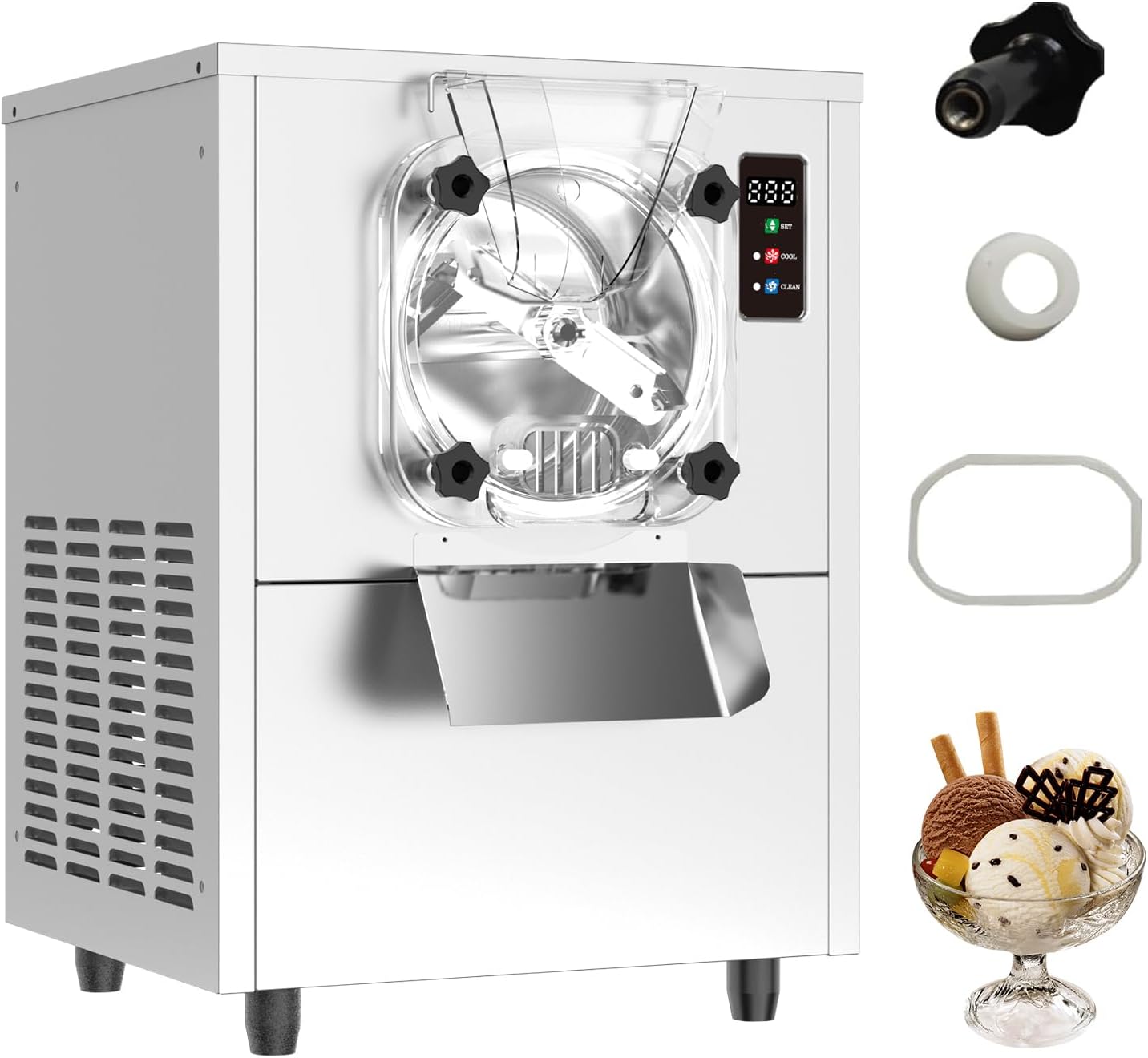
| Capacity | 4.5 liters |
|---|---|
| Operation Mode | Automatic |
| Material | Stainless Steel |
This AnyDoor commercial hard ice cream maker is a stainless steel countertop machine built for producing hard-serve ice cream and gelato in small commercial environments. It uses a built-in compressor and a high-power refrigeration system to freeze mixes quickly into the 4.5-liter cylinder, and the LED panel gives clear status and simple controls for monitoring runs. The machine includes features aimed at frequent use: a high-speed rotating mixer, anti-slip base, see-through lid, and an automatic clean function that helps reduce manual maintenance. Practical benefits include fast throughput—multiple liters per hour—durable food-grade 304 stainless steel contact surfaces, and a compact footprint for bars or cafes. Expect some noise and heat from the compressor during long runs and routine cleaning still requires disassembly and hand washing of parts. For operators who need steady daily production, the machine's solid compressor and straightforward controls make it a dependable choice, though it is intended for professional use rather than casual home entertaining.
Best for: Operators who prioritize a reliable, commercial-grade machine for steady daily production in cafes, snack bars, or small restaurants and need straightforward controls and durable construction.
Less Ideal for: Home users wanting a quiet, low-volume countertop dessert maker or buyers who need a fully hands-off cleaning system.
- Built-in compressor with high-power refrigeration for fast freezing
- Food-grade 304 stainless steel cylinder that resists pressure and is durable
- LED display and simple automatic operation for easy monitoring
- Automatic clean function and see-through lid to simplify maintenance
- Cleaning still requires hand washing of removable parts
- Likely produces noticeable noise and heat during extended operation
Verdict: Choose this AnyDoor unit when you need a compact, factory-quality hard-serve machine that reliably produces continuous batches for a small commercial operation.
FOHERE Commercial Ice Cream Machine 116Y

| Freezing cylinder capacity | 4.5 L |
|---|---|
| Production rate | 16–20 L per hour |
| Power | 1400W |
| Material | Stainless Steel (SUS304) |
| Special features | Automatic Clean, Built-In Timer, Low Noise |
This FOHERE commercial hard-serve ice cream machine is a countertop unit built for small restaurants, cafes, and food trucks that need steady production without a full-size floor machine. It uses a 4.5 L stainless steel freezing cylinder with a high-speed mixer and dual beaters to produce roughly 16–20 liters (4.2–5.3 gallons) per hour, and cycles from 10–35 minutes depending on batch size. The sloped LCD control panel gives straightforward monitoring of time and remaining quantity, plus auto refrigeration, a built-in timer, and a one-button automatic clean that simplifies end-of-shift sanitation. The fully encased SUS304 stainless shell looks durable and resists corrosion in daily commercial use, while the compact footprint helps fit tighter prep lines. Expect strong production and smooth, dense texture from the heavy-duty mixer, but plan for the machine to require a dedicated counter spot and routine service if used heavily; it is a commercial appliance rather than a consumer countertop counterpoint. For buyers wanting reliable, easy-to-operate hard-serve output in a small footprint, this model delivers practical performance and service-oriented features.
Best for: Operators who prioritize steady, restaurant-level hard-serve production and want an easy-to-use, easy-to-clean countertop machine that stands up to daily commercial use and visible customer service.
Less Ideal for: Home cooks or occasional users who need a compact, low-frequency machine or want a low-maintenance domestic unit should consider consumer-grade options instead.
- Commercial-grade SUS304 stainless steel cylinder and shell for durability and corrosion resistance
- Produces about 16–20 L (4.2–5.3 gal) of hard-serve per hour to handle peak service periods
- Sloped LCD control panel with timer, auto refrigeration, and real-time status for easy operation
- One-button automatic cleaning simplifies sanitation and daily maintenance
- Requires substantial counter space and is intended for commercial use rather than occasional home use
- Heavier duty components mean it may need professional servicing if used continuously
Verdict: Choose this FOHERE 116Y when you need a compact, commercial-grade hard-serve machine that reliably produces restaurant-quality batches and makes cleaning simple.
Choosing the Right Commercial Hard-Ice-Cream Ice Cream Maker: Key Factors to Consider
Freeze Speed and Recovery Time
Freeze speed determines how many batches you can produce per hour and directly affects service throughput. Faster initial freeze shortens production cycles during peak periods, while recovery time indicates how quickly the unit returns to operating temperature after a batch finishes. Machines with larger compressors and efficient heat-exchange designs recover faster, reducing downtime between batches and helping you meet continuous demand.
When operators underestimate recovery time, they face bottlenecks during rushes. Consider both the advertised cycle time and real-world recovery under repeated use, since continuous commercial operation stresses the refrigeration system more than intermittent home use.
Batch Size and Consistent Yield
Commercial hard-ice-cream makers are rated by batch capacity, which should match your typical production runs. Too-small batches force more frequent cycles and increase labor; too-large batches can sit too long and risk texture loss if you cannot finish them in time. Equally important is consistent yield: machines should produce predictable volume and overrun so your recipes scale correctly and portion control remains accurate.
Assess how a machine handles different mix consistencies and inclusions such as fruit or mix-ins. Units that maintain consistent churning speed and freeze profile across a range of recipes will make formulation and costing more reliable.
Materials, Construction, and Longevity
Durable construction reduces long-term downtime and service costs. Look for corrosion-resistant finishes, heavy-duty gearboxes, and commercial-grade compressors designed for continuous duty cycles. Thin sheet-metal panels and consumer-grade components may fail quickly under constant use, so prioritize solid frames, reinforced bearings, and proven mechanical parts.
Also consider the machine's operating envelope: units designed for extended runs typically have better thermal management and fewer premature failures. A longer service life offsets higher upfront costs in a commercial setting.
Sanitation, Accessibility, and Food Safety
Sanitation features affect cleaning speed, cross-contamination risk, and overall safety. Removable paddles, smooth interior surfaces, and tool-free access to food-contact components make routine cleaning faster and more thorough. Machines with fewer seams and crevices reduce places where residue can collect.
Check how easily seals, gaskets, and product-contact parts can be removed and replaced. Some commercial environments require frequent cleaning between flavors or shifts, so design choices that speed sanitation translate to more efficient operations and reduced labor burden.
Serviceability and Parts Availability
Rapid access to replacement parts and straightforward service procedures limit downtime. Machines that allow easy access to compressors, drive assemblies, and controls let technicians perform preventive maintenance and repairs quickly. Clear documentation and modular components simplify troubleshooting and part swaps.
Consider local service networks and whether common wear items are standardized across models. Even robust machines need periodic maintenance; units designed with replaceable consumables and easy diagnostics lower total cost of ownership.
Noise, Footprint, and Installation Needs
Noise levels affect employee comfort and customer experience, especially in open-kitchen or shop-floor settings. Compressors and air-cooled condensers can be loud; quieter designs improve the work environment. Also assess the physical footprint of the unit and ventilation needs, since some commercial freezers require clearance for airflow or dedicated electrical circuits.
Plan for installation logistics including drain lines, condensate handling, and any ventilation or clearance specified by the manufacturer. A machine that fits your production area with minimal modifications simplifies deployment and reduces hidden installation costs.
Matching Capacity to Service Patterns
Estimate peak hourly demand and typical batch rhythms before choosing a machine. If you operate shuttle service or have predictable surge periods, prefer units with shorter cycles and rapid recovery to meet bursts without needing multiple machines. For venues with steady, moderate traffic, a machine with a larger batch size but slightly longer cycle time can reduce labor frequency.
- Calculate average scoops per hour and convert that to liters or quarts to choose batch capacity.
- Factor in mix-in additions which can slow freeze times and change yield.
- Consider scheduling production runs during lulls to maintain texture for high-impact service times.
Installation and Utility Requirements
Commercial ice cream machines often require dedicated electrical circuits and adequate ventilation. Check the machine's power rating and whether it uses single or three-phase power. Insufficient power or cramped ventilation will reduce freezing efficiency and increase wear on the compressor.
Plan for drainage and floor load when placing larger units, and confirm clearance recommendations for airflow. Finally, coordinate delivery access and placement to avoid moving heavy machinery through tight doors or sensitive floor coverings.
- Verify electrical supply type and amperage requirements.
- Confirm ventilation clearances and condensate routing options.
- Ensure floor can support machine weight and vibration.
Flavor Rotation and Cross-Contamination Control
If you offer many flavors or frequently rotate seasonal recipes, workflow for flavor changeover matters. Machines that allow complete removal and quick cleaning of product-contact parts make changeovers faster and reduce the risk of flavor carryover. Some operations use separate machines for dairy versus non-dairy lines to avoid allergens crossing between batches.
Develop a documented changeover procedure that includes rinsing, sanitizer cycles, and drying. Staff training and checklists help maintain consistency and food-safety compliance during busy shifts.
- Use color-coded utensils and gaskets to prevent mix-ups.
- Schedule deep-cleaning during low-traffic windows.
- Train staff on allergen-control procedures and product-contact checks.
Operational Maintenance and Preventive Care
Preventive maintenance extends service life and keeps performance predictable. Regularly inspect belts, seals, and drive components, and maintain refrigeration condensers free of dust. Lubricate bearings and replace wear parts on the manufacturer-recommended schedule to avoid unexpected breakdowns.
Track runtime hours and create a maintenance log. Simple practices like keeping incoming mix at consistent temperatures and avoiding overloads reduce mechanical strain and help maintain texture consistency across batches.
- Set a calendar for condenser cleaning and gasket inspection.
- Keep spare wear items on hand to minimize downtime.
- Log issues and repairs to spot recurring problems early.
Control Features and Programmability
Programmable controls and simple operator interfaces make recipe replication easier across shifts. Look for machines that let you store cycle parameters, adjust churning speed, or set target temperatures to match specific formulations. Some units include diagnostics or alerts for maintenance that reduce guesswork when troubleshooting.
While advanced controls are helpful, also verify that basic manual overrides are available for experienced operators to fine-tune texture during production.
- Prefer units with memory for multiple recipes if you run varied menus.
- Look for clear diagnostic readouts and fault codes.
- Ensure controls are intuitive for staff turnover and quick training.
How We Chose the Best Commercial Hard-Ice-Cream Ice Cream Maker
Our selection focused on machines built for sustained, high-volume hard-ice-cream production rather than occasional or soft-serve use. We prioritized units with proven refrigeration systems and consistent batch control, looking for models that maintain target overrun and mix temperatures across repeated cycles. Durability and serviceability were key: we favored designs with accessible components, rugged compressors, and readily replaceable wear parts. We also considered production metrics that directly affect operations, including average cycle time at commercial batch sizes, yield per hour, and the machine's ability to hold product without degrading texture. Sanitation and user safety were judged by material finish, ease of disassembly, and compliance with common commercial foodservice hygiene practices. Noise and energy draw were secondary but tracked because they influence kitchen environment and operating cost. Excluded items included countertop soft-serve machines, non-freezing batch chillers intended for gelato texture, and small domestic mixers. The final picks balance steady throughput, manageable maintenance, and predictable freeze performance for professional environments.
Our full evaluation process is outlined in our review methodology.
FAQ
How often should I deep-clean a commercial hard-ice-cream machine?
Deep cleaning frequency depends on usage, but daily cleaning of product-contact parts is common in high-volume shops. Perform a more thorough service that disassembles and inspects seals, gaskets, and paddles at least weekly or per local health-code requirements.
Can I run different recipes back-to-back in the same machine?
You can, but thorough cleaning between flavors is necessary to avoid flavor transfer and allergen risk. For rapid changeovers, use machines with easily removable product-contact parts designed for tool-free cleaning.
What maintenance tasks can my staff do versus a technician?
Staff can handle routine cleaning, gasket inspections, and basic lubrication following the manufacturer checklist. Technicians should perform compressor service, refrigerant work, gearbox repairs, and any electrical diagnostics requiring specialized tools or certifications.
How do I know if a machine is undersized for my operation?
Signs of undersizing include long queues during peak hours, machines running near-continuously without recovery, and texture problems from overworked compressors. Match estimated hourly output and peak demand to the machine's rated throughput to avoid these issues.
Are there common add-ons that improve commercial performance?
Useful add-ons include additional holding cabinets for finished batches, remote condensers for heat-sensitive spaces, and spare paddle sets for faster flavor changeovers. These accessories help scale throughput without altering the core production machine.
Final Verdict
Choose a Commercial Hard-Ice-Cream Ice Cream Maker by prioritizing the operational metrics that affect daily production: freeze speed and recovery, batch capacity and consistency, sanitation, and access for service. Tradeoffs are normal: faster recovery may mean larger electrical or space requirements, and easier cleaning designs can influence initial cost or footprint. Match the machine to your busiest service windows and cleaning routines, plan for preventive maintenance, and prioritize units with straightforward parts access and clear controls. With those factors balanced, you can select a machine that sustains reliable output and predictable texture for commercial service.