
Note: This article contains affiliate links. If you click on these links and make a purchase, we may earn a small commission at no extra cost to you. This helps support our research and content. Read our full affiliate disclosure here.
If you bake at scale, the oven you choose determines product consistency, throughput, and energy use. A commercial oven for baking must deliver predictable heat, fast recovery between loads, and the capacity to handle the pans and sheet sizes you use every day. This guide covers our shortlisted top picks across common commercial baking needs and explains the tradeoffs between speed, footprint, and uniformity. Read on for the evaluation criteria we used and practical guidance to match a unit to your production volume and kitchen layout.
Top Picks at a Glance
| Best Overall The best all-around choice for most situations | Waring WCO500X Convection Oven |  |
| Best Quality Built to a higher standard if you want something more solid | Kratos 29Y-057 Convection Oven | 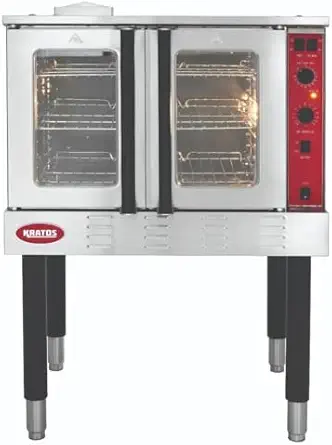 |
| Best Value The sweet spot between price and what you get | CROSSON Double Deck Pizza Oven |  |
| Best Budget The cheapest option that still gets the job done reliably | Winco EPO-1 Pizza Oven |  |
| Top Rated A top-rated pick with lots of positive feedback | AAOBOSI 36 Inch Gas Range Oven |  |
| Most Popular A crowd favorite that many people choose with confidence | VEVOR Commercial Convection Oven 60Qt |  |
| Best Seller A high-volume bestseller chosen again and again | VEVOR Commercial Convection Oven 47L |  |
Waring WCO500X Convection Oven
| Capacity | 1.5 Cubic Feet |
|---|---|
| Wattage | 1700 watts |
| Control Type | Knob Control |
| Number of Shelves | 3 |
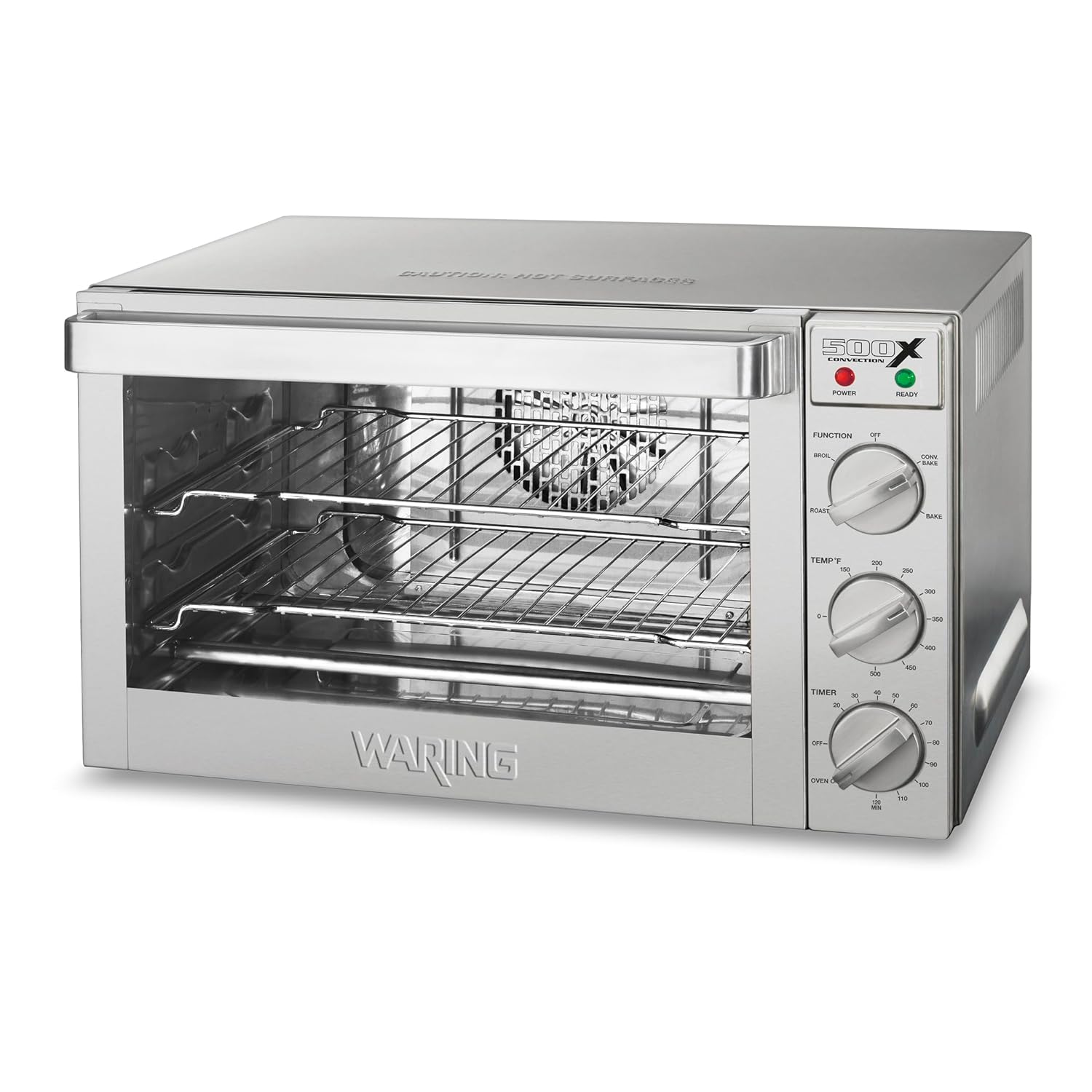
The Waring WCO500X is a half-size sheet pan convection oven designed for light commercial use in cafes, diners, and small kitchens. It provides four cooking modes—convection bake, roast, bake and broil—and includes three adjustable racks and a half-sheet pan so multiple items can be cooked or baked at once. The brushed alloy steel exterior and double-pane tempered glass door make it durable and easy to monitor while cooking, and knob controls plus a 1700-watt power rating keep operation straightforward for busy staff. For baking it delivers consistent browning thanks to the convection airflow and the adjustable racks let you manage batch sizes and spacing. Limitations include a compact interior that suits small batch baking rather than high-volume production and basic knob controls that lack programmable timers or digital precision found on larger ovens. Cleaning and maintenance are simple, and the unit's portable footprint helps businesses add baking capacity without a full kitchen retrofit.
Best for: Buyers who need a compact, durable convection oven that delivers reliable, even baking for small commercial operations or tight kitchen spaces and prioritize straightforward, robust equipment over advanced controls.
Less Ideal for: Large bakeries or high-volume commercial kitchens that require full-sheet capacity, programmable controls, or higher throughput should choose a larger, more automated oven solution.
- Four cooking modes (convection bake, roast, bake, broil) for flexible kitchen use
- Includes three adjustable racks and a half-size sheet pan for small-batch baking
- Durable brushed alloy steel construction with tempered glass door for visibility
- Simple knob controls and 1700-watt power make setup and operation quick
- Interior is compact and best suited to small-batch or light commercial baking rather than high-volume production
- Control panel is basic with no digital programming or advanced timer features
Verdict: A compact, heavy-duty convection oven that reliably delivers small‑batch commercial baking with simple, durable controls.
Kratos 29Y-057 Convection Oven

| Heating Method | Convection |
|---|---|
| Wattage | 11 KW |
| Voltage | 240 volts |
| Timer Function | Timer Function Available |
The Kratos 29Y-057 is a commercial single-deck electric convection oven built for high-volume baking and foodservice kitchens. It uses forced hot-air convection with an 11 kW heating system and a 1/2 HP two-speed fan to deliver even heat and consistent results across full-size sheet pans. The stainless steel cabinet, tempered double-pane viewing window, interior light, and cool-touch handles make it practical for constant use while helping staff monitor baking without opening the door. Controls are straightforward with a 30-minute timer and a wide temperature range from 150 to 500 F, which covers most baking needs from proofing to high-heat finishing. The oven ships with three adjustable racks on 11 pan slides, so it accepts full-size sheet pans and handles multiple trays at once. Important considerations are that it requires hardwiring to a 240V single-phase supply and professional installation, and at 360 pounds it is a permanent, floor-installed unit rather than a movable countertop oven. For bakeries and commercial kitchens prioritizing throughput and even bake quality, it is a workhorse option.
Best for: Bakers and commercial kitchens that need a reliable, high-throughput convection oven for full-size sheet pans and consistent batch baking.
Less Ideal for: Small cafes or mobile operations that lack 240V wiring or need a portable countertop oven should look at compact or lower-voltage alternatives.
- Powerful 11 kW heating with forced convection and two-speed fan for even, fast baking
- Accepts full-size sheet pans with three adjustable racks and 11 built-in pan slides
- Durable stainless steel construction with tempered double-pane window and interior light for visibility
- Wide temperature range (150 to 500 F) and simple controls including a 30-minute timer
- Requires 240V single-phase hardwired installation by a qualified electrician
- Heavy and large footprint intended for permanent floor installation, not portable use
Verdict: A heavy-duty, full-size electric convection oven built for bakeries and commercial kitchens that need consistent, high-volume baking performance.
CROSSON Double Deck Pizza Oven

| Wattage | 3.2 KW |
|---|---|
| Power Source | electric |
| Temperature Range | 175 – 660 °F |
| Number of Shelves | 2 |
| Included Components | Pizza Stone |
This stainless steel double-deck countertop oven is built for commercial kitchens that need quick, repeatable pizza results. Each deck has its own 1600 W heating circuit, independent temperature knobs and a 60-minute audible timer so you can run two orders at different settings without swapping pans. The full-cavity heating elements and included pizza stones promote even browning so thin-crust pies reach finished texture in 6 to 8 minutes at higher temperatures, and the interior lights and viewing windows let you monitor without opening doors. The unit is heavily insulated to keep the exterior cooler and reduce heat loss, and its commercial-grade construction and ETL listings target heavy daily use. Expect a large, heavy footprint and significant electrical draw that requires appropriate circuit capacity and counter space, and note the oven is optimized for 16-inch pizzas and thin-crust baking rather than large-sheet or pan-style breads.
Best for: Small restaurants, pizzerias, and high-volume caterers who prioritize consistent, fast thin-crust baking and want a durable countertop oven that can run two different items at once.
Less Ideal for: Home cooks with limited counter space or single 15A circuits and operators who primarily bake large-sheet breads or thick-crust pizzas.
- Independent upper and lower deck temperature controls for simultaneous, different jobs
- Powerful 3200 W total output and full-cavity heating elements for fast, even cooking
- Commercial-grade stainless steel construction and full insulation for durability and stable interior temps
- Includes pizza stone and oven light with viewing window for better bake control
- High electrical draw and two plugs require sufficient circuit capacity
- Large, heavy countertop footprint reduces mobility and needs substantial counter space
Verdict: A rugged, double-deck countertop oven engineered to deliver fast, consistent thin-crust pizza results for busy commercial kitchens.
Winco EPO-1 Pizza Oven

| Wattage | 1500 watts |
|---|---|
| Power Source | AC, 120V, 60Hz |
| Capacity | 12 cubic inches |
| Control Type | Knob Control |
The Winco EPO-1 is a straightforward commercial countertop pizza oven built for small restaurants, concession stands, and busy home cooks who need a reliable, compact baking appliance. It uses two heating elements and 1500 watts of power to reach and hold baking temperatures quickly, and the pull-out tray and removable crumb tray make cleanup simple. A 60-minute mechanical timer with bell and a stay-on switch let you run timed batches or continuous cooking during service. The stainless steel exterior holds up in a light commercial setting and the oven fits a 12” pizza, breadsticks, and similar items. Limitations include its modest internal capacity that restricts output to one pizza at a time and basic knob controls without precise digital temperature readouts, so achieving repeatable results may require some operator adjustment. For kitchens that need a durable, no-frills pizza oven that heats evenly and is easy to maintain, this model performs well.
Best for: Small commercial operators or budget-minded kitchens that need a durable, compact oven to bake single pizzas and similar items reliably during regular service.
Less Ideal for: High-volume pizzerias that require larger capacity or precise digital controls for repeatable multi-pizza production.
- Dual heating elements for faster, more even baking
- Commercial stainless steel construction suitable for light commercial use
- 60-minute timer plus stay-on switch for both batch and continuous operation
- Removable crumb tray and pull-out tray for easy cleaning
- Interior capacity only fits one 12-inch pizza at a time
- Mechanical knob controls lack precise digital temperature display
Verdict: A rugged, no-frills countertop pizza oven that delivers even baking for single 12-inch pizzas at a budget-conscious commercial scale.
AAOBOSI 36 Inch Gas Range Oven

| Capacity | 6 cubic feet |
|---|---|
| Number of Heating Elements | 6 |
| Voltage | 120 volts |
| Heating Element | Sealed |
This AAOBOSI 36-inch gas range pairs a large 6 cu ft convection oven with a six-burner sealed cooktop intended for heavy use in kitchens that need capacity and versatility. The oven supports baking, convection roasting, air fry-style circulation, grilling, and timed or delayed cooking, and includes two racks, two baking pans, an internal temperature probe and a convection fan for more even results across large batches. The cooktop offers a range of outputs from high-power 22,000 BTU to a low 3,500 BTU simmer burner and removable cast-iron grates that are dishwasher-safe for easier cleanup. Controls combine knobs and touch functions while the oven door uses triple-glazed glass and an insulated handle to reduce surface heat. Practical limitations are that the unit is large and heavy so it needs proper installation space and professional gas hookup, and smart features are oriented to convenience rather than advanced commercial controls. For bakery-minded kitchens this model emphasizes capacity, robust burners, and straightforward, serviceable construction rather than boutique or software-driven features.
Best for: Bakeries or busy home chefs who prioritize a durable, high-capacity oven for frequent batch baking and reliable, serviceable hardware.
Less Ideal for: Small kitchens, occasional home bakers, or operations needing advanced programmable commercial controls or a compact footprint should look elsewhere.
- Large 6 cu ft oven capacity suitable for baking multiple trays at once
- Convection fan and temperature probe for more even, consistent baking
- Six sealed burners with a wide BTU range for flexible stovetop cooking
- Stainless steel build and removable cast-iron grates that simplify cleaning
- Includes useful accessories: baking pans, racks and a gas converter for NG/LPG
- Requires substantial installation space and professional gas hookup due to size and weight
- Control set is practical but not tailored to advanced commercial automation or programmability
Verdict: Buy this if you need a heavy-duty, high-capacity gas range that delivers even convection baking and rugged, easy-to-service hardware for frequent commercial-style use.
VEVOR Commercial Convection Oven 60Qt
| Wattage | 1800 watts |
|---|---|
| Temperature Range | 65-250 °C |
| Number of Shelves | 4 |
| Capacity | 60 quarts |
| Power Source | ac |
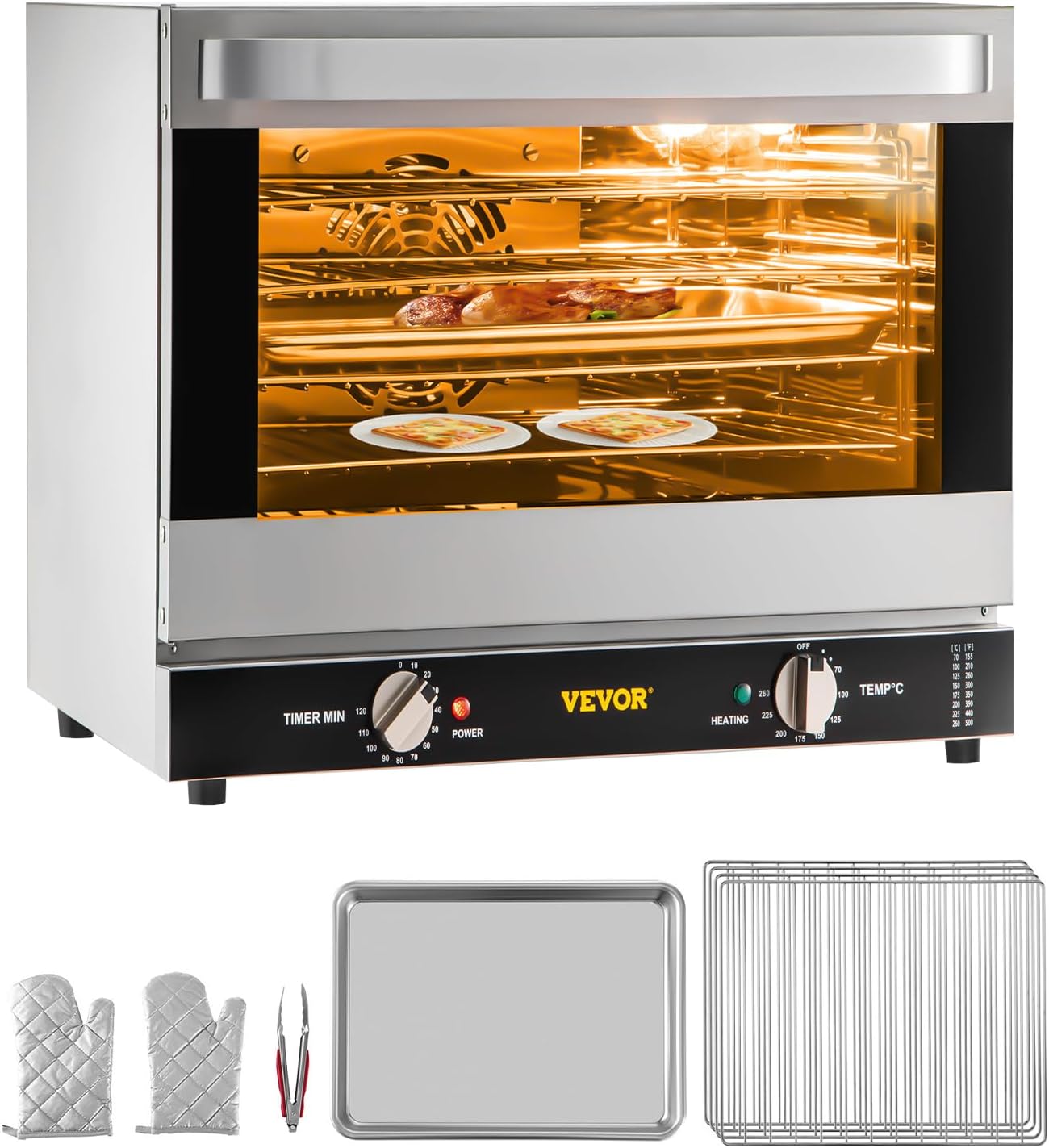
This VEVOR 60Qt commercial convection oven is a heavy-duty countertop unit aimed at small bakeries, cafes, and busy home cooks who need to bake batches reliably. It uses an 1800W heater with a fan to circulate hot air across four wire-rack levels so you can run multiple trays of pastries, pizzas, or roast chickens at once. Controls are simple knob dials for temperature and a 0–120 minute timer, and the stainless steel body plus dual-wall tempered glass door make the interior easy to monitor and wipe down. The unit ships with four racks, a baking tray, a bread clip and heat-resistant gloves so you can start baking right away. Expect fast, even browning thanks to the convection fan, but note the controls are manual knobs rather than digital presets so exact repeatable programming is limited. The oven is sizable for a countertop footprint and needs a dedicated 120V 5-15P outlet. For kitchens that want reliable, pro-style baking capacity without complex electronics, this is a practical option.
Best for: Buyers who prioritize proven performance and visible social proof and want a solid, no-frills convection oven for regular batch baking in a small commercial or busy home kitchen.
Less Ideal for: Those seeking compact travel-friendly units, fully digital programmable ovens, or owners who need an oven with smart/Wi‑Fi controls should look elsewhere.
- Large 60 qt (66 L) interior with four shelves for batch baking
- Convection fan delivers more even heat and faster browning than static ovens
- Durable stainless steel body and tempered glass door for easy cleaning and monitoring
- Includes useful accessories: four wire racks, a tray, bread clip and heat-resistant gloves
- Knob controls lack digital presets or precise programmable cycles
- Requires a full countertop space and a dedicated 120V 5-15P outlet
Verdict: A practical, workhorse countertop convection oven that delivers reliable batch baking with durable construction and straightforward controls.
VEVOR Commercial Convection Oven 47L

| Capacity | 43 quarts |
|---|---|
| Wattage | 1600 watts |
| Temperature Range | 155-500 °F |
| Number of Shelves | 4 |
| Control Type | Knob Control |
This VEVOR commercial convection oven is a compact half-size countertop unit aimed at small restaurants, bakeries, and busy home kitchens that need reliable medium-batch baking. The 1600W heater and forced-air fan circulate heat across four tiers, which helps produce even browning on pizzas, breads, pastries, and sheet-pan items while cutting cook times compared with still-air ovens. Controls are simple two-knob settings for temperature (155-500°F) and a 0-120 minute timer, so it is straightforward to operate and troubleshoot. The stainless steel body, tempered glass door, magnetic seal, and included wire racks and tray make it easy to clean and get into service quickly. Trade-offs are minimal but practical: the manual knob controls mean fewer preset programs or digital precision, and the unit requires a substantial counter footprint for a commercial space. For buyers who prioritize durability and predictable performance in a shop environment, this oven delivers a practical, no-frills solution.
Best for: Shops and bakers who want a sturdy, easy-to-use countertop convection oven for consistent medium-batch production without complex digital controls.
Less Ideal for: Operators who need precise digital programmability, touchscreen presets, or a very compact unit for tight countertops should consider other models.
- Four-tier 47L interior supports medium-batch baking on multiple racks
- 1600W convection fan promotes faster, more even cooking than conventional radiant ovens
- Durable stainless steel construction with tempered glass door for visibility and easy cleaning
- Includes useful accessories (wire racks, tray, bread clip, heat-resistant gloves) for immediate use
- Basic knob controls lack digital presets and fine temperature programming
- Requires a significant counter footprint for smaller kitchens
Verdict: A durable, no-frills 47L convection oven that delivers reliable, even medium-batch baking for risk-conscious commercial operators.
Choosing the Right Commercial Oven for Baking: Key Factors to Consider
Temperature Control and Stability
Precise temperature control is essential for repeatable bakes. Small fluctuations can change crumb structure, oven spring, and browning, so look for tight thermostatic control, digital setpoints, and even heat distribution.
Stability matters under load. Commercial operations often move multiple trays at once, so the oven needs to recover to setpoint quickly and maintain even heat across racks to avoid having to rotate pans mid-bake.
Heat Recovery Time
Recovery time measures how fast an oven returns to the target temperature after the door opens or a cold load is added. Faster recovery supports higher throughput and reduces cycle time between batches.
Consider how many pans or racks you bake per hour. If you run continuous batches, prioritize ovens with higher power ratings and airflow designs that reestablish temperature quickly to avoid inconsistent results.
Capacity and Interior Layout
Capacity is more than cubic feet. The usable rack spacing, number of pans per rack, and whether the oven accepts standard sheet pan sizes determine real productivity.
Think about your typical pan types and how you stage product. An oven with flexible shelving or adjustable rack positions will adapt to different recipes and allow you to optimize spatial efficiency without overcrowding trays.
Humidity and Steam Options
Steam control affects crust formation, oven spring, and surface finish on breads and laminated doughs. Some commercial units have injected-steam systems, while others rely on steam trays or manual methods.
Choose an oven with reliable and controllable humidity if you bake artisan breads or high-moisture pastries. The ability to add measured steam early in the bake and vent later helps you achieve consistent crust and volume.
Airflow and Heat Distribution
An oven's airflow design—convection fans, impingement, or radiant elements—shapes how heat moves around pans and influences color and texture uniformity.
Even with accurate temperature control, poor airflow creates hot and cold spots. For mixed loads or multi-rack baking, favor designs that promote uniform circulation so you can run full loads without constant pan rotation.
Serviceability and Cleaning
Commercial kitchens demand equipment that is easy to maintain. Look for accessible service panels, removable racks and crumb trays, and surfaces that withstand frequent cleaning.
Reduced downtime and simpler maintenance procedures lower operating costs. Also consider the availability of replaceable parts and how the oven's design affects daily sanitation workflows.
Types of Commercial Ovens and How They Affect Bakes
Commercial baking ovens come in several functional types, each with distinct heat characteristics. Deck-style ovens use stacked baking chambers that provide strong radiant heat and are often favored for artisan breads and items that benefit from direct radiant browning. Convection ovens circulate air with fans to promote faster and more even baking, which is helpful for cookies, sheet cakes, and multi-rack loads. Conveyor or rack ovens are designed for continuous production with moving racks, offering high throughput and repeatable results for larger operations.
Select the type that matches your core products. For rotating menus or mixed pastry production, convection models usually offer the most flexibility. For specialty breads where crust and oven spring are paramount, a deck oven or a model with steam injection can deliver better results.
- Deck ovens: strong radiant heat, good for hearth-style loaves
- Convection ovens: even circulation, best for multi-rack baking
- Rack/conveyor ovens: optimized for high-volume continuous production
Sizing Your Oven for Production Volume
Estimate peak hourly output and match oven capacity to that throughput instead of average output. Underpowered ovens create bottlenecks and force schedule compromises. Count how many sheet pans or racks you need to bake per hour and account for load and recovery time when sizing equipment.
Also factor in kitchen footprint, ventilation requirements, and staging space for cooling and handling. A larger oven may reduce batch frequency but increase energy use and require more ventilation infrastructure.
- Calculate peak pans per hour, not daily totals
- Consider door swing and clearance for loading
- Check compatibility with your pan and rack dimensions
Controls, Programmability, and Recipe Consistency
Digital controls and programmable recipes make it easier to reproduce results across shifts. Look for straightforward interfaces that lock settings, store multiple programs, and allow fine control of steam, fan speed, and ramp rates. These features reduce variation when different staff members operate the oven.
Programmability also supports batch scaling. Save configured cycles for common products so you can maintain consistent bake profiles even during busy service periods.
- Programmable cycles for repeatability
- Controls that log or display current bake status
- User access levels to prevent accidental changes
Ventilation and Kitchen Integration
Commercial ovens affect kitchen ventilation and heat load. Ensure your hood and exhaust system can handle the oven type you choose. Some high-capacity units require dedicated ducting or greater makeup air to maintain kitchen comfort and safety.
Plan for service clearance and utility access. Gas ovens need proper gas supply sizing and venting, while electric ovens require adequate electrical capacity and breaker provisioning.
- Confirm hood and exhaust compatibility
- Allow clearance for maintenance and airflow
- Verify utility supply meets oven specifications
Energy Use and Long-Term Operating Costs
Energy efficiency influences long-term costs and can affect the oven's ability to hold temperature during heavy use. Consider insulation quality, control precision, and how quickly the oven meets and maintains set temperatures. Efficient models often pay back in lower utility consumption and more stable bake conditions.
Also weigh the tradeoffs between higher power ratings that shorten recovery time and their additional energy draw. For very high-volume operations, spending on better recovery performance can be operationally worthwhile.
- Insulation and door seals reduce heat loss
- Higher wattage or BTU supports faster recovery
- Monitor real-world energy use in your production mix
How We Chose the Best Commercial Oven for Baking
We focused on the features that directly affect commercial baking outcomes and day-to-day kitchen operations. Key evaluation criteria included temperature control and stability, which determines how evenly goods brown and whether recipes translate from test batches to full racks; heat recovery time, which affects throughput during busy service periods; usable capacity and rack configuration, since oven geometry and tray spacing change yields and workflow; humidity and steam capability, which is critical for crust development on breads and certain pastries; energy efficiency and airflow design, to estimate operating costs and the oven's ability to maintain setpoints under load; and ease of cleaning and maintenance, because downtime and sanitation burden matter in commercial kitchens. We excluded units that lack professional-grade temperature control, inadequate capacity for common sheet pan sizes, or that are intended only for light domestic use. Our list favors ovens that balance consistent bake results with practical serviceability. Technical specs, real-world fit for common commercial tray sizes, ventilation needs, and control precision were prioritized. Units with poor access for cleaning, limited spare-part support, or unclear humidity control were not considered for inclusion.
Our full evaluation process is outlined in our review methodology.
FAQ
How much recovery time should I expect from a commercial baking oven?
Recovery time varies by oven type and power rating. For busy commercial use, aim for models specified with fast recovery or high power ratings. Typically, good commercial units recover quickly enough to sustain continuous batches without significant temperature drop.
Do I need steam injection for artisan breads?
Steam injection helps with crust development and oven spring, so it is beneficial for many artisan breads. If your menu emphasizes crusty loaves or laminated doughs, choose an oven with reliable and controllable steam capability or plan a consistent manual steam method.
Can I use a convection commercial oven for all bakery items?
Convection ovens are versatile and work well for many pastries, cookies, and multi-rack items. However, certain hearth-style breads may perform better in radiant or deck-style ovens, especially when steam control is needed for crust characteristics.
How should I size an oven for my bakery's peak hours?
Size based on peak hourly demand. Calculate how many pans or racks you must produce during the busiest hour and include recovery time between loads. This ensures you avoid bottlenecks during service peaks.
What maintenance matters most for commercial baking ovens?
Regular cleaning of racks, trays, and interior surfaces, routine inspection of door seals, and scheduled checks of fans and heating elements are key. Easy access for service reduces downtime and keeps temperature performance consistent.
Final Verdict
Choosing the right commercial oven for baking means balancing capacity, heat behavior, and the control features that keep batches consistent. Prioritize temperature stability and recovery time if you run frequent batches, or value humidity control and radiant heat for artisan bread production. Factor in usable interior layout, serviceability, and ventilation requirements to match the oven to your kitchen. Make decisions based on the products you bake most often and your peak throughput needs. That focus will help you select a unit that delivers reliable, repeatable results and minimizes operational friction.