
Note: This article contains affiliate links. If you click on these links and make a purchase, we may earn a small commission at no extra cost to you. This helps support our research and content. Read our full affiliate disclosure here.
If you run a professional kitchen, the right Commercial Oven makes the difference between on-time service and chaotic prep. You need equipment that holds steady temperatures, stands up to heavy daily use, and fits your menu and kitchen workflow. This guide shortlists the top options for commercial cooking and baking, focusing on consistent heat, uptime, and ease of use so you can choose an oven that meets production demands. Below are our top picks for commercial ovens across common professional needs, followed by the evaluation criteria we used. Use these recommendations and the detailed buying guidance to narrow choices based on capacity, installation, and maintenance requirements.
Top Picks at a Glance
| Best Overall The best all-around choice for most situations | KoolMore Commercial Countertop Convection Oven KM-CTCO-44 |  |
| Best Quality Built to a higher standard if you want something more solid | Moffat Turbofan E23 |  |
| Best Budget The cheapest option that still gets the job done reliably | VEVOR Commercial Convection Oven 19Qt |  |
| Top Rated A top-rated pick with lots of positive feedback | Avantco CO-14 Quarter Convection Oven |  |
| Most Popular A crowd favorite that many people choose with confidence | Waring WCO500X Convection Oven |  |
| Best Seller A high-volume bestseller chosen again and again | VEVOR Commercial Convection Oven 60Qt |  |
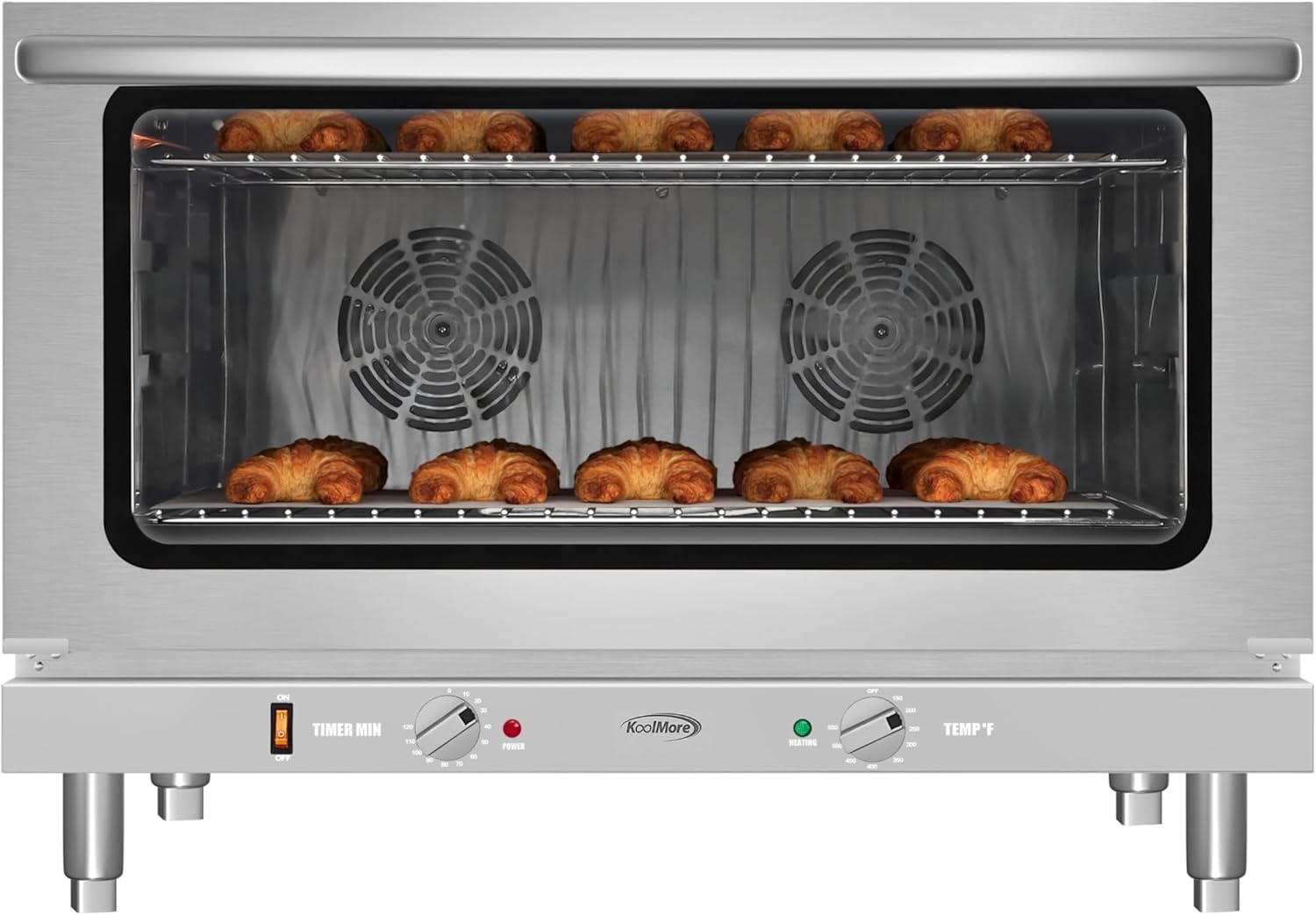
KoolMore Commercial Countertop Convection Oven KM-CTCO-44
| Wattage | 3500 watts |
|---|---|
| Power Source | Electric |
| Temperature Range | 0-550 °F |
| Number of Shelves | 4 |
| Capacity | 4.4 cubic feet |
This KoolMore countertop convection oven is a heavy-duty unit aimed at low-volume commercial kitchens, coffee shops, and bakeries that need full-size pan capacity without a built-in installation. It holds four full-size racks in a 4.4 cu. ft. chamber and uses convection heat driven by a 3500W electric element to deliver faster, more even cooking across multiple pans. Controls are simple dial-style settings and the temperature range goes up to 550°F, which covers baking, roasting, and reheating tasks common in a small commercial setting. The stainless-steel body and tempered glass door feel durable and the drop-down door makes loading pans straightforward. Downsides to plan for are the unit weight and footprint, which are substantial for a countertop appliance, and the basic dial controls lack programmable presets for repeat production runs. It is best used where sturdy, even performance and full-size pan capacity matter more than compactness or advanced digital controls.
Best for: Buyers who need a durable, high-capacity countertop oven for a small commercial operation and value even convection cooking and full-size pan capacity over compact size or advanced controls.
Less Ideal for: Home cooks with limited counter space or operations that require programmable, repeatable digital controls should consider other options.
- Holds four full-size racks so multiple pans can cook simultaneously
- High-power 3500W electric heating for faster, even convection cooking
- Wide temperature range up to 550°F for baking, roasting, and reheating
- Stainless-steel construction and tempered glass door built for commercial use
- Large and heavy for a countertop unit, requiring sturdy support and space planning
- Dial-only controls mean no programmable timers or digital presets for production consistency
Verdict: Choose this oven when you need a durable, high-power countertop convection unit that handles full-size pans and consistent, even cooking in small commercial kitchens.
Moffat Turbofan E23

| Power Source | Electric |
|---|---|
| Number of Shelves | 3 |
| Control Type | Knob Control |
| Capacity | 24 inches |
The Moffat Turbofan E23 is a compact, full-size countertop convection oven built for steady commercial use. It cooks with an internal blower that promotes even airflow across three 1/2-size sheet pans and offers a mechanical thermostat from 150°F to 500°F plus a 60-minute timer for straightforward temperature and time control. The stainless steel exterior, porcelain-lined interior and twin-pane glass pull-down door make it durable and relatively easy to clean in a busy kitchen. Manual knob controls mean there is no learning curve and fewer electronics to fail, which suits high-volume back-of-house environments that prioritize reliability and consistent bake results. It is NSF and cETLus certified, so it meets commercial safety and sanitation standards, but it is a single-deck, manually controlled unit so it lacks digital programming, multi-stage cooking, or the expanded capacity of larger stacked or combi ovens. For teams that need solid convection performance in a small footprint, the E23 delivers dependable, even baking without unnecessary complexity.
Best for: Kitchen operators who want a reliable, no-frills countertop convection oven that delivers consistent bake performance and is easy to maintain.
Less Ideal for: Operators who need large throughput, digital programming, multi-step baking cycles, or combi functionalities should consider larger or feature-rich models.
- Even airflow suitable for three 1/2-size sheet pans for consistent baking results
- Wide mechanical thermostat range (150°F–500°F) and 60-minute timer for precise manual control
- Durable stainless steel exterior and porcelain-lined interior for easy cleaning and longevity
- cETLus and NSF certifications that meet commercial safety and sanitation standards
- Manual knob controls with no digital programming or presets
- Single-deck capacity limits throughput compared with larger stacked or combi ovens
Verdict: A compact, dependable countertop convection oven built for consistent commercial baking performance with simple manual controls.
VEVOR Commercial Convection Oven 19Qt

| Capacity | 19 quarts |
|---|---|
| Wattage | 1440 watts |
| Number of Shelves | 3 |
| Control Type | Knob Control |
The VEVOR Commercial Convection Oven is a compact 3‑tier countertop oven built for small commercial kitchens, kiosks, or busy home cooks who need extra baking capacity. It uses a 1440W heater and an internal fan to circulate hot air for faster, more even baking across the three wire racks, and simple knob controls let you set temperature and time without a digital learning curve. The stainless steel exterior, tempered glass door and included accessories (tray, racks, bread clip and heat gloves) make it ready for immediate use and reasonably easy to keep clean. Practical touches like a magnetic sealing strip, oven light and cool-touch handle improve daily operation. Limitations include its modest 19 qt/21 L capacity, which is best for small batches rather than high-volume production, and the basic knob control means fewer precision features compared with pricier programmable models. For buyers focused on value, it delivers solid convection performance and commercial styling at a lower price point.
Best for: Buyers who need a budget-friendly, compact commercial-style oven for small-batch baking or a busy countertop in a cafe, concession stand, or home kitchen.
Less Ideal for: Large restaurants or high-volume catering operations that require full-size ovens or faster throughput should choose larger commercial units instead.
- Three internal shelves for simultaneous small-batch cooking
- 1440W with convection fan for faster, more even baking
- Durable stainless steel body and tempered glass door for easy cleaning
- Includes useful accessories (wire racks, tray, bread clip, heat-resistant gloves)
- Capacity is limited to small batches suitable for 1–3 people or light commercial use
- Controls are basic knob dials without advanced digital programming
Verdict: A value-oriented countertop convection oven that gives small businesses and home cooks reliable, even baking without the premium price.
Avantco CO-14 Quarter Convection Oven

| Capacity | 0.8 cubic feet |
|---|---|
| Wattage | 1440 watts |
| Temperature Range | 150°F–500°F |
| Number of Shelves | 3 |
The Avantco CO-14 is a small commercial countertop convection oven intended for light-duty foodservice tasks where space is limited. It uses a 1440W forced-air system to deliver even cooking across up to three quarter-size sheet pans on the included wire racks, and simple knob controls and a built-in timer keep operation straightforward for busy back-of-house environments. The oven covers a wide temperature range from 150°F to 500°F, so it can handle proofs through high-heat baking and finishing, and its stainless steel exterior is easy to clean. Practical benefits include compact footprint for tight counters, ETL sanitation listing for commercial use, and a standard 120V NEMA 5-15P plug that avoids the need for special wiring. Expect limited interior volume relative to full-size equipment, and because it runs on 120V power it will not match the capacity or continuous heavy-load performance of larger 208/240V commercial ovens. For kitchens that need a reliable, small convection unit for prep, finishing, and low-to-moderate throughput, the CO-14 is a sensible option.
Best for: Operators who need a dependable, compact convection oven for light to moderate commercial use and value straightforward controls and easy cleaning.
Less Ideal for: High-volume kitchens or operations that require large batch cooking or continuous heavy-duty baking should choose larger 208/240V commercial ovens instead.
- Compact quarter-size footprint fits small counters and tight kitchens
- Convection forced-air system promotes even cooking across three 1/4 sheet pans
- Wide adjustable temperature range from 150°F to 500°F for versatile cooking
- Stainless steel exterior is durable and simple to wipe down
- Plug-and-play 120V NEMA 5-15P connection avoids special electrical work
- Interior capacity is limited compared with full-size commercial ovens
- 120V power and 1440W rating limit continuous high-throughput performance
Verdict: A reliable, space-saving countertop convection oven that delivers even cooking and easy operation for low- to mid-volume commercial kitchens.
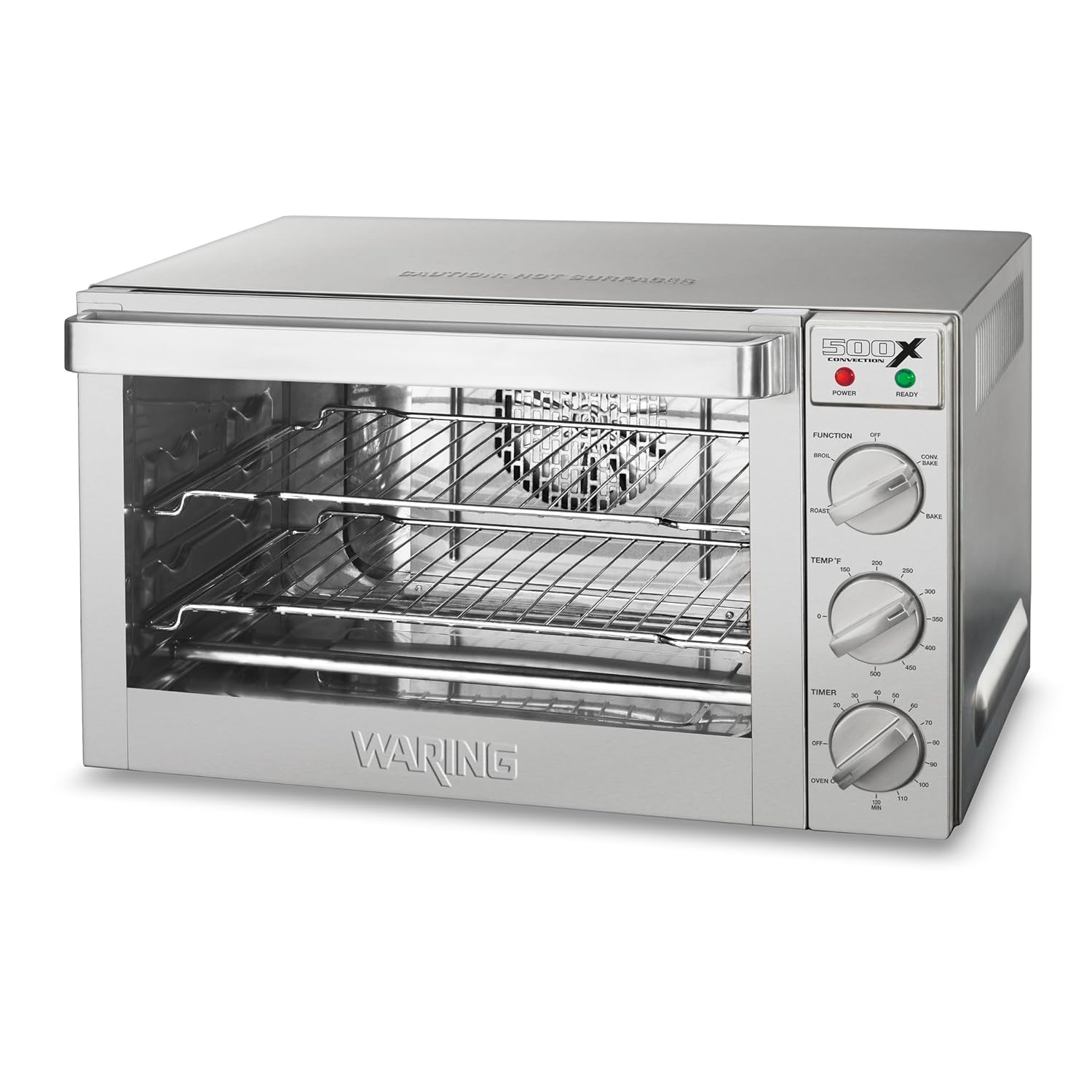
Waring WCO500X Convection Oven
| Capacity | 1.5 Cubic Feet |
|---|---|
| Wattage | 1700 watts |
| Control Type | Knob Control |
| Number of Shelves | 3 |
| Included Components | 3 baking racks, 1 half-size sheet pan |
The Waring WCO500X is a half-sheet pan convection oven built for small commercial kitchens, cafés, and food service counters that need a compact, heavy-duty cooker. It provides four cooking modes—convection bake, roast, bake and broil—across three adjustable rack positions, so you can handle pizzas, roasts, breads and sheet-pan batches with even heat circulation. The brushed alloy steel exterior and tempered glass dropdown door feel rugged and are straightforward to wipe down after service, while the knob controls keep operation simple for busy staff. At 1700 watts it heats quickly for short production runs, though the half-sheet capacity means it is best suited to smaller volumes rather than large-batch cooking. The oven is portable enough to reposition on a counter but may be heavy for frequent moves. If you want a no-frills, durable countertop convection oven that performs core commercial tasks reliably, the WCO500X delivers a practical blend of power, visibility and easy cleaning, with the expected size limits of a half-sheet unit.
Best for: Kitchen operators who need a compact, durable countertop convection oven for light to moderate commercial use and value straightforward controls and easy cleaning.
Less Ideal for: High-volume restaurants or catering kitchens that require full-size or larger-capacity ovens for continuous large-batch production.
- Multiple cooking modes (convection bake, roast, bake, broil) for versatile kitchen use
- Three adjustable racks and included half-size sheet pan for flexible batch sizes
- Durable brushed alloy steel construction and tempered glass door for easy cleaning and visibility
- Simple knob controls and 1700 watt power for quick heat-up and straightforward operation
- Half-sheet capacity limits output for higher-volume commercial operations
- Relatively heavy for a countertop unit, reducing portability for frequent moves
Verdict: Choose the WCO500X when you need a rugged, easy-to-use half-sheet commercial convection oven that reliably handles small to moderate production tasks.
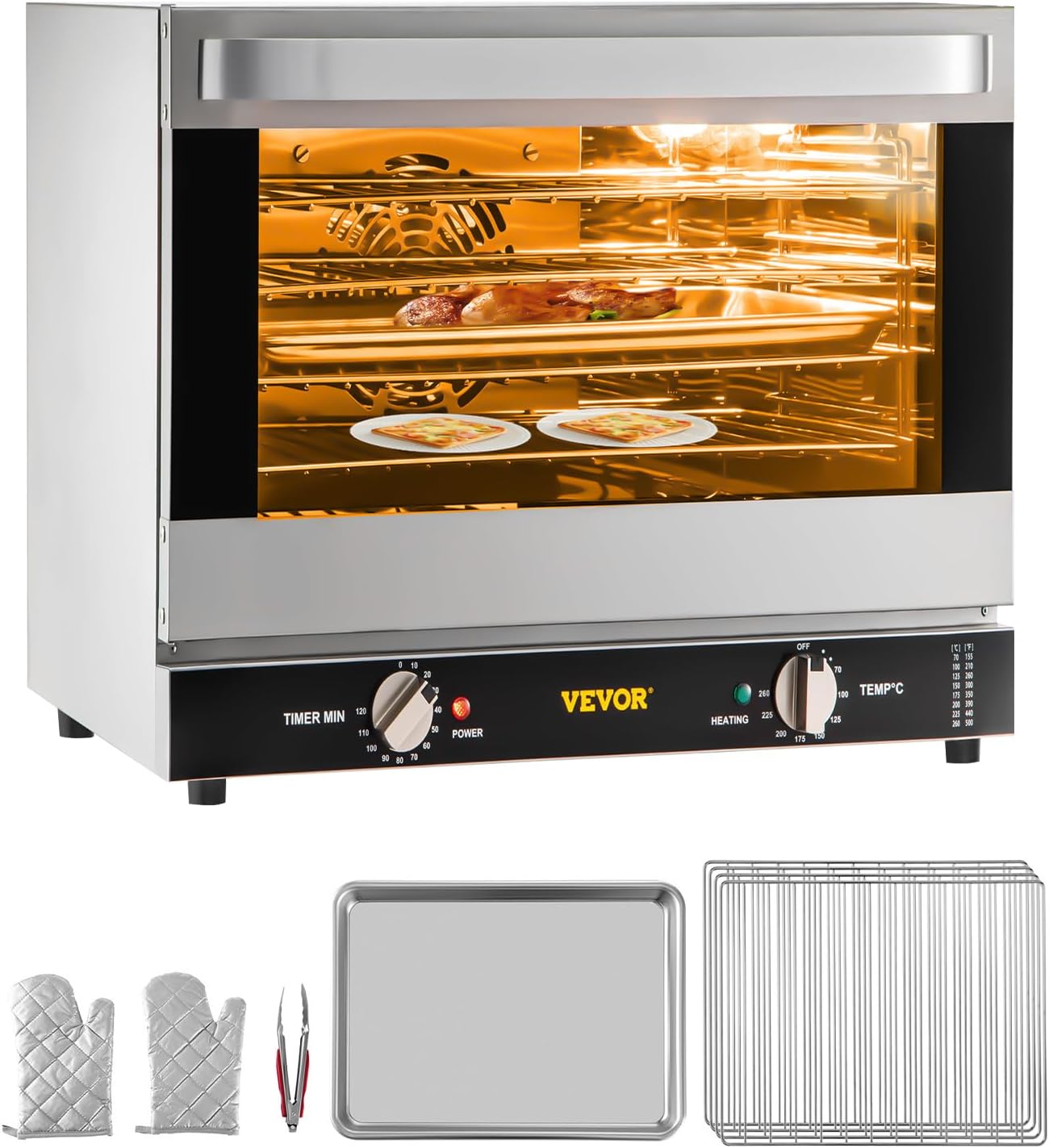
VEVOR Commercial Convection Oven 60Qt
| Wattage | 1800 watts |
|---|---|
| Temperature Range | 65-250 °C |
| Number of Shelves | 4 |
| Capacity | 60 quarts |
| Control Type | Knob Control |
This VEVOR commercial convection oven is a sturdy countertop unit aimed at small commercial kitchens or busy home bakers who need extra capacity. It uses an 1800W heater and an internal fan to circulate hot air across four wire-rack tiers, so you can bake pizzas, breads, pastries, and roasted proteins in larger batches than a typical home toaster oven. Controls are simple two-knob dials for temperature (65–250°C) and a 0–120 minute timer, which makes operation straightforward and reduces the learning curve for staff. The stainless steel exterior and tempered glass dual-wall door feel durable and are easy to wipe down, and included accessories (racks, tray, bread clip, gloves) mean it is ready to use out of the box. Expect even heating for most bakes, though knob controls lack digital precision and there is no advanced programming beyond the timer. The unit is sizable for a countertop and requires a standard 5-15P outlet and adequate ventilation in commercial settings.
Best for: Buyers seeking a reliable, no-frills commercial countertop oven that can handle larger batch baking with simple controls and durable construction.
Less Ideal for: If you need precise digital programming, touchscreen control, or a very compact home toaster oven, a smaller or digitally controlled model would be a better choice.
- Large 60‑quart interior with four shelves for baking multiple trays at once
- Fan-forced convection delivers more even, faster cooking than non-convection ovens
- Durable stainless steel body and tempered glass door for easy cleaning and visibility
- Includes practical accessories (wire racks, baking tray, bread clip, heat-resistant gloves) so it is usable immediately
- Manual knob controls lack the precision and programmability of digital controllers
- Relatively high power and physical footprint require a dedicated outlet and counter space
Verdict: A rugged, high-capacity countertop convection oven that delivers reliable batch baking with simple, durable controls.
Choosing the Right Commercial Oven: Key Factors to Consider
Temperature Accuracy & Recovery
Temperature precision determines cooking consistency across shifts. Commercial kitchens rely on ovens that hold set temperatures and recover quickly after door openings or loading cycles. Poor accuracy can lead to uneven batches and increased waste.
Look for ovens with reliable thermostats, uniform heat distribution, and documented recovery times. Faster recovery is particularly important for high-volume operations where repeated loading is the norm.
Throughput and Internal Capacity
Capacity affects how many pans, trays, or racks you can process per cycle. Higher capacity reduces cycle counts and labor for the same output, but a larger oven requires more floor space and may increase energy use.
Consider both usable internal volume and rack/pan spacing. Think about typical load sizes and whether the oven can handle simultaneous batches without sacrificing airflow or even cooking.
Construction and Materials
Durable materials resist warping, corrosion, and wear under heavy daily use. Stainless-steel interiors and robust door hinges extend service life and keep performance consistent.
Check for reinforced frames, professional-grade insulation, and hardware designed for frequent opening. A solid build reduces long-term maintenance costs and minimizes unexpected failures during service.
Energy Use and Operating Costs
Energy efficiency affects monthly operating expenses, particularly in high-use kitchens. Ovens with better insulation, efficient burners or elements, and smart controls can reduce fuel or electricity consumption.
Factor in estimated energy consumption for your typical workload and consider features like programmable preheat, standby modes, or improved insulation that lower fuel use between services.
Serviceability and Parts Availability
Quick access to replacement parts and simple field service procedures minimize downtime. Units designed with removable panels, modular components, and clear diagnostics save technician time and keep kitchens running.
Ask about local service networks, recommended maintenance intervals, and ease of routine tasks such as gasket replacement, burner cleaning, or fan servicing.
Control Interface and Programmability
Controls determine how easily staff can reproduce recipes and adapt to busy shifts. Intuitive timers, programmable recipes, and clear readouts reduce training time and help maintain consistent outputs.
Advanced programmability matters for multi-step cooking processes and operations that need repeatable results across multiple operators.
Sizing Your Commercial Oven for Kitchen Workflow
Match oven size to your daily throughput and kitchen layout. Consider whether you need a single large chamber for batch cooking or multiple smaller units to support parallel workflows.
Also evaluate door configuration and rack layout. Vertical stacking saves floor space but can complicate loading for heavy pans. Horizontal, pass-through designs may support smoother chef flow and service staging.
- Estimate peak load: how many pans or portions per hour you must produce
- Account for clearance and ventilation needs in your kitchen footprint
- Think through staff movement and whether door placement interferes with service
Ventilation, Installation, and Utility Requirements
Commercial ovens have defined ventilation and utility needs that affect installation cost and feasibility. Gas, electric, and combination units differ in required connections and exhaust configuration.
Confirm electrical service capacity, gas line size, and whether a dedicated exhaust hood or canopy is mandatory. Proper ventilation improves food quality and reduces heat load in the kitchen, while incorrect hookups can limit performance or create safety issues.
- Check local codes for hood and exhaust requirements
- Verify available amperage or gas BTU capacity before choosing a unit
- Plan for routing and clearance for power, gas, and ventilation ducts
Cleaning Protocols and Sanitation Practicalities
Sanitation requirements shape the daily cleaning routine. Smooth interiors, accessible corners, and removable racks simplify compliance with health inspections and reduce labor for washing.
Look at door gasket design, drip pans, and the ability to access fans or heating elements for periodic cleaning. Some ovens offer built-in cleaning cycles or easy-to-remove crumb trays that cut cleaning time.
- Prefer rounded corners and removable components to ease scrubbing
- Confirm whether high-temperature sanitization cycles are supported
- Plan for where soiled racks and pans will be cleaned relative to oven placement
Controls, Automation, and Recipe Consistency
Automation features and programmable controls reduce operator error and improve batch-to-batch consistency. Look for memory presets, multi-step programs, and clear user interfaces that your staff can adopt quickly.
If you run a menu with tight tolerances, consider units that support multiple recipe steps or can log cycle data for quality control.
- Simple digital presets reduce training time for new staff
- Multi-stage programs help with complex cook sequences
- Clear error codes and diagnostics shorten repair times
Common Maintenance Tasks and Lifecycle Expectations
Regular maintenance keeps commercial ovens reliable. Routine tasks include gasket inspection, fan checks, burner cleaning, and verifying calibration of temperature controls. Scheduling these during slower service hours prevents unexpected failures.
Budget for periodic professional servicing and parts replacement over the oven's lifetime. Well-documented maintenance procedures and accessible parts reduce total cost of ownership and extend usable life.
- Keep a log of calibration checks and service visits
- Inspect door seals monthly and replace as needed
- Clean burners, fans, and condensate drains on recommended intervals
How We Chose the Best Commercial Oven
We started by filtering for ovens designed for sustained commercial use and durable duty cycles. We focused on units with documented temperature-control systems, commercial-grade construction, and serviceability features that reduce downtime. Key evaluation criteria included temperature accuracy and recovery, oven capacity and throughput, build quality and materials, energy efficiency and operating cost, and ease of cleaning and routine maintenance. We also considered control ergonomics and programmability for consistent recipe reproduction. Exclusions: We excluded consumer-grade countertop ovens and specialty single-use units not intended for continuous commercial service. We also excluded units lacking clear support or replacement-parts pathways. The final selections represent ovens that balance reliable temperature control, production capacity, and maintainability for professional kitchens.
Our full evaluation process is outlined in our review methodology.
FAQ
How do I choose between gas and electric commercial ovens?
The choice depends on available utilities, desired heat response, and menu needs. Gas often provides faster temperature recovery and lower operating costs in some regions, while electric ovens can offer more uniform heating and simpler installation where electrical capacity is sufficient.
What ventilation is required for a commercial oven?
Ventilation needs vary by oven type and local code. Many commercial ovens require a dedicated hood and exhaust to remove heat and combustion byproducts. Confirm local regulations and plan for sufficient airflow to protect kitchen staff and maintain food quality.
How often should a commercial oven be calibrated?
Calibration frequency depends on usage intensity, but most kitchens verify temperature calibration monthly and after major service. High-volume operations may check more frequently to ensure consistent batch results.
Can I install a commercial oven in a small kitchen space?
Yes, but you must balance capacity needs with ventilation and clearance requirements. Consider compact or modular units designed for tight footprints and plan utility hookups and service access carefully.
What routine cleaning tasks keep an oven reliable?
Daily wipe-downs of interior surfaces, removal and washing of racks and trays, and clearing crumb pans help prevent buildup. Periodic deeper cleaning of fans, burners, and door gaskets preserves airflow and heat performance.
Final Verdict
Prioritize temperature control, production capacity, and serviceability when selecting a Commercial Oven. Match oven size and door configuration to your workflow, verify utility and ventilation requirements before purchase, and favor designs that simplify cleaning and maintenance. Balance long-term operating costs against upfront fit and capacity. By focusing on recovery time, durable construction, and accessible parts, you can select an oven that keeps service consistent and minimizes unexpected downtime.