
Note: This article contains affiliate links. If you click on these links and make a purchase, we may earn a small commission at no extra cost to you. This helps support our research and content. Read our full affiliate disclosure here.
If you run a busy cafe, food truck, or catering operation, the right commercial sandwich maker can mean faster service and fewer remakes. Commercial units must deliver consistent heat across dozens of cycles, tolerate heavy daily use, and be simple to maintain so downtime is minimal. This guide shortlists the top commercial sandwich makers for professional kitchens and evaluates them on durability, cook consistency, throughput, and ease of cleaning. Use these picks and the evaluation notes to match a machine to your volume and service style.
Top Picks at a Glance
| Best Quality Built to a higher standard if you want something more solid | Waring Tostato Supremo WDG250 |  |
| Best Value The sweet spot between price and what you get | VEVOR Commercial Panini Grill |  |
| Top Rated A top-rated pick with lots of positive feedback | POPFOODEX Commercial Panini Press |  |
| Most Popular A crowd favorite that many people choose with confidence | HTTSICHI Commercial Panini Press |  |
| Best Seller A high-volume bestseller chosen again and again | VEVOR Commercial Panini Grill S-811B | 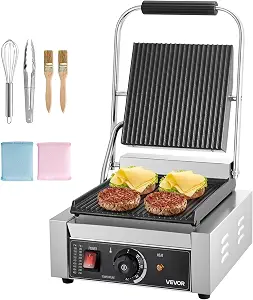 |
Waring Tostato Supremo WDG250

| Cooking surface | 14.5" x 11" |
|---|---|
| Wattage | 1800 watts |
| Voltage | 120 volts |
| Max temperature | 570°F |
| Number of settings | 6 |
The Waring WDG250 Tostato Supremo is a commercial-grade panini press built for high-volume foodservice. It pairs a ribbed cast-iron top plate with a flat cast-iron bottom plate across a 14.5" x 11" surface so you can grill paninis, burgers, chicken, and vegetables consistently and quickly. The unit reaches high temperatures (up to 570°F) via an 1800-watt heating system and a six-setting adjustable thermostat, while the auto-balancing hinged top handles items up to about 3" thick without uneven contact. Stainless steel construction and a removable drip tray simplify cleaning and hold up to daily use, and indicator lights for power and ready status help pace service. Important practical limits are its weight and footprint that reflect its commercial build, and the fixed single cooking area means it is best for continuous sandwich production rather than flexible small-batch tasks. For kitchens that need reliable, fast grilling and robust construction, this model delivers professional results; for occasional home use the size and power may be overkill.
Best for: Buyers running busy cafes, sandwich shops, or catering operations who prioritize fast, repeatable grilling performance and durable commercial construction.
Less Ideal for: Casual home cooks or operators with very limited counter space who need a lightweight, multi-zone appliance for occasional use.
- Cast-iron ribbed top and flat bottom plates for even searing and versatile cooking.
- Adjustable thermostat up to 570°F with six settings for precise temperature control.
- 1800-watt power for fast heat-up and sustained cooking during busy service.
- Auto-balancing hinged top accommodates items up to 3" thick for consistent contact.
- Removable drip tray and stainless steel exterior for easier cleanup and durability.
- Large, heavy commercial footprint that is cumbersome for small kitchens or occasional users.
- Single cooking surface limits simultaneous different-temperature cooking zones.
Verdict: Choose the Waring Tostato Supremo when you need a rugged, high-temperature commercial panini press that delivers consistent, rapid grilling for high-volume service.
VEVOR Commercial Panini Grill

| Wattage | 3600 watts |
|---|---|
| Voltage | 120 volts |
| Temperature range | 50°C-300°C (122°F-572°F) |
| Material | Stainless Steel + Iron |
This VEVOR commercial panini grill is built for frequent countertop use in small food-service settings, with a stainless steel housing, thickened enamel plates, and a large 19 x 9 cooking surface that heats top and bottom simultaneously. It uses powerful 3600W heating tubes and a temperature knob that ranges from 122°F to 572°F, so you can sear steaks, press paninis, or grill burgers at high heat and also run lower-temperature jobs. The removable oil tray and scraper simplify cleanup, and vents plus non-slip feet help stability during continuous operation. At about 50 pounds it is a substantial unit intended for a dedicated workspace rather than occasional home use, and customers should expect the size and power to demand a proper 120V circuit and counter space. The grill is straightforward to operate and durable in appearance, making it a practical choice where durability, quick heat and a large flat press surface matter more than compactness or portability.
Best for: Operators who need a durable, high-output countertop press that holds up to frequent cooking and prioritizes fast heat and a large flat grilling area for sandwiches, burgers, and grilled proteins.
Less Ideal for: Those who want a lightweight, compact home appliance or need portability for occasional use should consider smaller, lower-power models instead.
- Large 19 x 9 inch full flat enamel plates heat top and bottom for even cooking
- High 3600W power delivers fast preheat and high-temperature searing
- Adjustable temperature control from 50°C to 300°C for versatile cooking
- Removable oil tray and simple scraper make cleaning easier after heavy use
- Heavy and bulky at around 50 pounds, not suited to frequent relocation
- High power draw requires adequate electrical supply and counter space
Verdict: Choose this grill when you need a rugged, high-power commercial press with a large flat cooking surface for fast, consistent results in a busy kitchen.
POPFOODEX Commercial Panini Press

| Wattage | 3600 watts |
|---|---|
| Voltage | 110 volts |
| Other Special Features of the Product | Dual Zone Cooking, Keep Warm Setting, Non Stick Coating, Temperature Control |
| Material | Cast iron plate and stainless steel body |
This POPFOODEX commercial panini press is built for busy foodservice environments that need fast, consistent results. The 19" x 9" grooved plates and 3600W power deliver rapid, even dual‑sided heating so sandwiches, burgers, and steaks brown uniformly; the manufacturer claims it can handle multiple paninis or bacon strips per batch, which matches the large plate area. Independent temperature knobs let you run different heat levels on each side (122°F–572°F), useful when you are grilling protein on one half and toasting bread on the other. The stainless steel body and cast iron plates feel durable and the removable drip tray, vents, and included scraper simplify cleanup between service periods. It is configured for commercial use with non‑slip feet and a design focused on reliability rather than home kitchen features. Expect a heavy, professional appliance that needs appropriate electrical supply and counter space and that will be best for continuous, front‑of‑house or back‑of‑house cooking rather than occasional home use.
Best for: Operators who prioritize a dependable, heavy‑duty sandwich press for steady, high-volume service and need consistent, restaurant-quality results.
Less Ideal for: Home cooks or operators with limited electrical capacity, small counters, or infrequent use should consider smaller, lower-power models instead.
- High 3600W power for rapid, even cooking across the full 19" x 9" plate.
- Dual independent temperature controls allow different heat zones for versatile cooking.
- Stainless steel body and cast iron plates designed for commercial durability.
- Removable drip tray and simple cleaning tools make maintenance straightforward.
- Requires substantial electrical capacity and counter space for commercial operation.
- Cast iron plates may need seasoning care and are heavier to handle than lightweight alternatives.
Verdict: A rugged, high‑power commercial panini press built to deliver fast, reliable, restaurant-quality results during heavy service.
HTTSICHI Commercial Panini Press

| Wattage | 2200 watts |
|---|---|
| Voltage | 110 volts |
| Material | Stainless Steel |
| Other Special Features | Cast Iron Griddle, Non Stick Coating, Temperature Control |
This HTTSICHI commercial panini press is built for high-volume sandwich prep, using 2200 watts to heat cast iron griddles quickly and sustain high cooking temperatures. It has a wide 14"x9" cooking surface that can handle multiple sandwiches at once and an adjustable thermostat that ranges from low warm settings up to very high searing temperatures, so you can toast bread, melt cheese, or crisp fillings consistently. The nonstick coating and removable drip tray make cleanup simpler after busy service, and the stainless steel housing is aimed at resisting corrosion in a commercial kitchen. On the downside the unit is heavy and designed for a fixed countertop, so it is less suited to occasional home use or mobile setups, and controls are basic with only two primary settings indicated in the specs. For kitchens that need a rugged, fast-heating press for repeated runs, this model delivers predictable results without complicated controls.
Best for: Operators who need a reliable, hard-working press for frequent sandwich production in a restaurant, cafe, or catering setup and who value fast heat-up and durable construction.
Less Ideal for: Casual home cooks, mobile vendors, or anyone seeking a lightweight, highly portable machine with advanced digital controls should consider other options.
- High 2200W power for fast heat-up and steady high cooking temperatures
- Large 14"x9" cast iron griddle area suited for multiple sandwiches per cycle
- Adjustable temperature control for consistent, even heating top and bottom
- Removable drip tray and nonstick coating simplify cleaning after service
- Stainless steel body built for commercial durability
- Heavy, countertop design is not portable and requires substantial space
- Controls appear basic with limited discrete settings compared to digital models
Verdict: Choose this press when you need a rugged, high-power commercial panini grill that heats fast and handles repeated service reliably.
VEVOR Commercial Panini Grill S-811B
| Power | 1800W |
|---|---|
| Temperature range | 50°C-300°C (122°F-572°F) |
| Cooking plate type | Grooved enamel top and bottom |
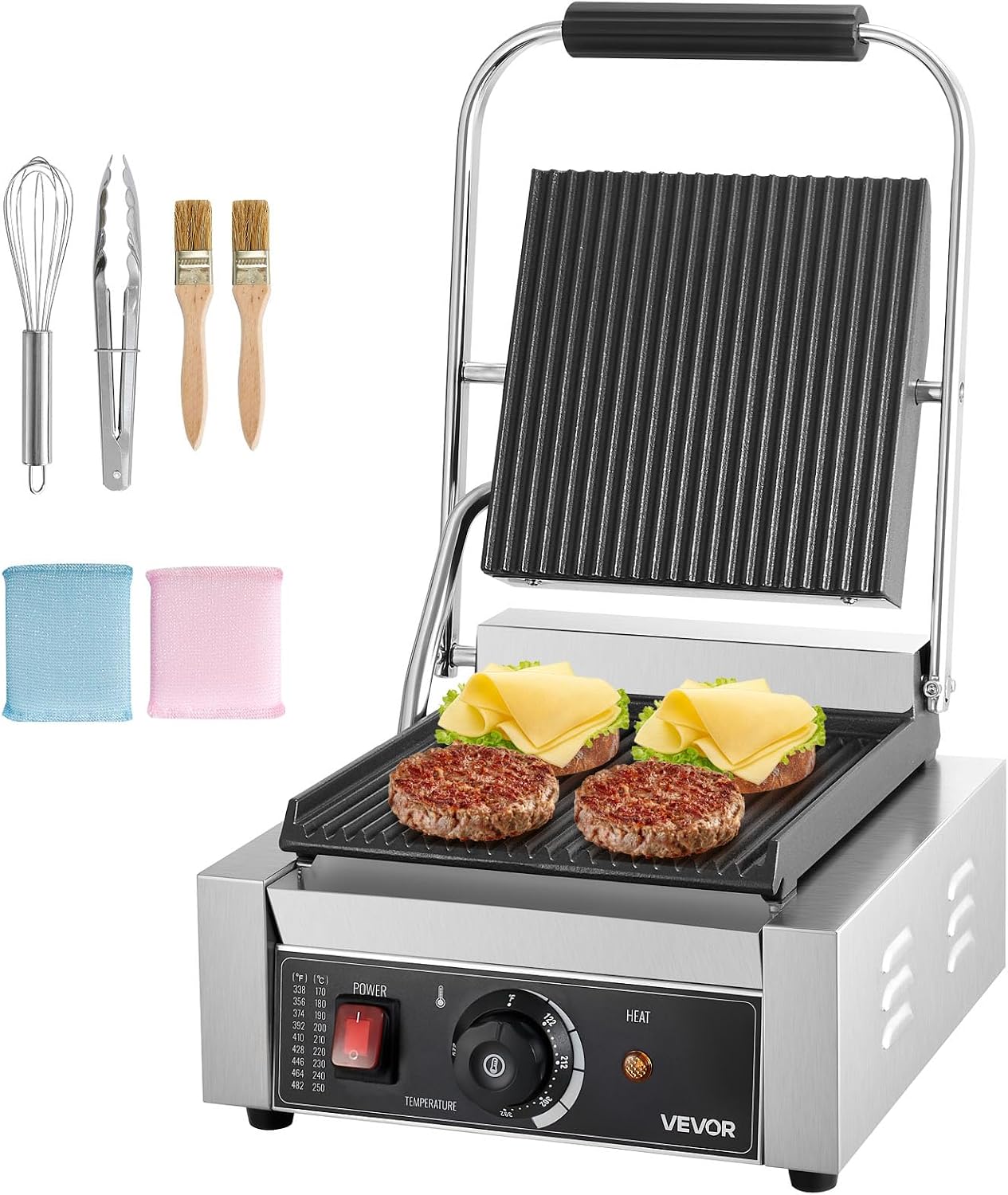
| Included components | Tongs, whisk, brush, 3 dishcloths, removable grease tray |
This VEVOR commercial panini grill is a heavy-duty countertop press intended for frequent use in small food service settings or busy home kitchens. It uses 1800W and thickened heating tubes to heat the grooved enamel top and bottom plates at the same time, producing fast, even searing for paninis, burgers, vegetables and more. The temperature knob ranges from 50°C to 300°C (122°F to 572°F), so you can dial in low heat for delicate items or high heat for a crisp crust, and an LED shows heating status. The stainless steel body, non-slip feet and heat-resistant handle give it a commercial feel, while a removable grease tray simplifies cleanup. Because it is a single-unit press with an 8.8 x 9.1 inch cooking surface, it is best for small batches rather than high-volume line cooking, and the unit is fairly heavy so it is more of a semi-permanent countertop appliance. Overall it suits cooks who want fast, reliable contact grilling with straightforward controls and easy maintenance.
Best for: Buyers who want a sturdy, no-frills commercial-style press for reliable, repeatable grilling in a small food-service or busy home kitchen and who prioritize durability and temperature control over portability.
Less Ideal for: Those who need large-capacity or true production-line output, or buyers who require a lightweight, highly portable grill for occasional use.
- Commercial-grade stainless steel exterior and thickened heating elements for durable, consistent performance
- Wide temperature range (50°C–300°C) for precise control across many foods
- Simultaneous top-and-bottom heating for even searing and faster cook times
- Removable grease tray and vents for easier cleaning and heat management
- Includes basic accessories (tongs, whisk, brush, dishcloths) to start cooking right away
- Relatively compact 8.8 x 9.1 inch cooking area limits batch size
- At about 28 pounds the unit is heavy and not ideal for frequent repositioning
Verdict: A solid, commercial-style panini press that delivers even, high-temperature grilling and dependable durability for small-scale food service or heavy home use.
Choosing the Right Commercial Sandwich Maker: Key Factors to Consider
Construction Materials
Construction materials directly affect longevity in a commercial kitchen. Heavy-gauge stainless steel or die-cast aluminum bodies resist denting, maintain alignment under repeated use, and handle the occasional bump or spill without degrading. Plate materials matter too; solid aluminum or cast iron plates hold heat well and transfer it evenly, while nonstick coatings simplify cleanup but may wear over time.
Choosing the right materials reduces the likelihood of warping, hot spots, and mechanical failure, which can cause inconsistent cooking and unexpected downtime. For operations with very high cycle counts, prioritize sturdier metal stacks and reinforced hinges to keep plates aligned under pressure.
Heating Design & Temperature Control
How the unit distributes and regulates heat determines how consistently sandwiches cook across the plate surface and from batch to batch. Embedded, evenly spaced heating elements and good thermal mass help avoid hot or cold spots that produce uneven toasting.
Accurate temperature controls with clear settings or thermostats allow staff to dial in doneness quickly and repeatably. For high-volume use, systems that recover heat fast between cycles maintain output without lengthy cool-downs. Avoid units that lack clear control feedback, as these increase guesswork during busy service periods.
Throughput Capacity
Throughput capacity is about how many sandwiches you can produce in a given time and how that matches your service flow. Consider plate size and whether the unit grills one large sandwich, two medium sandwiches, or multiple smaller portions per cycle. Larger plates increase yield per cycle but may also take longer to reach stable temperature.
Also evaluate cycle time and heat recovery. A fast-cycling machine with consistent results is preferable for peak service hours. For operations with fluctuating demand, a mid-size unit that heats quickly and stays stable may be more versatile than a single very large machine.
Cleaning And Maintenance
Ease of cleaning affects daily labor and long-term hygiene. Removable plates or designs that allow quick access to cooking surfaces reduce turn-around time between batches and simplify deep cleaning. Smooth, sealed control panels and drip channels that collect grease help prevent buildup around electrical components.
Maintenance considerations include how accessible wear parts are, such as gaskets, hinges, and thermostats. Units designed for straightforward disassembly lower repair time and service costs. Prioritizing models that minimize crevices and use wipe-clean surfaces reduces the need for harsh cleaning chemicals and speeds up sanitation routines.
Footprint And Placement
Size and weight determine where a machine can live in your service area and how it affects workflow. Counter space is often limited, so consider depth and clearance for opening lids and removing plates. Heavier units may require a dedicated location or mounting, but they often offer better thermal stability.
Also think about ventilation and proximity to other equipment. Machines that vent heat or steam should be placed where they will not raise nearby food temperatures. Compact high-speed units can be ideal for small operations, while larger shops may benefit from stacked or multi-plate configurations to maximize throughput.
Operator Safety And Controls
Safety features reduce the risk of burns and accidents during peak service. Look for well-insulated handles, stable base feet, and reliable latch or hinge mechanisms that prevent sudden lid drops. Clear, intuitive controls reduce operator error, especially when staff turnover is high.
Indicators such as ready lights or audible alerts help staff time batches correctly without opening the lid and losing heat. Overload protection and grounded plugs are important for electrical safety in busy back-of-house environments.
Matching Capacity To Service Volume
Estimate peak sandwich demand per hour and use that to choose plate size and cycle frequency. For low-volume counters, a compact single-plate unit that produces one sandwich per cycle may suffice. Medium-traffic operations benefit from dual or larger plates that increase yield without doubling staff.
For very high-volume service, consider machines that offer rapid heat recovery and larger continuous cooking surfaces. Remember that larger plates often require more energy and a stable power source, so account for electrical capacity when planning placement.
- Calculate sandwiches per hour: (sandwiches per cycle) × (cycles per hour).
- Account for prep and transfer time when estimating real throughput.
- Factor in staff workflow to avoid bottlenecks at one cooking station.
Plate Types And Their Trade-offs
Removable nonstick plates simplify cleaning and reduce downtime, but the coating can wear with abrasive scrubbing and heavy use. Cast or solid plates offer long life and excellent heat retention but may require more effort to clean and can weigh substantially more.
Ribbed plates create sear marks and help drain grease away from sandwiches, while flat plates are better for evenly pressed sandwiches and panini. Choose based on the menu profile and how much residual grease you expect to handle during service.
- Nonstick: easier cleaning, watch for coating wear.
- Cast/solid: durable and even heat, heavier maintenance.
- Ribbed vs flat: aesthetic sear vs even press and drainage.
Electrical Needs And Installation
Commercial sandwich makers can have higher power draws than consumer models. Verify the unit's voltage and amperage requirements and ensure your kitchen circuit can supply consistent power, especially if you plan to run multiple machines simultaneously.
Hardwiring may be required for some heavy-duty models. Coordinate with an electrician to confirm outlet placement, grounding, and whether dedicated circuits are necessary to prevent nuisance tripping during peak hours.
- Check voltage/amperage on the spec sheet before purchase.
- Plan for dedicated circuits for high-draw units.
- Allow space for airflow and heat dissipation around the unit.
Workflow Integration And Placement
Position the sandwich maker close to assembly and plating areas to minimize handling time. Leave clearance on both sides for removing finished items and staging ingredients. If the unit vents significant heat, avoid placing it near temperature-sensitive products or packaged goods.
Consider mounting, shelving, or counter reinforcements for heavier machines. A stable, level surface preserves consistent plate alignment and reduces wear on hinges and latches.
- Place near prep and service zones to streamline movement.
- Provide insulated surfaces or mats to protect countertops.
- Ensure staff can open lids and remove items without obstruction.
Sanitation Practices For Daily Use
Create a routine that includes wiping surfaces between batches, emptying drip trays, and performing a deeper clean at the end of each day. Use food-safe cleaners and avoid abrasive tools on coated plates to extend their life.
Schedule periodic inspections of gaskets, hinges, and electrical connections to catch wear before it leads to failure. Training staff on safe cleaning methods reduces accidental damage and ensures consistent food-safety practices.
- Wipe plates after cooling to remove buildup.
- Use removable trays and plates when possible for faster sanitation.
- Record maintenance checks to track wear over time.
How We Chose the Best Commercial Sandwich Maker
We prioritized machines built for continuous, high-volume use rather than consumer or light-duty models. Key filters included construction materials and thermal design, because thick cast or solid-aluminum plates and robust hinges indicate resistance to warping and long-term reliability. We also evaluated heating system layout and temperature control precision to assess cook consistency between batches. Throughput matters for commercial settings, so cycle time and usable plate area were weighed heavily. Serviceability and cleaning were required criteria; models with easily removable plates, accessible heating elements, or simple hinge designs scored higher. Safety and controls were assessed for reliable operation during busy shifts. We excluded units intended only for occasional household use, and we filtered out machines lacking clear specification for continuous-duty operation. The final selection balances proven durability, repeatable cooking results, manageable maintenance, and capacity appropriate to different professional volumes.
Our full evaluation process is outlined in our review methodology.
FAQ
How long should a commercial sandwich maker last in a busy kitchen?
Lifespan depends on construction and maintenance. Heavier-duty machines with metal plates and robust hinges often last many years under daily use, while lighter units may show wear sooner. Regular cleaning and timely replacement of wear parts extend service life.
Can I use removable nonstick plates in a high-volume operation?
Yes, removable nonstick plates work well and speed cleaning, but coatings can degrade faster under continuous heavy use. If you rely on nonstick, plan for periodic replacement and use gentle cleaning methods to preserve the surface.
What maintenance items should I budget for?
Budget for replacement gaskets, hinge pins, thermostat calibration, and occasional plate recoating or replacement. Also plan for periodic professional checks of electrical connections if the unit is hardwired or heavily used.
Do commercial sandwich makers need special ventilation?
Most do not need dedicated hood ventilation but do generate heat and some steam. Ensure adequate airflow around the unit and avoid placing it near heat-sensitive foods or tight enclosures that trap heat.
How do I improve cook consistency between batches?
Allow the unit to reach stable operating temperature before starting service, avoid opening the lid unnecessarily, and use consistent press and loading techniques. Accurate temperature controls and well-maintained plates also reduce variation.
Final Verdict
Choose a commercial sandwich maker by balancing capacity, durability, and ease of upkeep against your service patterns. Prioritize solid construction and even heating if you run continuous shifts, and favor removable plates and accessible controls if quick cleaning and low downtime are essential. Match plate size and cycle speed to peak demand, verify electrical requirements, and maintain a regular cleaning and inspection routine to keep output consistent. With those tradeoffs in mind, you can select a machine that fits your workflow and delivers reliable performance.