
Note: This article contains affiliate links. If you click on these links and make a purchase, we may earn a small commission at no extra cost to you. This helps support our research and content. Read our full affiliate disclosure here.
If you serve frozen treats in a busy setting, the right commercial soft-serve ice cream maker makes the difference between steady service and long lines. You need equipment that produces consistent texture, handles peak demand, and cleans quickly so downtime is minimal. This guide highlights seven shortlisted machines selected for reliability, output, and sanitation in commercial environments. We evaluate capacity, cooling consistency, ease of cleaning, and build quality so you can match a machine to your expected daily volume and service style. Read on for practical guidance to help you pick the right unit for your operation.
Top Picks at a Glance
| Best Overall The best all-around choice for most situations | VEVOR Commercial Ice Cream Machine |  |
| Best Quality Built to a higher standard if you want something more solid | GSEICE BH488C Commercial Soft Serve |  |
| Best Value The sweet spot between price and what you get | EKway Soft Serve Machine BQL-8218T |  |
| Best Budget The cheapest option that still gets the job done reliably | Sunseota Commercial Soft Serve ZB-BQL28 |  |
| Top Rated A top-rated pick with lots of positive feedback | FOHERE Commercial Ice Cream Machine 4L |  |
| Most Popular A crowd favorite that many people choose with confidence | FOHERE Commercial Soft Serve 818B |  |
| Best Seller A high-volume bestseller chosen again and again | VEVOR Commercial Soft Serve 3-Flavor |  |
VEVOR Commercial Ice Cream Machine

| Power | 2200W |
|---|---|
| Production | 20-28 L/h |
| Capacity | 6 L x 2 |
| Operation Mode | Automatic |
| Material | Stainless Steel |
This VEVOR commercial soft-serve machine is built for steady, small-to-medium volume production in shops and cafes. It has two 6 L hoppers and three dispensing heads that support two primary flavors plus a mix flavor, and a high-performance compressor that gets the first batch ready in about 15 minutes and subsequent batches in roughly five minutes. Useful controls on the LED panel include hardness adjustment, a puffing function for creamier texture, a pre-cooling fresh-keeping mode to hold mixes at 8–12°C, and a one-touch automatic clean cycle that eases daily maintenance. The puffing pump and hopper agitation help produce smoother, airier serves and a higher yield than basic machines, while a low-mix alert prevents running the cylinders dry. At commercial scale the unit is heavy and requires adequate space and dedicated power, and setup may need two people, but the stainless steel construction and self-cleaning function make it practical for an everyday foodservice workflow.
Best for: Operators who need a reliable, mid-volume soft-serve solution that balances steady output, texture control, and easy cleaning for cafes, dessert counters, or small ice cream shops.
Less Ideal for: Home users or businesses with very low daily demand that cannot accommodate the machine's size, weight, and commercial power requirements should consider smaller countertop models instead.
- High production rate of 20–28 liters per hour suitable for steady service
- Three-flavor dispensing (2+1) lets you serve two flavors plus a mixed option simultaneously
- Pre-cooling fresh-keeping mode preserves mix at 8–12°C for overnight holding
- Integrated puffing pump and hopper agitation improve texture and yield
- One-touch automatic cleaning and LED controls simplify operation and maintenance
- Very heavy and large, requiring substantial floor space and likely professional installation
- High power and commercial-grade capacity may be overkill for very small operations or occasional use
Verdict: A workhorse commercial soft-serve machine that delivers consistent mid-volume output with built-in texture control and easy cleaning for small shops and cafes.
GSEICE BH488C Commercial Soft Serve

| Output | 32–42 L/H |
|---|---|
| Hopper capacity | 2 × 6L |
| Freezing system | True independent dual systems |
| Operation mode | Automatic |
| Material | SUS304 Stainless Steel |
The GSEICE BH488C is a heavy-duty floor-standing soft serve machine built for continuous commercial use. It pairs two independent freezing systems and compressors so each side can run separately or together, which helps sustain service during peak periods and lets staff adjust texture or flavors without stopping production. Typical use cases are dessert counters, cafeterias, and busy cafés where operators need two single flavors plus a twist option and steady output (roughly 32–42 L/hour). Notable features include dual smart displays for separate controls, magnetic hopper mixing with three texture presets, pre-cool and night modes to preserve mix, low-mix alerts, and automatic wash-assist/defrost for daily maintenance. The air-cooled design removes the need for a water line and built-in spare seals and tools simplify repairs. Trade-offs are the floor-standing footprint and the requirement for proper ventilation and electrical planning, and daily disassembly and cleaning of food-contact parts remain necessary for hygiene. For teams prioritizing uptime and independent control, the BH488C offers robust, operator-friendly performance.
Best for: Operators who need reliable, high-throughput soft-serve production with independent control over two flavors and a twist option for busy commercial counters and foodservice venues.
Less Ideal for: Small operators with very limited floor space or low-volume, occasional soft-serve needs should consider smaller countertop or single-system units instead.
- True independent left/right operation with two compressors for uninterrupted service
- Magnetic hopper mixing plus three texture presets for consistent, adjustable product quality
- Built-in pre-cool, night mode and low-mix alerts to simplify workflow and reduce waste
- Air-cooled 115V design requires no water line and includes removable filter for easier maintenance
- Dual smart displays and wash-assist/defrost controls speed staff operation and cleaning
- Floor-standing footprint requires planning for ventilation and outlet capacity
- Daily disassembly and cleaning of food-contact parts is still necessary despite wash-assist features
Verdict: Choose the BH488C when you need a durable, high-output soft-serve machine that keeps service moving with true independent dual systems and operator-friendly controls.
EKway Soft Serve Machine BQL-8218T
| Hopper capacity | 2 × 6L |
|---|---|
| Output | 20–28 QT/H |
| Power | 2450W |
| Material | 304 stainless steel |
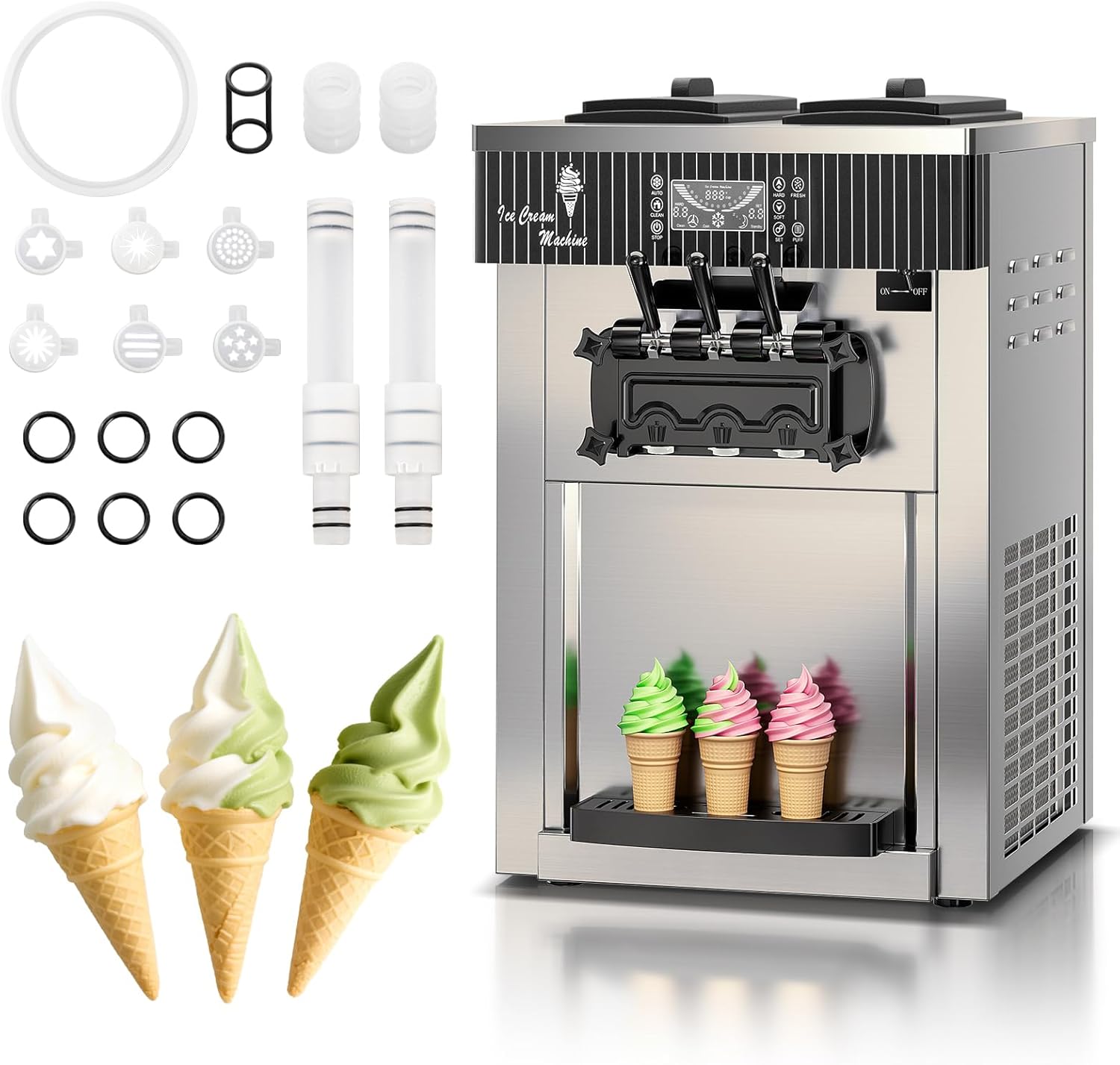
This EKway commercial soft-serve machine is built for high-volume soft ice cream service, offering two 6L hoppers and three dispensing heads so you can run two single flavors and one mixed flavor simultaneously. It uses a 2450W compressor with dual independent circuits and copper condenser for faster cooling and staggered startups to reduce electrical demand, while built-in puffing technology claims to boost yield. Operators interact through an LCD panel that handles pre-cooling, texture adjustments, production monitoring, and a one-touch self-cleaning cycle to simplify daily maintenance. The stainless steel body and food-grade 304 cylinders make it durable and suited to busy snack bars, cafes, or small restaurants. Expect substantial output and fewer interruptions from cleaning, but the unit is heavy and requires a proper commercial power circuit and floor space, so it is best installed in a fixed counter location with room for venting and service access.
Best for: Operators who need reliable, high-output soft-serve production for cafés, snack bars, or small restaurants and who prioritize automated controls and easy cleaning to keep service moving.
Less Ideal for: Occasional home users or mobile vendors who need a lightweight, portable unit or who cannot meet commercial electrical and space requirements should look elsewhere.
- Dual 6L hoppers and three dispensers support two single flavors plus a mixed flavor for flexible menu options
- Independent dual-compressor design with staggered startup reduces power surges and speeds cooling
- One-touch self-cleaning and LCD controls simplify operation and routine maintenance
- Stainless steel body and food-grade 304 cylinders provide commercial durability and food safety
- Heavy, floor-model design requires dedicated counter space and likely professional installation
- High power draw and commercial electrical requirements limit placement to properly wired locations
Verdict: Buy this machine if you need a heavy-duty, high-output soft-serve unit with automated controls and easy cleaning for a busy commercial setting.
Sunseota Commercial Soft Serve ZB-BQL28

| Rated Power | 450W |
|---|---|
| Cylinder Capacity | 3.5L |
| Flow Rate | 4-5L/h |
| Refrigerant | R290 |
| Display | LED |
This Sunseota commercial soft-serve machine is a compact countertop unit built for steady shop use, producing roughly 4 to 5 liters per hour with a 2.5L bowl and 1L freezer compartment. It uses a compressor and R290 refrigerant to reach serving temperatures quickly, with the first batch ready in about 10 minutes and subsequent batches in 4 to 6 minutes, enabling continuous production of roughly 80 to 100 80 g portions per hour. Controls are handled through an LCD panel that offers timer, auto cooling, defrost, and a one-touch cleaning cycle to help speed turnaround during busy shifts. The stainless steel bowl and body simplify cleaning and look durable in a service environment, while an expansion pump increases air mixing for a lighter, creamier texture and ingredient savings. Expect a relatively heavy, professional-feel unit and a 450W power draw that suits small shops and carts, but note it is a single-flavor machine so you will need additional units for flavor variety.
Best for: Small ice cream shops, cafes, or event vendors seeking an affordable commercial soft-serve unit that can deliver steady hourly output and fast batch turnaround.
Less Ideal for: Operators who need multi-flavor capability from a single machine or those who require a very lightweight, portable solution for frequent transport.
- High continuous output of about 4–5 L/hour suitable for steady shop service
- Rapid cooling and short batch times enable quick turnaround between batches
- LCD controls with timer, auto cooling, defrost, and one-touch cleaning simplify operation
- Food-grade stainless steel construction is durable and easy to clean
- Expansion pump increases overrun by about 40% for lighter texture and ingredient savings
- Single-flavor design limits variety unless you buy multiple machines
- Relatively heavy and sized for countertop commercial use rather than portable setups
Verdict: Choose this machine if you need a compact, budget-friendly commercial soft-serve unit that delivers fast, continuous production and easy cleaning for a single-flavor operation.
FOHERE Commercial Ice Cream Machine 4L

| Capacity | 4.5 liters |
|---|---|
| Hopper capacity | 4L |
| Freezer tank | 1.6L |
| Operation Mode | Automatic |
The FOHERE commercial soft-serve machine is built for steady output in small- to mid-volume foodservice settings. It uses a high-performance compressor and claims fast freeze cycles (first batch around 12 minutes, subsequent batches in about 6 minutes), producing roughly 10–20 liters per hour; those specs make it suitable for cafes, food trucks, or dessert counters. The machine includes a 4L hopper and a 1.6L freezing cylinder, an LCD touch panel for adjusting serving size, hardness and temperature, and a pre-cooling mode plus an automatic clean cycle to simplify daily maintenance. Construction mixes stainless steel with food-grade plastics and a removable drip tray and ergonomic handle for easier access and cleaning. Important limitations are its bulk and weight for a countertop unit and the need for proper ventilation and routine maintenance to keep refrigeration performance reliable under heavy duty. Noise is described as low but expect compressor sound during long runs. For buyers who need a dependable, feature-rich soft-serve unit, this model offers practical controls and commercial-oriented refrigeration.
Best for: Buyers who prioritize reliable, continuous soft-serve production in a small commercial setting and want programmable controls and easy cleaning to minimize downtime.
Less Ideal for: Home users or very low-volume operations that need a lightweight, compact machine or minimal maintenance demands.
- Commercial-grade compressor with fast freeze cycles for steady throughput
- Touch LCD for easy control of hardness, temperature and timers
- Automatic cleaning program and removable drip tray simplify upkeep
- Stainless steel food-contact surfaces for durability and easy cleaning
- Relatively heavy and large for a countertop unit which limits placement flexibility
- Requires good ventilation and regular maintenance to sustain commercial performance
Verdict: A solid, feature-rich countertop soft-serve machine designed to deliver consistent, reliable production for small commercial outlets.
FOHERE Commercial Soft Serve 818B
| Capacity | 8 liters |
|---|---|
| Hopper capacity | 4L x 2 |
| Material | 304 stainless steel |
| Operation Mode | Automatic |
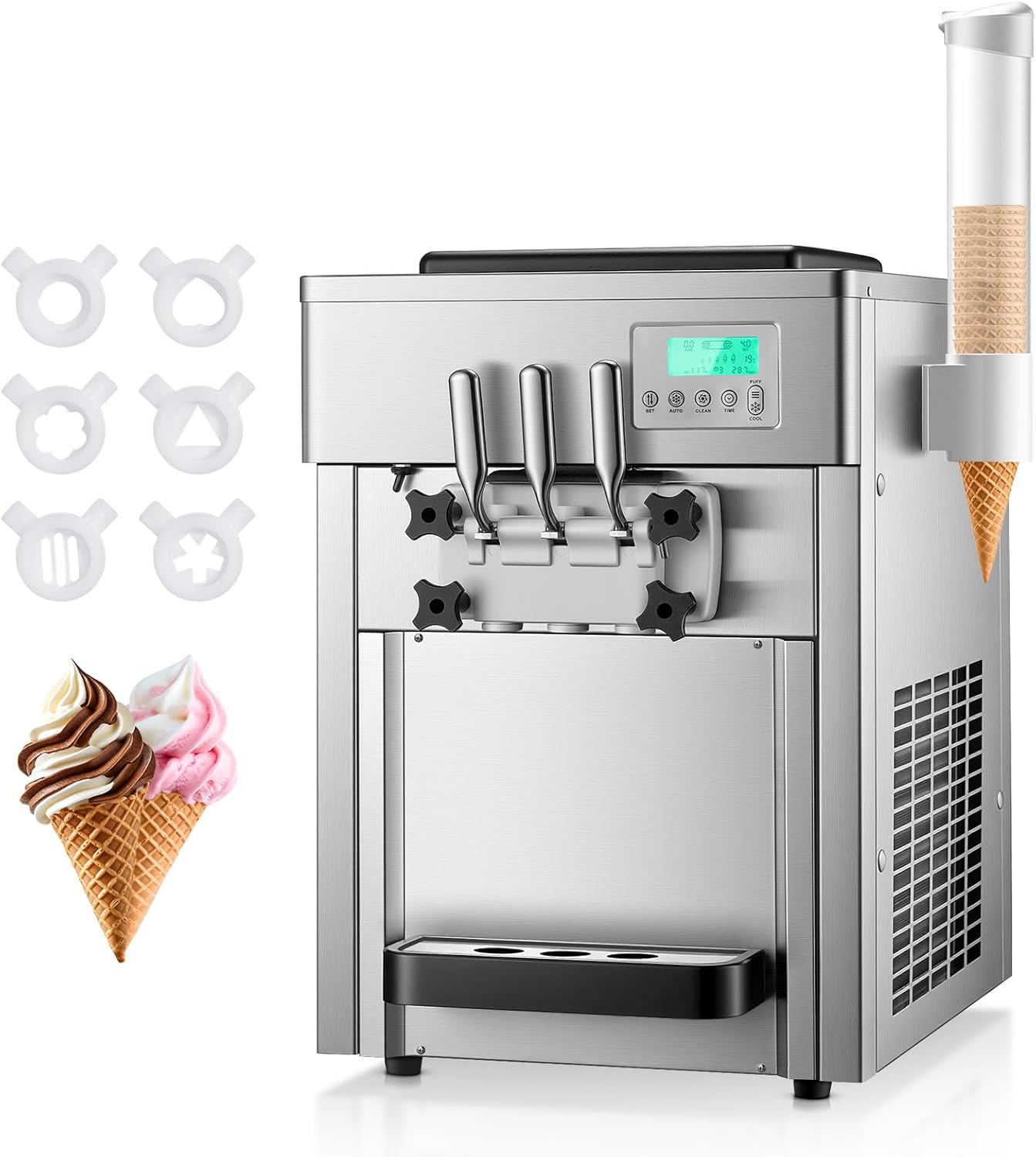
This FOHERE 818B commercial soft-serve machine is built for small shops and high-traffic counters that need steady output and simple operation. It uses a powerful compressor and an automatic cycle to freeze mix quickly—first batch in about 25 minutes and follow-up batches in roughly 6 minutes—producing roughly 20 to 28 liters per hour. The unit has two 4L hoppers feeding three dispense heads that let you run two single flavors plus a mixed flavor, which is handy for variety during peak shifts. The 304 stainless steel housing, removable drip tray, anti-slip base, and automatic clean function make daily cleaning and hygiene straightforward, while the keep-cool feature preserves leftover mix between service periods. It is designed for commercial environments and includes practical touches like external cone storage and an ergonomic handle. Expect a large, heavy countertop footprint and the usual demands of commercial installation and maintenance, but the overall package delivers consistent texture and fast throughput for cafes, food trucks, and dessert counters.
Best for: Buyers who prioritize reliable, repeatable soft-serve output for cafes, food trucks, or small ice cream shops and who value units with built-in cleaning and preservation features.
Less Ideal for: Home users or very small operations with infrequent use or limited counter space should consider smaller or portable models instead.
- Two 4L hoppers with three dispense heads for two single flavors plus a mix option
- Fast freezing cycle with first batch in about 25 minutes and quick subsequent batches
- 304 stainless steel construction for durability and easier cleaning
- Automatic clean and keep-cool function to preserve mix and simplify maintenance
- Large, heavy countertop unit that requires commercial power and space considerations
- Produces noise and needs routine professional servicing in high-use settings
Verdict: Choose this FOHERE 818B when you need a durable, fast commercial soft-serve machine that delivers two flavors plus a mixed option with built-in cleaning and preservation features.
VEVOR Commercial Soft Serve 3-Flavor

| Power | 2200W |
|---|---|
| Production | 20–28 L/h |
| Capacity | 6 L x 2 |
| Operation Mode | Automatic |
| Other Special Features | Automatic Clean, Digital Display |
This VEVOR commercial soft-serve machine is built to deliver steady production for a small shop or cafe, producing roughly 20–28 liters per hour from two 6L hoppers and three dispensing heads for 2+1 flavor service. It uses a high‑efficiency compressor with hopper agitation and a pre-cooling fresh-keeping mode to maintain mix temperature and minimize ice crystals, and the LED digital display controls hardness, timer, keep‑fresh, and a one‑touch self-clean cycle. In practice the unit freezes an initial batch in about 13–17 minutes and rebuilds batches in 3–5 minutes, which is useful during short rushes. Construction is stainless steel for durability and food safety, and the automatic clean and agitation help reduce maintenance time. Important limitations are its large footprint and heavy weight that require a dedicated counter and likely professional installation, and the noise and power draw expected from a 2200W compressor in continuous use. For cautious buyers focused on reliable, repeatable output, the machine's features favor consistent texture and straightforward daily operation.
Best for: Buyers who need dependable, repeatable soft‑serve output for a small commercial setting and prioritize consistent texture, easy controls, and low-maintenance operation.
Less Ideal for: Homes, pop‑up stands, or operations with minimal counter space or limited electrical capacity should consider smaller, lighter machines instead.
- High hourly production suitable for steady retail service (20–28 L/h).
- Dual 6L hoppers with continuous agitation and pre-cooling preserve mix quality and reduce ice crystal formation.
- LED digital controls with hardness, timer, keep‑fresh, and one‑touch self-clean simplify daily operation.
- Stainless steel construction offers durability and easy cleaning to meet food safety needs.
- Large and heavy countertop unit that needs significant counter space and likely professional setup.
- High power draw and noticeable operating noise compared with small consumer machines.
Verdict: A workhorse countertop soft‑serve machine that delivers reliable, high‑volume output with built‑in pre‑cooling and self‑cleaning for low‑hassle commercial service.
Choosing the Right Commercial Soft-Serve Ice Cream Maker: Key Factors to Consider
Production Capacity and Recovery Time
Production capacity determines how much soft-serve a machine can dispense per hour, and recovery time is how quickly it returns to serving temperature after heavy use. For counter-service venues or event catering, a higher hourly yield reduces queuing and lets you serve consistent portions during rush periods.
Recovery time affects whether a single unit can handle peak shifts or whether multiple machines are necessary. Consider typical daily sales and busiest hour forecasts, then choose a machine with a comfortable margin above that peak to avoid service slowdowns.
Consistency and Texture Control
Accurate temperature control and precise mix-to-air ratio management are essential for consistent soft-serve texture. Machines with adjustable overrun and reliable thermostats produce uniform mouthfeel and reduce product waste caused by separation or icy textures.
Look for units with stable refrigeration components and controls that let you fine-tune output for different mixes. Consistency matters for customer satisfaction and for maintaining predictable portion yields.
Sanitation Features and Ease of Cleaning
Commercial soft-serve machines require regular cleaning to meet health codes and avoid bacterial growth. Models with tool-free disassembly, smooth food-grade surfaces, and accessible drip trays greatly reduce the time and labor of cleaning cycles.
Consider how often your operation will need to deep clean versus daily rinse procedures. Faster, simpler cleaning saves staff time and lowers the chance of missed steps that could lead to compliance issues.
Build Quality and Serviceability
Durable components such as stainless steel exteriors, robust drive trains, and commercial-grade compressors improve uptime under heavy use. Serviceability is equally important: easily replaceable wear parts, accessible motors, and clear maintenance guides shorten repair times.
Assess whether replacement parts are commonly available for the unit type and whether routine maintenance tasks are straightforward for on-staff technicians or third-party service providers.
Footprint and Installation Needs
Physical footprint, ventilation requirements, and electrical needs determine where a machine can be installed. Some units require dedicated circuits or specific ambient clearance for proper compressor ventilation, which affects kitchen layout.
Plan for installation space, drainage, and airflow. A machine that fits poorly into your workflow can slow service even if it has high capacity.
Operational Costs and Energy Use
Energy consumption, refrigerant efficiency, and typical maintenance expenses impact long-term operating costs. Machines with modern compressors and insulation can provide lower electricity draw and reduced runtime.
Also consider how frequently parts like seals and belts need replacement and whether the machine needs costly periodic servicing. Lower ongoing costs support better margins over the equipment lifespan.
Matching Capacity to Your Business
Estimate peak-hour demand first, then pick a machine whose hourly output exceeds that number by at least 20 percent to avoid bottlenecks. For mobile or pop-up operations, prioritize units with quick recovery times over maximum continuous throughput.
If you plan menu variety such as multiple flavors or mix-ins, factor in additional dispensing time and cleanup between flavors. Using two smaller machines can sometimes provide more flexibility than one large unit.
- Low-volume cafes: smaller-capacity models with fast cleanup
- High-volume counters: larger tanks and continuous freezing cycles
- Catering/events: portable units with reliable recovery
Sanitation Workflow and Staff Training
Create a cleaning schedule aligned with staff shifts and anticipated service levels. Machines that allow partial rinse cycles for minor cleaning and full disassembly nightly help reduce labor without compromising safety.
Train employees on correct disassembly, temperature checks, and sanitizing procedures. Clear procedures reduce cleaning time and prevent missed steps that can lead to food-safety problems.
- Daily rinse and wipe procedures
- Nightly or end-of-day full disassembly and sanitizing
- Record-keeping for cleaning verification
Installation Tips and Utility Requirements
Confirm electrical supply and breaker capacity before purchase. Many commercial soft-serve units need dedicated circuits and specific voltage. Also allow for proper ventilation clearance to maintain compressor efficiency.
Plan drain access and stable counter placement. Vibration isolation pads and level surfaces reduce wear on moving parts and ensure consistent mixing.
- Verify voltage and breaker needs
- Allow ventilation clearance around the unit
- Ensure nearby floor or sink drains are available
Maintenance Checklist to Maximize Uptime
Regularly inspect seals, gaskets, and drive belts for wear and replace them proactively. Scheduled compressor checks and refrigeration inspections prevent abrupt failures during service hours.
Keep spare wear items on hand and establish a relationship with a qualified technician to minimize downtime. A simple preventive maintenance routine reduces emergency repairs and extends equipment life.
- Weekly visual inspection and lubrication where specified
- Monthly temperature calibration and seal checks
- Annual refrigeration system service
Choosing Between Single and Multi-Flavor Machines
Single-flavor machines are efficient when you have a focused menu and high volume for one product. Multi-flavor or twin-hopper units provide versatility and let you offer combinations without needing separate machines for each flavor.
Consider how often you will change flavors and the additional cleaning complexity of multi-hopper systems. If menu rotation is frequent, choose models designed for easy hopper cleaning and quick flavor changes.
- Single-hopper: simpler cleaning, consistent output
- Twin-hopper: menu flexibility, higher cleaning demands
- Multi-hopper: consider cross-contamination controls
How We Chose the Best Commercial Soft-Serve Ice Cream Maker
Our shortlist was built around operational reliability and factors that matter in daily commercial use. We prioritized continuous output capacity because businesses need machines that handle service peaks without long recovery times. Temperature and consistency control were required criteria since stable cooling and accurate mix-to-air ratios determine end-product texture. Sanitation and disassembly ease were weighted heavily because frequent cleaning cycles and health-code compliance are routine in commercial kitchens. Build materials and component durability were considered to ensure long service life under heavy use. Energy efficiency and sensible footprint were included to balance operating costs and space constraints. We excluded units designed only for home use or those lacking commercial-grade cooling systems and sanitary features. Final picks reflect machines that meet capacity, consistency, cleanup, durability, and operational efficiency standards.
Our full evaluation process is outlined in our review methodology.
FAQ
How often should a commercial soft-serve machine be fully sanitized?
Full sanitization is usually required at least once per day in commercial settings, with more frequent cycles if the machine is in constant use. Daily disassembly, cleaning, and sanitizing of food-contact parts helps meet health-code expectations.
Can one machine handle an entire shift of high-volume service?
It depends on the machine's rated hourly output and recovery time. For consistent high-volume service, choose a unit with capacity comfortably above your peak-hour forecast or use multiple machines to spread the load.
What electrical and ventilation considerations matter for installation?
Confirm that the site has the correct voltage and a dedicated circuit for the unit. Allow manufacturer-recommended clearance for ventilation and place the machine on a level, stable surface with access to drainage if required.
Are there differences in cleaning complexity between single- and multi-hopper units?
Yes. Multi-hopper machines offer more flavor flexibility but usually increase cleaning time and complexity due to additional hoppers and valves. Consider staff capacity for more involved sanitation procedures when choosing multi-hopper designs.
How can I reduce downtime from repairs?
Perform preventive maintenance, keep common wear parts on hand, and establish service arrangements with a qualified technician. Regular inspection of seals, belts, and refrigeration performance helps catch issues before they cause downtime.
Final Verdict
Prioritize machines that match your predictable peak output and that are designed for simple, frequent sanitation. Balance capacity and recovery time against footprint and installation constraints to find equipment that fits your operation. Ultimately, choose a commercial soft-serve unit with robust refrigeration, easy servicing, and clear cleaning workflows to minimize downtime and deliver consistent product quality.