
Note: This article contains affiliate links. If you click on these links and make a purchase, we may earn a small commission at no extra cost to you. This helps support our research and content. Read our full affiliate disclosure here.
If you run a busy foodservice operation, picking the right commercial waffle maker changes throughput, consistency, and cleanup time. The wrong unit can bottleneck service or produce uneven results that frustrate staff and guests. This guide covers five shortlisted commercial waffle makers that suit high-volume environments, with a focus on reliable output, durable construction, and easy maintenance. We'll evaluate each pick against key operational criteria so you can match a unit to your kitchen workload and service style. Read on for practical, production-minded guidance before the product list.
Top Picks at a Glance
| Best Overall The best all-around choice for most situations | VEVOR Dual-Head Waffle Maker |  |
| Best Quality Built to a higher standard if you want something more solid | Waring Commercial WW185X Belgian Waffle Maker |  |
| Best Value The sweet spot between price and what you get | POPFOODEX Commercial Waffle Maker |  |
| Best Budget The cheapest option that still gets the job done reliably | MilleLoom Commercial Waffle Maker |  |
| Top Rated A top-rated pick with lots of positive feedback | FOHERE Double-Head Waffle Maker |  |
VEVOR Dual-Head Waffle Maker

| Wattage | 2460 watts |
|---|---|
| Number of settings | 2 |
| Material | Non-stick coating, Stainless steel |
| Temperature range | 50–300°C (122–572°F) |
This dual-head waffle maker is built for small commercial use and heavy home entertaining, letting you bake two 1-inch-thick Belgian-style waffles at once. Each head has an independent control panel with adjustable temperature (50–300°C) and a timer plus an audible beep when the cycle finishes, so you can run two different settings in parallel for crisp or fluffy results. The 2460W heating system and closed-loop design aim to give even browning and fast cycle times, while nonstick plates and spill channels simplify release and cleanup. The stainless-steel housing, stable triangular support and rubber feet make the unit feel durable and steady on a counter, and the spiral stainless handles reduce the risk of slips or burns during use. It is a sizable, relatively heavy machine intended for frequent use, so it needs adequate counter space and a dedicated circuit; the plates are not removable for dishwasher cleaning. For kitchens or stalls that need steady throughput and straightforward controls, this model strikes a practical balance of performance and value.
Best for: Buyers who need a compact commercial-grade waffle maker for steady production and want simple, manual controls to run two waffles at once.
Less Ideal for: People with very limited counter space, low home electrical capacity, or those who need fully removable plates for quick dishwasher cleaning should consider alternatives.
- Dual independent cooking heads let you make two waffles with different settings at once
- High 2460W power and closed-loop heating for fast, even browning
- Stainless-steel body and stable base designed for commercial use
- Nonstick plates and built-in spill channels speed cleanup and reduce mess
- Plates are not removable which makes deep cleaning more cumbersome
- Large footprint and weight require ample counter space and a suitable power circuit
Verdict: A practical, high-power dual-head waffle maker that delivers fast, consistent Belgian waffles for small commercial kitchens and busy weekend hosts.
Waring Commercial WW185X Belgian Waffle Maker

| Wattage | 1200 watts |
|---|---|
| Voltage | 120 volts |
| Material | Diecast Metal |
The Waring WW185X is a commercial-grade single Belgian waffle maker built for steady, high-volume kitchens. It uses a rotating iron design and a digital countdown timer so cooks can flip the plate for even browning while the timer signals when waffles are ready, which helps maintain consistent results during busy service. The 1200W heating system and ceramic triple-coated nonstick plates produce thick Belgian waffles quickly—Waring rates output at about 25 waffles per hour—and the plates are user-serviceable for easier replacement if damaged. NSF and cETLus certifications mean it meets foodservice safety standards, and the diecast metal housing feels sturdy for frequent use. Cleanup is simplified by the nonstick surface, though a commercial footprint and 120V requirement mean it is best suited to kitchens with counter space and dedicated power. If you want reliable, repeatable Belgian waffles in a small commercial environment, this unit focuses on performance rather than home-style bells and whistles.
Best for: Kitchen operators and caterers who need a compact, high-throughput Belgian waffle maker that delivers consistent, restaurant-quality waffles during busy service.
Less Ideal for: Casual home cooks or buyers seeking a compact, low-output domestic waffle iron with simpler plug-and-play convenience.
- Rotating plate and digital countdown timer deliver even browning and consistent results
- 1200W commercial-grade heating for high output—about 25 Belgian waffles per hour
- Triple-coated ceramic nonstick plates for easy release and faster cleaning
- NSF and cETLus certifications for commercial foodservice safety
- User-serviceable plates allow replacement without replacing the whole unit
- Designed for commercial countertop use and may be bulky for limited home kitchens
- Requires 120V dedicated power and has a commercial footprint that needs space
Verdict: Choose the Waring WW185X when you need a sturdy, commercial-grade Belgian waffle maker that reliably produces consistent waffles at a high throughput.
POPFOODEX Commercial Waffle Maker

| Wattage | 1200 watts |
|---|---|
| Voltage | 120 volts |
| Number of settings | 10 |
| Material | Stainless Steel |
This POPFOODEX commercial waffle maker is built for busy foodservice environments that need fast, consistent waffles. It uses dual heating elements and a 1200W heater to cook both sides simultaneously, which speeds cycle time and reduces the risk of undercooked centers. The unit offers a broad adjustable temperature range (122 to 572°F) and 10 settings plus a 5-minute timer with an alert beep, so you can dial in crispiness for different batter recipes. The stainless steel housing, non-slip feet, and a stainless handle add durability and stability for continuous use, and the nonstick double-layer coating makes waffle release and wipe-down cleaning straightforward. Because it is intended for commercial operation, it is relatively heavy and sized for counter use, and the very high top-end temperature is more than most casual users will need. For a restaurant, food truck, or cafe where throughput and consistent results matter, this machine delivers practical, reliable performance.
Best for: Buyers who prioritize productivity and consistent results in commercial settings like cafes, food trucks, or hotel breakfast lines and want a durable, easy-to-clean waffle maker that handles continuous cycles.
Less Ideal for: Casual home users or buyers seeking a compact, lightweight waffle maker for occasional use should consider smaller consumer models instead.
- Dual heating elements cook both sides at once for faster, more even results
- Wide adjustable temperature range and 10 settings let you control texture and browning
- 1200W power supports continuous commercial use without frequent cooldowns
- Stainless steel construction and non-slip feet designed for durability in busy kitchens
- Double-layer nonstick coating makes release and cleaning easier
- High top temperature and commercial design add bulk and capability that exceed home needs
Verdict: A workhorse commercial waffle maker that delivers fast, even cooking and easy cleanup for operators who need reliable throughput.
MilleLoom Commercial Waffle Maker

| Power | 1200 Watts |
|---|---|
| Voltage | 110 Volts |
| Temperature range | 122–572°F |
| Timer range | 0–5 minutes |
This MilleLoom commercial waffle maker is a straightforward stainless steel waffle iron designed for heavy use in small foodservice settings or busy home kitchens. It offers a 1200W heating element that preheats quickly and a wide temperature range (122 to 572°F) plus a 0–5 minute timer, so you can dial in crispiness and cook time for different batter types. The round nonstick plates and brushed stainless exterior make batter release and surface cleaning easier, and the insulated handle and rubber feet help with stability during service. The unit ships with a few cleaning tools and a whisk for basic prep, but it is a single-plate model so throughput is limited compared with dual-plate or larger commercial machines. Also note the high top temperature is useful for specialty batters but requires care during cleaning and operation. For its price point this model balances power, simple controls, and durable materials for budget-focused operators who need consistent, easy-to-clean waffle production without advanced automation or large-capacity features.
Best for: Operators on a tight budget who need a durable, no-frills waffle maker for low- to moderate-volume service and want reliable temperature control and easy cleanup.
Less Ideal for: High-volume restaurants or vendors that require continuous, high-throughput waffle production and faster cycle times should choose larger-capacity commercial models.
- Powerful 1200W element for fast preheat and consistent browning
- Wide temperature range (122–572°F) and 0–5 minute timer for precise control
- Stainless steel construction with insulated handle and nonstick plates for easier cleaning
- Includes basic accessories like brush and whisk for immediate use
- Single round plate limits output compared with larger or double-plate commercial units
- High maximum temperature requires careful handling and may need gentle cleaning to protect the nonstick coating
Verdict: A budget-friendly stainless steel waffle maker that delivers fast, controllable cooking and easy cleanup for low- to moderate-volume commercial use.
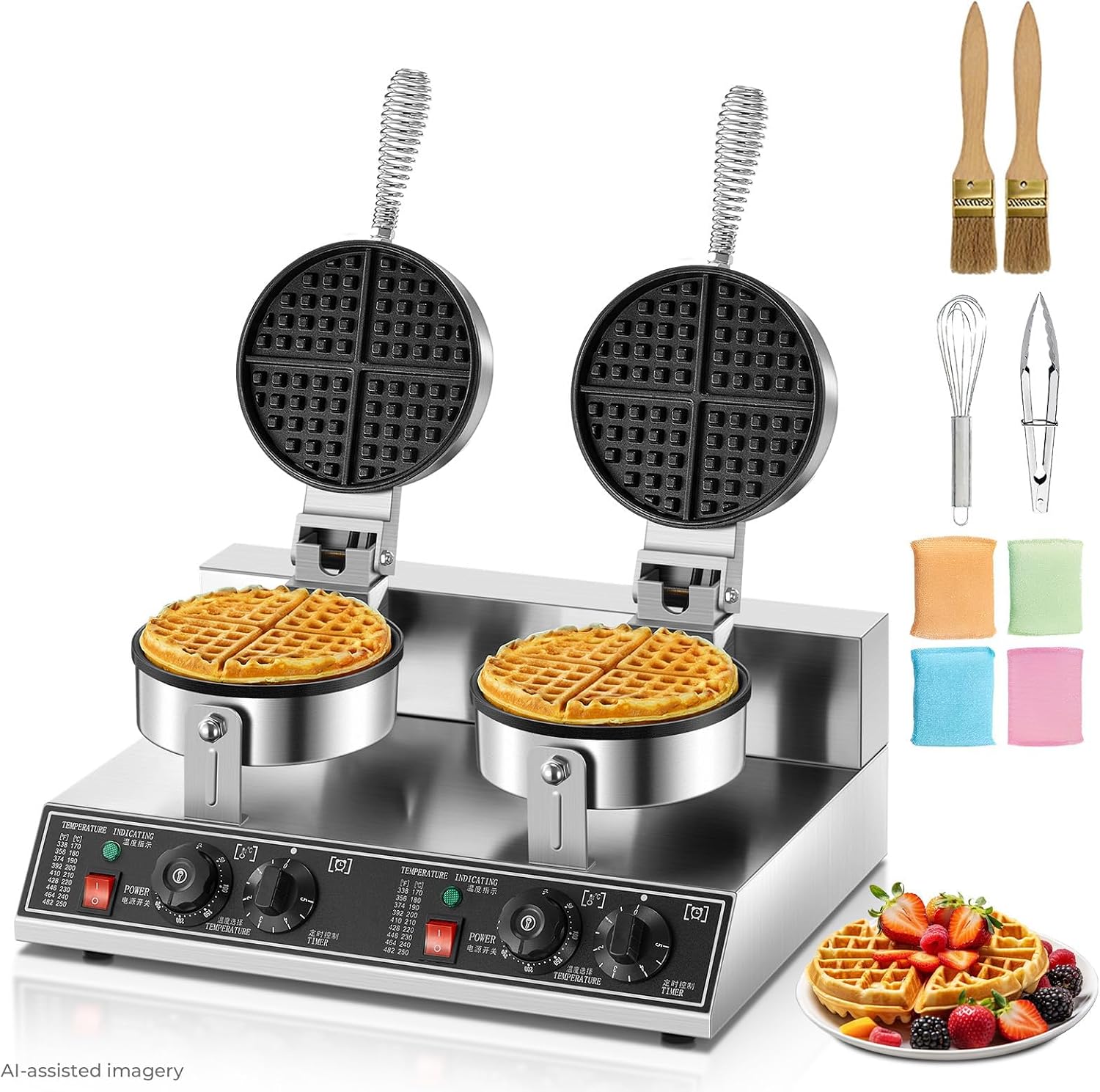
FOHERE Double-Head Waffle Maker
| Wattage | 2400 watts |
|---|---|
| Voltage | 120 volts |
| Other Special Features | Non Stick Coating, Temperature Control |
This FOHERE dual-head waffle maker is built for commercial use, pairing a stainless steel body and cast-aluminum plates with a 2400W heater to produce two waffles at once in roughly 2 to 5 minutes. Each head has independent temperature (122°F–572°F) and timer (0–5 minutes) knobs so staff can run different bake settings simultaneously, and an automatic shut-off adds a layer of safety during busy service. The food-grade nonstick coating helps waffles release cleanly and speeds cleanup, while heat-insulated ergonomic handles reduce burn risk when opening and closing the heads. In practice it is designed to deliver consistent color and crisping across back-to-back batches, which is useful for cafes, bakeries, or concession stands handling high throughput. The unit is straightforward to operate with a simple preheat-and-bake workflow, though its commercial power draw means it should be on a dedicated circuit in busy kitchens. Overall, this model emphasizes durability and repeatable results for small commercial operations.
Best for: Operators who need a dependable, high-throughput waffle maker that delivers consistent results during peak service and values straightforward, durable equipment.
Less Ideal for: Home users or very low-volume operators who do not need commercial power or the space and electrical capacity a dual-head unit requires.
- Dual-head design bakes two waffles simultaneously for higher throughput
- Independent temperature and timer controls for each head allow different bake profiles
- Stainless steel body and cast-aluminum plates built for commercial durability
- Food-grade nonstick coating promotes easy release and faster cleaning
- High 2400W power draw may require a dedicated circuit in commercial kitchens
- Timer range tops out at 5 minutes which may limit very long-bake recipes
Verdict: Choose this FOHERE dual-head waffle maker when you need a robust, fast, and repeatable commercial machine that handles continuous service reliably.
Choosing the Right Commercial Waffle Maker: Key Factors to Consider
Throughput and Heat Recovery
Throughput measures how many waffles a unit can produce in a given time and is critical for service pacing during peak periods. Fast heat recovery between cycles keeps cook times short and reduces order wait times. When evaluating throughput, consider both cycle time per waffle and whether the unit can sustain that rate over an extended run without tempering performance.
Heat recovery is affected by plate mass, heating element capacity, and thermostat response. A heavier plate can hold heat better for back-to-back batches, but may take slightly longer to reach operating temperature. Look for machines with controls or thermostats that maintain set temperatures under load to avoid undercooked centers or burnt exteriors.
Build Materials and Construction
Commercial waffle makers operate in high-use environments, so material choice affects longevity and maintenance demands. Stainless steel housings resist corrosion and stand up to daily cleaning regimes. Plates finished with durable coatings reduce sticking and minimize the need for excessive oiling while still allowing crisp crust formation.
Also inspect hinge and latch designs, fastening methods, and the quality of wiring and insulation. Units with replaceable plates or modular heating assemblies allow easier repairs and longer service life. Robust construction reduces the likelihood of warping, misalignment, or premature failure in a busy kitchen.
Temperature Control and Consistency
Consistent temperature across the cooking surface yields uniform browning and predictable cook times. Precise temperature control lets staff dial in batter settings for different recipes or desired textures. For production kitchens, digital controls or well-calibrated analog thermostats help maintain repeatable results.
Evaluate how evenly the plate heats and whether the control system recovers after opening and refilling. Poor control creates variability from batch to batch, increasing waste and forcing staff to monitor each waffle closely.
Cleaning, Sanitation, and Upkeep
Commercial foodservice standards require equipment that can be cleaned quickly and thoroughly. Smooth surfaces, rounded corners, and removable drip trays reduce trapped batter and grease. Nonporous finishes and stainless exteriors simplify sanitizer application and reduce bacterial niches.
Consider how accessible heating elements and internal cavities are for deeper cleaning and how often routine maintenance is required. Units that minimize crevices and use food-safe, durable coatings lower daily labor and support compliance with health inspections.
Footprint, Energy Use, and Kitchen Fit
Physical footprint and power requirements determine whether a unit integrates cleanly into existing line layouts. A compact, high-output design can be preferable in tight spaces, but be sure the power draw matches your electrical supply and distribution. High-wattage machines produce faster results but may require dedicated circuits.
Also consider ventilation and clearance needs for steam and heat dissipation. Placement near service lines, batter staging, and plate cooling areas affects workflow, so choose a unit whose dimensions and utility needs complement your kitchen's operational flow.
Types of Commercial Waffle Makers
Commercial waffle makers come in several format families that influence throughput and product style. Countertop single-head machines are common for made-to-order service and offer straightforward operation and small footprints. Multi-head or stacked machines increase throughput without expanding countertop space as much, making them suitable for busy breakfast lines.
Specialty formats include Belgian deep-pocket plates and thin-crisp plates. Deep-pocket plates produce thicker, airier waffles that hold toppings, while thin plates yield crisper, more uniform pieces for sandwiches or high-volume grab-and-go menus. Choose the format that matches your menu direction and portioning needs.
- Single-head: simple operation, good for made-to-order stations
- Stacked or multi-head: higher throughput in limited space
- Deep-pocket plates: thicker waffles, better for toppings
- Thin-crisp plates: faster cook times, better for sandwiches
Operational Best Practices
Standardize batter temperature and portion size to achieve consistent cook times. Using a calibrated disher and keeping batter at a steady temperature reduces variability between operators. Train staff to monitor the first waffle after any setting change to confirm timing and color.
Establish a cleaning schedule that fits production rhythms. Wipe drips and empty trays during slow periods, and perform a deeper clean at shift end. Keep a small kit of replacement gaskets, screws, and non-sparking tools on hand to minimize downtime for quick fixes.
- Use measured portions and consistent batter viscosity
- Train staff on timing and visual doneness cues
- Perform light cleaning between runs and deep cleaning after service
- Stock common replacement parts to reduce downtime
Plate Options and Surface Finishes
Plate geometry and finish directly affect product texture and release. Nonstick coatings reduce sticking and ease cleanup but will eventually wear. Cast iron or heavy aluminum plates provide excellent heat retention and can produce superior crust development, though they may require more maintenance.
Removable plates offer flexibility and easier deep cleaning or replacement when the finish degrades. Consider whether the vendor supplies spare plate options and the ease of swapping plates without specialized tools.
- Nonstick coatings: ease of release and cleaning, finite lifespan
- Cast or aluminum plates: better heat retention, may need seasoning
- Removable plates: simplify cleaning and allow pattern swaps
Safety and Compliance Considerations
Ensure the unit meets local electrical and food safety standards for commercial kitchen equipment. Proper grounding, clear labeling of controls, and guarded heating elements reduce accident risk. Training staff on safe lifting, hot surfaces, and scheduled maintenance prevents common injuries.
Verify that drip trays and steam pathways are designed to avoid cross-contamination. A design that contains and channels batter and grease helps maintain sanitation between batches and simplifies inspection readiness.
- Confirm electrical ratings match kitchen circuits
- Use units with accessible breakers or resets
- Design workflows to avoid cross-contamination
- Train staff on hot-surface handling and safe cleaning
How to Size a Unit for Your Service Volume
Estimate peak-period demand in waffles per hour and match that to a unit's rated throughput. Account for realistic cycle times including loading, cooking, unloading, and any plating or finishing steps. If staff will produce mixed menu items, factor in the time to adjust settings between batches.
If footprint is constrained, consider staggered production using two smaller units rather than a single large machine to provide redundancy and flexibility. Redundancy can prevent total service interruption if a single unit requires service during a shift.
- Calculate waffles per hour for busiest 15-minute window
- Factor in operator time for loading and unloading
- Consider redundancy with multiple smaller units where space allows
- Allow margin for cleaning and brief maintenance during service
How We Chose the Best Commercial Waffle Maker
We focused on criteria that matter for continuous, professional use in commercial kitchens. First, throughput and heat recovery were prioritized because a high-capacity unit must produce multiple waffles per minute without long cool-down gaps. Build durability and plate longevity were next, with attention to heavy-gauge materials and serviceability that reduce downtime in busy shifts. We also evaluated temperature control and consistency to ensure repeatable browning across batches. Ease of daily cleaning and maintenance was included to limit labor burden and sanitation risk. Finally, we considered footprint and energy use to help buyers match units to constrained kitchen spaces and utility limits. We excluded home or light-duty waffle irons and any units clearly designed only for occasional residential use. Units that required extensive aftermarket modification to perform reliably in commercial settings were also removed. The remaining models met minimum thresholds for continuous operation, replaceable wear parts, and commercial-grade construction.
Our full evaluation process is outlined in our review methodology.
FAQ
How many waffles per hour can a commercial waffle maker produce?
Production depends on cycle time and the machine format. Single-head units typically produce fewer waffles per hour than stacked or multi-head designs. Check the rated cycle time, then multiply by realistic operator loading and unloading times to estimate hourly output.
Are removable plates worth it for a commercial setting?
Removable plates simplify deep cleaning and make replacement straightforward when finishes wear. They are worth the investment if your operation requires frequent cleaning or if you plan to change plate patterns for different menu items.
What maintenance tasks should be scheduled for a commercial waffle maker?
Routine tasks include daily surface cleaning, emptying drip trays, and inspecting seals and hinges. Periodic checks should cover thermostat calibration, element integrity, and fastener tightness. Keep a log of maintenance to track wear and anticipate part replacement.
Can a commercial waffle maker run continuously during long service periods?
Many commercial units are designed for continuous operation, but actual performance depends on construction, cooling, and heat recovery. Even with commercial-rated machines, plan short rest intervals if specified by the manufacturer and monitor temperature stability during long runs.
How do plate finishes affect batter sticking and cleanup?
Smooth, food-grade nonstick finishes reduce sticking and cut cleanup time, though they will wear eventually. Heavier metal plates with well-managed lubrication or seasoning can produce excellent crusts but may require more frequent manual cleaning and care.
Final Verdict
Prioritize throughput and temperature consistency when choosing a commercial waffle maker, because those factors drive service speed and product uniformity. Build materials, plate finish, and ease of cleaning determine long-term operating costs and downtime. Match unit footprint and electrical needs to your kitchen layout, and plan for basic maintenance and spare parts to preserve uptime. With the right balance of capacity, durability, and serviceability, you can select a machine that meets peak demand and keeps operations running smoothly.