
Note: This article contains affiliate links. If you click on these links and make a purchase, we may earn a small commission at no extra cost to you. This helps support our research and content. Read our full affiliate disclosure here.
If you want straightforward countertop baking, broiling, and toasting without the extra features of an air fryer, a convection toaster oven without air fryer simplifies the job. These models focus on even heat distribution, consistent temperature control, and practical cooking space so you can bake small batches, crisp slices of toast, or reheat leftovers without complicated presets. This guide shortlists the top convection toaster ovens without air fryer features and explains the specs and performance points that matter. Below you will find our top picks along with the evaluation criteria we used and clear buying guidance to help you choose the best fit for your kitchen.
Top Picks at a Glance
| Best Overall The best all-around choice for most situations | GE Convection Toaster Oven G9OCAASSPSS |  |
| Best Quality Built to a higher standard if you want something more solid | Cuisinart Chef's Convection Toaster Oven TOB-260N1 |  |
| Best Value The sweet spot between price and what you get | Hamilton Beach Easy Reach Toaster Oven |  |
| Top Rated A top-rated pick with lots of positive feedback | Breville Smart Oven Pro BOV845BSS |  |
| Most Popular A crowd favorite that many people choose with confidence | BLACK+DECKER Convection Toaster Oven CTO6335S |  |
GE Convection Toaster Oven G9OCAASSPSS

| Capacity | 0.88 cubic feet |
|---|---|
| Wattage | 1500 watts |
| Control Type | Knob Control |
| Power Source | Corded Electric |
This GE convection toaster oven is a straightforward, roomy countertop oven that handles everyday tasks like toasting, baking, broiling, and reheating without fuss. Its 0.88 cu ft interior fits a 12" pizza, six slices of toast, or a 9"x11" pan, and the seven cook modes (toast, bake, broil, bagel, pizza, roast, keep warm) cover most home cooking needs. Controls are simple knob-style dials and the unit uses 1500 watts of Calrod heating power for consistent browning; a convection setting speeds cooking and helps with even results. The oven ships with practical accessories—a baking rack, baking pan, tongs, and a removable drip/crumb tray—that make setup and cleanup easier. The stainless steel exterior looks durable and matches many kitchens, though the unit is fairly heavy and takes up counter space. There are no advanced digital features or air-fry capability, so this is best for buyers who want solid, no-frills convection performance rather than smart controls or multifunction novelty features.
Best for: Buyers who want a roomy, reliable countertop convection oven with simple controls and practical accessories for everyday cooking tasks.
Less Ideal for: Users seeking advanced digital features, app control, or an air-fryer function should look at more feature-rich models instead.
- Large 0.88 cu ft interior fits 12" pizza or 9"x11" pan
- Seven cook modes for toast, bake, broil, bagel, pizza, roast and keep warm
- Includes useful accessories: baking rack, pan, tongs and removable drip/crumb tray
- 1500-watt Calrod heating provides consistent browning and roasting
- Knob controls lack advanced digital timers or preprogrammed presets
- No air fry function or smart connectivity
Verdict: A solid, no-frills convection toaster oven that gives roomy, reliable cooking performance for everyday baking and toasting.
Cuisinart Chef's Convection Toaster Oven TOB-260N1

| Wattage | 1800 watts |
|---|---|
| Capacity | 0.95 cubic feet |
| Number of Shelves | 2 |
| Control Type | Knob Control |
The Cuisinart Chef's Convection Toaster Oven is a high-power countertop oven aimed at replacing a small range for everyday cooking tasks. With 1800 watts and a speed-convection setting it heats quickly and maintains precise temperatures for baking pizzas, roasting a whole chicken, or toasting multiple slices at once. The interior fits a 13" pizza or a 9"x13" pan and ships with useful accessories including a pizza stone, two racks, a baking pan and broiler pan, plus a removable crumb tray for easier cleanup. Controls are knob-based with a large backlit display and features like Even Toast control, dual cook modes and a door sensor add convenience for repeatable results. The nonstick interior cleans easily but the unit is fairly heavy and wide, so it needs a steady counter spot and enough clearance for the dropdown door and venting. For cooks who want fast, even convection performance without extra air-fryer functions, this oven delivers consistent results across baking, broiling and roasting jobs.
Best for: Buyers who prioritize cooking performance and consistent convection results for baking, roasting and toasting and who plan to use the oven as a primary small-appliance workhorse.
Less Ideal for: Anyone with very limited counter space or those seeking a compact, lightweight toaster oven intended mainly for occasional reheating or minimal baking.
- High 1800W power and speed-convection for fast, even heating
- Large 0.95 cu ft interior fits a 13" pizza, 9"x13" pan, or whole chicken
- Includes practical accessories: 13" pizza stone, two racks, baking and broiling pans
- Even Toast control, dual cook modes and a large backlit display for repeatable results
- Nonstick interior and removable crumb tray simplify cleanup
- Bulky and heavy countertop footprint requires adequate space and clearance
- Knob controls may offer less precise input than full digital touch interfaces
Verdict: Choose this oven if you want powerful, fast convection performance and a roomy interior for full-size baking and roasting without air-fryer features.
Hamilton Beach Easy Reach Toaster Oven

| Wattage | 1400 watts |
|---|---|
| Heating Method | Convection |
| Cooking Program | Bake, Broil, Convection, Toast |
| Capacity | 16 liters |
The Hamilton Beach Easy Reach is a practical countertop convection toaster oven built for everyday cooking tasks. It uses a 1400W convection fan to speed and even out baking and roasting, and the 16-liter interior fits a 12-inch pizza, a 9×11 pan, or six slices of toast. Controls are simple dials for mode, temperature and a 30-minute timer with a stay-on option and auto shutoff, and the included bake pan, oven rack and front-access crumb tray make setup and cleanup straightforward. The distinctive roll-top door lifts up and out of the way so you can load, baste or remove food without a swinging door blocking the counter or catching drips, and the removable door and crumb tray simplify cleaning. Limitations are the basic single power level and manual dial controls versus digital presets, and the oven is best for typical household portions rather than large batches. For someone who wants a reliable, easy-to-use convection toaster oven without extra smart features or air-fry gimmicks, this model covers the essentials well.
Best for: Buyers who prioritize straightforward, reliable countertop cooking and want convection performance with easy access and simple controls for daily family meals and reheating.
Less Ideal for: Users seeking advanced digital controls, multi-function smart features, or heavy-duty baking capacity for large gatherings should consider other options.
- Convection fan for faster, more even cooking and crisper results
- Roll-top door that stays up and out of the way for easy access and countertop clearance
- Spacious interior fits a 12-inch pizza or 9" x 11" pan and six slices of toast
- Front slide-out crumb tray and removable door for easier cleaning
- Only manual dial controls and a single power level without digital presets
- Not suited for very large batches or commercial use
Verdict: Choose this oven if you want a no-frills convection toaster oven with easy roll-top access and dependable everyday cooking performance.
Breville Smart Oven Pro BOV845BSS

| Wattage | 1800 watts |
|---|---|
| Capacity | 0.49 cubic feet |
| Control Type | Knob Control |
| Number of Shelves | 1 |
The Breville Smart Oven Pro is a roomy countertop convection toaster oven designed to replace multiple appliances for everyday baking and roasting. It uses the Element iQ system with five independent quartz elements and an internal fan to concentrate heat where needed, which shortens cook times and promotes even browning. Typical uses include baking cookies or small pizzas, toasting bread, roasting a chicken, and slow-cooking stews using the dedicated slow-cook mode. The oven includes 10 preset functions, an LCD for clear status and preheat indication, an interior light, and a set of practical accessories including a baking pan, broiling rack, pizza pan, and wire rack. At 1800 watts it heats up quickly and the convection mode can reduce baking times substantially. Trade-offs are its countertop footprint and weight, which require counter space and limit portability, and it lacks touchscreen or smart-home connectivity for remote control. For home bakers who want reliable, consistent results across a range of tasks, it performs very well.
Best for: Home bakers who prioritize consistent, reliable baking results and want a single countertop appliance that handles baking, roasting, toasting and slow cooking without fuss.
Less Ideal for: Those who need a very compact, lightweight toaster oven for small kitchens or who require smart-home connectivity and remote control features.
- Element iQ with five quartz elements for targeted, even heating
- Convection fan reduces cook time and improves browning
- Includes versatile preset functions for baking, roast, pizza, cookies and slow cook
- Comes with useful accessories: enamel baking/broiling racks and a pizza pan
- LCD display and interior light make monitoring and timing easy
- Large countertop footprint and relatively heavy compared with small toaster ovens
- No Wi-Fi or app control for remote operation
Verdict: Buy this if you want a dependable, high‑performance countertop oven that delivers consistent baking and roasting results across many functions.
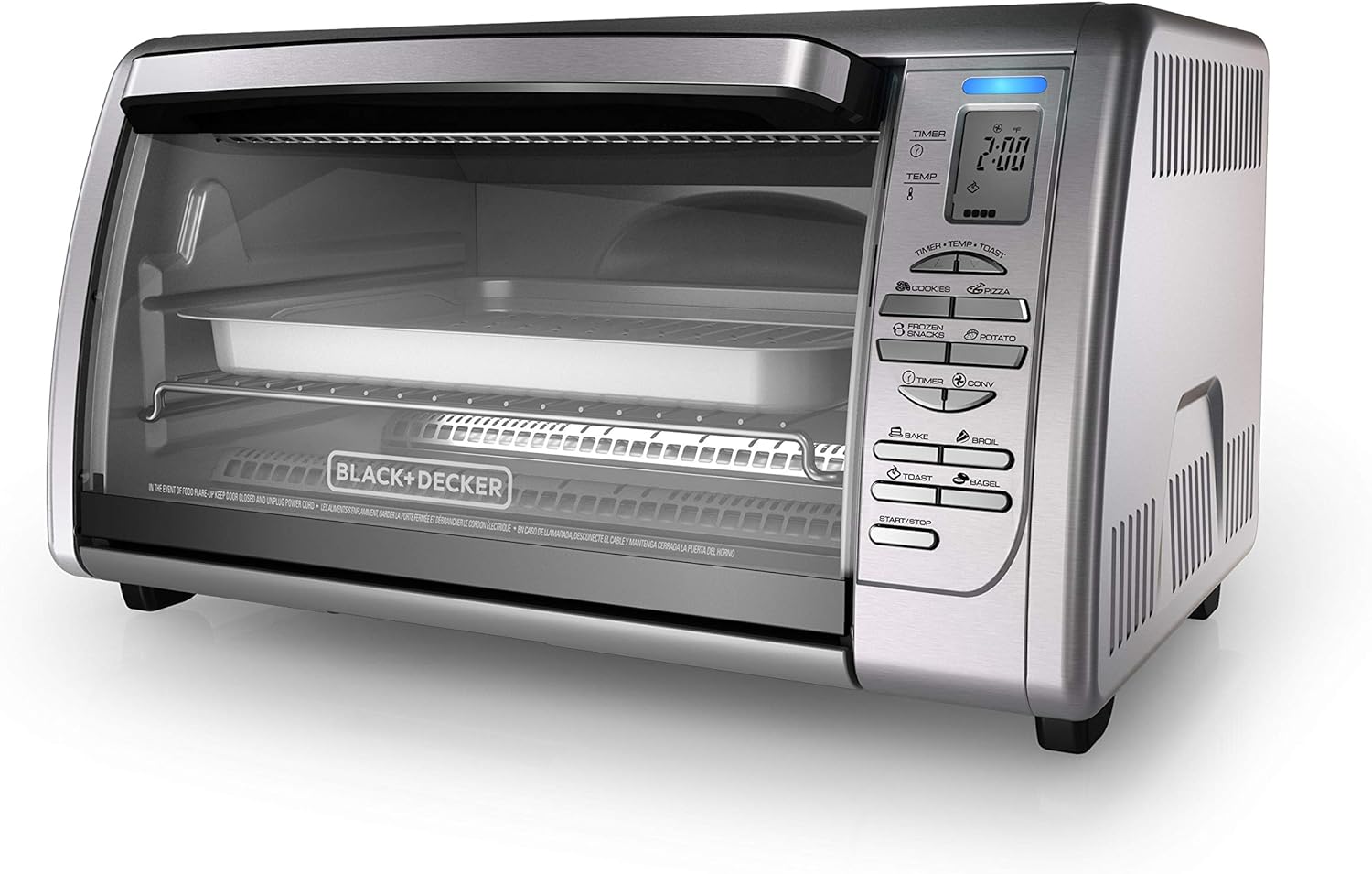
BLACK+DECKER Convection Toaster Oven CTO6335S
| Wattage | 1500 watts |
|---|---|
| Control Type | Knob Control |
| Power Source | Corded Electric |
| Capacity | 6 liters |
The BLACK+DECKER CTO6335S is a straightforward countertop convection toaster oven aimed at everyday cooking for small households. It offers one-touch functions for bake, broil, toast, and keep warm plus a 30-minute timer with auto shut-off, making it easy to heat a range of foods from toast and bagels to frozen pizza. Convection heating helps circulate air for faster, more even browning, and the extra-deep interior and dual-position rack let you fit small pans or a personal pizza. Built-in conveniences include a removable crumb tray, a nonstick interior for wipe-clean maintenance, and simple knob controls that are intuitive to use. At 1500 watts it reaches cooking temperatures quickly, but the compact 6-liter capacity limits how much you can cook at once, so it is best for singles, couples, or small batches. If you want a no-frills convection toaster oven that prioritizes dependable performance and easy cleanup over advanced features or large capacity, this model covers that use well.
Best for: Buyers who value a reliable, easy-to-use convection toaster oven for everyday small-batch cooking and prefer appliances with a proven, familiar design.
Less Ideal for: Those who need to cook for larger families, prepare full-size baking sheets, or want advanced digital controls and programming features.
- Convection heating for faster, more even cooking and browning
- One-touch cooking functions and intuitive knob controls for simple operation
- Removable crumb tray and nonstick interior for easy cleanup
- Extra-deep interior with dual-position rack for flexible cooking arrangements
- Small 6-liter capacity limits the size and number of items you can cook at once
- Manual knobs only, so no digital timer precision or advanced programming
Verdict: Choose this model if you want a simple, dependable convection toaster oven that delivers even cooking and easy cleanup for small everyday meals.
Choosing the Right Convection Toaster Oven Without Air Fryer: Key Factors to Consider
Heating Consistency
Even heat across the oven cavity determines how uniformly items brown and cook. Convection fans help reduce hot spots, but fan design and element placement influence results. Look for data or user reports about how evenly an oven toasts across multiple rack positions.
Poor consistency forces you to rotate pans or use only a single rack, which erodes the convenience of a countertop oven. Consistent heat reduces monitoring and delivers repeatable baking and broiling outcomes.
Temperature Accuracy and Recovery
Accurate temperature control ensures recipes bake correctly and prevents overcooking. A good convection toaster oven holds the set temperature closely and recovers quickly after the door is opened. Check whether the unit allows precise temperature settings in 5-degree or 10-degree increments and whether the thermostat is known to be reliable.
Fast recovery matters when you open the door to check food or add items mid-cycle. Slow recovery can lengthen cooking times and lead to uneven browning, so prioritize ovens with tight tolerance and responsive controls.
Interior Capacity and Rack Flexibility
Capacity affects what you can cook in one session. Consider cavity dimensions and the usable height between racks to ensure common items like a 9×13 pan, sheet of toast, or a small roast will fit. Multiple rack positions add versatility for broiling, baking, or toasting multiple items.
A removable crumb tray and accessible interior make cleaning easier. Think about how much counter space you are willing to dedicate and whether the oven's footprint and door swing will work in your kitchen layout.
Controls and User Interface
Controls range from simple dials to digital touch panels. For cooks who prefer hands-on control, straightforward dials for temperature, function, and time are often faster to use. Digital interfaces may offer timers and precise temperature settings but can add complexity.
Consider whether you value tactile feedback, preset programs, or the ability to manually set time and temperature. Easy-to-read markings and responsive knobs or buttons reduce mistakes and make everyday use more pleasant.
Build Quality and Serviceability
Durable heating elements, a sturdy door hinge, and quality interior finishes extend an oven's useful life. Metal racks that resist warping and a well-sealed door help maintain performance over time. Look for units with replaceable parts or clearly documented support options.
A well-built oven also tends to retain temperature better and withstand frequent use. Consider materials, warranty terms where available, and whether the design allows simple maintenance tasks like replacing heating elements or cleaning the interior.
Safety and Ease of Maintenance
Safety features such as cool-touch exteriors, automatic shutoff timers, and stable rubber feet reduce risk during daily use. A removable crumb tray and accessible interior surfaces make cleanup faster and limit buildup that can cause smoking or fire hazards.
Maintenance considerations also include how easy it is to remove and clean racks, whether the door glass can be cleaned from the inside, and if crumb containment is effective. Safer, easier-to-maintain designs save time and reduce long-term problems.
Why Skip the Air Fryer Function
Some home cooks want a dedicated convection toaster oven without air fryer features because they prefer straightforward temperature and timing control without additional rapid-circulation modes. Units without integrated air-frying presets often focus on optimized baking and broiling performance, simpler user interfaces, and fewer components that can fail.
If you frequently bake small casseroles, broil proteins, or toast batches of bread, a convection toaster oven designed specifically for those tasks can be more predictable and easier to maintain than multi-function devices that try to cover everything.
- Simpler controls reduce accidental mode selection.
- Fewer internal components can mean fewer points of failure.
- Classic convection performance is often more consistent for baking.
Sizing Your Countertop Oven for Real Cooking Tasks
Think beyond advertised liters or cubic inches and consider what you plan to cook. Measure the maximum pan or dish you expect to use and compare it to the oven's usable interior dimensions. Depth and height are particularly important for items that need clearance for racks or browning.
Also account for exterior footprint and ventilation needs. Leave a few inches of clearance around the oven for airflow and to avoid heat damage to nearby surfaces. If you have limited counter space, a compact model might fit better but will limit the size of dishes you can prepare.
- Measure your most-used pan and compare to interior dimensions.
- Check how many rack positions you get and the height between them.
- Allow clearance around the unit for safe ventilation.
Maintenance Tips to Keep Performance Consistent
Regular cleaning prevents burned-on residue that can affect taste and smoke levels. Remove the crumb tray after each session and wipe spills from the interior once the oven cools. Avoid abrasive cleaners on glass and finished interiors to prevent damage.
Inspect heating elements periodically for buildup and ensure racks are seated properly. If an oven offers removable or dishwasher-safe racks, use that feature to cut down on manual scrubbing. Proper maintenance preserves temperature accuracy and extends the appliance's lifespan.
- Wipe interior surfaces after cooling to prevent buildup.
- Use removable trays and racks to simplify cleaning.
- Periodically test temperature accuracy with an oven thermometer.
Cooking Techniques That Benefit From Convection
Convection circulation moves hot air to minimize cold spots, which helps with even browning and crisper exteriors. Use convection for roasting vegetables, toasting bread, and finishing small cuts of meat. Recipes may cook faster or brown more quickly under convection, so monitor timing closely.
For delicate baked goods, such as cakes or custards, you may prefer conventional modes or lower the convection setting if available. Understanding when to use convection versus still-heat modes helps you get predictable results from a toaster oven.
- Use convection for roasting and toasting to improve browning.
- Reduce recommended baking time slightly and watch for early doneness.
- Reserve still-heat for delicate bakes that need gentle, even rise.
Installation and Placement Advice
Place the oven on a stable, heat-resistant surface with adequate clearance for ventilation. Avoid enclosing the oven in a tight cabinet unless the manufacturer specifically allows it. Position the door so it can open fully without obstruction.
Consider proximity to the sink or stove for convenience, but keep the toaster oven away from direct water exposure. Ensure the outlet used can handle the oven's power draw and avoid running extension cords, which can be a safety hazard.
- Leave several inches of clearance on the sides and back for ventilation.
- Ensure the countertop surface tolerates heat.
- Avoid extension cords; use a dedicated outlet when possible.
How We Chose the Best Convection Toaster Oven Without Air Fryer
We selected convection toaster ovens without air fryer based on objective, kitchen-relevant performance measures and everyday usability. Key evaluation criteria included heating consistency across the cavity, temperature accuracy and recovery time, interior capacity and rack flexibility, build quality and longevity of heating elements, and user control ergonomics. We prioritized ovens that delivered predictable baking and broiling results, had straightforward control layouts, and offered useful accessories such as adjustable racks and removable crumb trays. We excluded models that primarily marketed air-frying as a core feature or those with heavily automated multi-function presets that obscure temperature control. We also filtered out units with unreliable temperature control or inadequate cavity depth for common baking tasks. Our process emphasized utility for home cooks who prefer direct convection performance, easy maintenance, and consistent results for toasting, roasting, and baking small items.
Our full evaluation process is outlined in our review methodology.
FAQ
Is a convection toaster oven without air fryer good for baking cookies?
Yes. Convection helps promote even browning and consistent results, especially when baking multiple trays. You may need to reduce baking time slightly and rotate pans if the oven has noticeable hot spots.
Can I roast a small chicken in a convection toaster oven?
Often yes, provided the cavity fits the bird and a rack position allows proper air circulation. Check internal dimensions and recommended maximum roast size in the product specifications before attempting larger roasts.
How do I know if the oven's temperature is accurate?
Use a standalone oven thermometer placed in the center of the cavity to verify actual temperatures. Test at a few common settings and note any consistent offsets so you can adjust cooking times or temperature accordingly.
Will a convection toaster oven without air fryer save counter space?
These ovens vary in size. Compact models save counter space but limit dish size, while larger units require more surface area. Measure available space and compare it to the oven footprint and door swing to ensure a good fit.
Are digital controls better than manual knobs for everyday use?
It depends. Knobs are often quicker for simple adjustments and are more tolerant of kitchen conditions, while digital controls can offer precise temperature settings and timers. Choose based on whether you value speed and simplicity or exact control.
Final Verdict
When choosing a convection toaster oven without air fryer, prioritize heating consistency, accurate temperature control, and the right interior capacity for the dishes you cook most often. Balance ease of use and cleanup with build quality to ensure reliable long-term performance. For most cooks, a model with straightforward controls, multiple rack positions, and a well-sealed cavity will provide the most predictable results and the least maintenance.