
Note: This article contains affiliate links. If you click on these links and make a purchase, we may earn a small commission at no extra cost to you. This helps support our research and content. Read our full affiliate disclosure here.
When you sew and quilt, control over heat and mobility matters as much as steam and weight. A cordless iron for quilting gives you the freedom to move around a cutting table or ironing board without dragging a cord across delicate fabric. The right tool helps you press seams flat, set appliques, and touch up hems without risking scorch marks or distorted fabric. This guide highlights the top shortlisted cordless irons for quilting, focusing on temperature accuracy, soleplate glide, and battery or charging convenience. Use the evaluations below to find a model that supports precise pressing, reduces handling time, and protects a variety of quilting fabrics. Read on for our key criteria and practical tips before the product list.
Top Picks at a Glance
| Best Overall The best all-around choice for most situations | XAbitat Cordless Iron XACLI002 |  |
| Best Quality Built to a higher standard if you want something more solid | Panasonic Cordless Steam Iron NI-QL1100L |  |
| Best Value The sweet spot between price and what you get | OMAIGA Cordless/Cord Iron OM-951RV |  |
| Best Budget The cheapest option that still gets the job done reliably | PUSOKEI Mini Cordless Iron |  |
| Top Rated A top-rated pick with lots of positive feedback | Panasonic NI-WL700A Cordless Iron |  |
| Most Popular A crowd favorite that many people choose with confidence | Martisan Cordless Iron |  |
| Best Seller A high-volume bestseller chosen again and again | Rowenta Freemove Cordless Iron DE6730 |  |
XAbitat Cordless Iron XACLI002

| Wattage | 1500 watts |
|---|---|
| Voltage | 120 volts |
| Special Features | Anti Drip, Anti-Calc Function, Auto Shutoff, Cordless, Spray & Steam Burst Setting |
| Base Material | Ceramic |
The XAbitat cordless iron is a lightweight, 1500W steam iron built for quick heat-up and easy maneuvering during regular ironing tasks. It is designed to be used both on its base and cordless for short sessions, delivering steam burst, spray, and continuous steam to tackle wrinkles on a range of fabrics. The ceramic soleplate and thermal protection technology aim to protect garments while the anti-drip and anti-calc functions reduce leaks and mineral buildup over time. The included water refilling cup and auto shutoff add convenience and safety for home use. For quilting specifically, its cordless design and light feel make it easier to press blocks and seams without being tethered to a cord, but cordless run time and the small reservoir typical of cordless irons mean frequent returns to the base for longer projects. The iron offers a solid mix of power and fabric protection, though heavy continuous pressing for large quilt assemblies may be better served by a full-size corded iron or a dedicated pressing surface.
Best for: Quilters who value a lightweight, cordless iron for quick seam pressing, small blocks, and trimming tasks where portability and fabric care matter more than long uninterrupted run time.
Less Ideal for: Users planning long, continuous pressing on large quilts or professional studios that need extended steam time and larger water capacity should consider a corded iron or a commercial steam press.
- Cordless, lightweight design improves maneuverability for short pressing tasks
- 1500W heating delivers quick heat-up for fast touch-ups
- Ceramic soleplate with thermal protection to reduce fabric damage
- Anti-drip and anti-calc features help prevent water stains and mineral buildup
- Cordless operation limits continuous run time, requiring frequent trips to the base for longer quilting sessions
Verdict: A lightweight cordless iron that is ideal for quilters who need portable, fabric-safe pressing for small to medium tasks.
Panasonic Cordless Steam Iron NI-QL1100L

| Wattage | 1500 watts |
|---|---|
| Special Features | Auto Shutoff, Cordless, Lightweight |
| Voltage | 120 volts |
| Included Components | Iron, Carrying case, Power base |
The Panasonic NI-QL1100L is a high-power cordless steam iron built for fast, versatile pressing and on-the-go use. It delivers 1500 watts of heat with selectable steam and dry settings and a nickel-coated stainless steel double-tipped soleplate designed to glide in all directions, which is especially helpful when working across large quilt pieces or navigating seams and collars. Steam vents around the soleplate provide strong, even steaming and a sensor prevents drip during vertical steaming for hanging fabrics. The cordless design and retractable cord power base let you move freely across the ironing surface and the included heat-resistant carrying case makes it easy to transport to classes or sew-ins. Practical limits include a 360-degree freestyle soleplate that favors maneuverability over a heavier, press-like feel and a cordless runtime dependency on the power base between charges, so continuous heavy-duty ironing may require frequent re-docking. For quilters who value maneuverability and portable steaming power, this iron is a compelling option.
Best for: Quilters and sewing hobbyists who prioritize freedom of movement, precise multi-directional ironing, and a portable iron they can take to classes or use across large quilt tops.
Less Ideal for: Users who need a heavy, press-like iron for long uninterrupted sessions on very thick batting or who prefer a permanently tethered, continuous-power workstation.
- Cordless design with snap-in power base for untethered movement and easy storage
- 360-degree double-tipped stainless steel soleplate that glides over seams and detailed work
- 1500W power and full steam/dry settings for strong, even steaming including vertical use
- Heat-resistant carrying case included for safe transport and storage
- Cordless operation requires periodic re-docking which can interrupt long continuous pressing sessions
- Lighter, maneuverable feel may not match the firm press of a heavier iron for flattening very thick quilt layers
Verdict: For quilters who want cordless freedom, precise 360-degree steaming, and easy transport to classes, the NI-QL1100L delivers portable high-power performance.
OMAIGA Cordless/Cord Iron OM-951RV

| Wattage | 1550 watts |
|---|---|
| Frequency | 60 hertz |
| Special Features | 2-in-1 Cordless/Cord, Auto Shutoff, 12.85oz Tank |
The OMAIGA OM-951RV is a hybrid steam iron that switches between cordless and corded use via a 360° docking base, letting you work untethered for short bursts or keep continuous power for longer sessions. It heats quickly with 1550 watts to deliver up to 20 g/min continuous steam and a steam boost for stubborn creases, and the tapered ceramic soleplate helps reach seams and collars—useful when pressing quilt blocks and seams flat. A 380 ml (12.85 oz) tank reduces refill frequency during multi-piece projects and built-in anti-calc and self-clean functions aim to keep steam output consistent. The iron cycles on and off while redocking to maintain temperature, and motion-sensitive auto-off provides basic safety. Limitations to note: cordless mode only sustains heat for about 60 seconds between re-docks, so continuous high-volume pressing still needs the base attached, and the iron is heavier than some handheld steamers which may matter during long quilting sessions. For quilting tasks that require precise tip access and intermittent cordless convenience, it is a practical, feature-rich choice.
Best for: Quilters and home sewists who value a precise soleplate and the option to press seams cordless for short intervals while still having the stability of corded power for longer pressing sessions.
Less Ideal for: Users who need uninterrupted cordless operation for long continuous pressing or those who prefer an ultra-lightweight iron for extended hand-held use.
- 2-in-1 cordless and corded design for short cordless bursts and continuous base-powered use
- Large 380 ml water tank reduces refill interruptions during multi-piece projects
- Ceramic tapered soleplate provides smooth glide and precise access to seams and small areas
- 1550W heating with continuous steam and a steam boost for tackling stubborn wrinkles
- Self-clean and anti-calc features help maintain steady steam performance over time
- Cordless mode only holds heat for about 60 seconds between placements on the base
- Requires frequent re-docking to keep consistent temperature during long continuous ironing tasks
Verdict: Choose this iron if you want a practical hybrid that gives precise steam pressing for quilting plus short cordless convenience while keeping corded power available for longer sessions.
PUSOKEI Mini Cordless Iron

| Wattage | 100 |
|---|---|
| Battery Capacity | 1200mAh |
| Run Time | 40 minutes |
| Temperature Settings | 3 Levels |
The PUSOKEI Mini Cordless Iron is a lightweight rechargeable dry iron designed for small pressing jobs and travel use. It heats in about five seconds and offers three adjustable temperature settings up to 200 degrees, which makes it suitable for a range of fabrics from synthetics to medium-weight cotton. The 1200mAh battery provides roughly 40 minutes of continuous run time, enough to press a couple of garments or tackle quilt blocks and seams in short sessions. Its cordless, phone-sized form factor and built-in handle make it easy to maneuver over patches and small pieces without wrestling an iron cord or a full ironing board. Because it is a dry iron with a 100W rating and no steam function, it works best for surface pressing, edge work, and quick seam flattening rather than heavy steaming or large quilt pressing. Build is simple ABS plastic, so treat it gently in a sewing room. For quilters who want a cheap, portable spot iron for blocks and seams, this is a practical, no-frills option; for all-day pressing of full-size quilts you will want a higher-powered steam-capable iron or a dedicated pressing station.
Best for: Quilters on a tight budget who need a small, portable iron for pressing blocks, seams, and small pieces during piecing and quilting sessions.
Less Ideal for: Not suited to quilters who need sustained heavy pressing, steam capabilities, or full-size quilt pressing and finishing work.
- Very fast heat-up time for quick seam presses.
- Three temperature settings for basic fabric versatility.
- Cordless, compact design makes it easy to maneuver on small quilt pieces and seams.
- Rechargeable battery gives around 40 minutes of run time for short sewing sessions.
- No steam function limits ability to relax fabric or press large quilt layers.
- Simple ABS construction is less durable than heavier, professional irons.
Verdict: An inexpensive, portable cordless spot iron that is great for quick seam pressing and small quilting tasks.
Panasonic NI-WL700A Cordless Iron

| Special Features | Cordless |
|---|---|
| Wattage | 1500 watts |
| Base Material | Stainless Steel |
The Panasonic NI-WL700A is a cordless steam and dry iron designed for fast, versatile pressing and portable use. It heats to high temperature in under two minutes and delivers both steam and dry ironing modes from a 1500W power base that energizes the iron while it rests, so you lift it off the base to iron without battery concerns. The contoured stainless steel 360° freestyle soleplate lets you move forward, backward, or side-to-side for precise stitching and fabric smoothing, and a vertical steam feature works for hanging quilts or appliques. Practical details like easy refills, a retracting power cord stored in the base, and a heatproof cover that snaps onto the base make it simple to take to sewing meetups or pack away between sessions. Expect brief ironing intervals per lift—set it back on the base to reheat for longer jobs—so while it speeds small to medium tasks and boosts mobility, heavy marathon ironing will require periodic resets on the base.
Best for: Quilters and sewing hobbyists who prioritize a dependable, portable iron that lets them maneuver easily around seams, appliques, and small quilt sections while avoiding cord clutter.
Less Ideal for: Users who need a single iron to press large quilts or long continuous seams without stopping for reheating should consider a traditional corded steam iron with uninterrupted heat.
- Cordless design with power base provides continuous heat without relying on batteries
- 1500W heating reaches high temperature in under two minutes for quick starts
- 360° contoured stainless steel soleplate enables multi-directional ironing for precise fabric work
- Vertical steam option removes wrinkles on hanging fabrics and quilt layers
- Compact storage with retracting cord and heatproof snap-on cover for portability
- Requires returning to the base to reheat during long sessions, which interrupts continuous ironing
- Not ideal for extended marathon ironing without periodic pauses on the base
Verdict: A reliable cordless iron that gives quilters precise, mobile pressing with a factory-quality soleplate and a power base that keeps it ready between lifts.
Martisan Cordless Iron

| Power | 1600W |
|---|---|
| Soleplate | Ceramic |
| Features | Anti-drip, Anti-calc, Self clean |
This Martisan cordless iron is built around a 1600W heating system and a charging base that lets you iron without a tether for short stretches before returning the iron to the base to reheat. It heats quickly (about a minute on first heat, then fast reheats) and delivers continuous steam for smoothing wrinkles while the ceramic soleplate glides over fabric. The retractable wireless cord stored in the base keeps the workspace tidy and makes the unit easier to carry and store. Built-in features like anti-drip, anti-calc, and self-clean help reduce maintenance and mineral buildup over time. For quilting tasks the portability and quick heat-up let you press seams on the go and reach small areas without wrestling a long cord, though cordless irons typically require more frequent trips to the base than corded models and may not sustain long continuous pressing sessions without reheating.
Best for: Quilters who value a nimble, easy-to-maneuver iron for pressing seams, applique, and small touches without being limited by a cord, and who prefer a low-maintenance steam iron.
Less Ideal for: Users who need to do long, continuous pressing on large quilts or who rely on sustained high-temperature output should consider a corded professional steam iron instead.
- Fast heat-up from 1600W element for quick start-up
- Cordless operation with charging base for easier maneuvering around quilts
- Ceramic soleplate provides smooth gliding over fabric
- Anti-drip, anti-calc, and self-clean features reduce maintenance
- Cordless design requires returning to the base for reheating during long pressing sessions
- May not sustain continuous high-temperature output as long as a corded iron
Verdict: A quick-heating cordless steam iron that gives quilters flexible, cord-free maneuverability for spot pressing and seam work.
Rowenta Freemove Cordless Iron DE6730
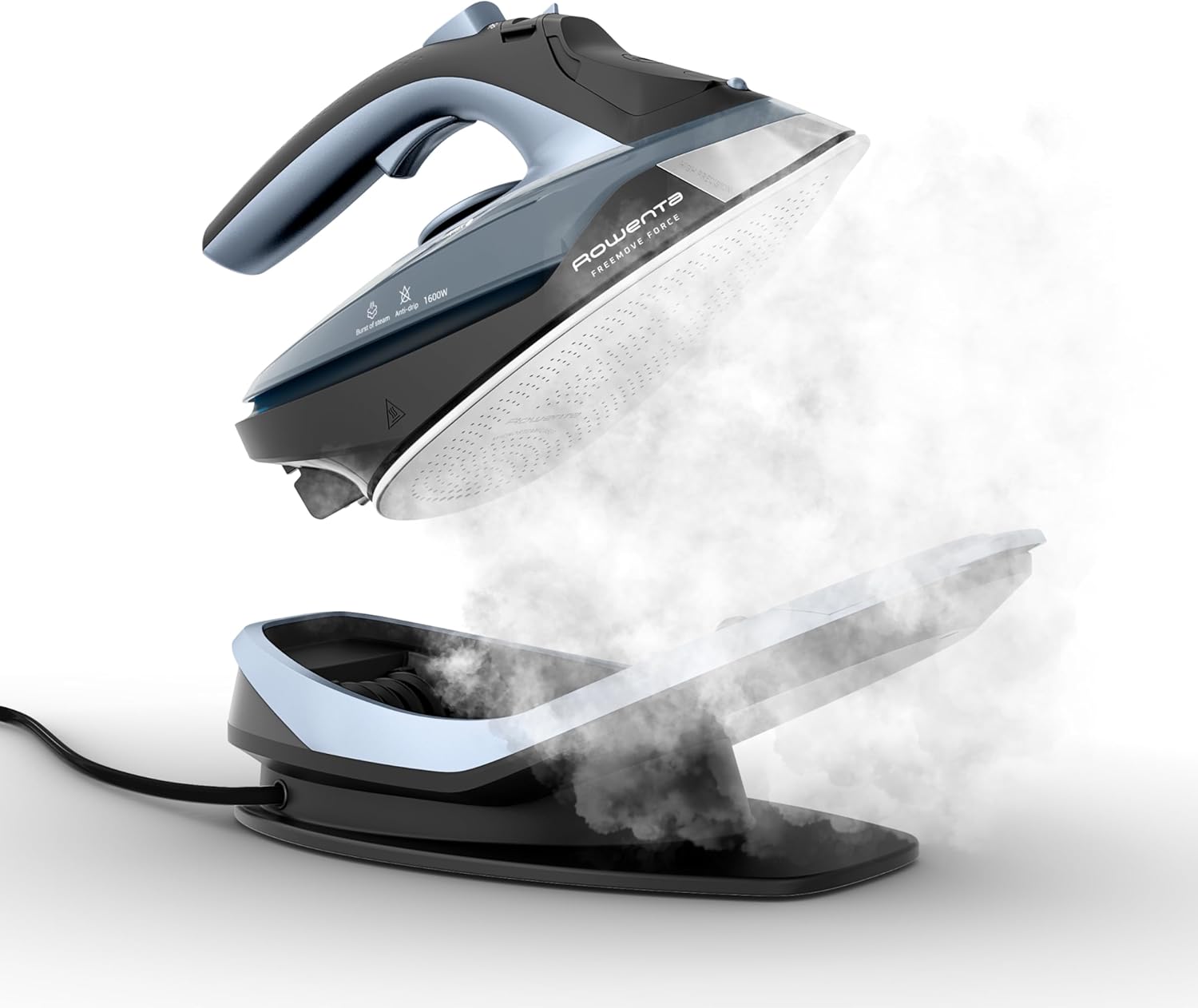
| Wattage | 1600 watts |
|---|---|
| Voltage | 120 volts |
| Special Features | Anti-Calc Function, Anti-Drip, Auto Shutoff, Cordless, Lightweight |
The Rowenta Freemove DE6730 is a cordless steam iron aimed at making daily garment care quicker and more flexible. It heats in about 30 seconds and delivers continuous steam with a short 110 g/min boost for stubborn wrinkles, while a dense pattern of 400 micro-steam holes spreads steam evenly across fabric for smooth gliding. The cordless design and rechargeable base let you press flat or use vertical steaming on hanging pieces, and the iron locks to the base for quick 10-second reheats between passes to keep workflows moving. Built-in anti-drip, anti-calc, and auto-shutoff features reduce maintenance and safety concerns, and the stainless steel soleplate balances glide and durability. Expect solid wrinkle removal on quilting cottons and linen; however, the cordless format means you must return the iron to its base frequently to recharge, which can interrupt very long pressing sessions. The unit is lightweight and travel-friendly but not intended as a continuous plugged-in powerhouse for full-day professional production work.
Best for: Buyers who prioritize safety, predictable steam performance, and the convenience of cordless use for home sewing and quilting touch-ups will appreciate this iron.
Less Ideal for: Users who need uninterrupted, full-day pressing for large production quilting runs should consider a high-capacity corded steam iron or steam press instead.
- Rapid 30-second heat-up for quick starts
- Strong steam output with a 110 g/min boost for removing deep wrinkles
- 400 micro-steam holes and stainless steel soleplate for even steam distribution and smooth glide
- Cordless operation with a rechargeable base enables vertical steaming and freer movement
- Anti-calc, anti-drip, and auto-shutoff features improve safety and reduce maintenance
- Cordless design requires frequent returns to the base for reheating during long pressing sessions
- Not designed for continuous, professional-scale ironing without interruption
Verdict: A safety-minded, fast-heating cordless iron that delivers even steam and easy maneuverability for home quilting and regular garment care.
Choosing the Right Cordless Iron for Quilting: Key Factors to Consider
Temperature Accuracy and Stability
Accurate and stable temperature control matters because quilting involves a range of fabrics from dense cotton batting to delicate silk accents. An iron that overshoots or fluctuates can scorch blocks, cause shine on darker fabrics, or fail to properly set seams. Look for irons with clear temperature settings or thermostatic feedback that maintain heat during prolonged pressing sessions.
Stability also affects repeatability. When you press dozens of seams, predictable heat reduces the need for multiple passes and helps maintain uniform seam allowance and crisp block edges.
Soleplate Material and Glide
The soleplate's material and finish determine how smoothly the iron moves across fabric and how likely it is to stick or drag. A well-polished stainless steel or ceramic-coated soleplate typically glides over layers and batting without catching threads or leaving marks. Avoid rough finishes that increase friction or can pull delicate appliques.
Consider how the soleplate performs with starch or pressing sprays. Some finishes are easier to keep clean and resist buildup from sizing agents, which preserves glide over time.
Tip Shape and Precision
Quilting requires detailed work around seams, corners, and small pieces. A narrow or shaped tip lets you press into tight junctions and seams without flattening adjoining pieces. A pointed yet smooth tip reduces the need to reposition fabric repeatedly, which improves accuracy when piecing blocks and pressing seam allowances open.
Tip precision also helps when pressing appliques or binding: a controlled point of contact concentrates heat where you need it without disturbing surrounding quilt top elements.
Battery Life and Charging Workflow
Cordless irons rely on batteries or charging cradles, so runtime and recharge speed directly influence workflow. For quilting, you want enough continuous heat to press several seams or blocks before returning to the base. Short runtimes force frequent interruptions and can lengthen project time.
Equally important is how the iron recharges. A stable docking base that allows quick heat recovery between uses keeps you productive. Consider whether the charging system fits your workspace and whether spare batteries or rapid recharge features are available for sustained sessions.
Weight, Balance, and Ergonomics
Frequent pressing makes weight and balance important. An iron that is too heavy will tire your wrist and hands during long quilting sessions, while one that is too light may require extra pressure and decrease control. Ergonomic handle design and a balanced center of gravity let you press consistently without strain.
Also consider user controls that are easy to reach while holding the iron, and whether the on/off and temperature controls are intuitive to operate when you are mid-project.
Safety Features and Docking
Safety matters in a sewing room full of flammable threads and batting. Look for automatic shutoff after a period of inactivity, heat-safe docking stations, and stable bases that prevent tipping. A docking system that safely isolates the hot soleplate protects fabric and reduces the risk of accidental burns.
Clear indicator lights or audible cues for charging and ready-to-use status also help prevent mistakes and unintended contact with a hot iron.
Why Quilting Needs a Different Iron
Quilting involves layering, precise seams, and detailed work that differ from everyday clothing pressing. You repeatedly press small areas, turn corners, and work over batting that can compress or shift under heat. A cordless iron designed for quilting balances heat control with maneuverability so you can handle these tasks without repeatedly repositioning cords or struggling around the ironing board.
A quilting-appropriate iron emphasizes tip precision, stable temperatures, and a forgiving soleplate finish that will not snag threads or flatten texture. Mobility matters because you may press on a cutting table, a longarm station, or a smaller pressing station rather than a full-size ironing board.
- Cordless freedom reduces cord drag that can shift small fabric pieces.
- Short bursts of heat often work better than one long press on layered quilts.
- Small, pointed tips are valuable for seams and applique edges.
Setting Up a Pressing Station for Quilting
Create a dedicated pressing station with a stable surface, heat-resistant pad, and good lighting. Place the cordless iron's charging base within easy reach so you can dock frequently without interrupting your workflow. Use a padded, low-profile pressing mat for small blocks and quick touch-ups.
Organize tools nearby, such as a seam roll, tweezers, and spray bottle for a consistent routine. Keeping the station tidy reduces the chance of fabric catching on pins or scissors while you move the iron around delicate pieces.
- Use a seam roll to press seams without flattening surrounding areas.
- A heat-resistant pressing mat lets you work off-board for small pieces.
- Keep a lint-free cloth handy to protect dark fabrics from shine.
Maintenance Tips to Preserve Soleplate Glide
Regular maintenance keeps the soleplate moving smoothly over fabric. After sessions, wipe the cool soleplate with a soft cloth to remove residue from sizing or starch. For sticky buildup, use a manufacturer-recommended cleaner or a diluted solution designed for iron maintenance.
Avoid abrasive cleaners that can scratch the finish and increase friction. Periodic checks of the tip and base contacts ensure good heat transfer and stable docking performance.
- Clean residue after it cools to avoid smear marks.
- Avoid sticky adhesives near the pressing area that can transfer to the soleplate.
- Check docking contacts for lint that can affect charging or heat recovery.
Pressing Techniques Quilters Rely On
Use short, firm presses rather than sliding the iron aggressively across seams. For seam allowances, press from the back of the block to set the seam and then press open or to one side on the front. When working with batting, use minimal pressure to avoid compressing loft unnecessarily.
For appliques and small pieces, use the tip to apply localized heat and avoid broad strokes that can mis-shape the patchwork. When using spray starch or sizing, apply sparingly and test on fabric scraps to prevent buildup on the soleplate.
- Press in place for a few seconds, lift, and reposition as needed.
- Press seams from the back first, then refine on the front.
- Test starch on scraps to judge effect before pressing the quilt top.
How to Judge Runtime Needs for Your Projects
Estimate how often you press during typical sewing sessions. If you piece several blocks before pressing, a longer battery runtime or faster recharge may be more important. For one-at-a-time pressing or binding work, shorter bursts between docking might be perfectly adequate.
Consider whether you can structure work into cycles: piece a set of blocks, then complete a pressing cycle with the iron. If you often press while sitting at a cutting table or longarm station, factor in the convenience of the docking position and whether you need a spare battery for uninterrupted work.
- Match runtime to your typical session length to avoid frequent interruptions.
- Plan workflow so docking happens during other non-pressing tasks.
- If longer runtime matters, favor models designed for extended heat retention.
How We Chose the Best Cordless Iron for Quilting
We evaluated cordless irons for quilting using hands-on usability factors and measurable specifications that matter to stitchers. Core criteria included temperature accuracy and stability, since consistent heat prevents scorching on cotton, blends, and delicate quilt blocks. We also assessed soleplate material and glide for smooth, snag-free pressing and how well the tip handles seams, corners, and applique details. Mobility and charging convenience were weighed heavily, focusing on runtime between charges, ease of docking, and how quickly the iron returns to working temperature. Weight and ergonomics were considered because long pressing sessions should not fatigue the wrist. Finally, we looked at safety features like automatic shutoff and heat-safe docking to reduce risk in a busy sewing room. We excluded travel-only or extremely low-powered irons that cannot sustain consistent heat for quilting tasks. We prioritized models designed for frequent pressing and those with the temperature control range and soleplate finish suited to fabric work. The result is a list of cordless irons that meet practical durability and performance expectations for quilters.
Our full evaluation process is outlined in our review methodology.
FAQ
Can cordless irons reach temperatures high enough for cotton quilting?
Many cordless irons can reach the temperatures necessary for cotton quilting, but capability varies by model. Check for thermostatic control and a high enough temperature range to properly press cotton and batting without repeatedly re-pressing.
Are cordless irons safe to dock on fabric surfaces?
Most cordless irons come with a heat-safe docking station intended to protect surfaces and fabric. Avoid placing the iron directly on quilt tops or flammable materials while hot, and use a dedicated heat-resistant pad when pressing off the docking base.
How do I prevent shine or scorch marks on dark quilt fabrics?
Use lower temperatures, a pressing cloth, and light pressure to reduce shine. Test settings on scraps first and avoid prolonged single-point contact. A well-polished soleplate and stable temperature control also help minimize unwanted marks.
Is a lighter iron always better for quilting?
Not always. A lighter iron reduces fatigue but may require more downward pressure to get the same result. Balance weight and ergonomics so you can press steadily without adding strain to your wrist during long sessions.
How often should I clean the soleplate when quilting frequently?
Clean the soleplate after several heavy sessions or whenever you notice residue affecting glide. Wipe it down when cool and use recommended cleaners for stubborn buildup. Regular maintenance prevents transfer of sizing or starch to your quilt fabrics.
Final Verdict
Choosing the right cordless iron for quilting means balancing precise heat control, a smooth soleplate, and a tip that can handle detailed work. Prioritize temperature accuracy and tip precision if you do a lot of small-piece pressing, or favor longer runtime and easy docking if you press many blocks in a row. Weigh the tradeoffs between weight and control, and set up a dedicated pressing station to make the most of cordless mobility. With the right combination of features, a cordless iron can speed workflow, improve seam accuracy, and protect your fabrics during every quilting project.