
Note: This article contains affiliate links. If you click on these links and make a purchase, we may earn a small commission at no extra cost to you. This helps support our research and content. Read our full affiliate disclosure here.
A crawl space that stays damp invites mold, wood rot, and poor indoor air quality for the whole house. Choosing the right dehumidifier for crawl space matters because these areas need equipment built for low airflow, variable temperatures, and long unattended runs. This guide collects seven shortlisted dehumidifiers tailored to crawl-space use and explains the features that determine long-term performance. We evaluate capacity, drainage and temperature operation so you can pick a unit that controls moisture without constant babysitting. Read on to compare the top picks and what to look for in a crawl-space setup.
Top Picks at a Glance
| Best Overall The best all-around choice for most situations | ALORAIR Sentinel HD55 |  |
| Best Quality Built to a higher standard if you want something more solid | Aprilaire E070 70-Pint Dehumidifier |  |
| Best Value The sweet spot between price and what you get | Moiswell Defender ME-7 |  |
| Best Budget The cheapest option that still gets the job done reliably | AEOCKY LEO-Lite 74 Pint Dehumidifier |  |
| Top Rated A top-rated pick with lots of positive feedback | Prikod 155 Pint Dehumidifier |  |
| Most Popular A crowd favorite that many people choose with confidence | Waykar 80-Pint Dehumidifier JD025CE-80 |  |
| Best Seller A high-volume bestseller chosen again and again | DECIUU 100-Pint Dehumidifier |  |
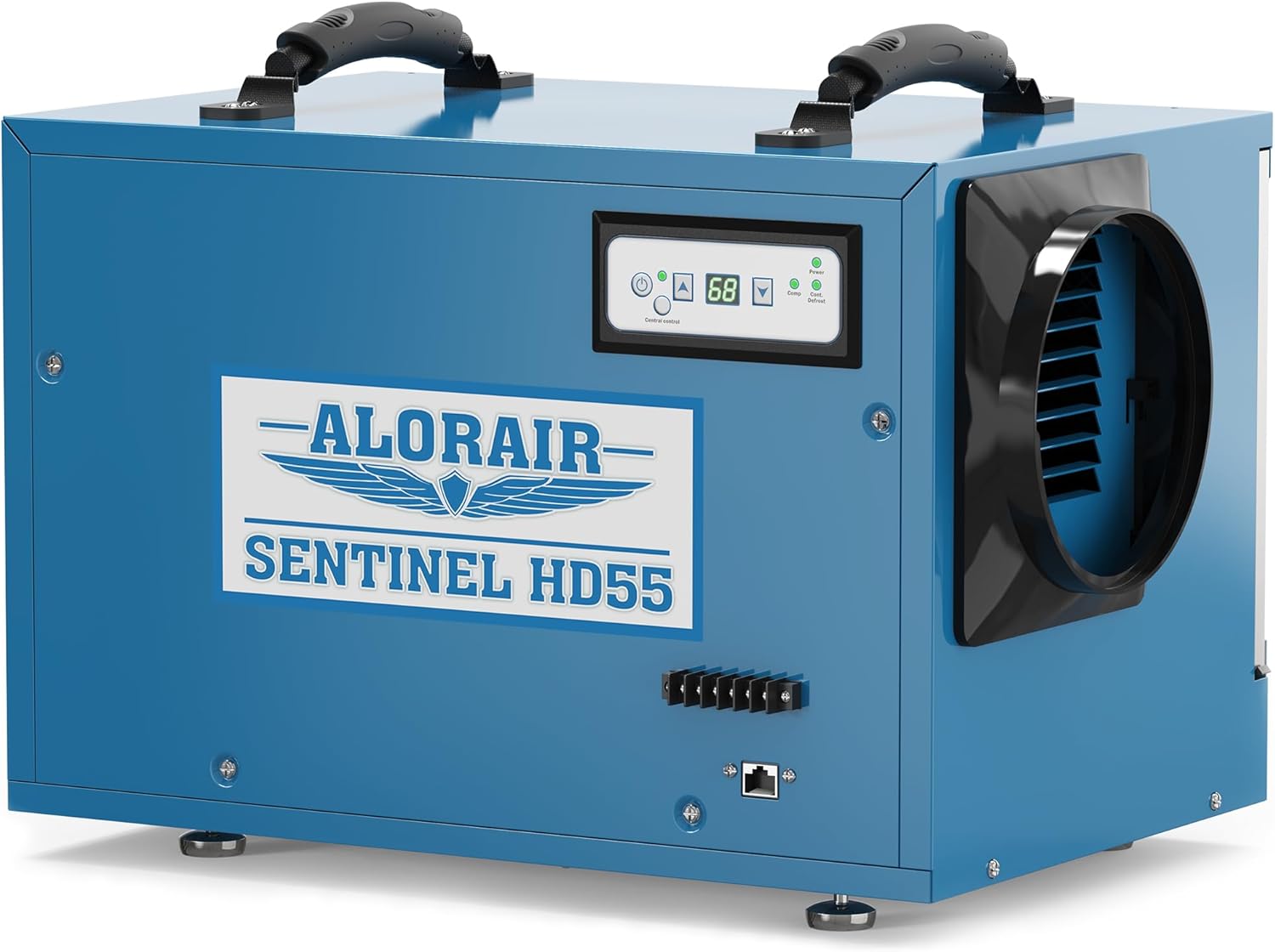
ALORAIR Sentinel HD55
| Capacity | 113 pints |
|---|---|
| AHAM Capacity | 53 pints per day |
| Floor Area | 1200 square_feet |
| Air Flow Capacity | 120 cfm |
| Operation Mode | Continuous |
The ALORAIR Sentinel HD55 is a compact commercial dehumidifier built for crawlspaces, basements, and similar low-clearance or industrial areas where continuous moisture control is needed. It removes up to 113 pints per day at saturation (53 PPD AHAM) and is rated to service about 1,200 square feet while using an automatic drain system rather than an internal tank. The metal cabinet, MERV-1 service filter option, and cETL listing make it suited to rougher environments, and built-in auto-defrosting lets it run in cooler conditions without damage. Practical touches include a rugged carrying handle, ductable air outlet, and optional hanging or remote-control accessories for flexible installation and quieter operation. Limitations are that it lacks a built-in pump on this model, so gravity or external drainage is required, and its commercial focus means it is louder and heavier than typical consumer room units. It is a solid choice where reliable, high-capacity continuous removal is the priority and space and drainage allow permanent or semi-permanent setup.
Best for: Owners who need a reliable, high-capacity dehumidifier for crawlspaces or basements and prioritize continuous moisture removal and rugged construction over quiet, portable convenience.
Less Ideal for: People looking for a lightweight, very quiet home dehumidifier or units that can collect water in an internal tank for occasional use should consider consumer-focused models instead.
- High removal capacity up to 113 pints per day at saturation and 53 PPD AHAM for fast dehumidification
- Metal cabinet and cETL listing for durable, commercial-grade use
- Auto-defrosting allows operation in low temperatures without frost damage
- Continuous operation with automatic drain eliminates the need to empty a water tank
- Compact footprint and rugged handle for easier placement in crawlspaces
- No built-in condensate pump on this model, so requires gravity or external drain
- Heavier and louder than consumer room dehumidifiers due to commercial components
Verdict: Choose the Sentinel HD55 when you need a durable, high-capacity crawlspace dehumidifier that runs continuously and handles low-temperature conditions.
Aprilaire E070 70-Pint Dehumidifier

| Capacity | 70 pints |
|---|---|
| Dehumidification Capacity | 70 pints_per_day |
| Air Flow Capacity | 200 cfm |
| Wattage | 696 watts |
| Voltage | 110 volts |
The Aprilaire E070 is a high-capacity 70-pint dehumidifier intended for basements, crawl spaces, and whole-home applications up to roughly 2,800 sq ft. It runs automatically off a relative-humidity set point and offers continuous draining so you do not need to empty a collection tank, and the included risers, duct collars, drain hose, and extra filters simplify installation and maintenance. The unit advertises a 200 cfm airflow and energy-efficient operation; Aprilaire positions this model for steady, long-run moisture control rather than short bursts. Practical benefits include an adjustable digital control, automatic defrost for low-temperature operation, washable filters, and overheat protection for reliable operation in conditioned and semi-conditioned spaces. Trade-offs are its size and weight that make moving and tight installations more involved, and the unit requires a proper drain or plumbing connection to realize continuous operation. This bundle is best when you need sustained, professional-grade humidity control in damp crawl spaces or basements and want a largely hands-off solution once installed.
Best for: Buyers who need robust, long-term moisture control for crawl spaces or large basements and prioritize reliable, automatic operation with included installation accessories.
Less Ideal for: People who need a lightweight, portable dehumidifier for occasional spot use or who cannot provide a permanent drain connection should consider smaller portable units instead.
- High 70-pint dehumidification capacity suitable for large basements or crawl spaces
- Automatic on/off via %RH set point for set-and-forget operation
- Continuous drain capability eliminates daily tank emptying
- Energy-efficient design aimed at lower power use for extended runs
- Bundle includes drain hose, risers, duct collars, and extra filters to simplify installation
- Large and heavy, which can complicate placement and handling during installation
- Requires a dedicated drain or plumbing hookup to use continuous draining effectively
Verdict: Choose the Aprilaire E070 bundle when you want a high-capacity, energy-efficient dehumidifier that delivers continuous, set-and-forget humidity control for crawl spaces and large basements.
Moiswell Defender ME-7

| Capacity | 70 pints |
|---|---|
| Dehumidification Capacity | 70 pints_per_day |
| Air Flow Capacity | 100 cfm |
| Wattage | 450 watts |
| Voltage | 120 volts |
The Moiswell Defender ME-7 is a compact, Energy Star certified dehumidifier built for crawl spaces, basements, and other confined areas up to about 1,000 sq ft. It uses a refrigeration system with upgraded copper components and can remove up to 70 pints at saturation (about 35 pints under AHAM conditions), routed through a gravity drain using the included hose for continuous operation without emptying a tank. The control panel is straightforward with a large display, adjustable humidity control, and a 24-hour timer, and the unit includes automatic defrost for cooler environments. At roughly 40 pounds with lift handles and a small footprint, it is easy to position in tight spaces. Expect reliable, energy-efficient moisture removal for maintenance drying and mold prevention, though gravity drainage requires planning for a downhill drain point and the 100 cfm airflow and 450 watt power draw reflect its commercial-focused capability rather than ultra-quiet home use.
Best for: Buyers who want a practical, efficient dehumidifier for crawl spaces or small basements and prioritize continuous, low-maintenance moisture removal over silent operation.
Less Ideal for: Households that need a near-silent bedroom or living-room unit or locations without any downhill drain option should consider alternative models with built-in pumps or quieter consumer designs.
- Energy Star certified for better long-term energy efficiency
- Gravity drainage system with included hose enables continuous unattended operation
- Upgraded copper refrigeration components for improved durability
- Compact, portable design with handles for placement in tight crawl spaces
- Gravity drain requires a lower drain point or modification to route condensate
- Airflow and noise profile suit commercial use more than ultra-quiet living spaces
Verdict: A compact, energy-efficient choice for crawl spaces and small basements that need continuous, low-maintenance dehumidification.
AEOCKY LEO-Lite 74 Pint Dehumidifier

| Capacity | 74 pints per day |
|---|---|
| Tank Volume | 1.45 gallons |
| Floor Area | 4500 square_feet |
| Operation Mode | Auto |
| Other Special Features of the Product | Timer |
The AEOCKY LEO-Lite is a high-capacity compressor dehumidifier built for large, damp spaces like basements. It removes up to 74 pints per day under peak conditions and uses a rotary compressor and a 3+2 evaporator/condenser layout to prioritize efficiency while keeping noise low. Controls include an intelligent humidistat with fast humidity sensing, an auto mode and timer, plus power-off memory for automatic recovery after outages. A 1.45 gallon tank and included drain hose let you choose between emptying the tank or continuous drainage. The unit meets ENERGY STAR Version 6.0 efficiency standards, so it runs more economically than many older basement models and includes an auto-defrost system to keep working in cooler basement temperatures. It is fairly quiet at low speed and is aimed at continuous or near-continuous operation for moisture control. Trade-offs are its single-speed fan control and relatively large footprint compared with tiny portable units, so it is best where sustained extraction and energy savings outweigh simple portability.
Best for: Buyers who want an efficient, high-capacity dehumidifier to control persistent basement humidity and reduce energy use over long runtimes.
Less Ideal for: If you need a lightweight, highly portable unit for small rooms or infrequent use, a compact low-capacity dehumidifier is a better fit.
- High dehumidification capacity rated at 74 pints per day for heavy basement humidity
- ENERGY STAR Version 6.0 rating for improved seasonal energy efficiency
- Auto-defrost keeps the unit operating in cool basement temperatures
- Included drain hose plus 1.45 gallon tank enables continuous drain or manual emptying
- Quiet operation for its class thanks to rotary compressor and low fan noise
- Single speed setting limits fine-grained control of airflow and sound
- Relatively large and heavier than compact room dehumidifiers
Verdict: Choose the LEO-Lite when you need a quiet, energy-efficient, high-capacity dehumidifier built to run continuously in a basement.
Prikod 155 Pint Dehumidifier

| Capacity | 155 pints/day |
|---|---|
| Floor Area | 6000 square_feet |
| Air Flow Capacity | 265 cfm |
| Operation Mode | Continuous |
This Prikod commercial dehumidifier is built for heavy-duty, unattended moisture control in crawl spaces, basements, and medium commercial areas. It is rated at 155 pints/day under high-temperature, high-humidity DOE conditions and supports continuous operation with a built-in condensate pump plus a gravity drain port so you can route water uphill or down without extra plumbing. The unit includes automatic defrost to keep it running in cooler environments, a washable quick-release filter for easy maintenance, a 24-hour timer, and automatic restart with memory after power loss. Practical benefits include the long included pump hose, a duct collar for ducting into tight crawl spaces, and adjustable leveling feet to protect the chassis from damp floors. Trade-offs are its commercial size and weight, which make it less portable than household models, and the higher power draw when operating at maximum capacity compared with small residential dehumidifiers. For persistent humidity problems where reliability and continuous drainage are essential, this model focuses on dependable operation rather than compact convenience.
Best for: Buyers who need a dependable, always-on dehumidifier for crawl spaces, commercial basements, or similar large damp areas and prioritize uninterrupted drainage and low-maintenance operation.
Less Ideal for: People looking for a lightweight, portable home unit for a single room or occasional use should consider smaller residential dehumidifiers instead.
- Built-in condensate pump plus gravity drain option for flexible continuous drainage
- Automatic defrost enables reliable operation down to low temperatures
- Quick-release washable filter and accessible controls simplify maintenance
- Timer and automatic restart with memory support set-and-forget operation
- Large, heavy commercial chassis reduces portability and may need two people to move
- Higher power draw at full capacity compared with typical home dehumidifiers
Verdict: Choose this unit when you need a robust, low-maintenance dehumidifier that reliably removes large volumes of moisture and provides flexible continuous drainage for crawl spaces and commercial basements.
Waykar 80-Pint Dehumidifier JD025CE-80

| Dehumidification Capacity | 80 pints_per_day |
|---|---|
| Tank Volume | 2.5 gallons |
| Wattage | 270 watts |
| Air Flow Capacity | 165 cfm |
| Operation Mode | Continuous |
The Waykar 80-Pint Dehumidifier is built to handle large, damp areas such as basements by extracting up to 80 pints per day and offering both tank and continuous drain options. It is commonly used running continuously or on a timed schedule to bring basement humidity down to a selected setpoint between 30% and 80% relative humidity, and the 90° auto-swing helps spread airflow for more even drying. Practical features include an included drain hose and connector for gravity drainage, a washable removable filter, automatic defrost and overload protection for low-temperature reliability, and an Energy Star rating to keep running costs lower than noncertified units. At roughly 42 dB it is quieter than many similarly sized machines, making it reasonable for finished basements or nearby living areas. The unit is relatively heavy and targeted at larger spaces, so it is less convenient to move frequently, and the 1.14 gallon tank means emptying is still needed if you do not use continuous drainage. For buyers focused on dependable basement performance and energy efficiency, this model delivers strong moisture removal with sensible protections for extended operation.
Best for: Homeowners who need a reliable, high-capacity dehumidifier to control moisture in large basements and prefer proven features and energy efficiency over portability.
Less Ideal for: People looking for a lightweight, highly portable unit for small rooms or occasional use should consider smaller, easier-to-move models instead.
- High dehumidification capacity rated at 80 pints per day for large basements
- ENERGY STAR certification for better energy efficiency during extended use
- Multiple drainage options with included drain hose for continuous gravity drain
- Auto-defrost and overload protection improve reliability in cool basement conditions
- 90° auto-swing airflow and washable filter help distribute air and simplify maintenance
- Relatively heavy and sized for large spaces, so not ideal for frequent transport
- Water tank is modest at 1.14 gallons if continuous drainage is not used
Verdict: A powerful, Energy Star certified 80‑pint unit that reliably handles large basement humidity with continuous drain and protective auto-defrost features.
DECIUU 100-Pint Dehumidifier

| Capacity | 100 pints_per_day |
|---|---|
| Floor Area | 5000 square_feet |
| Tank Volume | 1.45 gallons |
| Wattage | 300 watts |
| Air Flow Capacity | 9396 cubic_feet_per_hour |
This DECIUU dehumidifier is built for large, damp spaces like basements, garages, and crawl areas where continuous moisture control is needed. It extracts up to 100 pints per day in high-humidity conditions and maintains a set humidity between 35% and 80% using its intelligent humidity control and timer. Practical features include a 1.45 gallon removable tank, three drainage options (tank, included drain hose, or garden-hose connection) for long unattended runs, a washable filter, auto defrost for cooler environments, and three fan speeds for tuning performance versus noise and energy use. Mobility is easy thanks to 360 degree swivel casters and a hidden handle. The unit is ENERGY STAR Most Efficient 2024 rated and runs at 300 watts, which helps limit operating cost during continuous use. Trade-offs are its weight and footprint for fitting into tight crawl spaces and the need to route a drain for fully continuous operation in remote spots.
Best for: Buyers who prioritize reliable, low-energy continuous moisture control in large or problem damp spaces and want simple, flexible draining and auto-maintenance features.
Less Ideal for: People needing a compact, lightweight unit for very tight crawl spaces or those who cannot run a drain hose and prefer only small portable units for occasional use.
- High dehumidification capacity up to 100 pints per day for large damp spaces
- Three drainage options including continuous hose and garden-hose connection for unattended operation
- ENERGY STAR Most Efficient 2024 rating for better energy performance during long runs
- Auto defrost and adjustable humidity control for reliable operation in cooler, variable conditions
- Relatively large and heavy which can make placement in very tight crawl spaces challenging
- Requires drain routing or regular tank emptying for continuous operation
Verdict: Choose this model if you need dependable, energy-efficient continuous dehumidification and flexible drainage for large crawl spaces and basements.
Choosing the Right Dehumidifier for Crawl Space: Key Factors to Consider
Moisture Removal Capacity (Pints Per Day)
Capacity determines how quickly a unit can lower relative humidity in an enclosed crawl space. A higher pint-per-day rating is important when the area has substantial vapor intrusion, active leaks, or poor ventilation.
Underestimating required capacity leads to constant runtime and reduced lifespan. Choose a unit rated for the square footage and typical humidity load of the crawl space, and allow extra capacity if the area houses a lot of wood, insulation, or stored items that absorb moisture.
Low-Temperature Operation
Crawl spaces are often cooler than conditioned rooms, especially in winter. Refrigerant-based dehumidifiers lose efficiency and risk coil frosting at low temperatures, so look for units specified to operate effectively at the lowest expected ambient temperature.
Some models include auto-defrost or hybrid desiccant-assisted systems that maintain extraction rates in cool environments. Ensuring reliable operation across the crawl space temperature range prevents seasonal moisture spikes and protects structural components year-round.
Drainage and Condensate Handling
Because crawl spaces are inconvenient to access, continuous drain capability is critical. Options include built-in pumps, gravity drains, or fittings for external condensate lines. The right drainage approach depends on crawl-space slope, proximity to a drain, and whether you can route a line to a sump or exterior location.
Consider condensate pump capacity, hose diameter, and the availability of a float switch or overflow protection. A poorly planned drainage setup can cause backups, leaks, or require frequent manual emptying.
Airflow and Placement Constraints
Crawl spaces typically have low clearances and restricted airflow. A dehumidifier with flexible ducting options or directional airflow works better in tight cavities. Placement affects intake and exhaust performance; the unit should be positioned to avoid dead air pockets and to allow access for service.
Also consider clearances for venting warm exhaust and any required distance from insulation or exposed wiring. Units designed for compact installation or with remote sensors make it easier to control humidity without obstructing the space.
Durability and Corrosion Resistance
Crawl-space environments can be corrosive due to high humidity, soil gases, and occasional splashing. Materials and coatings that resist rust extend service life. Look for corrosion-resistant coils, treated control panels, and a sturdy cabinet that stands up to damp conditions.
Longer warranties and replaceable parts availability are signs the manufacturer expects heavy-duty use. Durability reduces total cost of ownership and lowers the chance of midseason failures that are hard to fix in tight spaces.
Maintenance Accessibility
Limited access makes easy maintenance essential. Removable, tool-free filter access and clear condensate connections simplify routine cleaning and reduce the need for frequent trips into the crawl space. Clear service panels and straightforward drain fittings minimize time spent on upkeep.
Also factor in how often filters need replacement, whether coils are accessible for cleaning, and if common wear items can be swapped without major disassembly. Less invasive maintenance keeps the system operating reliably with minimal hassle.
Understanding Crawl-Space Humidity Dynamics
Crawl spaces differ from basements and conditioned rooms because they are semi-enclosed, often vented to the outdoors, and have direct contact with cool, moist soil. Water vapor can migrate upward through the soil and through gaps in the foundation, producing persistent humidity even when interior conditions are dry.
Because of these dynamics, a dehumidifier for crawl space needs to be sized and configured based on the specific enclosure, ground moisture conditions, and any existing vapor barriers or ventilation. Treating the crawl space as part of the house envelope is the first step to effective moisture control.
- Check whether the crawl space has a vapor barrier and where it may be damaged.
- Map potential water entry points like plumbing penetrations or grading issues.
- Measure baseline humidity at several locations and times of day to understand variability.
Installation Best Practices for Crawl Space Units
Proper installation reduces maintenance headaches and improves performance. Mount or place the unit on a level, raised platform to avoid contact with standing water and to promote airflow through the intake and exhaust. Ensure the unit is stable and vibration-isolated to prevent rattling against joists.
Plan condensate routing before final placement. If using a gravity drain, position the unit above the exit point. If a pump is required, verify the pump's vertical lift and continuous-run capability. Seal any intentional openings around ducts and lines to prevent warm, humid air from being drawn back into the structure.
- Use flexible vibration-isolating mounts or pads.
- Route condensate lines with a consistent downward pitch when possible.
- Protect electrical connections from moisture and follow local codes.
Controlling Cold-Weather Performance
If the crawl space drops below typical indoor temperatures, consider units with reliable defrost cycles or those rated for lower ambient temperatures. Some designs switch to a desiccant stage or use electric heat to avoid coil icing. Without proper cold-weather design, a refrigerant dehumidifier can lose effectiveness or cycle excessively.
Monitoring is key. Install a humidity and temperature sensor that records extremes and trends so you can confirm year-round performance and decide whether supplemental measures, like modest heating or insulation upgrades, are necessary.
- Select units with documented low-temperature operation or defrost features.
- Use sensors to identify when and where icing or performance dips occur.
- Consider insulating ducts and adding a small heater only if clearly needed.
Ventilation, Vapor Barriers, and Complementary Measures
A dehumidifier is part of a system. Sealing vents, installing or repairing a vapor barrier, and addressing exterior grading often reduce the dehumidifier load significantly. Reducing the source of moisture lowers runtime and improves the lifespan of the equipment.
Assess whether intermittent ventilation is beneficial in your climate. In many cases, reducing exterior air exchange and focusing on sealing plus mechanical dehumidification yields the most consistent interior humidity control.
- Install or repair a continuous vapor barrier over exposed soil.
- Correct exterior drainage issues and grade away from the foundation.
- Limit unnecessary venting to the outdoors unless recommended by local building codes.
Monitoring, Controls, and Remote Access
Crawl spaces are out-of-sight, so remote monitoring can prevent surprises. Look for units or add-on sensors that report relative humidity and temperature remotely or provide local alarms. Timed schedules, continuous-run options, and hygrostat control modes let you tune operation to changing conditions.
Smart control can reduce energy use by avoiding continuous high-power operation when not needed and by allowing early detection of faults such as pump failure or full-drain conditions.
- Use a hygrostat placed in a representative location, not directly at the unit.
- Set alarm thresholds a few percentage points above your target relative humidity.
- Consider controllers that log data to show seasonal trends.
How We Chose the Best Dehumidifier for Crawl Space
We focused on features that actually matter for long-term crawl-space moisture control and excluded units designed only for living areas or occasional use. Selection began with models rated for continuous operation and a moisture removal capacity suitable for enclosed, low-airflow spaces. We prioritized devices with robust drainage options for remote installations, durable corrosion-resistant components, and controls that support timed or continuous operation. Temperature range and cold-climate performance were essential filters because many crawl spaces run cooler than conditioned rooms. We also favored units with manageable maintenance requirements, such as accessible filters and easy condensate access, since crawl-space access is often limited. Finally, reliability signals such as build quality, warranty coverage, and quiet operation were considered. Exclusions: portable room-only dehumidifiers with low daily capacity, units without continuous-drain capability, and models untested for cooler ambient temperatures.
Our full evaluation process is outlined in our review methodology.
FAQ
What humidity level should I aim for in a crawl space?
Aim for a relative humidity between 45 and 55 percent in most crawl spaces. Lower levels reduce mold risk but may dry out wood in certain climates, so staying in this midrange balances moisture control with material health.
Can I use a regular room dehumidifier in a crawl space?
Often not. Room dehumidifiers are typically rated for higher airflow and warmer indoor temperatures. For continuous operation in a cool, confined crawl space, choose a unit specified for that environment or one with low-temperature capability and continuous-drain features.
Do I need a pump for condensate removal?
A pump is recommended if you cannot route a gravity drain to an appropriate outlet. Pumps add complexity and require occasional maintenance, but they allow continuous unattended operation when the drain point is above the unit.
How often should I maintain a crawl-space dehumidifier?
Inspect filters and drain fittings every 1 to 3 months and clean coils or replace filters as the manufacturer suggests. If access is difficult, plan more frequent remote inspections or use units with longer maintenance intervals.
Will insulating the crawl space reduce dehumidifier size requirements?
Yes. Adding or repairing insulation and a vapor barrier reduces moisture ingress and heat transfer, which lowers the load on the dehumidifier. Effective sealing and insulation can allow a smaller unit to maintain the same humidity control.
Final Verdict
A successful crawl-space dehumidification strategy balances capacity, durability, and drainage. Prioritize units with the right moisture-removal rating for your space, proven low-temperature performance, and a drainage solution that supports unattended operation. Addressing source issues such as vapor barriers and exterior drainage reduces equipment runtime and cost over time. Focus on long-term reliability and maintainability when selecting a crawl-space dehumidifier so the system protects the structure with minimal intervention.