
Note: This article contains affiliate links. If you click on these links and make a purchase, we may earn a small commission at no extra cost to you. This helps support our research and content. Read our full affiliate disclosure here.
A properly sized dehumidifier for offices keeps workspaces comfortable, protects equipment and paperwork, and reduces mold and odor risks. Picking the right unit matters because office environments vary in ceiling height, layout, and occupancy, and a mismatched dehumidifier will either run constantly or fail to control humidity effectively. This guide covers seven shortlisted dehumidifiers selected for office use and evaluates them across practical criteria like moisture removal capacity, noise, and ease of maintenance. Read on to find the model that fits your office size and operational priorities.
Top Picks at a Glance
| Best Overall The best all-around choice for most situations | hOmeLabs 50 Pint Dehumidifier | 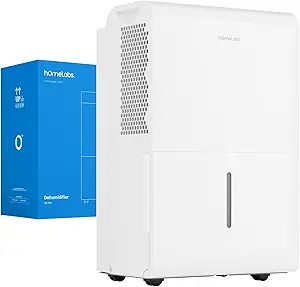 |
| Best Quality Built to a higher standard if you want something more solid | Frigidaire 50 Pint Dehumidifier |  |
| Best Value The sweet spot between price and what you get | VEAGASO VG380 34‑Pint Dehumidifier |  |
| Best Budget The cheapest option that still gets the job done reliably | TABYIK 35OZ Dehumidifier DH-CS01 |  |
| Top Rated A top-rated pick with lots of positive feedback | hOmeLabs 32-Pint Dehumidifier |  |
| Most Popular A crowd favorite that many people choose with confidence | BEDRED CT11 Dehumidifier |  |
| Best Seller A high-volume bestseller chosen again and again | ToLife Dehumidifier TZ-C2 |  |
hOmeLabs 50 Pint Dehumidifier
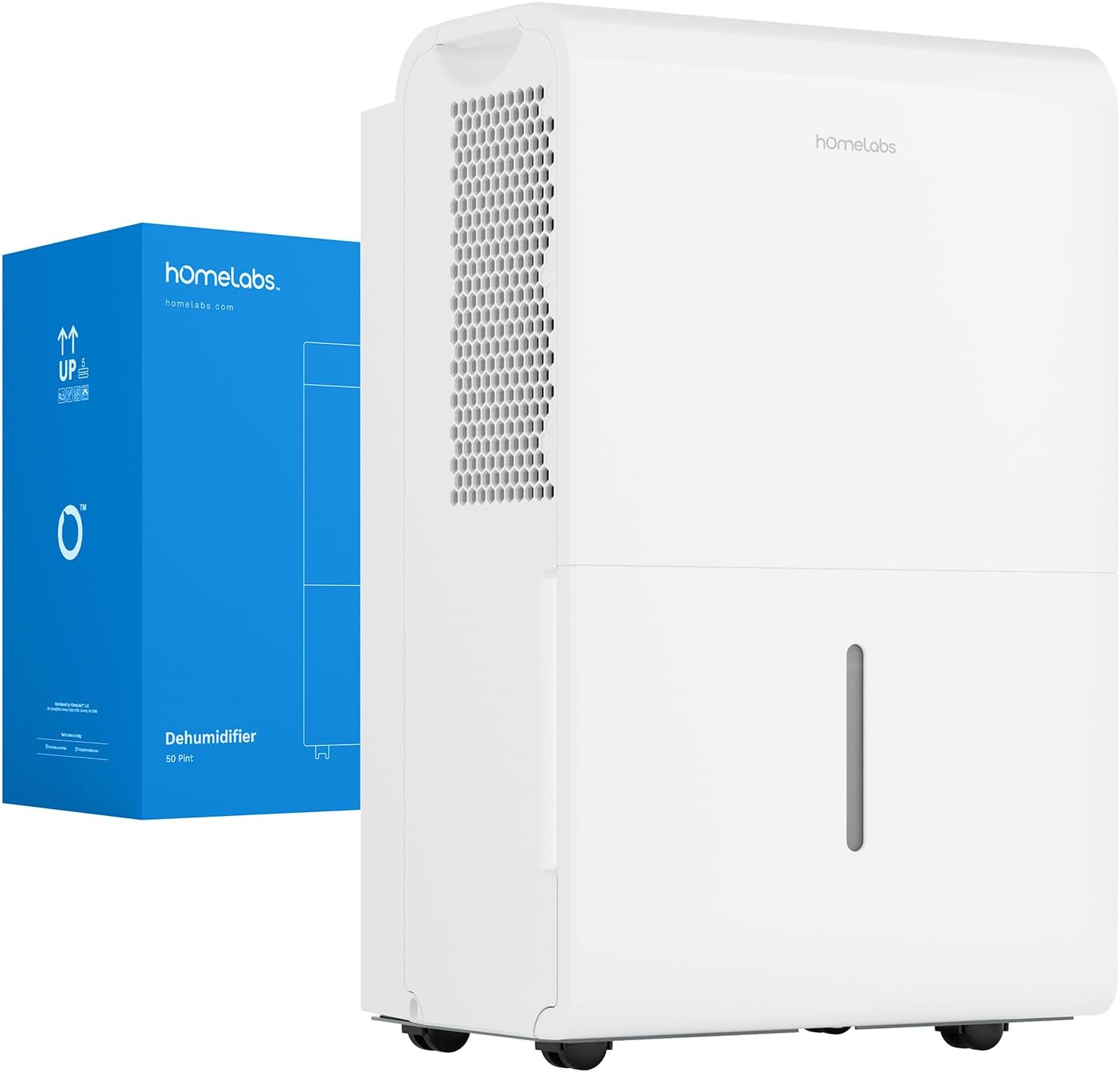
| Dehumidification Capacity | 50 pints_per_day |
|---|---|
| Floor Area | 7000 square_feet |
| Tank Volume | 1.6 gallons |
| Wattage | 322 watts |
| Air Flow Capacity | 165 cfm |
This hOmeLabs unit is a 50‑pint dehumidifier that targets large rooms and workspaces, with Wi‑Fi for remote control and a continuous operation mode that stops when the tank is full or can run into a hose for continuous drainage. It is typically used in basements, offices, or large open floor plans where humidity control is needed across broad areas — the spec sheet claims coverage up to 7,000 sq ft and 50 pints per day at standard test conditions. The control panel, two fan speeds, timer, and washable filter make routine use straightforward, and the included wheels and handles simplify moving the unit between rooms. Practical benefits include automatic restart and defrost for reliable year‑round operation, plus a quiet fan profile suitable for office environments. Important limitations are that real‑world removal will vary with temperature and relative humidity, the continuous drain hose is not included, and it is a relatively heavy floor unit that needs space and an accessible drain or frequent tank emptying if not plumbed.
Best for: Office managers or facilities buyers who need dependable humidity control across large open work areas and value remote monitoring and unattended continuous draining.
Less Ideal for: People who need a lightweight, highly portable unit for small rooms or infrequent spot use or who cannot provide a drain for continuous operation.
- Wi‑Fi remote control for adjusting settings from anywhere
- Rated to remove up to 50 pints per day under standard conditions
- Continuous drain outlet for unattended operation
- Auto defrost, auto restart, and automatic shutoff for reliable use
- Washable filter and simple controls make maintenance easy
- Continuous drain hose not included
- Performance will depend on room temperature and humidity so results may be lower than rated
- Bulky and heavy compared with small portable units
Verdict: A robust, Wi‑Fi‑enabled 50‑pint dehumidifier built for large offices that need steady, remotely managed humidity control.
Frigidaire 50 Pint Dehumidifier

| Capacity | 50 pints |
|---|---|
| Tank Volume | 2.7 gallons |
| Air Flow Capacity | 235 cfm |
| Wattage | 470 watts |
| Number of Speeds | 3 |
This Frigidaire 50 Pint Dehumidifier is a straightforward, performance-focused unit meant to pull substantial moisture from large rooms. It removes up to 50 pints per day and moves air at 235 cfm, which makes it suited to offices or open-plan work areas that need reliable humidity control. The unit includes programmable controls, custom humidity setpoints, three fan speeds, continuous drain capability and a washable filter for easier maintenance. Wi‑Fi connectivity lets you monitor and adjust settings remotely, and the front-loading tank with handle simplifies manual emptying when not using continuous drain. Expect noticeable humidity reduction in a short time on moderate to high-moisture days, though the unit is relatively heavy and sized for larger spaces rather than a single small office. Noise is typical for a high-capacity dehumidifier at higher fan speeds, and it draws around 470 watts while running at full load. For offices that prioritize rapid moisture removal and scheduling/remote control, this model delivers solid performance with practical upkeep features.
Best for: Managers or facility buyers who need fast, reliable humidity control for medium to large office spaces and value remote scheduling and continuous drainage to minimize maintenance.
Less Ideal for: Individuals needing a compact, ultra-quiet dehumidifier for a single small private office or those prioritizing the lowest possible energy draw.
- High dehumidification rate (50 pints/day) for quickly lowering office humidity
- Wi‑Fi and programmable controls enable remote monitoring and scheduling
- Continuous drain option removes need for frequent bucket emptying
- Washable air filter simplifies maintenance and helps trap dust
- Relatively heavy and large, limiting placement flexibility in small offices
- Consumes up to 470 watts under full load, which may increase running costs compared with smaller units
Verdict: A high-capacity, Wi‑Fi enabled dehumidifier that rapidly reduces humidity in medium to large offices while offering programmable control and continuous-drain convenience.
VEAGASO VG380 34‑Pint Dehumidifier

| Capacity | 34 pints per day |
|---|---|
| Floor Area | 2500 square_feet |
| Tank Volume | 2 liters |
| Wattage | 230 watts |
| Operation Mode | Continuous, Dry, Dehumidify |
The VEAGASO VG380 is a compressor dehumidifier built to manage humidity in larger rooms and offices up to about 2,500 square feet. It offers three useful modes — automatic humidity maintenance, a high‑intensity dry mode for faster laundry drying, and a continuous run mode for persistently damp spaces — all controlled via an intuitive LED touch panel that displays real‑time humidity. Practical features include a 0.53 gallon tank with auto shutoff and an included drain hose for continuous draining, a child lock and power‑failure memory that restores settings after outages, and auto defrost to allow reliable operation down to around 41°F. The unit is fairly quiet at under 40 dB on low, rolls on swivel casters, and has a recessed handle for easy moving between rooms. Tradeoffs are a modest tank size that will require frequent emptying in very humid conditions unless you use the drain hose, and a 2‑speed fan rather than variable fan control, which limits fine tuning of airflow and noise. For office use it balances performance, quiet operation, and practical controls.
Best for: Managers or facility buyers who need consistent, quiet humidity control across offices or a single large workspace and value easy controls, mobility, and unattended continuous drainage.
Less Ideal for: Users who need variable fan speeds for precise noise control or who cannot route a continuous drain and want a very large internal tank for extended unattended operation.
- Three operating modes (DEHU, DRY, CONT) for everyday humidity control, faster clothes drying, or continuous protection
- Continuous drain option with included hose plus auto shutoff and full‑tank alert
- Quiet operation under 40 dB suitable for office or bedroom environments
- Power failure memory that restores settings after outages and child lock for safety
- Auto defrost and compressor design allow operation in cooler spaces down to about 41°F
- Small 0.53 gallon internal tank requires frequent emptying in high humidity without the drain hose
- Only two fan speeds so noise and airflow have limited fine tuning
Verdict: A practical, quiet 34‑pint dehumidifier that delivers reliable, hands‑off humidity control for offices when you want simple modes, continuous drainage, and low noise.
TABYIK 35OZ Dehumidifier DH-CS01

| Tank Volume | 1000 ml |
|---|---|
| Dehumidification Capacity | 0.45 liters_per_day |
| Wattage | 40 watts |
| Number of Speeds | 1 |
| Floor Area | 280 square_feet |
The TABYIK 35OZ DH-CS01 is a small Peltier dehumidifier intended for bedrooms, bathrooms, closets, RVs or small office spaces. It runs continuously on a single speed at about 40 watts and can collect up to 16 oz (≈450 ml) in 24 hours under warm, humid conditions, storing water in a 35 oz (1000 ml) removable tank with an auto shutoff that stops the unit when the tank nears full. The unit is very quiet (around 28 dB) and includes a seven-color LED light you can turn off, plus a simple one-button control and a built-in handle for easy placement. Practical benefits include low daily energy use and easy tank removal and cleaning; the Peltier design means no compressor noise spikes and lighter weight. Limitations are its low dehumidification rate, making it unsuitable for large or very damp rooms and slower to reduce high humidity levels, and it offers only a single speed and no humidity setpoint control, so you cannot dial a target relative humidity level or program cycles.
Best for: Buyers wanting an affordable, low-energy unit to control mild moisture in a small private office or desk area who prioritize quiet operation and portability.
Less Ideal for: Do not choose this for larger offices, shared open-plan spaces, or rooms with significant dampness where faster moisture removal and precise humidity control are needed.
- Compact, portable design with built-in handle for easy placement
- Very quiet operation (~28 dB) suitable for offices or bedrooms
- Large transparent 35 oz (1000 ml) tank with easy removal and visible water level
- Low power draw (about 40 watts) for inexpensive continuous use
- Auto shutoff protects against overflow and notifies with a flashing light
- Low dehumidification capacity (about 0.45 liters/24 hours) is slow in high-humidity spaces
- Single speed and no humidity target or timer limits control and automation options
Verdict: A budget-friendly, ultra-quiet small-room dehumidifier that is ideal for keeping a single office or workspace mildly drier with minimal energy use.
hOmeLabs 32-Pint Dehumidifier

| Dehumidification Capacity | 35 pints_per_day |
|---|---|
| Capacity | 1.8 gallons |
| Tank Volume | 1.6 gallons |
| Number of Speeds | 2 |
| Floor Area | 4500 square_feet |
This hOmeLabs unit is a straightforward, room‑scale dehumidifier built for large spaces like basements and open living areas. It removes up to 32 pints per day under typical conditions (and higher at very warm, humid extremes), and offers both a removable 1.6 gallon water tank with auto shutoff and a continuous drain outlet for hands‑free operation. The machine includes washable filter media, two fan speeds plus a TURBO mode for faster moisture removal, and smart features such as Wi‑Fi control and voice assistant compatibility so you can monitor and change humidity from your phone. Mobility is simple thanks to built‑in casters and a handle, and safety conveniences include automatic defrost and auto restart after power interruptions. Expect practical, reliable performance for basement humidity control, though it is a single‑hose portable unit so performance will vary with room layout and extreme cold conditions can reduce extraction rates. For buyers who want easy setup, remote control, and reliable daily dehumidification, this model covers the essentials without complex installation.
Best for: Buyers who want a reliable, easy‑to‑use dehumidifier for a basement or large room and value remote control, straightforward maintenance, and portability.
Less Ideal for: People seeking a hard‑plumbed or whole‑house solution or those who need maximum extraction in consistently cold spaces should consider other types of systems.
- Removes up to 32 pints per day with higher capacity at very high temperature and humidity
- Wi‑Fi control and compatibility with Alexa and Google Assistant for remote monitoring and adjustments
- Continuous drain option plus a removable tank with auto shutoff reduces manual emptying
- Washable air filter and caster wheels make maintenance and relocation simple
- Performance drops in cold environments since rated capacity is specified at warmer test conditions
- Only two fan speeds may limit fine control of noise versus extraction rate
Verdict: A portable, Wi‑Fi enabled dehumidifier that delivers dependable moisture removal and easy maintenance for large basements and open rooms.
BEDRED CT11 Dehumidifier

| Floor Area | 1000 square_feet |
|---|---|
| Tank Volume | 95 fluid ounces |
| Capacity | 5.9 pounds |
| Operation Mode | Intermittent |
| Other Special Features of the Product | 7 Color Ambient Light, Automatic Shutoff, Sleep Mode |
The BEDRED CT11 is a compact thermoelectric dehumidifier intended to reduce humidity in small spaces such as bedrooms, bathrooms, and modest basements up to about 1000 sq ft. It uses semiconductor cooling rather than a compressor, so it runs quietly and is simple to operate with an intermittent operation mode and an automatic shutoff when the 95 oz tank fills. Sleep Mode turns off the lights and lowers noise for overnight use, and the seven-color ambient light gives an optional mood-lighting feature. Practical benefits include easy emptying from the included tank, portability thanks to a lightweight design, and low sound levels that suit living spaces. Important limitations are inherent to semiconductor units: lower capacity compared with compressor dehumidifiers, reduced performance in very cold or very damp basements, and a smaller tank that requires more frequent emptying in high-humidity conditions.
Best for: Buyers who prioritize quiet, low-maintenance dehumidification and want a compact unit that is easy to move and run in living spaces or small basements without frequent intervention.
Less Ideal for: People needing heavy-duty moisture control for large, cold, or very damp basements should choose a higher-capacity compressor dehumidifier instead.
- Quiet thermoelectric operation suitable for bedrooms and living rooms
- Automatic shutoff protects against overfill and simplifies unattended use
- 95 oz removable tank for straightforward water removal
- Sleep Mode and ambient light options for low‑noise nighttime use
- Compact and lightweight for easy placement or moving between rooms
- Semiconductor cooling gives lower moisture removal capacity than compressor models
- Performance drops in cold basement conditions and very high humidity areas
Verdict: Choose the BEDRED CT11 if you want a quiet, portable dehumidifier with auto‑shutoff and sleep‑friendly operation for small basements or living spaces.
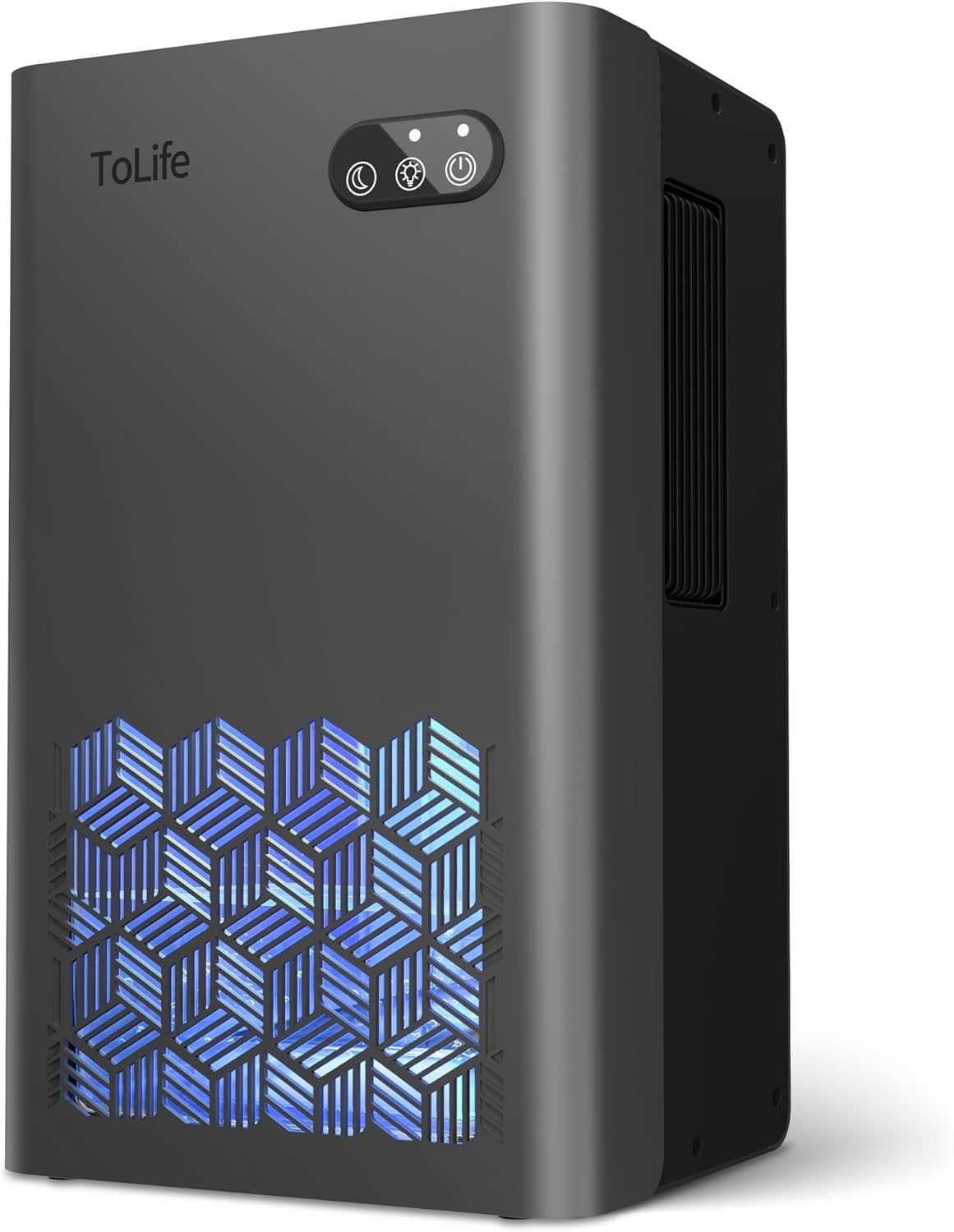
ToLife Dehumidifier TZ-C2
| Floor Area | 1000 |
|---|---|
| Tank Volume | 95 fluid ounces |
| Number of Speeds | 2 |
| Wattage | 93 watts |
| Voltage | 220 volts |
The ToLife TZ-C2 uses semiconductor condensation technology to quietly pull moisture from the air and deposit it into a removable 95 oz tank, making it a straightforward option for damp rooms. It offers two operating modes: a higher-power setting for faster moisture removal and a low-speed sleep mode that runs under 30 dB for overnight use. A seven-color LED can act as a night light and the unit includes automatic shutoff when the tank is full or removed, plus handles for easy moving between rooms. Practical benefits include simple setup, low noise, and a compact footprint that fits in basements, bathrooms, or bedrooms. Limitations are its modest rated dehumidification capacity and stated coverage, which means it will be most effective in smaller basement zones or for spot treatments rather than drying a large, very damp basement quickly. Also this model runs on 220 volts, so electrical compatibility should be confirmed for your location.
Best for: Buyers who need an affordable, portable dehumidifier for spot dehumidifying small basement areas, bathrooms, or bedrooms and who prioritize low noise and easy portability.
Less Ideal for: People looking to dry large, very damp basements or whole-house coverage should consider a higher-capacity compressor dehumidifier instead.
- Large removable 95 oz water tank reduces how often you need to empty it
- Quiet sleep mode under 30 dB suitable for nighttime operation
- Portable design with handles for moving between rooms
- Automatic shutoff prevents overflow when the tank is full
- Dehumidification capacity is modest and may be slow in very damp or large basements
- Requires 220 volt power which may not match all household outlets
Verdict: A compact, budget-friendly portable dehumidifier that is best for quiet, small-area moisture control and occasional basement spot treatments.
Choosing the Right Dehumidifier for Offices: Key Factors to Consider
Capacity Relative to Office Size
Dehumidifier capacity, usually expressed in pints per day, determines how quickly a unit can remove moisture from the air. Offices with open floor plans or high ceilings require higher-capacity units than single private offices. Estimate the square footage and consider ceiling height when matching capacity to space.
Underpowered units will run almost continuously without reaching the set humidity, increasing wear and energy use. Oversized units can short-cycle, causing humidity swings and potential premature component wear. Choose a capacity that matches the typical moisture load of the office, not just occasional spikes.
Noise Output and Operational Quiet
Noise level matters more in offices than in basements or warehouses because people need to concentrate and hold conversations. Look for published decibel ratings measured at a standard distance and compare low-speed noise since units often cycle at reduced fan speeds when maintaining set humidity.
Fan design, compressor type, and cabinet insulation all affect perceived noise. If the dehumidifier will be in a conference room or open-plan area, prioritize models with low operating noise or those that offer a 'quiet' setting to minimize disruption.
Drainage Options and Unattended Operation
Office dehumidifiers should support continuous drain to avoid frequent emptying of collection buckets. Units that offer gravity drain, pump-assisted drainage, or direct plumbing options make long-term unattended use feasible in offices with a nearby floor drain or sink.
Consider drain tube length and whether a condensate pump is needed to move water vertically. Reliable overflow protection and auto-shutoff are essential to prevent leaks if drains clog, especially in spaces with sensitive equipment or carpeting.
Control Features and Monitoring
Useful control features include an accurate built-in humidistat, programmable timers, and multiple fan speeds. A precise humidistat helps maintain stable relative humidity, preventing over-drying or persistent dampness. Timers and scheduling let you run the unit only during occupied hours or precondition the space before staff arrive.
Some units offer simple digital displays while others provide remote or app-based controls. For most offices, an intuitive local control panel with clear humidity readout is sufficient; advanced connectivity is a bonus for facility managers monitoring multiple rooms.
Energy Efficiency and Operating Cost
Because dehumidifiers often run for extended periods, energy efficiency directly impacts utility costs. Look for ratings or specifications that indicate power draw at typical operating conditions. Models with variable-speed compressors or fans tend to use less energy under partial-load conditions.
Consider how often the unit will run and whether energy-saving features like auto-mode or eco-settings are available. Over the long term, selecting an efficient unit can offset a higher upfront cost through lower monthly energy consumption.
Maintenance Accessibility and Filter Care
Regular cleaning of air filters and easy access to the collection bucket or drain fittings reduce downtime and maintain indoor air quality. In an office environment, choose units with tool-free filter removal and clear instructions for cleaning or replacement.
Failing to maintain filters increases dust buildup on coils, reducing efficiency and potentially causing odors. Units that provide filter change indicators or washable filters simplify upkeep for building staff or office managers.
Sizing Your Dehumidifier for Different Office Layouts
Determine square footage and account for high-traffic areas, open layouts, and ceiling height. A small private office and a multi-cubicle open plan with the same floor area can have different moisture dynamics because of airflow patterns and occupancy.
Start with the recommended capacity for the room size, then adjust upward for factors that increase humidity load such as plants, frequent hot showers in adjacent spaces, or older buildings with higher baseline moisture. When in doubt, pick the next capacity level up to avoid chronic underperformance.
- Private office: lower pint/day capacity often suffices
- Open-plan space: choose higher-capacity or multiple smaller units
- High ceilings: increase capacity estimate by 20 to 30 percent
Placement and Airflow Considerations
Place the dehumidifier where it can draw and discharge air freely. Avoid corners or tight spaces that restrict airflow and reduce efficiency. Elevating portable units a few inches off carpeted floors can improve intake and prevent dust buildup.
Keep a clear zone around air inlets and outlets. If you must place the unit in a corridor or shared space, ensure the discharge airflow does not blow directly at desks or meeting areas to prevent discomfort.
- Maintain at least 12 inches of clearance around the unit
- Orient the discharge away from occupied workstations
- Avoid placing unit directly under air diffusers or returns
Integration With Office HVAC and Ventilation
Dehumidifiers work best when coordinated with ventilation and HVAC systems. If the office HVAC provides frequent fresh-air exchanges, expect higher moisture loads during humid weather and select a unit capable of handling that variation.
Some installations benefit from using the dehumidifier in a specific zone rather than treating the entire building. Consult with facility staff to identify whether the dehumidifier should operate continuously, on a schedule, or be tied into an existing building control system.
- Coordinate schedules with HVAC runtime to avoid counterproductive operation
- Consider zoned dehumidification for targeted problem areas
- Ensure condensate drainage is compatible with building plumbing
Maintenance Checklist for Office Managers
Create a simple maintenance routine that includes monthly filter checks, quarterly deep cleaning of coils if needed, and inspection of drain lines for blockages. Assign responsibility to a staff member or facilities manager and track service tasks on a shared calendar.
Keep spare parts on hand such as replacement filters and a short length of drain tubing. Regular maintenance prevents efficiency loss, reduces noise from worn components, and extends the lifespan of the unit.
- Monthly: inspect and clean or wash filter
- Quarterly: check coils, drain fittings, and condensate pump if present
- Annually: professional inspection for units in continuous use
Addressing Noise Concerns in Shared Workspaces
If noise is a primary concern, evaluate units based on decibel ratings at low and high fan speeds and consider placement options that reduce perceived sound. Installing the unit in a nearby utility closet with adequate ventilation can isolate noise but requires longer drain runs or a condensate pump.
Rubber feet and anti-vibration pads reduce transmitted vibration through furniture and floors. For conference rooms, consider running the dehumidifier before occupancy or using models with whisper modes for low-noise continuous operation.
- Compare dB ratings at realistic operating settings
- Use anti-vibration mounts to limit structure-borne noise
- Schedule higher-speed operation outside core meeting times
How We Chose the Best Dehumidifier for Offices
We focused on features that directly affect office comfort, air quality, and ongoing operation. Selection began by filtering for units with published moisture removal rates appropriate for small to medium commercial and office spaces. We excluded units intended solely for bathrooms or closets and any models without user-serviceable filters or drain options. Our evaluation prioritized real-world metrics: moisture removal capacity at typical room temperatures, continuous drain capability for unattended operation, noise levels at typical fan speeds, and control features such as built-in humidistats and programmable timers. Energy efficiency and filter accessibility were also considered because they influence operating cost and maintenance burden in busy offices. We excluded specialized industrial dehumidifiers and units lacking basic safety features like auto-defrost and overflow protection. The final shortlist includes units that balance quiet operation, reliable moisture control, and practical installation or drainage options suitable for office environments.
Our full evaluation process is outlined in our review methodology.
FAQ
What humidity level should I set for an office?
Aim for relative humidity between 40 and 50 percent for comfort and to reduce mold risk. Levels below 30 percent can cause dry skin and static; levels above 60 percent increase the chance of condensation and microbial growth.
Can a dehumidifier run continuously in an office?
Yes, models with continuous-drain options and adequate capacity are designed for long runs. Ensure proper drainage and choose units with overflow protection and reliable condensate pumps if gravity drainage is not available.
Will a dehumidifier affect office heating or cooling efficiency?
A dehumidifier removes moisture without directly heating or cooling the space, though compressors produce some heat. Coordinating runtime with HVAC helps avoid counterproductive operation and maintains overall comfort efficiently.
How often should I clean the dehumidifier filter in an office?
Check filters monthly in dusty or high-traffic offices and clean or replace them as recommended. Regular filter maintenance preserves airflow, maintains efficiency, and prevents dust accumulation on internal components.
Is it better to use one large dehumidifier or several smaller units?
It depends on layout and access to drainage. Multiple smaller units can provide more even moisture control across partitions and are easier to service. A single large unit may be more convenient if a central drain is available and the space is contiguous.
Final Verdict
For office use, prioritize capacity that matches your layout and moisture load, low noise for occupied spaces, and dependable drainage options for unattended operation. Energy-efficient models with easy filter access reduce operating costs and maintenance time. Balance the tradeoffs between quieter lower-speed operation and moisture-removal needs. Focus on the specific room characteristics and how the unit will be installed, then choose a dehumidifier that meets those operational priorities with minimal disruption to the workspace.