
Note: This article contains affiliate links. If you click on these links and make a purchase, we may earn a small commission at no extra cost to you. This helps support our research and content. Read our full affiliate disclosure here.
Old basements often trap moisture and create musty odors, warped wood, and mold risk. Choosing the right dehumidifier for an old basement matters because these spaces typically need higher extraction rates, robust corrosion resistance, and simple maintenance to stay dry over the long term. This guide shortlists seven top-performing dehumidifiers for old basements and explains the practical criteria we used to evaluate them. Expect clear guidance on capacity, drainage options, noise, and durability so you can pick a unit suited to your basement size and conditions. Read on for concise buying advice and the factors that matter most when managing damp, aged basement spaces.
Top Picks at a Glance
| Best Overall The best all-around choice for most situations | KNKA 80-Pint Dehumidifier PD30MA-20 |  |
| Best Quality Built to a higher standard if you want something more solid | Gasbye DryPrime-50 Dehumidifier |  |
| Best Value The sweet spot between price and what you get | AEOCKY BOREAS-001 Dehumidifier |  |
| Best Budget The cheapest option that still gets the job done reliably | POOYUPPC ZQB-201A Dehumidifier |  |
| Top Rated A top-rated pick with lots of positive feedback | KeepGlad 80‑Pint Dehumidifier |  |
| Most Popular A crowd favorite that many people choose with confidence | BEDRED CT11 Dehumidifier |  |
| Best Seller A high-volume bestseller chosen again and again | ToLife Dehumidifier TZ-C2 |  |
KNKA 80-Pint Dehumidifier PD30MA-20

| Capacity | 80 pints per day |
|---|---|
| Tank Volume | 1.45 gallons |
| Wattage | 360 watts |
| Floor Area | 4500 square_feet |
| Operation Mode | AUTO, DRY, SETTING |
The KNKA PD30MA-20 is a performance-focused dehumidifier built for large, damp spaces such as basements. Its high-efficiency compressor can remove up to 80 pints per day under extreme conditions and about 56 pints in typical basement conditions, while an internal 1.45 gallon tank plus a supplied 6.56 ft drain hose enable continuous drainage to avoid frequent emptying. Controls include AUTO, DRY, and a SETTING mode for 30%–80% RH, and the digital display with a color-changing humidity indicator makes it easy to monitor conditions at a glance. The unit is designed to run quietly (40–45 dB), has a washable filter, casters for moving between rooms, cord storage, a 12-hour timer, and a child lock for steady, unattended operation. Expect good energy efficiency thanks to ENERGY STAR certification and a 360 watt power draw, but note that humidity readings come from the air inlet and may differ slightly from a separate hygrometer; the unit also needs upright siting for 24 hours before first use. For heavy-duty basement dehumidification this model balances strong capacity with thoughtful usability features.
Best for: Buyers who need powerful, reliable moisture removal in large basements or very damp rooms and prioritize steady performance and easy continuous drainage.
Less Ideal for: People seeking a compact or ultra-light unit for small rooms or occasional use should consider lower-capacity, more portable models instead.
- High maximum dehumidification capacity up to 80 pints per day for large, very humid spaces
- Includes 6.56 ft drain hose and built-in tank for continuous drainage to reduce manual emptying
- ENERGY STAR certified and uses a high-efficiency compressor for lower operating costs relative to output
- Quiet operation (40–45 dB) and caster wheels make it suitable for basements and living spaces
- Digital display with real-time humidity readout and color indicator simplifies monitoring and control
- Humidity reading is measured at the air inlet and may not match a separate room hygrometer
- Requires upright placement for 24 hours before first use to avoid operational issues
Verdict: Choose this KNKA if you need a strong, ENERGY STAR certified dehumidifier that can handle large basements with continuous-drain capability and quiet operation.
Gasbye DryPrime-50 Dehumidifier
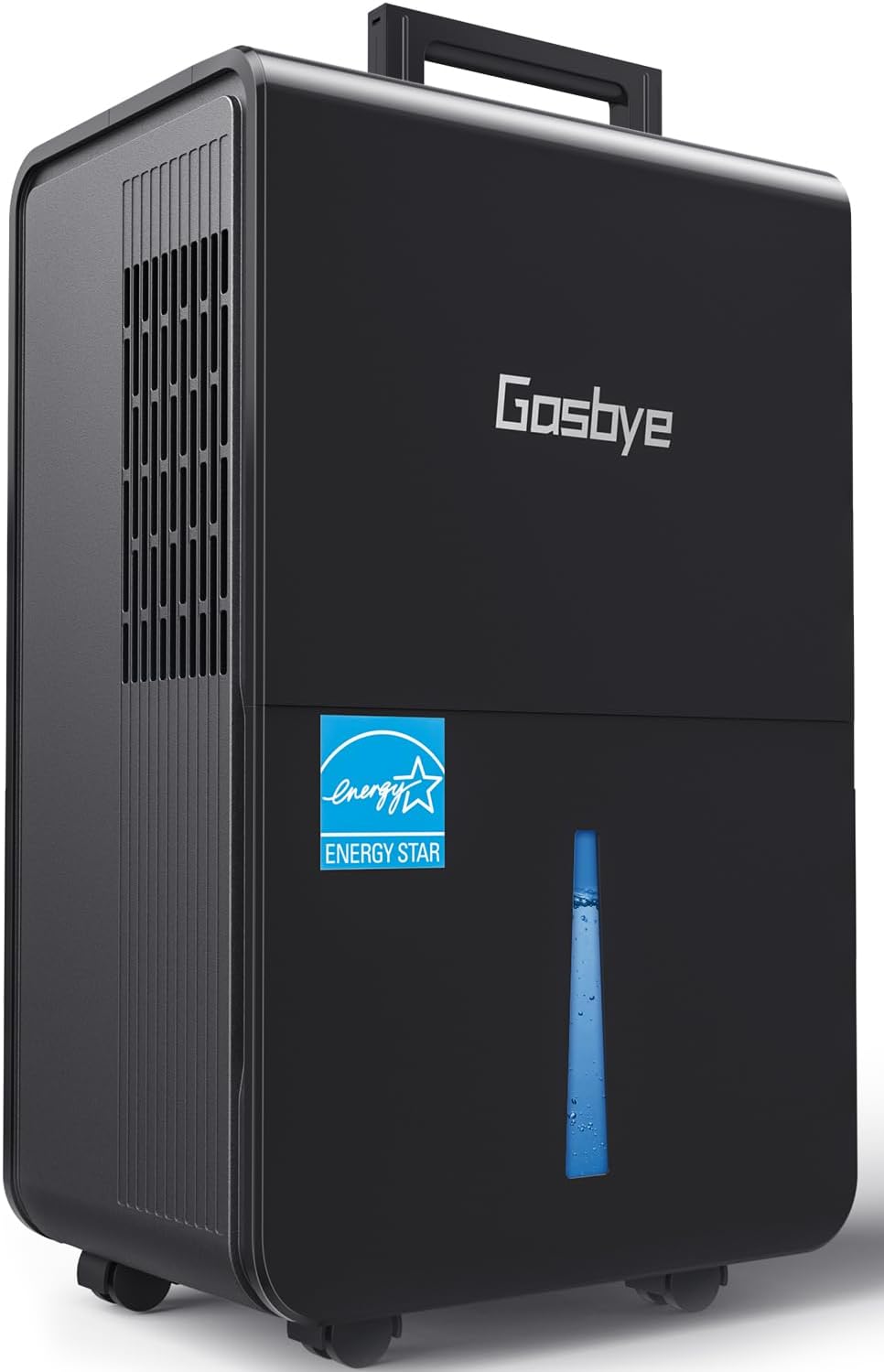
| Capacity | 115 pints |
|---|---|
| Tank Volume | 1.72 gallons |
| Wattage | 500 watts |
| Air Flow Capacity | 12600 cubic_feet_per_hour |
| Operation Mode | Normal, Turbo, Comfort, Continuous |
The Gasbye DryPrime-50 is a compressor dehumidifier built for high-capacity jobs in basements and large rooms. It delivers up to 115 pints/day under hot, humid conditions and provides tested capacity curves at lower temperatures so you can anticipate real-world performance. Practical features include a 1.72 gallon tank, three drainage options (tank, gravity hose, or 3/4-inch garden-hose connection), automatic shut-off and auto-restart after power loss, and an adjustable humidity control with four operation modes. The unit uses reinforced multi-tier copper tubing for durability, runs a compressor rated around 45 dB, and carries Energy Star certification for improved efficiency compared with nonqualified models. Trade-offs are its size and weight compared with lightweight consumer models and that compressor-based operation emits warm exhaust so it is less suited to small bedroom use. For wet basements that need steady, high-volume moisture removal, this model emphasizes robust hardware and predictable capacity over compactness or ultra-quiet operation.
Best for: Buyers who prioritize reliable, high-capacity moisture removal in damp basements and large utility spaces and want a robust, energy-efficient compressor unit built for long-term use.
Less Ideal for: People seeking a lightweight, ultra-quiet dehumidifier for small bedrooms or portable spot-dehumidifying should consider smaller or semiconductor-style alternatives.
- High tested dehumidification up to 115 pints/day with published capacity at multiple temperature/humidity points
- Three drainage methods including threaded garden-hose hookup for continuous drainage
- Energy Star certification for improved energy efficiency versus nonqualified units
- Reinforced copper tubing and heavier build aimed at long-term durability
- Auto shut-off and auto-restart after power loss with adjustable humidity control
- Relatively heavy and larger footprint compared with compact consumer models
- Compressor operation produces warm exhaust and modest noise around 45 dB
Verdict: If you need dependable, high-volume dehumidification for an old damp basement, this Energy Star compressor unit delivers predictable performance and durable construction.
AEOCKY BOREAS-001 Dehumidifier

| Dehumidification Capacity | 50 pints_per_day |
|---|---|
| Floor Area | 3500 square_feet |
| Wattage | 380 watts |
| Tank Volume | 0.8 gallons |
| Operating Noise (Min-Max) | 40-43 dB |
The BOREAS-001 is a compact compressor dehumidifier built to remove heavy moisture from residential spaces such as basements, bedrooms, bathrooms, and RVs. It delivers up to 50 pints per day (95°F, 95% RH) with a smaller 0.8 gallon collection tank, and the included 2 m drain hose and garden-hose adapter make continuous gravity drainage straightforward for rooms with a nearby drain. Controls include an intelligent humidistat, adjustable humidity range, child lock, fan speeds, and a 24-hour timer, while auto-defrost keeps the unit running in cooler basement temperatures. The manufacturer emphasizes quiet operation (about 40–43 dB) and durable internal components like copper tubing and hydrophilic fins that resist corrosion. The trade-off is the small tank, which will fill quickly in very damp basements, meaning you will likely rely on continuous drainage; the unit also consumes power typical of compressor machines. For an older basement with persistent dampness but limited floor space, the BOREAS-001 balances strong extraction, quiet running, and rugged build in a compact footprint.
Best for: Buyers who want a durable, space-saving dehumidifier that delivers strong moisture removal in older basements without taking up much floor area and who plan to set up continuous drainage.
Less Ideal for: Users who cannot install a gravity drain or who need a very large onboard tank for infrequent maintenance should consider larger-capacity models instead.
- High extraction rate up to 50 pints/day for effective moisture removal in damp spaces
- Compact footprint with casters and reinforced handle for easy placement in tight basements
- Includes 2 m drain hose and garden-hose adapter for continuous gravity drainage
- Quiet operation rated about 40–43 dB suitable for living areas or bedrooms
- Auto-defrost and intelligent humidistat for reliable performance in cool basement conditions
- Small 0.8 gallon tank fills quickly in heavy-humidity environments, requiring continuous drainage
- Consumes typical compressor-level power (380 watts) during sustained operation
Verdict: If you need powerful, quiet dehumidification in a compact unit for an old basement and can use continuous drainage, this model delivers strong performance and durable components.
POOYUPPC ZQB-201A Dehumidifier

| Dehumidification Capacity | 22 pints_per_day |
|---|---|
| Floor Area | 1000 |
| Tank Volume | 2800 ml |
| Operation Mode | Automatic |
This compact POOYUPPC ZQB-201A is a budget-friendly dehumidifier designed for residential spaces up to about 1,000 square feet. It uses refrigerant condensing technology to pull up to 22 pints per day and stores moisture in a 95 oz (2800 ml) visible tank with an auto shutoff and LED indicator, or you can attach the included drain hose for continuous drainage. Controls are simple via an LED touch panel with modes for normal, powerful and sleep plus a child lock, and the unit runs quietly enough for bedrooms in sleep mode. Its small footprint and 47 dB normal/35 dB sleep noise profile make it easy to tuck into basements or corners, but the modest capacity means it will need emptying in very damp conditions unless you use the drain hose. The plastic construction and basic feature set keep cost down but also limit premium durability and advanced humidity controls. For routine dampness in an older basement this unit offers straightforward performance without extras, but heavy or whole-house moisture problems will require a more powerful system.
Best for: Buyers looking for an affordable, easy-to-use dehumidifier to manage moderate dampness in a single room or smaller basement areas who prioritize low noise and simple operation.
Less Ideal for: Homes with severe or whole-basement moisture issues or buyers who want advanced controls, smart connectivity, or a heavy-duty commercial-grade unit.
- Visible 95 oz (2800 ml) water tank with automatic shutoff and indicator
- Includes drain hose for continuous unattended drainage
- Quiet operation with a 35 dB sleep mode suitable for bedrooms
- Simple LED touch controls with child lock and multiple modes
- 22 pints per day capacity and compact tank may be insufficient for very wet basements
- Basic plastic construction without advanced humidity scheduling or smart controls
Verdict: A budget-oriented, quiet dehumidifier that provides straightforward moisture removal for a single room or smaller basement when you need an inexpensive, no-frills solution.
KeepGlad 80‑Pint Dehumidifier

| Capacity | 80 pints_per_day |
|---|---|
| Tank Volume | 1.84 gallons |
| Wattage | 300 watts |
| Floor Area | 4500 square_feet |
| Voltage | 115 volts |
The KeepGlad 80‑pint dehumidifier is built for sustained operation in large, moisture-prone areas like basements and garages. It actively removes up to 80 pints per day under extreme conditions and uses multiple modes — Comfort, Dry, Turbo, Continuous and Sleep — to match different needs from steady humidity control to rapid drying. Practical features include a visible tank with full‑tank protection, continuous drain hose option, 90° adjustable airflow, washable filter, child lock and a 24‑hour timer. The unit also claims quiet operation (about 35–40 dB) and an AI-driven protection system that triggers defrost cycles and overload cutoffs to limit downtime. Energy Star 2025 certification and a 300 W rating mean it aims to balance strong performance with lower energy use. Expect a fairly large, portable cabinet with ergonomic handles and a detachable filter that requires occasional cleaning; continuous drain is most convenient for long runs. If you need a dependable, high‑output dehumidifier for a basement that runs for long stretches, this model focuses on steady removal, energy efficiency and protective safeguards to reduce failure risk.
Best for: Buyers who prioritize a durable, high‑capacity dehumidifier for large basements or storage areas and want energy-efficient continuous operation with protective safety features.
Less Ideal for: Those who need a compact, lightweight unit for small rooms or infrequent use should consider lower‑capacity, more portable models instead.
- Very high dehumidification capacity up to 80 pints per day for large or very damp basements
- ENERGY STAR 2025 certification for lower energy use compared with similar output units
- Continuous drain option and full‑tank protection reduce maintenance during long runs
- Multiple modes including Turbo and Continuous let you tailor drying speed and humidity targets
- AI protection with auto‑defrost and overload cutoff helps prevent damage during continuous operation
- Relatively large physical footprint compared with low‑capacity models
- Requires periodic filter cleaning and occasional drain management for continuous use
Verdict: If you need reliable, energy‑efficient moisture removal for a large basement, this 80‑pint KeepGlad unit is built to run continuously with protective safeguards that minimize failure risk.
BEDRED CT11 Dehumidifier

| Floor Area | 1000 square_feet |
|---|---|
| Tank Volume | 95 fluid ounces |
| Capacity | 5.9 pounds |
| Operation Mode | Intermittent |
| Other Special Features of the Product | 7 Color Ambient Light, Automatic Shutoff, Sleep Mode |
The BEDRED CT11 is a compact thermoelectric dehumidifier intended to reduce humidity in small spaces such as bedrooms, bathrooms, and modest basements up to about 1000 sq ft. It uses semiconductor cooling rather than a compressor, so it runs quietly and is simple to operate with an intermittent operation mode and an automatic shutoff when the 95 oz tank fills. Sleep Mode turns off the lights and lowers noise for overnight use, and the seven-color ambient light gives an optional mood-lighting feature. Practical benefits include easy emptying from the included tank, portability thanks to a lightweight design, and low sound levels that suit living spaces. Important limitations are inherent to semiconductor units: lower capacity compared with compressor dehumidifiers, reduced performance in very cold or very damp basements, and a smaller tank that requires more frequent emptying in high-humidity conditions.
Best for: Buyers who prioritize quiet, low-maintenance dehumidification and want a compact unit that is easy to move and run in living spaces or small basements without frequent intervention.
Less Ideal for: People needing heavy-duty moisture control for large, cold, or very damp basements should choose a higher-capacity compressor dehumidifier instead.
- Quiet thermoelectric operation suitable for bedrooms and living rooms
- Automatic shutoff protects against overfill and simplifies unattended use
- 95 oz removable tank for straightforward water removal
- Sleep Mode and ambient light options for low‑noise nighttime use
- Compact and lightweight for easy placement or moving between rooms
- Semiconductor cooling gives lower moisture removal capacity than compressor models
- Performance drops in cold basement conditions and very high humidity areas
Verdict: Choose the BEDRED CT11 if you want a quiet, portable dehumidifier with auto‑shutoff and sleep‑friendly operation for small basements or living spaces.
ToLife Dehumidifier TZ-C2
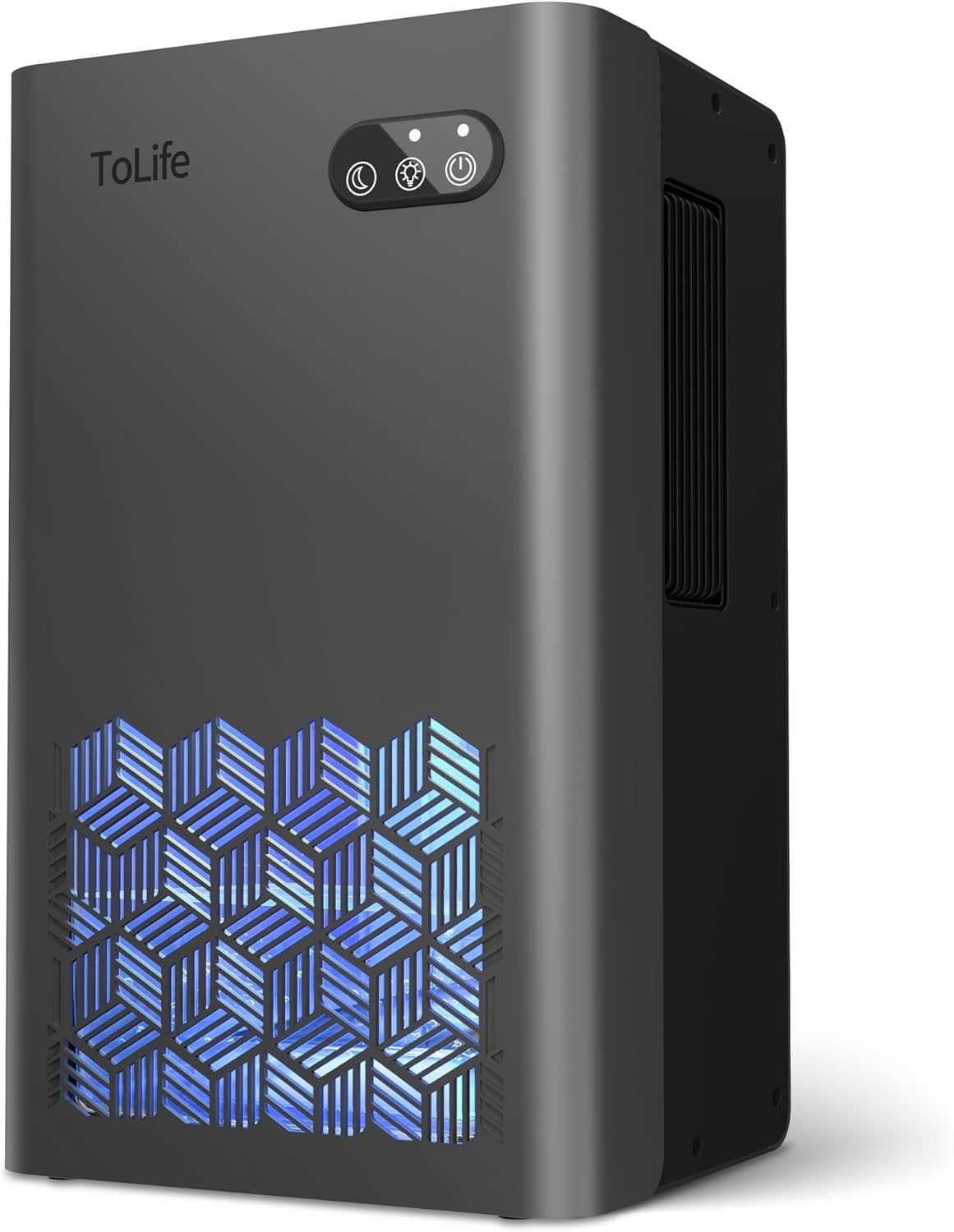
| Floor Area | 1000 |
|---|---|
| Tank Volume | 95 fluid ounces |
| Number of Speeds | 2 |
| Wattage | 93 watts |
| Voltage | 220 volts |
The ToLife TZ-C2 uses semiconductor condensation technology to quietly pull moisture from the air and deposit it into a removable 95 oz tank, making it a straightforward option for damp rooms. It offers two operating modes: a higher-power setting for faster moisture removal and a low-speed sleep mode that runs under 30 dB for overnight use. A seven-color LED can act as a night light and the unit includes automatic shutoff when the tank is full or removed, plus handles for easy moving between rooms. Practical benefits include simple setup, low noise, and a compact footprint that fits in basements, bathrooms, or bedrooms. Limitations are its modest rated dehumidification capacity and stated coverage, which means it will be most effective in smaller basement zones or for spot treatments rather than drying a large, very damp basement quickly. Also this model runs on 220 volts, so electrical compatibility should be confirmed for your location.
Best for: Buyers who need an affordable, portable dehumidifier for spot dehumidifying small basement areas, bathrooms, or bedrooms and who prioritize low noise and easy portability.
Less Ideal for: People looking to dry large, very damp basements or whole-house coverage should consider a higher-capacity compressor dehumidifier instead.
- Large removable 95 oz water tank reduces how often you need to empty it
- Quiet sleep mode under 30 dB suitable for nighttime operation
- Portable design with handles for moving between rooms
- Automatic shutoff prevents overflow when the tank is full
- Dehumidification capacity is modest and may be slow in very damp or large basements
- Requires 220 volt power which may not match all household outlets
Verdict: A compact, budget-friendly portable dehumidifier that is best for quiet, small-area moisture control and occasional basement spot treatments.
Choosing the Right Dehumidifier for Old Basement: Key Factors to Consider
Extraction Capacity (Pints Per Day)
Extraction capacity determines how much moisture a dehumidifier can remove in a 24-hour period and is one of the most important specs for old basements. Basements tend to be larger and damper than typical rooms, so choose a unit rated for the square footage and the severity of dampness you observe. If the basement has visible condensation, wet insulation, or active mold, plan for a higher-capacity unit that can run effectively for longer intervals.
Capacity ratings are typically given at standard test conditions. Real-world performance in cold, poorly insulated basements is often lower, so factor in a safety margin by selecting a unit with higher nominal capacity than the minimum suggested for your square footage.
Low-Temperature Performance
Old basements are often cooler than finished living spaces, especially in winter. Many dehumidifiers lose efficiency and stop producing condensate below a certain temperature because the coils can ice up. Pick a model designed to operate at lower ambient temperatures or that includes an auto-defrost feature to maintain extraction when it is cool.
Low-temperature performance affects how reliably a unit can control dampness year-round. If your basement drops near or below typical defrost thresholds, favor systems rated for cool basements or those that incorporate frost management to avoid lost capacity and frequent manual interventions.
Drainage Options and Accessibility
Drainage flexibility matters for basements because emptying a water bucket manually can be impractical in tight or frequently unattended spaces. Look for dehumidifiers that offer continuous gravity drain ports, included drain hoses, or built-in condensate pumps that can move water uphill to a sink or drain.
Consider the layout of your basement when evaluating drainage: gravity drains require a nearby floor drain or lower-level outlet, while pump-assisted models allow placement farther from fixed drains. Proper drainage minimizes overflow risk and reduces the need for daily monitoring.
Durability and Corrosion Resistance
Basements with chronic humidity place extra stress on mechanical components. Units with corrosion-resistant coatings, coated coils, and durable housing will last longer in damp conditions. Pay attention to construction quality, warranty terms, and whether components that commonly fail are easy to source and replace.
Durability also ties to serviceability. Models that allow straightforward access to filters, coils, and drains reduce downtime and upkeep effort when you need to clean or repair parts affected by long-term damp exposure.
Noise and Placement Considerations
Although basements are separated from living areas, dehumidifier noise can matter if the space is used as a home office, media room, or bedroom. Noise ratings give an indication of how intrusive a unit will be during continuous operation. Compressors and fans are the primary noise sources, and larger-capacity units tend to be louder.
Placement can mitigate noise: locating a unit away from seating or sleeping areas and on anti-vibration pads will reduce transmitted sound. If low noise is a priority, compare decibel ratings and look for models with variable fan speeds so you can run quieter at night.
Ease of Maintenance and Filter Access
Regular maintenance such as emptying traps, cleaning filters, and checking coils is essential for reliable operation in old basements. Choose a dehumidifier with clear access to dust filters, washable or replaceable elements, and simple drain connections. Indicator lights or digital readouts for full tanks, filter cleaning, and humidity targets help you maintain the unit properly without frequent guesswork.
Maintenance ease also includes how often components need service and whether the unit design minimizes common clogging points. Units that reduce manual cleaning steps will save time and encourage consistent upkeep.
Sizing Your Dehumidifier for an Old Basement
Measure the basement square footage and estimate the dampness level before selecting a capacity. For lightly damp basements, a lower-capacity unit may be sufficient, but for musty or wet conditions plan for a higher-rated model. Ceiling height matters too; multiply square footage by height to assess total volume if your basement has high ceilings or open areas.
Factor in room layout and airflow. Open floor plans, stairwells, and connected crawlspaces can increase the effective area a single unit must handle. In large or compartmentalized basements, multiple smaller units placed strategically may outperform one oversized unit located in a corner.
- Light dampness: choose the lower end of the capacity range.
- Musty or wet: select higher-capacity units or multiple units.
- High ceilings or open plans may need additional extraction.
Placement Tips to Maximize Performance
Place the dehumidifier near the moisture source when possible, such as near a sump pump, exterior wall, or area with visible damp. Avoid pushing the unit against walls; allow a few inches of clearance for air intake and exhaust to keep airflow unobstructed.
Elevate the unit slightly if floor-level water or puddles are possible, but ensure the drain hose can still reach the chosen drain point. Keep the unit on a hard, level surface and consider anti-vibration pads to reduce noise transfer to the floor structure.
- Allow space for airflow around the unit.
- Position near a convenient drain or routing for the condensate hose.
- Avoid enclosed closets or sealed corners that block air intake.
Managing Condensation and Mold Risk
A dehumidifier controls airborne moisture but does not fix water intrusion sources. Address leaks, poor grading, or failing vapor barriers as part of a comprehensive moisture mitigation plan. Use the dehumidifier to maintain relative humidity in the 45 percent or lower range to limit mold growth and slow material degradation.
Combine dehumidification with improved ventilation and targeted insulation to reduce cold surfaces where condensation forms. Monitor humidity over time and adjust setpoints seasonally to balance comfort, mold prevention, and energy use.
- Aim for 40 to 50 percent relative humidity in most basements.
- Pair dehumidification with structural fixes to stop recurring wetness.
- Use a separate hygrometer to verify basement RH and trends.
When to Consider a Pump-Assisted Unit
If your basement lacks a nearby floor drain or if the only drain is uphill from the intended unit location, a condensate pump is a practical choice. Pump-assisted dehumidifiers actively move extracted water to a higher sink, laundry drain, or exterior connection and reduce the need to frequently empty buckets.
Pump systems add some complexity and potential maintenance but greatly increase placement flexibility. Evaluate how often you can access the unit and whether a pump will save time or reduce overflow risk in your setup.
- Choose pump units for remote placement or uphill drainage.
- Confirm pump capacity and recommended maximum lift before installation.
- Expect slightly higher maintenance due to additional moving parts.
Energy Use and Operating Cost Considerations
Dehumidifiers run for long stretches in basements, so energy efficiency affects seasonal operating costs. Look for units with adjustable humidistats and multiple fan speeds to run at lower power when conditions allow. Duty cycle will depend on climate, the basement's dryness goals, and whether insulation or moisture sources have been corrected.
Perform a basic cost estimate by checking the unit's power draw at typical settings and multiplying by your local electricity rate and expected run hours. Balancing extraction speed against energy use helps find a model that controls humidity without excessive running expenses.
- Variable fan speeds improve efficiency during mild conditions.
- Higher capacity units may run less often but draw more power when active.
- Seasonal monitoring helps fine-tune setpoints to lower energy use.
How We Chose the Best Dehumidifier for Old Basement
To assemble the list we prioritized features and specifications that directly affect performance in older basement environments. Key evaluation criteria included extraction capacity at typical basement temperatures, long-term corrosion resistance for humid conditions, continuous drainage options, and ease of maintenance for infrequent access. We also considered durability of components such as compressors and coils, plus user-facing controls and effective humidity control ranges. Noise level was assessed because basements are often adjacent to living spaces or used as work areas, and energy efficiency was reviewed to estimate operating cost over a season. We excluded units designed only for small, heated living rooms or short-term spot use because those typically lack the capacity or ruggedness needed for older basements. Units without clear continuous-drain or condensate-pump options were deprioritized for basements with limited access. Overall, the list favors dehumidifiers with verified low-temperature extraction performance, robust drainage options, and straightforward upkeep needs that fit the realities of older, often colder basement spaces.
Our full evaluation process is outlined in our review methodology.
FAQ
What humidity level should I aim for in an old basement?
Aim for a relative humidity between 40 and 50 percent to minimize mold risk and condensation. Exact setpoints depend on how cold the basement gets and if you have stored materials sensitive to moisture.
Can I use a dehumidifier in a cold basement during winter?
Many dehumidifiers lose efficiency at low temperatures, but units with auto-defrost or those rated for low-temperature use can still remove moisture in cool basements. Check the operating temperature range and defrost features before selecting a unit if winter performance is important.
Do I need a pump or will gravity drain work?
Use gravity drain when a nearby floor drain or lower-level outlet is available. If the nearest drain is above the unit or hard to reach, a pump-assisted dehumidifier provides flexibility and reduces manual emptying.
How often should I clean the dehumidifier in a basement?
Inspect and clean filters monthly during heavy use, and check coils and drain lines every few months. Frequency depends on dust, debris, and how continuously the unit runs; basements with more airborne dust may need more frequent maintenance.
Will a dehumidifier stop mold from returning?
A dehumidifier reduces the moisture that supports mold growth but will not eliminate mold that is fed by ongoing water intrusion. Combine dehumidification with fixing leaks, improving drainage, and cleaning existing mold to prevent recurrence.
Final Verdict
Older basements pose distinct moisture challenges that make capacity, low-temperature performance, and drainage options the top priorities when choosing a dehumidifier. Focus on a unit with sufficient extraction for the basement size, reliable frost management if the space is cool, and drainage flexibility that fits your layout. Balance durability and maintenance ease against noise and energy use to find a practical long-term solution. Prioritizing these tradeoffs helps you select a dehumidifier that reduces dampness, protects materials, and minimizes upkeep in an old basement.