
Note: This article contains affiliate links. If you click on these links and make a purchase, we may earn a small commission at no extra cost to you. This helps support our research and content. Read our full affiliate disclosure here.
If you want a sleek kitchen layout without an overhead hood, a downdraft electric cooktop can provide powerful ventilation and a clean look. Picking the right downdraft cooktop matters because these units must balance extraction power, burner responsiveness, and easy cleaning while fitting into existing counter and cabinet constraints. This guide shortlists the top downdraft electric cooktops across common installation needs and explains the practical tradeoffs. Below you will find our top picks followed by the factors we used to evaluate them, plus hands-on guidance for common installation and maintenance scenarios.
Top Picks at a Glance
| Best Overall The best all-around choice for most situations | GASLAND 31.5" Electric Downdraft Cooktop |  |
| Best Quality Built to a higher standard if you want something more solid | GASLAND Downdraft Electric Cooktop |  |
| Best Value The sweet spot between price and what you get | Noxton 30" Electric Cooktop |  |
| Best Budget The cheapest option that still gets the job done reliably | Hobsir 30-Inch Electric Cooktop |  |
| Top Rated A top-rated pick with lots of positive feedback | Hobsir 36 Inch Downdraft Cooktop |  |
| Most Popular A crowd favorite that many people choose with confidence | Cooksir 30-Inch Electric Cooktop |  |
GASLAND 31.5" Electric Downdraft Cooktop

| Number of Heating Elements | 4 |
|---|---|
| Additional Features | Adjustable Temperature, Downdraft Exhaust, Safety Lock, Sync Bridge Element, Timer |
| Heating Element | Radiant |
| Control Type | Touch |
| Wattage | 7400 watts |
This GASLAND 31.5" cooktop combines cooking surface and ventilation into one built-in unit that is well suited for islands and open layouts. It uses four radiant heating elements with a dual-ring element and a sync bridge to handle small pans or larger griddle-style cookware, and touch controls with a 99-minute timer make routine tasks simple. The integrated downdraft pulls steam and odors down through a three-speed fan rated up to 330 CFM, and removable grease filters and a dishwasher-safe grate keep maintenance straightforward. Safety features including child lock, hot surface warning, overheat protection, and automatic shutoff reduce accidental operation. The smooth glass ceramic surface wipes clean quickly, though it will show scratches if abrasive tools are used and requires proper cutout and 240V wiring for installation. For buyers who want a streamlined island cooktop with built-in ventilation, this model delivers versatile cooking zones and practical upkeep, while requiring professional installation and careful handling to avoid surface damage.
Best for: Home cooks fitting a kitchen island or open-plan space who want a consolidated cooktop and ventilation solution that offers flexible cooking zones and easy maintenance.
Less Ideal for: Those who need a plug-and-play countertop unit or who cannot accommodate 240V hardwiring and a built-in cutout should consider other ventilation or cooktop options.
- Integrated downdraft vent eliminates need for overhead hood and fits island layouts
- Three fan speeds with up to 330 CFM for effective smoke and odor removal
- Sync bridge and dual-ring element provide flexible cooking zones for varied cookware
- Dishwasher-safe grease filter and removable grate simplify cleaning
- Requires 220/240V hardwiring and professional installation
- Glass ceramic surface can scratch or crack if abused or with heavy impacts
Verdict: Choose this GASLAND downdraft cooktop when you want a built-in island-friendly unit that pairs flexible cooking zones with a powerful integrated ventilation system.
GASLAND Downdraft Electric Cooktop
| Number of Heating Elements | 4 |
|---|---|
| Power Source | AC |
| Additional Features | Downdraft Exhaust, Sync Element, Safety Lock, Warm Setting |
| Voltage | 220 volts |
| Wattage | 7400 watts |
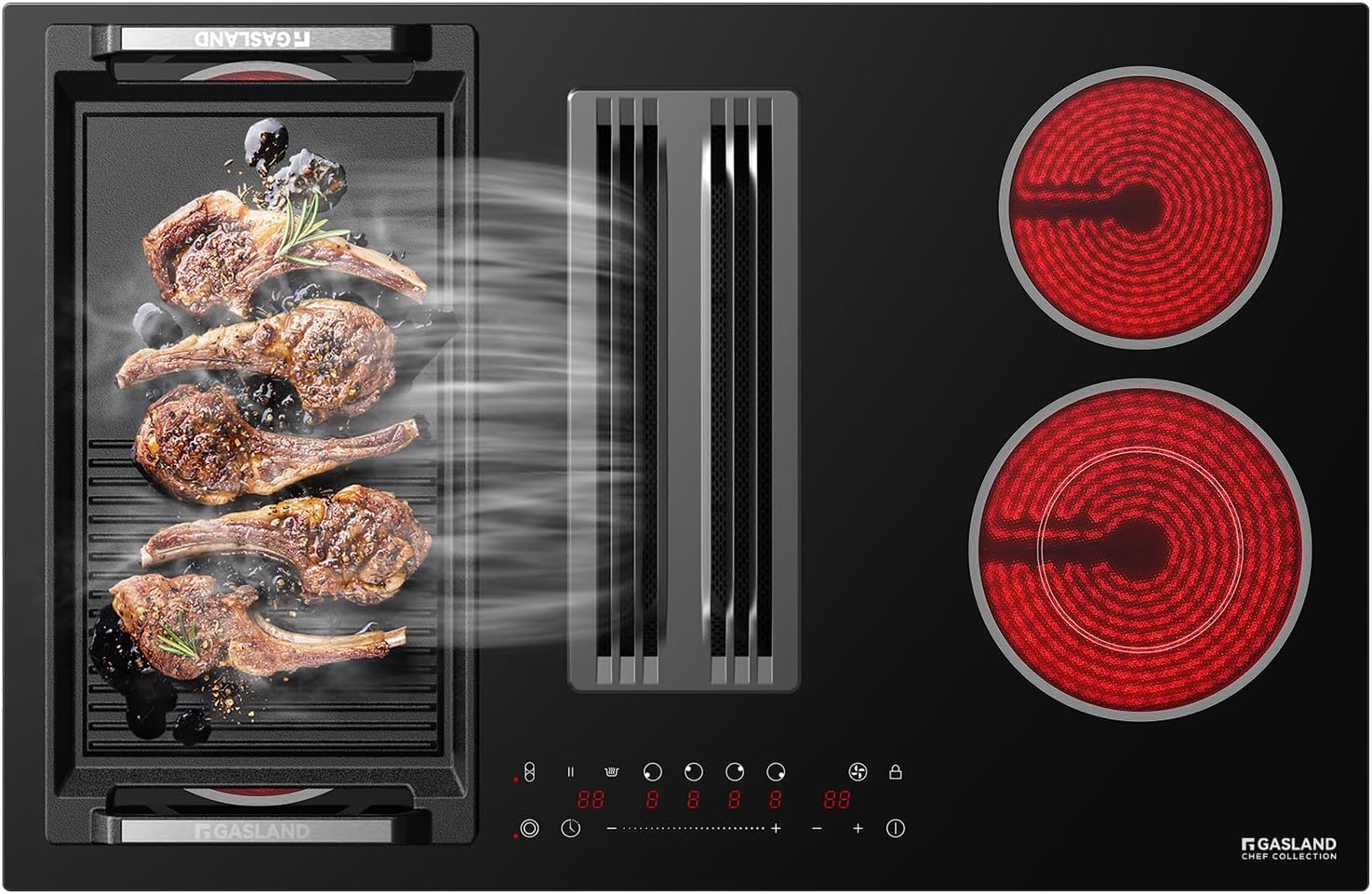
This GASLAND downdraft electric cooktop combines a sleek glass-ceramic surface with a built-in downdraft ventilation system so you can place it on an island or open-plan counter without an overhead hood. It offers four radiant heating elements including a bridge element that links two zones into a large 4,200 W cooking area for griddles or long pans, plus a dual-ring style element for better fit with different cookware. Slide touch controls and a 99-minute timer give precise, easy adjustments while safety features like a child lock, hot-surface warning, and auto shutoff reduce risk during busy cooking. The downdraft fan runs at three speeds and is rated up to about 330 CFM, and removable filters, grates, and a drip pan are dishwasher-safe for easier cleanup. Expect strong power and flexible cooking layout, but installation requires 220 V wiring and the integrated vent needs ducting or planning for exhaust routing, which can complicate retrofits.
Best for: Buyers who prioritize strong cooking performance and a clean island look and need flexible cook zones for griddles or large pans will appreciate this unit.
Less Ideal for: People who cannot provide 220 V wiring or want a simple plug-and-play replacement, and those who prefer gas flame control should look elsewhere.
- Built-in downdraft with up to ~330 CFM removes smoke and steam for island installations
- Bridge element creates one large cooking zone for griddles and long pans
- Dual-ring/variable elements accommodate a range of cookware sizes
- Slide touch controls and 99-minute timer provide precise, convenient operation
- Removable dishwasher-safe vent filter, grate, and drip pan simplify cleaning
- Requires 220-volt connection and planning for exhaust routing during installation
- Cooktop is radiant electric so it lacks the instant visual/knob feedback of gas controls
Verdict: Choose this cooktop if you want powerful, flexible electric cooking plus a built-in downdraft for island or open-plan kitchens.
Noxton 30" Electric Cooktop

| Number of Heating Elements | 4 |
|---|---|
| Control Type | Touch |
| Installation Type | Built-In |
| Voltage | 240 volts |
| Wattage | 6000 watts |
The Noxton 30" Electric Cooktop combines a smooth ceramic glass surface with a built-in three-speed downdraft ventilation system so you can cook without adding a separate hood. It has four radiant burners (two higher-power and two lower-power elements) that together deliver 6000W and nine heat settings per zone for a range of tasks from simmering to rapid boiling. Controls are touch-based and include a 99-minute timer, pause function, auto shut-off and a child safety lock for safer busy-kitchen use. The downdraft vents through a charcoal filter under the counter so no external exhaust ducting is required, simplifying installation in kitchens where wall or ceiling venting is impractical. Expect spot cleaning on the glass-ceramic top and professional hardwiring to 240V during installation, since it does not plug into standard outlets. The unit is best where a built-in look and integrated venting are priorities, but plan for an electrician and routine filter maintenance for the downdraft system.
Best for: Home cooks who want a sleek built-in cooktop with built-in ventilation and safety features and who prioritize a clean countertop look without adding a separate hood.
Less Ideal for: Those who cannot accommodate a 240V hardwire or who prefer venting to the outside rather than an internal charcoal filter should consider other cooktop or hood options.
- Integrated three-speed downdraft vent removes smoke and odors without external ducting
- Four radiant burners with nine heat levels provide flexible cooking control
- Safety features including child lock, pause, timer and auto shut-off for unattended cooking
- Glass-ceramic surface is easy to wipe clean and gives a built-in modern look
- Requires 240V hardwired installation by an electrician
- Downdraft uses an internal charcoal filter that needs periodic replacement and under-counter space
Verdict: Choose this cooktop if you need a built-in radiant stove with effective integrated downdraft ventilation and practical safety features without installing an external hood.
Hobsir 30-Inch Electric Cooktop

| Number of Heating Elements | 4 |
|---|---|
| Control Type | Digital Touch |
| Voltage | 220 volts |
| Wattage | 6000 watts |
| Additional Features | Downdraft Exhaust |
This 30-inch Hobsir cooktop combines four ceramic radiant burners with a built-in ductless downdraft extractor to give a tidy, island-friendly cooking surface without an overhead hood. It provides two 1800W and two 1200W elements for a total of 6000W, nine power levels, a 99-minute timer, touch controls and a child safety lock, so you can simmer, boil or pause cooking with straightforward digital controls. The downdraft uses a 135W motor rated up to 496 m3/h and a removable, dishwasher-safe filter to trap grease and steam without running external ductwork, which helps in condos or open-plan kitchens. Installation is drop-in for a standard 30-inch cutout and the smooth glass-ceramic surface wipes clean easily. Expect typical ductless limitations: it recirculates air rather than exhausting outside, so strong odors or heavy grease may not be removed as effectively as a vented hood, and performance depends on proper filter maintenance. Customer feedback is limited and mixed, which suggests confirming seller support and warranty details before buying.
Best for: Buyers who need a built-in 30-inch cooktop with integrated ventilation for island or open-plan kitchens and who prioritize a compact solution over running ductwork.
Less Ideal for: Those who require commercial-strength ventilation or live in spaces with heavy frying and smoke, where an externally ducted hood is necessary.
- Integrated downdraft ventilation removes smoke and steam without external ductwork
- Four ceramic radiant burners with mixed wattages for versatile heating
- Touch controls with 9 power levels, timer and child safety lock for simple, safe operation
- Removable dishwasher-safe filter and smooth glass-ceramic surface for easy cleaning
- Ductless recirculation cannot match the grease and odor removal of a properly vented external hood
- Limited public reviews and lower customer rating reduce confidence in long-term reliability
Verdict: A space-saving 30-inch cooktop with built-in ductless downdraft ventilation that suits island installations where external ducting is impractical.
Hobsir 36 Inch Downdraft Cooktop

| Number of Heating Elements | 4 |
|---|---|
| Heating Element | Ceramic |
| Control Type | Digital Touch |
| Voltage | 220 volts |
| Wattage | 7535 watts |
This Hobsir 36-inch cooktop combines a glass-ceramic surface with a built-in ductless downdraft extractor to give you a tidy, island-friendly cooking station without a separate hood. The four heating elements include two standard burners, a dual-ring zone for small and large cookware, and a rectangular BBQ/griddle zone that links burners for large pans. Controls are handled via a capacitive touch panel with nine power levels, a 99-minute timer, pause function and a child safety lock for everyday safety and convenience. The downdraft pulls steam and grease downward into a removable washable filter, so you avoid external venting and simplify maintenance. In practice the cooktop is versatile—works with any cookware material—and the ceramic surface wipes clean easily. Expect high combined wattage for responsive heat but plan for 220V/240V electrical hookup and proper cutout installation. The ductless extractor is convenient for space-limited layouts, though it will not match the raw airflow or odor removal of a fully ducted hood in heavy-duty cooking scenarios.
Best for: Buyers who prioritize a tidy, island-ready cooktop with built-in ventilation and straightforward maintenance for regular family cooking and entertaining.
Less Ideal for: Those who do a lot of high-smoke cooking or require maximum ducted ventilation performance should choose a dedicated ducted hood instead.
- Integrated downdraft extractor removes steam and grease without external ductwork
- Four versatile heating zones including dual-ring and linked BBQ/griddle zone
- Smooth glass-ceramic surface cleans easily and accepts any cookware
- Touch controls with 9 power levels, timer, pause and safety lock for precise, family-safe operation
- Ductless downdraft cannot match the exhaust performance of a ducted hood in heavy smoke or high-odor cooking
- Requires 220V/240V hardwired installation and correct cutout sizing
Verdict: If you want a reliable, space-saving 36-inch cooktop with built-in downdraft ventilation and versatile burners, this Hobsir model delivers practical performance and easy upkeep.
Cooksir 30-Inch Electric Cooktop
| Number of Heating Elements | 4 |
|---|---|
| Wattage | 7400 watts |
| Voltage | 220 volts_of_alternating_current |
| Heating Element | Radiant |
| Additional Features | Automatic Shut-Off, Downdraft Exhaust, Hot Surface Indicator, Safety Lock, Timer |
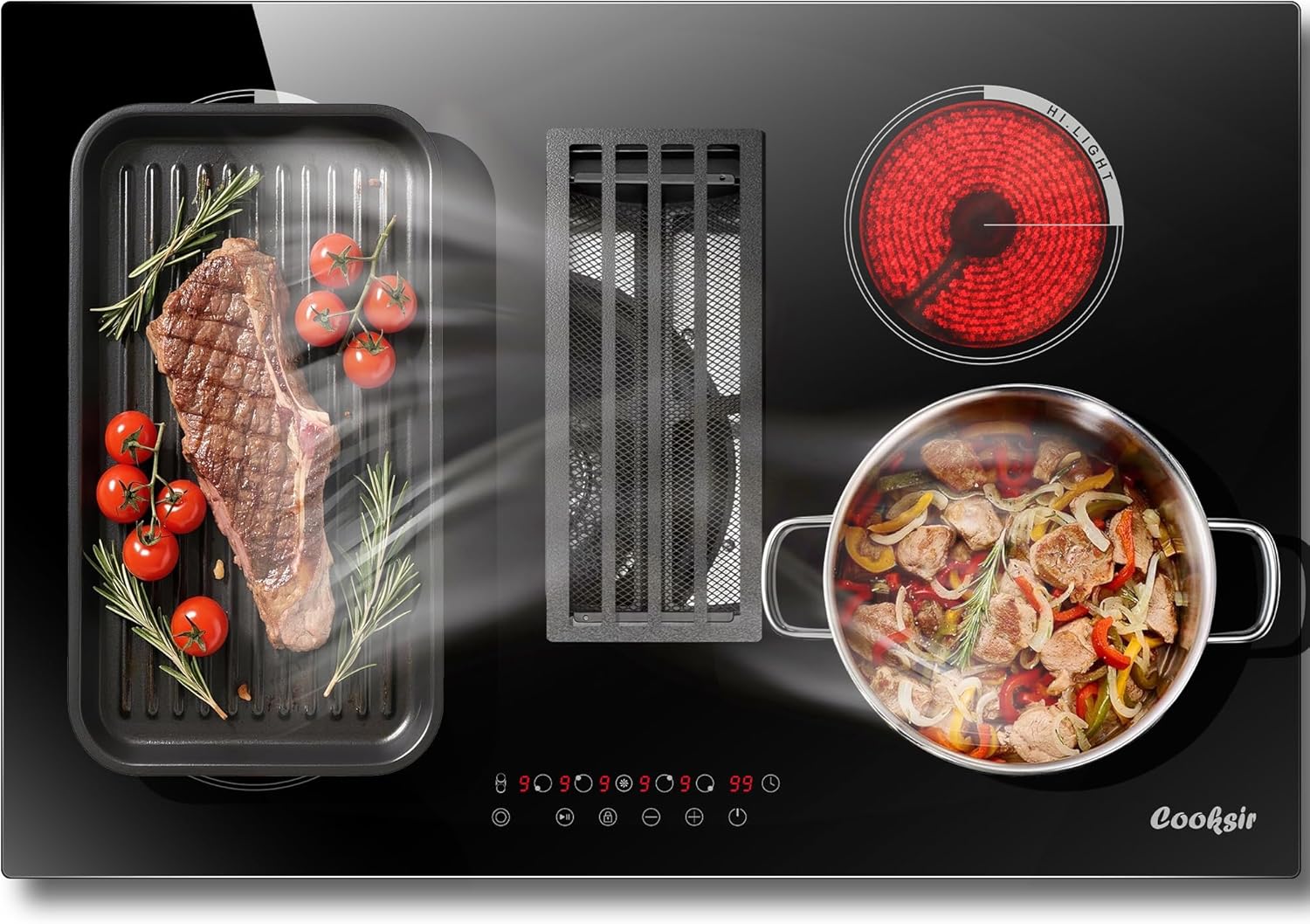
This Cooksir 30-inch cooktop combines a glass-ceramic four-burner radiant stove with a ductless recirculating downdraft, making it a compact two-in-one option for kitchens where a separate hood or ducting is impractical. It is typically installed as a 220V drop-in unit in a standard 30-inch cabinet opening and is used like a conventional electric cooktop with touch controls, timer, child lock and residual-heat indicators. Notable features include a high total cooktop wattage (7400W) with a dual-ring burner and a high-power bridge-style burner for large pans, plus a 135W downdraft motor that filters and returns air to the room. Practical benefits are space savings, simplified installation thanks to the ductless design, and broad pan compatibility because it works with any flat-bottomed cookware. Important limits are the recirculating downdraft will not move air outside the home like a ducted hood, and the unit requires a 220V hardwired installation and suitable cutout dimensions, so planning is needed before purchase.
Best for: Buyers who need a space-saving built-in cooktop with integrated ventilation and prefer a simpler installation without external ductwork, while valuing flexible burner power and safety features.
Less Ideal for: People who frequently do heavy, high-smoke cooking or who need true outdoor exhaust ventilation should choose a ducted hood system instead.
- Integrated ductless downdraft hood removes need for external ductwork
- High total cooktop power with dual-ring and bridge burners for flexible heat control
- Touch controls with timer, child lock, pause and hot-surface indicators for safer use
- Glass-ceramic surface accepts all flat-bottomed pans and is easy to wipe clean
- Recirculating downdraft filters air rather than exhausting it outdoors, which is less effective for heavy smoke or strong odors
- Requires 220V hardwired installation and correct cutout sizing, so professional installation may be necessary
Verdict: Choose this unit if you want a built-in 30-inch electric cooktop that saves space by combining powerful burners with a ductless downdraft for simpler installation.
Choosing the Right Downdraft Electric Cooktop: Key Factors to Consider
Vent Performance and Airflow
Vent performance determines how effectively a downdraft cooktop removes smoke, steam, and cooking odors from the work area. Look at rated airflow (CFM) and whether the system uses an integrated blower or provisions for a remote blower. Higher airflow helps with heavy frying and searing, but motor placement and ducting length also affect real-world performance.
Noise is tied to airflow and motor speed. A cooktop with multiple speed settings or a remote blower option lets you run extraction quietly during simmering and at higher power when needed. Consider whether the downdraft vents at the rear or pop up at the countertop, as positioning affects capture efficiency for tall cookware and steam.
Burner Heat Output and Control
Burner responsiveness and range matter for achieving consistent cooking results. Electric downdraft cooktops may use radiant, ceramic, or induction-style heating elements; each has different heat-up times and temperature stability. Evaluate maximum and minimum heat levels, step granularity, and whether the controls allow for precise simmering and rapid boiling.
Even heat distribution across burners matters when you use multiple pots at once. Pay attention to burner size and layout so large pans do not block vent intake and so controls remain intuitive during busy cooking.
Installation and Countertop Fit
Proper installation is critical for downdraft cooktops because venting requires space below the countertop for fans and ducting or a remote blower. Check counter cutout dimensions, clearance under the cabinet, and whether the unit supports ducted or recirculating configurations. Some designs require a dedicated cabinet space for the blower, while others route air below the floor or to an exterior wall.
Electrical requirements vary. Confirm that your kitchen has the appropriate circuit and connection points and whether any cabinet or countertop modification is necessary. Ease of access for maintenance and filter changes should also be considered during site planning.
Cleaning and Surface Durability
The cooktop surface will see spills, splatters, and heat exposure daily. Smooth glass-ceramic surfaces or sealed radiant elements are easier to wipe down, while durable finishes resist staining and scratches. Consider whether control knobs are removable for cleaning and whether the downdraft inlet is designed to trap grease in a removable, dishwasher-safe tray or filter.
Filter type and accessibility matter. Metal grease filters usually require periodic cleaning and are more effective for heavy frying, while charcoal filters are required for recirculating setups and need routine replacement.
Controls, Safety Features, and Usability
User-friendly controls reduce friction during cooking. Look for clearly labeled touch or knob controls, programmable timers, and indicators for hot surfaces. Safety features such as automatic shutoff, child locks, and boil-dry protection contribute to safer everyday operation.
Ergonomics matter too. Control placement should be intuitive and not interfere with cookware. Easy-to-read indicators for vent speed and filter status simplify upkeep.
Ducted Vs Recirculating Configurations
Downdraft cooktops are commonly offered in two ventilation approaches: ducted extraction to the outside and recirculating systems that filter and return air to the kitchen. Ducted setups generally perform better at removing heat and odors but require a route to the exterior and more installation planning.
Recirculating configurations are easier to install where exterior venting is not possible, but they rely on charcoal filters and tend to be less effective at removing moisture. If you cannot run a duct through cabinetry or an exterior wall, recirculation is a practical alternative.
- Ducted: better contaminant removal, requires exterior routing.
- Recirculating: flexible installation, needs charcoal filters and more maintenance.
Planning for Under-Cabinet and Below-Counter Space
Measure available depth and height below the countertop before selecting a unit. Some downdraft systems need substantial clearance for integrated blowers or duct elbows. Remote blower options move the fan away from the cooktop and can reduce noise near the cooking area, but they need routing and potentially additional cabinet space.
Account for service access when installing. Filters and electrical connections should be reachable without full disassembly so routine cleaning and filter replacement are straightforward.
- Check cutout and clearance dimensions against your cabinet layout.
- Plan for blower location and duct runs during early renovation stages.
Noise Considerations and Speed Controls
Vent noise increases with blower speed. Review the number and effectiveness of speed settings and whether the fan speed ramps smoothly. Some units include a low-noise mode that balances extraction with quieter operation for light cooking.
Consider how often you cook at high heat. If you frequently sear or stir-fry, prioritize higher maximum airflow and accept higher noise at peak speeds, or plan for a remote blower to move the noise source away from the kitchen.
- Look for multiple speed levels and quiet modes.
- Remote blowers can significantly reduce perceived noise in the kitchen.
Maintenance Routines and Filter Choices
Establish a maintenance routine that fits your cooking habits. If you do a lot of frying, you will need to clean metal grease filters more often and may replace charcoal filters on recirculating units more frequently. Grease-trap accessibility and dishwasher-safe components simplify upkeep.
Keep an inventory of replacement charcoal filters if using recirculation. For ducted systems, periodic inspection of duct runs and seals helps maintain airflow efficiency and prevents buildup.
- Clean metal filters monthly with heavy use; replace charcoal filters per manufacturer guidance.
- Inspect duct seals annually to preserve extraction performance.
Cooking Habits That Affect Downdraft Effectiveness
How you cook impacts a downdraft system more than it does an overhead hood. Tall pots, splatter from frying, and dramatic steam plumes reduce the capture efficiency of a low-level vent. Using lids, lowering heat during initial searing, and positioning pans to avoid blocking the intake will improve performance.
Consider cookware height when planning; choose burners near the center of the vent zone for best results. For occasional heavy-duty cooking, run the fan at higher speeds and allow a brief post-cook run to clear lingering odors and moisture.
- Use lids and lower initial heat to reduce airborne droplets.
- Position larger pans to avoid blocking the intake area.
How We Chose the Best Downdraft Electric Cooktop
We focused on features that directly affect day-to-day cooking and ventilation when evaluating downdraft electric cooktops. Key evaluation dimensions included vent performance and airflow, because sufficient extraction at the cooktop surface is essential to remove smoke and odors; burner heat control, to judge how quickly and precisely the unit responds for common cooking techniques; installation flexibility, covering countertop cutout compatibility and built-in ducting or remote blower options; surface durability and cleaning, since smooth, easy-to-clean surfaces reduce maintenance time; and safety and control features, including child locks, automatic shutoff, and user-friendly controls. We also reviewed build quality and materials to assess long-term reliability. We excluded units that require full custom cabinetry changes or nonstandard power supplies not commonly available in residential kitchens. We did not include downdraft modules that are strictly add-on accessories for existing cooktops. Our short list reflects appliances that balance extraction, cooking performance, and practical installation for typical home kitchens.
Our full evaluation process is outlined in our review methodology.
FAQ
Can a downdraft electric cooktop match the extraction of an overhead hood?
A downdraft cooktop can be effective for many everyday cooking tasks, but it usually does not match the wide-area capture of a full overhead hood. Ducted downdraft systems with a powerful blower and short duct runs perform best, while recirculating setups are less effective for heavy smoke.
How often do I need to clean or replace filters?
Metal grease filters typically need cleaning every few weeks with regular frying and monthly with lighter use. Charcoal filters used in recirculating systems require replacement on a schedule recommended by the manufacturer, often every 6 to 12 months depending on usage.
Will a downdraft cooktop fit standard countertop cutouts?
Many downdraft cooktops are designed for common countertop cutouts, but dimensions and under-counter clearance vary. Always measure your available space and confirm cutout and clearance requirements before purchase and installation.
Are remote blowers worth the extra installation work?
Remote blowers can significantly reduce noise near the cooking area and improve extraction for long duct runs. They require planning for placement and ducting but are often worth it if you do frequent high-heat cooking and want lower sound levels in the kitchen.
Do downdraft cooktops use more electricity than standard electric cooktops?
The cooktop heating elements consume similar electricity to other electric cooktops. Additional power is used for the downdraft blower, and consumption depends on blower size and runtime. Overall energy use is typically modest compared with the cooktop heating load.
Final Verdict
Downdraft electric cooktops are a practical solution when you want integrated ventilation without an overhead hood. Prioritize vent performance and installation fit first, then consider burner responsiveness and cleaning convenience based on your cooking style. Balance noise and airflow by choosing ducted or remote blower options when possible. Focus on realistic tradeoffs: a powerful ducted downdraft will extract better but requires routing, while recirculating systems are easier to install but need more filter maintenance. Use the criteria discussed here to match a unit to your kitchen layout and cooking habits so you get reliable extraction and consistent heat control.