
Note: This article contains affiliate links. If you click on these links and make a purchase, we may earn a small commission at no extra cost to you. This helps support our research and content. Read our full affiliate disclosure here.
When you need dependable warmth on a cool campsite, the right electric heater can make evenings comfortable and extend your season. You want a unit that produces meaningful heat without drawing excessive power, fits your shelter or RV, and includes safety features that protect fabric and people. This guide presents seven shortlisted electric heaters for camping chosen for real-world use outdoors and in sheltered camping spaces. We evaluated units for heat output, power efficiency, portability, and safety to help you pick an option suited to your trip style and power budget.
Top Picks at a Glance
| Best Overall The best all-around choice for most situations | Amazon Basics Oscillating Ceramic Heater |  |
| Best Quality Built to a higher standard if you want something more solid | DR. Infrared Heater DR-968 |  |
| Best Value The sweet spot between price and what you get | Kismile PTC-902A Ceramic Space Heater |  |
| Best Budget The cheapest option that still gets the job done reliably | Amazon Basics Ceramic Mini Heater |  |
| Top Rated A top-rated pick with lots of positive feedback | DREO Portable Space Heater HSH006 |  |
| Most Popular A crowd favorite that many people choose with confidence | GiveBest Portable Space Heater PTC-905 |  |
| Best Seller A high-volume bestseller chosen again and again | DREO Portable Space Heater DR-HSH006 |  |
Amazon Basics Oscillating Ceramic Heater

| Heat Output | 1500 watts |
|---|---|
| Heating Coverage | 160 square feet |
| Number of Speeds | 3 |
| Heating Method | Convection |
This compact Amazon Basics ceramic heater is a simple, no-frills indoor heater that uses a 1500W ceramic element and a 45-degree oscillation to spread warmth across small rooms. It offers three modes — high (1500W), low (900W), and fan only — and an adjustable thermostat so you can dial back output once a room reaches a comfortable temperature. The unit is lightweight and portable, making it easy to move from a bedroom to a home office, and built-in tip-over and overheat protection add a layer of safety for everyday use. Noise is modest around 43 dB on heat, so it is fairly unobtrusive for sleeping or working. On the downside this is designed for indoor, floor use and is sized for roughly 160 square feet, so it will struggle to heat larger or drafty spaces and offers no outdoor or camping-specific weather protection. Controls are basic rather than digital, so you should expect simple mechanical operation rather than precise scheduling or remote control.
Best for: Buyers who want an inexpensive, portable indoor heater for small rooms and value simple, reliable warming with basic safety features.
Less Ideal for: People who need a heater for outdoor use, uninsulated tents, or large rooms where higher-capacity or weatherproof units are required.
- Portable, lightweight design makes it easy to move between rooms
- 45-degree oscillation helps distribute heat more evenly across a small area
- Three heat/fan settings and an adjustable thermostat for basic temperature control
- Built-in tip-over and overheat protection improve everyday safety
- Intended for indoor use only and not weatherproof for outdoor or camping use
- Limited coverage around 160 sq ft, so not suitable for larger or poorly insulated spaces
Verdict: A lightweight, affordable indoor heater that delivers quick, even warmth for small rooms thanks to its 1500W ceramic element and oscillation.
DR. Infrared Heater DR-968

| Power | 1500 Watts |
|---|---|
| Heating Coverage | 576 square feet |
| Number of Speeds | 3 |
| Voltage | 120 |
| Thermostat Range | 50 to 85 °F |
The DR. Infrared Heater DR-968 uses a dual heating system (PTC plus quartz infrared) and a high-velocity, low-noise blower to deliver fast, even heat across a room. It is typically used as a freestanding heater in bedrooms, living rooms, home offices, or similar indoor spaces and offers three power modes including an Auto energy-saving mode that cycles between high and low to maintain the set temperature. The unit includes caster wheels and a 72-inch power cord for easy repositioning, an electronic thermostat adjustable from 50 to 85 F, a 12-hour timer, and an IR remote for convenience. Built-in safety features include tip-over and overheat protection and a cool-to-touch exterior, and the blower runs quietly at about 39 dB. Important limitations are that it is designed for indoor use on standard 120V circuits and weighs about 19 pounds, so it is less suited to outdoor or very lightweight portable scenarios; it also consumes up to 1500 watts which limits use on low-power circuits. For in-room performance it provides strong, factory-quality heating and sensible controls, but it is not an outdoor camping-specific heater.
Best for: Buyers who prioritize strong in-room heating performance and want a heater that reaches and holds temperature quickly with convenient controls and built-in safety.
Less Ideal for: People needing a lightweight, battery- or propane-powered heater for outdoor camping or off-grid use should look for purpose-built portable camp heaters instead.
- Dual heating system (PTC plus quartz) for faster heat delivery than typical single-element 1500W heaters
- Auto energy-saving mode that cycles power to maintain a set temperature
- Quiet high-pressure blower for broad, even heat distribution at low noise levels
- Remote control, electronic thermostat, and timer for easy temperature management
- Designed for indoor use on 120V circuits so not intended for outdoor camping or nonstandard power sources
- At 19 pounds it is portable within a home but heavier than lightweight camping heaters
Verdict: Choose the DR-968 when you need a powerful, fast-heating indoor unit that maintains set temperatures efficiently with quiet operation and safety features.
Kismile PTC-902A Ceramic Space Heater

| Heat output | 1500 watts |
|---|---|
| Number of speeds | 3 |
| Heating method | ceramic |
| Voltage | 120 volts |
| Heating coverage | 10-20 square meters |
The Kismile PTC-902A is a small, portable ceramic heater designed to warm personal areas quickly using PTC ceramic technology and a 750/1500W two-step power selection plus a fan-only mode. It is typically used on a tabletop or floor near a desk or sleeping area to provide directional heat for one or two people rather than heating a whole tent or large room. Notable features include an adjustable thermostat, three speed/heat settings, a built-in carry handle, tip-over and overheat shutoff, and ETL listing for safety. In practice the heater reaches noticeable warmth fast and the fan-only mode makes it usable as a quiet circulator in milder conditions. Important limitations are that it requires standard 120V AC power and is intended for indoor use, so using it in genuine camping scenarios is only feasible when you have reliable campsite electricity or a sufficiently sized inverter; it is not suitable for wet environments or unventilated spaces. Its small footprint and safety features make it convenient for controlled small-space heating when mains power is available.
Best for: Buyers who prioritize a compact, safe, and fast personal heater for small enclosed spaces and plan to use it where shore power or a reliable inverter is available.
Less Ideal for: People who need an off-grid, battery-powered, or outdoor-rated heater for remote camping trips should choose a purpose-built camping or propane heater instead.
- Fast-heating PTC ceramic element for quick, focused warmth
- Two power levels (750W and 1500W) plus fan-only mode for flexible use
- Built-in handle and compact footprint make it easy to move and position
- Multiple safety features including tip-over and overheat shutoff and ETL listing
- Requires 120V AC power so not suitable for off-grid camping without an inverter or generator
- Not rated for use in damp or outdoor-exposed environments
Verdict: A compact, safety-focused ceramic heater that delivers quick personal warmth when you have access to standard AC power.
Amazon Basics Ceramic Mini Heater
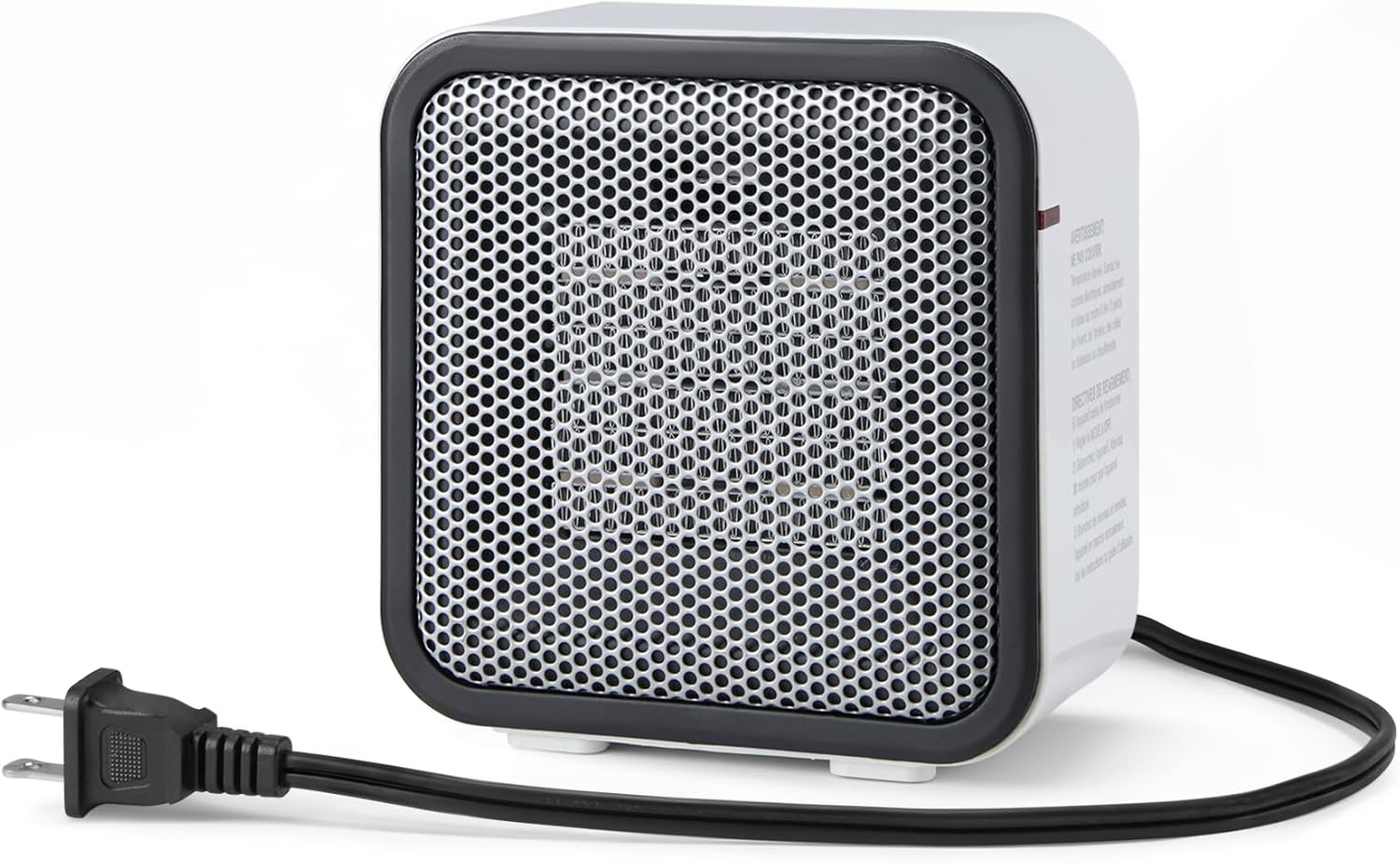
| Heat Output | 500 watts |
|---|---|
| Heating Method | Convection |
| Power Source | Corded Electric |
| Heating Coverage | 107.6 square feet |
| Special Features | Tip-Over Protection |
This Amazon Basics ceramic mini heater is a tiny, portable 500-watt unit built for quick spot warmth in small spaces such as desks, bedside tables, or tent interiors when indoor power is available. It uses ceramic convection heating and ceramic coils to produce heat quickly while producing modest noise around 48 dB. The heater is very lightweight and easy to move, and its small footprint makes it simple to tuck into tight spots. Safety is addressed with tip-over protection that cuts power if the unit is knocked over. Because it has a single heat setting and no thermostat or multiple fan speeds, you get straightforward on/off warmth rather than precise temperature control. At 500 watts it will not warm large rooms and will require a reliable 120V power source, which limits use to campsites or RVs with adequate shore power rather than dry outdoor setups. For buyers who want an inexpensive, no-frills personal heater for short-term spot heating, it does the job effectively.
Best for: Buyers looking for an inexpensive, portable personal heater to provide quick spot warmth in small, powered camping setups or indoor tents where space and budget are the main concerns.
Less Ideal for: People who need to heat larger tents or unpowered outdoor locations or who want precise temperature control and multiple heat settings.
- Compact and lightweight for easy placement and transport
- Quick heat delivery from ceramic heating element
- Built-in tip-over protection for safer operation
- Quiet operation around 48 dB suitable for desk or bedside use
- Single heat setting with no thermostat limits temperature control
- Low 500W output is only suitable for very small spaces or personal heating
- Requires 120V power so not suitable for unpowered outdoor camping
Verdict: A budget-friendly, ultra-compact personal heater that delivers quick spot heat for small, powered camping setups.
DREO Portable Space Heater HSH006

| Heat Output | 1500 watts |
|---|---|
| Heating Element | PTC Ceramic |
| Heating Coverage | 200 sq.ft |
| Sound Level | 34 dB |
| Timer | 1–12 H |
The DREO HSH006 is a small tower heater that delivers quick forced-air warmth using a 1500W PTC ceramic element and a focused funnel design. You control temperature precisely from 41 to 95°F in 1°F steps via onboard buttons or the included remote, and the unit offers multiple heat modes, an ECO option, fan-only, and a 12-hour timer for scheduled use. Safety features include tip-over detection, overheat protection, flame-retardant materials, and an ETL listing, which makes it easy to run unattended in short sessions. Its brushless DC motor and winglet fan are tuned to keep noise down to about 34 dB, so it is suitable for bedrooms or offices where quieter operation matters. The heater is compact and lightweight with a carry handle, but it is designed strictly for indoor, plug-in use and sized to warm rooms up to about 200 sq ft; it is not built for wet or rustic outdoor conditions. For routine spot heating and precise thermostat control in small indoor spaces, this model is a practical, safety-minded option.
Best for: Buyers who prioritize reliable, safe, and quiet spot heating for small indoor rooms and want fine thermostat control and scheduling in a compact package.
Less Ideal for: People needing a rugged, weatherproof heater for outdoor or open-camp use or those who must heat large or poorly insulated areas.
- 1500W PTC ceramic element for fast, consistent heat
- Precise digital thermostat (41–95°F in 1°F increments) with remote control
- Multiple modes plus 12-hour timer and memory function for scheduled use
- Safety features including tip-over sensor, overheat protection, flame-retardant materials, and ETL listing
- Brushless DC motor and design tuned for low noise (around 34 dB)
- Intended for indoor, corded use only so not suitable for open-air camping
- Effective coverage limited to about 200 sq ft, so not for large or uninsulated spaces
Verdict: Choose the DREO HSH006 when you need a compact, safety-focused indoor heater that delivers fast, quiet, and precisely controlled warmth for small spaces.
GiveBest Portable Space Heater PTC-905

| Heat output | 1500 watts |
|---|---|
| Heat settings | 1500W / 750W |
| Heating coverage | 200 sq.ft |
| Number of speeds | 2 |
| Max temperature setting | 158 °F |
The GiveBest PTC-905 is a small ceramic space heater designed to warm single rooms quickly with 1500W (or 750W) output and a built-in fan for faster circulation. You set a target temperature on the adjustable thermostat and the heater cycles on and off to maintain it, which helps reduce continuous runtime. It has a carry handle for moving between desk, bedroom, or home office and a cool fan mode for summer use. Safety features include overheat and tip-over shutoffs plus flame-retardant housing, so it behaves like a cautious, everyday portable heater. Practical limits are its 200 sq ft coverage rating and reliance on standard 120V power, so it is meant for indoor spot heating rather than whole-home use or remote outdoor setups; it is also not designed for wet environments. Noise is low for a fan heater, but you will still hear the fan at higher settings. For buyers prioritizing a simple, safety-forward heater for small indoor spaces, this model is a dependable choice.
Best for: Buyers who want a compact, safety-focused heater to warm a single room or workspace quickly and prefer proven customer feedback when choosing a reliable everyday unit.
Less Ideal for: People needing a heater for outdoor use, bathrooms, whole-house heating, or larger open-plan spaces should look at purpose-built or higher-capacity solutions.
- Two heat settings (1500W and 750W) plus cool fan mode for year-round use
- Adjustable thermostat that cycles the unit to maintain a preset temperature
- Multiple safety protections including overheat shutoff and tip-over auto shutdown
- Compact, lightweight design with carry handle for easy room-to-room portability
- Quiet operation suitable for bedrooms and home offices
- Rated for about 200 sq ft so not suitable for heating larger areas
- Requires standard 120V AC power and is not intended for outdoor or damp locations
Verdict: A compact, safety-minded ceramic heater that reliably warms single rooms and workspaces while prioritizing quiet operation and built-in protections.
DREO Portable Space Heater DR-HSH006

| Heat Output | 1500 watts |
|---|---|
| Heating Element | PTC Ceramic |
| Number of Speeds | 4 |
| Min Temperature Setting | 41 °F |
| Max Temperature Setting | 95 °F |
This DREO tower heater delivers quick, directed warmth using a 1500W PTC ceramic element and a funnel design that boosts circulation beyond a typical small heater. It is used as a portable indoor heater — place it on the floor in a bedroom, office, or similar room and choose from power, ECO, or fan-only modes, set the temperature precisely between 41 and 95°F, or use the 12-hour timer and remote for hands-off control. Safety features include ETL certification, tip-over and overheat protection, flame-retardant materials, and a tilt-detection sensor, which make it suitable where safety is a priority. The brushless DC motor and winglet fan keep operation quiet at about 34 dB so it will not disturb sleep or work. Trade-offs are its indoor-only design and reliance on household AC power, so it is not suited to off-grid camping; also the unit is compact so it is best for single rooms rather than heating larger open spaces.
Best for: Buyers who prioritize a safe, quiet, and easy-to-control indoor heater for bedrooms or offices and want precise thermostat control and built-in safety features.
Less Ideal for: People needing a heater for outdoor or off-grid camping, garages, or to warm large open spaces should look at models designed for those conditions.
- 1500W PTC ceramic element provides fast, even heat and enhanced air circulation
- Wide adjustable thermostat from 41 to 95°F with 1°F increments for precise control
- Multiple convenient controls including remote, 12-hour timer, mute and memory
- Comprehensive safety features: tip-over detection, overheat protection, flame-retardant materials and ETL listing
- Brushless DC motor and winglet fan design keep noise low (~34 dB)
- Requires household AC power and is not designed for off-grid or tent camping
- Compact floor-footprint limits effectiveness to single rooms rather than large areas
Verdict: If you want a compact, quiet indoor heater with precise thermostat control and strong safety protections, this DREO tower heater is a dependable choice.
Choosing the Right Electric Heater for Camping: Key Factors to Consider
Heat Output and Coverage
How much warmth a heater produces determines whether it can maintain comfortable temperatures in your tent or RV. Look for stated wattage ranges and estimated square-foot coverage, but also consider the enclosure type. A small two-person tent needs far less output than a family cabin tent or a camper van.
Real-world performance varies with insulation, wind, and ambient temperature. For camping, choose a heater that can raise the air temperature quickly and maintain it without constant high power. Consider models with adjustable output so you can dial back energy use once the space has warmed.
Power Source and Efficiency
Where you will get electricity in the field dictates acceptable heater choices. If you rely on portable power stations or batteries, you need low-draw, efficient heaters or models that offer low-wattage modes. If campsite shore power is available, higher-wattage units are feasible.
Compare nominal wattage and whether the heater has ECO or low-power settings. Efficiency affects how long a given battery or generator will run a heater and whether you need to budget fuel or battery capacity. Some heaters use radiant panels or ceramic elements that can be more efficient in small enclosed spaces.
Built-in Safety Features
Safety is critical when using electric heaters near tent fabric, sleeping bags, and people. Essential protections include tip-over shutoff, overheat detection and shutdown, and cool-touch exteriors or grille designs that keep hot parts away from accidental contact.
Also consider whether the unit has a grounded plug or double-insulated construction and whether controls are simple to operate in low light. For campsite use, a heater that minimizes open hot surfaces and has reliable automatic cutoffs reduces the risk of fire or burns.
Portability and Ease of Setup
Camping demands compact gear that is easy to carry and set up at camp. Weight, footprint, and how the heater packs matter, especially if you pack by hand or carry gear long distances. Look for integrated handles, secure feet or mounting options, and simple plug-and-play controls.
Quick setup also reduces exposure while you are working in cold conditions. A heater that can sit stably on uneven ground or be secured to a rigid surface without complicated assembly is a strong choice for campers.
Noise Level and User Comfort
Noise can affect sleep and conversation around camp. Fan-forced heaters typically produce some audible sound while radiant models may run silently. Consider the noise rating or subjective quietness, especially for overnight use in tents and RVs.
Also look at thermostat control, fan speed settings, and whether the unit cycles smoothly without abrupt temperature swings. A quiet heater with steady warmth improves comfort and encourages longer run times at lower power.
Durability and Weather Resistance
Camping exposes gear to bumps, dust, humidity, and occasional wet conditions. Materials and build quality determine how well a heater will survive repeated trips. Metal housings, protected controls, and IP-rated or splash-resistant components extend usable life.
Consider how easy it is to clean and whether the device tolerates brief exposure to condensation or a dusty environment. More durable units repay the upfront convenience with fewer failures on the trail.
Choosing a Heater for Tent Use Versus RV Use
Tents and RVs create different heating challenges. Tents have thin fabric walls and more air exchange, so a heater that produces quick radiant heat or a focused warm zone is often more effective than a slow air-heating unit. RVs have better insulation and built-in electrical systems, allowing use of higher-wattage models and thermostatic control.
Match the heater style to the shelter. For tent camping prioritize low-draw radiant or ceramic heaters with robust safety cutoffs. For RV use, you can consider units with greater output and integrated thermostats that maintain a steady cabin temperature.
- Tents: look for tip-over protection and low surface temperatures.
- RVs: prioritize thermostats and higher continuous output.
- Consider ventilation needs in both settings to avoid condensation build-up.
Managing Power on Multi-Day Trips
Estimate your available watt-hours from batteries or fuel for each night and plan heater run times accordingly. Use lower heat settings during sleep and preheat the shelter briefly before bed to conserve energy. Portable power stations provide predictable output, but understand inverter limits and continuous discharge ratings.
Pair heaters with other energy-saving practices like insulated sleeping pads, tent rugs, and closeable vents to reduce warm-up time and overall energy use.
- Calculate nightly energy needs based on heater wattage and planned run hours.
- Use intermittent heating cycles rather than continuous high-output running.
- Bring a backup plan for unexpected cold nights, such as extra insulation layers.
Safe Placement and Ventilation Tips
Place heaters on stable, level surfaces away from flammable materials and tent walls. Maintain manufacturer-recommended clearances even in tight campsites. Use heat shields or barrier plates if necessary to prevent direct contact with fabric.
Ensure adequate ventilation to reduce condensation and maintain oxygen levels, especially in tightly sealed shelters. Even electric heaters can create localized hot pockets, so arrange sleeping areas and gear to avoid accidental contact with hot grilles or elements.
- Keep a minimum clearance on all sides as recommended for the device.
- Avoid placing heaters on soft, uneven ground where they can tip.
- Check cords and connections for wear and protect them from moisture.
Low-Draw Strategies and Accessory Options
If power is limited, choose heaters with multiple heat settings and timers. A short preheat period followed by lower-maintain settings dramatically reduces total energy use. Supplement electric heat with passive measures such as insulating liners or foam pads to get more warmth per watt.
Accessories like heat-reflective blankets or small stand platforms can improve perceived warmth and protect surfaces. Battery-friendly thermostats or programmable controllers help avoid unnecessary runtime.
- Use reflective barriers to trap radiant heat.
- Employ timers to avoid running the heater longer than needed.
- Select low-watt modes for overnight operation when possible.
Maintenance and Winter Storage
Regular maintenance prolongs a heater's useful life. Keep intake and exhaust areas free of dust and debris and inspect cords and plugs before each season. For fan models, occasional cleaning of grills and blades prevents buildup that reduces airflow and efficiency.
Store heaters in dry, padded cases or boxes to prevent dents and moisture damage between trips. Follow manufacturer guidance for long-term storage, especially regarding capacitors or battery-powered control modules.
- Clean grilles and vents at the end of each camping season.
- Inspect safety switches and ensure they operate freely.
- Store in a dry, temperature-stable place to avoid corrosion.
How We Chose the Best Electric Heater for Camping
We focused on performance and safety metrics that matter for camping use. Heat output and coverage were primary considerations because campsite comfort depends on a heater's ability to raise air temperature quickly in small to medium tents and enclosed RV spaces. Power efficiency and draw were evaluated to ensure suitability for battery packs, portable power stations, and campsite shore power. Safety features such as tip-over shutoff, overheat protection, and cool-touch housings were required because fabric tents and close-quarters camping increase risk. Portability and setup ease were assessed to reflect weight, dimensions, handle design, and simple controls for quick deployment. Noise level and durability under outdoor conditions were also considered since quieter fans and weather-resistant construction improve the camping experience. We excluded devices intended solely for indoor household heating that lack explicit safety features for enclosed camping environments or that require permanent electrical installations. We also filtered out heaters with excessive continuous power draw that make them impractical for common campsite power sources. Final selections balance usable heat, safe operation near camping gear, and straightforward transport and setup.
Our full evaluation process is outlined in our review methodology.
FAQ
Are electric heaters safe to use inside a tent?
They can be safe if the heater is designed for enclosed spaces and includes tip-over and overheat shutoffs, cool-touch surfaces, and appropriate clearances. Always follow safety guidelines and never leave a heater unattended while in use.
Can I run an electric heater from a portable battery pack?
Yes, but it depends on the heater's wattage and the battery pack's continuous output and capacity. Low-wattage heaters or brief preheat cycles are most practical for battery use. Calculate required watt-hours to ensure your pack can supply runtime.
What wattage is appropriate for heating a two-person tent?
Smaller tents usually require lower output. Models with adjustable settings often offer a few hundred watts that are adequate when combined with good insulation. Exact needs vary with ambient temperature and tent size.
Do electric heaters pose a carbon monoxide risk?
Electric heaters do not produce combustion so they do not generate carbon monoxide. However, proper ventilation is still important to manage humidity and ensure fresh air circulation.
How can I reduce noise from a fan-forced heater at night?
Choose lower fan speeds or models with quiet modes, and position the heater on a stable surface to minimize vibration. Using periodic heating cycles rather than continuous operation can also reduce overall noise exposure.
Final Verdict
Prioritize safety features and realistic power requirements when choosing an electric heater for camping. Heat output should match the shelter size while power efficiency dictates whether you can run the heater from batteries, a generator, or campsite power. Portability, durable construction, and quiet operation are useful secondary considerations that improve usability. Balance the tradeoffs between higher continuous output and limited power resources, and favor heaters with reliable safety cutoffs for enclosed camping. With the right priorities, you can pick a heater that keeps you comfortable without compromising safety or exhausting your power supply.