
Note: This article contains affiliate links. If you click on these links and make a purchase, we may earn a small commission at no extra cost to you. This helps support our research and content. Read our full affiliate disclosure here.
Picking the right electric heater matters because it directly affects comfort, running cost, and how quickly a room reaches a comfortable temperature. Whether you need supplemental heat for a single room or a consistent overnight solution, the wrong heater can be loud, inefficient, or offer poor temperature control. This guide shortlists the top electric heaters across common home use cases and evaluates each option on real decision factors like heating output, safety features, and energy use. Read on to see the shortlist and a clear explanation of the attributes that matter most when choosing an electric heater.
Top Picks at a Glance
| Best Overall The best all-around choice for most situations | Lasko Ceramic Tower Heater 751320 |  |
| Best Quality Built to a higher standard if you want something more solid | DR. Infrared Heater DR-968 |  |
| Best Value The sweet spot between price and what you get | Amazon Basics Ceramic Space Heater |  |
| Best Budget The cheapest option that still gets the job done reliably | Amazon Basics Ceramic Mini Heater |  |
| Top Rated A top-rated pick with lots of positive feedback | DREO Space Heater HSH006 |  |
| Most Popular A crowd favorite that many people choose with confidence | GiveBest Portable Space Heater PTC-905 |  |
| Best Seller A high-volume bestseller chosen again and again | DREO Portable Space Heater DR-HSH006 |  |
Lasko Ceramic Tower Heater 751320

| Heat Output | 1500 watts |
|---|---|
| Heating Element | Ceramic |
| Heat Settings | 2 |
| Timer | 7-hour auto-off timer |
| Power Source | Corded Electric |
The Lasko Ceramic Tower Heater is a slim, portable 1500-watt electric heater meant to warm small to medium rooms. Its elongated ceramic element and widespread oscillation help move warm air across a room, while the electronic thermostat and two heat settings let you pick steady warmth or lower output for quieter use. A seven-hour auto-off timer and included multi-function remote make it simple to control temperature and oscillation from across the room, and the built-in carry handle makes moving the unit between bedroom, office, or living room straightforward. Safety features such as overheat protection, cool-touch housing, and ETL listing offer added reassurance for everyday use. Limitations include only two heat settings rather than multiple fan speeds and no tip-over switch on this model, so it may lack fine-grain control that some larger or premium heaters provide.
Best for: Buyers who want an easy-to-use, reliable heater for everyday indoor comfort and value simple remote and timer controls for bedrooms or home offices.
Less Ideal for: People who need granular heat and fan-speed control, heavy-duty heating for large open spaces, or specialty features like built-in tip-over protection should consider other options.
- Powerful 1500W ceramic element for fast room warming
- Widespread oscillation for more even heat distribution
- Electronic thermostat and timer for simple temperature control
- Includes remote control with onboard storage for convenience
- Built-in safety features including overheat protection and cool-touch housing
- Only two heat settings limit precise output control
- No tip-over switch on this specific model
Verdict: A compact, safety-focused 1500W ceramic tower heater that delivers reliable, easy-to-control warmth for everyday indoor rooms.
DR. Infrared Heater DR-968

| Power | 1500 Watts |
|---|---|
| Heating Coverage | 576 square feet |
| Number of Speeds | 3 |
| Voltage | 120 |
| Amperage | 12.5 A |
The DR. Infrared Heater DR-968 pairs a quartz infrared tube with a PTC element and a high-velocity low-noise blower to move heat quickly and evenly through a room. It is designed for freestanding indoor use and offers Auto, Low (1000W) and High (1500W) modes with an electronic thermostat you can set between 50 and 85 F and a 12-hour timer for scheduled shutoff. Practical features include caster wheels for easy repositioning, a remote control for hands-off operation, and UL-listed safety systems such as tip-over and overheat auto shutoff. The unit focuses on delivering object-centered infrared warmth rather than just heating air, so it tends to warm occupants and furniture quickly and can feel efficient in larger rooms. Downsides to expect are the typical 1500W power limit—it cannot replace central heating for very large open-plan spaces—and at 19 pounds it is not the lightest portable heater. Noise is low thanks to the blower design, but you will still have some fan sound on higher settings.
Best for: Buyers who prioritize fast, performance-oriented room heating and want a portable heater that delivers direct infrared warmth with programmable controls and safety features.
Less Ideal for: Those needing to heat very large, open-plan homes or replace central heating should consider higher-capacity or whole-house systems instead.
- Dual heating system (infrared quartz + PTC) for faster, more direct warmth
- Electronic thermostat with Auto mode helps maintain a set temperature efficiently
- Remote control and caster wheels make placement and operation convenient
- UL-listed safety features including tip-over and overheat auto shutoff
- 1500W maximum limits effectiveness as the sole heat source in very large or open homes
- At 19 pounds it is moderately heavy for frequent carrying between rooms
Verdict: Choose this heater if you want a performance-focused 1500W infrared portable unit that heats occupants and objects quickly while offering thermostat control and robust safety features.
Amazon Basics Ceramic Space Heater

| Heat Output | 1500 watts |
|---|---|
| Number of Speeds | 3 |
| Heating Coverage | 161.4 square_feet |
| Heating Element | Infrared Heating |
| Special Features | Overheat Protection, Tip-Over Protection |
This Amazon Basics ceramic space heater is a small, no-frills tabletop unit designed to warm single rooms quickly. It offers three modes — high (1500W), low (900W) and fan-only — and uses a ceramic heating element for rapid convection heating while producing low noise. The adjustable thermostat and simple controls make it easy to dial in comfortable temperatures for home offices, bedrooms, or small living spaces, and the unit includes tip-over and overheat protection plus a power indicator light for safer everyday use. Its compact, lightweight design makes it easy to move between rooms, though the tower form factor does not oscillate so coverage is best for localized spots rather than whole large rooms. The heater runs on standard corded power and reaches up to a stated max temperature, so expect noticeable warmth fast but with the usual energy draw of a 1500W appliance.
Best for: Buyers who prioritize a simple, portable heater to warm individual rooms quickly and value straightforward controls and built-in safety.
Less Ideal for: People seeking whole-room or whole-apartment heating, ultra-quiet units for sleeping, or features like oscillation and smart controls.
- 1500W ceramic heating for fast room warm-up
- Three settings including fan-only for circulation
- Built-in tip-over and overheat protection for safety
- Compact, lightweight tabletop design for easy portability
- Non-oscillating output limits even heat distribution across larger rooms
- Runs at 1500W on high which can be a higher energy draw
Verdict: A compact, safety-minded 1500W ceramic heater that delivers fast, portable warmth for single rooms.
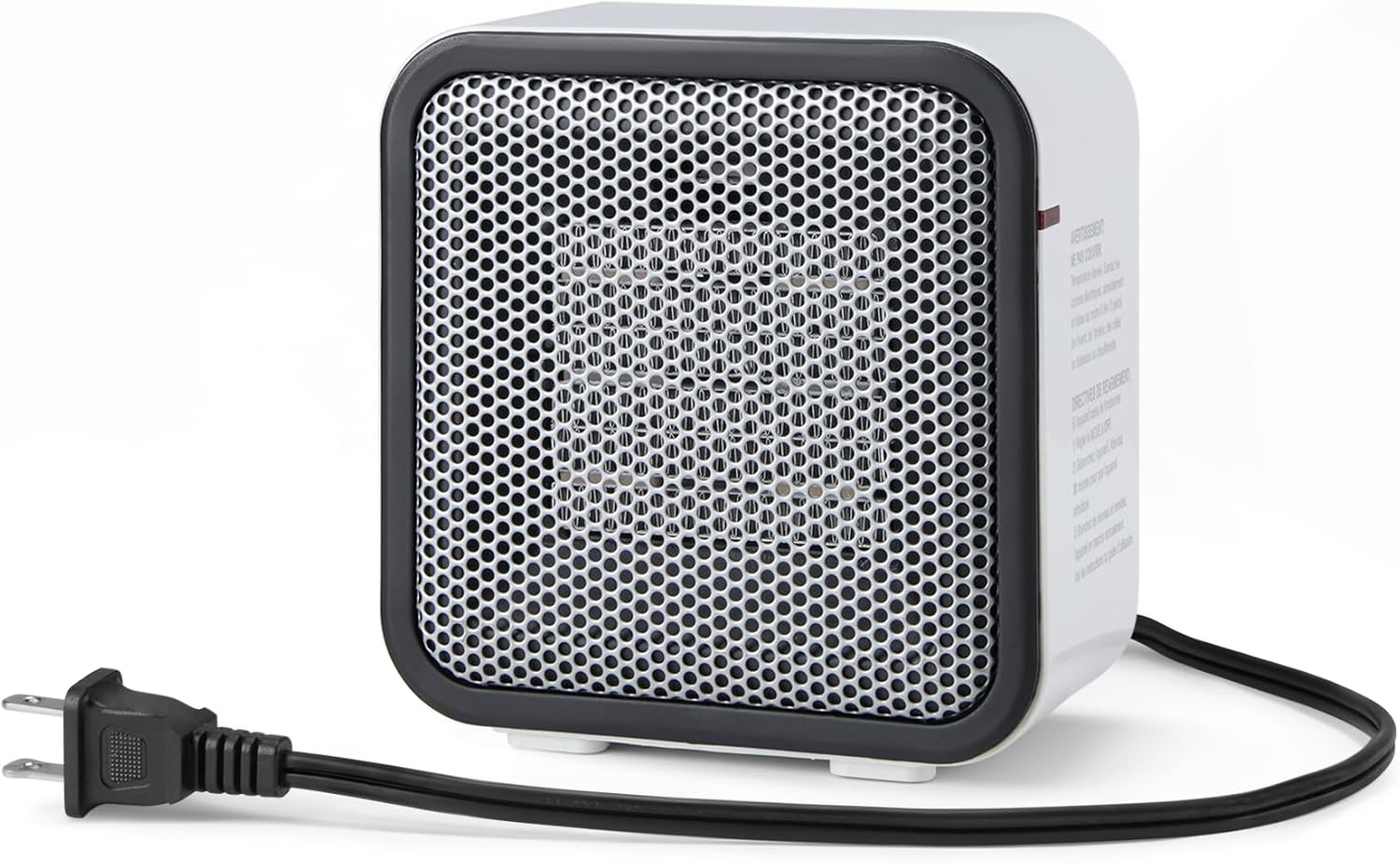
Amazon Basics Ceramic Mini Heater
| Heat Output | 500 watts |
|---|---|
| Heating Method | Convection |
| Power Source | Corded Electric |
| Heating Coverage | 107.6 square feet |
| Special Features | Tip-Over Protection |
This Amazon Basics ceramic mini heater is a small, lightweight tabletop unit that delivers quick, localized warmth with a 500W ceramic heating element. It is intended for desks, bedside tables, or small home office spaces and produces heat within seconds while remaining relatively quiet at around 48 dB. The heater runs on standard 120V power, has a single heat output setting and uses convection and radiant heating to cover roughly 107.6 square feet in close-range use. Notable features include a compact footprint that is easy to move at 1.4 pounds and a tip-over safety shutoff for safer use around desks and crowded work surfaces. The simplicity of one-speed operation keeps it straightforward to use but limits temperature control and flexibility compared with multi-setting models. This unit is best as an economical spot heater for short-term use rather than a whole-room solution or continuous, high-demand heating.
Best for: Buyers who want an inexpensive, portable heater to warm a personal workspace or small room for short periods without fuss.
Less Ideal for: People seeking a full-room heater, adjustable temperature control, or continuous high-output heating should consider larger, multi-setting models.
- Compact, lightweight design is easy to place on desks or small tables
- 500W ceramic element provides quick, localized heat
- Built-in tip-over protection increases safety during use
- Quiet operation (~48 dB) suitable for offices and bedrooms
- Single heat output with no adjustable temperature settings limits control
Verdict: A budget-friendly, portable ceramic heater that gives quick, quiet spot heat for small desks and personal spaces.
DREO Space Heater HSH006

| Heat Output | 1500 watts |
|---|---|
| Heating Coverage | 200 sq.ft |
| Heating Element | PTC Ceramic |
| Number of Speeds | 4 |
| Min-Max Temperature | 41 °F – 95 °F |
The DREO HSH006 is a compact tower heater built to deliver quick, controllable warmth for bedrooms, home offices and similar rooms. It uses a 1500W PTC ceramic element and a funnel design to push heated air farther and claims coverage around 200 sq ft; controls include a precise thermostat (41 to 95°F in 1°F steps), four fan/speed settings and multiple heating modes including ECO and fan-only. Practical touches such as a 12-hour timer, remote control, carry handle, child lock, mute function and memory make it easy to run unattended or on a schedule. Safety is emphasized with ETL listing, tip-over detection, overheat protection and flame-retardant materials. The brushless DC motor and winglet fan help keep noise low at about 34 dB, which is useful for bedrooms. Downsides are typical for compact forced-air heaters: it relies on fan circulation so it warms the air rather than radiating heat, and its 1500W ceiling limits how fast very large rooms will heat. For buyers who want a feature-rich, safety-minded electric heater for small to medium rooms, this model is a sensible choice.
Best for: Buyers who prioritize a reliable, safety-focused electric heater for nightly or scheduled use in bedrooms, home offices and other small to medium rooms.
Less Ideal for: People needing a primary heat source for large open-plan areas or those who prefer radiant or oil-filled heaters for longer residual warmth should consider other heater types.
- 1500W PTC ceramic element provides fast, consistent forced-air heat
- Adjustable thermostat with 1°F increments for precise temperature control
- Multiple safety features including tip-over detection, overheat protection and ETL listing
- Quiet brushless DC motor and winglet fan design reduce noise to around 34 dB
- Convenience extras: remote, 12-hour timer, child lock and carry handle
- Forced-air design depends on circulation so it is less effective as a primary heater for very large rooms
- 1500W power cap limits maximum heat output compared with larger systems
Verdict: A safety-forward, feature-packed 1500W tower heater that delivers precise, quiet warmth for small to medium indoor rooms.
GiveBest Portable Space Heater PTC-905

| Heat Output | 1500 watts |
|---|---|
| Heating Coverage | 200 sq.ft |
| Number of Speeds | 2 |
| Power Source | Corded Electric |
| Max Temperature Setting | 158 °F |
The GiveBest PTC-905 is a compact ceramic space heater meant to warm small to medium indoor rooms quickly. It offers two heat settings (1500W and 750W) plus a cool-fan mode, and an adjustable thermostat that cycles the unit to hold a set temperature without constant monitoring. Its PTC ceramic element and high-speed fan provide fast, noticeable warmth across rooms up to about 200 sq ft while running quieter than many comparable heaters, making it suitable for bedrooms and home offices. Safety features include V0 flame retardant housing, automatic overheat shutoff, and tip-over protection that beeps and cuts power if the unit is knocked over. The built-in carry handle and tabletop form factor make it easy to move where you need localized heat, but it is designed for single-room use and will not replace central heating. Controls are simple and there are no advanced smart features, so users wanting Wi-Fi scheduling or app control should look elsewhere.
Best for: Buyers who want a reliable, safety-focused portable heater to provide quick, quiet warmth in a bedroom, office, or small living area backed by strong customer feedback.
Less Ideal for: People seeking whole-home heating, smart-home integration, or larger space coverage should consider higher-capacity or connected alternatives.
- Dual heat modes plus cool-fan for year-round use
- Adjustable thermostat that cycles to maintain set temperature
- Multiple safety protections including overheat shutoff and tip-over sensor
- Compact, lightweight design with carry handle for easy relocation
- No smart controls or remote for scheduling
- Best suited for single rooms and not effective as whole-house heating
Verdict: A safe, portable ceramic heater that delivers fast, quiet warmth for single rooms and buyers who prioritize dependable performance and user-tested reliability.
DREO Portable Space Heater DR-HSH006

| Heat Output | 1500 watts |
|---|---|
| Heating Element | PTC Ceramic |
| Number of Speeds | 4 |
| Min Temperature Setting | 41 °F |
| Max Temperature Setting | 95 °F |
The DREO Portable Space Heater is a small tower-style electric heater designed to warm bedrooms, home offices, and similar indoor spaces quickly using a 1500W PTC ceramic element and forced-air delivery. It reaches set temperatures fast thanks to a focused heat funnel and a brushless DC motor that keeps operating noise low (about 34 dB), making it reasonable for night-time use. You control temperature precisely from 41 to 95°F in 1°F increments via onboard controls or the included remote, and there are multiple modes including power heat, ECO, and fan-only along with four fan speeds and a 12-hour timer. Safety is emphasized with ETL certification, tip-over detection, overheat protection, flame-retardant materials, and a child lock. The unit is lightweight and portable with a carry handle and memory function that restores settings after power cycles. Limitations are its small footprint, which targets single rooms rather than whole-house heating, and reliance on forced air means it can feel less like radiant warmth compared with oil-filled radiators.
Best for: Buyers who prioritize dependable safety features and precise temperature control for heating a single room or bedroom and want a quiet, easy-to-use portable heater.
Less Ideal for: People seeking whole-house heating or the sustained radiant warmth of oil-filled radiators should consider larger or different heater types instead.
- 1500W PTC ceramic heating delivers quick warming
- Precise adjustable thermostat (41–95°F in 1°F increments) for better temperature control
- Multiple modes, 4 speeds, 12-hour timer and remote for flexible operation
- ETL-listed safety features including tip-over and overheat protection plus child lock
- Quiet brushless DC motor suitable for bedroom use (~34 dB)
- Designed for single-room use so not suitable for heating large or open-plan areas
- Produces forced-air heat which feels different than radiant or oil-filled heaters
Verdict: A compact, safety-focused 1500W tower heater that gives precise, quiet, single-room warmth with multiple convenient controls.
Choosing the Right Electric Heater: Key Factors to Consider
Heating Output and Room Size
Match the heater's rated output to the space you intend to warm. Electric heaters are rated in watts; typical portable units range from 750 to 1500 watts. A higher wattage produces more heat faster but also draws more electricity. Consider ceiling height, insulation quality, and typical outdoor temperature when estimating required output.
Undersized heaters will struggle to maintain set temperatures and run continuously, increasing energy use and wear. Oversized units can cycle on and off frequently, which can feel less comfortable and may stress components. Look for clear coverage guidance so you can select a model sized for your specific room.
Energy Efficiency and Thermostat Control
Thermostat accuracy and responsive control directly influence running costs. Models with programmable or precise thermostats avoid constant full-power running by maintaining a steady temperature. Some units use adaptive fan speeds or ceramic elements that warm quickly and reduce duty cycles.
Energy-efficient operation matters for frequent use or when heating larger areas. Consider features like multiple heat settings, an Eco mode, or an accurate digital thermostat. These allow you to run the heater at lower average power while preserving comfort, lowering monthly electricity impact.
Safety Features
Safety features are essential because electric heaters operate at high temperatures and are often placed near furniture or bedding. Key protections include tip-over shutoff, overheat cutout, cool-touch housing, and cord strain relief. For rooms where children or pets are present, a low-surface-temperature design or grille spacing that prevents finger access is important.
Also inspect advertised safety certifications and the clarity of the owner manual's placement and clearance recommendations. Proper safety design reduces fire risk and allows more flexible placement options in typical home layouts.
Noise and Comfort
Noise level affects where you can comfortably use a heater. Fan-forced models provide rapid circulation but can generate noticeable sound, which may be distracting in bedrooms or home offices. Radiant or oil-filled convectors run more quietly but may take longer to warm a space.
If you need overnight or low-distraction heat, prioritize models with low-decibel operation or an adjustable fan with a quiet low setting. Consider placement and whether the heater will run continuously or in short bursts when evaluating acceptable noise levels.
Portability, Size, and Placement
Size and weight influence how easy the unit is to move between rooms and where it can be stored. Look for integrated handles, caster wheels, or a slim profile for tight spaces. Cord length and plug orientation also affect placement options near available outlets.
Consider where you will store the heater during warmer months and whether the design allows upright or horizontal storage. A compact, lightweight design is beneficial if you plan to move the heater frequently; larger oil-filled models are better left in a primary location.
Durability and Maintenance
Durability matters for a device that may operate through an entire season each year. Check for solid housing, well-sealed fan assemblies, and easily replaceable or serviceable components. Units with dust filters or simple wipe-clean surfaces reduce maintenance time.
Also consider warranty length and clarity, and whether the design minimizes crevices where dust accumulates. Reliable construction reduces the chance of overheating and prolongs useful life.
Types of Electric Heaters and When to Use Them
There are several common technologies: fan-forced convection heaters, ceramic heaters, oil-filled radiators, and infrared or radiant panels. Fan-forced units heat air quickly and distribute warmth using a fan. Ceramic heaters combine a ceramic heating element with a fan for fast heat and often include compact safety benefits. Oil-filled radiators warm more slowly but retain heat for longer after power is removed, making them efficient for steady background heating. Infrared panels heat objects and people directly and can be effective for targeted spot heating without heating the entire room air.
Choose the type that matches your use case. For quick spot heat in a drafty corner, a fan-forced or ceramic heater works well. For overnight or sustained background warmth, an oil-filled radiator or a low-wattage convector may be more comfortable and quieter.
- Fan-forced: fast warm-up, higher noise, good for short-term use
- Ceramic: compact, efficient, often safer surface temps
- Oil-filled: quiet, long heat retention, slower to respond
- Infrared: direct radiant warmth, ideal for focused spots
Placement, Clearances, and Safe Operation
Placement affects both effectiveness and safety. Place heaters on flat, stable surfaces away from high-traffic walkways and combustible materials. Maintain recommended clearances from furniture, curtains, and bedding as specified by the manufacturer. Keep cords untangled and positioned so they are not tripping hazards.
Avoid using extension cords unless the manufacturer explicitly allows them. For heaters used in bedrooms, configure thermostats and timers to avoid continuous all-night high-power operation and reduce fire risk. Always follow ventilation and proximity guidance for best results.
- Keep at least manufacturer-specified clearance on all sides
- Use on level surfaces and avoid placing near water
- Plug directly into wall outlets unless the manual permits an extension
Reducing Operating Costs Without Sacrificing Comfort
You can lower running costs by improving how you use the heater. Use thermostats, timers, and lower heat settings to avoid wasteful continuous full-power operation. Combine the heater with simple home strategies such as closing doors to heat only occupied rooms, adding weatherstripping, or using rugs to reduce heat loss from floors.
Another tip is to match heater type to session length. For short bursts of use, a quick-response ceramic unit is often more efficient. For sustained background warmth, a slowly cycling oil-filled radiator may use less energy to maintain a steady temperature.
- Use programmable thermostats or timers
- Heat only the rooms you occupy
- Combine heater use with basic insulation improvements
Maintaining Your Electric Heater
Simple maintenance extends service life and maintains safe operation. Clean dust from grilles and fan inlets regularly, and follow the manual for any filter care. Inspect the power cord before each season and store the heater in a dry location when not in use.
Do not attempt internal repairs unless you are qualified. Many common issues are resolved by cleaning and ensuring adequate airflow. Follow the manufacturer's recommended maintenance schedule for best results.
- Unplug and cool before cleaning
- Wipe external surfaces and vacuum vents to remove dust
- Store in a dry, protected place during off-season
Sizing a Heater for Different Room Types
Room function affects ideal heater size. Bedrooms usually benefit from quieter, lower-wattage units with accurate thermostats for steady overnight warmth. Living rooms and open-plan areas need higher output or multiple units to achieve even temperature distribution. Small offices or workshops may prefer directional infrared units to heat occupants without wasting energy heating empty air.
Account for insulation, window area, and whether the space has high ceilings. These factors can significantly increase the required heat output compared with a standard 8-foot ceiling, so choose a unit with sufficient capacity or plan to supplement with additional measures.
- Bedrooms: prioritize quiet operation and thermostat accuracy
- Living rooms: higher output and circulation
- Workshops: consider targeted radiant heating
How We Chose the Best Electric Heater
We focused on selection criteria that reflect everyday homeowner priorities when adding electric heat to living spaces. Primary evaluation metrics included rated heat output relative to room size, measured as wattage and estimated coverage; energy efficiency and thermostat accuracy to gauge likely running costs; safety features such as tip-over protection, overheat shutoff, and cool-touch surfaces; noise level during operation for placement in bedrooms and living rooms; and build quality plus portability for frequent repositioning and storage. Products with inadequate safety safeguards, vague or missing thermostat control, or poor energy documentation were excluded. We prioritized heaters with clear wattage ratings and user-adjustable controls, robust safety systems, and straightforward maintenance. Our process filtered out specialty units that require dedicated wiring or are intended only for industrial or outdoor use, focusing instead on models suitable for typical home rooms and daily living scenarios.
Our full evaluation process is outlined in our review methodology.
FAQ
Are electric heaters safe to leave on overnight?
Electric heaters can be used overnight when they include safety features such as tip-over protection, overheat shutoff, and a reliable thermostat. Choose a model designed for continuous operation and follow placement and clearance recommendations. Use timers or thermostats to avoid constant full-power running.
Do electric heaters increase my electric bill a lot?
Running costs depend on wattage, duration, and local electricity rates. A 1500-watt heater consumes 1.5 kWh when on full power for an hour. Using thermostats, lower settings, and heating only occupied rooms helps control costs and reduces total energy consumption.
Which heater type is quietest for a bedroom?
Oil-filled radiators and convectors are generally the quietest because they rely on passive convection rather than a continuously running fan. If you need quick heat, choose a model with a low-noise fan setting to balance speed and quiet operation.
Can I use a space heater in a small bathroom?
Bathrooms present moisture and safety concerns. Only use heaters that are explicitly rated for bathroom or damp locations and follow all clearance guidance. Avoid placing heaters where they can contact water or be knocked into sinks or tubs.
How do I choose the right wattage for my room?
Estimate room size in square feet and use the heater's coverage guidance. As a rule of thumb, higher wattage is needed for poorly insulated rooms, high ceilings, or cold climates. When in doubt, choose a slightly larger capacity for faster warm-up but rely on thermostat control to avoid wasting energy.
Final Verdict
Focus on matching capacity and control to the specific space you need to heat. Prioritize accurate thermostat control and safety features for daily use, and choose a form factor that fits how frequently you will move the unit. Balance quick-response technologies with quieter, longer-retaining options depending on whether you need spot heat or steady background warmth. Ultimately, identify your primary use case, then select a heater with the appropriate output, reliable safety systems, and the control features that will keep operating costs reasonable and comfort consistent.