
Note: This article contains affiliate links. If you click on these links and make a purchase, we may earn a small commission at no extra cost to you. This helps support our research and content. Read our full affiliate disclosure here.
If you work or spend time in a cold garage, the right electric space heater changes comfort and productivity. Garages present special demands: larger, less insulated volumes, potential dust and fumes, and occasional tool-related power needs. This guide focuses on heaters suited specifically for garage environments and includes the top shortlisted options that meet those requirements. We evaluated units for usable heat output, safety in semi-dusty or workshop settings, ease of installation and maintenance, and how they perform across typical garage sizes. Below you will find practical guidance to match a heater to your space, plus the top picks that meet real-world garage needs.
Top Picks at a Glance
| Best Overall The best all-around choice for most situations | Comfort Zone Ceiling Garage Heater CZ230ERBK |  |
| Best Quality Built to a higher standard if you want something more solid | InoKraft 7,500W Garage Heater |  |
| Best Value The sweet spot between price and what you get | CCC COMFORT ZONE Milkhouse Heater CZ12150 |  |
| Best Budget The cheapest option that still gets the job done reliably | Elevoke NFJ-9 Tower Heater |  |
| Top Rated A top-rated pick with lots of positive feedback | DREO Space Heater DR-HSH020 |  |
| Most Popular A crowd favorite that many people choose with confidence | Lasko Ceramic Tower Heater 751320 |  |
| Best Seller A high-volume bestseller chosen again and again | DREO Space Heater HSH006 |  |
Comfort Zone Ceiling Garage Heater CZ230ERBK

| Power Source | Hard-Wired |
|---|---|
| Heating Method | Forced Air |
| Heating Coverage | 1250 sq. ft. |
| Heat Output | 25600 british thermal units |
| Voltage | 240 volts |
This Comfort Zone ceiling heater is built to warm large, open workspaces without taking up floor space. It hard-wires to 240V and uses a fan-forced coil element to push heat across an advertised 1,250 sq ft coverage area, with three fan speeds and directional louvers plus a tilting mount to aim warmth where you work. Controls are straightforward: a digital thermostat, 12-hour timer and a full-function remote let you set temperature and schedule runs from a distance. The heavy-gauge steel housing and enclosed motor suit dusty garages and workshops, and an overheat sensor provides an added safety layer. Installation requires hard-wiring and ceiling mounting, so plan on professional electrical work and a secure mounting point. The unit is sizable and intended for year-round duty rather than occasional spot heating, and it does not include plug-and-play portability or lower-voltage options.
Best for: Buyers who want a durable, permanently installed heater to efficiently warm a garage or workshop and prefer remote/digital controls and targeted ceiling-mounted airflow.
Less Ideal for: People who need a portable, plug-in heater for occasional use or those without access to a 240V circuit and suitable ceiling mounting.
- Ceiling-mounted design saves floor space and keeps the unit out of the way
- Digital thermostat with 12-hour timer and included remote for easy control
- Heavy-gauge steel body and enclosed motor built for dusty workshop environments
- Directional louvers and tilting mount allow targeted airflow to work areas
- Requires hard-wired 240V installation, so professional wiring is likely needed
- Not portable or suitable for temporary spot heating needs
- High amperage (31.3 A) demands appropriate circuit capacity
Verdict: A robust, ceiling-mounted 240V heater that delivers powerful, targeted heating for large garages and workshops with permanent installation.
InoKraft 7,500W Garage Heater
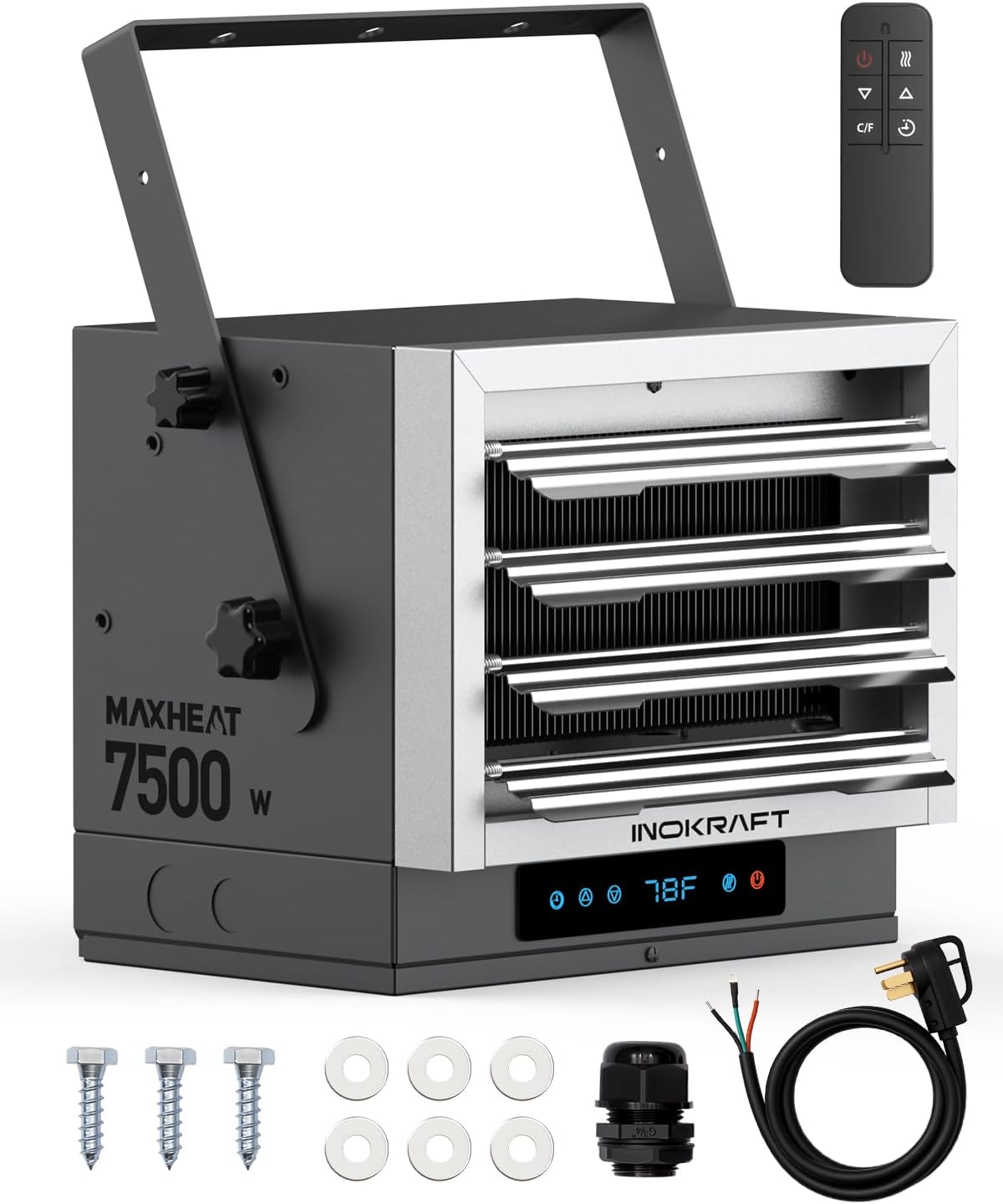
| Heat output | 7500 watts |
|---|---|
| Heating coverage | 750 sq ft |
| Power source | 240V corded electric |
| Temperature range | 40–99 °F |
| Special features | ECO Mode, Overheat Protection, Remote Control |
The InoKraft 7,500W garage heater is a hardwired 240V fan-forced unit intended to warm large garages, workshops, or shops quickly. It offers manual high/low settings plus an automatic ECO mode that adjusts output based on the difference between set and ambient temperature to save energy. The built-in digital thermostat (40 to 99°F), 1–24 hour timer, and remote control make it straightforward to set and maintain a target temperature, while adjustable mounting angles and louvers help direct airflow for more even coverage. Safety features include CSA certification, overheat protection and a 90-second fan runout after shutoff. Installation requires a double-pole breaker and professional wiring, and the unit runs at about 65 dB when operating. The heater delivers strong, steady heat for spaces up to roughly 750 square feet, but it needs correct 240V circuit wiring and professional installation which adds upfront complexity compared with plug-in options.
Best for: Buyers who prioritize powerful, reliable heating for a larger garage or workshop and are comfortable arranging professional 240V installation to get consistent, controllable warmth.
Less Ideal for: People who need a portable or plug-and-play heater or who cannot provide a dedicated 240V circuit and professional installation should consider other options.
- High 7,500W output suitable for heating garages up to ~750 sq ft
- Digital thermostat with wide 40–99°F range and 1–24 hour timer for precise control
- ECO mode that modulates high/low settings to reduce energy use
- Adjustable mounting angles and louvers to direct heat where needed
- Built-in safety features including CSA certification, overheat protection, and fan runout
- Requires professional hardwiring to a 240V double-pole breaker rather than a simple plug-in
- Operates at around 65 dB which may be noticeable in quiet settings
Verdict: Choose this heater if you want a high-output, thermostat-controlled 240V unit that reliably heats a large garage while managing energy with ECO mode.
CCC COMFORT ZONE Milkhouse Heater CZ12150

| Heat Output | 1500 watts |
|---|---|
| Heating Coverage | 150 sq. ft. |
| Number of Speeds | 2 |
| Power Source | Corded Electric |
| Heating Method | Forced Air |
This Milkhouse Utility Space Heater is built for practical garage and workshop use, delivering up to 1500 watts of forced-air heat across roughly 150 sq. ft. The metal housing and cool-touch exterior make it durable for rougher utility environments, while the tabletop form factor keeps it easy to position on benches or shelves. Controls are simple: two heat settings plus a fan-only mode and a manual thermostat that includes an anti-freeze setting to prevent low-temperature damage. Safety features are strong for the price class, with tip-over shutoff, an overheat sensor, and a visible running light. Expect straightforward, fast spot heating rather than whole-bay warmth; the coil element works quickly but runs at full amperage on high, so it is best for intermittently heating targeted zones. Portability and simple controls are highlights, but this is not a low-power or silent option for continuous background climate control.
Best for: Buyers who want a no-frills, rugged heater to quickly warm a single workbench, small garage bay, or basement workspace and who prioritize durability and simple controls over quiet operation.
Less Ideal for: Not a good fit for heating large, open garages, multiple rooms, or users seeking near-silent background heating throughout a whole bay.
- Durable metal housing with cool-touch exterior suited to garages and workshops
- Two heat settings plus fan-only mode for basic zone control
- Adjustable thermostat with anti-freeze setting for maintaining minimal temps
- Multiple safety features including tip-over shutoff and overheat sensor
- Compact, portable tabletop design that is easy to move and position
- Heating coverage limited to about 150 sq. ft., not intended for large open garages
- Coil-based forced-air operation can be louder and draws full amperage at high setting
Verdict: A sturdy, easy-to-use 1500W utility heater ideal for quickly warming a small garage workspace or workshop bench.
Elevoke NFJ-9 Tower Heater

| Heat Output | 1500 watts |
|---|---|
| Power Settings | Fan/750W/1500W |
| Voltage | 120 volts |
| Number of Speeds | 3 |
The Elevoke NFJ-9 is a portable PTC ceramic tower heater designed to deliver quick, focused warmth for small to medium indoor spaces such as a garage workspace or home office. It offers three modes — fan (20W), low heat (750W), and high heat (1500W) — so you can conserve power when you only need a little warmth or run full output for faster heating. The ceramic element and high-speed fan claim near-instant heat and a 90° tilt feature helps direct airflow where you need it. Practical touches include a carry handle and a 5-foot cord for easy relocation and a built-in high-temperature cutoff for safety. Expect low operating noise and straightforward mechanical controls, but note the product is intended for indoor floor placement and requires a dedicated outlet; it should not share circuits with other heavy appliances. Also the base needs simple assembly. For a budget-focused garage heater this model prioritizes fast, portable heating over advanced controls or thermostatic temperature hold.
Best for: Buyers needing an inexpensive, portable heater to warm a small garage workspace or hobby area who prioritize quick warm-up and simple controls over smart features.
Less Ideal for: People looking to keep a large garage uniformly heated for long periods or those who need programmable thermostats, remote control, or outdoor-rated equipment.
- 1500W max output gives usable heat for small garage work areas
- PTC ceramic element with high-speed fan for faster warm-up
- Three settings including a low-power fan mode to save energy
- 90° tilt to aim heat where needed and a carry handle for portability
- Built-in overheat protection for safer unattended operation
- No digital thermostat or temperature display to maintain precise room temperature
- Designed for indoor use only and requires a dedicated outlet on a sufficiently rated circuit
Verdict: A budget-friendly, portable tower heater that delivers fast, usable heat for small garage workspaces and short-term tasks.
DREO Space Heater DR-HSH020

| Heat Output | 1500 watts |
|---|---|
| Heating Method | Forced Air, PTC Ceramic |
| Power Source | Corded Electric |
| Number of Speeds | 6 |
| Min Temperature Setting | 41 °F to 95 °F |
The DREO DR-HSH020 is a portable 1500W PTC ceramic forced-air tower heater designed to deliver fast, targeted warmth for small to medium indoor spaces. It heats quickly thanks to Hyperamics tech and a brushless DC motor, and the 0°–60° manual tilt lets you aim warm air toward feet or a workbench in a garage. Controls include a precise digital thermostat adjustable from 41 to 95°F in 1°F increments, three heat and three fan settings, a timer, touch controls and a remote for hands-free adjustments. Safety features are comprehensive for this class: tip-over shutoff, overheat protection, a safety plug and flame-retardant materials with ETL certification. Noise is low at around 34 dB, so it is suitable for focused work areas. Trade-offs are its tower form and 1500W limit, which are best for spot heating rather than warming large, uninsulated garages, and it requires a standard 120V outlet so positioning near power matters. Overall it is a reliable, safety-forward option for quickly adding localized heat to a garage workspace or entry area.
Best for: Buyers who prioritize dependable, safety-focused spot heating for a garage workspace or entry area and want precise temperature control and low noise while working.
Less Ideal for: Those looking to heat a large, poorly insulated garage or whole-bay space should consider higher-capacity or hardwired heating solutions instead.
- Fast warm-air output from 1500W PTC ceramic element for quick spot heating
- Adjustable 0°–60° tilt to aim heat where needed
- Precise digital thermostat with 1°F increments for consistent temperature control
- Multiple built-in safety protections including tip-over and overheat shutoff and ETL certification
- Quiet brushless DC motor design around 34 dB suitable for workspaces
- 1500W power is intended for spot or small-area heating and may not warm large, uninsulated garages effectively
- Requires placement near a 120V outlet which can limit positioning in some garage layouts
Verdict: A safety-focused, fast-warming portable heater that gives precise, quiet spot heat for garage workspaces where reliable, controlled warmth matters.
Lasko Ceramic Tower Heater 751320

| Heat Output | 1500 watts |
|---|---|
| Heating Element | Ceramic |
| Heat Settings | 2 heat settings plus adjustable thermostat |
| Timer | 7-hour programmable timer |
| Power Source | Corded Electric |
The Lasko Ceramic Tower Heater (751320) is a slim, portable 1500-watt electric heater that uses a ceramic element and widespread oscillation to move warm air through small to medium rooms. It runs in high or low heat or automatic thermostat mode, and a programmable seven-hour timer and multi-function remote make it easy to change settings from across the space. The unit includes safety features common to ceramic heaters such as overheat protection and a cool-touch housing, plus a built-in carry handle for moving it around a garage or workshop. Practical benefits include fast warm-up for a localized area, more even coverage via oscillation, and simple electronic controls that are straightforward to operate. Limitations are that it is designed for indoor, residential use so it lacks rugged weatherproofing for unprotected outdoor spaces, and its two basic heat settings do not offer fine-grained power control for heavy-duty or very large workshop environments.
Best for: Buyers who want a reliable, easy-to-use electric heater for occasional garage or workshop heating that prioritizes proven safety features and strong user feedback.
Less Ideal for: Those needing a heater rated for unconditioned or semi-outdoor garages, large commercial bays, or precise multi-stage power control should consider industrial or garage-specific heating solutions instead.
- 1500-watt ceramic element delivers quick, effective warmth for small to medium spaces
- Widespread oscillation helps distribute heat more evenly across a room
- Remote control and programmable timer for convenient adjustments from a distance
- Built-in safety features including overheat protection and cool-touch housing
- Slim, portable tower design with carry handle for easy repositioning
- Intended for indoor residential use and not weatherproof for exposed garages or outdoor areas
- Only two heat settings plus automatic thermostat provide limited power granularity
Verdict: A straightforward, safety-focused 1500W ceramic tower heater that reliably warms small to medium garage or workshop spaces with easy remote and timer controls.
DREO Space Heater HSH006

| Heat Output | 1500 watts |
|---|---|
| Heating Coverage | 200 sq.ft |
| Heating Element | PTC Ceramic |
| Timer | 1-12 H |
| Power Source | Corded Electric (120 volts, 12.5 A) |
The DREO HSH006 is a portable tower heater that delivers quick, forced-air warmth using a 1500W PTC ceramic element and a focused funnel design to extend airflow up to about 200 square feet. It is typically used to heat single rooms, home offices, or small garage work areas where a compact unit and fast warm-up matter. Notable features include an adjustable thermostat with a wide 41 to 95°F range in 1°F increments, multiple modes (power heat, ECO, fan only), a 12-hour timer, remote control, and a low-noise brushless DC motor that keeps operation around 34 dB. Safety is emphasized with ETL listing, tip-over detection, overheat protection, child lock, flame-resistant materials, and a safety plug. Practical benefits are precise temperature control, quiet operation for occupied spaces, and carry-friendly portability. Important limitations are that it is a 1500W corded electric heater so it requires a dedicated 120V circuit and will only heat modestly sized areas; it also lacks specific ruggedization or weatherproofing that would be needed for unconditioned garage spaces.
Best for: Buyers who prioritize safe, precise, and quiet electric heat for a small workspace or conditioned garage and want an easy-to-use, well-protected portable heater.
Less Ideal for: People needing to heat large, uninsulated garages or outdoor spaces or those who require a hardier, weather-resistant unit built for heavy workshop use.
- 1500W PTC ceramic element provides fast, consistent heat
- Adjustable thermostat with 1°F increments for precise control
- ETL-listed safety features including tip-over and overheat protection
- Quiet brushless DC motor operation (~34 dB) suitable for occupied spaces
- Convenient extras: remote control, 12-hour timer, child lock, and carry handle
- Designed for indoor use only and not weatherproof for unconditioned garages
- 1500W output limits effective heating to small to medium-sized areas
- Requires a standard 120V circuit and will draw up to 12.5 A
Verdict: A safe, quiet, and precise 1500W portable heater that suits conditioned garages or small workshop spaces where reliable indoor heating and built-in safety are the priority.
Choosing the Right Electric Space Heater for Garages: Key Factors to Consider
Heating Capacity and Coverage
Heating capacity determines how quickly and effectively a heater raises and maintains garage temperature. Garages are typically larger and less insulated than living spaces, so you need a heater rated to cover the square footage and ceiling height you have. Pay attention to both wattage and BTU equivalents. A unit with adjustable power settings or multiple heat stages lets you dial output to match the space without cycling excessively.
Coverage also depends on placement. Ceiling- or wall-mounted units can distribute heat differently than floor models. Consider whether you need spot heat for a workbench or whole-bay warmth, and choose a capacity that can handle the colder end of winter rather than just average conditions.
Durability and Build Quality
A garage heater should withstand dust, occasional impacts, and sometimes higher humidity or fumes than indoor rooms. Look for robust housings, metal grilles, and components rated for workshop environments. Corrosion-resistant finishes and reinforced casings reduce the chance of physical damage during routine garage activity.
Durable controls and simple service access are also important. Heaters with tool-accessible panels and replaceable parts make long-term ownership easier. Avoid fragile plastic housings or exposed elements in high-traffic garage locations.
Safety Features and Certifications
Safety is critical in garages where flammable materials, fuel residues, and power tools are often present. Essential safety features include tip-over shutoff for portable units, automatic overheat protection, and cool-to-touch surfaces or grille guards to reduce burn risk. Units intended for permanent installation should provide clear grounding and wiring access.
Certifications from recognized testing organizations indicate the heater was evaluated for safe operation. Also consider an automatic thermostat or programmable timer so the unit does not run unattended at high settings for long periods.
Power Source and Electrical Requirements
Garages may have different electrical availability than living spaces. Check whether a heater requires a standard 120V outlet, a dedicated 240V circuit, or hardwiring. Higher-output heaters often need 240V or dedicated circuits to run safely and efficiently. Confirm your garage panel capacity and whether installation will need an electrician.
Cord length and plug type matter for portable units. Hardwired or mounted units reduce trip hazards but require professional installation. Balance convenience against the required electrical upgrades and operating costs.
Installation and Placement Options
How a heater is installed affects its effectiveness. Wall- or ceiling-mounted units free floor space and keep units away from clutter, while portable floor models offer flexibility but need careful placement to avoid obstruction. Consider mounting height, clearance requirements, and whether you need directional louvers or a fan to move warm air across the bay.
Evaluate whether a unit supports multiple mounting brackets, swivel mounts, or casters for portability. Clearances for combustibles and airflow should be followed to maintain safety and performance.
Noise, Controls, and Usability
If the garage doubles as a workshop, noise level influences comfort and communication. Fan-forced heaters tend to be louder than radiant or convection-only models. Look for units with variable fan speeds or quieter blower designs if noise is a concern.
Controls should be intuitive and robust. Mechanical thermostats can be durable, while digital controls offer finer temperature management and timers. Ease of access to controls, readable displays, and clear indicator lights improve day-to-day use.
Sizing Your Garage: Quick Calculation
Estimate the heater capacity you need by calculating the garage volume in cubic feet and considering insulation levels. A basic rule of thumb uses wattage per square foot for typical ceiling heights, but for taller or uninsulated garages you should increase the estimate to compensate for heat loss. Account for door openings and any areas you will not need heated.
If you want spot heating for a workshop bench, a smaller directional unit may suffice. For whole-bay comfort, choose a heater rated to maintain temperatures during the coldest expected conditions rather than relying on average days.
- Measure length × width × height to get volume.
- Increase capacity estimate for poor insulation or high ceilings.
- Factor in frequent door openings and cold drafts.
Placement Best Practices for Effective Heat
Place floor units where airflow is unobstructed and away from flammable materials. Aim heat toward work areas or toward the center of the bay for even distribution. For wall- or ceiling-mounted heaters, follow clearance guidelines and aim louvers down and toward the open floor.
Avoid placing heaters directly under car exhaust paths or where dust and debris will clog intakes. Combine a ceiling-mounted unit with a small fan if you need to break thermal layers and move warm air back toward ground level.
- Keep clearances from combustibles as specified by the manufacturer.
- Avoid blocking air intake or exhaust vents.
- Consider directional airflow to target work zones.
Ventilation and Safe Use in Workshop Environments
Even electric heaters benefit from good ventilation when used in garages that store solvents, fuels, or paint. While electric units do not produce combustion gases, they can circulate dust and fumes. Ensure the garage has periodic fresh air exchange, especially during long work sessions.
Use heaters with sealed elements or guarded heating surfaces to minimize accidental contact with dust. Regularly inspect and clean intakes to prevent buildup that can reduce efficiency and create hotspots.
- Ensure periodic fresh air exchange when working with chemicals.
- Keep heater intakes free of sawdust and debris.
- Use sealed or guarded heating elements in dusty environments.
Energy Use and Running Costs
Electric heaters can draw significant power, so understand expected runtime and local electricity rates to anticipate costs. Thermostats and programmable timers reduce energy waste by maintaining setpoints instead of running at full blast all day. Multiple lower-wattage units with zoning controls can be more efficient than one oversized heater for intermittent use.
Insulating the garage and sealing gaps often yields bigger savings than adding heater capacity. Combine modest heating with improved insulation to minimize runtime and cost.
- Use thermostats and timers to limit runtime.
- Consider zone heating for targeted use.
- Improve insulation before upsizing heater capacity.
Maintenance Tips to Extend Service Life
Regular maintenance keeps heaters safe and operating efficiently. Periodically clean dust from vents and fans, inspect electrical cords and connections, and replace filters if applicable. For mounted units, check brackets and fasteners to ensure secure installation.
Schedule visual inspections before the cold season to catch wear or damage. Promptly address unusual noises, smells, or reduced output to avoid escalation into failures or hazards.
- Clean vents and fans every few months in dusty garages.
- Inspect cords and mounting hardware regularly.
- Address abnormal operation promptly to avoid safety risks.
How We Chose the Best Electric Space Heater for Garages
We prioritized practical, garage-focused performance when narrowing the list. Key evaluation criteria included usable heating output and coverage, because garages often need more sustained heat over open floor plans. Durability and enclosure type were assessed to ensure units tolerate dust, occasional bumps, and workshop conditions. Safety features were required, including tip-over protection, overheat cutoff, and temperature controls suitable for unattended operation. Installation flexibility mattered for garages that may use wall-mounts, portable plug-in units, or hardwired options, so we favored heaters with multiple mounting or placement choices. Energy efficiency and thermostat accuracy were checked to limit running costs and avoid temperature swings in large spaces. Noise level and fan design were considered for owners who use the garage as a workspace. We excluded units intended only for indoor residential living rooms, small personal space heaters that cannot maintain garage temperatures, and any products lacking clear safety certifications for mechanical environments. The final selections balance heat capacity, safety, durability, and user-friendly controls relevant to garages.
Our full evaluation process is outlined in our review methodology.
FAQ
Can I use a standard 120V heater safely in my garage?
Often yes for smaller garages or spot heating, but it depends on the heater's rated output and your garage's insulation. Larger, colder spaces may require a higher-wattage 240V unit or multiple 120V heaters. Confirm circuit capacity and avoid overloading shared outlets.
Are electric heaters safe around flammable liquids stored in a garage?
Electric heaters do not produce combustion gases, but they can raise surrounding temperatures and circulate fumes. Keep heaters away from flammable liquids, maintain proper clearances, and ensure good ventilation when working with solvents or fuels.
Do I need professional installation for wall- or ceiling-mounted heaters?
Installation requirements vary. Hardwired or 240V units typically need an electrician, while plug-in wall mounts or portable models can be installed by a homeowner following the manufacturer's instructions. Always follow local electrical codes.
How can I reduce running costs when heating a garage?
Use a thermostat and timer to avoid continuous full-power operation, improve insulation and door seals to reduce heat loss, and consider targeted zone heating to warm only occupied areas instead of the entire garage.
What maintenance keeps a garage heater reliable?
Periodic cleaning of intakes and fans, checking electrical connections and cords, ensuring mounting hardware is secure, and inspecting for dust buildup or corrosion will keep a heater operating safely and efficiently.
Final Verdict
Prioritize a heater that matches your garage size, insulation level, and electrical capacity. Focus on sufficient heating output, robust construction, and essential safety features to ensure reliable performance in a workshop setting. Balance energy use with thermostat control and placement to get the comfort you need without oversizing the unit. With those tradeoffs in mind, choose the heater type and installation method that best fits how you use the garage, and plan for routine maintenance to extend service life.