
Note: This article contains affiliate links. If you click on these links and make a purchase, we may earn a small commission at no extra cost to you. This helps support our research and content. Read our full affiliate disclosure here.
Picking the right energy-efficient electric heater affects both your comfort and your monthly bills. The right heater delivers steady room warmth, responds well to thermostats, and minimizes wasted energy during runtime. This guide highlights seven shortlisted energy-efficient electric heaters that excel at converting electricity into usable heat while keeping noise and operating costs low. We assessed how each option performs for common home uses such as bedrooms, living rooms, and home offices, and we flag features that matter most for efficient daily use. Read on to see the evaluation criteria and which features to prioritize when selecting a heater.
Top Picks at a Glance
| Best Overall The best all-around choice for most situations | DR. Infrared Heater DR-968 |  |
| Best Quality Built to a higher standard if you want something more solid | EdenPURE CopperPLUS Infrared Heater 1500W |  |
| Best Value The sweet spot between price and what you get | DREO Atom One Space Heater |  |
| Best Budget The cheapest option that still gets the job done reliably | Amazon Basics Ceramic Space Heater |  |
| Top Rated A top-rated pick with lots of positive feedback | Lueptexx 1500W Wall Panel Heater |  |
| Most Popular A crowd favorite that many people choose with confidence | Lasko Ceramic Tower Heater 751320 |  |
| Best Seller A high-volume bestseller chosen again and again | DREO Space Heater HSH006 |  |
DR. Infrared Heater DR-968

| Wattage | 1500 Watts |
|---|---|
| Heating Coverage | 576 square feet |
| Number of Speeds | 3 |
| Voltage | 120 |
| Amperage | 12.5 A |
The DR. Infrared Heater DR-968 combines a quartz infrared tube and a PTC element with a high-velocity, low-noise blower to heat rooms quickly and evenly. It is used as a freestanding portable heater for bedrooms, living rooms, home offices, and similar indoor spaces and offers an Auto energy-saving mode that cycles between high and low power to maintain a set temperature. Notable features include a 12-hour timer, electronic thermostat with a 50 to 85 F range, three power settings (Auto, Low 1000W, High 1500W), tip-over and overheat protection, caster wheels for repositioning, and a remote control for convenience. In practice it delivers fast perceived warmth by heating objects as well as air, and the blower helps spread that heat across larger rooms; the unit is UL certified and designed to stay relatively cool to the touch. Trade-offs are typical of powerful portable heaters: it draws full household current at 12.5 amps and weighs enough to feel substantial when moving, and it does not replace whole-house heating but is effective as a zone heater to cut central heating use.
Best for: Buyers who want an efficient, room-focused heater that warms people and objects quickly while offering thermostat control and safety features to reduce reliance on central heat.
Less Ideal for: People seeking whole-house heating or an ultra-lightweight travel heater should look elsewhere since this unit is meant for zonal indoor use and has notable weight and power draw.
- Dual heating system (quartz infrared + PTC) for faster, more even warmth
- Auto energy-saving mode that cycles between power levels to hold set temperature
- Remote control, electronic thermostat, and timer for easy, hands-off operation
- Safety features including tip-over and overheat protection and UL certification
- High-pressure low-noise blower and caster wheels improve heat distribution and mobility
- Draws 12.5 amps at 1500 watts which may limit simultaneous high-load appliance use on the same circuit
- Relatively heavy for a portable heater, making it less convenient to carry up stairs
Verdict: Choose the DR-968 if you want a safety-minded, energy-efficient zone heater that delivers fast, evenly distributed warmth to cut central heating use.
EdenPURE CopperPLUS Infrared Heater 1500W

| Heating Coverage | 1000 square feet |
|---|---|
| Heat Output | 5000 BTU |
| Power | 1500W (high mode) |
| Number of Speeds/Settings | 24 |
| Power Source | Corded Electric |
The EdenPURE CopperPLUS is a portable infrared zone heater built to deliver steady, energy-conscious heat for large indoor spaces. It uses a copper PTC heating surface and runs at selectable power levels up to 1500W, letting you choose lower output for smaller rooms or full power for bigger areas. The unit includes 24 preset heat settings with a 40 to 90°F control range, a wireless remote for convenience, and built-in casters for room-to-room mobility. Safety protections include dual overheat sensors, tip-over shutoff, and a cool-touch grill, and the washable lifetime filter reduces ongoing maintenance costs. Practical benefits are quiet operation, zone-heating capability that can reduce central heating use, and a compact cabinet form that requires no installation. Trade-offs are the reliance on electric heating so running costs vary with local electricity rates and its effectiveness depends on room insulation; buyers seeking whole-house heating or lower operating cost than electric may prefer other systems. The heater is best used as a targeted supplemental unit for living rooms, offices, or bedrooms where rapid, quiet warmth and precise control matter.
Best for: Buyers who prioritize efficient, controllable zone heating and want a portable, quiet heater to warm specific large rooms without installing permanent equipment.
Less Ideal for: People looking for a whole-house heating solution, very low-running-cost fuel options, or those who need a purely ducted or HVAC-integrated system.
- High maximum output (1500W) for quick warming of large rooms
- Copper PTC element designed for efficient, steady heat transfer
- 24 precision settings and remote control for fine temperature tuning
- Built-in safety features including dual overheat sensors and tip-over shutoff
- Lifetime washable filter reduces ongoing maintenance costs
- Operating cost depends on local electricity rates since it is an electric heater
- Performance is affected by room insulation and is best for zone heating rather than whole-house use
Verdict: Choose this if you want a portable, energy-aware infrared heater that delivers quiet, controllable warmth for large rooms.
DREO Atom One Space Heater
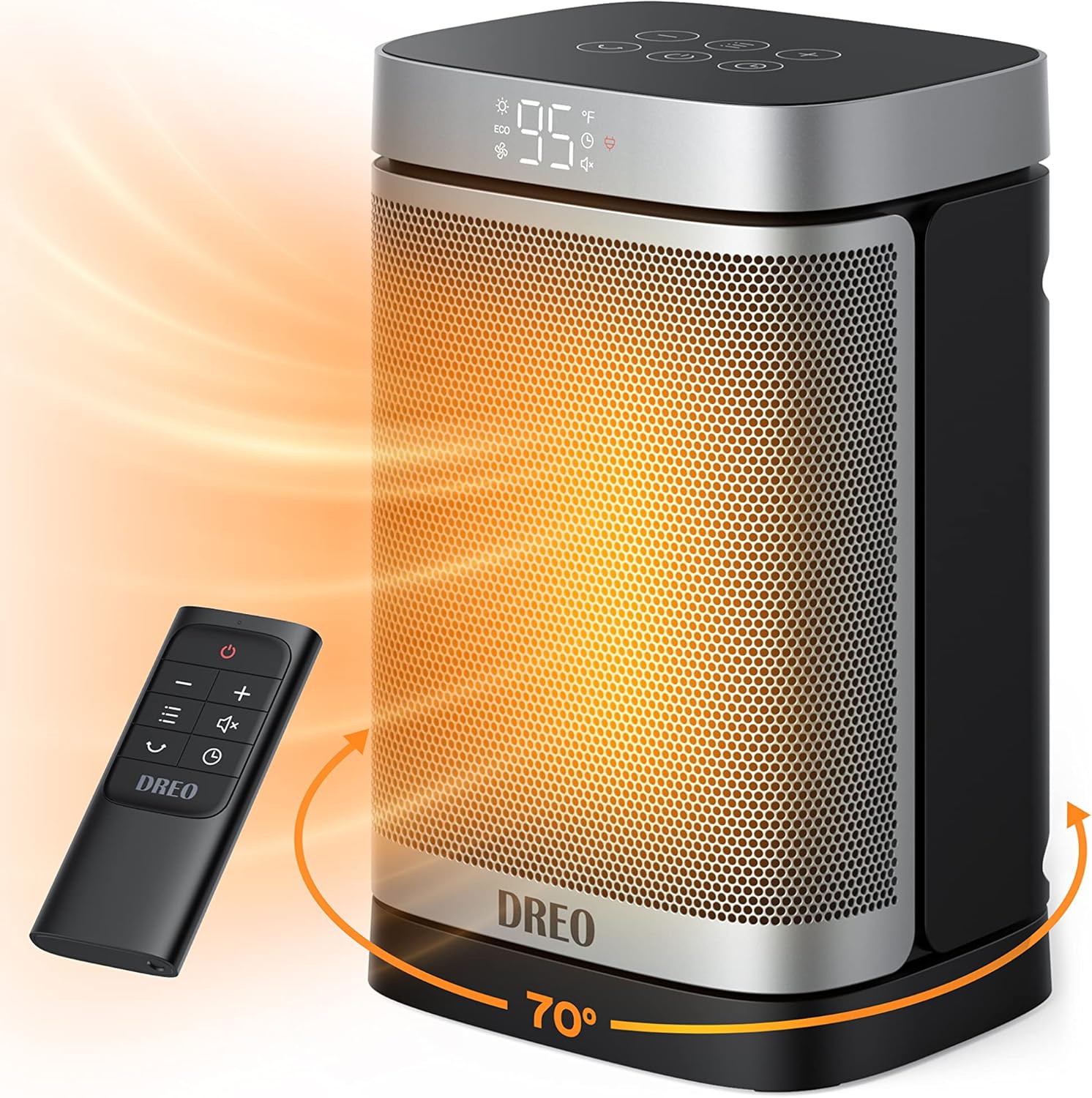
| Heating Coverage | 200 sq.ft |
|---|---|
| Heat Output | 1500 watts |
| Heating Element | PTC Ceramic |
| Number of Speeds | 5 |
| Min Temperature Setting | 41 °F |
The DREO Atom One is a small tower heater designed to deliver fast, targeted warmth for bedrooms, home offices, and other indoor spaces. It uses a PTC ceramic heating element and up to 1500 watts to heat quickly, and a programmable digital thermostat (41 to 95°F in 1°F increments) lets you set a precise temperature. The unit offers 70° oscillation to spread heat across a room, five fan speeds including ECO mode to cut power when the set temperature is reached, and a 1–12 hour timer for scheduled runtime. A detachable filter and LED control panel make upkeep straightforward, and the included remote keeps settings handy from across the room. Safety features include ETL listing, tip-over and overheat protection, and flame-retardant materials. Trade-offs are its focus on personal or small-room heating rather than whole-house warmth and the typical energy draw when running at the 1500W maximum, which is common for compact electric heaters.
Best for: Buyers who prioritize efficient, controllable heat for a bedroom, office, or other single room and want simple energy-saving features like ECO mode and a programmable thermostat.
Less Ideal for: People seeking a primary heater for large, open-plan areas or whole-home heating should consider larger-capacity systems or whole-house solutions.
- Precise digital thermostat adjustable in 1°F increments for consistent comfort.
- 70° oscillation and five speeds help distribute heat across a small to medium room.
- ECO mode and programmable timer reduce unnecessary run time and save energy.
- Compact tower form with detachable filter and remote makes placement and maintenance easy.
- Built-in safety features including tip-over and overheat protection and ETL listing.
- Maximum 1500W output means higher energy use if run at full power for large areas.
- Designed for single-room use, so it is not intended to heat large open spaces.
Verdict: A precise, safety-minded tower heater that balances quick, targeted heat with ECO and timer features to help cut energy use in single rooms.
Amazon Basics Ceramic Space Heater

| Heat Output | 1500 watts |
|---|---|
| Heating Coverage | 161.4 square_feet |
| Number of Speeds | 3 |
| Heating Method | Convection |
| Special Features | Overheat Protection, Tip-Over Protection |
The Amazon Basics Ceramic Space Heater is a small, portable tabletop heater designed to warm personal rooms quickly using a 1500W ceramic element. It offers three settings — high (1500W), low (900W), and fan-only — so you can balance heat output and energy use depending on how cold the room is. The unit uses convection with infrared-style ceramic heating to produce fast warmth and lists coverage around 161 square feet, which makes it suitable for bedrooms, home offices, or small living areas. Built-in tip-over and overheat protection plus a power indicator light make it safer for everyday use, and the lightweight, compact design is easy to move and store. Trade-offs are its non-oscillating tower form and basic control set, which limit directional heat spread and advanced scheduling or thermostatic control, and it is not intended for damp spaces like bathrooms. For buyers seeking a simple, no-frills heater that heats quickly and is inexpensive to run at lower settings, this is a practical choice.
Best for: Buyers looking for an affordable, portable heater to warm single rooms quickly and who prioritize low upfront cost and simple operation.
Less Ideal for: People who need whole-room or multi-room heating, precise programmable thermostats, or use in damp environments should choose a different solution.
- 1500W ceramic element delivers quick, effective room heating
- Three settings (1500W, 900W, fan-only) let you reduce energy use when full power is unnecessary
- Built-in tip-over and overheat protection increase everyday safety
- Compact and lightweight for easy placement and storage
- No oscillation or directional adjustment limits even heat distribution
- Basic controls and no programmable thermostat for automated energy savings
Verdict: A budget-friendly, portable ceramic heater that delivers fast warmth for single rooms while letting you dial back power to save energy.
Lueptexx 1500W Wall Panel Heater

| Heat Output | 1500 watts |
|---|---|
| Heating Coverage | 150-300 sq.ft |
| Heating Method | Convection |
| Voltage | 120 volts |
The Lueptexx 1500W wall panel heater uses convection heating to deliver steady, fanless warmth across small to medium rooms without blowing air or making noise. It is designed for wall mounting but ships with universal wheels so you can roll it between rooms; controls include an LED touch display, a 24-hour timer, ECO mode, and a remote for hands-off adjustments. Safety features such as tip-over and overheat protection plus a child lock make it suitable for households with kids or pets. The aluminum frame looks clean on a wall and the unit claims up to 50% energy savings compared with less efficient space heaters, which fits the goal of energy-efficient heating for bedrooms, home offices, garages, and similar spaces. Expect consistent background heat rather than rapid spot heating like a ceramic fan heater, and because it is convection-based it will be slower to warm a very cold room but provides quiet, even warmth once up to temperature.
Best for: Buyers who prioritize quiet, reliable, energy-conscious heating for bedrooms, home offices, or small living areas and want straightforward digital controls and safety features.
Less Ideal for: People who need rapid spot heating for very large or poorly insulated rooms or who prefer strong fan-forced airflow for immediate warmth.
- Fanless convection design provides quiet, even heating without circulating dust
- LED touch display plus remote and 24-hour timer for convenient control
- Safety features including tip-over and overheat protection and child lock
- Portable mounting options with wall-mount capability and included wheels
- Convection heating warms a room more slowly than a fan-forced unit
- Coverage limited to roughly 150–300 sq ft, not intended for large open spaces
Verdict: Choose this wall panel heater if you want a quiet, safety-minded, energy-efficient convection heater for consistent background warmth in small to medium rooms.
Lasko Ceramic Tower Heater 751320

| Heat Output | 1500 watts |
|---|---|
| Heating Element | Ceramic |
| Heat Settings | 2 |
| Timer | 7-hour |
| Power Source | Corded Electric |
The Lasko Ceramic Tower Heater 751320 is a slim, portable 1500-watt ceramic heater designed to warm small to medium indoor rooms. It uses a self-regulating ceramic element and forced-air delivery plus widespread oscillation to distribute heat more evenly across a living room, bedroom, or home office. Controls include two heat settings, an adjustable electronic thermostat, a seven-hour auto-off timer and a multi-function remote with onboard storage for convenient adjustments from across the room. Safety features include overheat protection and a cool-touch housing. In everyday use the unit is straightforward: set the thermostat or pick high/low, turn on oscillation for whole-room coverage, and let the timer or remote manage runtime. Limits to expect are typical for a tower ceramic heater — it is best for targeted room heating rather than whole-house use, and the two heat settings mean fewer fine-grain power options compared with variable-output models. The slim design and built-in handle make it easy to move, and the familiar Lasko controls keep operation simple for households that prioritize reliable, easy-to-use supplemental heat.
Best for: Buyers who want a proven, easy-to-use portable heater that provides reliable supplemental warmth and clear user feedback from many real owners.
Less Ideal for: People needing heat for large open spaces or those who want multi-step power control and granular energy management should consider other heater types.
- 1500-watt ceramic element delivers quick, effective warmth for small to medium rooms
- Widespread oscillation helps circulate heat for more even room coverage
- Electronic thermostat plus timer and remote offer easy temperature and runtime control
- Built-in safety features include overheat protection and cool-touch housing
- Only two heat settings limit fine-grained power control compared with variable-output models
- Not intended to heat large open-plan areas or whole homes
Verdict: A straightforward, safety-minded 1500W ceramic tower that reliably delivers targeted room heat with simple controls and remote convenience.
DREO Space Heater HSH006

| Heat Output | 1500 watts |
|---|---|
| Heating Coverage | 200 sq.ft |
| Heating Element | PTC Ceramic |
| Number of Speeds | 4 |
| Min-Max Temperature | 41 °F – 95 °F |
The DREO HSH006 is a portable tower heater designed to warm small to medium rooms quickly using a 1500W PTC ceramic element and forced-air circulation. It offers precise thermostat control from 41 to 95°F in 1°F increments, multiple heat modes including ECO and fan-only, a 12-hour timer and a remote for hands-off adjustment. Safety is emphasized with tip-over detection, overheat protection, flame-retardant materials and an ETL listing, which suits use in bedrooms and offices. Noise is kept low by a brushless DC motor and winglet fan design, which the brand lists at about 34 dB for quieter overnight use. The unit is compact and easy to carry, but as a 1500W forced-air heater it still consumes significant power at high output and is best used to supplement central heat rather than replace it for large or open-plan spaces. Overall its mix of precise temperature control, safety features and low noise make it a practical pick for targeted, energy-aware supplemental heating in personal rooms.
Best for: Buyers who want a safe, low-noise supplemental heater with precise thermostat control for bedrooms, home offices, or small living spaces and who prioritize dependable safety features.
Less Ideal for: People seeking whole-home heating or a low-power constantly-on option should look at whole-house systems or lower-wattage radiant solutions instead.
- 1500W PTC ceramic element provides fast, consistent heat
- Precise adjustable thermostat with 1°F increments for targeted comfort
- Multiple modes plus remote and 12-hour timer for convenient control
- Built-in safety features include tip-over detection, overheat protection and ETL listing
- Brushless DC motor and fan design keep operating noise low (~34 dB)
- As a 1500W forced-air heater it can raise electricity use if run continuously at full power
- Designed for rooms up to about 200 sq ft, so not suitable as a primary heat source for large open areas
Verdict: A safe, quiet and precisely controllable 1500W tower heater that is ideal for energy-conscious supplemental heating in bedrooms and small rooms.
Choosing the Right Energy-Efficient Electric Heater: Key Factors to Consider
Room Size and Heat Load
Choose a heater with an appropriate wattage range for the space you want to warm. Small bedrooms need far less output than open-plan living areas. Undersized heaters must run near maximum output constantly, which reduces efficiency and shortens component life.
Consider heat loss factors such as ceiling height, window area, insulation quality, and draft paths. A room with large, single-pane windows will need a higher-capacity unit or supplemental layering to maintain comfort without excessive runtime. Matching heater capacity to the actual heat load keeps cycling to a minimum and improves energy efficiency.
Thermostat and Control Precision
Precise temperature control reduces on-off cycling and prevents overshoot, which wastes energy. Look for adjustable thermostats with small-degree increments or digital controls that maintain setpoints accurately. Features like programmable schedules, eco modes, or smart connectivity let you reduce output automatically when a room is unoccupied.
Controls that allow gradual ramping of heat are more efficient than simple full-on/full-off switches because they keep the heater operating within an efficient band. If you use the heater in a bedroom, quieter fan speed and gentle ramp behavior are useful for comfort and lower perceived energy use.
Heat Delivery Method
Different technologies—convection, oil-filled radiators, and fan-assisted ceramic elements—move heat differently and affect efficiency in practice. Convection units warm air gradually and maintain ambient temperature well with minimal noise. Oil-filled radiators hold heat and continue radiating after power-down, reducing cycle frequency. Fan-assisted heaters provide rapid heat but can be noisier and may cycle more often.
Choose the method that matches typical usage. For long evening runs in a living room, a radiator-style unit that retains warmth is often more efficient. For brief, targeted boosts, a fan-assisted ceramic heater can bring a room to comfort faster with lower initial energy draw.
Energy-Saving Features
Look for built-in energy-saving modes, such as eco settings that cap maximum output, adaptive thermostats that learn room characteristics, and timers for scheduled runtime. These features reduce total runtime or keep the heater operating at lower, more efficient power levels. An adjustable power mode that lets you select partial wattages is preferable to a single full-power setting.
Automatic setback features that reduce temperature during sleep or away periods can meaningfully lower monthly consumption. Connectivity that integrates with a smart home system allows more precise control and automation based on occupancy or external temperature data.
Safety Protections
Safety features indirectly affect efficiency by allowing you to run a heater confidently without excessive caution or interruption. Essential protections include overheat shutoff, tip-over switch, and insulated housing where appropriate. Units with reliable thermal cutouts prevent dangerous operation and often include circuitry that limits power surges which can cause inefficiency.
Certifications or third-party safety marks indicate that the unit passed baseline electrical and thermal safety tests. If you plan unattended operation, choose heaters with multiple redundant protections to safely allow programmable schedules that improve energy savings.
Placement and Installation
Where you place the heater changes how efficiently it warms a room. Avoid blocking airflow or placing units in corners where circulation is restricted. Position the heater to encourage even air mixing across the space, and keep it away from curtains and upholstery to prevent heat sinks that lower effective output.
If the heater supports wall mounting or elevating to improve convection, factor installation ease into the decision. Proper placement reduces runtime needed to reach comfort and keeps the heater operating within its most efficient range.
Types of Energy-Efficient Electric Heaters
Understanding common heater types helps you match performance to your use case. Oil-filled radiators trap heat in a thermal mass and release it gradually, which smooths temperature swings and reduces cycling. Convection panel heaters move warm air passively and are quiet, making them suitable for bedrooms and open living spaces.
Ceramic and fan-assisted models heat quickly and are good for short-term spot warming, but they often run fans that increase noise and can use more electricity during warm-up. Infrared or radiant panels directly heat objects and people in their path rather than the entire air volume, which can be efficient in drafty rooms or for focused use.
- Oil-filled: steady heat, retains warmth after shutdown
- Convection: quiet, good for even ambient warmth
- Fan-assisted ceramic: fast heat, ideal for short sessions
- Infrared radiant: targeted warmth, efficient for occupied zones
How to Estimate Operating Cost
Operating cost depends primarily on wattage, runtime, and your electricity rate. To estimate daily cost, multiply the heater wattage by hours used, convert to kilowatt-hours, and apply your per-kWh rate. This simple calculation highlights why reducing runtime and choosing eco modes often yields larger savings than tiny differences in labeled efficiency.
Using a programmable schedule, thermostat setback, or a timer reduces unnecessary runtime. Also consider heat retention in the room; improving insulation or sealing drafts lowers the required runtime for any heater, which is usually the most effective way to cut costs.
- Daily cost = (Wattage / 1000) x Hours used x Electricity rate
- Short bursts at high power may cost more than longer low-power operation
- Insulation upgrades often reduce heater runtime the most
Noise and Comfort Tradeoffs
Noise level plays a big role in whether you keep a heater at a lower setting. Fan-assisted units are typically louder but can reach comfort faster. If noise is a priority, choose convection or oil-filled designs that operate silently and rely on retained heat rather than continuous fan operation.
Comfort also involves airflow and temperature stratification. Some heaters create warm patches near the unit, while others provide even ambient temperatures. If you are sensitive to drafts or background noise, prioritize models designed for quiet, steady output over blast-heat capability.
- Quiet units support lower thermostat setpoints because occupants are less likely to increase temperature to compensate for perceived cold
- Faster-acting heaters are useful for occasional use, slower thermal-mass units suit continuous background heating
Installation and Maintenance Tips
Most electric heaters require minimal installation, but follow spacing and clearance recommendations to ensure safe operation and efficient heat flow. Keep intake and exhaust areas clear, and avoid placing heaters behind furniture or curtains.
Routine maintenance is usually limited to dusting vents and ensuring fan blades remain unobstructed. Regularly inspect cords and plugs for damage, and test safety shutoffs periodically. Replacing or cleaning filters when applicable keeps airflow efficient and reduces noise and wear.
- Allow recommended clearance on all sides for safe airflow
- Dust vents and fan blades to maintain efficient heat transfer
- Check cords and safety cutoffs before extended seasonal use
Smart Controls and Integration
Smart thermostats and Wi-Fi-enabled heaters allow more precise scheduling and integration into home automation that reduces wasted runtime. Use geofencing, occupancy sensors, or temperature-based triggers to keep the heater off when the room is unoccupied and back on shortly before return.
If you prefer a simpler approach, choose units with reliable programmable timers and adaptive eco modes. The ability to lower setpoints automatically during sleep or away periods often yields consistent savings without daily user input.
- Smart integration supports automated setbacks and remote preheating
- Local timers and adaptive eco modes offer energy savings without network setup
How We Chose the Best Energy-Efficient Electric Heater
We prioritized measurable efficiency and real-world usability when narrowing candidates. Key evaluation criteria included steady-state heat output and control accuracy to ensure a heater can maintain set temperatures without cycling wastefully, and thermostat and control quality to judge how well units respond to user inputs and automated schedules. We also measured implied operating cost potential by comparing wattage ranges and available energy-saving modes. Safety and build quality were critical filters, including automatic shutoff, tip-over protection, and thermal cutouts. Noise level during normal operation was another applied filter since quieter fans and convection designs reduce the likelihood of users increasing thermostat settings to compensate for perceived discomfort. We excluded units that lacked explicit adjustable controls, basic safety cutouts, or documented power ranges suitable for typical room sizes. We also set aside designs meant exclusively for outdoor or industrial use, focusing on home-appropriate pieces. The final picks balance efficient heat delivery with smart controls, safety features, and low operational noise so they perform well in everyday home settings.
Our full evaluation process is outlined in our review methodology.
FAQ
Are electric heaters efficient for whole-room heating?
Electric heaters convert nearly all input power to heat, so they are efficient at the element level. Whole-room effectiveness depends on matching heater capacity and delivery method to room size and insulation. For sustained whole-room heating, choose units sized for the space and with features that minimize runtime.
Will an oil-filled radiator cost less to run than a fan heater?
An oil-filled radiator can be more efficient in practice for extended runs because it continues to radiate after shutdown and cycles less often. Fan heaters warm a room faster but may run more frequently. Actual cost depends on runtime patterns and thermostat control, so consider use case when choosing.
What safety features should I prioritize for overnight use?
Prioritize automatic overheat shutoff, tip-over protection, and certified thermal cutouts when running a heater overnight. Programmable timers and reliable thermostats also reduce the chance of prolonged high-power operation. Avoid leaving heaters blocked or placed near fabrics.
Can smart thermostats significantly reduce heater energy use?
Smart thermostats and connectivity can reduce energy use by enabling schedules, remote control, and automation tied to occupancy. Savings vary by behavior, but automated setbacks and preheating only when needed are common ways to lower runtime and overall consumption.
How important is insulation when using an electric heater?
Insulation is very important because it reduces how long a heater must run to maintain comfort. Improving seals, adding weatherstripping, or upgrading window coverings can reduce required heater runtime more effectively than switching between similar heater models.
Final Verdict
When choosing an energy-efficient electric heater, prioritize matching output to room size, thermostat precision, and the heat delivery method that fits your schedule. Expect tradeoffs between rapid heat-up capability and steady, low-noise operation; pick based on whether you need quick bursts or sustained background warmth. Emphasize safety features and energy-saving modes to lower runtime and operating cost. Focus on the combination of capacity, controls, and placement to make a confident selection that balances comfort and efficiency.