
Note: This article contains affiliate links. If you click on these links and make a purchase, we may earn a small commission at no extra cost to you. This helps support our research and content. Read our full affiliate disclosure here.
Picking the right energy-efficient portable heater can cut operating costs and keep living spaces comfortable without overloading circuits. Whether you need supplemental warmth in a single room or a mobile solution that follows you through the house, the right heater balances wattage, thermostat control, and run-time efficiency. This guide covers seven shortlisted portable heaters selected for their efficiency features and real-world performance factors. We evaluate each option on measurable criteria like heat output consistency and estimated running cost to help you choose the best fit for your space and habits.
Top Picks at a Glance
| Best Overall The best all-around choice for most situations | Dr. Infrared Heater DR-968 |  |
| Best Quality Built to a higher standard if you want something more solid | De'Longhi ComfortTemp EW7707CM |  |
| Best Value The sweet spot between price and what you get | Amazon Basics Ceramic Personal Heater |  |
| Best Budget The cheapest option that still gets the job done reliably | Amazon Basics Ceramic Mini Heater |  |
| Top Rated A top-rated pick with lots of positive feedback | DREO Space Heater HSH006 |  |
| Most Popular A crowd favorite that many people choose with confidence | GiveBest Portable Space Heater PTC-905 |  |
| Best Seller A high-volume bestseller chosen again and again | DREO Atom One Space Heater |  |
Dr. Infrared Heater DR-968

| Wattage | 1500 Watts |
|---|---|
| Heating Coverage | 576 square feet |
| Number of Speeds | 3 |
| Voltage | 120 |
| Amperage | 12.5 A |
The Dr. Infrared Heater DR-968 combines a quartz infrared tube with a PTC element and a high-velocity low-noise blower to heat rooms quickly and maintain even warmth. It is designed for freestanding indoor use and offers Auto, Low (1000W) and High (1500W) modes controlled by an electronic thermostat that ranges from 50 to 85°F, plus a 12-hour timer and remote for convenient operation. Safety features include tip-over protection and overheat auto shut-off, and the unit is UL certified. In practice this heater warms objects and people directly rather than just heating air, so it feels faster and leaves ambient air less dry than many convection-only heaters. The caster wheels and 6-foot cord make repositioning straightforward, but the unit is relatively heavy compared with smaller ceramic heaters. For energy-conscious users the Auto mode cycles between power levels to hold a set temperature, which can reduce runtime and electricity use versus running at full power continuously.
Best for: Buyers who want a portable heater that delivers fast, comfortable infrared warmth across a medium to large room while prioritizing safety and energy-saving automatic control.
Less Ideal for: People who need an ultra-lightweight travel heater or those who require an integrated humidifier or wall-mountable solution.
- Dual heating system (PTC + quartz) for faster, more effective heat delivery
- Electronic thermostat with Auto mode that cycles power to maintain set temperature
- UL certified safety with tip-over and overheat auto shut-off
- Remote control, timer, and quiet high-pressure blower for convenient, low-noise operation
- Heavier and bulkier than many compact ceramic heaters, making lifting awkward
- No built-in humidifier on this model to actively add moisture
Verdict: Choose the DR-968 if you want a safety-minded, energy-efficient portable infrared heater that heats rooms quickly and maintains set temperatures with minimal noise.
De'Longhi ComfortTemp EW7707CM

| Heat Output | 1500 watts |
|---|---|
| Heating Method | Radiant |
| Number of Speeds | 3 |
| Voltage | 120 volts |
| Min Temperature Setting | 44 °F |
The De'Longhi ComfortTemp EW7707CM is an oil-filled radiator that delivers steady, fanless radiant heat for bedrooms, home offices, and other small to medium rooms. It uses a 1500 watt element and an exclusive thermal slot design to push warm air into the room while keeping outer surfaces relatively cool, and the ComfortTemp mode claims to cut energy use by up to 20% by automatically maintaining optimal power levels. Controls are straightforward with an adjustable thermostat, three heat settings, and an anti-freeze option that turns the unit on below 44 F. Because it is oil-filled and sealed, the unit runs silently and requires almost no maintenance, and integrated handles and snap wheels make it easy to move between rooms. Safety features include thermal cut-off and fully enclosed elements, which suit homes with kids or pets. The main trade-offs are the slower warm-up compared with forced-air heaters and the unit's footprint and weight that make it less portable than compact ceramic heaters.
Best for: Buyers who prioritize efficient, quiet full-room heating and want a low-maintenance solution that reduces energy use while avoiding fan noise or airborne dust.
Less Ideal for: People who need immediate, spot heat or a very lightweight travel-style heater should consider fast-response ceramic or infrared models instead.
- Fanless radiant heating provides quiet, gentle warmth without stirring dust or allergens
- ComfortTemp mode automatically adjusts power to improve energy efficiency
- Permanently sealed oil reservoir requires no refilling and low maintenance
- Built-in safety features including thermal cut-off and enclosed heating elements
- Slower to heat a room compared with fan-forced space heaters
- Heavier and bulkier than compact portable heaters, limiting easy relocation
Verdict: Choose this oil-filled radiator if you want quiet, energy-conscious full-room heat with low maintenance and solid safety features.
Amazon Basics Ceramic Personal Heater

| Heat Output | 1500 watts |
|---|---|
| Heating Method | Convection |
| Number of Speeds | 3 |
| Power Source | Corded Electric |
| Max Temperature Setting | 130 °F |
This Amazon Basics ceramic heater delivers quick, focused warmth for small rooms and personal spaces. It offers three modes — high (1500W), low (900W), and fan-only — so you can dial heat output to the task, and the ceramic convection element brings up temperature quickly with relatively low noise. The unit is lightweight and portable, which makes it easy to move between an office and a bedroom, and the adjustable thermostat helps avoid wasted energy when used for spot heating. Safety features include tip-over and overheat protection plus a power indicator light for peace of mind during everyday use. The heater does not oscillate and is intended for dry indoor areas only, so it works best as a supplementary source rather than a whole-room replacement for central heat. If you need very quiet operation, extremely precise temperature control, or coverage for larger spaces, you will want a different class of heater, but for efficient personal warming this unit is a practical, no-frills option.
Best for: Buyers who prioritize efficient, portable spot heating to reduce reliance on whole-house heat and want a simple, dependable heater for small rooms or a workspace.
Less Ideal for: People seeking quiet, whole-room heating for large spaces or units rated for use in high-humidity rooms like bathrooms should look elsewhere.
- Three heat settings including 1500W and 900W for adjustable power use
- Ceramic convection element provides fast warm-up with low noise
- Lightweight, compact design makes it easy to move and place on a table or floor
- Built-in tip-over and overheat protection with indicator light for safe operation
- Non-oscillating design limits even heat distribution across larger rooms
Verdict: A compact, safe, and energy-conscious choice for targeted personal heating in small rooms.
Amazon Basics Ceramic Mini Heater
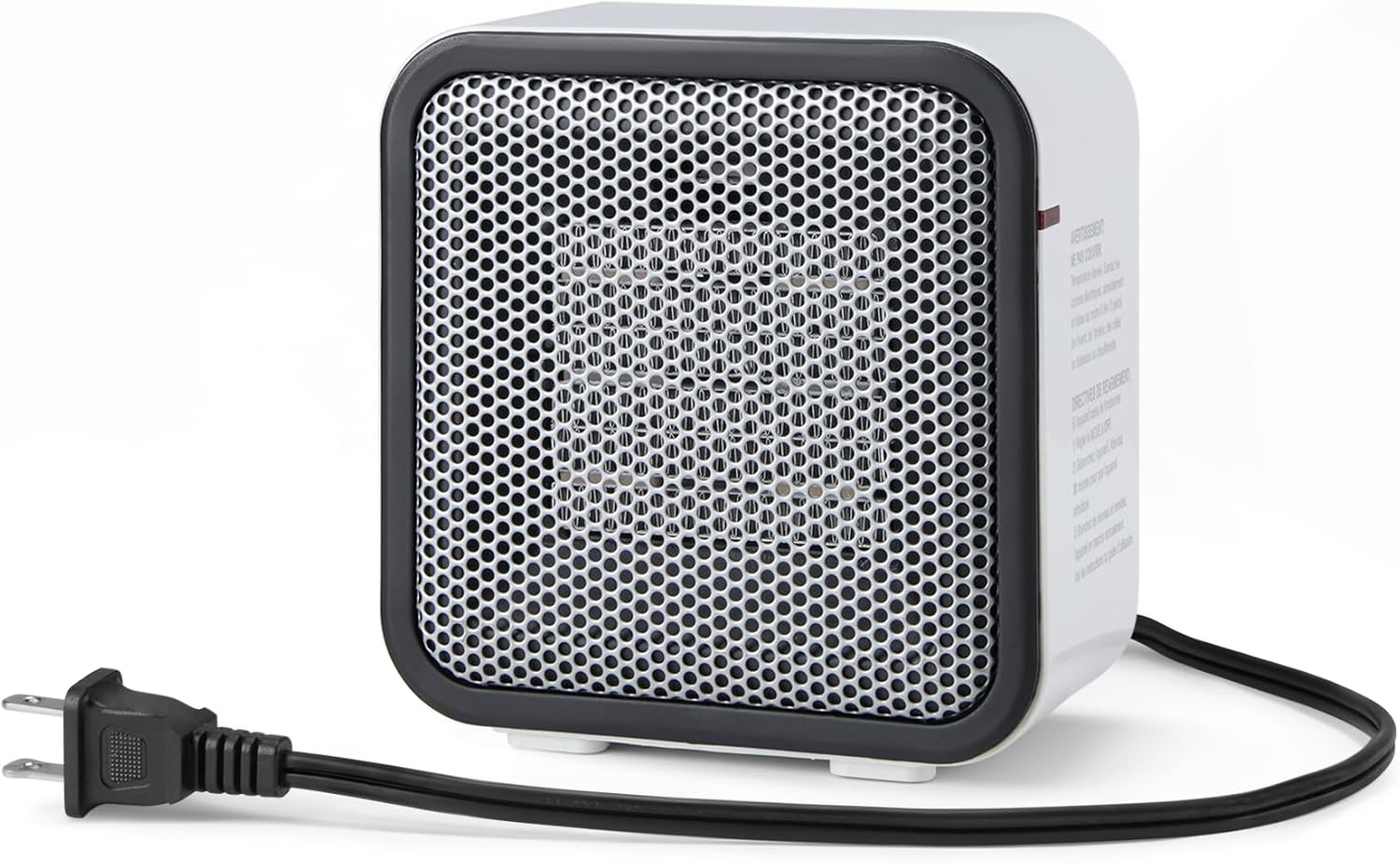
| Heat Output | 500 watts |
|---|---|
| Heating Method | Convection |
| Indoor Outdoor Usage | Indoor |
| Power Source | Corded Electric |
| Special Features | Tip-Over Protection |
This Amazon Basics ceramic mini heater delivers quick, local warmth from a very small footprint. It runs on 500 watts using ceramic coils and convection to heat nearby air, so it works best when placed on a desk or tabletop to warm one person or a small area rather than an entire room. The unit is lightweight and portable, making it easy to move between home and office, and it reaches usable warmth within seconds while operating quietly. Safety features include tip-over protection that shuts the heater off if knocked over. Expect only a single heat setting and basic controls, so there is no thermostat or precise temperature control; the fixed 500W output is efficient for short-term personal use but not suitable when you need sustained whole-room heating. The simple design and low power draw make it a practical, no-frills option for supplementing heat in cold spots or for conserving energy compared with larger heaters.
Best for: Buyers who prioritize low upfront and operating costs and need a portable, energy-light heater to warm a desk or single seating area.
Less Ideal for: People who need precise temperature control, multiple heat settings, or a heater capable of warming medium to large rooms.
- Compact footprint fits on desks and small tables
- Low 500-watt power draws less electricity than larger heaters
- Ceramic heating elements produce fast, localized warmth
- Tip-over protection adds a basic safety layer
- Lightweight and easy to move between rooms
- Single fixed heat output with no thermostat or multiple heat settings
- Designed for personal or very small-area heating, not whole-room warming
Verdict: A low-power, portable ceramic heater that saves energy while providing fast personal warmth at a budget-friendly price.
DREO Space Heater HSH006

| Heat Output | 1500 watts |
|---|---|
| Heating Element | PTC Ceramic |
| Heating Coverage | 200 sq.ft |
| Number of Speeds | 4 |
| Min–Max Temperature | 41 °F–95 °F |
The DREO HSH006 is a compact tower space heater that uses a 1500W PTC ceramic element and forced-air delivery to warm small to medium rooms quickly. It is designed for everyday indoor use in bedrooms, offices, and living areas and offers four fan speeds plus modes like Power Heat and ECO to balance warmth and energy use. The heater's adjustable thermostat ranges from 41 to 95 F in 1-degree increments so you can dial in a precise comfort level, and a 12-hour timer and memory function make it convenient for scheduled operation. Safety features include tip-over detection, overheat protection, flame-retardant materials, and an ETL listing, while a brushless DC motor and winglet fan design keep noise down to about 34 dB for quiet operation. The unit is lightweight and includes a remote for out-of-reach adjustments, but as a 1500W forced-air heater it still consumes significant power at high settings and is best for single-room use rather than whole-house heating.
Best for: Buyers who prioritize dependable, safe, and controllable room heating for a single bedroom or office and want precise thermostat control to limit wasted runtime.
Less Ideal for: People needing to heat large open-plan spaces or those who want an ultra-low-power supplemental heater for long continuous use.
- 1500W PTC ceramic element delivers fast heat for single rooms
- Precise thermostat control from 41 to 95 F in 1 F increments for energy-conscious setpoints
- Multiple modes and a 12-hour timer help reduce runtime and save energy
- Comprehensive safety features including tip-over and overheat protection and ETL listing
- Brushless DC motor and winglet fan design produce low noise (~34 dB) suitable for bedrooms
- 1500W maximum means noticeable energy draw at highest setting compared with lower-watt alternatives
- Designed for up to about 200 sq ft so not suitable for larger open areas
Verdict: A reliable, feature-rich 1500W tower heater that gives precise temperature control and solid safety features for energy-conscious single-room heating.
GiveBest Portable Space Heater PTC-905

| Heat Output | 1500 watts |
|---|---|
| Heating Coverage | 200 sq.ft |
| Number of Speeds | 2 |
| Power Source | Corded Electric |
| Max Temperature Setting | 158 °F |
The GiveBest PTC-905 is a compact ceramic space heater designed to warm a single room quickly without heating the whole house. It offers two heat modes (1500W and 750W) plus a cool-fan setting, and an adjustable electronic thermostat that cycles the unit to maintain a set temperature. The PTC ceramic element and high-speed fan deliver fast, noticeable warmth for bedrooms, home offices, and small living areas rated up to about 200 sq ft. Safety features include V0 flame-retardant housing, automatic overheat shutoff and tip-over protection that cuts power if the heater is knocked over. Its small footprint and built-in carry handle make it easy to move between rooms, and the quieter-than-average operation means it is usable while working or sleeping. Trade-offs are typical for compact portable heaters: it is best for single-room spot heating rather than whole-home use, and the two fixed heat settings limit fine-grained power control compared with fully variable models.
Best for: Buyers who want an energy-conscious, moveable heater for improving comfort in a single room and who value quiet operation and basic automatic thermostat control backed by many user reviews.
Less Ideal for: Not a good choice for heating large open-plan areas or as a primary heat source for an entire home, and not ideal if you need precise variable power control.
- Dual heating modes plus cool-fan for year-round use
- Adjustable electronic thermostat that maintains a set temperature
- Multiple safety systems including overheat shutoff and tip-over protection
- Compact, lightweight design with carry handle for easy relocation
- Quieter operation suitable for bedrooms and home offices
- Limited to spot heating for single rooms rather than full-house heating
- Only two heat power settings instead of a continuous power dial
Verdict: A compact, safety-minded ceramic heater that delivers fast, quiet spot heating with basic thermostat control for energy-conscious single-room use.
DREO Atom One Space Heater
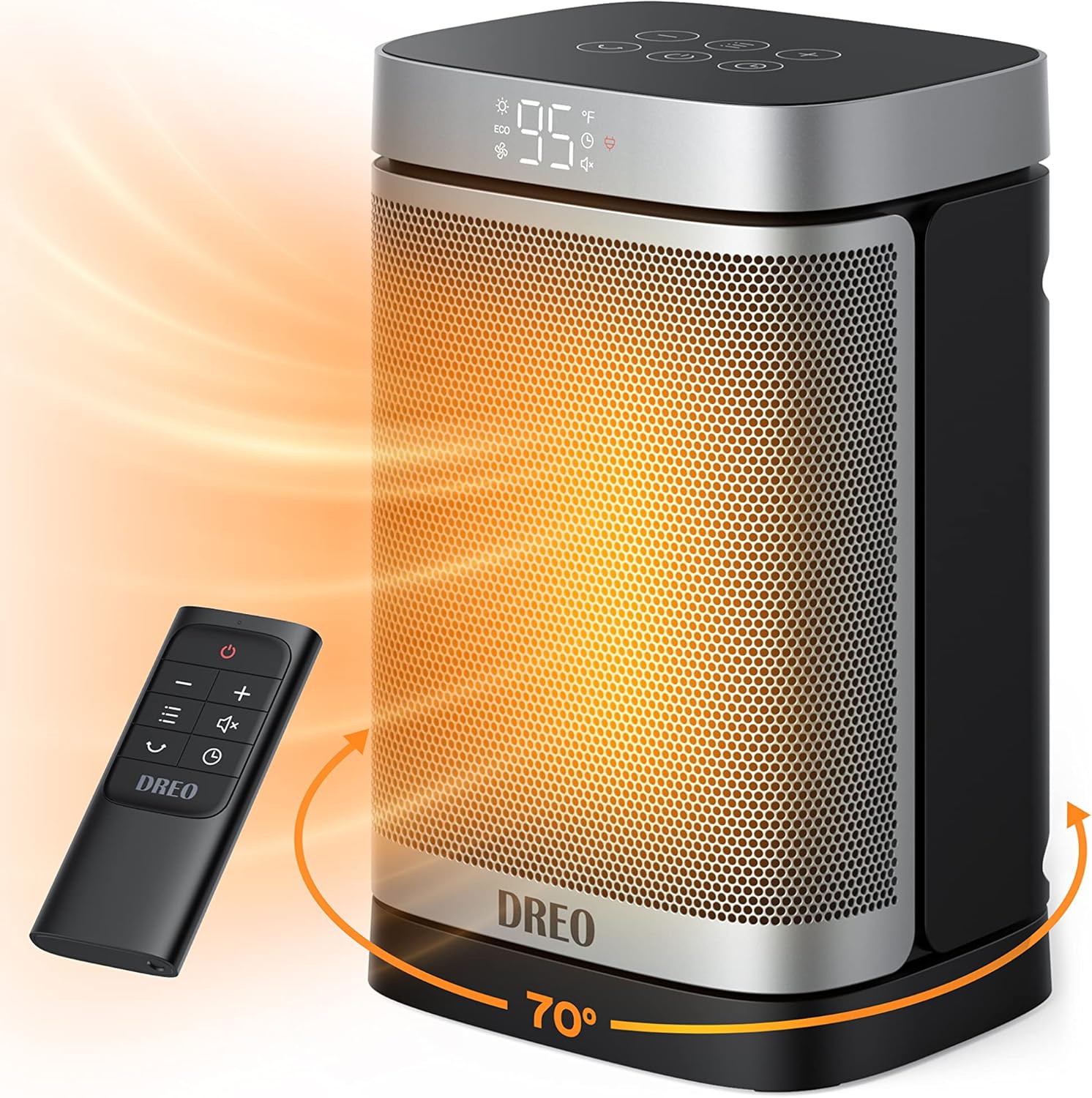
| Heat Output | 1500 watts |
|---|---|
| Heating Coverage | 200 sq.ft |
| Heating Element | PTC Ceramic |
| Number of Speeds | 5 |
| Min/Max Temp Setting | 41 °F – 95 °F |
The DREO Atom One is a compact tower heater that delivers up to 1500 watts of forced-air heat using a PTC ceramic element and DREO's Hyperamics technology to warm a small to medium room quickly. You control temperature precisely with the programmable digital thermostat (41 to 95°F in 1°F steps), a 1–12 hour timer, and five fan/power modes including an ECO setting that adjusts output to save energy once your setpoint is reached. A 70° oscillation spreads warmth across a room and a detachable filter helps keep the intake clean. Built-in safety features include tip-over and overheat protection and an enhanced safety plug, and the unit is ETL-listed. Practical trade-offs are typical for a 1500W space heater: it provides fast, direct heat for a single room rather than whole-house heating, and continuous high-power use will draw significant electricity. The unit is quiet for this class thanks to a brushless DC motor, making it suitable for bedrooms and home offices.
Best for: Buyers who prioritize safe, controllable, and energy-aware room heating for bedrooms, home offices, or small living spaces and who want quiet operation and programmable temperature control.
Less Ideal for: People seeking whole-house heating or a heater for very large open areas should consider higher-capacity or whole-home solutions instead.
- Precise digital thermostat adjustable from 41 to 95°F in 1°F increments
- ECO mode that reduces power once target temperature is reached to save energy
- 70° oscillation for wider heat distribution across a room
- ETL-listed safety features including tip-over and overheat protection and enhanced safety plug
- 1500W output limits use to single-room heating and can increase electricity consumption at high settings
- Tower form factor may not concentrate heat as well as directed ceramic spot heaters for feet-level warmth
Verdict: A safe, feature-rich 1500W tower heater with precise thermostat and ECO mode for risk-averse buyers who want efficient, controlled heating in a single room.
Choosing the Right Energy-Efficient Portable Heater: Key Factors to Consider
Heat Output and Zoning
Heat output determines how quickly a portable heater can raise the temperature in a given room. Look for units with multiple power settings so you can match output to room size and activity level. A heater that offers both a low steady-watt mode and a higher boost setting lets you use minimal energy for maintenance warming and more power only when you need a quick temperature rise.
Zoning matters because portable heaters are most efficient when heating a specific occupied area rather than trying to warm an entire house. Consider whether the heater's airflow pattern and placement options will concentrate warmth where you spend the most time.
Thermostat and Control Precision
A responsive, accurate thermostat prevents temperature overshoot and unnecessary cycling, which saves energy over time. Digital controls with setpoint programming or a reliable analog thermostat both work, but check for clear feedback so you can tell when the unit is maintaining the target temperature.
Additional control options such as timers, eco modes, and adjustable fan speeds let you tailor runtime and power consumption to your schedule. Remote control or smart app integration can add convenience but only meaningfully reduce energy use if you change settings routinely.
Energy Consumption and Operating Cost
Wattage indicates maximum power draw but does not by itself equal efficiency. Compare the heater's low and medium wattage settings and estimate daily run hours to project operating costs. Look for features that reduce runtime, such as programmable schedules, efficient fans, or ceramic heating elements that retain heat longer.
Also consider whether the unit offers adaptive modes that cycle power intelligently. A heater that maintains comfort at a lower continuous draw will often cost less to run than one that repeatedly fires at full power.
Safety Features and Placement Flexibility
Safety features directly affect where and how you can use a heater. Automatic shutoff for tip-over events, overheat protection, cool-touch exteriors, and child-lock functions decrease the risk of accidents and let you place the heater in higher-traffic areas with more confidence.
Placement flexibility, including vertical and horizontal stability and cord length, affects real-world usability. A unit that requires specialist mounting or limits placement options can lead to less efficient use if you cannot position it for optimal zoning.
Noise and Daily Usability
Noise level influences how you'll use the heater. Quiet units are suitable for bedrooms, home offices, and living rooms where background noise can be distracting. If a fan runs loudly at low settings, you may be tempted to increase heat output to shorten runtime, which can raise energy use.
Check manufacturer noise specs if available, and consider designs with variable fan speeds so you can balance airflow and acoustic comfort. Also evaluate ease of operation, cleaning access, and visible indicators for active safety features.
Size, Mobility, and Storage
Portability is a core benefit of these heaters. Weight, handle design, and footprint determine how easy it is to move the unit between rooms. Smaller units may be easier to store but might not provide wide coverage, while larger portable heaters can heat bigger zones more efficiently.
Storage considerations matter if you only use the heater seasonally. Units that disassemble, nest the cord, or have compact profiles are easier to store without damage.
How to Estimate Running Costs
Estimate running cost by combining the heater's wattage with your local electricity rate and expected daily run hours. Multiply wattage by hours to get watt-hours, convert to kilowatt-hours, then multiply by your utility rate. This gives a realistic baseline to compare units versus relying on manufacturer claims alone.
- Calculate: (Wattage ÷ 1000) × Hours Used = kWh per day
- Multiply kWh per day × Cost per kWh = Estimated daily cost
- Compare low and high power settings to see cost range across typical use
Best Placement Practices for Efficiency
Place the heater where you spend the most time and where heat will not immediately dissipate, such as near seating or work areas and away from drafts. Elevating small heaters slightly can improve convective flow in some rooms, while floor placement often suits radiant and baseboard-replacement styles.
Drafts, open doors, and large uncovered windows reduce efficiency. Use curtains and close doors to create a smaller zone to heat, and avoid placing the heater directly under vents that blow cold air into the heated zone.
- Avoid direct airflow obstructions like rugs or furniture
- Close interior doors to confine heat to occupied rooms
- Position away from flammable materials and moisture-prone areas
Safety Tips for Everyday Use
Always use a heater on a stable, flat surface and keep flammable materials at least three feet away. Never leave a portable heater running unattended for extended periods and unplug it when not in use. Regularly inspect the cord for wear and avoid extension cords unless the heater manufacturer explicitly allows them.
Be mindful of power requirements and circuit loads. High-wattage heaters can trip breakers if multiple appliances share the same circuit. Use units with automatic shutoff features to reduce the chance of incidents if the heater is tipped or overheats.
- Test tip-over and overheat protections periodically according to the manual
- Keep cords out of high-traffic paths to prevent tripping
- Follow manufacturer guidance on placement near carpets and upholstery
When to Use Supplemental Heat Vs Whole-House Heating
Supplemental portable heaters are most efficient when occupied zones need short-term or targeted warmth, like a single bedroom, home office, or seating area. Running a portable heater in a confined space often uses less energy than raising the thermostat for an entire house.
If multiple rooms require heating for long periods, whole-house systems may be more efficient despite higher fixed costs. Consider hybrid strategies: lower the central thermostat and use portable heaters in the most-used rooms to balance comfort and energy savings.
- Use portable heaters for occupied zones during peak evening hours
- Turn off or lower central heating when consistently using efficient portable options
- Monitor overall energy use to ensure net savings
How We Chose the Best Energy-Efficient Portable Heater
We focused on features and performance metrics that directly affect energy use and everyday convenience. Key evaluation criteria included steady heat delivery at varied power settings, accurate thermostatic control and setback programming, and measurable efficiency features such as low-watt modes and insulation-safe surface design. We also assessed heater footprint and placement flexibility to determine how effectively a unit can heat an occupied zone rather than wasting energy on unused space. Safety and longevity were essential filters. Units with clear overheat protection, tip-over shutoff, and durable heating elements scored higher. Noise level and fan efficiency were considered because noisy or inefficient blowers can reduce practical usability and lead users to run units at higher power for longer periods. We excluded products that lacked basic safety certifications or that were intended for industrial or outdoor use rather than indoor, portable applications. Our final shortlist favors units that deliver predictable temperature control and low incremental running cost across typical home scenarios. The scoring emphasized quantifiable energy-related features and real-world usability rather than marketing claims.
Our full evaluation process is outlined in our review methodology.
FAQ
Are portable ceramic heaters more energy-efficient than oil-filled radiators?
It depends on use. Ceramic heaters heat up and cool down quickly, which can be more efficient for short bursts. Oil-filled radiators retain heat longer and can be more efficient for steady, long-term background warmth. Choose based on how long and how often you plan to run the unit.
Can running a portable heater increase my fire risk?
Portable heaters have a higher fire risk if placed near flammable materials or used with damaged cords. Units with tip-over and overheat shutoffs reduce but do not eliminate risk. Follow placement and inspection guidance and never leave high-wattage heaters unattended for long periods.
Will a thermostat on the heater save money compared with fixed power settings?
Yes. A functional thermostat prevents unnecessary cycling at full power by maintaining a set temperature. This reduces runtime and usually lowers operating cost compared with running at a fixed high setting continuously.
Is it safe to use a portable heater overnight in a bedroom?
Many heaters are designed for overnight use if they include overheat protection, tip-over shutoff, and a cool-touch surface. Even so, use models rated for bedroom use, follow manufacturer safety instructions, and avoid placing them on soft bedding or near curtains.
Do smart plugs help reduce energy use for portable heaters?
Smart plugs can schedule runtime and power cycles, which may reduce unnecessary operation. However, ensure the smart plug is rated for the heater's wattage. For high-wattage units, built-in timers and controls are a safer option than underspecified external devices.
Final Verdict
Focus on how you plan to use the heater when choosing an energy-efficient portable model. Prioritize accurate thermostatic control, adjustable power settings, and safety features if you intend to run the unit for long periods or in bedrooms. For short-term or spot warming, fast-response elements and adjustable airflow can reduce wasted runtime. Tradeoffs are inevitable: smaller, quieter units are easy to move but may need higher output for larger rooms. Use the scoring criteria above to weigh heat control, efficiency, safety, and noise so you can select a portable heater that delivers the comfort you need without unnecessary energy waste.