
Note: This article contains affiliate links. If you click on these links and make a purchase, we may earn a small commission at no extra cost to you. This helps support our research and content. Read our full affiliate disclosure here.
Picking the right energy-efficient window air conditioner matters because it directly affects your monthly electric bill, home comfort, and peak-season performance. A poorly matched unit wastes energy and leaves rooms unevenly cooled, while the right one reduces runtime, keeps humidity in check, and runs quieter. This guide highlights five shortlisted energy-efficient window air conditioners that suit common room sizes and use cases. We evaluated each option against practical criteria like energy efficiency, cooling capacity, noise, and ease of installation so you can find a unit that saves power without compromising comfort. Read on to see which features matter most for your space.
Top Picks at a Glance
| Best Overall The best all-around choice for most situations | Midea U-Shaped 6,000 BTU AC |  |
| Best Quality Built to a higher standard if you want something more solid | LG 12,000 BTU Window AC LW1224IVSM |  |
| Best Value The sweet spot between price and what you get | Electactic 10,000 BTU Window Air Conditioner |  |
| Best Budget The cheapest option that still gets the job done reliably | Homhougo 6000 BTU Window Air Conditioner |  |
| Top Rated A top-rated pick with lots of positive feedback | Hisense 12,000 BTU Window AC |  |
Midea U-Shaped 6,000 BTU AC

| Cooling Power | 6000 BTU |
|---|---|
| Floor Area | 250 square_feet |
| Noise | 32 db |
| Refrigerant | R-32 |
| Wattage | 625 watts |
The Midea U-Shaped 6,000 BTU window air conditioner uses a U-shaped chassis and inverter compressor to deliver quiet, efficient cooling for small to medium rooms. It installs in single- or double-hung windows and is intended to keep bedrooms or living rooms comfortable without blocking the window sash. In real-world use the unit cools up to roughly 250 square feet while the inverter motor steps speed to hold temperature with lower energy draw, which Midea rates as about 37 percent savings compared with older non-inverter models. Control options are flexible: onboard touch buttons, the included remote, the SmartHome app, or voice assistants for scheduling and adjustments from anywhere. Practical benefits include a low reported noise floor around 32 dBA and included mounting bracket for straightforward setup. Limitations are inherent to its size: 6,000 BTU is best for single rooms rather than cooling open-plan living spaces, and the unit requires a compatible window opening and proper sealing to reach rated efficiency. Annual energy figures reflect real consumption, so expect modest running costs but not zero power use.
Best for: Buyers who want a quiet, energy-conscious window AC for cooling a single bedroom or living room and value smart controls and easy installation.
Less Ideal for: People needing to cool large open areas, multiple rooms, or who require heating capability should consider higher-capacity or multi-function systems instead.
- U-shaped design keeps window partially open and preserves view while installed
- Inverter compressor for lower noise and improved energy efficiency
- Multiple control methods including app, remote, touch, and voice assistants
- Includes mounting bracket and remote for easier installation and day-one use
- 6,000 BTU capacity limits effectiveness to single rooms up to about 250 sq ft
- Requires a compatible window opening and proper installation to meet performance and efficiency claims
Verdict: Choose this unit if you want a compact, smart, and energy-efficient window AC that keeps one room cool quietly while preserving your window view.
LG 12,000 BTU Window AC LW1224IVSM

| Cooling Power | 12000 british thermal units |
|---|---|
| Compressor Type | Dual Inverter |
| Controls | App, Remote, Touch, Voice |
| Noise | 44 db |
| Floor Area | 550 square_feet |
This LG 12,000 BTU window air conditioner uses a dual inverter compressor to deliver fast, efficient cooling for rooms up to about 550 sq ft while running significantly quieter than many conventional units. It offers four fan speeds, 4‑way air deflection and dehumidifying capability, and you can control it via the included LCD remote, the LG ThinQ app, or voice assistants. Real-world benefits include lower energy draw—LG claims up to 35 percent savings versus typical standards—automatic restart after power loss, and a washable filter with a filter‑check reminder that simplifies maintenance. The unit lists a 44 dB sleep‑mode noise level, so it is suited to bedrooms or living areas where low sound matters. Limitations to consider: installation requires a compatible window and the unit is heavy, and while the app and voice controls are convenient they require network setup to use remotely. For buyers prioritizing efficient, quiet performance, this model focuses on cooling effectiveness and user convenience rather than ultra‑basic budget pricing.
Best for: Buyers who prioritize strong cooling performance and lower operating costs and want smart controls and quiet operation for medium to large rooms.
Less Ideal for: Shoppers looking for a lightweight, budget-only window unit or those who need a simple plug‑and‑play appliance without smart features or complex installation.
- Dual inverter compressor for faster cooling and improved energy efficiency
- Wi‑Fi and voice control via LG ThinQ, Alexa and Google for remote operation
- Runs quietly with a 44 dB sleep‑mode noise rating
- Washable filter with filter‑check reminder for low‑effort maintenance
- Heavy and requires a sufficiently sized window and sturdy installation
- App and smart features depend on network setup and connectivity
Verdict: Choose this LG model if you want a powerful, energy‑efficient, and quiet window AC with modern smart controls for cooling medium to large rooms.
Electactic 10,000 BTU Window Air Conditioner
| Cooling Power | 10000 british thermal units |
|---|---|
| Floor Area | 450 square_feet |
| Seasonal Energy Efficiency Ratio (SEER) | 10.9 |
| Wattage | 1500 watts |
| Refrigerant | R-32 |
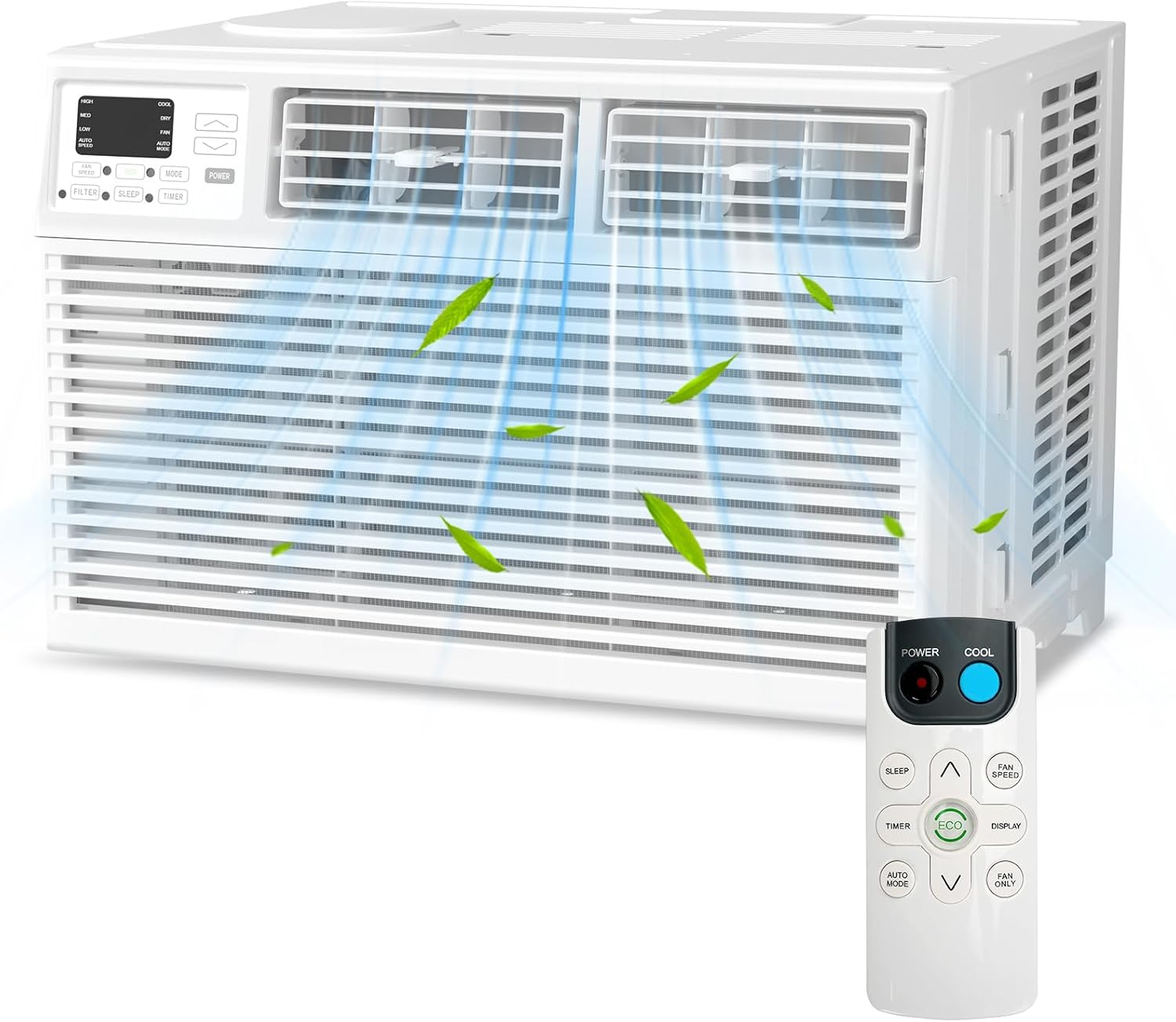
This Electactic 10,000 BTU window unit delivers targeted cooling for living rooms, bedrooms, or home offices up to about 450 square feet. It offers three fan speeds, dehumidification, and modes such as Sleep, Auto, and Eco so you can tune comfort and energy use; a programmable 0.5–24 hour timer and automatic resume after power loss add practical convenience. The washable reusable filter with a cleaning reminder helps maintain air quality without recurring replacement costs, and the included window mounting kit makes installation straightforward for a standard single-hung or sliding window. Efficiency is respectable for a non-inverter unit, with a CEER/SEER figure listed at 10.9 and a rated power draw consistent with 1500 watts, so it balances performance and operating cost for moderate-size spaces. Trade-offs include a rotary scroll compressor and no inverter technology, which means the unit runs at fixed speeds rather than modulating for maximum efficiency and quieter operation. Noise is specified around 51 dB, so expect audible operation at higher fan settings.
Best for: Buyers who prioritize sensible energy use and straightforward features for cooling a single medium to large room and who want low ongoing filter costs and easy installation.
Less Ideal for: People seeking the absolute lowest running cost and quietest operation should consider inverter-style models instead, and those needing whole-house cooling should look at larger systems.
- Rated to cool rooms up to 450 sq. ft., suitable for living rooms and large bedrooms
- Multiple modes (Sleep, Auto, Eco) plus a 0.5–24 hour timer for tailored, energy-conscious operation
- Washable reusable filter with reminder light reduces maintenance cost and preserves air quality
- Includes complete window mounting kit and remote control for easy installation and everyday convenience
- Uses a non-inverter rotary scroll compressor so it cannot modulate power for peak efficiency or the lowest noise levels
- Noise level around 51 dB may be noticeable in very quiet rooms
Verdict: A practical, energy-conscious 10,000 BTU window AC that balances effective cooling, simple installation, and low filter cost for single-room use.
Homhougo 6000 BTU Window Air Conditioner

| Cooling Power | 6000 british thermal units |
|---|---|
| Floor Area | 250 square_feet |
| Noise | 52 db |
| Wattage | 500 |
| Control Method | App, Remote, Voice |
This Homhougo 6000 BTU window air conditioner is a compact, Wi‑Fi‑enabled unit intended for single rooms such as bedrooms or small living areas. It offers app, remote, and voice control for scheduling and temperature adjustments from a phone or smart assistant, plus three fan speeds, ECO and Sleep modes to reduce runtime. The unit installs in standard single or double‑hung windows and includes an installation kit and a washable filter for routine maintenance. Rated for up to 250 sq ft, it runs at roughly 50–52 dB, so it is reasonably quiet for overnight use. Power draw and listed annual consumption indicate a focus on energy efficiency for its class, but buyers should note the modest 6000 BTU capacity means it is best for smaller rooms and will strain if used to cool larger open spaces. Build and controls are straightforward, and the smart features add convenience for remote scheduling, but longevity and long‑term support are not detailed beyond a 30 day manufacturer warranty.
Best for: Buyers seeking an affordable, energy-minded window AC with smart controls for a single bedroom or small living space who value low noise and simple installation.
Less Ideal for: Do not choose this unit if you need to cool larger open-plan rooms, multiple rooms, or if you require an extended manufacturer warranty or heavy‑duty commercial use.
- Smart controls with app, remote, and voice operation for convenient scheduling and remote access
- Energy saving modes including ECO and Sleep to cut runtime and lower consumption
- Compact 6000 BTU design suited to small rooms and bedroom use
- Includes installation kit and a washable filter for easy DIY setup and maintenance
- 6000 BTU capacity limits effective cooling to about 250 sq ft and small rooms only
- Only a 30 day manufacturer warranty is specified
Verdict: A compact, energy-focused 6000 BTU window AC that delivers quiet, smart-controlled cooling for budget buyers with small rooms.
Hisense 12,000 BTU Window AC

| Cooling Power | 12000 british thermal units |
|---|---|
| Noise | 35 db |
| Wattage | 1120 watts |
| Floor Area | 550 square_feet |
| Capacity | 31.2 pints |
This Hisense 12,000 BTU window air conditioner uses inverter technology to deliver steady cooling for larger rooms while drawing less energy than conventional compressors. It supports three modes—cooling, fan, and dehumidifier—plus four-way air direction to help distribute air evenly across spaces up to about 550 square feet. The unit pairs with the ConnectLife app for remote scheduling and temperature adjustments, and also includes a physical remote for local control. Practical touches include a washable, removable mesh filter and an installation bracket to simplify mounting. Noise is rated around 35 dB, so it aims to stay quiet during operation. On the downside the product is relatively heavy and requires a standard window installation, and the spec sheet lists annual energy consumption tied to its wattage rather than an explicit efficiency rating like EER or SEER, so buyers should check comparative efficiency figures if that is a priority. For someone who wants reliable, app-enabled cooling that balances performance and energy use, this unit delivers sensible features without complicated setup.
Best for: Buyers who prioritize dependable, energy-conscious cooling with remote app control and straightforward maintenance for larger rooms.
Less Ideal for: People who need a lightweight, portable solution or who require a specific certified efficiency rating for strict energy benchmarking.
- Inverter compressor for steadier temperature control and reduced energy draw compared with conventional compressors
- Wi‑Fi ConnectLife app plus remote control for flexible scheduling and adjustment
- Covers rooms up to 550 sq ft, suitable for larger bedrooms and living areas
- Washable removable mesh filter and included installation bracket simplify upkeep and setup
- No explicit EER/SEER efficiency value listed on the product page to compare against other models
- Window installation required and the unit is relatively heavy, which may complicate handling and mounting
Verdict: A reliable inverter window AC that combines steady, energy-aware cooling and app control for keeping larger rooms comfortable with minimal fuss.
Choosing the Right Energy Efficient Window Air Conditioner: Key Factors to Consider
Energy Efficiency Ratings
Energy efficiency ratings like EER or seasonal equivalents quantify how much cooling you get per unit of electricity. Higher ratings mean the compressor and system use less power to deliver the same cooling, which directly lowers running costs.
When you compare units, pay attention to the stated efficiency number and any eco or low-power modes that reduce compressor duty cycle. Efficiency matters most during long cooling seasons and in homes with high electricity rates because small differences compound over months of use.
Correct Cooling Capacity
Cooling capacity, typically expressed in BTUs, must match the room size and heat load. An undersized unit will run continuously and never reach comfortable temperatures, increasing energy use. An oversized unit cycles on and off too frequently, which can waste energy and reduce humidity control.
Calculate the room area and consider factors such as ceiling height, sun exposure, and occupant count. Choose a capacity that aligns with the real-world load rather than just the room square footage to avoid inefficiency and discomfort.
Noise and Runtime Comfort
Noise level affects where you can comfortably place a window unit. Units that run quieter are easier to run at higher fan speeds when outside temperatures spike, which can reduce runtime by increasing instantaneous cooling power.
Consider both decibel ratings and user-oriented noise descriptions. If the unit will be used in bedrooms or home offices, prioritize lower noise and look for night modes or lower fan-speed settings that preserve sleep and focus while still saving energy.
Installation, Sealing, and Fit
Proper installation and a tight seal around the unit are essential to prevent cooled air from escaping and hot air from entering. Poorly fitted units force the compressor to work harder and run longer, negating efficiency gains.
Look for units with adjustable side panels, foam gaskets, and clear installation guidance. Consider whether you can install the unit yourself or will need help, and how easily the unit can be removed and reinstalled for off-season storage.
Controls, Timers, and Smart Modes
Built-in controls that let you schedule operation, set thermostats precisely, or run eco modes help reduce unnecessary runtime. Programmable timers and temperature deadband settings prevent short cycling and limit operation to when cooling is needed most.
Some units offer basic digital controls while others include more advanced scheduling or remote access. Prioritize control features based on how often you plan to adjust settings and whether automated energy-saving modes will fit your daily habits.
Maintenance and Filter Access
Easy access to washable filters and straightforward maintenance reduces neglect that can degrade efficiency. A clogged filter or dirty coils increases airflow resistance and forces the compressor to run longer for the same cooling output.
Choose units with tool-free filter removal and clear cleaning instructions. Consider how often you are willing to perform basic upkeep and whether replacement parts like filters are simple to source.
Sizing Your Window Air Conditioner
Choosing the correct BTU rating for your room is the single most effective step to ensure efficient operation. Start with the room area and adjust for high ceilings, sun exposure, or rooms with many occupants. A unit sized to the actual heat load will reach set temperature faster and spend less time running.
For spaces that are unusually sunny or have many electronics, add 10 to 20 percent to the baseline capacity. Conversely, heavily shaded or well-insulated rooms may need less capacity. Always check manufacturer guidance for square footage ranges tied to BTU ratings.
- Measure room length and width, then multiply to find square footage
- Adjust capacity upward for sun-drenched rooms or high ceilings
- Prefer slightly smaller capacity to avoid short-cycling when insulation is excellent
Maximizing Efficiency Through Placement and Sealing
Placement in the window and a tight seal around the unit have a big impact on efficiency. Ensure the unit is level and that air intakes are unobstructed. Use weatherstripping or foam gaskets to close gaps and reduce infiltration of warm air.
Avoid installing units where they will fight direct heat sources like rooftop vents or large glass surfaces that absorb heat. Clear airflow paths on both the interior and exterior sides prevent the compressor from compensating for restricted circulation.
- Seal gaps with foam gaskets or adjustable side panels
- Keep outdoor side free of obstructions to maintain condenser airflow
- Level the unit slightly to facilitate condensate drainage
Using Controls to Cut Runtime
Effective use of thermostats, timers, and fan settings reduces compressor runtime and electricity use. Set a reasonable temperature that balances comfort and efficiency and use programmable timers to avoid cooling an empty room.
Eco modes and variable fan speeds can maintain comfort with lower compressor duty cycles. When available, use scheduling to pre-cool during off-peak hours and let the unit maintain rather than continually chase temperature swings.
- Set thermostats to a comfortable but efficient target, typically mid-70s F
- Use timers to avoid cooling unoccupied rooms
- Favor steady long cycles over frequent short cycles to preserve efficiency
Maintenance Habits That Preserve Efficiency
Regular maintenance keeps a window air conditioner operating near its rated efficiency. Clean or wash filters monthly during heavy use and inspect exterior coils for dirt buildup that reduces heat transfer.
Seasonal storage and off-season cover can protect the unit and prolong compressor life. Make a simple checklist for filter cleaning, coil inspection, and checking seals at the start and end of each cooling season.
- Clean washable filters every month during peak season
- Inspect condenser fins for debris and straighten bent fins carefully
- Check seals and gaskets at the start of each season
When to Consider Additional Energy-Saving Measures
If a single window unit cannot handle the heat load efficiently, consider supplemental measures like ceiling fans, improved insulation, or blackout curtains to reduce solar gain. These steps reduce cooling demand and allow a smaller, more efficient unit to perform well.
Programmable smart thermostats for whole-home systems are not applicable to window units, but timed usage and coordinated fan use across rooms can achieve similar savings without replacing the unit.
- Combine with fans to increase perceived cooling and allow higher thermostat settings
- Install window film or shades to reduce solar heat gain
- Improve attic insulation to lower overall cooling load
How We Chose the Best Energy Efficient Window Air Conditioner
We focused selection on characteristics that determine real-world efficiency and usability for window-mounted cooling. Primary evaluation criteria included energy efficiency ratings and real-world seasonal energy consumption, cooling capacity matched to room size, and measured or reported runtime under typical conditions. We also weighted noise levels during operation and ease of installation and maintenance because these factors affect daily experience and long-term energy use. Excluded from consideration were units that only offer minimal efficiency features or those designed for permanent through-wall installation. We prioritized units with clear efficiency specs, reliable cooling capacity across load conditions, and straightforward maintenance access. Other practical filters included the availability of user controls that support energy savings such as programmable timers or eco modes and the presence of quality sealing and insulation features to prevent air leaks. The result is a focused set of energy-efficient window air conditioners that score well on efficiency, cooling match to room size, noise, and practicality.
Our full evaluation process is outlined in our review methodology.
FAQ
How much electricity does an energy-efficient window air conditioner use?
Usage varies by capacity and duty cycle, but energy-efficient models use less power per BTU than standard units. Expect lower monthly consumption when a unit's efficiency rating is higher and it is properly sized and sealed.
Can a window air conditioner cool an open-plan living area?
Window units are best for single rooms or enclosed spaces. They can help open-plan areas if placed strategically and combined with fans, but large open layouts usually require multiple units or a different cooling strategy.
How often should I clean the filter to maintain efficiency?
Clean washable filters monthly during heavy use and inspect them at least once before the cooling season. Clogged filters increase runtime and reduce cooling effectiveness, so regular cleaning preserves efficiency.
Do eco modes really save energy?
Eco or energy-saving modes can reduce compressor runtime by optimizing fan speed and temperature differentials. The actual savings depend on usage patterns and ambient conditions, but these modes generally lower power draw compared with constant high-power settings.
Is it worth upgrading an older window unit for efficiency?
Upgrading can be worthwhile if the existing unit has low efficiency, frequent maintenance needs, or fails to maintain comfortable temperatures. Newer efficient units often provide noticeable reductions in electricity use when correctly sized and installed.
Final Verdict
Prioritize units that match your room size and have strong efficiency ratings paired with practical controls. Good sealing, straightforward maintenance access, and reasonable noise levels all contribute to real-world savings and comfort. Balance capacity and efficiency: a correctly sized energy-efficient window air conditioner will typically deliver the best tradeoff between lower electricity bills and reliable cooling. Use the factors discussed above to choose a unit that fits your room and daily habits, and maintain it regularly to preserve efficiency over time.