
Note: This article contains affiliate links. If you click on these links and make a purchase, we may earn a small commission at no extra cost to you. This helps support our research and content. Read our full affiliate disclosure here.
If you bake bread regularly, the right food processor for bread dough can transform how you work with flour, water, and yeast. A processor that handles heavy dough reduces the time you spend kneading and produces more consistent gluten development, which matters for loaf structure and crumb. This guide collects seven shortlisted food processors built to handle bread dough, focusing on torque, bowl volume, and durable dough tools. Below you will find our top picks and a clear explanation of the features that matter when mixing and kneading dough. Use the evaluation notes to match a model to your baking frequency and kitchen setup.
Top Picks at a Glance
| Best Overall The best all-around choice for most situations | Ninja Professional Plus BN601 |  |
| Best Quality Built to a higher standard if you want something more solid | Cuisinart 14-Cup Food Processor DFP-14BCNY |  |
| Best Value The sweet spot between price and what you get | Hamilton Beach 10-Cup Food Processor 70730 |  |
| Best Budget The cheapest option that still gets the job done reliably | BLACK+DECKER Food Processor FP4200B |  |
| Top Rated A top-rated pick with lots of positive feedback | Breville Sous Chef 16 Cup |  |
| Most Popular A crowd favorite that many people choose with confidence | Ninja Mega Kitchen System BL770 |  |
| Best Seller A high-volume bestseller chosen again and again | Ganiza Food Processor GC10 |  |
Ninja Professional Plus BN601

| Wattage | 1000 watts |
|---|---|
| Bowl Capacity | 4.5 pounds |
| Number of Speeds | 3 |
| Power Source | AC adapter |
The Ninja Professional Plus BN601 is a versatile kitchen processor aimed at simplifying batch prep and light baking tasks. It pairs a 1000-peak-watt motor with Auto-iQ preset programs for one-touch chopping, slicing, pureeing, and dough mixing, and the 9-cup bowl handles family-sized batches. Included stainless-steel blades and a dedicated dough blade let you mix cookie and pizza dough without needing a separate stand mixer, while the reversible slicing and shredding disc speeds up prep for salads and toppings. Controls are straightforward and assembly is simple, and most removable parts are dishwasher safe for easy cleanup. Practical limits are its compact feed chute, which can require pre-cutting for large vegetables, and the 9-cup capacity is better suited to small-to-medium dough batches rather than very large loaves or commercial volumes. Noise is typical for a 1000-watt motor during heavy loads, and plastic construction means it is lighter but less heavy-duty than pro-grade metal models. For home bakers who want a single appliance for both prep and occasional dough mixing, it strikes a reliable balance of power and convenience.
Best for: Home cooks who want a single, easy-to-use machine that handles everyday prep and occasional dough mixing without the footprint or expense of a stand mixer.
Less Ideal for: Bakers who routinely make very large or heavy bread dough batches or need a commercial-grade, metal-built machine should look at larger-capacity, heavier-duty mixers or processors.
- Strong 1000-peak-watt motor handles dense ingredients and dough mixing.
- Auto-iQ presets provide one-touch programs for common tasks.
- 9-cup bowl suits family-sized batches and weekly meal prep.
- Includes multiple blades plus a dough blade for versatile baking and prep.
- Dishwasher-safe removable parts simplify cleanup.
- Feed chute may require chopping larger items before processing.
- Plastic construction is less rugged than metal pro-grade machines.
Verdict: A powerful, user-friendly food processor that reliably handles prep and small-to-medium dough batches, making it a practical all-in-one choice for home bakers.
Cuisinart 14-Cup Food Processor DFP-14BCNY

| Wattage | 720 watts |
|---|---|
| Bowl Capacity | 14 cups |
| Number of Speeds | 1 |
| Power Source | Corded Electric |
The Cuisinart DFP-14BCNY is a heavy-duty, 14-cup food processor built around a 720-watt motor that can handle big prep jobs and light dough work. It comes with a stainless steel chopping/mixing blade plus medium shredding and 4mm slicing discs, and its extra-large feed tube accelerates throughput when processing whole vegetables. In real-world kitchen use the motor provides steady power for shredding cheese, making large batches of sauces or purees, and kneading small to medium quantities of dough; the generous bowl keeps ingredients contained so you can mix without frequent transfers. Controls are simple on/off and pulse which keeps operation straightforward but means no variable speed dialing for very fine control. Most removable parts are dishwasher-safe which eases cleanup, though the unit is sizable and heavy compared with compact processors. If you plan to make frequent, larger loaves or very dense doughs, a stand mixer still gives superior results, but this Cuisinart is a solid performance-focused choice for occasional to regular dough mixing plus broad food prep tasks.
Best for: Buyers who prioritize motor power and capacity for big prep sessions and want a food processor that can also mix dough occasionally without needing a separate machine.
Less Ideal for: Bakers who routinely make large, heavy or multiple loaves of bread and need consistent, high-torque kneading should consider a dedicated stand mixer instead.
- 720-watt motor delivers consistent power for heavy prep and light dough kneading
- Large 14-cup bowl suitable for batch cooking and mixing
- Stainless steel blades and discs for durable slicing and shredding
- Dishwasher-safe removable parts for easier cleanup
- Extra-large feed tube speeds processing of whole fruits and vegetables
- Single-speed with pulse only limits fine speed control for delicate dough handling
- Relatively heavy and takes up significant counter space
Verdict: Choose this Cuisinart if you want a high-capacity, power-focused food processor that can handle batch prep and occasional dough mixing without sacrificing durability.
Hamilton Beach 10-Cup Food Processor 70730

| Wattage | 450 watts |
|---|---|
| Bowl Capacity | 10 cups |
| Number of Speeds | 2 |
| Power Source | Wall outlet |
The Hamilton Beach 10-cup food processor is built for routine kitchen prep: chopping, shredding, slicing and pureeing with a stainless steel S-blade and reversible disc, plus a built-in bowl scraper that keeps ingredients moving without stopping to use a spatula. Its 450-watt motor and two speeds with pulse handle vegetables, cheese and softer dough tasks quickly, and the large feed chute reduces prep time. Dishwashable removable parts and a BPA-free bowl make cleanup straightforward. For bread dough specifically, this model can mix small dough batches and bring ingredients together, but its 450-watt motor and lack of a dedicated dough hook mean it is best for light, short kneading or small quick breads rather than heavy or large yeasted loaves. The simple controls and included scraper are practical for cooks who want efficient multitasking rather than a machine focused on heavy dough work. If you need a compact processor that doubles for general prep and occasional light dough mixing, this is a sensible, easy-to-use choice.
Best for: Buyers who want a practical, space-efficient processor for general kitchen prep and occasional small or light dough mixing without investing in a dedicated stand mixer.
Less Ideal for: Home bakers who regularly make large yeasted loaves or heavy doughs should choose a machine with a stronger motor and a dedicated dough hook instead.
- Built-in bowl scraper keeps ingredients close to the blade for more even processing
- 450-watt motor handles chopping, shredding, slicing and light mixing efficiently
- Large feed chute reduces pre-cutting and speeds up prep
- Dishwasher-safe, BPA-free removable parts simplify cleanup
- Motor and design are not intended for heavy or long dough kneading
- Only two speeds plus pulse limit fine control for delicate textures
Verdict: A compact, efficient all-purpose food processor that handles everyday prep and light dough mixing but is not meant for heavy kneading.
BLACK+DECKER Food Processor FP4200B

| Wattage | 450 watts |
|---|---|
| Bowl Capacity | 8 cups |
| Number of Speeds | 3 |
| Blade Material | Stainless Steel |
| Power Source | Electric |
The BLACK+DECKER FP4200B is a straightforward 8-cup food processor aimed at everyday kitchen tasks like chopping, slicing, shredding, and pureeing. It uses a stainless steel S-blade for quick chopping and mixing and includes a reversible metal disc for slicing or shredding vegetables and cheese. Controls are simple — low, high, and pulse — driven by a 450W motor that handles most soft-to-medium tasks efficiently. The work bowl locks into the base via the lid for easy assembly, and removable parts are dishwasher-safe for faster cleanup. For bread dough the 450W motor and relatively small bowl limit heavy kneading; it can manage small, short mixing jobs but is not designed for large or dense dough batches. Its plastic construction keeps the unit lightweight and budget friendly, though users seeking heavy-duty dough performance or large-capacity kneading would need a more powerful, dedicated dough mixer.
Best for: Buyers on a tight budget who need a reliable, no-frills processor for everyday chopping, shredding, and small-batch mixing in a compact kitchen.
Less Ideal for: People who plan to regularly mix or knead large or dense bread doughs or who need a heavy-duty, high-capacity machine for frequent baking.
- Compact 8-cup bowl suitable for small meal prep
- Stainless steel S-blade and reversible slicing/shredding disc included
- Simple touchpad controls with low, high, and pulse settings
- Dishwasher-safe removable parts for easy cleanup
- Easy assembly with lid-locking design
- 450W motor is underpowered for heavy or large bread dough kneading
- Plastic construction may feel less durable than heavier models
Verdict: A budget-friendly, compact food processor that handles everyday chopping and slicing well but is only suitable for light or very small dough tasks.
Breville Sous Chef 16 Cup

| Wattage | 1450 watts |
|---|---|
| Bowl Capacity | 16 cups |
| Power Source | electric |
| Material | Stainless Steel |
The Breville Sous Chef 16 is a heavy-duty countertop food processor built for large-batch prep and demanding tasks like kneading dough and shredding vegetables. Its 1450W induction motor with direct drive delivers steady torque for mixing and kneading bread dough without bogging down, while the large 16-cup BPA-free bowl and extra-large 3-in-1 feed chute reduce pre-prep for big loaves. The unit ships with a comprehensive set of blades and discs including an S-blade, dough blade, adjustable slicing deck, reversible shredder and French-fry disk, plus storage containers to keep accessories organized. Controls and multiple chute sizes help you maintain consistent results for even slicing and shredding. Trade-offs are its substantial footprint and weight, which make it less convenient for small kitchens or frequent repositioning, and the single speed listing suggests you rely on pulse/timer functions rather than many preset speed levels. For home bakers who want a durable, powerful machine that handles dough reliably, this processor is engineered to last and perform.
Best for: Home bakers and cooks who prioritize a durable, high-torque machine that reliably handles large dough batches and heavy prep work for regular use.
Less Ideal for: Those with very limited counter space, frequent need to move or store appliances, or shoppers seeking a lightweight, compact processor for occasional small-batch tasks.
- High-torque 1450W induction motor suited for kneading and heavy tasks
- Large 16-cup BPA-free bowl handles big batches without frequent refills
- Comprehensive accessory set includes dough blade and adjustable slicer for versatile prep
- Extra-large 3-in-1 feed chute reduces pre-cutting and speeds up workflow
- Removable, dishwasher-safe parts and onboard storage simplify cleanup and organization
- Bulky and heavy, which makes storage and moving it around the kitchen awkward
- Only a single listed speed control, relying on pulse and timer rather than multiple continuous speeds
Verdict: If you want a reliable, high-torque food processor that can handle bread dough and large batches, the Breville Sous Chef 16 is built to do the job consistently.
Ninja Mega Kitchen System BL770
| Wattage | 1500 watts |
|---|---|
| Number of Speeds | 5 |
| Capacity | 16 fluid ounces |
| Power Source | ac_dc |
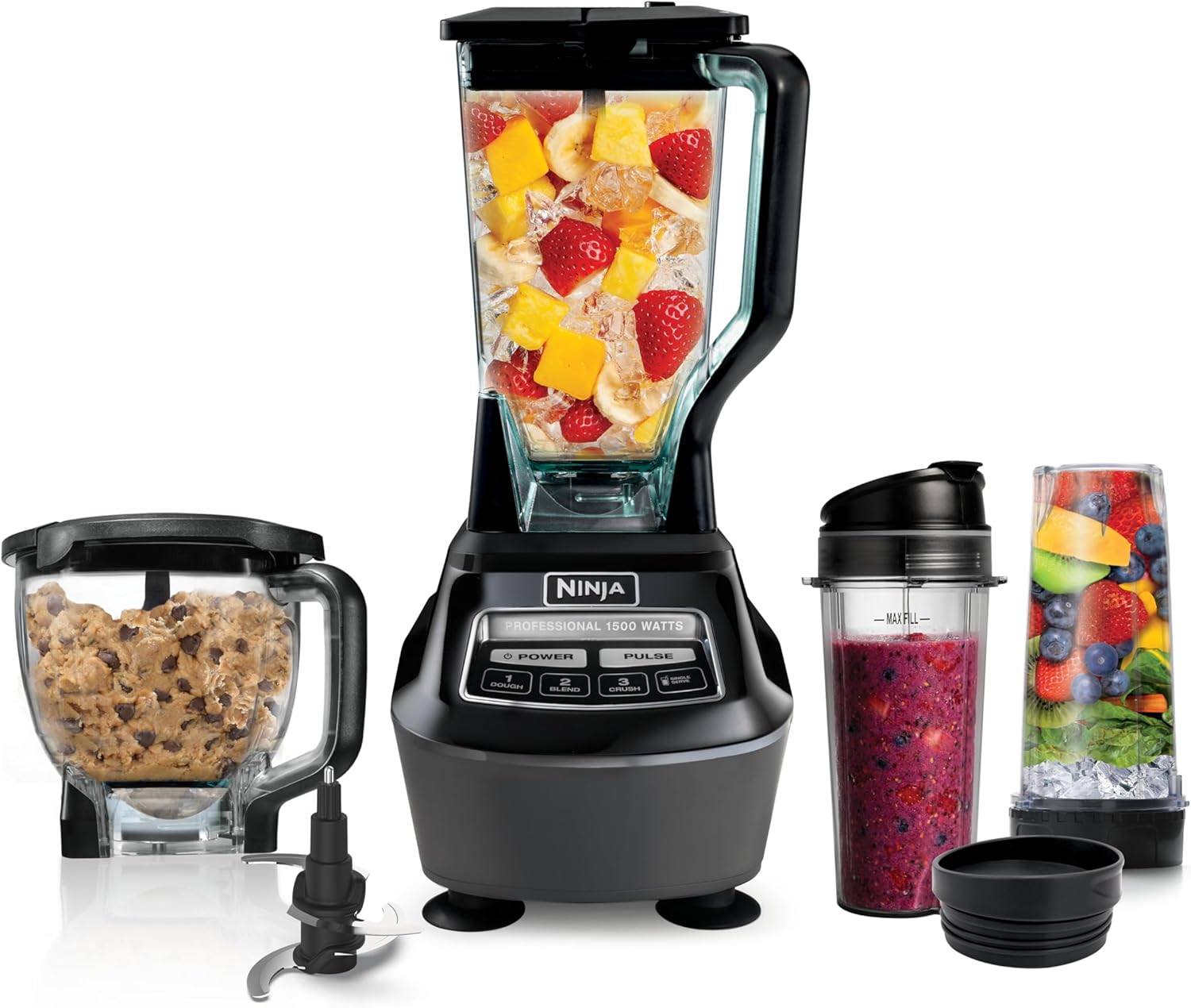
The Ninja Mega Kitchen System BL770 combines a powerful 1500W motor with multiple containers and blade sets to handle most home kitchen tasks. You get an XL 72-oz pitcher with Total Crushing Blades for smoothies and ice crushing, an 8-cup food processor bowl with chopping and dough blades for vegetables and quick dough mixing, plus two 16-oz Nutri Ninja to-go cups for single-serve drinks. Controls are manual with five speeds and four main function modes that make it simple to switch between blending, mixing, crushing, and single-serve work. Most removable parts are dishwasher safe, and the stainless steel blades are effective on frozen fruit and ice. The unit is versatile for batch smoothies, meal prep, and small baking projects, but the motor base is fairly large and the system takes some counter space and storage room. Also, the manual controls lack presets, so you need to watch run times for delicate tasks like purees. For buyers wanting a single machine that covers blending and food processing jobs, it delivers strong performance and a useful accessory set.
Best for: Buyers who want one versatile countertop appliance that handles large-batch smoothies, food prep, and occasional dough mixing without buying separate machines.
Less Ideal for: People with very limited counter or storage space or those who prefer compact single-function appliances with automatic preset programs.
- 1500-watt motor provides strong ice crushing and blending power
- Includes XL 72-oz pitcher plus 8-cup processor and two 16-oz to-go cups for multiple uses
- Multiple specialized blades (total crushing, pro extractor, chopping, dough) cover blending and processing tasks
- Most removable parts are dishwasher-safe for easier cleanup
- Large footprint that requires significant counter or cabinet space
- Manual controls with no preset programs require more user attention for consistent results
Verdict: A powerful, multi-function blender and food processor combo that covers large-batch blending, chopping, and dough mixing for buyers seeking one versatile countertop machine.
Ganiza Food Processor GC10

| Wattage | 450 watts |
|---|---|
| Bowl Capacity | 0.95 gallons |
| Number of Speeds | 2 |
| Power Source | AC |
| Blade Material | Stainless Steel |
The Ganiza GC10 is a small, multipurpose food processor aimed at everyday kitchen prep rather than heavy-duty dough work. It pairs a 450W copper motor with two 8-cup bowls — one glass and one stainless steel — and two S-shaped stainless blades that make quick work of chopping vegetables, grinding meat, or processing nuts and frozen fruit. Safety features include a lid lock and an automatic stop mechanism that halts the blades when the motor head is lifted, plus built-in overheating protection that pauses operation until the unit cools. Practical benefits are easy switching between bowls for separate tasks, removable blades for cleaning, and a compact footprint that fits small counters. Important limitations for the article goal: the motor and two-speed design are geared to chopping and grinding and are not optimized for heavy bread dough mixing or sustained kneading; expect short duty cycles and intermittent cool-down waits when processing dense mixtures. For light doughs or small batches you may get usable results, but this is best as a general prep chopper rather than a dedicated dough mixer.
Best for: A cautious buyer who prioritizes safe, reliable everyday meal prep tools that handle chopping, grinding, and small-batch tasks without needing a commercial mixer.
Less Ideal for: Home bakers who expect to regularly mix or knead large amounts of heavy bread dough should choose a dedicated stand mixer with higher torque and sustained duty ratings instead.
- Two bowls (8-cup glass and 8-cup stainless steel) let you keep wet and dry tasks separate.
- 450W full-copper motor for reasonably consistent chopping and grinding performance.
- Built-in safety features including lid lock, blade auto-stop, and overheating protection.
- Removable stainless steel S-blades are easy to clean and durable.
- Compact footprint suitable for small kitchens and counter storage.
- Motor and two-speed control are not designed for prolonged heavy-duty kneading or large bread doughs.
- Duty cycle limits require cool-down pauses during extended use due to thermal protection.
Verdict: Choose the Ganiza GC10 if you want a safe, compact processor that excels at chopping and light grinding but not heavy bread dough kneading.
Choosing the Right Food Processor for Bread Dough: Key Factors to Consider
Motor Torque and Cooling
Motor torque is the most important factor for processing bread dough because dense, hydrated dough puts constant load on the motor. Higher torque helps the blade or kneading tool move heavy dough without stalling, which results in better gluten development and less stress on the machine.
Cooling design matters because repeated or long kneading cycles generate heat. Look for processors with ventilation, thermal protection, or specifications that indicate continuous-duty capability. Poor cooling can lead to shutoffs or reduced lifespan when you make multiple loaves or work with very stiff doughs.
Bowl Capacity and Shape
Bowl capacity determines how much dough you can make in a single batch. For most home bread baking, a bowl that comfortably handles at least double the final dough volume is practical to avoid overflow and allow the dough to move and fold properly.
The bowl shape is also important. Taller bowls reduce splatter and encourage the dough to circulate, while very shallow bowls force dough against the lid and can gum up the mechanism. Consider how much dough you typically prepare and choose a capacity that matches your usual batch sizes.
Dough Blade and Attachment Design
A dough-specific blade or kneading attachment should have a shape and weight that mimics hand kneading without overworking the gluten. Metal or reinforced dough blades tend to be more durable and maintain their shape when handling sticky dough.
Attachment geometry affects how the dough is folded and developed. Look for blades that reach the bowl sides and encourage even mixing, and verify that the attachment locks securely to prevent wobble during mixing.
Control Options and Run Settings
Controls determine how you manage gentle mixing versus aggressive kneading. Variable speed settings allow you to start slow to hydrate ingredients and then increase speed for kneading. A pulse function helps incorporate add-ins without overworking dough.
Timers or preset dough cycles can be convenient but are not required. More important is the ability to maintain a steady low speed under load so the motor does not hunt or stall during long kneading cycles.
Build Quality and Stability
Bread dough can be heavy and generate torque that transmits to the housing. A stable base with non-slip feet and a robust drive coupling reduces vibration and wear on internal parts.
Metal gear trains or reinforced plastic couplings last longer under repeated dough loads than inexpensive plastic drives. Consider the overall build finish and how the unit feels on a countertop when operating under load.
How Much Dough Can You Make at Home
Estimate typical batch sizes before choosing a processor. If you bake a single sandwich loaf once a week, a medium-capacity bowl is usually fine. If you make multiple artisan loaves or bake larger batches for family meals, opt for the larger-capacity options that allow for 1.5 to 2 kg of finished dough.
Also consider proofing and post-knead handling. Even when a processor can physically mix a large dough, you need space to shape, proof, and store the loaves. Match the appliance capacity to your workflow, not just the maximum bowl volume.
- Small batches: lighter load, faster cleanup
- Large batches: fewer mixes, more countertop space needed
- Leave headroom in the bowl to avoid overflow
Mixing Technique: Hydration and Stages
Start at a low speed to hydrate flour and let the proteins absorb water; this reduces flour dust and minimizes splashing. After the ingredients come together, increase speed modestly to knead until dough forms a smooth, elastic mass.
Avoid forcing high speeds early, which can overwork dough or heat the mixture. For sticky, high-hydration doughs, intermittent pulsing and scraping the bowl can help achieve uniform consistency without overloading the motor.
- Begin slow to hydrate
- Increase speed gradually for kneading
- Use pulse and scrape for sticky doughs
Maintenance and Cleaning Tips
Remove dough attachments promptly and rinse before dried dough hardens. Most dough blades and bowls can be cleaned with warm, soapy water; check whether parts are dishwasher-safe for convenience. Avoid immersing motor housings and always dry components thoroughly before reassembly.
Inspect seals and couplings periodically for dough buildup. A quick wipe after each use prevents residue from hardening and affecting future performance. If a processor has removable seals, clean them on a regular schedule to prevent rancid odors or mold formation.
- Rinse attachments immediately after use
- Clean seals and couplings to prevent buildup
- Do not submerge motor base; dry parts completely
Accessories and Add-Ons That Help Bread Bakers
Useful accessories include extra-large work bowls, dedicated dough blades, and splash covers to reduce mess during high-hydration mixes. A transparent lid with a feed chute can let you add water or oil gradually without stopping the processor.
Consider accessory flexibility. Some processors accept multi-purpose attachments that broaden the machine's utility, while others focus on a dedicated dough setup. Choose based on whether you want a specialized dough workhorse or a multiuse kitchen appliance.
- Splash covers reduce cleanup
- Extra bowls speed batch work
- Dedicated dough blades improve mixing consistency
When a Stand Mixer Might Be Better
Stand mixers remain a strong alternative for very large or very stiff doughs because their planetary action and exposed hook geometry often handle heavy loads differently than a shredding-style processor blade. If you regularly make very high-hydration artisan doughs or very large quantities, compare the workflow tradeoffs.
However, food processors can be faster for short kneading cycles and easier to store. Evaluate your typical recipes and kitchen space to decide which tool better fits your baking routine.
- Stand mixers excel at large, stiff doughs
- Processors can be quicker and more compact
- Consider storage and frequency of use
How We Chose the Best Food Processor for Bread Dough
We prioritized criteria that actually affect dough mixing performance and everyday usability. Motor torque and sustained power were primary filters because kneading dense dough depends more on continuous torque than brief peak wattage. Bowl volume and shape were next: a properly sized and shaped work bowl prevents overflowing and allows dough to form and move without sticking excessively to the sides. We assessed the quality and design of dough/kneading attachments, looking for metal or reinforced plastic tools with the right geometry to simulate hand kneading. Durability and cooling were considered to ensure motors tolerate repeated dough batches without overheating. Ease of cleaning and user ergonomics were factored in since sticky dough tasks require accessible components and safe locking mechanisms. We excluded compact choppers and processors with small bowls or clearly underpowered motors that are not intended for bread dough. Units that lacked a dedicated dough blade or offered only shallow pulse-only operation were not shortlisted. Our evaluations focused on sustained torque, bowl capacity, attachment design, motor cooling, and cleaning ergonomics as the decisive dimensions.
Our full evaluation process is outlined in our review methodology.
FAQ
Can a food processor actually knead bread dough?
Yes, many food processors are capable of kneading bread dough effectively when equipped with a proper dough blade and sufficient motor torque. They perform best for short, intensive kneading cycles rather than prolonged mixing.
How much dough can I safely mix in a typical processor bowl?
Capacity varies by model, but a practical rule is to allow space for the dough to move. Aim for a bowl that holds at least twice the final dough volume to prevent overflow and ensure even mixing.
Will processing dough heat it up too much?
Short kneading cycles usually do not overheat dough, but prolonged runs or repeated batches can raise temperature. Use intermittent pauses, monitor dough temperature, and prefer units with good cooling if you bake frequently.
What cleaning precautions should I take after kneading dough?
Remove and rinse attachments immediately to prevent dried-on residue. Clean seals and couplings regularly and avoid immersing the motor base. Dry all parts thoroughly before storage to prevent odors or mold.
Do I need a special blade to knead dough in a processor?
A dedicated dough blade is recommended because it is shaped and weighted for folding and developing gluten. General-purpose chopping blades may not distribute force correctly and can produce inconsistent results.
Final Verdict
Pick a food processor for bread dough based on the amount you bake and how often you need continuous kneading. Prioritize motor torque, a suitably sized bowl, and a well-designed dough blade because these elements most directly affect dough quality and machine longevity. Expect tradeoffs between capacity and countertop footprint; choose the model that matches your batch sizes and cleaning preferences for the best long-term results.