
Note: This article contains affiliate links. If you click on these links and make a purchase, we may earn a small commission at no extra cost to you. This helps support our research and content. Read our full affiliate disclosure here.
If you bake bread regularly, choosing the right food processor can dramatically cut mixing time and reduce hand fatigue while producing more consistent dough. A processor designed to handle bread dough helps you form gluten quickly, mix wet batters without overworking, and free up time for proofing and shaping. This guide covers the top shortlisted food processors for bread, chosen for their motor strength, bowl capacity, and dough-handling durability. We evaluate models against practical, kitchen-focused criteria so you can pick the unit that matches your recipe load and routine. Read on for the factors we used and what matters when mixing dough at home.
Top Picks at a Glance
| Best Overall The best all-around choice for most situations | Cuisinart 14-Cup Food Processor DFP-14BCNY |  |
| Best Quality Built to a higher standard if you want something more solid | Breville Sous Chef 16 Cup |  |
| Best Value The sweet spot between price and what you get | Hamilton Beach Stack & Snap 12-Cup |  |
| Best Budget The cheapest option that still gets the job done reliably | Hamilton Beach 10-Cup Food Processor 70730 |  |
| Top Rated A top-rated pick with lots of positive feedback | Ninja PrecisionPro BZ601 |  |
| Most Popular A crowd favorite that many people choose with confidence | Ninja Mega Kitchen System BL770 |  |
| Best Seller A high-volume bestseller chosen again and again | Ganiza Food Processor GC10 |  |
Cuisinart 14-Cup Food Processor DFP-14BCNY

| Wattage | 720 watts |
|---|---|
| Bowl Capacity | 14 cups |
| Number of Speeds | 1 |
| Power Source | Corded Electric |
| Blade Material | Stainless Steel |
The Cuisinart 14-cup food processor is a heavy-duty countertop unit built around a 720-watt motor and a roomy work bowl that handles large batches and dough mixing. It ships with a stainless steel chopping/mixing blade plus a 4mm slicing disc and medium shredding disc, and the extra-large feed tube accepts full fruits and vegetables to speed prep. Controls are simple—on and off/pulse—which keeps operation straightforward but limits speed precision. Dishwasher-safe parts and a detachable disc stem make cleanup easier than older commercial-style machines. For bread and dough work the motor and large capacity let you mix and knead heavier batters and doughs with less effort than smaller models, though the single-speed control means you must use pulse technique for delicate dough handling. The unit is solidly built in brushed stainless steel but is fairly heavy, so it is better as a permanent counter appliance than a portable one. It is a practical choice for cooks who want a reliable, no-frills processor that can also tackle dough tasks reliably.
Best for: Buyers who want a robust, all-around food processor that can handle large batches and bread-making tasks without fuss and who prioritize capacity and motor strength over variable speed controls.
Less Ideal for: Those who need precise multi-speed control for delicate doughs or who require a lightweight, highly portable machine for occasional use.
- Powerful 720-watt motor suitable for mixing and kneading dough.
- Large 14-cup bowl for big batches and family-sized prep.
- Includes stainless steel slicing and shredding discs plus chopping blade.
- Dishwasher-safe removable parts and detachable disc stem for easier cleaning.
- Extra-large feed tube speeds prep of whole fruits and vegetables.
- Only a single speed plus pulse control limits fine speed control for delicate doughs.
- Relatively heavy unit makes it less convenient to move or store frequently.
- Shredding and slicing discs are not adjustable for thickness variation.
Verdict: A sturdy, high-capacity processor with a strong motor that reliably handles large batches and bread dough for cooks who value power and capacity over variable-speed finesse.
Breville Sous Chef 16 Cup

| Wattage | 1450 watts |
|---|---|
| Bowl Capacity | 16 cups |
| Number of Speeds | 1 |
| Power Source | electric |
The Breville Sous Chef 16 is a high-capacity, performance-focused food processor built around a powerful 1450W induction motor and a range of stainless-steel blades and discs. It is designed for serious home cooks who need consistent, repeatable results when slicing, shredding, making French fries, kneading dough and pureeing large batches. The machine includes an adjustable 24-setting slicer, reversible shredding disc, French fry disk, S-blade, dough blade and a mini bowl for small jobs, plus a large 5.5-inch feed chute that reduces pre-cutting. Practical benefits include strong torque for dense doughs, durable stainless-steel construction, dishwasher-safe parts and onboard storage for attachments. The size and power make it well suited to multiple loaves of bread dough or frequent baking prep, though the unit is relatively large and heavy which affects countertop space and moving it around. Controls are straightforward but the processor occupies more storage than compact models and may be more appliance than casual users need.
Best for: Serious home bakers and performance-oriented cooks who prioritize motor strength, consistent results and the capacity to handle multiple loaves of dough and large-batch prep.
Less Ideal for: Occasional cooks or anyone with very limited counter or storage space who would prefer a compact, lightweight machine for occasional tasks.
- Powerful 1450W induction motor with high torque for handling dense doughs and large batches
- Large 16-cup bowl and 5.5-inch feed chute reduce pre-prep and let you process bigger pieces
- Comprehensive accessory set including adjustable slicer, reversible shredder, dough blade and French fry disk
- Durable stainless-steel construction and dishwasher-safe parts for longevity and easy cleanup
- Large and heavy footprint makes it less convenient to move or store in small kitchens
- Single-speed control limits fine incremental speed variation compared with multi-speed competitors
Verdict: Choose the Sous Chef 16 if you want a high-torque, large-capacity food processor that reliably handles bread dough and heavy-duty baking prep.
Hamilton Beach Stack & Snap 12-Cup

| Wattage | 450 watts |
|---|---|
| Bowl Capacity | 12 cups |
| Number of Speeds | 2 |
| Blade Material | Stainless Steel |
The Hamilton Beach Stack & Snap 12-Cup food processor is built to handle medium to large prep tasks without complicated assembly. It uses Stack & Snap technology so the bowl and lid line up and lock quickly, and the big-mouth chute accepts whole potatoes or tomatoes to reduce pre-cutting. The included S-blade and reversible slicing/shredding disc cover everyday needs like chopping, pureeing, shredding cheese, and slicing vegetables, and the 450-watt motor provides steady power for routine jobs. Removable parts are dishwasher safe and the sealed center bowl helps prevent leaks while processing. For bread-related tasks it can mix dough-like batters and chop nuts or dried fruit, but it lacks a dedicated dough blade and higher wattage motors found on heavier-duty models, so dense bread doughs may require short pulses and manual finish by hand. Suction-cup feet improve stability during use. Overall it is a practical, easy-to-use machine for most home baking prep when you value simplicity and cleanup convenience.
Best for: Buyers who prioritize straightforward setup, fast cleanup, and reliable everyday prep for baking and cooking where occasional dough mixing and large batches are needed.
Less Ideal for: Those who frequently make heavy, long-knead bread doughs or want a processor designed specifically for extended dough kneading and very dense mixtures should consider more powerful, dough-capable models.
- Large 12-cup sealed bowl handles bigger batches and reduces spills
- Stack & Snap design makes assembly and disassembly fast and intuitive
- Big-mouth chute accepts whole produce to save prep time
- Dishwasher-safe removable parts simplify cleanup
- Stainless steel blades and reversible disc cover common slicing, shredding, and chopping tasks
- 450-watt motor is modest for heavy dough kneading or very dense mixtures
- Does not include a dedicated dough blade for long kneading sessions
Verdict: A user-friendly 12-cup processor that speeds prep and cleanup for home bakers who need larger batches but do not require heavy-duty dough-kneading capability.
Hamilton Beach 10-Cup Food Processor 70730

| Wattage | 450 watts |
|---|---|
| Bowl Capacity | 10 cups |
| Number of Speeds | 2 |
| Power Source | Wall outlet |
The Hamilton Beach 10-Cup Food Processor is a straightforward countertop unit aimed at everyday prep tasks. It uses a 450 watt motor with two speeds plus pulse and includes an S-blade for chopping and a reversible disc for slicing and shredding, so it handles salads, sauces, and cheese easily. The standout is the built-in bowl scraper that moves ingredients back toward the blade without stopping to use a spatula, which keeps processing even and saves cleanup time. The large feed chute reduces pre-cutting and the BPA-free, dishwasher-safe removable parts make cleanup simple. For bread-related tasks this model can mix and puree fillings, chop nuts, and grate cheese for toppings, but it lacks a dedicated dough hook or high-capacity motor for heavy kneading, so it is not designed to replace a stand mixer for making large or dense bread doughs. Overall the unit offers reliable basic performance and useful convenience features for routine kitchen prep at a modest power level.
Best for: Buyers looking for an affordable, no-frills processor to speed everyday prep—chopping, shredding, grating, and mixing small batches—who prioritize convenience over heavy-duty dough kneading.
Less Ideal for: People who need a machine to knead large or dense bread doughs or who want a powerful, mixer-like appliance for frequent artisanal bread baking should choose a stand mixer or a higher-powered processor with dough tools.
- Built-in bowl scraper keeps ingredients near the blade for more even processing
- Includes S-blade and reversible slicing/shredding disc for multiple prep tasks
- Large feed chute reduces need for pre-cutting
- Dishwasher-safe, BPA-free removable parts simplify cleanup
- 450W motor and two speeds are modest for heavy dough mixing or large batches
- No dedicated dough hook or kneading accessory for bread dough
Verdict: A wallet-friendly 10-cup processor with a clever bowl scraper and useful slicing/shredding tools that speeds routine prep but is not built for heavy dough kneading.
Ninja PrecisionPro BZ601

| Wattage | 1000 watts |
|---|---|
| Bowl Capacity | 9 cups |
| Number of Speeds | 3 |
| Power Source | ac_dc |
The Ninja PrecisionPro BZ601 is a compact 9-cup food processor built around a 1000-peak-watt motor and Auto-iQ presets that simplify common tasks like chopping, slicing, shredding, pureeing, and mixing dough. It includes a chopping blade, dough blade, and a reversible slicing/shredding disc plus an XL feed chute for handling whole vegetables or batch prep. Auto-iQ preset programs provide one-touch operation for repeatable results, while manual speed settings let you control texture when making dough or delicate purees. Stainless steel blades and dishwasher-safe, BPA-free parts make cleanup straightforward. For bread and dough work the dedicated dough blade and strong motor will handle mixing and light kneading for home loaves and pizza dough, though the 9-cup bowl size limits very large batches. The design balances power and footprint so it fits easily on most counters but users who need heavy commercial kneading or very large bread batches may prefer a stand mixer with a larger capacity.
Best for: Home bakers who prioritize a reliable, compact machine that can mix and knead dough for typical loaves and pizzas while also handling everyday chopping and slicing tasks.
Less Ideal for: People who regularly bake very large loaves, batches, or use heavy commercial-style doughs should consider a larger-capacity stand mixer instead.
- Powerful 1000-peak-watt motor suitable for mixing and light kneading
- Includes dough blade plus chopping blade and reversible slicing/shredding disc for versatile prep
- Auto-iQ presets simplify one-touch operations for consistent results
- Dishwasher-safe, BPA-free components and stainless steel blades for easy cleaning
- 9-cup bowl limits the size of dough batches you can mix in one go
- Not designed for heavy commercial kneading or very dense doughs
Verdict: Choose the Ninja PrecisionPro BZ601 when you want a dependable, countertop food processor that reliably mixes and kneads home-sized bread dough while also handling slicing and chopping.
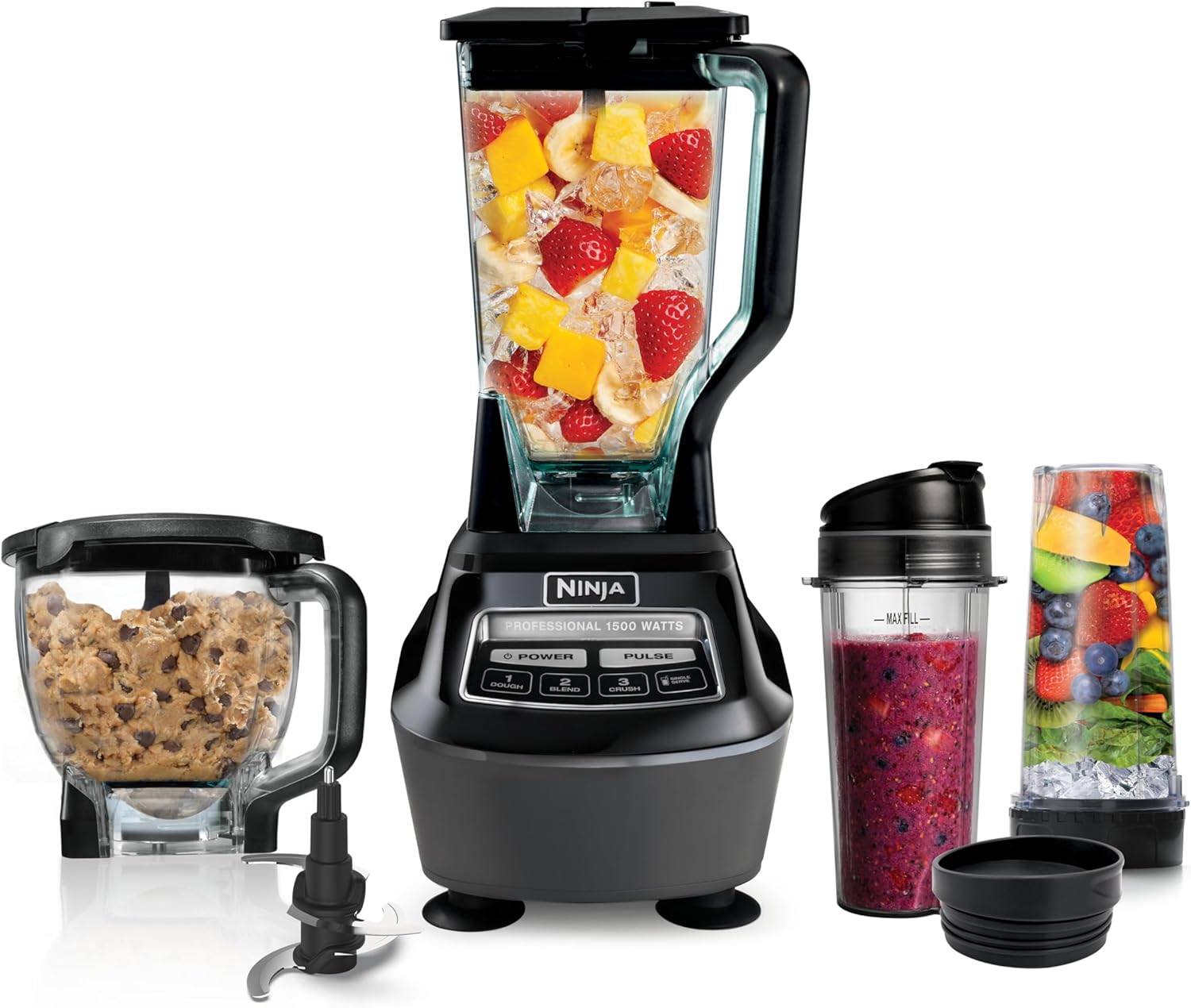
Ninja Mega Kitchen System BL770
| Wattage | 1500 watts |
|---|---|
| Number of Speeds | 5 |
| Capacity | 16 fluid ounces |
| Power Source | ac_dc |
The Ninja Mega Kitchen System BL770 combines a powerful 1500W motor with multiple containers and blade sets to handle most home kitchen tasks. You get an XL 72-oz pitcher with Total Crushing Blades for smoothies and ice crushing, an 8-cup food processor bowl with chopping and dough blades for vegetables and quick dough mixing, plus two 16-oz Nutri Ninja to-go cups for single-serve drinks. Controls are manual with five speeds and four main function modes that make it simple to switch between blending, mixing, crushing, and single-serve work. Most removable parts are dishwasher safe, and the stainless steel blades are effective on frozen fruit and ice. The unit is versatile for batch smoothies, meal prep, and small baking projects, but the motor base is fairly large and the system takes some counter space and storage room. Also, the manual controls lack presets, so you need to watch run times for delicate tasks like purees. For buyers wanting a single machine that covers blending and food processing jobs, it delivers strong performance and a useful accessory set.
Best for: Buyers who want one versatile countertop appliance that handles large-batch smoothies, food prep, and occasional dough mixing without buying separate machines.
Less Ideal for: People with very limited counter or storage space or those who prefer compact single-function appliances with automatic preset programs.
- 1500-watt motor provides strong ice crushing and blending power
- Includes XL 72-oz pitcher plus 8-cup processor and two 16-oz to-go cups for multiple uses
- Multiple specialized blades (total crushing, pro extractor, chopping, dough) cover blending and processing tasks
- Most removable parts are dishwasher-safe for easier cleanup
- Large footprint that requires significant counter or cabinet space
- Manual controls with no preset programs require more user attention for consistent results
Verdict: A powerful, multi-function blender and food processor combo that covers large-batch blending, chopping, and dough mixing for buyers seeking one versatile countertop machine.
Ganiza Food Processor GC10

| Wattage | 450 watts |
|---|---|
| Bowl Capacity | 0.95 gallons |
| Number of Speeds | 2 |
| Power Source | AC |
| Voltage | 120 volts_of_alternating_current |
The Ganiza GC10 is a small countertop food processor designed for everyday meal prep tasks like chopping vegetables, grinding meat, and making sauces. It ships with two 8-cup bowls—one glass and one stainless steel—so you can separate uses and avoid cross-contamination, and two sets of stainless steel S-blades let you switch between tougher and softer ingredients. The 450W copper-core motor runs two speeds and includes overheating protection, which pauses operation if the unit gets too hot and requires a short cool-down before restarting. Controls are simple and safety features such as a safety lock and spring-loaded blade stop make it straightforward to operate. The unit is best for batch prep for small households rather than heavy commercial use; continuous long runs will trigger the thermal cutoff. Cleanup is easier with removable blades and dishwasher-safe bowls, though the glass bowl is heavier to handle. For home bakers looking at bread prep, this unit is useful for chopping add-ins and grinding small amounts of meats or nuts but not for kneading large batches of dough.
Best for: Buyers who prioritize safe, reliable everyday meal prep tools and want a compact processor that reduces cross-contamination between wet and dry tasks.
Less Ideal for: People who need a heavy-duty machine for frequent large-batch dough kneading or continuous commercial-style processing should look at higher-capacity units.
- Two 8-cup bowls (glass and stainless steel) to separate tasks and reduce flavor transfer
- 450W copper-core motor with two speeds for quick chopping and grinding
- Safety lock and spring-loaded blade stop reduce risk during use
- Overheating protection helps prevent motor damage during heavy use
- Removable blades and bowls simplify cleaning
- Not designed for continuous heavy-duty kneading or very large dough batches
- Thermal cutoff requires waiting for the motor to cool before resuming extended tasks
Verdict: Choose the Ganiza GC10 if you want a compact, safety-focused food processor that handles everyday chopping, grinding, and small batch prep reliably.
Choosing the Right Food Processor for Bread: Key Factors to Consider
Motor Torque and Continuous Power
Bread dough is dense and requires sustained torque to develop gluten properly. A processor with high peak wattage is useful, but continuous torque and a stable motor under load matter more for kneading than short bursts of speed.
Look for units that specify continuous duty capability or have features to prevent motor stall. Overheated motors not only slow the mixing process but can also shorten appliance life, so cooling and thermal protection are important practical considerations.
Bowl Capacity and Shape
Capacity determines how large a batch you can mix without overflowing or under-kneading. Most home bread recipes benefit from a bowl that comfortably holds the combined flour, water, and rising space. A shallow, wide bowl helps ingredients incorporate faster, while a tall narrow bowl may impede proper folding and kneading.
Consider the typical loaf size you make and allow room for the dough to expand slightly during initial mixing. Removable, clearly marked bowls also simplify ingredient measurement and cleanup.
Dough Blade and Attachment Design
A dough blade that mimics folding and pushing action is better than a sharp slicing blade for developing gluten structure. Rounded, blunt blades or specially shaped dough hooks reduce cutting the dough and instead fold and stretch it, resulting in better crumb and elasticity.
Attachment stability and shaft robustness matter because dough applies lateral force. Loose or flexible attachments will produce inconsistent results and increase wear on the motor coupling.
Durability and Thermal Management
Kneading bread dough is a heavy-duty task compared with chopping vegetables. Durable gear trains, metal couplings, and efficient heat dissipation extend service life. Processors that add cooling vents, fan-assisted motors, or thermal cutoffs prevent shutdowns mid-knead and protect internal components.
Also consider warranty coverage and the availability of replacement parts; rugged construction reduces the chance of breakdowns from repeated dough cycles.
Ease of Cleaning and Maintenance
Dough is sticky and can build up on blades, bowl rims, and seals. Dishwasher-safe bowls and removable blades save time after heavy use. Smooth, accessible crevices and a removable drive shaft make thorough cleaning simpler and help prevent residual dough from hardening in hard-to-reach places.
Routine maintenance like checking seals and re-greasing couplings when recommended also keeps performance consistent over time.
Speed Control and Pulse Options
Controlled speed settings let you start with a slow mix to hydrate ingredients, then increase to knead without splattering. Variable speeds reduce the risk of over-working the dough, which can make loaves dense. A reliable pulse feature is useful for short mixes or for re-incorporating ingredients without continuous high-torque load.
Look for tactile, graduated speed controls rather than single-speed units for greater versatility with a range of dough hydration levels.
How Bread Dough Behavior Affects Processor Choice
Bread dough goes through distinct stages—hydration, gluten development, and shaping—and each stage places different demands on a processor. Early mixing needs even hydration and gentle folding, while kneading requires consistent torque to stretch gluten chains without tearing them.
Understanding these stages helps you prioritize motor strength and blade action over extras like slicing discs when your main goal is bread making.
- Hydration: slow speeds to fully incorporate liquids.
- Gluten development: sustained torque, gentle folding blades.
- Shaping: minimal over-mixing to preserve gas pockets for rise.
Batch Size Planning and Recipe Scaling
Match bowl capacity to the batch sizes you bake most often. If you plan to double recipes for freezing or family-sized loaves, choose a processor with extra capacity and a robust motor to handle the increased load.
If you occasionally make small loaves or experiment with high-hydration recipes, look for processors that perform predictably across a range of fill levels without stalling or splashing.
- Small batches: allow room for movement to develop gluten.
- Large batches: ensure motor and bowl volume are rated for heavier loads.
Practical Tips for Using a Food Processor for Bread
Start mixes at low speed to avoid dry flour clouds, then ramp up as the dough comes together. Use short runs with pauses to check texture and avoid overheating the motor. Scrape the bowl occasionally if the recipe calls for it.
When working with high-hydration doughs, add water in stages and consider using a bench scrape after a short rest to finish shaping rather than forcing very wet dough through a processor.
- Pre-measure ingredients and add liquid gradually.
- Pause to check dough temperature if kneading long enough to warm it.
Maintenance Checklist to Keep Dough Performance Consistent
Wipe attachments and seals after each use, and remove stubborn dough before it hardens. Regularly inspect the drive coupling and any rubber seals for wear. Replace worn components promptly to maintain efficient power transfer.
If your processor has a cooling fan or vents, keep them free of dust and debris. Follow manufacturer guidance on periodic service to prolong performance under frequent dough workloads.
- Clean blades and bowls immediately after use.
- Inspect couplings and seals monthly with heavy use.
When to Use a Food Processor Vs. Other Methods
A food processor excels at quick dough development for standard yeast breads where a short, forceful knead produces good gluten structure. It is less suitable for very large commercial batches or for doughs that benefit from long, slow fermentation and hand folding.
If you prefer an artisan sponge-and-fold technique or long autolyse periods, a processor can still speed early mixing but may not replace manual handling during shaping and final folds.
- Ideal for quick kneads and consistent small-to-medium batches.
- Less ideal for long, low-temperature fermentation workflows.
How We Chose the Best Food Processor for Bread
We shortlisted food processors that specifically handle bread dough reliably, focusing on attributes that matter to home bakers. Key evaluation dimensions included motor torque and continuous power delivery for kneading dense dough, bowl capacity and shape to accommodate rising dough and large batches, and the quality of the dough blade and shaft to form gluten without shredding. We also judged ease of cleaning and dishwasher-safe parts, since dough and sticky attachments can be time-consuming to clean. Build durability and cooling performance were considered to ensure a processor can handle repeated dough cycles without overheating. We excluded units designed only for light prep tasks or marketed for slicing and shredding without sufficient motor torque for dough work. Very small-capacity mini-processors were filtered out because they cannot handle standard bread batch sizes. The final selections balance power, capacity, and serviceability to meet the practical needs of home bread bakers.
Our full evaluation process is outlined in our review methodology.
FAQ
Can a standard food processor knead all types of bread dough?
Often, yes for many standard yeast doughs, but very heavy doughs like dense rye or very high-hydration batters may exceed some processors' capabilities. Choose based on motor torque and bowl capacity for your usual recipes.
How long should I run a processor to knead dough?
Typically short cycles totaling a few minutes are enough to develop gluten. Run in bursts with pauses to check texture and avoid overheating the motor. Exact time depends on dough hydration and mixer strength.
Will a food processor overwork my dough?
It can if left running too long at high speed. Using correct speed settings and checking dough elasticity during short intervals prevents overworking and keeps crumb structure light.
Is it better to use a dough blade or a metal blade?
A blunt or specially shaped dough blade is generally better for gluten development because it folds rather than slices the dough. Metal cutting blades can work for some mixes but may cut strands and reduce elasticity.
How do I prevent my processor motor from overheating?
Use short mixing intervals, allow cooling pauses during long kneads, and avoid continuously overloading the bowl. Units with thermal cutoff and adequate ventilation will also manage heat better.
Final Verdict
Prioritize motor torque, bowl capacity, and appropriate dough blade design when choosing a food processor for bread. These factors determine whether a unit can reliably develop gluten, handle the batch sizes you plan, and survive repeated dough cycles. Balance those priorities against ease of cleaning and serviceability to match your baking habits. For most home bakers, a processor that combines sustained power, a roomy bowl, and dishwasher-safe parts offers the best practical compromise. Focus on the performance dimensions discussed here to pick a model that will consistently produce good dough without unnecessary maintenance headaches.