
Note: This article contains affiliate links. If you click on these links and make a purchase, we may earn a small commission at no extra cost to you. This helps support our research and content. Read our full affiliate disclosure here.
If you run a busy professional kitchen, choosing the right food processor for commercial use shapes how fast and reliably you finish prep service. Commercial-grade processors differ from home models in capacity, motor longevity, and serviceability, and selecting the right one helps you avoid bottlenecks, frequent repairs, and inconsistent results. This guide shortlists the top commercial food processors across capacities and duty cycles and explains the practical criteria we used to evaluate them. Read on for a concise overview of the features that matter most to restaurateurs, caterers, and institutional kitchens, then review our picks tailored to high-volume food prep.
Top Picks at a Glance
| Best Overall The best all-around choice for most situations | Breville Sous Chef 9 Cup |  |
| Best Quality Built to a higher standard if you want something more solid | Robot Coupe R2B Food Processor |  |
| Best Value The sweet spot between price and what you get | Hamilton Beach Stack & Snap 12-Cup Food Processor |  |
| Best Budget The cheapest option that still gets the job done reliably | Hamilton Beach 8-Cup Food Processor 70740 |  |
| Top Rated A top-rated pick with lots of positive feedback | Breville Sous Chef 16 Cup |  |
| Most Popular A crowd favorite that many people choose with confidence | Ninja Professional Plus BN601 |  |
| Best Seller A high-volume bestseller chosen again and again | Cuisinart 14-Cup Food Processor DFP-14BCNY |  |
Breville Sous Chef 9 Cup
| Wattage | 625 watts |
|---|---|
| Bowl Capacity | 9 cups |
| Number of Speeds | 1 |
| Voltage | 120 volts |
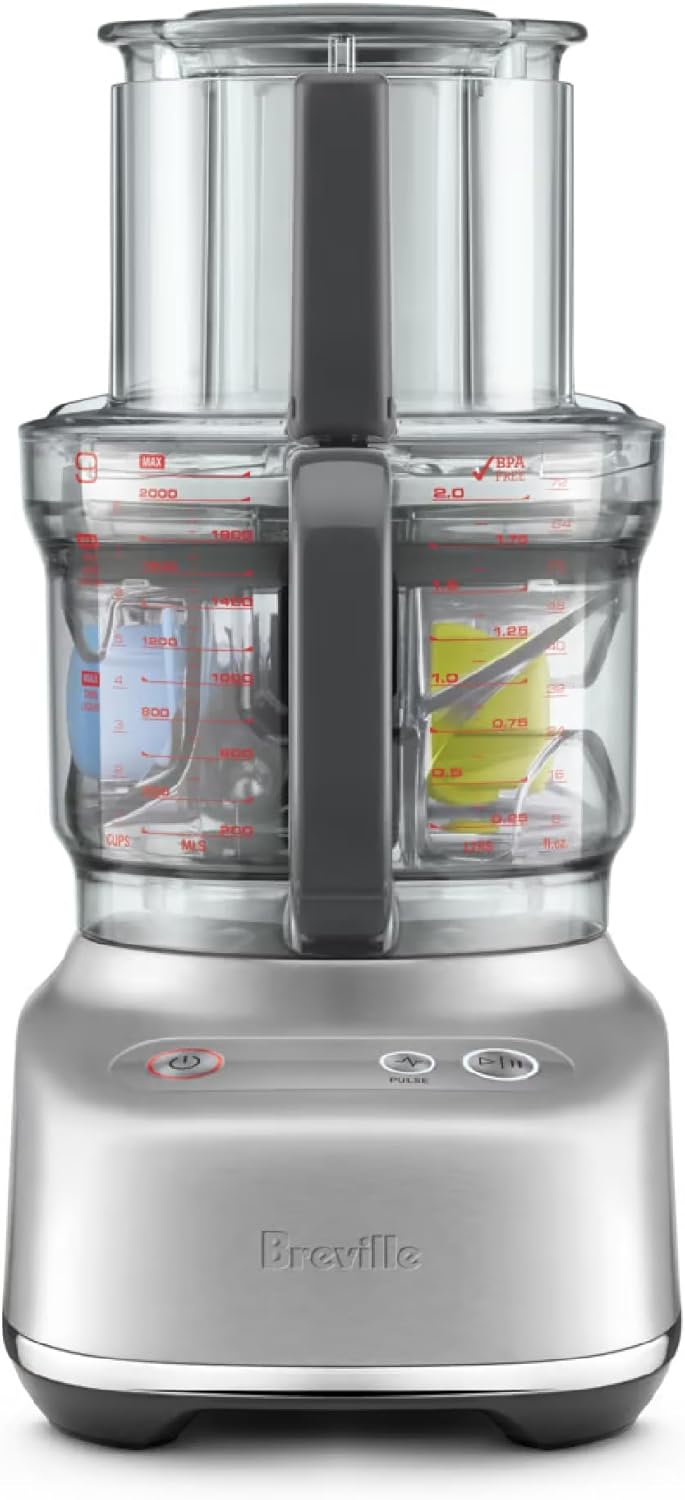
The Breville Sous Chef 9 Cup is a compact but capable food processor aimed at home cooks who want professional results without a large footprint. It uses a heavy-duty induction motor and direct-drive design to handle tough tasks like shredding, slicing, and kneading, while a 9-cup bowl and wide 2-in-1 feed chute let you process a range of ingredients quickly. The unit includes an onboard storage caddy and color-coded attachments — an S-blade, dough blade, reversible shredder, and adjustable slicer with 15 settings — which make setup and switching tasks straightforward. Controls are simple and cleaning is easier because removable parts and plastic components that contact food are dishwasher safe and made from BPA-free material. For commercial-heavy kitchens this model is smaller than full commercial processors, so you may need to run more batches for large volumes, but for prep stations with moderate throughput it delivers consistent cuts and solid durability backed by a long motor warranty.
Best for: Buyers who want a compact, high-performance processor that delivers consistent, professional-style results for moderate-volume prep and values organized storage and versatile cutting options.
Less Ideal for: Large commercial kitchens or caterers that need single-pass processing of very large quantities should choose a full-size commercial food processor instead.
- Powerful induction motor with direct drive handles dense ingredients reliably
- Wide 2-in-1 feed chute saves prep time by accommodating larger pieces
- Onboard storage caddy and color-coded attachments keep tools organized
- Adjustable slicer with up to 15 settings provides precise, repeatable cuts
- Bowl and food-contact parts are dishwasher safe and BPA free
- 9-cup capacity requires multiple batches for high-volume commercial prep
- Designed for home kitchens so lacking some heavy-duty commercial safety/features
Verdict: A compact, durable processor that brings near-commercial cutting precision to moderate-volume prep stations thanks to its induction motor and versatile attachments.
Robot Coupe R2B Food Processor

| Wattage | 1725 watts |
|---|---|
| Bowl Capacity | 2.8 liters |
| Number of Speeds | 1 |
| Voltage | 120 |
The Robot Coupe R2B is a purpose-built commercial cutter-mixer aimed at fast, repeatable prep tasks in busy kitchens. It uses a 1 HP motor running at about 1725 rpm with a pulse control and a stainless steel S blade to handle chopping, pureeing, sauces, and light dough work, while the 2.8 liter polycarbonate bowl and wide chute speed small-batch processing. Safety features include a safety lock and a motor brake, and many removable components are dishwasher safe for quicker cleanup. Because it is a single-speed unit with pulse, it is simple to operate and durable, but it is not intended for continuous heavy-duty commercial tasks that require larger bowls or multiple speeds. The compact footprint makes it easy to fit on crowded counters, and the combination of plastic and stainless materials keeps the unit relatively easy to maintain. For kitchens needing a reliable, high-performance small commercial processor, the R2B offers solid throughput and longevity, but restaurants that require large-volume or variable-speed processing may need a larger model.
Best for: Commercial kitchens or foodservice operators who prioritize powerful, reliable small-batch processing and a compact, easy-to-clean cutter-mixer for prep tasks.
Less Ideal for: Large-scale operations that need high-volume continuous throughput or processors with multiple speed settings for precise texture control.
- Powerful 1 HP motor delivering 1725 rpm for quick processing
- Stainless steel S blade handles chopping, purees, and light dough
- Compact footprint suited to crowded commercial countertops
- Dishwasher-safe polycarbonate bowl and removable parts for easier cleaning
- Single speed with pulse control limits fine speed control for delicate tasks
- 2.8 liter bowl may be small for high-volume continuous production
Verdict: A compact, high-performance commercial cutter-mixer built for reliable small-batch prep in busy kitchens.
Hamilton Beach Stack & Snap 12-Cup Food Processor

| Bowl Capacity | 12 cups |
|---|---|
| Wattage | 450 watts |
| Number of Speeds | 2 |
| Blade Material | Stainless Steel |
| Power Source | ac_dc |
The Hamilton Beach Stack & Snap 12-cup Food Processor is a straightforward countertop processor built for frequent prep tasks like chopping, shredding, slicing and pureeing. Its Stack & Snap design makes assembly and disassembly fast, which saves time during repeated use, and the sealed 12-cup bowl handles larger batches without center leaks. The 450-watt motor powers through cheeses, vegetables and herbs, while the included S-blade and reversible slicing/shredding disc cover most everyday commercial kitchen needs. A big-mouth chute reduces pre-cutting and speeds throughput, and suction-cup feet keep the unit stable on busy counters. Removable, dishwasher-safe parts and BPA-free food zones make cleanup easy between service runs. Limitations for heavy commercial kitchens include the modest 450-watt motor and plastic construction, which may not hold up to nonstop high-volume use or very tough jobs; this model is better suited to prep stations that need reliable, cost-conscious processing rather than industrial endurance. For setups that prioritize quick assembly, simple operation, and easy cleaning, this processor delivers sensible performance.
Best for: Buyers running small to medium commercial prep stations who need a dependable, easy-to-clean processor that speeds routine batch work and minimizes assembly time.
Less Ideal for: High-volume restaurants or commercial operations that require industrial-strength machines for continuous heavy-duty processing should consider larger, commercial-rated processors.
- Easy Stack & Snap assembly reduces setup time between tasks
- 12-cup sealed bowl accepts larger batches with minimal leaks
- Big-mouth chute accepts whole produce to reduce prep
- Dishwasher-safe removable parts simplify cleanup
- Includes versatile S-blade plus reversible slicing/shredding disc
- 450-watt motor may struggle with very dense or continuous heavy-duty processing
- Mostly plastic construction may wear faster under commercial-level use
Verdict: A practical, easy-to-use 12-cup processor that speeds routine prep with quick assembly and easy cleanup for small to medium commercial kitchens.
Hamilton Beach 8-Cup Food Processor 70740

| Bowl Capacity | 8 cups |
|---|---|
| Wattage | 450 watt-hours |
| Number of Speeds | 2 |
| Power Source | AC |
The Hamilton Beach 8-Cup Food Processor is a straightforward, budget-friendly machine for routine prep tasks like chopping, pureeing, slicing and shredding. It uses a 450 watt motor with two speeds plus pulse to handle blocks of cheese, vegetables and soft dough-like mixtures, while the stainless steel S-blade and reversible disc provide basic slicing and shredding functions. The large feed chute reduces pre-cutting, and the bowl, lid and blades are dishwasher-safe for faster cleanup. The lid nests inside the bowl for compact storage, which helps in tight back-of-house spaces. While the motor is capable for steady home use and short burst commercial tasks, it is not built as a heavy-duty continuous-use commercial unit and may show wear under constant restaurant-level loads. Controls are simple and intuitive, but accessory options are limited compared with higher-end commercial processors. For kitchens wanting a low-cost, space-saving processor for light prep and occasional high-volume days, this model covers core needs efficiently.
Best for: Small commercial kitchens, food trucks, or cafes that need an inexpensive, space-saving processor for light to moderate prep tasks and occasional busy periods.
Less Ideal for: High-volume restaurants or production kitchens that require continuous, heavy-duty processing or a wider range of industrial attachments.
- Compact 8-cup capacity fits small prep stations and stores easily
- Large feed chute accepts larger pieces and reduces chopping prep
- Stainless steel S-blade and reversible shredding/slicing disc add basic versatility
- Dishwasher-safe bowl, lid and blades speed cleanup
- Simple 2-speed plus pulse controls are easy to operate during busy shifts
- 450 W motor is suitable for light commercial bursts but not continuous heavy-duty use
- Limited accessory set compared with commercial-grade processors
Verdict: If you need a low-cost, compact processor for light commercial prep and occasional busy service, this Hamilton Beach 8-cup model gives reliable basic performance and easy cleanup.
Breville Sous Chef 16 Cup

| Wattage | 1450 watts |
|---|---|
| Bowl Capacity | 16 cups |
| Voltage | 120 volts |
| Power Source | electric |
The Breville Sous Chef 16 is a large-capacity food processor built to handle heavy, repeatable prep tasks in a busy kitchen. Its 1450W induction motor and direct-drive design provide high torque for shredding, slicing, French frying and kneading without bogging down, while the 16-cup BPA-free bowl and extra-large 3-in-1 feed chute reduce pre-cutting and let you process larger pieces faster. The package includes a 24-setting adjustable slicing deck, reversible shredding disc, French fry disk, S-blade, dough blade and mini attachments, which translate to consistent results across batches and quicker changeovers. Removable parts are dishwasher-safe and Breville supplies storage containers for the accessories to keep a cramped prep station tidy. The unit is heavy and sizable, so it demands stable counter space and may be overkill for solitary small-quantity tasks, and its single-speed control plus pulse/timer-focused interface is less flexible than multi-speed commercial controllers. For operations prioritizing durable, repeatable performance and precise cuts, this processor delivers solid real-world utility; for highly specialized or continuous production lines, a dedicated commercial-grade unit with multi-speed controls might be preferable.
Best for: Chefs and kitchens that need a durable, high-torque processor for frequent batch prep and consistent portioning, and that value long-term reliability over compact size.
Less Ideal for: Small cafés or mobile operations with very limited counter space or production lines that require continuous variable-speed control should consider smaller or purpose-built commercial units instead.
- Powerful 1450W induction motor for sustained heavy tasks
- Large 16-cup BPA-free bowl for batch processing
- Extra-large 3-in-1 feed chute reduces pre-cutting and speeds throughput
- Comprehensive accessory set including adjustable slicer, shredder and dough blade for versatile tasks
- Dishwasher-safe removable parts and storage containers simplify cleanup and organization
- Bulky and heavy, requiring substantial counter space and stable placement
- Single-speed control with pulse/timer rather than variable multi-speed adjustments
Verdict: A robust, large-capacity processor built for reliable, repeatable heavy-duty prep where precision and durability matter most.
Ninja Professional Plus BN601

| Wattage | 1000 watts |
|---|---|
| Bowl Capacity | 4.5 pounds |
| Number of Speeds | 3 |
| Power Source | AC adapter |
The Ninja Professional Plus BN601 is a high-power countertop food processor aimed at handling batch prep reliably. Its 1000-peak-watt motor and Auto-iQ intelligent presets provide one-touch programs for chopping, slicing, pureeing, and mixing dough, which speeds routine commercial-style tasks like vegetable prep, shred-and-slice operations, and batter or dough mixing. The 9-cup precision bowl and included chopping blade, dough blade, and reversible slicing/shredding disc let you move between functions without swapping appliances, and stainless-steel blades deliver even results. Removable parts are dishwasher safe to simplify cleanup after busy shifts, and built-in safety interlocks help prevent operation unless assembled correctly. Limitations for heavy commercial kitchens include a consumer-grade 9-cup capacity that may force more frequent batches than larger commercial processors and plastic construction that is lighter than industrial metal units. For small-scale commercial use or kitchens that need a compact, powerful processor for prep stations, the BN601 balances power, smart presets, and easy maintenance.
Best for: Buyers who want a compact but powerful processor for frequent prep tasks and value smart one-touch programs and easy cleanup over industrial-scale capacity.
Less Ideal for: Large commercial kitchens or caterers that need continuous high-volume processing and heavy-duty metal construction should consider larger commercial-grade processors instead.
- 1000-peak-watt motor handles tough ingredients for consistent processing
- Auto-iQ preset programs simplify one-touch chopping, slicing, pureeing, and dough mixing
- Includes multiple blades and a reversible slicing/shredding disc for versatile prep tasks
- 9-cup bowl fits family-size or small commercial batch jobs and reduces repeated fills
- Removable parts are dishwasher safe for faster cleanup
- 9-cup capacity is small for high-volume commercial kitchens
- Plastic construction and consumer-grade build may not match heavy industrial durability
Verdict: If you need a compact, powerful processor with intelligent presets and easy cleanup for small commercial or high-frequency prep, the Ninja BN601 is a practical, reliable choice.
Cuisinart 14-Cup Food Processor DFP-14BCNY

| Wattage | 720 watts |
|---|---|
| Bowl Capacity | 14 cups |
| Number of Speeds | 1 |
| Power Source | Corded Electric |
The Cuisinart 14-Cup Food Processor pairs a 720-watt motor with a large stainless steel work bowl and basic manual controls to handle heavy prep tasks in a home or light commercial kitchen. It comes with a 4mm slicing disc, a medium shredding disc and a stainless steel chopping/mixing blade, and the extra-large feed tube speeds through whole fruits and vegetables without pre-cutting. Parts that contact food are dishwasher-safe, and a detachable disc stem simplifies cleanup. With a single-speed plus pulse control the unit is straightforward to operate, which lowers training needs for staff but limits fine speed control for delicate jobs. The machine is solidly built and suited for high-volume batch prep like shredding cheese, making large batches of salsa or kneading dough for small-batch breads, though its 14-cup bowl and 720W motor are not as powerful as true commercial-class processors for continuous heavy-duty use. Overall it is a reliable, easy-to-use workhorse for kitchens that need robust prep capacity without moving to full commercial equipment.
Best for: Buyers who prioritize reliability and low operational risk in a busy kitchen and need a durable, easy-to-use processor for regular batch prep without specialized speed settings.
Less Ideal for: Large commercial kitchens that require continuous, full-shift commercial-grade equipment or precise multi-speed control should consider true commercial processors instead.
- Large 14-cup stainless steel bowl for batch prep
- 720-watt motor capable of handling dough, shredding and heavy chopping
- Includes stainless steel slicing and shredding discs plus chopping blade
- Dishwasher-safe parts and detachable disc stem for easier cleanup
- Extra-large feed tube reduces pre-cutting and speeds throughput
- Single speed plus pulse limits precise speed control for delicate tasks
- Not marketed as a full commercial-grade processor for continuous heavy use
Verdict: A dependable, easy-to-use 14-cup processor that gives mainstream buyers reliable batch prep performance without the complexity of commercial-only machines.
Choosing the Right Food Processor for Commercial Use: Key Factors to Consider
Motor Power and Cooling
Commercial kitchens run equipment for hours at a time, so motor capacity is a central buying consideration. A processor with higher continuous horsepower and an efficient cooling system can handle dense batches and repeated cycles without tripping thermal protection.
Choose units with documented continuous-duty ratings rather than peak or surge figures. Better-cooled motors reduce the frequency of forced downtime and prolong component life, which matters more over months of heavy use than an occasional single high-power burst.
Throughput and Bowl Capacity
Bowl size and usable volume determine how many portions you can process per cycle. Larger bowls reduce the number of batches but can be less efficient for small prep tasks, so consider typical batch sizes and peak service demands.
Also evaluate feed opening size and accessory options that let you work with whole vegetables or large cuts. Throughput is not just bowl liters; it includes how quickly the machine can process materials and how simple it is to unload and restart between batches.
Construction Materials and Wear Resistance
Heavy-duty processors should use robust materials in high-stress areas. Metal gear trains, stainless steel bowls and blades, and durable polymer housings at load points resist wear under continual use.
Inspect how moving parts are supported and whether common wear parts are replaceable. Kitchens that can swap a worn blade or seal quickly will see lower long-term downtime than those with sealed, non-serviceable units.
Serviceability and Parts Availability
In a commercial environment, easy access to replacement parts and straightforward maintenance procedures reduce repair time. Machines with modular components, widely available blades, and documented service manuals are easier to keep running.
Look for models with clear parts catalogs and support channels, and prefer units where routine service tasks such as belt replacement, seal changes, or motor brushes are user-accessible or supported by local technicians.
Safety Features and Compliance
Processors used in professional kitchens must protect staff and meet local safety regulations. Interlocked lids, emergency stops, and overload protection prevent accidents and minimize damage during misuse.
Verify that devices have the necessary agency listings and that safety mechanisms remain reliable after repeated use. Safety features that are easy to operate and reset help maintain workflow without cumbersome procedures.
Noise, Ergonomics, and Operator Comfort
Loud equipment can increase stress and reduce communication on a busy line. Noise ratings and vibration dampening matter when multiple devices run simultaneously.
Ergonomic design features—comfortable controls, accessible release latches, and manageable weight for repositioning—make daily tasks faster and reduce fatigue for staff who use the processor for extended periods.
Matching Capacity to Your Kitchen's Volume
Estimate peak and average daily batch volumes before selecting a processor. Small catering operations with occasional large orders need different capacity than high-turnover restaurants with steady demand.
If you process a mix of small and large batches, consider having two machines or choosing models with a wide speed range and versatile feed options instead of one oversized unit that operates inefficiently at low volumes.
- Calculate how many liters or pounds you need processed per hour.
- Factor in clean-up and reassembly time between batches.
- Account for peak shifts where multiple operators may need access.
Attachment and Blade Options for Commercial Tasks
Commercial processors often support a range of blades and discs for slicing, shredding, dicing, and pureeing. Choose equipment that accepts professional-grade blades and has secure attachment systems to prevent slippage during heavy loads.
Consider whether the unit offers reversible blades, graduated discs, or specialized cutters for tasks like mincing or emulsifying. Accessories that expand functionality can reduce the need for separate machines, saving floor space.
- Look for stainless steel blades rated for commercial sharpening or replacement.
- Check if the processor can accept optional feed hoppers for long produce.
- Confirm compatibility of accessories with cleaning and sanitation routines.
Cleaning, Sanitation, and Food Safety
Hygiene is essential in foodservice. Smooth, easy-to-disassemble surfaces minimize harbor points for bacteria and speed cleaning between shifts. Removable bowls, lids, and blades that tolerate high-temperature or commercial dishwasher cycles are especially helpful.
Also review how seals and gaskets are designed and whether they are simple to remove and replace. Seamless housings and rounded corners deter residue buildup and make daily sanitation checks more reliable.
- Prioritize parts rated for commercial dishwashers where applicable.
- Ensure seals and gaskets are replaceable and listed in parts catalogs.
- Follow manufacturer guidelines for sanitizing without degrading materials.
Power, Installation, and Electrical Requirements
Commercial processors can require specific electrical circuits or higher-voltage supplies. Confirm electrical requirements before purchase to avoid costly modifications or performance limitations.
Plan installation with ventilation and clearances in mind. Units with high continuous load produce heat and need space for air flow around cooling vents.
- Verify voltage and breaker needs with your facility electrician.
- Allow clearance for cooling vents and service access.
- Consider dedicated circuits for multiple heavy appliances on the same line.
Warranty, Support, and Long-Term Cost of Ownership
A commercial kitchen should evaluate warranty terms and what is covered for labor and parts. Longer commercial warranties and accessible service networks reduce total cost of ownership despite higher upfront cost.
Also factor in expected maintenance tasks and common consumables. Budget for replacement blades, seals, and routine service intervals when projecting ownership costs over several years.
- Ask about on-site service options and typical turnaround times.
- Confirm which wear items are considered routine maintenance versus warrantied failures.
- Track life expectancy of wearable parts to plan replacements proactively.
How We Chose the Best Food Processor for Commercial Use
We focused on attributes that directly affect daily operations in professional kitchens. Primary evaluation criteria included motor power and thermal protection to ensure continuous heavy use; throughput capacity, measured by bowl size and usable batch volume; durability of materials and build, emphasizing metal gears and reinforced housings; and serviceability, including parts availability and simplicity of routine maintenance. Noise levels and ergonomics were considered for staff comfort during long shifts, and safety features such as interlocks and overload protection were required for inclusion. We excluded consumer countertop models and any processors intended only for light domestic use. Products that lacked documentation on duty cycle, replacement parts, or commercial warranty options were removed from consideration. The final shortlist balances raw performance, long-term reliability, and operational convenience for commercial food-prep environments.
Our full evaluation process is outlined in our review methodology.
FAQ
How do I size a commercial food processor for my kitchen?
Size by estimating peak hourly throughput and typical batch sizes. Convert recipes to weight or volume per batch, add a safety margin for peak periods, and choose a bowl and motor combination rated to handle that continuous load.
Can commercial food processors run continuously during service?
Many commercial models are built for continuous or heavy intermittent duty, but you should verify the continuous-duty rating and cooling method. Even heavy-duty machines may require short cooldowns under extreme loads to protect the motor.
What maintenance keeps a commercial processor reliable?
Regularly inspect and replace seals, blades, and any drive belts per the service schedule. Keep cooling vents clear, lubricate moving parts if recommended, and use only approved replacement parts to maintain performance and safety.
Are there sanitation standards specific to commercial processors?
Processors used in foodservice should meet local health codes and be easy to disassemble for cleaning. Choose units with smooth surfaces and removable parts that tolerate commercial cleaning methods to simplify compliance.
How loud are commercial food processors and does noise matter?
Noise varies by motor size and enclosure design. In confined kitchens or open-plan spaces, lower-noise models improve communication and staff comfort, so factor noise into equipment placement and shift workflows.
Final Verdict
Prioritize motor durability, usable throughput, and serviceability when choosing a food processor for commercial use. Tradeoffs are inevitable: higher-capacity, heavy-duty units cost more initially but reduce downtime and maintenance over time, while smaller machines save space but may struggle during peak periods. Make a choice that matches your typical batch sizes, available electrical supply, and maintenance capabilities, and plan for consumable replacements to keep operations steady. With the right balance of power, capacity, and supportability, you can select a processor that reliably supports your kitchen's production needs.