
Note: This article contains affiliate links. If you click on these links and make a purchase, we may earn a small commission at no extra cost to you. This helps support our research and content. Read our full affiliate disclosure here.
If you regularly need uniform diced vegetables, fruits, or cheeses, the right food processor can cut prep time and improve plate presentation. Choosing a food processor optimized for dicing matters because blade design, bowl capacity, and feed-chute options determine how consistent and fast your results will be. This guide shortlists the top picks for dicing and focuses on the factors that directly affect cut uniformity, ease of use, and cleanup. Below you will find carefully chosen food processors suited for everyday dicing tasks, along with the evaluation criteria used to compare them and practical guidance to help you pick the best fit for your kitchen.
Top Picks at a Glance
| Best Overall The best all-around choice for most situations | Ninja PrecisionPro BZ601 |  |
| Best Quality Built to a higher standard if you want something more solid | Breville Sous Chef 16 |  |
| Best Value The sweet spot between price and what you get | FOHERE Food Processor FP9042 |  |
| Best Budget The cheapest option that still gets the job done reliably | Cuisinart Mini-Prep Plus DLC-2ABC |  |
| Top Rated A top-rated pick with lots of positive feedback | Cuisinart 14-Cup Food Processor DFP-14BCNY |  |
| Most Popular A crowd favorite that many people choose with confidence | Hamilton Beach 3-Cup Food Chopper |  |
Ninja PrecisionPro BZ601

| Wattage | 1000 watts |
|---|---|
| Bowl Capacity | 9 cups |
| Number of Speeds | 3 |
| Power Source | ac_dc |
| Blade Material | Stainless Steel |
The Ninja PrecisionPro BZ601 is a versatile 9-cup food processor aimed at everyday meal prep and batch tasks. Its 1000-peak-watt motor and stainless steel blades handle hard vegetables and softer ingredients with consistent results, while the reversible slicing/shredding disc and dedicated dough blade expand capability beyond simple chopping. Auto-iQ preset programs simplify common jobs like chopping, shredding, slicing, and pureeing with one-touch operation, and three manual speed settings let you fine tune texture when the presets are too broad. The large feed chute speeds up work with bigger pieces and the dishwasher-safe, BPA-free parts keep cleanup straightforward. Because it is a compact, countertop unit the bowl size is best for family-sized batches rather than very large commercial loads, and its plastic construction means buyers should handle components carefully to avoid damage. For buyers who value a reliable all-in-one processor that makes dicing, slicing, and shredding quick and repeatable, this model offers a strong mix of power, usable features, and easy maintenance.
Best for: Buyers who want a single, reliable countertop machine to handle everyday dicing, slicing, shredding, and dough mixing for family meals and weekly meal prep.
Less Ideal for: Commercial kitchens or users who need very large-capacity processing or ultra-precise speed control for specialty tasks should consider heavier-duty or pro-grade alternatives.
- Powerful 1000-peak-watt motor that handles tough ingredients reliably
- Includes chopping blade, dough blade, and reversible slicing/shredding disc for multiple tasks
- Auto-iQ presets simplify one-touch chopping, slicing, shredding, and pureeing
- 9-cup bowl with large feed chute suits family meals and batch prep
- Dishwasher-safe, BPA-free parts and stainless steel blades for easier cleaning and durability
- Plastic construction requires careful handling to avoid wear or damage
- Three speeds may be limiting for users who want very fine control beyond presets
Verdict: A powerful, compact 9-cup processor with Auto-iQ presets and multiple blades that makes consistent dicing and slicing fast and easy for home cooks.
Breville Sous Chef 16
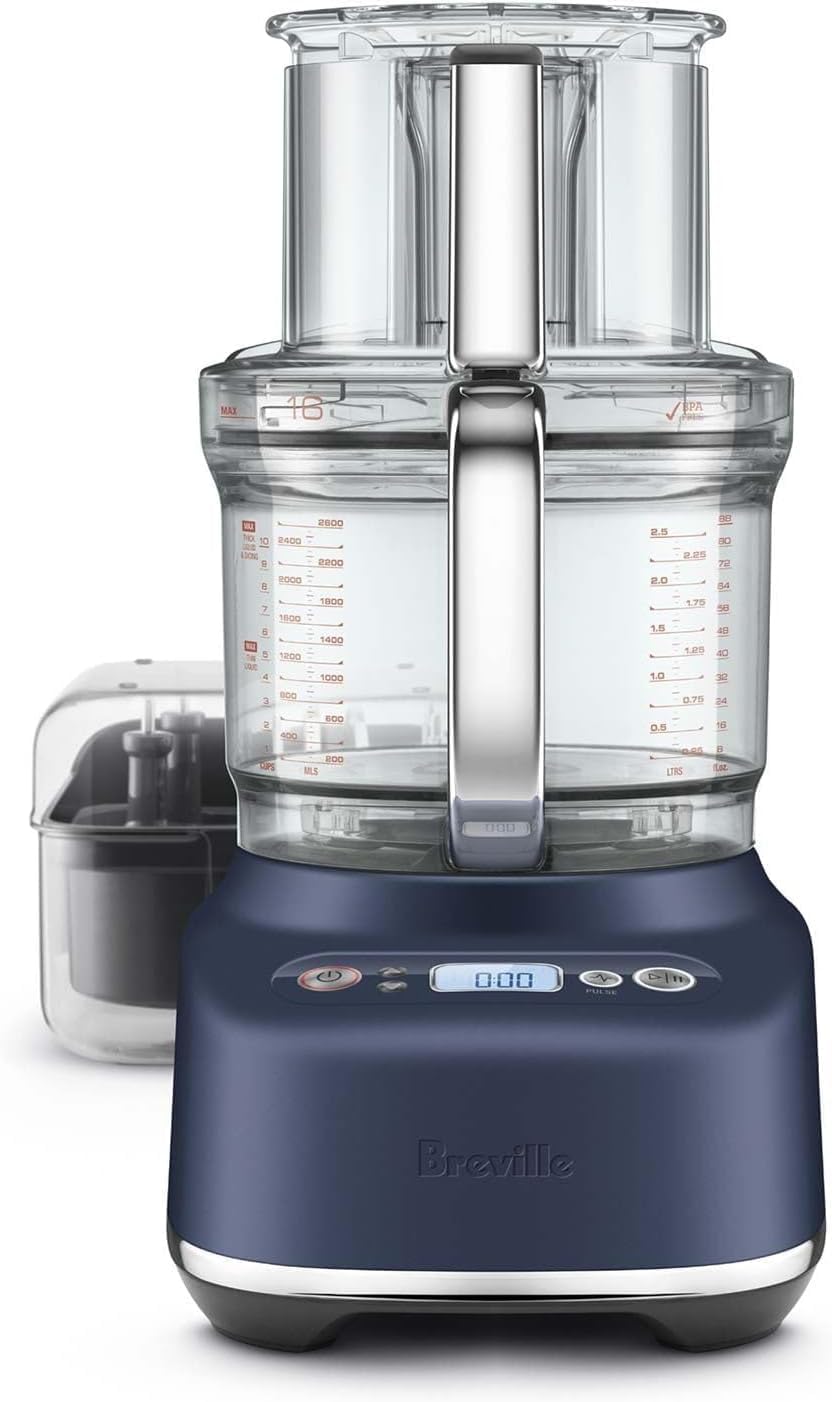
| Wattage | 1450 watts |
|---|---|
| Bowl Capacity | 16 cups |
| Number of Speeds | 1 |
| Material | Stainless Steel |
| Blade Material | Stainless Steel |
The Breville Sous Chef 16 is built around a powerful 1450W induction motor and a large 16-cup bowl to handle high-volume, precision prep tasks like dicing, slicing and shredding. It includes a 24-setting adjustable slicer, reversible shredding disc, French fry disk, S-blade, dough blade and smaller attachment set so you can dial in consistent cut sizes without repeated manual trimming. The oversized 3-in-1 feed chute accepts a range of shapes and cuts down on pre-cutting, and the storage container keeps discs and blades organized. In practice the motor delivers smooth, high-torque performance for dense vegetables and dough, and the adjustable slicing deck makes repeatable diced and sliced results easy for batch cooking. The unit is fairly large and heavy, so it needs stable countertop space and is less convenient to move or store in small kitchens. Also the processor has a single-speed control with adjustable discs rather than multiple variable-speed settings, so fine-tuning beyond the preset slice sizes depends on the chosen disc and pulse use.
Best for: Buyers who prioritize reliable, restaurant-style cutting performance and need to prep large batches with consistent dice and slices for meal prep or entertaining.
Less Ideal for: People with very small kitchens, limited storage space, or those who prefer lightweight, portable processors with multiple speed settings.
- High-torque 1450W induction motor handles dense vegetables and heavy batches
- Large 16-cup BPA-free bowl suitable for big meal prep
- 24-setting adjustable slicing disc and multiple specialized discs for consistent, repeatable cuts
- Extra-large 3-in-1 feed chute reduces pre-cutting and speeds processing
- Included storage container keeps blades and accessories organized
- Substantial size and weight make it bulky to store or move
- Only one motor speed with disc-based adjustments rather than fully variable speed control
Verdict: Choose the Sous Chef 16 when you want a heavy-duty, precision-focused processor that produces consistent diced and sliced results for large-batch cooking.
FOHERE Food Processor FP9042

| Bowl Capacity | 12 cups |
|---|---|
| Wattage | 500 watts |
| Number of Speeds | 3 |
| Power Source | AC adapter |
| Blade Material | Stainless Steel |
The FOHERE FP9042 is a mid-size food processor aimed at handling larger batches with a 12-cup bowl and a 500-watt motor. It ships with multiple accessories including stainless steel and plastic S-blades, a reversible slicing/shredding disc, dough blade, and a wide feed chute that speeds up prep when dicing vegetables or shredding cheese. Three speed settings plus a pulse mode let you control texture from coarse dice to finer chops, and dishwasher-safe parts make cleanup straightforward. Safety features include a dual-lock lid and an interlock on the feed pusher so the unit runs only when properly assembled. Practical limits are the 500W motor and consumer-grade build, which may struggle with very hard ingredients or very dense, long doughs compared with higher-end commercial models. Voltage is listed as 220V so be sure it matches your outlet. For everyday home dicing, shredding, and mixing, this processor offers good capacity and useful attachments at a modest power level.
Best for: Buyers who want a practical, high-capacity home processor for consistent dicing and batch prep and who prioritize usable attachments and easy cleanup.
Less Ideal for: Users who need commercial-grade power for frequent heavy-duty kneading or who require strict North American 120V compatibility without an adapter.
- Large 12-cup bowl suitable for batch cooking and party prep
- Multiple interchangeable blades and a reversible disc for dicing, slicing, shredding, and dough work
- Three speeds plus pulse give control over chop size and texture
- Dishwasher-safe parts and a wide feed chute speed up prep and cleanup
- Dual-lock safety lid and interlock on the food pusher enhance safe operation
- 500W motor may be underpowered for very hard ingredients or heavy-duty kneading
- Listed voltage is 220V which may require an appropriate outlet or adapter in some regions
Verdict: A roomy, accessory-rich food processor that makes fast, consistent dicing and batch prep practical for home cooks.
Cuisinart Mini-Prep Plus DLC-2ABC

| Wattage | 250 watts |
|---|---|
| Bowl Capacity | 1.5 pounds |
| Number of Speeds | 1 |
| Power Source | Corded Electric |
The Cuisinart Mini-Prep Plus is a small-capacity food processor designed for quick prep tasks like chopping herbs, dicing vegetables, and grinding cheese or nuts. It uses a 250-watt motor and a patented auto-reversing stainless-steel blade that switches between a sharp edge for chopping and a blunt side for grinding, so you can make emulsions, pesto, or finely chopped toppings without transferring to a blender. The 24-ounce (3-cup) work bowl fits under most cabinets and is lightweight plastic with a handle for easy pouring, and removable parts are dishwasher-safe which speeds cleanup. Controls are simple push-button operation with one speed, so it is fast to use but not suited for precise multi-speed control. Because the bowl is small, you will need to work in batches for larger quantities, and the single-speed motor limits how finely you can regulate texture compared with larger processors. For basic dicing and small-batch prep, it is efficient and easy to store and clean.
Best for: Buyers looking for an affordable, no-frills appliance to handle everyday small-batch dicing, chopping, and sauces will appreciate this compact, easy-to-use model.
Less Ideal for: If you regularly process large volumes, need multiple speeds for precise texture control, or require heavy-duty performance for dense ingredients, choose a larger-capacity processor instead.
- Compact 3-cup bowl fits small kitchens and stores easily.
- Reversible stainless-steel blade handles both chopping and grinding without swapping parts.
- Simple push-button control makes operation quick and intuitive.
- Dishwasher-safe bowl and lid speed cleanup.
- Single-speed motor limits fine control over texture.
- Small capacity requires batching for larger jobs.
Verdict: A compact, budget-friendly mini processor that reliably handles small-batch dicing and chopping tasks.
Cuisinart 14-Cup Food Processor DFP-14BCNY

| Wattage | 720 watts |
|---|---|
| Bowl Capacity | 14 cups |
| Number of Speeds | 1 |
| Power Source | Corded Electric |
The Cuisinart 14-cup food processor is a heavy-duty countertop unit built to handle large prep jobs like dicing onions, shredding cheese, and kneading dough. Its 720-watt motor powers a stainless steel chopping blade plus a 4mm slicing disc and medium shredding disc, and the extra-large feed tube accepts whole fruits and vegetables for quick throughput. Controls are simple with on and off/pulse settings, and most parts are dishwasher-safe which makes cleanup straightforward after big batches. The fixed discs are easy to install but not adjustable, so achieving very fine or variable slice thickness requires pre-cutting or a different disc size. At its size and motor strength this model is best for frequent cooks and those preparing meals for families or small gatherings rather than single-serve tasks. The included recipe booklet is a helpful touch, and the brushed stainless finish looks durable and resists staining, though the unit is fairly large and takes counter space when stored.
Best for: Buyers who prioritize a reliable, heavy-duty processor for frequent batch prep and want a durable, no-nonsense machine that speeds up dicing and shredding for family meals or entertaining.
Less Ideal for: People with very limited counter space or those who need precise, adjustable slicing thicknesses for delicate tasks should consider smaller or more feature-rich alternatives.
- Powerful 720-watt motor handles heavy-duty tasks like kneading dough and shredding cheese
- Large 14-cup bowl is suited for batch prep and cooking for groups
- Extra-large feed tube lets you slice or shred whole fruits and vegetables quickly
- Stainless steel blades and discs are dishwasher-safe for easier cleanup
- Solid stainless-steel body and components feel durable and kitchen-proof
- Slicing and shredding discs are fixed thickness and not adjustable
- Single speed plus pulse limits fine control over processing texture
Verdict: Choose this Cuisinart if you need a robust, dependable 14-cup processor that tackles large dicing and shredding jobs with a powerful motor.
Hamilton Beach 3-Cup Food Chopper

| Wattage | 350 watts |
|---|---|
| Bowl Capacity | 3 cups |
| Number of Speeds | 1 |
| Power Source | AC/DC |
The Hamilton Beach 3-Cup Food Chopper is a simple countertop tool for everyday small-batch prep like dicing onions, chopping herbs, making dressings, and pureeing baby food. Its stack-and-press design means you just place the lid and press to run the 350-watt motor, which makes operation intuitive and quick for short tasks. Stainless steel blades handle onions, nuts, and garlic cleanly and the lid includes an oil dispenser to help emulsify dressings and sauces. The bowl, lid, and blade are removable and dishwasher safe, which speeds cleanup and storage. Limitations are its single speed/press operation and modest 3-cup capacity, so it is best for prepping small quantities rather than large batches or continuous heavy-duty use. Noise and motor strain can increase with very dense ingredients, and there are no slicing or shredding attachments. For shoppers focused on reliable, easy-to-use dicing and quick chopping, this chopper covers the basics efficiently.
Best for: Buyers who want a low-friction, proven chopper for quick dicing and small everyday tasks and who value wide customer feedback when choosing a safe, reliable option.
Less Ideal for: Those who regularly process large volumes, need multiple speed settings, or require slicing and shredding attachments should choose a larger multi-function processor.
- Compact footprint that stores easily in small kitchens
- Simple stack-and-press operation requires no fiddly assembly
- 350-watt motor with stainless steel blades that handle onions, herbs, nuts, and garlic
- Bowl, lid, and blade are dishwasher safe for fast cleanup
- Single speed press limits control over texture
- 3-cup capacity is too small for large batches or meal-prep sessions
Verdict: A no-nonsense compact chopper that makes fast, reliable small-batch dicing and chopping effortless.
Choosing the Right Food Processor for Dicing: Key Factors to Consider
Blade and Disc Construction
Sharp, well-tempered blades and precise dicing discs are the most important factor for consistent dice. Blades made from high-grade stainless steel hold an edge longer and resist bending when processing dense vegetables. Discs with tight, well-machined holes or cutting grids produce uniform pieces, which matters for even cooking and presentation.
Poorly made blades or discs can crush or shred produce instead of cutting cleanly, creating uneven results and more cleanup. When assessing construction, consider how blades attach to the hub and whether replacement discs are readily available for long-term use.
Motor Torque and Duty Cycle
Peak motor wattage is less important than sustained torque when dicing dense vegetables or larger batches. Look for machines that maintain speed under load without stalling or overheating. A motor with good torque reduces the need for repeated pulses and produces more uniform cuts.
Also consider the duty cycle and ventilation design. If you plan on processing multiple batches in one session, a processor with better cooling and a higher recommended continuous run time will be more reliable and last longer.
Bowl Size and Feed-Chute Design
Bowl capacity determines batch size and how much manual pre-cutting you must do. Larger bowls reduce prep time for parties or meal prep, but very large bowls can be harder to clean and store. A wide feed chute minimizes pre-cutting and helps you process whole or large pieces more quickly.
Chute shape also affects how produce feeds to the blades. A deep, narrow chute may require more slicing of long items, while a wider chute accepts larger pieces and preserves the shape until cutting, improving uniformity.
Control Options and Precision
Good control options let you dial in short pulses and variable speeds for controlled dicing. Pulse controls are essential for preventing over-processing when you need a coarse or medium dice. Multiple speed settings help when switching between soft and hard produce so you can adjust for the texture without changing accessories.
Simple, intuitive controls reduce the learning curve and make it easier to repeat results. Tactile buttons or a clearly labeled dial are preferable to ambiguous or overly complex interfaces.
Ease of Cleaning and Maintenance
Frequent use requires parts that are easy to dismantle, clean, and dry. Dishwasher-safe bowls and blades speed cleanup, but check whether the manufacturer recommends hand washing sharp discs to preserve edges. Smooth interior surfaces and minimal crevices reduce trapped food and make sanitation simpler.
Also consider how accessories store and whether blades lock securely for safe handling. Replacement part availability and straightforward reassembly extend the useful life of the unit and keep performance consistent.
Stability and Safety Features
A stable base and secure lid locks make processing safer and more accurate. Suction feet or a heavy base reduce movement during pulses, which helps the blades cut cleanly and prevents accidental tip. Safety interlocks that prevent operation unless the bowl and lid are correctly seated reduce the risk of injury.
Attention to safety also includes cord length and storage, blade guards, and clear instructions for safe blade handling when assembling or cleaning.
Best Bowl Sizes for Different Kitchens
Choose bowl size based on how you will use the processor. If you frequently prep vegetables for family meals or batch-cook for the week, a medium to large bowl gives you fewer cycles and larger batches. For single cooks or small kitchens, a compact bowl reduces storage footprint and is often easier to manage for small quantities.
Remember that large bowls can handle whole onions, tomatoes, or large potatoes with less pre-cutting, while small bowls are better for quick tasks like dicing shallots or finishing garnishes.
- Small bowls excel at small, frequent tasks and take less storage space
- Medium bowls are the best everyday compromise for home cooks
- Large bowls are ideal when you need to process big batches or whole vegetables
Using Pulse and Speed to Control Dice Size
Short, controlled pulses are the key to consistent dicing. Use bursts of one to two seconds and check the pieces between pulses to avoid over-processing. For harder vegetables, start with a few short pulses and then adjust speed as needed.
If your processor has multiple speeds, use a lower setting for delicate produce and a higher one for dense roots. Practicing with the same vegetable a couple of times helps you learn how many pulses produce fine, medium, or coarse dice.
- Start with pulse to gauge progress
- Count pulses to reproduce results consistently
- Use gradually longer pulses rather than continuous runs
Preparing Produce for Best Results
Even with a capable dicing accessory, proper prep helps. Trim ends, peel when necessary, and cut irregularly shaped items into shapes that fit the chute. Uniform pieces feed more predictably and yield better, more even dice.
For very soft fruits or vegetables, chilling briefly can firm them up and reduce squashing. For long vegetables, quartering or halving so they sit flat in the bowl helps the disc cut more uniformly.
- Trim and square off items for consistent feeding
- Chill soft items to reduce crushing
- Cut long items to fit the feed chute when needed
Maintaining Sharpness and When to Replace Discs
Regularly inspect discs and blades for nicks, dulling, or bending. Dull edges produce torn or crushed pieces instead of clean dice. Some users prefer professional sharpening services for flat discs, while others replace discs when performance declines.
Follow manufacturer guidance for cleaning to preserve edges. Avoid dishwasher cycles that are known to accelerate dulling if the maker recommends hand washing for discs.
- Check cutting edges before use
- Avoid abrasive cleaners that dull blades
- Replace or professionally sharpen discs when cuts become inconsistent
Accessory Storage and Workspace Organization
Keeping blades and discs organized reduces setup time and protects sharp edges. Look for processors that include dedicated storage or cases, or plan a compact storage solution in a drawer. Labeling discs by cut size helps you reach the right tool quickly during prep.
Organize your workspace so you can move prepped produce from cutting board to chute with minimal handling. A tidy setup speeds cooking and reduces the temptation to over-process while eyeballing results.
- Store blades separately in a protective case
- Keep frequently used discs within easy reach
- Maintain a clear workspace to speed the feed-and-pulse workflow
How We Chose the Best Food Processor for Dicing
We focused on attributes that directly affect a food processor's ability to produce consistent dice and speed up prep tasks. Primary evaluation criteria included blade and disc quality, bowl and chute capacity, motor torque and reliability under load, control precision for short pulses and variable speeds, and ease of cleaning and assembly. We prioritized systems with durable cutting implements and discs that maintain sharp edges and produce uniform cuts rather than relying solely on high RPM ratings. We excluded units that lack pulse control or have very small bowls unsuitable for batch dicing. We also set aside models with overly complex toolkits that hinder straightforward dicing workflows. Our selection emphasizes real-world usability: how easily you can feed produce, whether the motor sustains torque during dense loads, how consistently the slicing or dicing accessory performs, and how fast cleanup and storage are. Safety features, warranty coverage, and accessory durability were secondary filters to ensure the shortlist holds up in regular kitchen use.
Our full evaluation process is outlined in our review methodology.
FAQ
Can any food processor produce a uniform dice?
Often a food processor can produce consistent dice if it has a proper dicing accessory and sharp discs. Results depend on blade quality, feed technique, and whether the processor maintains torque during pulses.
How do I avoid mashed or crushed vegetables?
Use short pulses rather than continuous runs, ensure blades are sharp, and avoid overfilling the bowl. Chilling soft produce slightly and feeding uniformly sized pieces also reduces crushing.
Is a larger bowl always better for dicing?
Not always. Larger bowls handle bigger batches and whole pieces but take more storage space and can be harder to clean. Choose bowl size based on typical batch size and kitchen space.
How often should I replace dicing discs?
It depends on frequency of use and the materials processed. Inspect discs for dulling or damage; replace when cuts become inconsistent. Proper cleaning and storage prolong disc life.
Can I dice delicate fruits without damaging them?
Usually yes, by using lower speeds, very short pulses, and by chilling the fruit if it is soft. Choosing a sharp, well-made disc also reduces tearing.
Final Verdict
Prioritize blade and disc quality, motor torque, and the right bowl size for how you plan to use a food processor for dicing. Those elements have the biggest impact on cut uniformity, speed, and how much hands-on attention your prep requires. Tradeoffs include compactness versus batch capacity and stronger motors versus potentially louder operation. Choose a processor that matches your typical batch sizes and offers crisp, easily maintained discs. With that alignment, you will get faster, more consistent dicing and fewer frustrating re-runs during meal prep.