
Note: This article contains affiliate links. If you click on these links and make a purchase, we may earn a small commission at no extra cost to you. This helps support our research and content. Read our full affiliate disclosure here.
If you rely on finely chopped vegetables, herbs, nuts, or aromatics, the right food processor makes the job fast and consistent. A model optimized for fine chopping saves time and prevents overworking delicate ingredients, which is important for sauces, salsas, and delicate garnishes. This guide covers our shortlisted top food processors for fine chopping and explains the features that matter most, from blade design and speed control to bowl size and cleanup. Use the evaluation criteria to match a model to your typical batch sizes and texture needs before moving on to the product list.
Top Picks at a Glance
| Best Overall The best all-around choice for most situations | Cuisinart Pro Classic 7-Cup |  |
| Best Quality Built to a higher standard if you want something more solid | Breville Sous Chef 16 Cup |  |
| Best Value The sweet spot between price and what you get | Cuisinart Mini-Prep Plus DLC-2ABC |  |
| Best Budget The cheapest option that still gets the job done reliably | BLACK+DECKER One-Touch Chopper HC150B |  |
| Top Rated A top-rated pick with lots of positive feedback | Ninja Mega Kitchen System BL770 |  |
| Most Popular A crowd favorite that many people choose with confidence | Hamilton Beach 3-Cup Food Chopper |  |
| Best Seller A high-volume bestseller chosen again and again | Ganiza Food Processor GC10 |  |
Cuisinart Pro Classic 7-Cup

| Wattage | 600 watts |
|---|---|
| Bowl Capacity | 7 cups |
| Number of Speeds | 1 |
| Power Source | AC adapter |
The Cuisinart Pro Classic 7-Cup is a versatile countertop food processor aimed at everyday kitchen tasks from fine chopping to shredding and kneading dough. It uses a 600-watt motor with simple on and pulse controls and includes a stainless steel chopping/dough blade, a medium slicing disc, and a medium shredding disc, plus pushers and a spatula for feed-tube convenience. In practice it handles herbs, nuts, and vegetables quickly for smooth purees and fine chops when pulsed carefully, and the extra-large feed tube takes whole fruits and vegetables to speed prep. The plastic bowl and stainless blades are easy to assemble and the components are hand-wash recommended. Limitations are a single speed plus pulse rather than multiple continuous speeds and the 7-cup bowl can be small for large batches, so heavier or very wet tasks may require working in batches. For cooks who want reliable, straightforward performance for most chopping and shredding needs, it offers solid power and useful attachments without unnecessary complexity.
Best for: Home cooks who want a reliable, no-frills processor that handles fine chopping, shredding and small-batch dough without a steep learning curve.
Less Ideal for: Those who routinely process very large batches or need multiple continuous speed settings for delicate texture control should consider larger or multi-speed alternatives.
- 600-watt motor provides steady power for chopping, pureeing and dough mixing
- Included stainless steel chopping blade plus slicing and shredding discs expand functionality
- Extra-large feed tube speeds prep by accepting whole fruits and vegetables
- Compact 7-cup bowl fits most countertop kitchens and stores easily
- Only one main speed with pulse limits fine control compared with multi-speed models
- Bowl capacity requires batching for larger quantities
Verdict: A dependable 7-cup processor with a powerful motor and useful discs that delivers straightforward fine chopping and shredding for everyday home use.
Breville Sous Chef 16 Cup

| Wattage | 1450 watts |
|---|---|
| Bowl Capacity | 16 cups |
| Voltage | 120 volts |
| Power Source | electric |
The Breville Sous Chef 16 is built for cooks who need consistent, professional results from a home food processor. Its 1450W heavy-duty induction motor and multiple blades and discs handle fine chopping, slicing, shredding and even dough mixing without bogging down, and the large 16-cup bowl lets you process big batches for meal prep or entertaining. The adjustable 24-setting slicing deck plus reversible shredding and French fry disks give tight control over cut size, and the 3-in-1 wide feed chute reduces pre-cutting. Included mini bowl and blades are useful for small-quantity jobs that require finer control. Removable parts are dishwasher-safe and Breville provides storage boxes to keep accessories organized. The unit is robust and built from stainless steel, which adds durability but makes it heavy and takes up significant counter space. The processor has a single speed with pulse and timer settings rather than multiple continuous speeds, so users who want variable-speed ramping may find the controls less flexible. For performance-focused cooks who prioritize consistent, fine chopping and large capacity, this model delivers reliable, professional-style results.
Best for: Serious home cooks and performance-focused buyers who want professional consistency and the ability to process large volumes with precise, repeatable cuts.
Less Ideal for: Buyers who need a lightweight, compact processor for occasional small tasks or those who prefer variable-speed control for gradual texture adjustments.
- Powerful 1450W induction motor handles heavy duty and continuous tasks
- Adjustable 24-setting slicing disc and reversible shredding for precise, consistent cuts
- Large 16-cup bowl suitable for big batches and entertaining
- Wide 3-in-1 feed chute reduces prep and accepts varied shapes and sizes
- Includes multiple blades and dedicated mini bowl for small and delicate jobs
- Single main speed with pulse rather than multiple variable continuous speeds
- Heavy stainless steel construction increases weight and requires substantial counter or storage space
Verdict: Choose the Sous Chef 16 when you need a powerful, high-capacity processor that delivers consistent, fine chopping and pro-level precision for large-batch prep.
Cuisinart Mini-Prep Plus DLC-2ABC

| Wattage | 250 watts |
|---|---|
| Bowl Capacity | 1.5 pounds |
| Number of Speeds | 1 |
| Power Source | Corded Electric |
| Voltage | 120 volts |
The Cuisinart Mini-Prep Plus is a small, utilitarian food processor built for quick jobs like chopping herbs, making pesto, or grinding cheese and nuts. It uses a 250-watt motor and a patented reversible SmartPower stainless-steel blade that runs in one direction for chopping and the opposite for grinding, so you can switch between fine chopping and coarse grinding with the push-button control. The 24-ounce work bowl is lightweight, has a handle for easy pouring, and the lid includes oil pinholes for making emulsions like dressings. Removable parts are dishwasher safe while the blade should be hand-washed to preserve its edge. Its single-speed/manual operation keeps things simple but means there is no pulse or variable speed control for delicate texturing. The plastic body is compact and easy to store, making it suited to small kitchens or occasional use, but it is not intended for heavy-duty or continuous processing. For buyers who want consistent fine chopping in small batches, this is an efficient, low-fuss option with a reliable blade system.
Best for: Buyers who prioritize efficient, no-frills performance for small-batch prep and want a compact appliance that stores easily.
Less Ideal for: People who regularly process large volumes, need variable speeds or pulse control, or plan heavy daily use should choose a larger, more powerful processor.
- Reversible stainless-steel blade supports both chopping and grinding.
- Compact 24-ounce bowl is suited to small batches and easy storage.
- Dishwasher-safe bowl and lid simplify cleanup.
- Simple push-button control makes operation straightforward.
- Single speed/manual controls limit precise texture adjustments.
- Plastic body is lightweight but less durable for heavy use.
Verdict: If you need a compact, reliable mini processor for consistent fine chopping and small-batch emulsions, the Cuisinart Mini-Prep Plus is a practical, space-saving choice.
BLACK+DECKER One-Touch Chopper HC150B

| Bowl Capacity | 1.5 cups |
|---|---|
| Wattage | 70 watts |
| Number of Speeds | 1 |
| Power Source | Corded Electric |
| Blade Material | Stainless Steel |
The BLACK+DECKER HC150B is a small, no-frills electric chopper designed for quick prep of herbs, nuts, breadcrumbs, salsa and small batches of sauces. It uses a one-touch pulse control to run a bi-level stainless steel blade driven by a modest 70W motor to produce evenly chopped results when used in short bursts; the bowl's 1.5-cup capacity keeps portions small and reduces waste. Removable parts are dishwasher-safe which speeds cleanup, and the lid includes oil holes so you can add oil while mixing for dressings and hummus without stopping. Expect limitations: the low-power motor and single-speed pulse mean it is not suited for heavy-duty tasks like grinding large quantities of hard vegetables or making very smooth purees. For fine chopping of small amounts—herbs, nuts, onions, garlic—it is efficient, fast to set up, and easy to store.
Best for: Buyers who want an inexpensive, space-saving chopper for quick, frequent small prep tasks like herbs, dips, and breadcrumbs and prioritize convenience over heavy-duty power.
Less Ideal for: People who regularly process large volumes, tough root vegetables, or who need a device that produces silky-smooth purees should choose a larger, more powerful processor instead.
- Compact 1.5-cup bowl ideal for small batches and limited counter space
- One-touch pulse control makes short, controlled chops simple
- Bi-level stainless steel blade designed to stay sharp for consistent chopping
- Dishwasher-safe removable parts for easy cleanup
- Oil holes in the lid let you add liquids without stopping the motor
- Low-power motor and single speed limit heavy-duty chopping and large batches
- Small capacity requires repeating cycles for larger recipes
Verdict: A budget-friendly, compact chopper that delivers fast, reliable fine chops for small batches and everyday prep.
Ninja Mega Kitchen System BL770
| Wattage | 1500 watts |
|---|---|
| Number of Speeds | 5 |
| Capacity | 16 fluid ounces |
| Power Source | ac_dc |
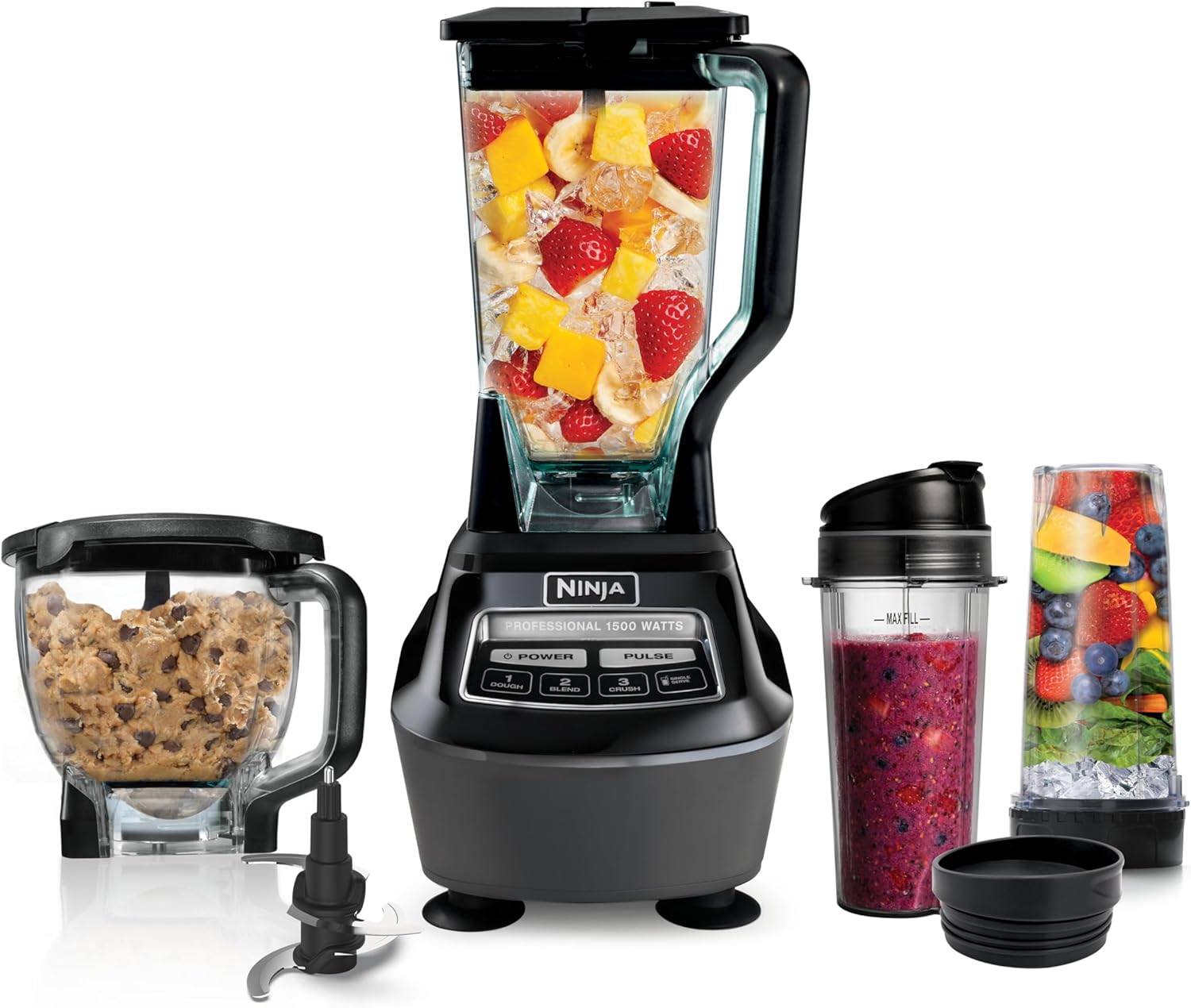
The Ninja Mega Kitchen System BL770 combines a powerful 1500W motor with multiple containers and blade sets to handle most home kitchen tasks. You get an XL 72-oz pitcher with Total Crushing Blades for smoothies and ice crushing, an 8-cup food processor bowl with chopping and dough blades for vegetables and quick dough mixing, plus two 16-oz Nutri Ninja to-go cups for single-serve drinks. Controls are manual with five speeds and four main function modes that make it simple to switch between blending, mixing, crushing, and single-serve work. Most removable parts are dishwasher safe, and the stainless steel blades are effective on frozen fruit and ice. The unit is versatile for batch smoothies, meal prep, and small baking projects, but the motor base is fairly large and the system takes some counter space and storage room. Also, the manual controls lack presets, so you need to watch run times for delicate tasks like purees. For buyers wanting a single machine that covers blending and food processing jobs, it delivers strong performance and a useful accessory set.
Best for: Buyers who want one versatile countertop appliance that handles large-batch smoothies, food prep, and occasional dough mixing without buying separate machines.
Less Ideal for: People with very limited counter or storage space or those who prefer compact single-function appliances with automatic preset programs.
- 1500-watt motor provides strong ice crushing and blending power
- Includes XL 72-oz pitcher plus 8-cup processor and two 16-oz to-go cups for multiple uses
- Multiple specialized blades (total crushing, pro extractor, chopping, dough) cover blending and processing tasks
- Most removable parts are dishwasher-safe for easier cleanup
- Large footprint that requires significant counter or cabinet space
- Manual controls with no preset programs require more user attention for consistent results
Verdict: A powerful, multi-function blender and food processor combo that covers large-batch blending, chopping, and dough mixing for buyers seeking one versatile countertop machine.
Hamilton Beach 3-Cup Food Chopper

| Wattage | 350 watts |
|---|---|
| Bowl Capacity | 3 cups |
| Number of Speeds | 1 |
| Power Source | AC/DC |
The Hamilton Beach 3-Cup Food Chopper is a simple, compact mini food processor that speeds routine prep tasks like dicing onions, chopping herbs, and pureeing sauces. Its stack-and-press lid lets you chop by applying downward pressure rather than turning switches, which makes operation straightforward for quick jobs; the single 350-watt motor and stainless steel blade deliver enough power to handle onions, nuts, garlic and soft vegetables. The removable bowl, lid and blade are dishwasher safe, so cleanup is fast, and the hideaway cord keeps counters neater. Because it is a one-speed unit without pulse settings or variable controls, it excels at coarse to medium chopping and quick purees but gives less control for ultra-fine or uniform textures needed for some recipes. The 3-cup bowl is ideal for small batches but requires multiple passes for larger quantities. For buyers who want a reliable, easy-to-use chopper for everyday small tasks, this is a practical, low-fuss choice; those needing fine, consistent processing for large batches may prefer a larger two-speed or variable-speed processor.
Best for: Someone who values straightforward, proven performance and lots of positive user feedback for everyday small-batch chopping, mincing and pureeing in a compact appliance.
Less Ideal for: Avoid this unit if you frequently process large volumes or need precise, factory-quality fine chopping and texture control for professional or bulk cooking.
- Compact 3-cup bowl fits small kitchens and stores easily
- 350-watt motor with stainless steel blade handles onions, nuts and soft vegetables
- Simple stack-and-press operation requires no complicated controls
- Removable parts are dishwasher safe for easy cleanup
- Hideaway cord reduces countertop clutter
- Single speed design limits control for very fine or ultra-uniform chopping
- Small capacity requires repeating batches for larger recipes
Verdict: A dependable, easy-to-use compact chopper that handles everyday small-batch chopping quickly and cleanly, making it a smart pick for most home cooks seeking simple fine-chopping performance.
Ganiza Food Processor GC10

| Wattage | 450 watts |
|---|---|
| Capacity | 0.95 gallons |
| Voltage | 120 volts_of_alternating_current |
| Material Type | Stainless Steel, Glass |
The Ganiza GC10 is a compact 450W food processor designed for everyday chopping, grinding, and pureeing tasks. It includes two 8-cup bowls—one glass and one stainless steel—plus two sets of S-shaped stainless blades and a two-speed motor that lets you move from coarse chopping to finer processing quickly. The package emphasizes safety features such as a spring-loaded blade stop and an overheating protection system that pauses operation when the motor gets hot. In practice the machine is useful for prepping vegetables, grinding meat for burgers, making nut butters or sauces, and handling frozen fruit for smoothies; removable blades make cleanup straightforward. The dual-bowl setup is handy for keeping raw meat separate from produce and for swapping tasks without washing immediately. Limitations are the modest 450W power for very heavy-duty continuous grinding and the cooling pauses required if the thermal protection engages during long runs. For routine kitchen prep and risk-averse users who value built-in safety, it performs reliably and simplifies many small chopping jobs.
Best for: Buyers prioritizing safe, reliable everyday prep who want a simple processor for chopping, grinding, and pureeing with clear safety protections and easy cleanup.
Less Ideal for: Users needing a heavy commercial-style grinder for long continuous runs or those who want the highest wattage for large-batch processing.
- Two 8-cup bowls (glass and stainless) for separating tasks and versatile prep.
- Two-speed control with stainless S-blades for coarse and finer chopping.
- Safety features including spring-loaded blade stop and overheating protection.
- Removable blades and bowls that simplify cleaning.
- 450W motor can struggle with very dense or continuous heavy grinding.
- Thermal protection may require waiting for cooldown during extended use.
Verdict: Choose the Ganiza GC10 if you want a safety-focused, two-bowl food processor that handles routine fine chopping and everyday grinding reliably.
Choosing the Right Food Processor for Fine Chopping: Key Factors to Consider
Blade Design And Material
The blade shape, angle, and metal quality determine how cleanly ingredients are cut and how long the edge stays sharp. Thinner, harder stainless steels hold a finer edge and produce cleaner slices, while thicker blades can bruise soft items and reduce precision.
Blade geometry also matters for recirculation. S-curve blades with shallow curves tend to shear ingredients more predictably for fine chopping, while overly aggressive profiles can puree rather than chop. Look for blades designed specifically for chopping rather than pureeing when precision is the priority.
Speed Control And Pulse Function
Fine chopping requires short, controlled bursts more often than steady high-speed runs. A dedicated pulse button or variable-speed control lets you feather the blade motion and stop immediately when you reach the desired texture.
Models with multiple slow-speed settings or a well-calibrated pulse deliver more consistent results across different ingredient types. Avoid single-speed units for fine work because they make it harder to prevent overprocessing delicate herbs and soft produce.
Bowl Size And Geometry Relative To Batch Size
The right bowl volume keeps ingredients close to the blade without leaving large empty spaces that allow uneven chopping. For small, precise batches like minced herbs or a single onion, a compact bowl or mixing adapter keeps pieces in the cutting zone.
Straight-sided bowls reduce lateral recirculation and help maintain uniform particle size. Wide, shallow bowls can cause ingredients to spread thin and not move under the blade, while very tall, narrow bowls may trap items above the blade until mixed.
Feed Tube And Lid Design
While feed tubes are less critical for fine chopping than for shredding, the lid and any central feed port affect how ingredients settle and how much you need to reposition between pulses. A low-profile lid with a small feed opening prevents large pieces from bouncing around and encourages consistent chopping.
A secure lid lock and stable base are essential to avoid spillage during short pulses. Some lids include built-in scrapers or mixing posts that reduce the need to stop and scrape, which speeds workflow and improves uniformity.
Maintenance And Ease Of Cleaning
Fine chopping often involves sticky or oily ingredients that cling to blades and the bowl. Removable parts that are dishwasher-safe or easily rinsed by hand make cleanup quicker and reduce the chance of residual flavors transferring between batches.
Also consider how easy it is to safely remove and reinstall sharp blades. Tools or simple press-fit mechanisms that minimize direct blade handling improve safety and encourage regular cleaning, which preserves performance and food safety.
Motor Power, Cooling, And Duty Cycle
You do not need the highest horsepower for fine chopping, but the motor must be capable of short, repeated bursts without overheating. A motor with good cooling and a reasonable duty cycle prevents automatic shutoffs during frequent short jobs.
Look for models with thermal protection and user-accessible rest cycles that match your expected prep rhythm. A motor that stalls or slows under light loads is a red flag for long-term reliability when used for repeated small batches.
Why Fine Chopping Is Different From Mincing Or Pureeing
Fine chopping aims for small, discrete particles that retain texture rather than a homogeneous paste. That means the goal is consistent sizing across pieces without releasing excessive cell juice or turning ingredients into a slurry.
Pulse control, short bursts, and properly sized bowls make the difference. In contrast, mincing breaks down fibers more aggressively and pureeing applies continuous high-speed shear. Recognizing this distinction helps you use a processor correctly and pick features that support the desired outcome.
- Fine chopping preserves mouthfeel and ingredient structure
- Avoid continuous high-speed runs when you want discrete pieces
- Use short pulses and periodic scraping to control uniformity
Techniques To Get Even, Fine Results
Use a handful of practical techniques every time you chop. Start by cutting larger items into uniform chunks so everything reaches the blade at the same rate. Add ingredients in small batches rather than overfilling the bowl. Use the pulse button in short bursts and inspect the texture between pulses to avoid overshooting the target.
If bits cling to the bowl walls, a quick scrape and an extra couple pulses usually fix unevenness. For herbs and soft ingredients, freeze briefly on a tray to firm them up if they smear too much.
- Pre-cut ingredients into uniform pieces
- Work in small batches for even contact with blades
- Pulse in brief intervals and check frequently
Maintaining Blade Sharpness And Safety
Blade edges dull slowly with normal use, and dull blades are the main reason fine chopping becomes inconsistent. Hand-wash and dry blades promptly to prevent corrosion and avoid dishwashers with aggressive detergents if the manufacturer advises against them.
Replace or professionally sharpen blades when you notice tearing instead of clean cuts. Always handle blades by the non-cutting hub, store them safely, and follow lock-and-release instructions to minimize direct contact with sharp edges.
- Wash and dry blades right after use to prevent corrosion
- Sharpen or replace blades that tear instead of cutting
- Use provided locking features and safe storage for blades
Small-Batch Workflows For Home Kitchens
If you mostly prepare small quantities, prioritize a compact processor or a mixing adapter that keeps ingredients within the blade path. Plan prep tasks to batch similar items together so you can do multiple short runs rather than one long processing session.
Keep a toolbox of common accessories such as spatulas and scraping tools near the processor to speed transitions between pulses. A consistent workflow reduces overhandling and helps you reach the same texture across multiple batches.
- Choose bowl sizes that match typical batch volumes
- Group similar tasks to minimize switching blades or bowls
- Keep tools handy to speed scraping and transfer
How We Chose the Best Food Processor for Fine Chopping
We prioritized models that deliver repeatable fine chopping without relying on trial-and-error techniques. Selection focused on measurable specs and real-use attributes: blade design and material, motor control and speed precision, bowl geometry and feed-chute layout, run-time and duty cycle for continuous small-batch work, and ease of disassembly for cleaning and food safety. We excluded units that are strictly mini-choppers or immersion-only appliances because those categories do not offer the blade geometry or stability needed for precise fine chops. We also deprioritized processors that lack variable speed or pulse capability, since fine chopping often requires short, controlled bursts. Editorial filters applied: documented blade materials and thickness, presence of pulse or variable-speed control, bowl volume options and locking stability, and parts dishwasher safety. We favored designs with straight-sided bowls and low-profile lids that reduce ingredient recirculation. The final list balances performance for small, precise batches with practical upkeep and durability considerations.
Our full evaluation process is outlined in our review methodology.
FAQ
Can I achieve fine chopping with any food processor?
Often you can approximate fine chopping with many processors, but precision depends on blade design, pulse control, and bowl size. Units without a pulse or with only a single high speed tend to overprocess delicate ingredients.
How do I avoid turning herbs into a paste?
Use very short pulses, work in small amounts, and avoid pressing the power for long intervals. Chilling herbs briefly or adding a small dry ingredient like a few nuts can help reduce smearing.
Is blade material important for flavor transfer?
Blade material mainly affects sharpness retention and corrosion resistance. Proper cleaning and drying are the primary ways to prevent flavor transfer; stainless blades that are well cared for are least likely to impart off-flavors.
How often should I replace chopping blades?
Replace blades when you notice more tearing than cutting or when chopping requires noticeably longer cycles. Frequency depends on use, but home cooks who chop frequently may notice wear sooner than occasional users.
Can I fine chop frozen ingredients?
You can, but entirely frozen blocks may damage blades or strain the motor. Use partially frozen items or break frozen ingredients into small chunks first and use short pulses.
Final Verdict
For fine chopping, prioritize blade geometry, pulse control, and a bowl size that matches your usual batch. Expect tradeoffs: very compact bowls give better control for small amounts but limit larger batches, while wider bowls handle volume at the cost of uniformity for tiny jobs. Favor processors with serviceable blades and cooling-friendly motors to preserve consistency over time. Use the evaluation criteria here to weigh what matters most in your kitchen and pick a model that matches your common tasks. Focus on controllable speed and blade options first, then consider cleanup and motor endurance to maintain those fine-chopping results for years.