
Note: This article contains affiliate links. If you click on these links and make a purchase, we may earn a small commission at no extra cost to you. This helps support our research and content. Read our full affiliate disclosure here.
If you cook vegetables frequently, the right food processor can cut prep time dramatically and produce consistent results across salads, sides, and mains. A machine that handles everything from delicate herbs to dense root vegetables means less hand chopping, more even cooking, and better texture in finished dishes. This guide shortlists seven top food processors for vegetables and evaluates them on the real factors that matter in daily kitchen use. Read on to see which models suit high-volume prep, small-batch tasks, or occasional veggie-focused cooks and why those evaluation points matter.
Top Picks at a Glance
| Best Overall The best all-around choice for most situations | Ninja Professional Plus BN601 |  |
| Best Quality Built to a higher standard if you want something more solid | Cuisinart 14-Cup Food Processor DFP-14BCNY |  |
| Best Value The sweet spot between price and what you get | Hamilton Beach Stack & Snap 12-Cup |  |
| Best Budget The cheapest option that still gets the job done reliably | BLACK+DECKER One-Touch Chopper HC150B |  |
| Top Rated A top-rated pick with lots of positive feedback | Ninja Mega Kitchen System BL770 |  |
| Most Popular A crowd favorite that many people choose with confidence | Hamilton Beach 3-Cup Food Chopper |  |
| Best Seller A high-volume bestseller chosen again and again | Ganiza Food Processor GC10 |  |
Ninja Professional Plus BN601

| Wattage | 1000 watts |
|---|---|
| Bowl Capacity | 4.5 pounds |
| Number of Speeds | 3 |
| Power Source | AC adapter |
| Blade Material | Stainless Steel |
The Ninja Professional Plus BN601 is a versatile mid‑size food processor built around a 1000-peak-watt motor and intuitive Auto-iQ preset programs that simplify common prep tasks. It is typically used for batch vegetable work like chopping onions, shredding carrots, slicing cucumbers, and pureeing cooked vegetables for soups or dips, and it also handles dough mixing for occasional baking. The 9-cup bowl and feed chute let you process larger batches without stopping to refill, while a set of stainless steel blades and a reversible slicing/shredding disc deliver even cuts for salads and slaws. Removable parts are dishwasher safe so cleanup is straightforward, and built-in safety interlocks prevent operation unless assembled correctly. Limitations include a predominantly plastic construction that may feel less heavy-duty than commercial units and only three manual speed settings, so precise speed control is limited for advanced technique work. Still, for vegetable-focused meal prep and family-sized batches, it balances power, capacity, and convenience well.
Best for: Home cooks who want a reliable, easy-to-use processor for regular vegetable prep and family-sized batches without fussing over manual settings.
Less Ideal for: Users seeking a heavy-duty commercial machine or precise variable-speed control for specialized techniques should look elsewhere.
- 1000-peak-watt motor handles tough vegetables and larger batches
- 9-cup bowl accommodates family-sized prep without frequent refills
- Auto-iQ preset programs simplify common tasks with one-touch operation
- Stainless steel blades and reversible disc provide even chopping, slicing, and shredding
- Dishwasher-safe removable parts make cleanup quick
- Mostly plastic construction may feel less durable than professional metal-bodied models
- Only three manual speeds limit fine-grain control for delicate tasks
Verdict: A powerful, mid-size processor that makes quick work of vegetable prep for families thanks to its 1000W motor, 9-cup capacity, and helpful Auto-iQ presets.
Cuisinart 14-Cup Food Processor DFP-14BCNY

| Wattage | 720 watts |
|---|---|
| Bowl Capacity | 14 cups |
| Number of Speeds | 1 |
| Power Source | Corded Electric |
The Cuisinart 14-cup food processor is built for heavy vegetable prep and family-sized batches, driven by a 720-watt motor and a large feed tube that accepts whole fruits and vegetables. It ships with a stainless steel chopping blade plus slicing and shredding discs, and the dishwasher-safe parts and detachable disc stem make cleanup straightforward after processing large quantities. The unit offers simple two-button controls with an on and pulse function, which keeps operation immediate and predictable for repeated runs when making salads, slaws, sauces, or kneading dough. Because the discs are fixed (non-adjustable), you get consistent 4mm slices and medium shreds rather than variable thickness options. The processor is substantial in size and weight, so plan for a dedicated counter spot or storage. For vegetable-focused cooks who need reliable, high-capacity processing, this model delivers fast, durable performance with minimal fiddling.
Best for: Vegetable-focused home cooks who prioritize fast, high-capacity prep and durable motor performance for frequent batch processing.
Less Ideal for: People who need ultra-compact units for small kitchens or who require fine control over slice thicknesses and many speed settings.
- Powerful 720-watt motor handles large batches and tougher vegetables
- Generous 14-cup bowl lets you process family-sized quantities in one go
- Includes stainless steel slicing disc, shredding disc, and chopping blade for common prep tasks
- Dishwasher-safe removable parts and detachable disc stem simplify cleanup
- Only two control positions (on and pulse) limit speed options for delicate tasks
- Slicing and shredding discs are not adjustable for multiple thicknesses
- Relatively heavy and large, requiring counter or storage space
Verdict: Choose this Cuisinart when you need a powerful, large-capacity processor that speeds through vegetable prep with reliable, no-nonsense performance.
Hamilton Beach Stack & Snap 12-Cup

| Wattage | 450 watts |
|---|---|
| Bowl Capacity | 12 cups |
| Number of Speeds | 2 |
| Blade Material | Stainless Steel |
| Power Source | ac_dc |
The Hamilton Beach Stack & Snap 12-Cup is a straightforward food processor built for everyday vegetable prep and larger batch jobs. Its Stack & Snap design makes assembly and disassembly quick, and the sealed 12-cup bowl processes big volumes without leaking. The 450-watt motor provides enough power to slice, shred, chop, and puree common vegetables, while the included S-blade and reversible slicing/shredding disc cover most prep tasks. A large feed chute accepts whole potatoes or tomatoes to reduce pre-cutting, and the two chute sizes help when you need more control for thinner produce. Suction-cup feet keep the unit stable during use, and removable parts are dishwasher safe for easy cleanup. Practical users will appreciate the simple function guide and pour spout for mess-free transfers. Expect basic, reliable performance rather than pro-level speed or the widest range of specialty attachments, and the plastic construction means it is lightweight but not as rugged as metal-bodied processors.
Best for: Buyers who prioritize efficient, no-fuss vegetable prep and want a roomy, easy-to-use machine for chopping, slicing, and shredding in household kitchens.
Less Ideal for: People who need commercial-speed processing, many specialty attachments, or a heavier-duty metal build for long continuous runs should consider more robust models.
- Easy Stack & Snap assembly and disassembly for fast setup
- Large sealed 12-cup bowl handles big batches without leaks
- Big Mouth feed chute fits whole vegetables to cut prep time
- Included S-blade and reversible slicing/shredding disc cover common tasks
- Dishwasher-safe removable parts simplify cleanup
- 450-watt motor is adequate for everyday use but not ideal for heavy-duty or continuous processing
Verdict: A roomy, easy-to-assemble food processor that simplifies vegetable prep for home cooks who want dependable batch processing and easy cleanup.
BLACK+DECKER One-Touch Chopper HC150B

| Bowl Capacity | 1.5 cups |
|---|---|
| Wattage | 70 watts |
| Power Source | Corded Electric |
| Blade Material | Stainless Steel |
| Number of Speeds | 1 |
The BLACK+DECKER HC150B is a small electric chopper built for quick prep tasks like herbs, salsa, breadcrumbs, and chopped vegetables. It uses a bi-level stainless steel blade driven by a 70W motor with one-touch pulse control to give short, controlled chops in the 1.5-cup bowl, and the lid includes oil holes so you can add dressings while mixing. Removable components are dishwasher-safe, which keeps cleanup fast after small batches. Because the bowl is compact this is best for single-serving prep and topping ingredients rather than large batches or heavy-duty jobs, and the single-speed pulse design limits fine control compared with multi-speed processors. The plastic construction keeps the unit lightweight and affordable, but buyers seeking heavy chopping power, multiple speed settings, or a larger capacity will want a larger food processor. For quick vegetable prep and small kitchen tasks this chopper is simple, easy to store, and easy to maintain.
Best for: Shoppers on a tight budget who need a simple, space-saving chopper for quick vegetable prep and small batch recipes in everyday cooking.
Less Ideal for: Those who regularly process large quantities, need multiple speed settings, or require a heavy-duty, higher-power appliance for dense vegetables.
- Compact 1.5-cup bowl suitable for small prep tasks
- One-touch pulse control for short bursts of chopping
- Bi-level stainless steel blade designed to stay sharp
- Dishwasher-safe removable parts for easy cleanup
- Built to be lightweight and easy to store
- Small capacity limits use to single servings or small batches
- Single-speed pulse only, no continuous or variable speeds
- Plastic construction may feel less durable under heavy use
Verdict: A low-cost, compact chopper that makes quick vegetable prep and single-serving tasks faster and easier.
Ninja Mega Kitchen System BL770
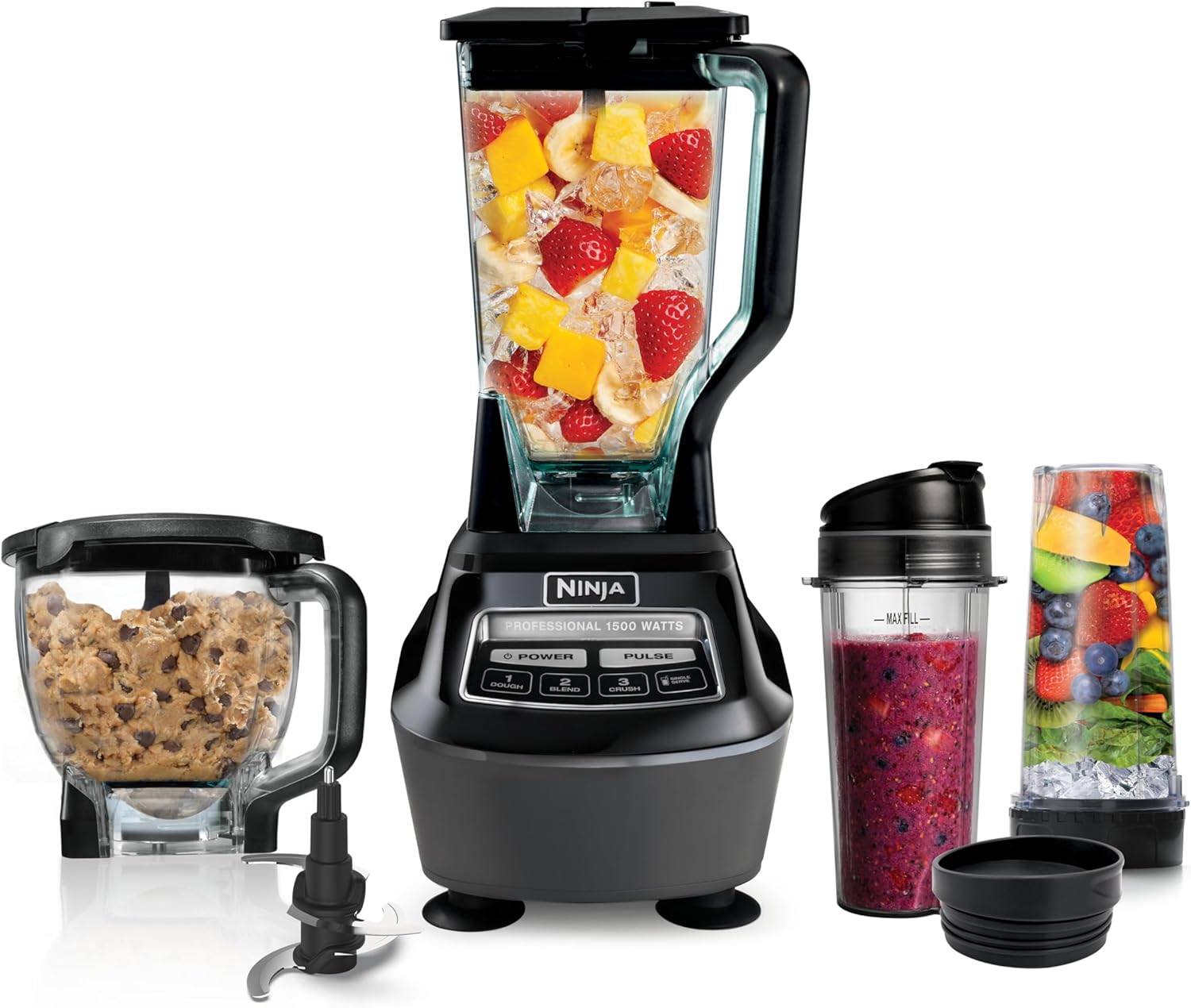
| Wattage | 1500 watts |
|---|---|
| Number of Speeds | 5 |
| Capacity | 16 fluid ounces |
| Power Source | ac_dc |
The Ninja Mega Kitchen System BL770 combines a powerful 1500W motor with multiple containers and blade sets to handle most home kitchen tasks. You get an XL 72-oz pitcher with Total Crushing Blades for smoothies and ice crushing, an 8-cup food processor bowl with chopping and dough blades for vegetables and quick dough mixing, plus two 16-oz Nutri Ninja to-go cups for single-serve drinks. Controls are manual with five speeds and four main function modes that make it simple to switch between blending, mixing, crushing, and single-serve work. Most removable parts are dishwasher safe, and the stainless steel blades are effective on frozen fruit and ice. The unit is versatile for batch smoothies, meal prep, and small baking projects, but the motor base is fairly large and the system takes some counter space and storage room. Also, the manual controls lack presets, so you need to watch run times for delicate tasks like purees. For buyers wanting a single machine that covers blending and food processing jobs, it delivers strong performance and a useful accessory set.
Best for: Buyers who want one versatile countertop appliance that handles large-batch smoothies, food prep, and occasional dough mixing without buying separate machines.
Less Ideal for: People with very limited counter or storage space or those who prefer compact single-function appliances with automatic preset programs.
- 1500-watt motor provides strong ice crushing and blending power
- Includes XL 72-oz pitcher plus 8-cup processor and two 16-oz to-go cups for multiple uses
- Multiple specialized blades (total crushing, pro extractor, chopping, dough) cover blending and processing tasks
- Most removable parts are dishwasher-safe for easier cleanup
- Large footprint that requires significant counter or cabinet space
- Manual controls with no preset programs require more user attention for consistent results
Verdict: A powerful, multi-function blender and food processor combo that covers large-batch blending, chopping, and dough mixing for buyers seeking one versatile countertop machine.
Hamilton Beach 3-Cup Food Chopper

| Wattage | 350 watts |
|---|---|
| Bowl Capacity | 3 cups |
| Number of Speeds | 1 |
| Power Source | AC/DC |
| Blade Material | Stainless Steel |
The Hamilton Beach 3-Cup Food Chopper is a simple, no-frills countertop tool that speeds routine prep for vegetables, herbs, nuts, and small batches of sauces or baby food. Its stack-and-press design lets you assemble quickly and chop by pressing the lid, so operation is intuitive for one-handed use and tidy counters. Stainless steel blades and a 350-watt motor provide enough power to handle onions, carrots, garlic, and tougher bits, while the removable bowl, lid, and blade are dishwasher safe for easy cleanup. Because it has a single-speed press control rather than variable speeds or pulse settings, it excels at quick, uniform chops but offers less control when you need very fine textures or intermittent pulsing. The compact 3-cup bowl is well suited to daily small batches but is too small for large meal prep. For buyers who value straightforward operation, reliable blades, and easy maintenance, this chopper is a practical kitchen companion; those needing larger capacity or more precision controls should look elsewhere.
Best for: Buyers who want a reliable, easy-to-use chopper for daily vegetable prep and quick small-batch tasks and who rely on others' positive experience when choosing practical kitchen tools.
Less Ideal for: People who regularly prepare large quantities or need precise multi-speed and pulse control for specialized textures should consider larger processors with variable settings.
- Compact footprint fits small kitchens and stores easily
- Simple stack-and-press operation makes it fast and intuitive to use
- Stainless steel blade and 350W motor handle onions, herbs, nuts, and purees effectively
- Dishwasher-safe removable parts simplify cleanup
- Single-speed press control limits fine texture control compared with multi-speed processors
- 3-cup bowl is too small for large batches or full meal prep
Verdict: If you want a compact, user-friendly chopper that reliably handles everyday vegetable prep, this 3-cup Hamilton Beach model is a sensible, low-risk choice.
Ganiza Food Processor GC10

| Wattage | 450 watts |
|---|---|
| Capacity | 0.95 gallons |
| Voltage | 120 volts AC |
| Material Type | Stainless Steel, Glass |
| Power Source | AC |
The Ganiza GC10 is a compact food processor designed for everyday vegetable prep and light meat grinding. It pairs an 450W full-copper motor with two 8-cup bowls—one glass and one stainless steel—so you can keep separate bowls for vegetables and meat without cross-contamination. Two speed settings and two sets of S-shaped stainless blades let you quickly chop, grind, or puree ingredients in seconds, and removable blades make cleanup straightforward. Built-in overheating protection and a safety stop that halts blade rotation when the motor is lifted add practical safeguards for regular household use. The motor is marketed as durable but the 450W power and relatively small bowl capacity mean it is best for chopped vegetables, sauces, dips, and occasional small batches of ground meat rather than continuous heavy-duty commercial tasks. Expect basic controls and a straightforward, no-frills setup that focuses on convenience and safety rather than advanced programmability.
Best for: Buyers who want a safe, straightforward countertop processor for everyday vegetable chopping, sauces, and occasional meat grinding and who prioritize reliability and simple controls over advanced features.
Less Ideal for: People who need large-capacity or industrial-strength processing for high-volume batches or continuous heavy meat grinding should consider more heavy-duty units.
- Includes two 8-cup bowls (glass and stainless steel) to separate uses and reduce cross-contamination
- 450W full-copper motor with two speeds handles quick chopping, pureeing, and light grinding
- Safety features include overheating protection and a spring-loaded stop that halts blades when the motor is lifted
- Removable stainless S-blades for easier cleaning and versatile processing tasks
- 0.95-gallon (8-cup) bowls limit batch size for larger meal prep
- Motor power and design are intended for home use and not for continuous heavy-duty grinding
Verdict: A safe, no-frills food processor built for reliable vegetable prep and light home meat grinding with separate bowls to reduce cross-contamination.
Choosing the Right Food Processor for Vegetables: Key Factors to Consider
Cut Quality and Blade Options
How a processor cuts vegetables is the most visible factor influencing final dishes. Different blades and discs produce finely minced herbs, uniform slices for gratins, or coarse chops for stews. Multiple blade options increase versatility, but the real test is whether the machine produces consistent results across firm items like carrots and potatoes and delicate items like tomatoes.
Blades that are easy to swap and remain sharp over time matter because they maintain cut quality without frequent replacement. Consider whether the processor offers reversible discs for two thicknesses, a dedicated chopping blade for wet mixtures, and a sturdy mounting system that prevents wobble during high-speed runs.
Motor Strength and Heat Management
Vegetable prep often involves dense or large batches that increase motor load. A motor with adequate wattage and a robust gearbox handles repeated chopping and slicing without bogging down. Good heat dissipation and thermal cutoff features protect the unit during prolonged use and extend lifespan.
For cooks who frequently process root vegetables or make large batches for meal prep, a stronger motor reduces the need for pulsing in short bursts, yielding more uniform cuts and faster overall throughput.
Bowl Size and Feed Tube Design
Bowl capacity determines how much you can process in one go. Larger bowls reduce the number of batches for big salads or side dishes, while smaller bowls are more efficient for single portions. The shape of the bowl and the diameter of the feed tube affect how easily you can push whole or cut produce through the discs without pre-chopping.
A well-designed feed tube and pusher make it safer and faster to add long or awkward items like cucumbers. Also consider whether the bowl locks securely to prevent leaks when processing wetter vegetables.
Ease of Cleaning and Maintenance
Vegetables can leave sticky or starchy residue that slows cleanup. Removable blades and dishwasher-safe bowls streamline maintenance. Smooth surfaces and minimal crevices reduce trapped debris and food buildup, which is important for hygiene and preserving blade sharpness.
Check how simple it is to remove and replace blades, whether seals are accessible for cleaning, and if the base requires frequent wiping. Units with too many small parts increase time spent at the sink and reduce the likelihood you will use the processor regularly.
Stability and Noise Levels
A stable processor stays firmly in place during high-speed chopping and slicing, which improves cut consistency and reduces safety risks. Non-slip feet, a low center of gravity, and well-balanced discs all contribute to better stability.
Noise and vibration are also practical considerations. Louder motors can be fatiguing in small kitchens or when processing large quantities. Vibration can cause discs to shift or ingredients to be thrown against the bowl, reducing uniformity.
Control Options and Usability
Simple, intuitive controls encourage frequent use. Pulse functions, multiple speed settings, and straightforward locking indicators help you tailor processing to different vegetables and textures. Clear markings and ergonomically placed buttons reduce the chance of incorrect assembly or accidental starts.
Consider whether the control layout supports repeatable results and whether safety interlocks prevent operation unless the unit is properly assembled.
Preparing Vegetables for Best Results
How you prep produce before it hits the processor affects final texture and cook times. For long items, trim ends and cut to lengths that easily fit the feed tube to avoid jams. Very hard roots benefit from halving or quartering to reduce stress on blades and motor.
Leafy greens and herbs are easier to handle when lightly bundled; add a small handful at a time to avoid overloading. For very wet items like tomatoes or cucumbers, blot excess moisture so processing yields firmer pieces and less puree.
- Cut large items to manageable lengths to prevent feed-tube jams
- Soak and dry hardy greens if you want fluffier results
- Pulse rather than run continuously for coarse textures
Maximizing Longevity of Blades and Discs
Blades dull with use, especially when they contact small amounts of grit or are washed harshly. Rinse immediately after use to remove acidic or sugary residues that can corrode metal. Avoid cutting frozen produce unless the product is explicitly rated for it.
Store discs flat or in a dedicated case when possible to prevent edge damage. If you notice uneven cuts developing, check for warped discs or loose mounting hardware before assuming blade dullness.
- Rinse and dry blades right after use to prevent corrosion
- Avoid abrasive scrubbers that can damage steel edges
- Keep discs in a protected organizer to prevent nicks
Safe Operation and Childproofing Tips
Food processors have sharp components and powerful motors, so follow basic safety steps. Always unplug before removing blades or reaching into the bowl. Use the provided pushers rather than fingers to feed produce.
For households with children, choose a model with clear interlocks that prevent the motor from running if the lid or bowl is not securely locked. Store blades separately and out of reach when not in use.
- Unplug before changing blades or cleaning the motor base
- Use feed pushers, never fingers, to guide produce
- Store sharp parts in locked drawers or high cabinets
When to Use a Food Processor Vs a Knife
Food processors speed up repetitive tasks and produce very uniform slices or chops, which is valuable for batch cooking and for dishes where presentation matters. However, for delicate finishing chops or tasks that require tactile control, a knife still has advantages.
Use the processor for bulk prep like shredding cabbage, slicing potatoes, or making large batches of salsa. Reserve hand chopping for final texture adjustments, fine mincing of aromatic herbs, or when a gentle touch is necessary.
- Processors excel at volume and uniformity
- Knives are better for nuanced cuts and finishing work
- Combine both tools for efficient, high-quality results
Storage and Countertop Considerations
Think about where the unit will live when not in use. Large-capacity bowls and multiple discs require more storage space. If countertop space is limited, consider smaller-footprint models or ones with nested parts that occupy less cabinet space.
Also evaluate how often you will use the processor. Frequent users may prefer a model that stays on the counter for easy access, while occasional users might favor something compact and easy to stow.
- Measure cabinet shelf height to ensure discs and bowls fit
- Look for models with nested storage to conserve space
- Consider leaving frequently used accessories accessible
How We Chose the Best Food Processor for Vegetables
We focused on attributes that directly affect how well a food processor handles vegetables and how easy it is to use in routine prep. Our selection criteria emphasized chopping and slicing performance across a range of produce, motor reliability under repeated loads, bowl and feed-tube capacity for both batch and continuous work, and how straightforward each unit is to disassemble and clean. We also considered build quality and the durability of blades and discs, since dull or warped cutting parts degrade results quickly. Noise and vibration were secondary filters because excessive vibration can affect cut consistency and countertop placement. We excluded units that are primarily designed for dough kneading or heavy pastry work since those tasks do not reflect vegetable prep performance. Also excluded were models lacking a basic slicing or chopping disc, or those with undersized bowls that prevent efficient batch processing. In short, the picks balance cutting quality, usable capacity, and daily convenience for cooks who prioritize vegetable prep.
Our full evaluation process is outlined in our review methodology.
FAQ
Can a food processor handle leafy greens without turning them to mush?
Often yes, but the key is technique. Add greens in small batches and use short pulses. Overloading or running at high speed continuously will puree leaves, while pulsing yields coarse, fluffed results.
Is it safe to process raw potatoes and other dense roots?
Usually, but dense roots put extra strain on the motor. Cut very large pieces into smaller chunks and use a pulsing motion. If you frequently process heavy roots, prioritize a model with a stronger motor and good cooling.
How do I avoid discoloration or oxidation after processing vegetables?
Minimize exposure to air and acid. Blot wet vegetables before storage and refrigerate promptly. For items prone to browning, brief acid treatments or immediate use in a cooked dish reduces visible oxidation.
Can I put processor bowls and blades in the dishwasher?
Many bowls and blades are dishwasher-safe, but repeated dishwasher cycles can dull blades faster. Rinsing and hand-drying sharp components extends their life. Check the care guidance for the specific unit you own.
Why does my processor throw ingredients against the bowl?
This is often caused by improper loading, a full bowl, or a misaligned disc. Reduce batch size, ensure the disc is seated correctly, and use the correct feed speed. Excessive vibration can also indicate an imbalanced load or loose parts.
Final Verdict
Choosing the right food processor for vegetables is about balancing cut quality, usable capacity, and daily convenience. Prioritize consistent chopping and slicing performance if presentation or even cooking is important, and look for a motor and feed design that handle the types of produce you use most. Ease of cleaning and safe, intuitive controls determine whether you will reach for the processor regularly. Focus on the factors most relevant to your cooking habits: a larger bowl and stronger motor for batch cooks, compact design for occasional users, and straightforward cleaning for anyone who wants low upkeep. Use those tradeoffs to select a unit that fits your workflow and makes vegetable prep faster and more consistent.