
Note: This article contains affiliate links. If you click on these links and make a purchase, we may earn a small commission at no extra cost to you. This helps support our research and content. Read our full affiliate disclosure here.
When you cook away from a full kitchen, the right gas cooktop for camping makes the difference between a stressful meal and an easy, enjoyable one. You want something that lights reliably, delivers consistent heat, and packs down small enough to carry or store in a vehicle. This guide gathers the top shortlisted options for camp cooking and evaluates them on practical criteria like burner output, stability, fuel efficiency, and carryability. Whether you plan short weekend trips or longer backcountry excursions, the picks here highlight appliances that perform dependably in outdoor conditions. Below are our top choices and the decision factors we used to select them, followed by guidance on setup, fuel management, and safe outdoor cooking.
Top Picks at a Glance
| Best Overall The best all-around choice for most situations | Camp Chef Explorer EX60LW |  |
| Best Quality Built to a higher standard if you want something more solid | Camp Chef Everest 2X 2-Burner Stove |  |
| Best Value The sweet spot between price and what you get | Chef Master Portable Butane Stove 90019 |  |
| Best Budget The cheapest option that still gets the job done reliably | Odoland Windproof Camp Stove OD0358 |  |
| Top Rated A top-rated pick with lots of positive feedback | Gas One GS-3400P Camping Stove |  |
| Most Popular A crowd favorite that many people choose with confidence | Coleman Triton 2-Burner Stove |  |
| Best Seller A high-volume bestseller chosen again and again | Gas One Single Propane Burner B-5120 |  |
Camp Chef Explorer EX60LW

| Fuel Type | Liquefied Petroleum Gas |
|---|---|
| Power Source | Propane |
| Maximum Energy Output | 60000 british thermal units |
| Material | Alloy Steel |
The Camp Chef Explorer EX60LW is a robust two-burner propane camping stove designed for serious outdoor cooking. It pairs two 30,000 BTU cast-aluminum burners for a combined 60,000 BTU output that brings water to a boil quickly and supports high-heat cooking like searing or large-pot simmering. The unit is built with a three-sided windscreen and sturdy alloy-steel frame to keep flames steady in breezy conditions, and detachable steel legs plus a supplied hose make setup and transport straightforward at campsites or tailgates. Knob controls provide precise flame adjustment for simmering as well as rapid heat, and the 14-inch cooking accessory compatibility lets you add griddles or pans from the same system. Practical limitations include the stove being for outdoor use only and its relatively large footprint compared with single-burner backpacking stoves, so it is best for car camping, group meals, or events rather than ultralight trips. For campers who want reliable power and a roomy cooking surface, this Explorer delivers dependable, appliance-like performance in the field.
Best for: Campers who want a powerful, reliable two-burner stove for car camping, tailgates, or group cooking and value fast heat-up and a stable cooking surface.
Less Ideal for: Solo backpackers or ultralight travelers who need a compact, lightweight single-burner solution should look elsewhere.
- High combined output (60,000 BTU) for fast boiling and high-heat cooking
- Cast-aluminum burners designed for durability and even heat
- Three-sided windscreen and solid frame improve performance in windy conditions
- Detachable legs and included hose simplify setup and transport
- Compatible with 14" Camp Chef accessories for flexible cooking options
- Large footprint and weight make it unsuitable for ultralight or backpacking trips
- Approved for outdoor use only, limiting indoor or enclosed-space use
Verdict: Buy this if you need a sturdy, high-output two-burner propane stove that performs like a portable kitchen for car camping and group meals.
Camp Chef Everest 2X 2-Burner Stove

| Fuel Type | Liquefied Petroleum Gas |
|---|---|
| Power Source | Gas Powered |
| Maximum Energy Output | 20000 british thermal units per burner |
| Cooking Area | 215 sq. inches |
The Camp Chef Everest 2X is a rugged, high-output two-burner camping stove built for fast meal prep on trips. Each burner puts out 20,000 BTU for a combined 40,000 BTU, so it brings restaurant-level heat to boil water quickly, sear meats, or run two large pans at once. The stove folds like a suitcase with an integrated carry handle and a lid that doubles as a three-sided windscreen, which improves performance in breezy conditions and makes the unit easier to transport. Matchless ignition and individual control knobs let you light and fine-tune each burner without a separate lighter. The 215 square inch cook surface and removable drip tray make setup and cleanup straightforward, while the redesigned frame and alloy steel construction give the stove a sturdy feel. It is heavier than ultralight backpacking gear and sized for car camping or basecamps rather than long-distance hikes, but for campers who prioritize quick, powerful cooking at the campsite it delivers dependable, wind-resistant heat.
Best for: Campers who need powerful, reliable campsite cooking for groups or hearty meals and value rapid boil times and wind resistance over ultralight weight.
Less Ideal for: Backpackers or minimalist hikers who need the lightest possible gear or anyone requiring ultra-low simmer control for delicate cooking.
- High combined output of 40,000 BTU for fast boiling and high-heat cooking
- Two independently controlled 20,000 BTU burners for simultaneous multi-pan cooking
- Folding lid that doubles as a three-sided windscreen improves performance in breezy conditions
- Matchless ignition and precise control knobs for easy starting and flame adjustment
- 215 sq in cooking area with removable drip tray for easy cleanup
- At about 15 pounds it is heavier than backpacking stoves and best suited to car camping
- No listed built-in temperature gauge or simmer plate for very low-heat tasks
Verdict: If you want fast, high-heat outdoor cooking with wind protection and reliable matchless ignition for car-camp or basecamp trips, this two-burner stove is a top practical choice.
Chef Master Portable Butane Stove 90019

| Fuel Type | Butane |
|---|---|
| Power Source | Gas Powered |
| Maximum Energy Output | 4396.06 watts |
| Material | Aluminum |
The Chef Master Portable Butane Stove is a compact camp burner built for fast, high-heat outdoor cooking. It uses single-use butane canisters and a piezo ignition so you can light the stove without matches, and the 15,000 BTU output gets water boiling and pans searing quickly. A built-in double wind guard and the included hard carry case help protect the flame and keep the unit stable in breezy conditions, while the in-line regulator and pressure-sensing shut-off add a layer of safety by cutting gas flow if pressure spikes. Practical for day trips, tailgating, or emergency use, the stove is straightforward to operate: lock the canister, turn the dial past the click, and adjust flame with the control knob. The main limits are reliance on butane canisters for fuel and the single-burner layout, which mean you need spare fuel for extended outings and will cook one pot at a time, but for solo cooks or small groups who value portability and quick heat, this model performs reliably.
Best for: Buyers who prioritize compact, reliable high-heat performance for short camping trips, tailgates, or emergency kits and want a stove that lights easily and stores neatly.
Less Ideal for: Large groups or long backcountry expeditions where multi-burner cooking or bulk fuel supplies are needed should consider a different setup.
- High 15,000 BTU output for fast boiling and searing
- Piezo ignition enables match-free, instant lighting
- Double wind guard improves flame stability in breezy conditions
- Pressure-sensing shut-off and in-line regulator for added safety
- Rugged hard-shell carry case for easy transport and storage
- Uses disposable butane canisters which require carrying spares for extended trips
- Single-burner design limits simultaneous cooking capacity
Verdict: Choose this stove when you want a lightweight, high-heat portable butane burner that lights instantly and packs in a hard case for easy camping and emergency use.
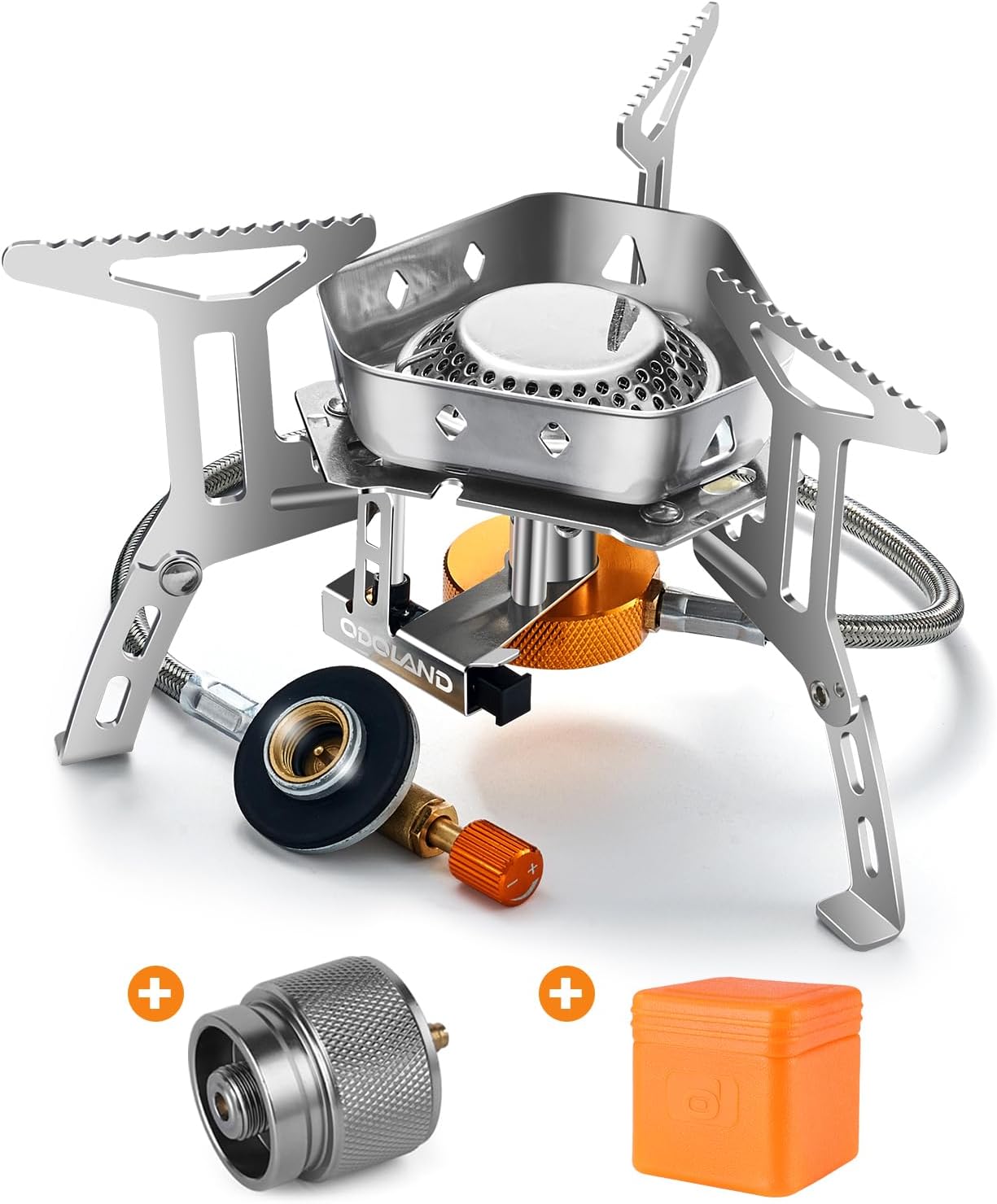
Odoland Windproof Camp Stove OD0358
| Fuel Type | Isobutane Propane |
|---|---|
| Maximum Energy Output | 3500 watts |
| Material | Aluminum, Stainless Steel |
The Odoland Windproof Camp Stove is a compact, single-burner backpacking stove built for basic outdoor cooking. It bolts onto standard 7/16-thread isobutane or propane-butane mixed fuel canisters using the included adapters, then uses a piezo ignition and a flame controller to start and regulate the flame. The windshield and burner geometry aim to improve performance in breezy conditions and the manufacturer rates peak output at 3500 watts, which the stove reports boiling roughly 1 L of water in about three minutes under good conditions. The stove is mostly aluminum and stainless steel, folds flat, and ships with a soft carrying case, so it packs easily for day hikes and car camping. Important limits are its single-burner layout and compact burner size, which make it best for kettles and small pans rather than simmering large pots or cooking for a crowd, and actual boil times will vary with weather and fuel. For a budget-focused camper who needs a reliable, portable heat source, it covers the essentials without frills.
Best for: Campers who want an inexpensive, no-frills stove that is easy to pack and reliably boils water for drinks or simple meals on short trips.
Less Ideal for: Groups who need to cook multiple dishes at once or prepare large quantities, and users who require precise low-heat simmering for complex recipes.
- Windshield design improves flame stability in breezy conditions
- Piezo ignition allows push-button lighting without a separate lighter
- Compatible with common 7/16 thread isobutane/propane-butane canisters via supplied adapters
- Lightweight, foldable construction and included carry case make it easy to pack
- Single burner and small burner area limit cooking to small pans and kettles
- Performance and boil times depend heavily on weather and choice of fuel canister
Verdict: A compact, budget-friendly windproof single-burner that reliably boils water and handles simple camp cooking for solo or small-group trips.
Gas One GS-3400P Camping Stove

| Fuel Type | Liquefied Petroleum Gas |
|---|---|
| Power Source | Gas Powered |
| Material | Alloy Steel, Metal |
The Gas One GS-3400P is a compact, dual-fuel camping stove built for simple outdoor cooking and emergency preparedness. It accepts a single 8 oz butane cartridge or a 16.4 oz propane cylinder (adapter included) and uses piezo-electric ignition so you can start the burner without matches. The stove has an adjustable heat dial for simmer-to-boil control and a three-burner-style top that supports typical camping pots and pans. Safety features such as a pressure-sensing cartridge ejection and a gas-flow cut-off for butane add protection against irregular pressure, and the flame supervision system helps prevent accidental gas leaks. At about 3.1 pounds and with a carrying case, it is easy to pack for backpacking car camping or keeping in an emergency kit. Trade-offs are its single-burner footprint limits how much you can cook at once and performance depends on fuel choice and altitude, where butane can struggle in very cold conditions.
Best for: Buyers who prioritize a dependable, easy-to-use stove for camping or emergency kits and want built-in safety features and straightforward ignition.
Less Ideal for: People who need to cook multiple dishes at once or require high-output, multi-burner cooking for large groups should consider a larger camp cooktop.
- Runs on either butane cartridge or propane cylinder with included converter for fuel flexibility
- Piezo-electric ignition removes need for matches or lighters
- Built-in safety systems including pressure-sensing cartridge ejection and gas flow cut-off
- Lightweight and includes a carrying case for easy transport and storage
- Single-burner design limits multitasking when preparing multiple dishes
Verdict: A reliable, safety-minded single-burner stove that gives flexible fuel options and simple ignition for camping and emergency use.
Coleman Triton 2-Burner Stove

| Fuel Type | Propane |
|---|---|
| Power Source | Gas Powered |
| Maximum Energy Output | 22000 british thermal units |
| Included Components | Stove, Grill/Griddle Plate |
The Coleman Triton 2-Burner Stove is a tabletop propane cooktop designed for campsite meals, tailgates, and picnics. It provides two independently adjustable burners with improved knob rotation for finer simmer control and two wind guards to keep flames steady in breezy conditions. The chrome-plated removable grate simplifies cleanup after frying or boiling, and a heavy-duty latch holds the unit closed for transport. It runs on a standard 16 oz propane cylinder and produces up to 22,000 BTUs total, which is enough for searing or running two pans at once for about an hour on high from a single cylinder. Practical limitations include the typical runtime constraint on a small canister and the fact that it is a tabletop stove, so you will need a stable surface and space for pans up to 12 inches. The build uses alloy steel which balances durability with portability, and the included grease tray helps contain messes during camp cooking.
Best for: Buyers who prioritize proven performance and reliable user feedback and want an easy-to-use, durable two-burner stove for group campsite cooking and tailgates.
Less Ideal for: People planning multi-day backcountry trips without resupply or those who need a built-in or full-size grill solution for permanent outdoor kitchens.
- Two independently adjustable burners for multi-pan cooking
- Wind guards protect flames in outdoor conditions
- Removable chrome-plated grate and grease tray make cleaning easier
- Heavy-duty latch and compact design improve portability and storage
- About one hour burn time on high from a single 16 oz propane cylinder can limit longer trips
Verdict: A dependable, easy-to-use two-burner propane stove that delivers proven outdoor cooking performance for small-group camping and tailgating.
Gas One Single Propane Burner B-5120

| Fuel Type | Propane |
|---|---|
| Power Source | Gas Powered |
| Included Components | Propane Burner, Propane Hose Assembly |
| Material | Alloy Steel, Cast Iron |
The Gas One single propane burner is a compact, high-output outdoor stove built for simple, robust camp cooking. It uses a dedicated propane hose assembly and a cast-iron burner head to deliver steady, high heat for boiling, frying, or one-pot meals while you are camping, tailgating, or doing a seafood boil. The unit includes a top heat guard to reduce spatter reaching the hose connection and a bottom heat shield to protect the support surface and internal components from excessive heat. Its alloy steel body and cast-iron parts give the burner a solid, durable feel that stands up to repeated outdoor use. Setup is straightforward: connect the hose to a standard propane cylinder, light, and adjust the flame for your pot size. Because it is a single-burner design, it is best for one-pot cooking or use alongside other gear rather than multi-burner meal prep, and the metal construction means it will be heavy compared with ultralight backpacking stoves. For anyone wanting a dependable, no-frills outdoor burner that emphasizes durability and straightforward performance, this model delivers practical, high-heat cooking without complicated features.
Best for: Buyers who prioritize a durable, reliable outdoor cooker for car camping, tailgating, or backyard boils and want a simple, high-heat single-burner they can trust.
Less Ideal for: Not a good fit for ultralight backpacking or groups that need multiple burners for simultaneous cooking.
- High-output burner provides fast, even boiling and searing
- Cast-iron burner head and alloy steel body for durable outdoor use
- Top heat guard and bottom heat shield protect hose and surfaces from heat and spatter
- Includes propane hose assembly for out-of-box hookup
- Single-burner design limits simultaneous cooking capacity
- Heavier, bulkier than ultralight backpacking stoves
Verdict: A rugged, high-output single propane burner that gives risk-averse campers dependable, heavy-duty heat for straightforward outdoor cooking.
Choosing the Right Gas Cooktop for Camping: Key Factors to Consider
Burner Power and Control
Heat output determines what you can cook and how quickly. Higher BTU or equivalent heat ratings let you boil water faster and maintain a steady simmer for sauces, while lower-output burners are better for delicate tasks. Look for cooktops with a wide range of flame adjustment and responsive controls so you can move from rapid boil to low simmer without overshooting.
On a campsite, consistent control matters because wind and ambient temperature can change cooking characteristics. If you plan to prepare varied meals, choose a unit with at least two distinct power settings or multiple burners with different outputs to handle pans of different sizes.
Portability and Packability
How easy the cooktop is to transport affects how often you will actually use it. Weight, footprint, and whether the unit nests or has a carry case all factor into packability. For backpack trips you will need ultralight designs; for car camping you can afford larger, heavier units with more features.
Also consider how the cooktop fits into your existing gear system. A flat, rectangular footprint stacks better in storage boxes or a trunk, while oddly shaped units can waste space. Handles or integrated latches that secure moving parts are helpful for keeping everything intact in transit.
Fuel Type and Efficiency
Different cooktops use canisters, small propane cylinders, or other portable fuels. Fuel availability and how long a canister lasts under normal boiling or simmering cycles should guide your choice. A more fuel-efficient burner reduces the number of spare canisters you must carry and lowers ongoing trip logistics.
Also, think about fuel safety and connector compatibility. Standard fuel fittings and easy-to-find canisters are preferable, and cooktops that operate on common fuels reduce the risk of being stranded without a usable fuel source at your destination.
Stability and Cooking Surface
A stable cooking platform prevents spills and makes it easier to use larger pans. Check for wide bases, non-slip feet, or integrated pot supports that accommodate common pan sizes. On uneven ground, a well-designed stability system keeps flames centered under the pan and reduces the chance of tipping.
Consider the spacing between burners if the model has multiple burners. Too close together can make it difficult to use large pots side by side. Also assess whether the cooktop requires additional stands or tripods for safe use on soft ground.
Durability and Weather Resistance
Outdoor gear endures bumps, moisture, and fluctuating temperatures. Materials that resist corrosion, rugged control knobs, and covers that protect sensitive parts extend the life of a cooktop used at campsites. Stainless steel, anodized aluminum, and protected ignition systems are examples of durable design choices.
Think about exposure to rain, sand, or salt air. Units with sealed or recessed controls and easily removable grease trays are simpler to clean and less likely to suffer long-term damage from campsite conditions.
Ease of Setup and Cleaning
Quick setup reduces the time you spend fussing before a meal. Cooktops that require minimal assembly, have intuitive ignition, and include clear visual indicators for flame levels make outdoor cooking faster. Some models offer tool-free attachment of fuel canisters or fold-out legs that lock in place.
Cleaning matters because grease and food debris are harder to manage outdoors. Removable grates, smooth surfaces, and accessible drip trays simplify post-meal cleanup so you can pack up and store the unit without lingering messes.
Choosing the Right Burner Layout
Think about the typical meals you will prepare and choose a burner layout that supports them. Single-burner units are ideal for solo trips or boiling water, while two- or three-burner layouts let you cook multiple dishes at once, which is useful for family camping or meal prep.
Also consider burner spacing and relative outputs. A layout with one high-output burner and a secondary low-output burner gives flexibility for both boiling and simmering. If you plan to use large pans or griddles, ensure that the spacing allows stable placement without crowding.
- Single burners: ultralight and compact for solo use
- Two burners: balanced for most car-camping needs
- Multiple burners: useful for groups or complex meals
Wind Management and Flame Performance
Wind can greatly reduce cooking efficiency by dispersing heat. Look for cooktops with integrated wind guards or designs that partially shield the flame. Some portable units place the burner beneath a raised lip or recessed well to help concentrate heat under the pan.
If you expect to cook in exposed conditions, practice positioning the cooktop relative to natural wind breaks or carry a simple windscreen. Even small changes in orientation can improve flame stability and reduce fuel use.
- Use natural shelter when possible to reduce wind impact
- Place a windscreen at a safe distance to avoid overheating chassis
- Avoid enclosing the cooktop in tight spaces that can trap heat
Safe Fuel Handling in the Outdoors
Store spare fuel canisters upright, away from heat sources and direct sunlight. When connecting or changing canisters, keep the cooktop off and check connections for leaks. A quick soap-and-water test at home before a trip helps you spot faulty fittings.
Know the local regulations and best practices for transporting fuel. Use approved containers and avoid mixing fuel types. Also plan how many canisters you will need based on expected meal frequency and burner output to avoid running out mid-trip.
- Check connectors and seals before departing
- Carry a small repair kit for hose or connector issues
- Dispose of empty canisters responsibly and follow local rules
Maintenance Tips for Longevity
After each trip, wipe down surfaces, remove food residue from grates, and dry components thoroughly before storage. Corrosion starts with trapped moisture, so complete drying prevents long-term damage.
Inspect ignition parts and control valves periodically. If a spark igniter becomes unreliable, many systems can be serviced or replaced without changing the entire unit. Regular maintenance preserves consistent performance and reduces the chance of failure on longer expeditions.
- Clean drip trays and removable parts after each use
- Store in a dry, ventilated area to prevent corrosion
- Replace worn seals and check hose fittings before season
Packing and Transport Best Practices
Protect delicate knobs and ignition assemblies during transport by using built-in latches, a padded case, or surrounding gear. Secure the cooktop in your vehicle so it cannot shift and suffer impact damage.
If you use a fuel canister with the unit while traveling, remove and transport canisters separately in dedicated compartments. This reduces risk and keeps the cooktop mechanism safer from accidental opening or damage.
- Use original packaging or a padded bag for storage
- Keep fuel and stove in separate compartments during travel
- Label fuel containers and used spares to track consumption
How We Chose the Best Gas Cooktop for Camping
We focused on attributes that matter for using a gas cooktop in outdoor camping environments. Selection began with units designed or portable enough for campsite use, excluding full-size household built-in models and any cooktops that rely solely on household electrical infrastructure. We prioritized reliable ignition systems, measured burner heat output and controllability, and evaluated how compact and lightweight each unit is for transport. Durability in outdoor use, including corrosion-resistant finishes and protected controls, was another key filter. Fuel compatibility and efficiency were scored, with attention to common camping fuels and how long a single fuel source will last under typical cooking loads. Safety features such as stable feet or brackets, flame failure protection, and clear control markings were also required. Finally, we considered ease of cleaning and setup, since campers benefit from low-maintenance gear. Products that lacked adequate portability, had fragile controls, or required specialized nonstandard fuel sources were excluded.
Our full evaluation process is outlined in our review methodology.
FAQ
Can I use a camping gas cooktop at high altitude?
Yes, but performance changes with altitude. Thinner air reduces combustion efficiency, so expect longer boil times and slightly different flame behavior. Choosing a cooktop with higher burner output helps mitigate altitude effects.
How many fuel canisters will I need for a weekend camping trip?
It depends on stove efficiency, burner output, and how often you cook. For a standard two- to three-day car-camping weekend with multiple meals, plan for at least one spare canister per primary cooktop plus the one in use. If you expect heavy frying or long simmering, add another spare.
Are canister-fed cooktops safer than connected-bottle propane setups?
Both systems can be safe when used correctly. Canister-fed units are compact and convenient, while small bottle propane setups offer longer burn times. Safety depends on proper connection, regular inspection, and following manufacturer instructions for fuel handling.
What should I do if the igniter stops working at camp?
Carry a reliable backup such as a handheld lighter or matches designed for outdoor use. At camp you can often clean the igniter area and dry it if moisture is the issue. If the igniter has failed permanently, manual ignition is a practical workaround until you can service the unit.
Can I use any pot or pan on a camping gas cooktop?
Most standard pots and pans work, but choose flat-bottomed cookware that matches the burner size for stable contact and efficient heat transfer. Very large or oddly shaped cookware may overhang and reduce stability, so check burner spacing before relying on oversized items.
Final Verdict
Choose a gas cooktop for camping by balancing burner power, portability, and fuel logistics. Prioritize models that provide reliable ignition, a useful range of heat settings, and a stable cooking surface suited to the pans you will bring. Durability and ease of cleaning are important because they reduce maintenance and extend service life when used outdoors. Decide whether you need ultralight simplicity for backpacking or a slightly larger, more capable unit for car camping. Match your choice to trip length, group size, and typical meals so you buy a cooktop that performs where and when you will use it most.