
Note: This article contains affiliate links. If you click on these links and make a purchase, we may earn a small commission at no extra cost to you. This helps support our research and content. Read our full affiliate disclosure here.
If you bake regularly, the right gas oven can make the difference between uneven cookies and reliably golden breads. A gas oven for baking changes how heat distributes, how moisture behaves, and how sensitive temperature adjustments feel compared with other fuel types. In this guide we shortlisted seven gas ovens for baking that excel at stable temperatures, sensible rack layouts, and precise controls. Below you will find our top picks along with the criteria we used to evaluate them, plus practical advice on capacity, convection, and oven setup to help you pick the best oven for your home baking needs.
Top Picks at a Glance
| Best Overall The best all-around choice for most situations | AAOBOSI 36 Inch Gas Range Oven |  |
| Best Quality Built to a higher standard if you want something more solid | AAOBOSI 48 Inch Freestanding Gas Range |  |
| Best Value The sweet spot between price and what you get | GE 30-Inch Freestanding Gas Range |  |
| Best Budget The cheapest option that still gets the job done reliably | Hike Crew Outdoor Gas Camping Oven |  |
| Top Rated A top-rated pick with lots of positive feedback | GASLAND Pro GS606MB 24" Gas Wall Oven |  |
| Most Popular A crowd favorite that many people choose with confidence | Avanti Gas Range Oven |  |
| Best Seller A high-volume bestseller chosen again and again | CAMPLUX RV Propane Range RGS17MSF |  |
AAOBOSI 36 Inch Gas Range Oven

| Capacity | 6 cubic feet |
|---|---|
| Number of Heating Elements | 6 |
| Controls Type | Knob/Touch |
| Heating Element | Sealed |
| Voltage | 120 volts |
This AAOBOSI 36-inch gas range pairs a large 6 cu. ft. convection oven with a six-burner sealed cooktop to handle both everyday meals and bigger baking sessions. The oven offers convection fans, air-fry capability, timed cooking, temperature probe support, and seven rack positions, which help deliver even baking and flexibility when roasting multiple pans at once. The cooktop provides a wide BTU spread across six burners and heavy-duty cast iron grates, so you can simmer or sear as needed while the oven maintains consistent heat. Practical touches include triple-pane oven glass, removable door for cleaning, a storage drawer, and NG/LPG conversion hardware. Because it is freestanding with a stainless steel finish and electronic ignition, installation and maintenance are straightforward for a home kitchen. Expect a professional-looking appliance with many functionality options, but buyers should plan for professional gas hookup and consider the unit footprint and weight during installation.
Best for: Home cooks who bake regularly and need a large, versatile oven that can handle multiple pans and advanced bake modes while also offering a powerful cooktop.
Less Ideal for: Those seeking a compact range for small kitchens or buyers who need built-in cabinetry integration or smart connected controls.
- Large 6 cu. ft. convection oven with air-fry and multiple bake functions for even results
- Six sealed burners with a broad BTU range for precise stovetop cooking
- Stainless steel construction and removable oven door for easier cleaning
- Comes with racks, baking pans, and NG/LPG conversion kit for flexible fuel use
- Freestanding footprint and 110 lb weight require planning for delivery and installation
- No explicit smart home connectivity or advanced digital controls listed
Verdict: A roomy, convection-equipped gas range that gives home bakers professional-style capacity and versatile stovetop power for multi-pan baking and roasting.
AAOBOSI 48 Inch Freestanding Gas Range

| Fuel Type | Natural Gas, Propane |
|---|---|
| Capacity | 7.8 cubic feet |
| Number of Heating Elements | 7 |
| Voltage | 120 volts |
This AAOBOSI 48-inch range pairs a powerful seven-burner gas cooktop with dual convection ovens to handle large baking and cooking tasks. The cooktop includes five mid-power burners, one 15,000 BTU and one 18,000 BTU burner plus a central iron grill burner, giving a wide heat range for searing, stir-frying, and gentle simmering. The double ovens (approximately 2.8 cu ft and 5 cu ft) both use convection fans and include temperature probes and multiple rack positions so you can bake different items simultaneously with more even heat. Controls are simple knob-operated, and the stainless steel construction plus removable grates and enamel-lined interiors make cleaning straightforward. It ships convertible for natural gas or propane and includes safety features like flame-failure protection. Trade-offs are its large footprint and professional-level power, which need proper installation, ventilation, and space in a baking-focused kitchen, and a mostly manual control layout compared with models that offer digital precision or smart controls.
Best for: Bakers and home cooks who prioritize professional-level heat range and capacity for frequent large-batch baking and multi-dish meal prep.
Less Ideal for: Small kitchens, occasional bakers, or buyers who want compact ranges with digital or smart controls and precision programming.
- High total cooktop output with seven sealed burners including high-BTU options for rapid searing and wok cooking
- Double convection ovens allow baking different dishes at once and promote even heat distribution
- Stainless steel construction and removable cast-iron grates simplify cleaning and durability
- Includes temperature probes, multiple rack positions, and explosion-proof lights for practical baking control
- Large 48-inch footprint requires a spacious kitchen and professional-style installation
- Knob-only controls lack digital timers and fine temperature programming found on some baking-focused ranges
Verdict: Choose this range if you need a high-capacity, high-power gas oven setup that lets you bake large quantities and run different recipes concurrently.
GE 30-Inch Freestanding Gas Range

| Fuel Type | Gas |
|---|---|
| Capacity | 4.8 cubic feet |
| Controls Type | Knob |
| Drawer Type | Broiler |
This GE 30-inch freestanding gas range is a straightforward, no-frills cooktop and oven combo built for reliable everyday use. It offers four sealed gas burners that contain spills and provide steady flame control via front-mounted knobs, which makes stovetop simmering and multi-burner cooking simple. The oven has a 4.8 cubic foot capacity with adjustable racks, giving enough room for sheet pan baking, roasts, and multiple dishes for family meals. The broiler drawer and polished alloy-steel finish are practical additions that fit most standard kitchens and are easy to wipe down. Controls are manual, so there is no digital programming or smart connectivity, which keeps operation intuitive but means you cannot rely on timed presets or remote monitoring. If you bake frequently, the gas oven gives quick temperature response and even browning when monitored, though it may need occasional calibration for precision baking compared with convection or probe-equipped models. Overall this range focuses on dependable performance and simple maintenance rather than advanced baking features.
Best for: Bakers and home cooks who prioritize straightforward, reliable gas performance and a roomy oven for family-sized bakes rather than advanced digital controls.
Less Ideal for: Users who need convection baking, precise temperature probes, or app-enabled scheduling and monitoring should consider models with those features instead.
- Large 4.8 cu ft oven provides roomy interior for sheet pans and roasts
- Four sealed gas burners contain spills and offer steady flame control
- Front knob controls are simple and intuitive for everyday use
- Polished alloy-steel finish wipes clean easily and fits standard kitchens
- No convection mode or digital controls for precision baking
- Limited to manual knob operation without smart features
Verdict: Choose this GE gas range if you want a roomy, dependable oven and simple, reliable stovetop performance for everyday baking and family meals.
Hike Crew Outdoor Gas Camping Oven

| Fuel Type | Propane |
|---|---|
| Power Source | Propane |
| Maximum Energy Output | 16000 btu_per_hour |
The Hike Crew Outdoor Gas Camping Oven combines a 16,000 BTU two-burner cooktop with a 3,800 BTU oven, giving you a true camp-ready stove and bake oven in one portable unit. It is used like a compact outdoor kitchen: the cooktop handles pots and pans up to about 10 inches while the oven with double removable racks and a built-in thermometer heats up to 425°F for baking, roasting, and reheating. Practical features include piezo auto igniters, temperature control knobs, a thermocouple overheat shutoff, removable grates and drip tray for cleaning, and an included propane hose, regulator, and carry bag for transport. The oven's 3,800 BTU output is sufficient for cookies, casseroles, and roasting at campsite conditions but will take longer to recover compared with full-size home ovens, so expect slower bake times and some temperature variance. At just under 30 pounds with integrated handles it balances portability and cooking capability for car camping, tailgates, or RV use. If you need reliable outdoor baking without electricity, this is a practical, safety-minded option that keeps cleanup and setup simple.
Best for: Buyers who want a budget-friendly, portable outdoor oven that can bake and cook like a small kitchen while camping, tailgating, or RVing and who prioritize ready-to-use convenience and safety.
Less Ideal for: Not a good choice for ultralight backpacking or users who need fast, high-output baking comparable to a full-size home oven.
- Combined two-burner range and oven lets you cook and bake in one portable unit
- Built-in thermometer and removable oven racks simplify baking and temperature monitoring
- Includes propane hose, regulator, and carry bag for out-of-the-box portability
- Safety features like thermocouple automatic overheat shutoff and piezo igniters reduce fire risk
- Removable grates and drip tray make cleaning easier after outdoor use
- Oven BTU (3,800) is lower than household ovens so bake times and heat recovery are slower
- Unit is relatively heavy compared with small backpacking stoves, making it better suited to car camping than long treks
Verdict: A practical, budget-focused portable gas oven that delivers real baking capability outdoors while including hose, regulator, and safety features for easy, safe setup.
GASLAND Pro GS606MB 24" Gas Wall Oven

| Fuel Type | Natural Gas |
|---|---|
| Heating Method | Convection |
| Capacity | 2.12 cubic feet |
| Voltage | 120 |
| Additional Features | Broiling, Rotisserie |
The GASLAND Pro GS606MB is a 24-inch built-in natural gas wall oven designed for everyday home baking and roasting. It offers six cooking modes including bake, broil, convection and a 360° rotisserie so you can roast poultry and use convection for more even browning. The oven uses a push-and-turn mechanical knob ignition with a 120V electric ignitor and an internal light for monitoring, and it includes two racks plus a rotisserie set that make it straightforward to load for multi-rack baking. Its 3-layer tempered glass door and enamel interior simplify cleanup and the five rack positions give flexibility for sheet pans and baking dishes. On the downside the capacity is modest at 2.12 cu.ft., so it is best for small to medium batches rather than large multi-sheet baking, and control is basic knob operation without digital presets. For bakers who prioritize dependable, simple gas performance and even convection heat, this oven covers the essentials without complicated electronics.
Best for: Home bakers who want a reliable, straightforward gas oven with convection and rotisserie functions for consistent results without complex electronics.
Less Ideal for: High-volume bakers who need larger interior capacity or precise digital controls for repeatable programming.
- Convection heating for more even baking and faster cook times
- 360° rotisserie and broil functions expand roasting options
- 3-layer tempered glass door and enamel interior simplify cleaning
- Five rack positions and included oven racks provide flexible baking layouts
- Modest 2.12 cu.ft. capacity limits large batch or multi-sheet baking
- Basic mechanical knob controls lack digital timers and presets
Verdict: A dependable, no-frills built-in gas oven that gives bakers convection and rotisserie capability for even, consistent results.
Avanti Gas Range Oven
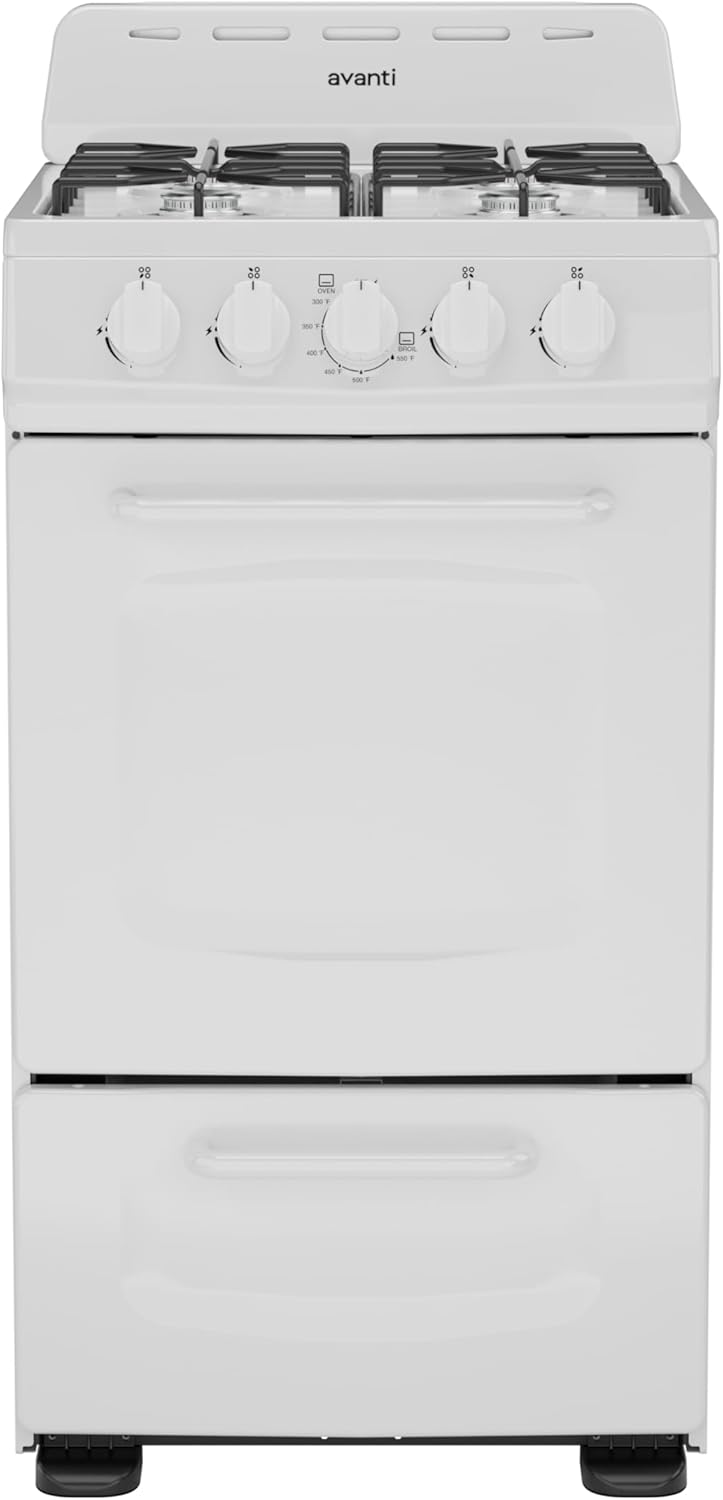
| Capacity | 2 cubic feet |
|---|---|
| Number of Heating Elements | 4 |
| Fuel Type | Gas |
| Voltage | 120 volts |
This Avanti gas range is built for small kitchens that still need full cooking capability. The four 9000 BTU burners on a cast iron grate provide steady stovetop heat for boiling, sautéing, and simmering, while the 2.1 cu. ft. oven offers full-range temperature control from 300 to 500 degrees for baking and roasting. Electronic ignition and push-turn knobs make it simple to operate, and the included propane conversion kit adds installation flexibility. Practical extras include two oven racks, a broiler drawer for finishing and browning, and a lower storage drawer for pans. Because it is a 20-inch freestanding unit, interior capacity is smaller than a standard home range, so baking several large pans at once may be tight. The solid door and painted finish are straightforward and easy to coordinate, but expect basic materials and a value-focused fit and finish rather than premium styling. Certified to ETLus standards and backed by a one-year limited warranty, this range is a sensible choice when space is the priority and dependable, everyday baking performance is required.
Best for: Buyers who need a full-function gas range that fits a compact kitchen and want reliable, everyday baking and stovetop performance without premium frills.
Less Ideal for: Households that bake large quantities, use oversized sheet pans, or prioritize high-end finishes and professional-grade components should consider a larger or higher-end range.
- Compact 20-inch footprint fits tight kitchens and apartments
- Four 9000 BTU burners with cast iron grate deliver steady stovetop heat
- Oven offers 300–500°F temperature range suitable for most baking and roasting
- Includes propane conversion kit for flexible fuel installation
- Electronic ignition and simple push-turn knobs for easy operation
- 2.1 cu. ft. oven limits capacity for large baking batches
- Basic painted finish and materials are utilitarian rather than premium
Verdict: A space-saving gas range that delivers dependable baking and stovetop performance for apartments and small kitchens.
CAMPLUX RV Propane Range RGS17MSF

| Fuel Type | Liquid Propane |
|---|---|
| Capacity | 1.27 cubic feet |
| Number Of Racks | 2 |
| Number of Heating Elements | 3 |
| Voltage | 12 volts_of_direct_current |
The CAMPLUX RGS17MSF is a slide-in propane range built for RVs and small mobile homes, combining a three-burner stovetop and a 1.27 cubic foot oven in a 17-inch footprint. The cooktop offers one higher-power burner plus two medium burners, and the oven uses propane ignition with DC-powered electronic pulse ignition for the burners and powered lighting and oven functions. Stainless steel surfaces, a tempered glass dust cover, removable cast-iron grate and an enamel-lined oven make cleaning straightforward for road use. Safety features include a CSA certification and a safety cutoff valve, while backlit stainless knobs and a solid oven handle give a durable, user-friendly feel. Practical limitations for baking: the oven is compact, so it fits small trays or one standard baking pan at a time, and precise temperature stability will be more modest than full-size household gas ovens. The unit needs a 12V connection for electronic ignition and oven lights, and installation requires proper slide-in cutout and propane hookup. For RV cooks who want real-burner capability and a usable oven in limited space, this range balances functionality and road-ready durability.
Best for: Buyers who prioritize a reliable, factory-quality propane cooking appliance for an RV or camper and want the convenience of a real oven plus burners in a compact footprint.
Less Ideal for: Home bakers who need full-size oven capacity or very precise temperature control for large-batch baking should choose a full-size kitchen range instead.
- Compact slide-in design fits tight RV kitchens while offering both stovetop and oven functions.
- Three sealed burners with a removable cast-iron grate provide real-flame cooking versatility.
- Enamel-lined oven and stainless steel surfaces are easy to wipe clean for travel use.
- CSA certification and a safety cutoff valve add measurable safety for propane operation.
- Oven interior is small, limiting the size and number of baking pans you can use.
- Requires 12V power for ignition and oven lights, so some features are unavailable without DC power.
Verdict: If you need a road-ready propane range that delivers real-burner cooking and a usable compact oven for RV baking, this CAMPLUX slide-in is a practical, safety-minded choice.
Choosing the Right Gas Oven for Baking: Key Factors to Consider
Temperature Accuracy and Calibration
Accurate temperature is the single most important factor for baking. Small deviations can change rise times, crumb structure, and browning. Look for ovens that come with clear calibration procedures or factory-tested thermostats. A model that holds within a few degrees of the set point reduces the need to modify recipes or rely on trial-and-error.
If you do serious baking, plan to use an independent oven thermometer to verify set-point accuracy and to calibrate if necessary. Frequent door openings, drafts, or a weak seal will affect measured temperature, so consider those factors when assessing accuracy in real use.
Heat Distribution and Convection Options
Even heat across the cavity prevents hot spots that burn edges while centers remain undercooked. Gas ovens vary by burner placement and whether they include a convection fan. True convection with a fan and well-placed baffles promotes consistent airflow and better multi-rack baking.
Some gas ovens rely on natural convection and careful burner design to reduce variation. When baking multiple trays, a convection mode or a design that minimizes vertical temperature gradients is especially useful to maintain uniform results without rotating pans constantly.
Baking Capacity and Rack Flexibility
Capacity matters when you bake in batches or make large items like multi-layer cakes or big loaves. Interior volume combined with the number and positions of racks determines how many pans fit comfortably without crowding.
Also check how easy it is to adjust rack heights and whether the oven supports standard sheet pans or larger casserole dishes. A taller cavity is useful for roasts and tall cakes, while more rack positions help when you need to bake several trays at once.
Control Precision and User Interface
Precise controls let you set and maintain exact temperatures and timed cycles. For baking, tactile knobs with fine detents or digital controls with clear feedback reduce guesswork. Programmable timers and staged temperature settings help with recipes that require changes mid-bake.
A straightforward control layout matters when you are focused on the bake rather than on complex menus. Controls that allow small temperature adjustments are preferable to coarse, hard-to-read dials.
Door Design and Oven Sealing
A tight-sealing door prevents heat loss and improves recovery time after opening. Heavy, insulated doors with robust hinges reduce temperature fluctuations when you check progress. A large, well-lit viewing window lets you monitor baking without opening the door.
If the door gasket is difficult to replace or the hinge design is prone to sagging, long-term performance can suffer. Consider how the door handle and latch operate when you need to open the oven quickly during active baking sessions.
Interior Finish and Ease of Cleaning
Interior materials and cleaning options affect maintenance and oven longevity. A smooth, durable enamel surface resists staining and is easier to wipe down after spills. Some finishes offer easy-clean coatings that reduce scrubbing.
Removable racks and a shallow crumb tray simplify cleanup between bakes. Consider whether the oven has hard-to-reach corners where grease can accumulate and whether manufacturer guidance on cleaning is practical for regular use.
Convection: When It Helps and When It Hurts
Convection can significantly improve bake consistency by moving heated air around the cavity. This is especially useful when baking multiple trays at once, as the airflow reduces vertical temperature gradients and shortens recovery time after opening the door.
However, convection can also accelerate browning and reduce bake time, which may require recipe adjustments. For delicate items like custards or some quick breads, you might prefer ordinary baking without active fan assistance. Look for ovens that let you disable convection or adjust fan intensity.
- Use convection for multiple-tray bakes and sheet cookies to equalize results.
- Disable convection for delicate custards, souffles, or recipes sensitive to surface browning.
- Expect to reduce baking time or temperature slightly when using convection.
Setting Up for Best Results
Placement within the kitchen and ventilation affect oven performance. Avoid placing the oven in a drafty area or behind cabinets that block airflow to the gas supply and venting. Ensure the oven is level so racks slide evenly and heat distributes predictably.
Invest in two or three reliable oven thermometers to map hot spots and verify the nominal temperature. When starting a new oven, run it empty to burn off manufacturing residues and to observe heat-up time and stability before baking food.
- Level the oven and check that racks slide smoothly.
- Use oven thermometers to map hot and cool zones.
- Preheat fully and allow extra time when baking dense items.
Rack Strategy for Multi-Tray Baking
How you arrange racks influences airflow and evenness when baking multiple pans. Stagger racks so pans are not directly above one another to allow air to move freely between trays. Rotating pans partway through the bake is often necessary in non-convection ovens to reduce edge differences.
Choose pans that fit comfortably with some clearance on all sides. Low-sided sheet pans encourage airflow while high-sided pans can trap steam and alter browning. If your oven supports additional rack positions or an extra shelf, that flexibility helps scale batch sizes without crowding.
- Stagger pans rather than stacking them vertically for better circulation.
- Rotate pans halfway through if results are uneven.
- Prefer low-sided sheet pans for cookies and biscuits to promote airflow.
Gas Oven Maintenance Tips
Regular cleaning, checking the burner ports, and inspecting the door gasket extend oven life and keep performance consistent. Wipe spills promptly when the cavity is cool to prevent baked-on residue that alters heat patterns.
Periodically check the ignition and burner flames for an even, stable burn. If you notice yellow tipping or flickering, schedule a professional inspection. Replace worn gaskets and warped racks to maintain proper clearance and sealing.
- Clean spills once cooled to avoid baked-on residue.
- Inspect burner flames and ignition for consistent operation.
- Replace door gasket if heat loss or uneven baking occurs.
Choosing Accessories That Improve Baking
Good accessories can compensate for some oven limitations. A heavy steel baking sheet or baking stone stores heat and smooths temperature swings when you open the door. An insulated baking steel helps with crust development for breads.
Quality racks, low-sided sheet pans, and an accurate oven thermometer are the simplest additions that yield the biggest improvements. Avoid warped pans that sit unevenly and distort airflow around the bake.
- Use a baking stone or steel for better bottom crust on bread.
- Choose low-sided, heavy-gauge sheet pans for consistent heat transfer.
- Keep a dedicated oven thermometer inside to monitor true cavity temperature.
How We Chose the Best Gas Oven for Baking
Our selection focused on attributes that most affect baking performance and day-to-day usability. We prioritized temperature accuracy and recovery because consistent heat is fundamental to predictable rises and browning. Even heat distribution was evaluated through design features such as burner placement and available convection modes. Capacity and rack configuration were included to reflect what bakers actually need: how many sheet pans or multiple racks can be used simultaneously without hot spots. Control precision and programmability matter for recipes that require staged temperatures and timed rests. We also considered build quality and oven sealing since heat loss alters bake results and increases recovery time. Practical usability filters excluded models lacking clear temperature calibration or with only minimal rack positions. Units with inadequate interior lighting or awkward door access were deprioritized. We did not include countertop or portable units because they do not meet standard home baking capacity needs.
Our full evaluation process is outlined in our review methodology.
FAQ
Do I need to adjust recipes for a gas oven?
Often yes. Gas ovens can have more humidity and different heat distribution compared with other fuel types. You may need to slightly increase baking time or adjust temperature for browning and texture. Test with an oven thermometer and make small changes until results match the recipe intent.
Is convection necessary for home bakers?
Convection is helpful for even multi-rack baking and faster recovery after opening the door. It is not essential for all baking; many classic recipes were developed for still air. Use convection selectively and adjust time or temperature as needed.
How can I check for hot spots in my oven?
Place oven-safe thermometers or a grid of sugar- or flour-dusted parchment sheets across different positions and run a short bake at a moderate temperature. Compare color or thermometer readings to identify warmer and cooler zones, then adjust rack placement or rotate pans during bakes.
How often should I service a gas oven?
Regular maintenance includes cleaning and a quick visual check of the burner flames every few months. A professional inspection of the gas connection and ignition system every 1 to 2 years is common for safety and consistent performance, depending on usage.
Will opening the door ruin my bake?
Briefly opening the door will cause some heat loss but usually does not ruin a bake if done quickly. For delicate items that rely on steady temperature, minimize checks and use the oven light or a viewing window when possible.
Final Verdict
When choosing a gas oven for baking, prioritize temperature accuracy and even heat distribution, because those factors most directly influence crumb, rise, and crust. Match oven capacity and rack flexibility to the volumes you plan to bake and favor models with user-friendly controls and solid door sealing. Accept tradeoffs such as slightly higher humidity or the need to adapt recipes, but look for features that reduce those issues, like good convection or tight sealing. Focus on the scoring criteria above to narrow your options and you will find an oven that reliably produces the kind of baked goods you want.