
Note: This article contains affiliate links. If you click on these links and make a purchase, we may earn a small commission at no extra cost to you. This helps support our research and content. Read our full affiliate disclosure here.
If you want the sleek look of a glass-top cooktop but need built-in ventilation where an overhead hood is impractical, a cooktop with downdraft is a practical solution. You will get a flat, easy-to-clean surface plus integrated venting that pulls smoke and steam away at countertop level. Choosing the right unit matters for kitchen performance, safety, and maintenance because venting capacity and heat control vary across models. This guide shortlists the top glass-top cooktops with downdraft and explains the criteria we used to evaluate venting strength, burner responsiveness, ease of cleaning, and installation needs. Read on to find the best option that fits your layout and cooking habits.
Top Picks at a Glance
| Best Quality Built to a higher standard if you want something more solid | GASLAND 31.5" Downdraft Electric Cooktop |  |
| Best Value The sweet spot between price and what you get | Cooksir 30-Inch Glass Ceramic Cooktop |  |
| Best Budget The cheapest option that still gets the job done reliably | Hobsir 36 Inch Electric Cooktop |  |
| Top Rated A top-rated pick with lots of positive feedback | GASLAND 31.5" Electric Cooktop |  |
| Most Popular A crowd favorite that many people choose with confidence | Cooksir 36-Inch Electric Cooktop |  |
GASLAND 31.5" Downdraft Electric Cooktop
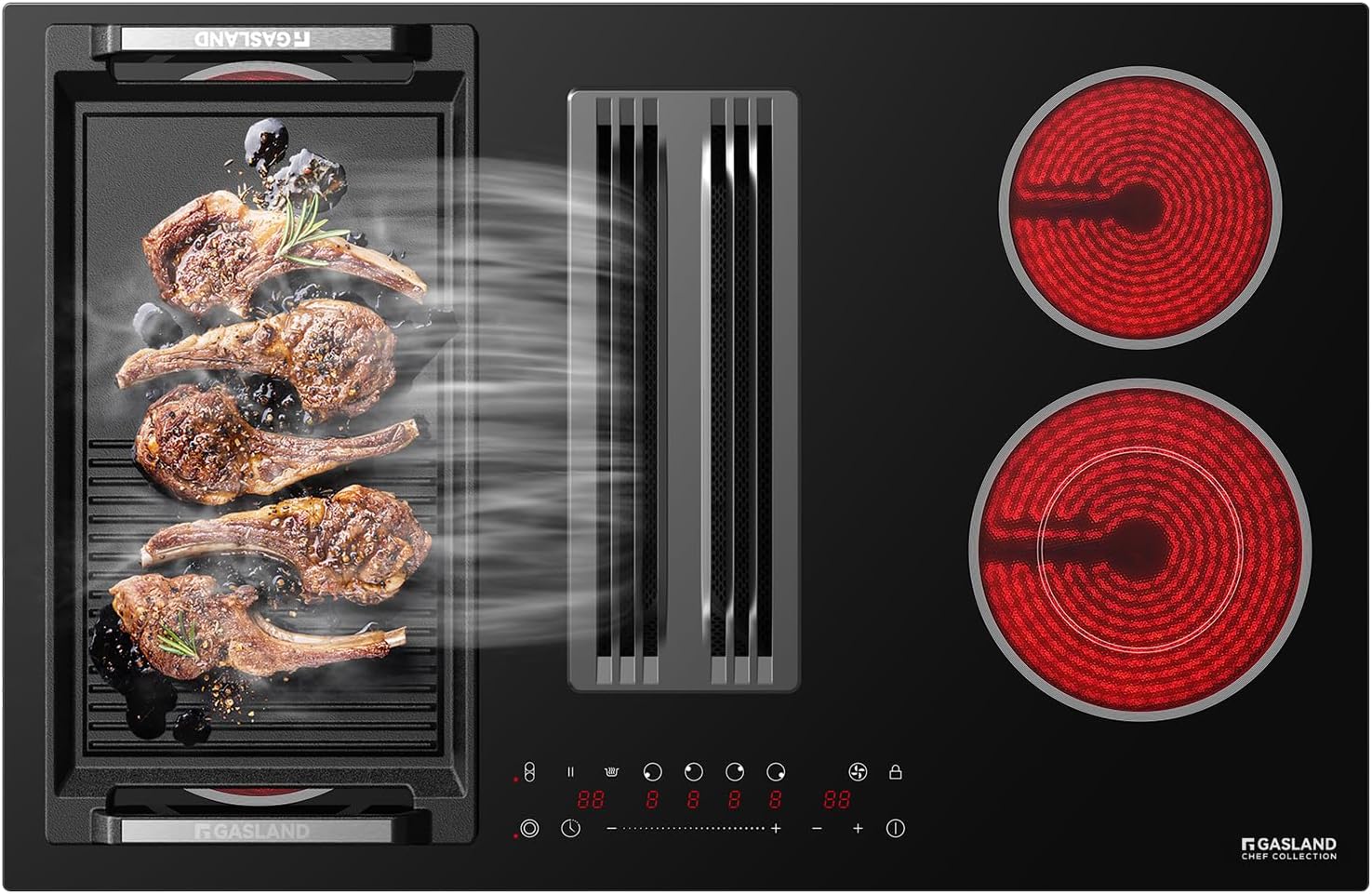
| Number of Heating Elements | 4 |
|---|---|
| Wattage | 7400 watts |
| Voltage | 220 volts |
| Additional Features | Downdraft Exhaust, Sync Element, Safety Lock, Warm Setting |
This GASLAND 31.5-inch glass-top cooktop combines four radiant heating elements with a built-in downdraft ventilation system to deliver strong everyday cooking performance in kitchens without an overhead hood. It offers a flexible bridge element that merges two zones for griddles or long pans and a dual-ring element for better fit with different cookware, while slide touch controls and a 99-minute timer make adjustments quick and intuitive. The integrated downdraft runs up to 330 CFM with three speeds and includes removable, dishwasher-safe grease filters and a drip pan, so it actually reduces smoke and cleanup compared with many countertop venting workarounds. Safety features such as child lock, hot surface indicator, and automatic shutoff add confidence during heavy use. Downsides to note are the need for 220V wiring and the usual care required for a glass-ceramic surface to avoid scratches, but for cooks who want high output and a streamlined island installation this unit delivers strong, practical performance.
Best for: Buyers who prioritize strong, flexible cooking performance and need integrated ventilation for an island or open-plan kitchen.
Less Ideal for: People who cannot accommodate 220V electrical installation or who prefer induction-level efficiency and faster heat response.
- Built-in downdraft ventilation up to 330 CFM removes smoke and steam without an overhead hood
- Bridge element combines two zones into a single high-power area for griddles and long pans
- Dual-ring element accommodates different cookware sizes for more efficient heating
- Dishwasher-safe grease filter and removable drip pan simplify maintenance
- Touch slide controls and 99-minute timer provide precise, convenient adjustments
- Requires 220V wiring, so installation may need an electrician
- Glass-ceramic surface is prone to scratches and needs careful cleaning
Verdict: Choose this cooktop if you want high-output radiant burners plus a built-in downdraft for powerful, island-friendly performance.
Cooksir 30-Inch Glass Ceramic Cooktop
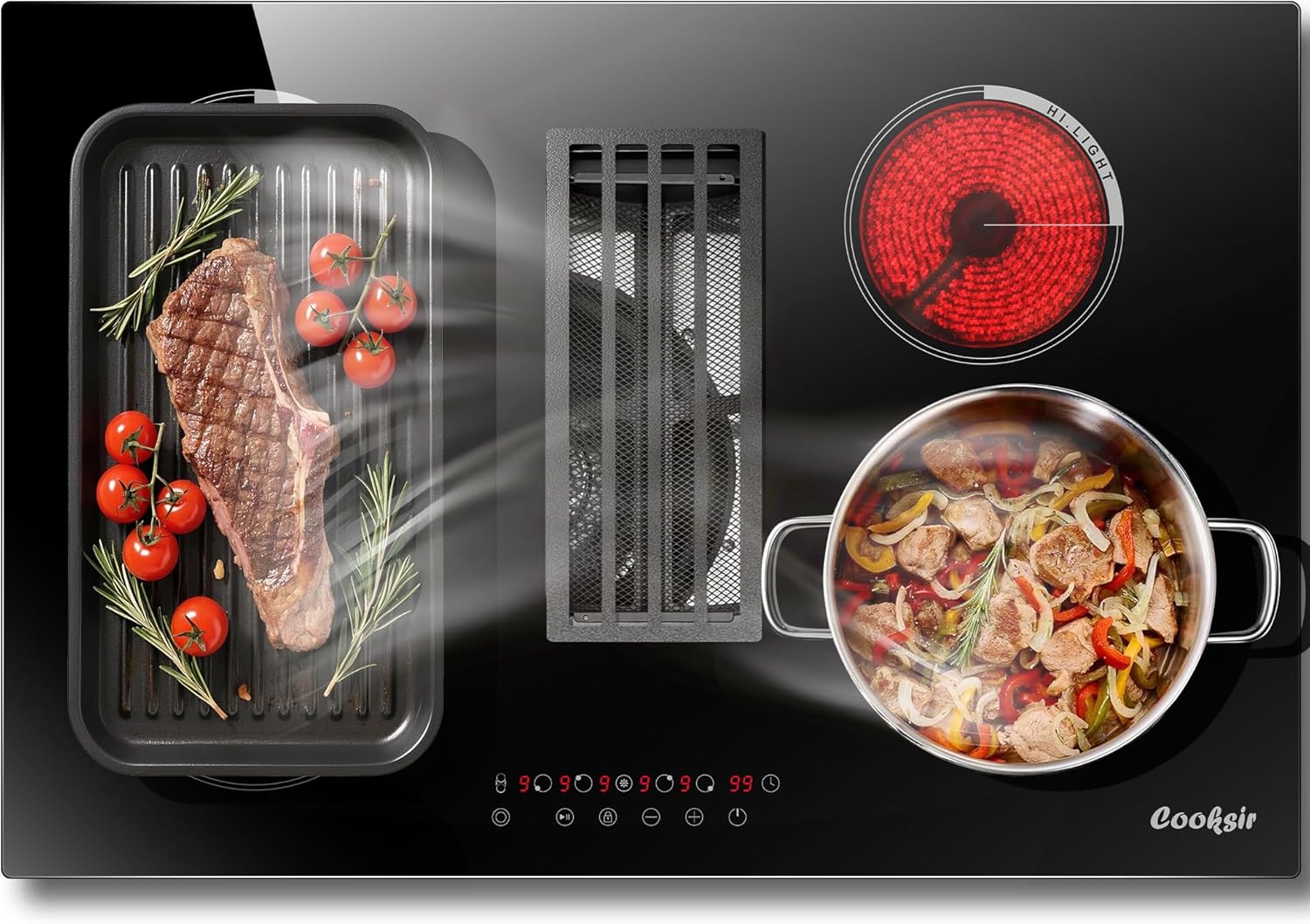
| Number of Heating Elements | 4 |
|---|---|
| Wattage | 7400 watts |
| Control Type | Touch |
| Voltage | 220 volts_of_alternating_current |
| Heater Surface Material | Glass Ceramic |
This Cooksir 30-inch glass-ceramic cooktop combines four radiant heating zones with a built-in ductless downdraft, letting you install a cooktop and vent in one unit where ducting is difficult. It offers a total 7400W of cooking power, a dual-ring burner for flexible heat and a high-output bridge-style burner for large pans, while touch controls deliver straightforward operation and a timer, safety lock and residual-heat indicator add useful safety. The downdraft uses a recirculating filter (135W) to capture fumes without an external exhaust, which simplifies installation but means smell removal depends on the recirculation system and filter maintenance. The smooth tempered glass surface cleans easily and accepts all flat-bottom pans, though it requires careful handling to avoid scratches and will be slower to change temperature than induction. For kitchens where a full hood or duct run is impractical, this unit provides a space-saving, integrated alternative with strong surface power and practical safety features.
Best for: Buyers who need a clean, built-in cooktop with powerful radiant burners and want a built-in vent solution where running ductwork is impractical.
Less Ideal for: Those seeking the fastest temperature response or the strongest odor removal should consider induction cooktops or a cooktop with a ducted hood instead.
- Integrated ductless downdraft removes need for external exhaust and simplifies installation
- High total cooking power with a dual-ring burner and a high-output bridge burner for versatile heat control
- Tempered glass-ceramic surface is easy to wipe clean and works with any flat-bottom cookware
- Touch controls plus timer, safety lock and residual-heat indicator improve safety and convenience
- Recirculating downdraft cannot match ducted hoods for odor and smoke removal
- Requires 220V hard-wired installation which can need an electrician for retrofit
Verdict: Choose this unit when you want a powerful 30-inch glass-top cooktop with a space-saving integrated downdraft for kitchens where ducting is not an option.
Hobsir 36 Inch Electric Cooktop

| Number of Heating Elements | 4 |
|---|---|
| Additional Features | Downdraft Exhaust |
| Heating Element | Ceramic |
| Control Type | Digital Touch |
| Wattage | 7535 watts |
This Hobsir 36-inch cooktop combines a smooth glass-ceramic surface with a built-in downdraft extractor so you get cooking and ventilation in one drop-in unit. It has four heating zones including a dual-ring burner and an elongated BBQ/griddle zone that can act as a combined high-output surface, and touch controls offer nine power levels, a 99-minute timer, pause and a child safety lock. The downdraft system is ductless with a removable washable filter, which makes it straightforward to install on kitchen islands or where an external vent is not possible, and the ceramic surface wipes clean quickly after use. Power listings indicate substantial output for searing and simmering, but because the extractor is ductless its performance depends on filter maintenance and it will not match a properly vented hood for heavy smoke. The unit requires 220 to 240 volts and a professional drop-in installation for the cutout, so plan accordingly if you need a simple plug-in replacement.
Best for: Buyers wanting a modern, space-saving cooktop and ventilation combo for an island or remodel where running ductwork is impractical and who prioritize integrated functionality over top-tier venting.
Less Ideal for: Homes that need heavy-duty smoke extraction for frequent high-heat or smokey cooking and buyers who cannot accommodate a 220V hardwired installation.
- Integrated ductless downdraft extractor removes steam and grease without external ductwork
- Four cooking zones including a dual-ring burner and large BBQ/griddle zone for flexible cooking
- Glass-ceramic surface is easy to clean and compatible with all cookware types
- Touch controls with nine power levels, timer, pause and safety lock for precise and safe operation
- Ductless extractor cannot fully match the suction and particle removal of a vented hood
- Requires 220 volts and a drop-in installation which may need professional electrical work
Verdict: A practical all-in-one glass-top cooktop with a built-in ductless downdraft ideal for island installations that need ventilation without external ducting.
GASLAND 31.5" Electric Cooktop

| Number of Heating Elements | 4 |
|---|---|
| Additional Features | Adjustable Temperature, Downdraft Exhaust, Safety Lock, Sync Bridge Element, Timer |
| Control Type | Touch |
| Voltage | 220 volts |
| Wattage | 7400 watts |
This GASLAND 31.5" electric cooktop combines a smooth glass-ceramic surface with a built-in downdraft ventilation system to keep an island or open kitchen looking clean while removing smoke and odors. It includes four radiant heating elements with a dual-ring element and a sync bridge to handle both small pans and larger griddles, and three fan speeds that reach up to 330 CFM for heavier cooking. Touch controls, a 99-minute timer, child lock, hot-surface warning, and automatic shutoff provide practical safety and convenience in everyday use. Maintenance is straightforward: the removable drip pan, dishwasher-safe grease filter, and vent grate simplify cleaning compared with external hoods. The cooktop runs on 220 volts and 7400 watts, so installation requires proper electrical hookup and a built-in cutout. Expect the usual limitations of radiant glass surfaces, including slower heat changes than gas and careful handling to avoid scratches or heavy impacts on the glass top.
Best for: Buyers who prioritize a dependable, integrated downdraft cooktop for an island or open-plan kitchen and want user-friendly safety and maintenance features rather than a gas range.
Less Ideal for: Those who need instant, highly responsive flame control or prefer a portable surface for temporary kitchens should consider other cooktop types.
- Integrated downdraft vent with 3 speeds and up to 330 CFM removes smoke and odors without an overhead hood
- Flexible cooking with dual-ring element and sync bridge for small and oversized cookware
- Smooth glass-ceramic surface and removable filters make daily cleaning easier
- Several safety features including child lock, hot-surface warning, overheat protection, and automatic shutoff
- Requires 220V/7400W dedicated electrical installation, which may need an electrician
- Radiant glass surface responds slower than gas and is vulnerable to scratches or heavy impacts
Verdict: Choose this built-in glass-top cooktop when you want a reliable downdraft solution for an island kitchen that balances flexible cooking zones with easy cleaning and strong safety features.
Cooksir 36-Inch Electric Cooktop

| Number of Heating Elements | 4 |
|---|---|
| Wattage | 7400 watts |
| Control Type | Touch |
| Installation Type | Drop-In |
| Voltage | 220 volts of alternating current |
This Cooksir 36-inch electric cooktop pairs a glass-ceramic four-burner surface with a built-in downdraft vent to deliver cooking and ventilation in one built-in unit. It is typically installed as a drop-in cooktop in kitchens where an overhead hood is undesirable or impossible, and is used like a conventional radiant electric stove with touch controls, a digital timer, and safety lock. Notable features include a powerful 7400W total output, a bridge griddle area and a dual-ring burner for flexible cookware fit, nine downdraft fan speeds providing up to 360 CFM of suction, and standard safety aids such as hot-surface indicators and residual heat display. Practical benefits are space savings from eliminating an above-cooktop hood, effective localized smoke capture from the downdraft for high-heat cooking, and simple maintenance thanks to a smooth tempered glass surface. Important limitations are the requirement for 220–240V hardwiring and that downdraft systems can be less effective than a properly ducted overhead hood for very heavy smoke or greasy venting needs.
Best for: Buyers who want a streamlined, space-saving glass-top cooktop that also handles ventilation without adding an overhead hood and who value adjustable venting and modern safety features.
Less Ideal for: Homes that need heavy-duty ducted ventilation for frequent high-smoke or commercial-style cooking should consider a separately ducted hood instead.
- Integrated downdraft vent eliminates need for overhead hood and saves wall space
- High combined power (7400W) with a bridge griddle and dual-ring burner for flexible cooking
- Nine-speed fan up to 360 CFM gives adjustable suction for smoke and odors
- Touch controls with timer, child lock, and residual heat indicator improve safety and convenience
- Requires 220–240V hardwired installation, not a simple plug-in upgrade
- Ductless recirculating downdraft may struggle with very heavy smoke or grease compared with a ducted hood
Verdict: Choose this unit if you want a built-in glass-top cooktop that saves vertical space by combining strong electric cooking power with a built-in downdraft ventilation system.
Choosing the Right Glass-Top Cooktop with Downdraft: Key Factors to Consider
Venting Capacity and Airflow
Venting capacity determines how effectively the downdraft system removes smoke, steam, and odors from the cooking zone. Look for models with clear airflow specifications measured in cubic feet per minute or similar ratings, and consider blower location because an under-counter blower can move more air than a compact in-unit fan.
Stronger airflow reduces lingering odors and grease deposition on nearby cabinets, but it can also increase noise. Balance required ventilation power with acceptable sound levels for your kitchen layout. If you do a lot of high-heat cooking or frequent frying, prioritize higher airflow and multiple fan speeds to keep the cooking area comfortable.
Burner Layout and Heat Control
Burner configuration affects how you use the cooktop day to day. Consider the number of burners, spacing, and the range between low-simmer and high-boil settings. Precise low-heat control matters for tasks like simmering and melting, while higher output burners are useful for searing and rapid boiling.
Even heat distribution across the glass surface prevents hotspots and makes it easier to use large pots. Check whether controls provide fine increments or stepped settings and whether the cooktop offers an express or power-boil feature for faster heating.
Surface Durability and Cleaning
A glass-top surface is easy to wipe but is also prone to scratches, cracks, and staining from spills. Prioritize tempered glass construction and a finish that resists etching from acidic spills. Controls that sit above the surface or flush-mounted knobs can affect how easily you wipe down the cooktop.
Downdraft vents introduce extra cleaning needs because grease and food particles can collect in vent grilles and ducts. Removable, accessible grease filters and a vent pathway that is simple to disassemble will reduce long-term maintenance work.
Installation and Ducting Options
Downdraft cooktops require careful planning for duct runs and power connections. Some systems use internal blowers that route air through an under-counter duct, while others rely on remote blowers placed in an adjacent cabinet or crawl space. Measure the countertop cutout and ensure you have clearance below for the blower and ducting.
Consider whether your kitchen can accommodate vertical or horizontal ducting and whether a recirculating mode with charcoal filters is acceptable if external venting is impractical. Installation complexity affects overall cost and feasibility, so verify local building constraints and available cabinet space before choosing.
Noise Levels and Blower Placement
Noise is a practical tradeoff with vent power. Blowers mounted directly beneath the cooktop often produce more audible sound at higher speeds, while remote or under-floor blowers can be quieter but require longer duct runs. Check published noise ratings when possible, and consider how open your kitchen is to living spaces.
If the cooktop will be used for extended high-heat cooking or in an open-plan home, select a model with multiple speed settings and an option for lower-noise operation. Also factor in vibration control and how easily the blower can be serviced or replaced.
Safety Features and Controls
Safety features reduce risk during everyday use. Look for hot-surface indicators, child-lock options, and automatic shutoff timers that help prevent unattended cooking accidents. Controls that are intuitive and clearly labeled lower the chance of user error when switching between burners and vent speeds.
Because downdraft vents sit close to the cooking surface, ensure that grills and vent openings are designed to avoid trapping pots or obstructing airflow. Easy-to-access filters and clearly indicated maintenance alerts also contribute to safer, long-term operation.
How Downdraft Venting Works
Downdraft ventilation pulls cooking smoke and steam down through an opening at the cooktop rather than up to a ceiling hood. A fan draws air through grille openings and pushes it into ductwork or through filters if the system is run in recirculation mode.
Understanding the basic mechanics helps set realistic expectations. Downdrafts are most effective when placed close to pans and when paired with robust blowers. They excel at localized ventilation, but their overall capture efficiency depends on airflow, cooktop layout, and how much lateral air movement occurs in the kitchen.
- Effective for kitchens without room for an overhead hood
- Works best with properly sized ducting and blower power
- Captures vapors near the source but may struggle with very tall pots
Ducting Planning and Space Requirements
Plan ducting early to avoid surprises during installation. Measure the available cabinet depth and identify the nearest exterior wall or floor chase for venting. Short, straight duct runs with minimal bends maximize airflow and reduce noise.
If external venting is impossible, evaluate recirculation kits that use charcoal filters. Recirculating systems reduce the need for a complex duct run but are less effective at removing heat and moisture. Confirm electrical requirements and blower clearance under the counter before finalizing the purchase.
- Shorter duct runs improve performance
- Allow service access to the blower and filters
- Recirculation is simpler but less effective than external venting
Cleaning and Maintaining a Glass-Top Downdraft Cooktop
Regular cleaning keeps the glass surface looking good and maintains venting efficiency. Wipe spills promptly with appropriate cleaners to prevent staining or etching. Use nonabrasive pads to avoid scratching the glass.
Maintenance of the downdraft channel is equally important. Remove grease filters per the manufacturer's schedule, clean them with warm, soapy water, and inspect ducts for buildup. Routine checks of fan function and vibration will extend blower life and keep noise levels steady.
- Clean spills immediately with recommended glass-top cleaners
- Remove and wash grease filters on a regular schedule
- Check ductwork annually for grease or debris buildup
Matching Cooktop Size to Your Kitchen Workflow
Choose a cooktop width and burner layout that match your typical cookware and meal prep style. A compact unit saves counter space but may force you to cluster pots, reducing downdraft capture. Wider cooktops allow better spacing and make full use of the venting opening.
Think about how you move around the kitchen. If the cooktop sits near a seating area, prioritize quieter blowers. If it is the primary cooking surface, prioritize burner spread and higher output burners for faster boiling and searing.
- Larger cooktops provide better spacing and capture
- Compact units suit small kitchens but need careful pot placement
- Consider adjacent counters and traffic flow when planning installation
Common Installation Pitfalls and How to Avoid Them
Underestimating the space needed for a blower or mismeasuring the cutout can delay installation. Verify manufacturer cutout dimensions and allow extra room for electrical connections and duct transitions.
Another common issue is choosing a blower with insufficient power for the chosen duct length. Match blower capacity to the ducting plan and avoid excessive bends. If in doubt, consult a licensed installer to confirm clearances and vent routing before purchase.
- Double-check cutout dimensions and under-counter clearances
- Match blower capacity to duct length and number of bends
- Hire professional help for complex ducting or electrical work
How We Chose the Best Glass-Top Cooktop with Downdraft
We focused on features that directly affect daily use and long-term satisfaction with a glass-top cooktop that includes a downdraft vent. Key evaluation criteria included venting performance, burner heat control, surface durability and ease of cleaning, installation and ducting flexibility, and safety features such as automatic shutoff or hot-surface indicators. We examined official specifications and product literature to compare airflow rates, blower placement, and noise ratings for ventilation performance. For cooking performance we looked at burner configuration, power range, and simmer-to-boil responsiveness. Durability and upkeep were judged by glass composition, scratch resistance, and whether cooktop controls and vent channels are accessible for cleaning. Installation factors considered cutout dimensions, ducting options, and compatibility with standard countertop layouts. We excluded units without integrated downdraft systems and any cooktops that require a separate hood to meet the article scope. The products we shortlisted meet the practical requirements for built-in countertop ventilation and strong, consistent heating.
Our full evaluation process is outlined in our review methodology.
FAQ
Are downdraft systems as effective as overhead hoods?
Downdraft systems can be very effective for localized smoke and steam removal, especially when properly sized and ducted. They generally do not match the total capture efficiency of a well-installed overhead hood but are ideal where a hood is impractical.
Can I install a downdraft cooktop without external ducting?
Yes, many models offer recirculation kits that use charcoal filters to remove odors when external ducting is not possible. Recirculation reduces installation complexity but will not remove heat and moisture as effectively as venting to the outside.
How often should I clean the downdraft filters?
Grease filters should be checked monthly with regular cooking and washed every 1 to 3 months depending on use. Charcoal odor filters used for recirculation may need replacement every 6 to 12 months according to usage and manufacturer guidance.
Will downdraft vents work with large pots and high-sided cookware?
Downdrafts can struggle to capture all fumes from very tall pots because the capture source sits at countertop level. For large, high-sided cookware you may need to use higher fan speeds and be mindful of pot placement to maximize airflow capture.
How noisy are downdraft blowers?
Noise varies by blower type and speed. Internal blowers tend to be louder at high speeds, while remote blowers can be quieter. Look for published noise ratings and multiple speed settings if sound is a concern.
Final Verdict
When choosing a glass-top cooktop with downdraft, prioritize ventilation power and burner control based on how you cook and the space available for ducting. Balance strong airflow against acceptable noise levels and select a surface and filter design that support easy cleaning. If external venting is limited, consider recirculation options but expect reduced removal of heat and moisture. Focus on installation clearances and service access to avoid surprises during setup. With the right balance of venting, burner performance, and maintenance accessibility, you can get a sleek, easy-to-clean cooktop that keeps kitchen air cleaner and supports your cooking style.