
Note: This article contains affiliate links. If you click on these links and make a purchase, we may earn a small commission at no extra cost to you. This helps support our research and content. Read our full affiliate disclosure here.
If you want repeatable shots and predictable brew yield, a grinder that measures by weight can make a big difference. Grind-by-weight coffee grinders dose beans to a target mass rather than timing or estimating, so you get consistent doses shot after shot and less waste when you change recipes or roasts. This guide covers the top shortlisted grind-by-weight coffee grinders across home and small commercial use and explains the evaluation criteria we used. Below you will find our top picks and what each option offers for accuracy, speed, and daily use. Read on to match a grinder to your brewing routine and workflow.
Top Picks at a Glance
| Best Overall The best all-around choice for most situations | Eureka Mignon Libra |  |
| Best Quality Built to a higher standard if you want something more solid | Mahlkönig E64 WS Grinder |  |
| Best Value The sweet spot between price and what you get | MOKKOM Conical Burr Grinder CG020 |  |
| Best Budget The cheapest option that still gets the job done reliably | MOKKOM Conical Burr Grinder CG020 |  |
| Top Rated A top-rated pick with lots of positive feedback | Baratza Sette 270Wi |  |
Eureka Mignon Libra

| Capacity | 12 ounces |
|---|---|
| Voltage | 120 volts |
| Power Source | Electric |
The Eureka Mignon Libra is a purpose-built espresso grinder that grinds directly into a portafilter and doses by weight for repeatable results. It uses 55mm hardened steel burrs and a stepless adjustment knob so you can dial in very fine settings for espresso, while bottom-burr adjust and weight-based dosing help keep your grind consistent between cleanings. The Libra includes a dosing funnel and saves two dose profiles, which speeds routine morning use. Silent Technology and anti-vibration design make the machine noticeably quieter than many prosumer grinders, and its compact footprint fits small counters. This is a single-purpose espresso grinder rather than an all-in-one for multiple brew methods, and its focus on precision means it favors shorter doses and shot-focused workflows. Expect professional-level grind quality and tactile adjustment, but plan to pair it with an espresso setup rather than using it as a multi-method brewer grinder.
Best for: Buyers who want a compact, precision espresso grinder that delivers repeatable, weight-based dosing and quiet operation for daily shot pulling.
Less Ideal for: People who need a single grinder for coarse brew methods, high-volume grinding, or flexible multi-method use should consider a different model.
- Grind-by-weight dosing with two programmable dose presets for consistent shot dosing
- Large 55mm hardened steel burrs balance speed and grind quality for espresso
- Stepless grind adjustment and bottom-burr adjust let you micro-tune for precise extraction
- Silent Technology and anti-vibration design reduce noise during operation
- Compact footprint and included dosing funnel make daily use tidy on small counters
- Designed specifically for espresso grind ranges so it is not ideal for coarse brew methods
- Limited hopper capacity and single-purpose workflow may require frequent refills for high-volume use
Verdict: If you want a quiet, compact grind-by-weight grinder tuned specifically for repeatable espresso dosing, the Mignon Libra is a strong choice.
Mahlkönig E64 WS Grinder

| Included Components | 64mm Steel Burrs |
|---|---|
| Model Number | E64 WS |
| Capacity | 8.8 ounces |
| Recommended Uses For Product | Grinding Coffee Beans |
The Mahlkönig E64 WS brings pro-level espresso grinding to the home kitchen by combining large 64 mm special-steel flat burrs with grind-by-weight dosing and electronic burr adjustment. It is used primarily for dialling in single and double espresso doses where consistency matters; the built-in scale measures to 0.1 g for repeatable dosing and the electric grind control with patented Disc Distance Detection allows micron-level calibration and easy zeroing without tools. Grind-by-Sync and Wi-Fi app features let the grinder communicate with compatible machines and record usage or receive updates, which streamlines workflow for users who track extractions. The grinder is relatively quiet for its performance and the compact footprint fits under many cupboards, while the adjustable spout and ambient lighting add usability. This model is priced and specified for serious home baristas who want near-commercial control, but it demands a willingness to invest in a premium grinder and to use the app for the fullest feature set.
Best for: Serious home baristas who prioritize precise, repeatable espresso dosing and professional-grade grind quality and are willing to invest in a high-end grinder and app-driven workflow.
Less Ideal for: Casual coffee drinkers who want a simple, inexpensive grinder or users who prefer fully manual controls without app integration.
- 64 mm special-steel flat burrs deliver uniform particle size for richer crema and flavor
- Grind-by-weight dosing with 0.1 g accuracy for highly repeatable espresso shots
- Electric grind control with Disc Distance Detection enables micron-precise adjustments and easy zero calibration
- Wi-Fi and Sync app integration for automatic adjustments, updates, and usage tracking
- Premium-level cost and complexity that may exceed casual users' needs
- Full feature set relies on app connectivity and compatible machine integration
Verdict: If you want commercial-grade, grind-by-weight precision and app-driven sync for home espresso, the E64 WS delivers pro-level consistency and control.
MOKKOM Conical Burr Grinder CG020
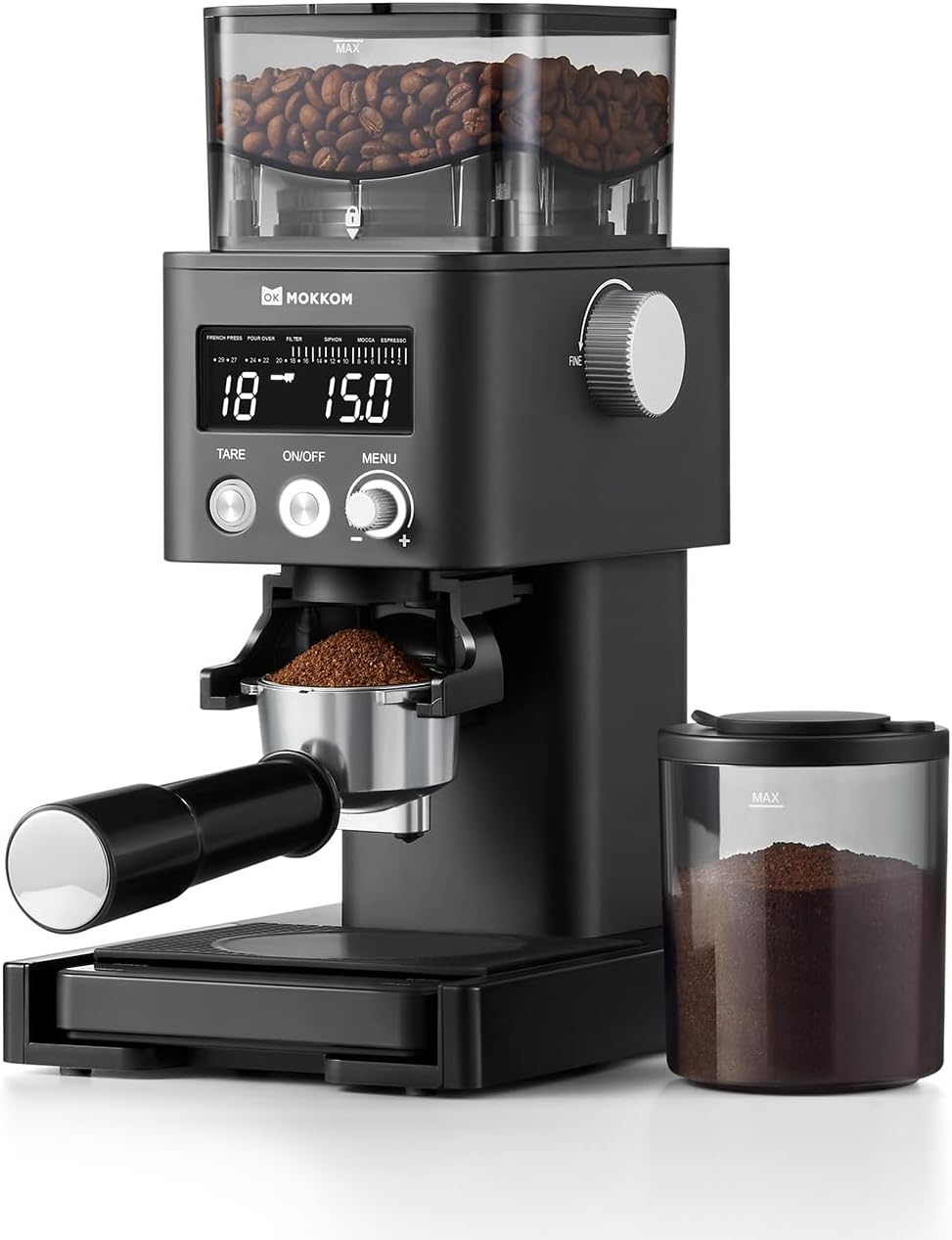
| Burr type | Conical stainless steel |
|---|---|
| Burr size | 40mm |
| Grind settings | 31 |
| Power source | Electric |
This MOKKOM conical burr grinder is built around espresso-ready workflow and precise dosing by weight. It grinds directly into a portafilter using supplied cradles or into the included grounds cup, and the removable digital scale supports grams, ounces, cups and a timer for repeatable dosing. The 40mm stainless steel conical burrs and 31 grind settings cover fine espresso through coarse French press, while an anti-static system and quieter motor reduce mess and noise during daily use. Removable hopper, burr and grounds container make maintenance straightforward compared with integrated units. Expect solid value for home baristas who want weight-based dosing without a separate scale, but note the grind setting range is modest compared with prosumer 100-step grinders and the product is aimed at countertop use rather than heavy commercial load.
Best for: Buyers who prioritize accurate grind-by-weight dosing and a compact all-in-one countertop solution for home espresso and manual-brew routines.
Less Ideal for: Users who need professional-grade stepless or 100-step grind adjustment for micro-tuning or those seeking a grinder built for high-volume commercial use.
- Built-in detachable digital scale for grind-by-weight dosing
- 40mm stainless steel conical burrs for consistent particle distribution
- 31 grind settings that cover espresso to French press
- Anti-static system reduces retention and mess
- Removable burr, hopper and grounds cup for easier cleaning
- 31-step adjustment is less fine-grained than higher-end 100-step grinders
- Designed for home use and not intended for heavy commercial throughput
Verdict: If you want reliable grind-by-weight dosing in a single countertop grinder for home espresso and manual brews, this MOKKOM delivers precise, low-static dosing without needing a separate scale.
MOKKOM Conical Burr Grinder CG020
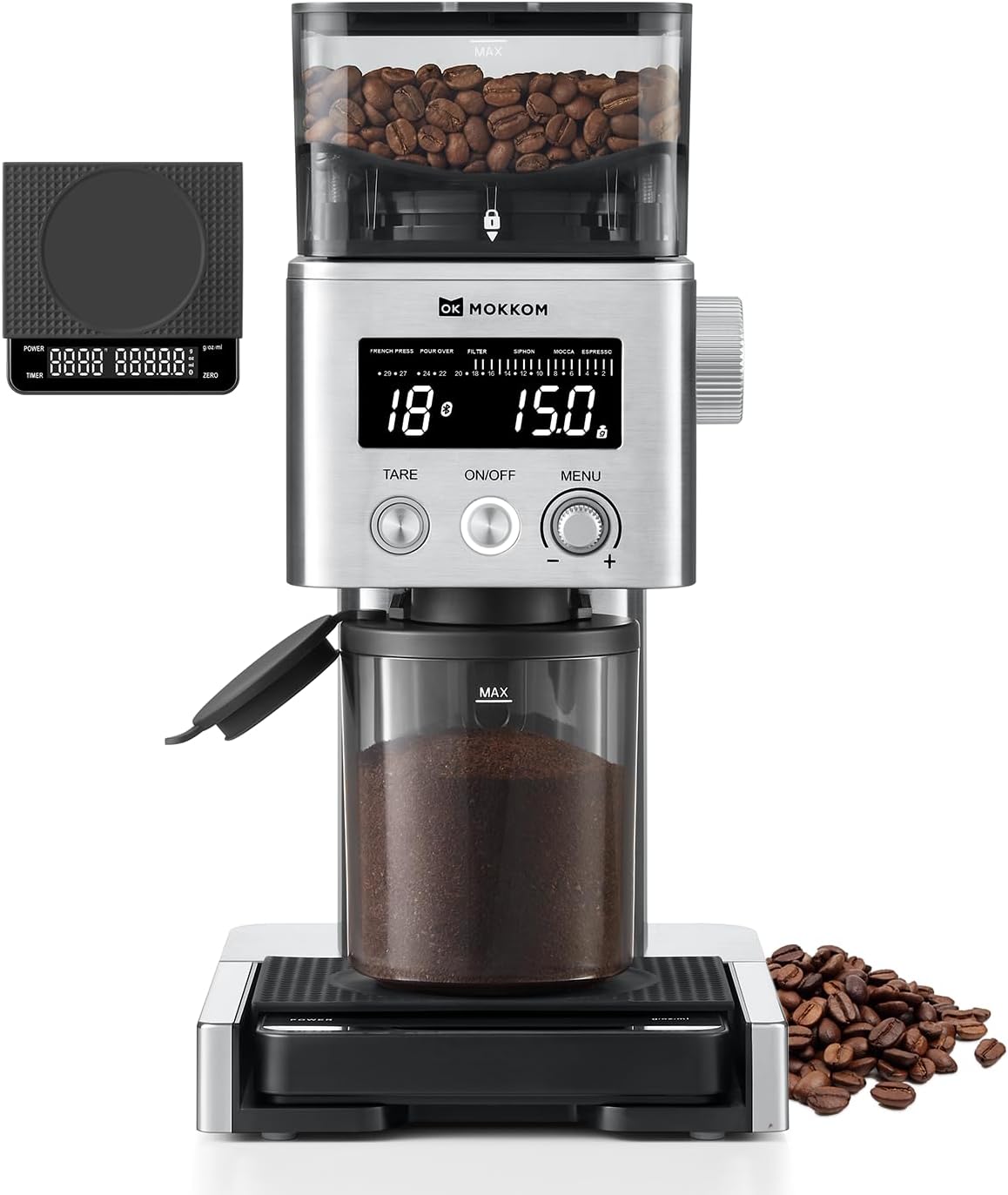
| Capacity | 5.3 ounces |
|---|---|
| Wattage | 200 watts |
| Grind settings | 31 grind settings |
| Material Type | Stainless Steel |
The MOKKOM CG020 is a countertop conical-burr grinder built around an integrated removable scale and programmable timer so you can grind precisely by weight or time. It offers 31 discrete grind settings that span espresso to French press, a 40mm stainless steel conical burr, and a 5-in-1 grinding control (cups, oz, grams, time, manual) that makes it straightforward to dose for pour-over and single-shot espresso. The detachable scale syncs to the grinder and reports real-time weight, which removes guesswork when chasing brew ratios. Practical touches include anti-static circuitry to reduce mess, a low-noise motor, removable burr and hopper for cleaning, and two portafilter cradles for direct dosing into 50–53mm and 58mm portafilters. Trade-offs are the modest 5.3 ounce bean capacity and the 200W motor that suit home use but limit high-volume grinding; cleaning and calibration still require care to keep weight accuracy reliable. For buyers focused on grind-by-weight results without stepping up to pro flat-burr machines, this grinder delivers strong, usable performance for daily brewing.
Best for: Buyers who want precise grind-by-weight control on a budget and who prioritize consistent daily dosing for espresso and pour-over at home.
Less Ideal for: People who need to grind large volumes quickly for a cafe or commercial setting or who require the absolute finest commercial flat-burr consistency.
- Built-in removable scale that syncs in real time for accurate grind-by-weight dosing
- 31 grind settings covering espresso through French press for versatile brewing
- Anti-static system and low-noise motor reduce mess and operating sound
- Programmable timer and multiple dosing modes (cups/oz/g/manual) for repeatable results
- Includes portafilter cradles for direct dosing into common espresso sizes
- Relatively small bean hopper capacity limits large-batch grinding
- 200W motor and conical burr design are optimized for home use rather than heavy commercial throughput
Verdict: If you want dependable grind-by-weight dosing for home espresso and pour-over without paying pro prices, this grinder puts an integrated scale and programmable dosing into a value-friendly package.
Baratza Sette 270Wi

| Capacity | 0.3 kg |
|---|---|
| Wattage | 200 watts |
| Voltage | 120 volts |
The Baratza Sette 270Wi is a grind-by-weight conical burr grinder designed for precise, repeatable dosing for espresso and finer manual methods. It uses Acaia weighing technology with Bluetooth and three programmable dose buttons to deliver consistent doses to within a tenth of a gram, and the straight-thru grind path minimizes retention for fast, clean transitions between doses. With up to 270 stepped grind settings and macro/micro adjustment it offers fine control for dialing in espresso and pour-over styles, and its high-speed motor can grind several grams per second for quick preparation. Practical benefits include reliable, repeatable shots once dialed in, minimal mess from low retention, and the convenience of a convertible holder for portafilter or grounds bin. Important limitations are its reliance on an AC adapter, which ties placement to an outlet, and the premium price point relative to basic burr grinders. It is a workshop-grade option for users who prioritize dosing accuracy and speed over portability or bargain cost.
Best for: Buyers who want a reliable, repeatable espresso workflow and accurate dosing to lock in shots consistently will appreciate this grinder's precision and consistency.
Less Ideal for: Casual users who rarely make espresso, need a portable battery-powered grinder, or are shopping strictly for the lowest-cost option should consider simpler alternatives.
- Grind-by-weight dosing with Acaia sensor and Bluetooth for highly repeatable doses
- Wide 270-step grind range with macro and micro adjustment for precise dialing
- Straight-thru mechanism yields minimal retention for quick changeovers
- High-speed grinding up to several grams per second reduces wait time
- Requires AC adapter so it is not battery or travel friendly
- Higher upfront cost compared with basic grinders
Verdict: Choose the Sette 270Wi when you need fast, professional-grade grind-by-weight dosing that delivers consistent, repeatable espresso shots.
Choosing the Right Grind-by-Weight Coffee Grinder: Key Factors to Consider
Dosing Accuracy and Consistency
Accurate weight-based dosing is the primary reason to choose a grind-by-weight coffee grinder. Measure-to-weight systems reduce dose variability compared with time-based dosing, but implementation varies. Consistency matters both across consecutive doses and when changing dose targets. Inconsistent dosing forces you to compensate with adjustments at the machine or in brewing technique, which defeats the point of automated weight dosing.
Look for grinders with precise load cells, stable calibration routines, and software that averages or filters raw readings to prevent spikes. Also consider how the grinder handles small doses for single espresso shots versus larger doses for batch brew, since low-mass readings are inherently harder to stabilize.
Grind Speed and Throughput
Speed matters when you are preparing multiple drinks or want minimal delay between dosing and extraction. Faster grinding reduces waiting time and can keep workflow moving during busy mornings. However, sheer speed is not sufficient if it sacrifices consistency or heats the burrs excessively.
Evaluate the grinder's throughput at the target grind size and dose. Some grinders slow significantly at finer settings. Good machines maintain stable speed across a useful range and are designed to dissipate heat so beans do not roast from friction during long runs.
Control Interface and Presets
An intuitive control layout and programmable presets make weight-based dosing practical. Clear displays that show target mass, real-time progress, and error states let you monitor doses without guessing. Preset slots for common doses speed up repeatable workflows and reduce the need to enter numbers manually each time.
Consider whether the interface supports incremental adjustments on the fly, how it stores multiple user profiles or recipes, and whether it offers fine control for dialing in espresso versus coarser brew methods.
Burr Type, Size, and Maintenance
Burr design and material influence particle distribution, flavor clarity, and longevity. Larger burrs often grind faster and stay cooler, while high-quality steel or ceramic burrs maintain edge retention longer. The grind-by-weight advantage is only useful if the grinder produces a consistent particle size for the intended brew method.
Also assess how easy it is to access and clean the burrs and whether replacement burrs or tuning options are available. Regular cleaning and occasional burr replacement are part of ownership, so think about long-term maintenance.
Footprint and Workflow Integration
Counter space and how the grinder fits into your brewing workflow are practical considerations. A compact footprint benefits smaller kitchens, while a taller or wider unit might offer a larger hopper and faster throughput. Noise level and placement relative to your espresso machine or brew station matter for comfort and efficiency.
Check how the grounds are delivered to portafilters or receptacles, whether there is a compatible portafilter holder or chute, and how the hopper size matches your typical daily bean consumption.
Reliability and Serviceability
A precise scale and mechanical dosing system add complexity, so reliability is crucial. Look for units with robust electronics and solid mechanical dosing components. Consider the availability of replacement parts, accessibility for cleaning, and the clarity of calibration procedures.
Devices that allow easy calibration of the weighing system and straightforward firmware updates provide a smoother ownership experience and keep dosing accurate over time.
How Grind-by-Weight Works
Grind-by-weight grinders integrate a load cell or scale into the dosing path so the grinder measures mass in real time as beans are dispensed. Instead of running for a set time, the grinder stops when the target mass is reached. This removes variability from motor speed changes, bean density differences between lots, and dose-to-dose scatter that can occur with timed dosing.
Many systems combine hardware weighing with software smoothing to filter out transient readings. Understanding this interaction helps you interpret display readouts and choose appropriate target masses for single shots, double shots, or larger brewing volumes.
- Real-time weighing during the grind cycle for direct mass control
- Software filters to stabilize readings and avoid over- or under-dosing
- Better repeatability when beans or roast levels change
Calibrating and Maintaining the Scale
Proper calibration keeps dosing accurate. Most grinders include a calibration routine or require a one-time setup with a reference weight. Recalibrate after moving the grinder, changing the surface, or whenever readings seem inconsistent.
Regular cleaning prevents grounds from accumulating around the load cell or weighing path, which can skew results. Follow manufacturer guidelines for safe cleaning and avoid using excessive force near the weighing mechanism.
- Recalibrate when the grinder is relocated
- Keep the weighing path clean of compacted grounds
- Avoid liquids near electronic components during maintenance
Workflow Tips for Espresso and Manual Brew
For espresso, target repeatable single or double doses that match your tamp and basket capacity. Use presets for commonly used doses and check the display quickly before pulling a shot. Allow time for any static or retention behavior to settle so the display reads the finished mass accurately.
For pour-over or batch brew, use the grinder's larger dose settings and ensure the hopper holds enough beans to avoid frequent refills. Consider weighing the final grounds in a separate cup for verification when dialing in a new recipe, but rely on the grinder's mass dosing once you are consistent.
- Use presets for daily routines to reduce manual entry
- Verify doses during initial recipe dialing
- Account for retention when switching grind sizes or beans
Common Limitations and Workarounds
Weight-based dosing is excellent for consistency but is not immune to edge cases. Very small single-gram doses may be harder for load cells to stabilize, producing more variance. Likewise, changes in bean moisture or roast profile can slightly alter the effective mass dispensed per grind cycle.
To mitigate these issues, use internal averaging features if available, increase the target dose slightly for more stable readings when appropriate, and combine the grinder's mass readout with occasional verification on a dedicated scale for critical recipes.
- Small doses can show higher relative error
- Environmental factors like humidity affect bean density
- Combine grinder dosing with spot checks during setup
Space, Noise, and Kitchen Placement
Think beyond specs when locating the grinder. Place it on a stable, flat surface to protect the weighing mechanism and reduce vibration. If counter space is limited, choose a model with a smaller footprint or a removable hopper to ease storage when not in use.
Noise level varies with motor power and burr size. If quiet operation matters, run the grinder briefly at startup or position it away from seating areas. Remember that faster grinders can be noisier but save time, so balance noise tolerance with throughput needs.
- Use a stable surface to protect the load cell
- Consider hopper size relative to daily bean use
- Balance noise tolerance against desired grind speed
How We Chose the Best Grind-by-Weight Coffee Grinder
We focused on grinders that dose by weight on the grinder itself rather than relying on a separate scale or timed dosing. Selection prioritized measurement accuracy, repeatable dosing mechanics, and build quality so the units deliver consistent mass across consecutive doses. We also evaluated grind speed and throughput because faster grinding matters for back-to-back shots and for multiple pour-over servings. User-facing controls and workflow were considered to ensure the grinder is practical in daily use, including programmability, dose presets, and how the display integrates with normal bar workflow. Noise level and heat management were reviewed to reduce bean scorching and preserve flavor when grinding larger quantities. Finally, we considered serviceability and hopper/burr compatibility to support long-term ownership. We excluded grinders that only offer timed dosing, manual scales-only workflows, or devices clearly designed solely for commercial high-volume production with impractical size for home or small cafe settings. The final list represents models that balanced accuracy, speed, and user-friendly controls.
Our full evaluation process is outlined in our review methodology.
FAQ
Do grind-by-weight grinders eliminate the need for a separate scale?
Often they remove the need for a separate dosing scale for routine use, because the grinder measures mass during the dose. For critical recipe dialing you may still use a dedicated scale for independent verification.
Are weight-based grinders accurate for single espresso doses?
They can be, but very small doses are more challenging for load cells to stabilize. Some grinders use software smoothing or slightly larger target doses to improve repeatability for single shots.
How often should I calibrate the grinder's scale?
Calibrate after moving the grinder, changing countertops, or if you notice dose drift. Routine spot checks every few weeks are sensible for regular home use.
Will a grind-by-weight system compensate for different bean densities?
Yes, because it measures mass directly, the system compensates for bean density variations between lots. However, grind retention and extraction behavior still require brewing adjustments.
Can the weighing mechanism be damaged by coffee grounds?
Ground build-up around the weighing path can affect accuracy, so regular cleaning is important. Avoid hitting the load cell and follow maintenance instructions to prevent damage.
Final Verdict
Prioritize dosing accuracy and consistent burr performance when choosing a grind-by-weight coffee grinder. Balance grind speed and throughput against noise and heat management so the unit fits your daily routine. Consider control ergonomics and maintenance needs to ensure long-term repeatability. With the right tradeoffs, a grind-by-weight grinder streamlines dialing and keeps doses predictable across beans and recipes.