
Note: This article contains affiliate links. If you click on these links and make a purchase, we may earn a small commission at no extra cost to you. This helps support our research and content. Read our full affiliate disclosure here.
When you camp in cold weather, the right heater for tent camping changes an uncomfortable night into a restful one. You need a unit that produces steady heat, fits your tent layout, and prioritizes safety around fabric, sleeping bags, and packed gear. This guide gathers seven top-rated tent camping heaters that made our shortlist after evaluating warmth, runtime, and safety systems. We focus on practical features that matter at camp: usable heat output, fuel or power logistics, and built-in protections to reduce risk. Read on to see how each option performs across those criteria and which features suit different tent sizes and trip styles.
Top Picks at a Glance
| Best Overall The best all-around choice for most situations | CAMPLUX NanoAir 2 Propane Heater |  |
| Best Quality Built to a higher standard if you want something more solid | Mr. Heater Buddy FLEX MH11BFLEX |  |
| Best Value The sweet spot between price and what you get | AeriePrecium Portable Propane Heater GS-05 |  |
| Best Budget The cheapest option that still gets the job done reliably | SANAUGAS Propane Camping Heater BTT-01KG-B |  |
| Top Rated A top-rated pick with lots of positive feedback | Mr. Heater Portable Buddy F232000 |  |
| Most Popular A crowd favorite that many people choose with confidence | GiveBest Portable Space Heater PTC-905 |  |
| Best Seller A high-volume bestseller chosen again and again | DREO Tower Space Heater HSH006 |  |
CAMPLUX NanoAir 2 Propane Heater

| Heat Output | 8500 BTU |
|---|---|
| Fuel Type | Propane |
| Heating Coverage | 200 Square Feet |
| Number of Speeds | 2 |
The CAMPLUX NanoAir 2 is a compact propane radiant heater designed for portable outdoor heating like tent camping, ice fishing, and patios. It offers two heat stages that produce up to 8,500 BTU and claims quick warm-up in about 30 seconds via a one-step piezo ignition. The unit is designed to run from common 1 lb or 20 lb propane cylinders (regulator and hose not included) and includes a small conduction plate on top useful for keeping a mug warm. For campsite use the heater is genuinely convenient: at about 4.2 pounds with a carrying grip, removable tripod legs, and a storage bag it packs down small and is easy to move. Safety features include an oxygen depletion sensor and tip-over shutoff to reduce risk in enclosed outdoor shelters. Practical limits are its radiant heating method and modest coverage—advertised for roughly 200 square feet—so it is best for small tents or personal warmth rather than heating larger group shelters, and you will need appropriate propane fittings to hook it to larger tanks.
Best for: Campers who prioritize a lightweight, easy-to-carry heater for small tents or personal outdoor use and who want quick radiant warmth with basic safety features.
Less Ideal for: People trying to heat large shared shelters, full-size RV interiors, or anyone who needs a forced-air heater for even whole-space warmth.
- Very lightweight and portable with removable tripod legs and storage bag
- Provides up to 8,500 BTU on two adjustable heat stages for quick radiant warmth
- Built-in safety features: low-oxygen shutoff and tip-over protection
- One-step piezo ignition for tool-free starting and a top plate that can keep a mug warm
- Radiant heat and 200 sq ft coverage limit effectiveness in larger tents or group shelters
- Requires separate regulator and hose to connect to 20 lb propane tanks
Verdict: A very portable propane heater that delivers quick personal radiant heat for small tent camping trips while prioritizing lightweight convenience and basic safety.
Mr. Heater Buddy FLEX MH11BFLEX
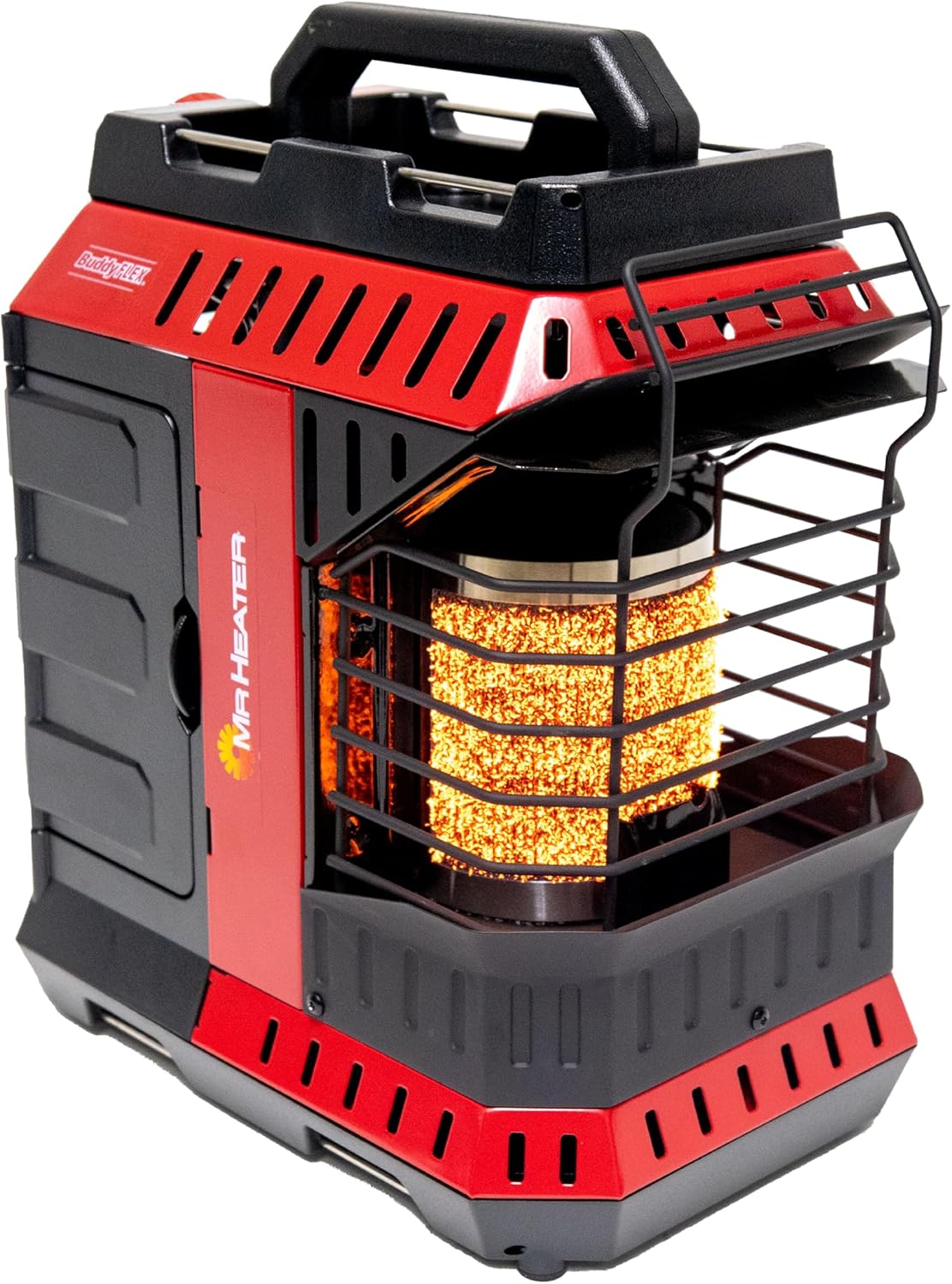
| Heat Output | 11000 BTU (max) |
|---|---|
| Heating Coverage | 275 square feet |
| Fuel Type | Propane |
| Heating Method | Radiant |
The Mr. Heater Buddy FLEX is a compact propane radiant heater built for portable heating tasks where reliable, high-output warmth is needed. It produces 8,000 to 11,000 BTU through an omni-directional fiber mesh burner, giving even radiant heat across its rated 275 sq ft coverage, and it supports both 1 lb cylinders and an optional 20 lb tank hookup for extended run time. Key safety and convenience touches include an electronic ignition, low-oxygen safety shutoff, tip-over protection, and a manual thermostat for variable output. In practice it is simple to start and adjust, resists wind better than some portable heaters thanks to its wind-resistant design, and its size makes it easy to move between a tent vestibule, campsite, or workshop. Limits to expect: run time is relatively short on high output, it requires propane fuel and ventilation considerations for enclosed spaces, and it does not offer forced-air circulation so it warms by radiation rather than quickly heating moving air. For campers who prioritize dependable, directional heat and portability, it performs well; for users needing long continuous runtime or whole-tent forced-air warming, consider other solutions.
Best for: Campers and outdoor users who need a compact, performance-focused propane heater that delivers strong radiant heat and can be moved between tent, campsite, and small shelters.
Less Ideal for: People who need long unattended runtimes, whole-tent forced-air heating, or who cannot provide safe ventilation for propane use in enclosed spaces.
- High radiant output (8,000–11,000 BTU) for quick localized warmth.
- Omni-directional fiber mesh burner for more uniform heat distribution.
- Electronic ignition and safety features including low-oxygen shutoff and tip-over protection.
- Flexible fuel options with 1 lb cylinder use or optional 20 lb tank hookup.
- Shorter run time when operating at high output compared with low output.
- Radiant design does not move air, so it does not quickly warm large volumes or create airflow.
Verdict: Choose the Buddy FLEX if you want a portable, high-output propane radiant heater that reliably delivers directional warmth for tent-side and small shelter use.
AeriePrecium Portable Propane Heater GS-05

| Heat Output | 8500 BTU |
|---|---|
| Heating Coverage | 200 sq.ft. |
| Fuel Type | Propane |
| Power Source | gas_powered |
The AeriePrecium GS-05 is a lightweight, single-tank-top propane heater aimed at short outdoor trips and tent use. It connects to a 1-lb propane cylinder (not included) and offers push-button piezo ignition for quick startup and a firepower regulating valve to adjust output up to about 8500 BTU, which the listing estimates can warm roughly 200 sq ft. The heater includes a foldable cylinder base for improved stability, a stainless-steel protective mesh around the heating core, and a sealed threaded interface to reduce leaks. It ships with a cylinder base holder and a storage case for easier transport. Practical limitations to note are that it runs only on disposable propane cylinders (incompatible with ISO butane), offers about 2.5 hours runtime at maximum on a 1-lb cylinder, and must be used only in well ventilated outdoor areas; moving or storing a hot unit requires care. For short tent camping or ice-fishing trips where portability and fast heat matter, this unit is a straightforward choice.
Best for: Buyers who prioritize compact, easy-to-carry warmth for short outdoor trips and tent camping where quick startup and simple controls are more important than long runtimes.
Less Ideal for: People who need continuous, long-duration heating, built-in CO/oxygen sensors for enclosed use, or compatibility with refillable propane tanks should consider other solutions.
- Push-button piezo ignition for simple, tool-free startup
- Adjustable output up to 8500 BTU with regulating valve
- Includes foldable cylinder base and storage case for transport and stability
- Stainless-steel protective mesh reduces contact burns and improves safety
- Runs only on disposable 1-lb propane cylinders and is incompatible with ISO butane
- Limited runtime at maximum output (about 2.5 hours on a 1-lb cylinder)
Verdict: AeriePrecium GS-05 is a compact, transportable propane heater that delivers quick, adjustable radiant heat for short tent camping trips.
SANAUGAS Propane Camping Heater BTT-01KG-B

| Heat Output | 6200 BTU |
|---|---|
| Fuel Type | Propane |
| Heating Method | Radiant |
| Power Source | gas_powered |
| Special Features | Adjustable Temperature, Tip-Over Protection |
This compact SANAUGAS propane heater delivers up to 6200 BTU of radiant heat from a stainless steel burner, making it suitable for warming a tent or other small outdoor shelter. It connects to a 1 lb propane cylinder and offers an adjustable control valve so you can dial the flame and run time, with the manufacturer claiming up to eight hours on low. The unit is lightweight, has a wide stabilizing base and a pressure regulator for a steady fuel connection, and includes a USB lighter for ignition. Practical benefits for campers include fast spot heating, easy transport, and simple setup for car camping, ice fishing, or tailgating. Important limitations are that it is intended for outdoor use only and uses open-flame radiant heat, so ventilation and safe placement are mandatory; the small fuel cylinder also limits continuous run time compared with bulk propane setups. Noise is minimal and the heater is built for rugged outdoor use, but buyers should bring spare cylinders for extended trips and follow all safety guidelines for tent use.
Best for: Campers and outdoor users who prioritize a low-cost, easy-to-carry heater for short trips or occasional tent use and want quick radiant warmth without a complex setup.
Less Ideal for: People needing continuous long-duration heating, those planning to heat large tents or enclosed spaces, or users who require electric or flameless heating options.
- Portable, lightweight design with included storage bag for easy transport
- Adjustable flame control lets you modulate heat output up to 6200 BTU
- Stable wide base and pressure regulator for secure 1 lb cylinder connection
- Durable stainless steel burner suited to outdoor conditions
- Rated for outdoor use only, not safe for enclosed indoor spaces
- Runs on small 1 lb cylinders that provide limited continuous runtime
Verdict: A budget-friendly, portable propane radiant heater that gives campers fast, adjustable warmth from 1 lb cylinders for short trips and spot heating.
Mr. Heater Portable Buddy F232000

| Heat Output | 9000 BTU |
|---|---|
| Heating Coverage | 225 |
| Fuel Type | Propane |
| Number of Speeds | 2 |
The Mr. Heater Portable Buddy is a small, propane-powered radiant heater that provides two heat settings—4,000 and 9,000 BTU—so it can warm a personal area or a small enclosed space. It runs on a 1-lb propane cylinder and connects quickly with a swivel regulator, and optional accessories let you hook up a larger 20-lb tank for extended use. The unit is built for portability with an easy-grip handle and a pedestal form factor that keeps the radiant burner elevated. Safety features include an oxygen depletion sensor, thermal shut-off, and a tip-over switch, which are important for indoor or tent-adjacent use. Runtime on a 1-lb cylinder is several hours depending on the setting, making it suitable for short overnight trips or warming a tent before bedtime. Trade-offs are that it is a direct radiant heater without forced-air distribution, so heat is localized, and it requires careful ventilation planning when used in semi-enclosed spaces.
Best for: Campers who prioritize a rugged, dependable portable heat source with built-in safety features for short-term tent or shelter heating.
Less Ideal for: People who need whole-tent heat distribution or continuous multi-night heating without refilling fuel should consider alternatives with forced-air or larger fuel capacity.
- Portable pedestal design with easy-grip handle for camp-to-camp transport
- Two heat settings (4,000 and 9,000 BTU) for flexible output
- Life Safety System with oxygen depletion sensor, thermal shutoff, and tip-over protection
- Runs on common 1-lb propane cylinders and accepts 20-lb tank with accessories
- Radiant-only heating concentrates warmth near the unit rather than circulating heat
- Requires strict ventilation and safety precautions for tent or enclosed use
Verdict: A reliable, safety-focused portable propane radiant heater that delivers quick personal warmth for tent-side use.
GiveBest Portable Space Heater PTC-905

| Heat Output | 1500 watts |
|---|---|
| Power Modes | 1500W / 750W / fan |
| Heating Coverage | 200 sq.ft |
| Voltage | 120 volts |
| Number of Speeds | 2 |
The GiveBest PTC-905 is a compact ceramic space heater that delivers quick, localized warmth using PTC technology with two power settings (1500W and 750W) plus a cool-fan mode for year-round use. It is typically used on a desk, bedside table, or small room where you want fast spot heating without running central heat. Notable features include an adjustable electronic thermostat that cycles the unit to hold a set temperature, a built-in carry handle for easy placement, and several safety systems such as overheat shutoff, tip-over protection, and flame-retardant housing. In practice it heats small rooms quickly and runs quietly enough for sleep or focused work, and the lower 750W setting can reduce energy use when full power is not required. Limitations are inherent to its size: it is intended for small-to-medium rooms up to about 200 square feet and will not replace whole-house heating or perform outdoors; the basic control layout and two-speed fan keep things simple but offer less fine control than higher-end digital models.
Best for: Buyers who prioritize reliable, compact spot heating with established customer feedback and safety features for bedrooms, offices, or small shelter spaces where quick warmth and quiet operation matter.
Less Ideal for: People needing to heat large or open areas, or campers who require an outdoor-rated or propane-based tent heater designed for unvented spaces and off-grid use.
- Fast PTC ceramic heating that warms small rooms quickly
- Two power modes (1500W/750W) plus a cool-fan option for seasonal use
- Adjustable electronic thermostat for automatic on/off temperature control
- Multiple safety features including overheat shutoff and tip-over protection
- Lightweight and portable with a built-in carry handle
- Designed for indoor, localized heating only and not suitable for whole-house or outdoor use
- Controls are basic (two speeds) compared with models that offer more precise digital programming
Verdict: A compact, safety-focused ceramic heater that gives reliable, quiet spot heating for small indoor spaces where proven performance and protections matter.
DREO Tower Space Heater HSH006

| Heat Output | 1500 watts |
|---|---|
| Heating Element | PTC Ceramic |
| Heating Coverage | 200 sq.ft |
| Voltage | 120 volts |
| Sound Level | 34 dB |
This DREO tower heater delivers rapid forced-air warmth using a 1500W PTC ceramic element and a brushless DC motor designed for quieter operation. It is meant for indoor, close-range heating and offers an adjustable thermostat from 41 to 95°F in 1°F increments, four fan speeds/modes including ECO and fan-only, a 12-hour timer, and a remote for hands-free control. Built-in safety—tip-over detection, overheat protection, child lock, flame resistant materials, and ETL listing—makes it straightforward to run in occupied spaces. The unit is compact and light with a carry handle, so it is easy to move between rooms. Noise is relatively low at about 34 dB on its typical setting, which helps in sleeping areas. Important limitations for tent camping: this is a corded 120V appliance intended for indoor household circuits, not for direct outdoor use or unventilated fuel-burning setups, so it only fits campsites with reliable shore power or an appropriate inverter-capable generator and safe ventilation practices.
Best for: Buyers who prioritize simple, well-protected electric heating for short-term use in powered campsites or indoor sleeping setups and value quiet, precise temperature control.
Less Ideal for: People camping without shore power or relying solely on small battery packs should avoid this unit and choose a heater designed for propane or low-voltage use instead.
- Powerful 1500W PTC ceramic element for fast heat-up
- Precise thermostat control with 1°F increments for steady comfort
- Multiple safety features including tip-over and overheat protection plus child lock
- Quiet brushless DC motor reduces noise during sleep or low-demand use
- Compact, lightweight tower design with remote and carry handle for easy placement
- Requires 120V mains power so not usable without shore power or a compatible generator/inverter
- Designed for indoor household use and not rated for outdoor exposure in tents
Verdict: A safe, quiet, and precise 1500W electric tower heater best suited for tent campers who have reliable 120V power at their campsite.
Choosing the Right Heater for Tent Camping: Key Factors to Consider
Heat Output Relative to Tent Size
Getting the right heat output is crucial because tents have limited insulation and can lose heat quickly. A heater that lists a high BTU or watt rating may still be insufficient in a large or poorly sealed tent, so consider the heater's effective coverage in square feet and match it to your tent's interior volume. Pay attention to how heat is delivered: radiant heaters warm objects and people directly, while convective heaters warm air. Depending on your tent layout and whether occupants are stationary or moving, one method may feel warmer faster.
Also factor in ambient temperatures and wind exposure. For quick warming on still nights, a compact radiant heater can feel effective; for sustained overnight warmth in colder conditions, a unit with greater convective capacity or longer runtime will be more practical.
Safety Systems and Certifications
Safety is paramount when using any heater inside a fabric shelter. Look for built-in protections such as tip-over shutoff, oxygen depletion sensors, overheat protection, and cool-touch exteriors. These features reduce the risk of fire and carbon monoxide issues when a heater is used in a confined space.
Check for clear manufacturer guidance on indoor or tent use and any testing or certifications relevant to indoor operation. Even with safety systems, proper ventilation and placement away from walls and gear remain essential. Choosing a heater with multiple redundant protections lowers risk during overnight use and when occupants are sleeping.
Fuel Type and On-Trip Logistics
Different heaters rely on propane canisters, liquid fuel, or battery/electric power, and each fuel type affects how you plan a trip. Propane canisters are convenient for car camping and moderate runtimes, but you must carry spare canisters. Liquid-fuel heaters can offer longer runtimes and refueling options but add complexity in handling and maintenance. Battery-powered or electric heaters require access to strong battery packs or shore power and are quieter and cleaner but may not provide the same heat density as combustion-powered units.
Consider how long you want to run the heater overnight, how easy it is to source or carry fuel, and any transport restrictions related to fuel transport. Practical fuel logistics can be the deciding factor between two otherwise similar heaters.
Portability, Weight, and Packability
How you transport the heater determines what is practical. For backpacking you need a low-weight, compact unit that stows safely inside a pack. For car camping, size and weight are less restrictive, allowing heavier units with higher output or longer runtime. Consider the footprint inside the tent so the heater does not block pathways or create trip hazards.
Also think about how the heater is carried and anchored. Sturdy handles, protective covers, and a stable base are helpful. A model that breaks down for storage or nests into a case reduces the chance of accidental damage during transport.
Noise, Light, and Sleep Impact
Overnight comfort depends not just on warmth but on whether the heater disturbs sleep. Combustion heaters can produce low-level combustion noises and pilot flame glow, while fan-assisted electric or forced-air units create continuous airflow noise. If you are a light sleeper, prioritize quieter designs or models with adjustable fan speeds.
Consider light output from controls or pilot lights if you sleep in close proximity. Some campers prefer a small amount of light for safety; others need near-dark conditions. Select a heater whose operational sounds and visible indicators match your preferred sleeping environment.
Ease of Use and Maintenance
Simple ignition, reachable controls, and straightforward refueling save time and reduce frustration in cold conditions. Electronic ignition or push-button starters are valuable in the dark, and clear fuel-level indicators prevent mid-night surprises. Maintenance needs matter for long-term ownership: look for units with accessible parts for cleaning and easily replaceable consumables like filters or igniters.
Durability under rugged use is another part of ease of ownership. Heaters designed with robust housings and simple service procedures will stay reliable across multiple seasons of tent camping.
Matching Heater Output to Tent Volume
Estimate your tent's interior volume rather than just floor area to choose a heater with adequate output. Taller tents require more energy to warm; a small heater that works in a low-profile bivy may be insufficient in a cabin-style tent with high ceilings. Consider whether you will heat only a sleeping area or the entire tent when occupied.
Use conservative assumptions for very cold nights and factor in occupants and gear as heat sinks. Placing the heater centrally and orienting it toward sleeping areas improves perceived warmth and reduces the need for higher-output units.
- Calculate approximate cubic feet to compare against heater coverage claims.
- Account for ceiling height and vestibules that draw heat away.
- Place bedding and gear to retain heat near occupants.
Ventilation and Carbon Monoxide Awareness
Combustion heaters can reduce oxygen and produce carbon monoxide even if they are marketed for tent use. Maintain recommended ventilation by cracking a zip or vent as instructed. Never seal a tent when running a combustion heater; small vents allow fresh air exchange and reduce risk.
If a heater includes an oxygen depletion sensor, understand its limitations and maintain redundancy by using CO alarms rated for enclosed spaces when available. Regularly inspect the heater for soot, flame irregularities, or fuel leaks as part of safe operation.
- Keep vents unobstructed and follow clear manufacturer ventilation guidance.
- Use a CO alarm if sleeping with a combustion heater, and test it before each trip.
- Perform a quick visual check of the flame and fuel connections before leaving the heater unattended.
Setting Up a Safe Tent Heater Zone
Create a dedicated zone inside the tent for the heater that keeps it away from fabric, sleeping bags, and gear. Use a flat, stable surface and, if provided, a heat shield or protective mat underneath to protect the tent floor. Maintain the minimum clearance distances listed by the heater maker.
Secure loose items and ensure pets or sleeping children cannot easily knock the heater. Plan the tent layout so occupants can get in and out without passing too close to the operating unit.
- Place heater on a non-flammable base and maintain clearances.
- Use guy lines and tent pole placement to separate gear from the heater.
- Monitor the unit periodically during use, especially when conditions change.
Battery and Power Strategies for Electric Models
If you plan to use battery-powered or electric heaters, size your battery bank to cover continuous run times and peak power draw. Heaters with fan motors can have high startup currents, so verify that your battery or inverter can handle transient loads. Consider multi-day energy budgets when charging is limited.
Portability-minded campers can combine a small heater with high-capacity power packs, but note the added weight and recharge requirements. Electric models offer clean operation and lower in-tent emissions, making them attractive where power logistics are feasible.
- Match battery amp-hour capacity and inverter rating to heater wattage.
- Plan for recharging options on multi-day trips.
- Balance heat needs with battery weight for backpack-compatible systems.
Seasonal Use and Storage Considerations
Store fuel and the heater according to manufacturer instructions to prevent leaks, degradation, or component damage. Winter storage considerations include keeping seals and gaskets protected from freeze-thaw cycles and emptying or stabilizing fuel systems when recommended.
Regularly inspect and exercise the heater before cold-season trips. Simple pre-season checks and cleaning improve reliability and reduce failure risk in the field.
- Drain or stabilize fuels if the heater will be stored long-term.
- Protect electronic components from moisture during storage.
- Run periodic maintenance and test starts before each season.
How We Chose the Best Heater for Tent Camping
We shortlisted heaters based on the attributes that most affect tent camping performance and safety. Primary evaluation metrics included usable heat output measured in realistic tent scenarios, runtime and fuel efficiency for overnight use, and safety features such as tip-over shutoff, oxygen depletion sensing, and cool-touch surfaces. Portability and setup were assessed by looking at weight, footprint, and how easily the unit can be secured or stowed in a tent. We also considered noise levels and ease of ignition for night-time operation, plus practical fuel or power logistics like battery life, propane cylinder compatibility, or fuel-canister availability. Units were excluded if they lacked essential tent-safe protections, did not offer clear runtime estimates, or were impractically large for typical backpacking and car-camping tents. Our selection focused on heaters that balance sustained heat with safety and portability, and that provide clear manufacturer guidance for tent use. The scoring emphasized measurable dimensions buyers can compare: heat output, safety systems, portability, runtime, and user convenience.
Our full evaluation process is outlined in our review methodology.
FAQ
Is it safe to run a heater inside a tent overnight?
It can be safe if the heater is designed for enclosed-space use and you follow ventilation and safety instructions. Use models with oxygen-depletion and tip-over protection, maintain recommended venting, and consider a carbon monoxide alarm as an additional safeguard.
What fuel type is best for tent camping?
The best fuel depends on trip type. Propane is convenient for car camping and short stays, liquid fuels give longer range for extended trips, and electric heaters are clean where you have reliable power. Choose based on runtime needs, availability of fuel, and transport constraints.
How do I size a heater for a two-person tent?
Estimate the tent volume and choose a heater whose effective coverage matches that volume, not just floor area. For a typical two-person tent, prioritize a unit with moderate output and reliable safety features rather than maximum possible heat, because excessive output in a small space can be unsafe.
Do heaters produce dangerous gases inside a tent?
Combustion heaters can produce carbon monoxide and reduce oxygen levels. Proper ventilation, working safety sensors, and correct setup minimize these risks. If in doubt, choose a sealed or electric heating option and use a CO alarm.
Can I use a small portable heater with battery power?
Yes, battery-powered heaters are available and provide clean operation, but they require sufficient battery capacity and possibly a high-current inverter. Check continuous draw and runtime estimates and plan charging or spare batteries for longer trips.
Final Verdict
Prioritize safety and realistic heat delivery when choosing a heater for tent camping. Focus first on models with verified safety systems and adequate usable output for your tent volume. Balance fuel logistics, portability, and noise to match how you camp, and accept tradeoffs between runtime and weight. Choosing a heater that aligns with your trip style and follows safe setup practices gives dependable warmth without unnecessary risk. Emphasize ventilation, routine checks, and conservative placement so you can enjoy cold-weather nights with confidence.