
Note: This article contains affiliate links. If you click on these links and make a purchase, we may earn a small commission at no extra cost to you. This helps support our research and content. Read our full affiliate disclosure here.
If you need reliable whole-room filtration for roughly 1,000 square feet, the right HEPA air purifier can make a noticeable difference in dust, allergens, and airborne particles. In larger living rooms, open-plan condos, or combined kitchen-living areas, airflow capability and sustained filter performance matter more than single-room features. This guide shortlists six HEPA air purifiers chosen for coverage, filtration effectiveness, and user-focused details like noise and maintenance. We evaluate clean air delivery rate, filter longevity, energy use, and practical setup considerations so you can match a unit to your room layout and daily habits. Read on for the criteria we used and the buying factors that matter most for 1,000-square-foot spaces.
Top Picks at a Glance
| Best Quality Built to a higher standard if you want something more solid | Levoit Core 600S-P |  |
| Best Value The sweet spot between price and what you get | WINIX 5520 Air Purifier |  |
| Best Budget The cheapest option that still gets the job done reliably | MOOKA B-D02L Air Purifier |  |
| Top Rated A top-rated pick with lots of positive feedback | Levoit Core 300-P |  |
| Most Popular A crowd favorite that many people choose with confidence | Coway Mighty AP-1512HH |  |
| Best Seller A high-volume bestseller chosen again and again | PuroAir 240 Air Purifier |  |
Levoit Core 600S-P

| Filter Type | 3-In-1 Filtration |
|---|---|
| Floor Area | 2933 square_feet |
| Noise Level | 26 db |
| Particle Retention Size | 0.1 micron |
| Wattage | 66 watts |
The Levoit Core 600S-P is built to purify very large rooms and open floor plans using a 3-stage filtration system with a preinstalled 3-in-1 original filter and HEPA-grade performance down to 0.1 micron. It is typically placed in living rooms, basements, or open-plan areas and runs in Auto Mode to adjust fan speed based on real-time air quality readings; a Sleep Mode and light sensor keep noise and display lights low at night. The unit supports app control via VeSync and voice assistants for remote monitoring and scheduling, and it carries Energy Star and CARB certifications for energy-efficient operation. Practical benefits include a high CADR and the ability to refresh very large volumes of air quickly, quiet low-speed operation, and clear filter recommendations to maintain peak performance. Limitations are its physical footprint and weight for smaller rooms, the need to use genuine Levoit filters for stated performance, and that strong purification for entire 1,000 sq ft spaces will run the unit more frequently, which impacts long-term filter replacement needs.
Best for: Buyers who prioritize fast, reliable purification across large, open spaces and want smart automation and quiet night operation to maintain air quality without constant manual adjustments.
Less Ideal for: People who only need a compact or ultra-portable purifier for a single small bedroom or who prefer a lower-maintenance, filterless technology.
- Designed for extra-large rooms with high CADR to move and clean large volumes of air
- Three-stage filtration including HEPA-grade capture down to 0.1 micron for particles like pollen and smoke
- Smart controls with VeSync app and Alexa/Google voice support for remote monitoring and automation
- Quiet operation with Sleep Mode and light sensor for low-nighttime disturbance
- Energy Star certified for relatively efficient continuous operation
- Relatively large and heavier than small-room purifiers, so less convenient to move frequently
- Best performance requires using genuine Levoit replacement filters
- Power draw is higher than small-room units when running at top speeds
Verdict: Choose the Core 600S-P when you need a powerful, smart HEPA system that can quickly and quietly clean air across very large rooms and open layouts.
WINIX 5520 Air Purifier
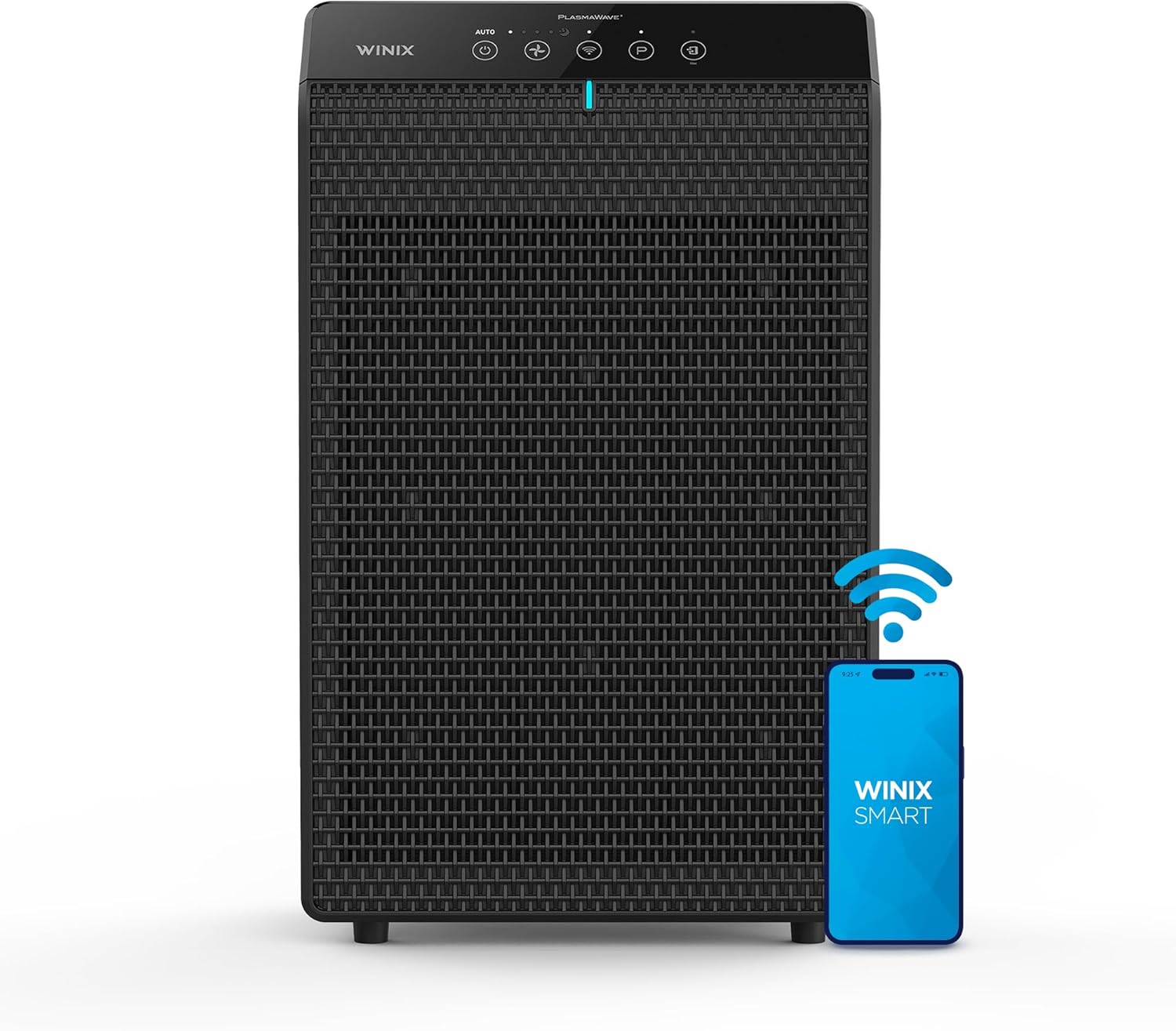
| Item model number | 5520 |
|---|---|
| AHAM verified coverage | 392 sq ft (per AHAM) |
| Noise level (low) | 23.5 dB |
| App | Winix Smart App compatible |
The WINIX 5520 is a four-stage air purifier built to clean large rooms quickly while adapting to real-world conditions. It combines a washable pre-filter, advanced carbon deodorization, a True HEPA filter that captures extremely small particles, and Winix PlasmaWave technology to reduce airborne pollutants. Built-in sensors and an LED air quality indicator let the unit automatically adjust fan speed in Auto Mode, and Sleep Mode cuts noise and power use when the room is dark. Practical features include washable mesh pre-filters to extend filter life and app connectivity for remote monitoring. The unit is AHAM verified for high coverage and is relatively quiet on its lowest setting, but replacement HEPA and carbon filters are required over time and will add running costs. For the buyer prioritizing measurable performance and hands-off operation, the 5520 delivers fast coverage and sensible automation, though ongoing filter maintenance and occasional higher fan noise at peak speeds are worth planning for.
Best for: Buyers who want a hands-off, efficient purifier that visibly reports air quality and automatically adjusts performance for large rooms.
Less Ideal for: People seeking a no-maintenance device with zero consumable costs or those who need an ultra-quiet unit at maximum cleaning power.
- True HEPA filtration captures particles down to 0.01 microns for strong allergen and smoke removal
- Smart sensors with Auto Mode and LED air quality indicator provide real-time automatic adjustments
- Advanced carbon filter reduces household odors and volatile organic compounds
- Washable fine mesh pre-filter prolongs main filter life and reduces replacement frequency
- Very low noise in Sleep Mode for nighttime use
- Requires periodic replacement of HEPA and carbon filters which adds ongoing cost
- Higher fan speeds can be noticeably louder when rapidly cleaning large spaces
Verdict: Choose the WINIX 5520 if you want a fast, automated HEPA purifier that reports air quality in real time and handles large rooms with minimal hands-on effort.
MOOKA B-D02L Air Purifier
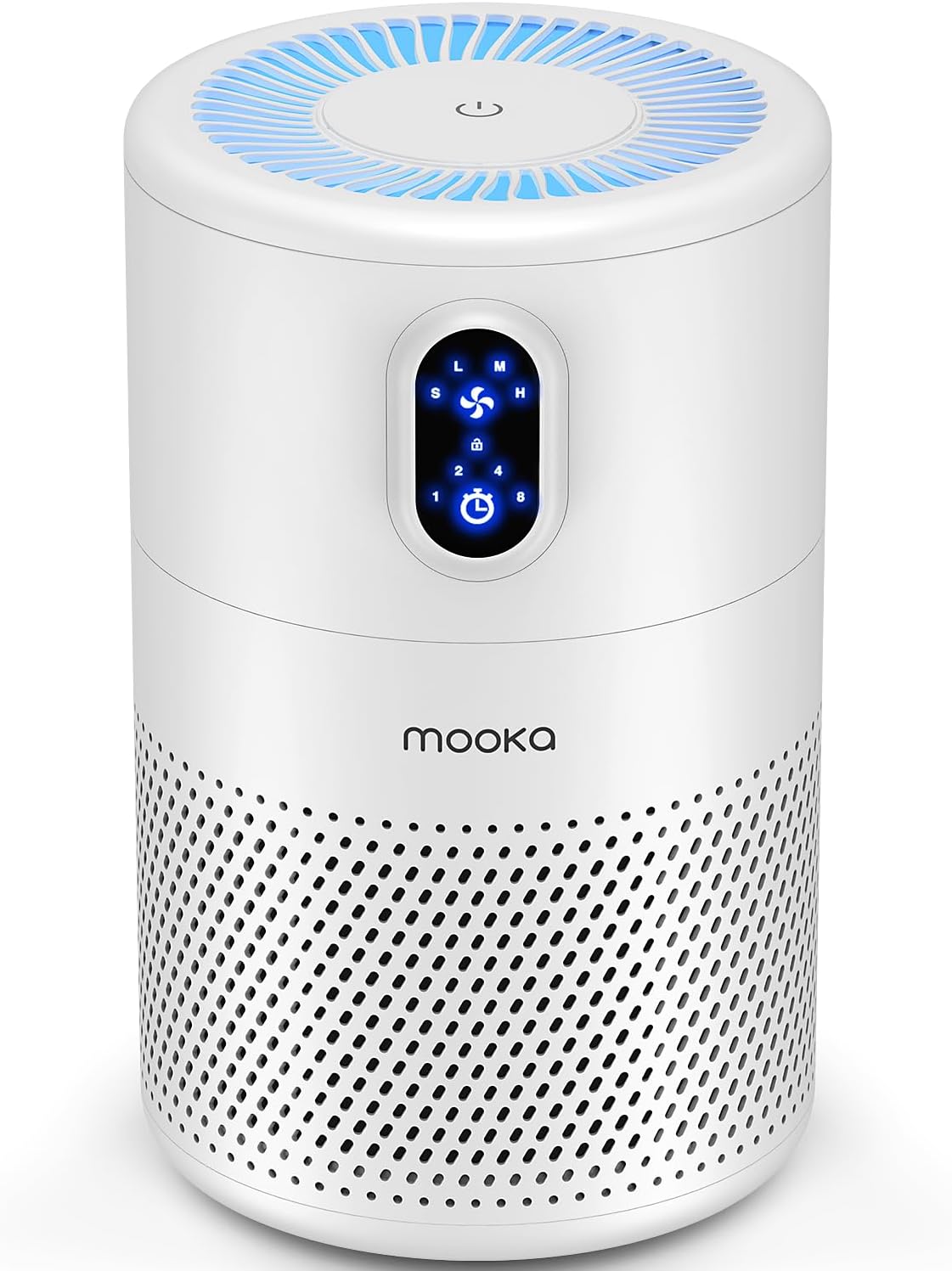
| Effective area | 1076 sq ft |
|---|---|
| Filter type | H13 True HEPA + activated carbon |
| Fan modes | 4 speeds |
| Timer | 1/2/4/8 hours |
The MOOKA B-D02L is a budget-friendly HEPA air purifier built for larger spaces, using a three-stage filtration stack (pre-filter, H13 True HEPA, activated carbon) to capture pet hair, dust, pollen, smoke and odors down to 0.3 microns. It is typically placed in living rooms, bedrooms, or offices and can deliver one air change per hour across roughly 1,076 sq ft or faster circulation in smaller rooms. Controls include four fan speeds, four timer settings, a night light you can turn off, and a child lock for safety. The unit emphasizes quiet, low-power operation with a brushless motor and claims a very low noise floor in sleep mode. Filters are user-replaceable and recommended every 3 to 6 months depending on use. Trade-offs are expected for the price: while filtration and coverage are strong for general airborne particles and odors, there is no smart connectivity or app control and the unit's stated coverage assumes a single air change per hour at max area which may be marginal for heavy-smoke or high-allergen scenarios.
Best for: Buyers looking for a cost-conscious, no-frills purifier that can handle whole-room coverage in homes and offices and who prioritize effective HEPA filtration and quiet operation over smart features.
Less Ideal for: People who need integrated smart controls, real-time air quality feedback, or rapid multiple air changes per hour for heavy smoke or severe allergy situations should consider higher-end models.
- H13 True HEPA filter plus activated carbon for particle and odor removal
- Rated to cover up to 1,076 sq ft with variable fan speeds and timers
- Very quiet operation and energy-saving brushless motor
- Child lock and simple controls make it easy and safe to run
- No smart-home connectivity or remote/app control
- Filter replacement every 3–6 months adds ongoing cost
Verdict: A practical, budget-friendly HEPA purifier that delivers large-room coverage and quiet, energy-efficient operation for buyers focused on value rather than smart features.
Levoit Core 300-P

| Filter Type | 3 in 1 Filtration |
|---|---|
| Floor Area | 1073 square_feet |
| Noise Level | 24 db |
| Particle Retention Size | 0.1 micron |
| Wattage | 56 watts |
The Levoit Core 300-P is a compact HEPA-grade air purifier built to move a lot of air without a bulky footprint. It uses a three-in-one original filter plus a 56W motor and AHAM-verified CADR figures to refresh air in large spaces; the listing cites coverage up to 1,073 ft² with multiple full-room air changes per hour. Controls are touch-based and include a near-silent Sleep Mode that drops noise to about 24 dB and can turn display lights off for undisturbed nights. Practical features include a timer, filter change indicator, and compatibility with several Levoit replacement filter types for smoke, pet allergies, or VOC reduction. Important limits: this model does not include automatic sensor-driven Auto Mode (only the Core 300S-P does), so fan speed must be adjusted manually, and peak cleaning performance depends on using genuine Levoit filters. The unit is corded and intended for standard 120V U.S. outlets.
Best for: Buyers who prioritize dependable, proven cleaning performance for whole rooms and want a simple, low-noise purifier that runs continuously without fuss.
Less Ideal for: People who want fully automatic, sensor-driven operation or smart connectivity should consider models that include Auto Mode and built-in air quality sensing.
- AHAM-verified CADR with strong reported coverage for large rooms
- HEPA-grade three-in-one original filter with 99.97% efficiency for 0.1–0.3 μm particles
- Very quiet Sleep Mode (around 24 dB) and dimmable display for nighttime use
- Touch controls, timer and filter-change indicator make routine use simple
- No Auto Mode or built-in air quality sensor on this model
- Best performance requires using genuine Levoit replacement filters
Verdict: Choose the Core 300-P when you need a compact, quiet HEPA purifier with AHAM-verified capacity to reliably clean large rooms.
Coway Mighty AP-1512HH

| Coverage | Up to 1,748 sq. ft. in 60 minutes |
|---|---|
| Filtration stages | Pre-filter, deodorization filter, bipolar ionizer, HEPA filter |
| HEPA efficiency | 99.97% of 0.3 micron particles |
| Features | Auto mode, air quality indicator, filter indicator |
The Coway Mighty AP-1512HH is a stand-alone HEPA air purifier built to move a lot of air quietly for sustained use in living rooms, open-plan areas, or home offices. It uses a four-stage system — washable pre-filter, deodorization filter, bipolar ionizer, and a True HEPA filter — to capture 99.97% of 0.3 micron particles while also reducing odors and some VOCs. An auto mode uses the built-in pollution sensor and colored LED to adjust fan speed to current conditions, and an eco setting reduces fan activity when air is clean to save energy. The unit includes filter-life indicators and a washable pre-filter that cuts ongoing maintenance costs, and it can cover large spaces quickly thanks to its high CADR and stated 1,748 ft² one-hour coverage. Trade-offs are that replacement filters are required for peak performance and the unit itself is not the smallest option for tight spaces, though its noise levels stay reasonable on low and eco settings. Overall it is a capable, user-friendly purifier for continuous household use where reliable particle removal and automatic operation matter.
Best for: Buyers who prioritize proven filtration performance and want a reliable, continuously operating purifier with sensor-driven automatic control and visible air-quality feedback.
Less Ideal for: People seeking the smallest, most portable purifier for tight bedrooms or those who want a permanently filter-free solution.
- True HEPA filtration capturing 99.97% of 0.3 μm particles.
- Auto mode with real-time pollution sensor and LED air-quality indicator.
- Washable pre-filter reduces waste and lowers short-term maintenance cost.
- High stated coverage suitable for large rooms or open spaces.
- Replacement filters are required periodically to maintain performance.
- Larger footprint than some compact purifiers, which may limit placement options.
Verdict: Choose the Coway Mighty AP-1512HH when you want a well-tested, sensor-driven HEPA purifier that reliably cleans large rooms and runs automatically with minimal fuss.
PuroAir 240 Air Purifier

| Item model number | PuroAir 240 |
|---|---|
| Sq Ft Coverage | 1,000 sq ft |
| Filter | 3-layer HEPA + CarbonTech |
| Certifications | CARB, ETL, ISO, UL |
The PuroAir 240 is a tower-style HEPA air purifier built for large rooms and open living areas up to about 1,000 square feet. It uses a three-layer filtration stack with HEPA plus CarbonTech to trap particles, smoke, and odors, and an automatic air-quality sensor with auto mode that adjusts fan speed as conditions change. Typical use is continuous room circulation in living rooms, bedrooms, or offices where you want near-constant particle removal and reduced odors from pets or cooking. Notable practical benefits include a whisper-quiet sleep mode for night use and multiple fan speeds for faster cleaning when needed. The unit is relatively compact for its coverage and includes factory certifications such as CARB and ETL. Important limitations are routine filter replacement costs and the need to size placement to allow good air flow; it is not intended as a whole-house HVAC solution. For buyers who prioritize certified filtration and simple automatic operation in a single large room, the 240 delivers solid real-world performance.
Best for: Buyers who want a certified, easy-to-use purifier for a large living room or master bedroom and prefer automatic air-quality control and quiet night operation.
Less Ideal for: Households seeking whole-house air cleaning or those who want a DIY, maintenance-free option that never requires filter changes.
- Covers up to roughly 1,000 sq ft for single-room use
- Three-layer HEPA plus activated CarbonTech for particles, smoke, and odors
- Auto air-quality sensor and auto mode adjust fan speed automatically
- Whisper-quiet sleep mode suitable for nighttime operation
- Requires periodic replacement filters which add ongoing cost
- Not designed to replace whole-house HVAC filtration
Verdict: A certified, quiet, and automatic HEPA purifier built to reliably clean the air in a single large room up to about 1,000 sq ft.
Choosing the Right HEPA Air Purifier for 1,000 Sq Ft: Key Factors to Consider
Clean Air Delivery Rate and Real Coverage
CADR is the most practical single metric for matching an air purifier to a larger space. It measures the volume of filtered air delivered for specific particle sizes and lets you estimate how many air changes per hour the unit will provide in 1,000 square feet. A higher CADR means faster reduction of particulates, but also typically requires higher fan speeds which affect noise and energy use.
Room geometry, ceiling height, and placement affect real coverage. Open-plan layouts benefit from units with higher airflow and omnidirectional intakes, while closed rooms can often manage with lower CADR if circulated well. Use CADR alongside manufacturer coverage ratings to predict performance over time, not just initial particle removal.
True HEPA Filtration and Additional Stages
Confirm that the purifier uses a true HEPA element that captures at least 99.97% of particles down to 0.3 microns. Pre-filters trap large debris and extend HEPA life, while activated carbon layers reduce odors and volatile organic compounds. Additional stages, such as antimicrobial coatings or specialized gas-phase media, can help in specific scenarios but are secondary to core HEPA performance.
For larger rooms, filter surface area and pleat depth matter because they determine how long the HEPA element lasts under high airflow. Larger or higher-capacity filters typically need replacement less often, which affects total cost of ownership and consistent performance.
Noise Output at Usable Fan Speeds
Noise is a practical tradeoff in 1,000-square-foot spaces because units must move a lot of air. Look at measured decibel levels for low, medium, and high settings. Low-speed noise determines comfort during daily use, while high-speed noise shows the sound impact when you need rapid air cleaning. Consider sleep modes and whether the unit's quiet setting still delivers meaningful air changes for your room.
Also account for perceived noise, which is influenced by frequency as well as decibel level. A unit that runs quietly but produces a high-pitched tone may be more annoying than a slightly louder, low-frequency fan.
Filter Life, Availability, and Replacement Cost
Filter lifespan depends on particle load and runtime. For large-area use, filters will load faster, so look for clear replacement intervals and reasonable costs. Transparent filter indicator systems and easy-to-access cartridges reduce maintenance friction. Consider whether pre-filters are washable or reusable to cut running costs.
Availability matters because long lead times or uncommon filter sizes can disrupt maintenance. Choose units with widely available replacement parts and simple DIY filter swaps to keep downtime minimal.
Placement, Airflow Pattern, and Room Integration
Where you locate the purifier affects performance as much as CADR. Centers of large rooms or positions that allow unobstructed intake and exhaust deliver the best circulation. Avoid tucking units into corners or behind furniture where airflow is restricted. For open plans, consider two smaller units placed strategically instead of a single central unit when ducting or partitions impede air movement.
Consider aesthetics and footprint since a large-capacity purifier may be taller or wider. Units with wheels or easy handles are easier to reposition for seasonal needs or temporary occupancy changes.
Energy Use and Control Flexibility
Large-coverage purifiers can use meaningful electricity if run continuously at high settings. Check wattage at typical operating speeds and look for energy-saver modes. Programmable timers, auto modes driven by particle sensors, and app integration allow you to match runtime to occupancy and outdoor air quality, reducing needless operation.
Controls also affect convenience. Simple tactile controls may be preferable for shared spaces, while digital displays and remote control are useful for hands-off management in larger layouts.
Sizing Up a Unit for Open-Plan Vs. Partitioned Rooms
Open-plan living areas and partitioned layouts behave differently even when the total square footage is the same. In open plans, a single high-CADR purifier can create wide circulation if placed centrally and unobstructed. In partitioned spaces, walls and furniture disrupt airflow so you may need higher CADR or multiple units to achieve similar air changes.
Assess how air moves in your home before choosing. Start by observing where dust accumulates and how HVAC registers distribute air. That will help you decide whether one powerful unit or two medium units will give more even filtration across the entire 1,000-square-foot footprint.
- Central placement favors single-unit solutions in open areas
- Multiple units can equalize coverage in segmented floorplans
- Check intake and exhaust clearances to avoid dead zones
Using Sensors and Auto Modes Effectively
Particle sensors and auto modes can reduce manual adjustments by scaling fan speed to real-time conditions. However, sensor accuracy varies, so pay attention to how the unit responds during typical activities like cooking or vacuuming. A responsive auto mode will raise airflow when needed and return to quiet operation afterward.
For bedrooms or home offices within the larger space, enable sleep or quiet settings overnight but consider scheduled boosts in the morning when activity increases. Combining sensor-driven control with timer schedules balances quietness and cleanliness.
- Auto modes save energy but verify responsiveness
- Use timers for predictable daily routines
- Pair sensor use with occasional manual boosts for peak events
Dealing With Odors and VOCs in Larger Spaces
HEPA filters remove particulates but do not capture gases. If odors, cooking fumes, or VOCs are concerns across the 1,000-square-foot area, look for models that include a substantial activated carbon stage or allow add-on gas-phase media. Carbon capacity is more important in bigger spaces because gases are diluted but persistent.
For intermittent strong sources of odor, portable localized ventilation combined with carbon filtration can accelerate clearance. Remember that replacing saturated carbon filters frequently is part of effective odor control in larger rooms.
- Activated carbon reduces common household odors
- Gas-phase cartridges have finite capacity and need replacement
- Combine ventilation with carbon filtration for best results
Maintenance Habits That Keep Performance High
Set a maintenance rhythm that accounts for higher particle loads in large areas. Clean or wash pre-filters monthly if visible dust accumulates, and monitor HEPA indicators rather than relying solely on calendar schedules. Regular upkeep preserves CADR and extends filter life.
Keep the exterior and intake grilles clear of obstructions and vacuum pre-filter surfaces during filter changes. If you host pets or live in high-dust environments, budget for more frequent replacements to sustain peak performance.
- Inspect pre-filters monthly in higher-load homes
- Follow manufacturer guidance for HEPA replacement intervals
- Vacuum intake grilles to maintain airflow
Placement Tips to Maximize Air Changes
Place the purifier where air moves freely and away from walls or furniture that block intake or exhaust. Elevating a unit slightly can improve circulation in rooms with low furniture, while floor placement works well for units with low intake heights.
Avoid placing the purifier directly beside HVAC returns that can short-circuit airflow. If budget allows, run short tests with a portable particle sensor or visualization method to confirm that the chosen position increases air changes across the space.
- Keep several feet of clearance around intake and exhaust
- Test different positions to find the most effective spot
- Avoid nearby obstructions that create dead zones
How We Chose the Best HEPA Air Purifier for 1,000 Sq Ft
We prioritized criteria that directly affect real-world performance in rooms around 1,000 square feet. First, we screened units by verified clean air delivery rate (CADR) and manufacturer-stated coverage to ensure each model can handle the target area when placed and operated correctly. Second, we looked at filtration stages and true HEPA efficiency to confirm removal of particles down to 0.3 microns. Third, we considered noise output across fan speeds because larger-coverage units often run at higher airflow and can be disruptive in living spaces. Fourth, maintenance factors such as filter life, replacement ease, and filter cost were evaluated since ongoing upkeep strongly affects ownership experience. Finally, energy use and control options were reviewed to reflect common daily patterns like continuous low-speed operation. We excluded units that only list room area without corresponding CADR numbers, novelty products without HEPA-rated filters, and purifiers designed exclusively for single small rooms. The list favors balanced machines that combine verified airflow, proven HEPA filtration, tolerable noise at usable speeds, and serviceable filters. These evaluation points align with the scoring criteria used for each product entry.
Our full evaluation process is outlined in our review methodology.
FAQ
How many air changes per hour should I expect for a 1,000 sq ft space?
Aim for at least 4 to 6 air changes per hour for general allergen control in a 1,000 sq ft open area. Exact needs depend on ceiling height and particle sources, so higher activity or sensitive occupants may want more frequent changes.
Will a HEPA purifier remove cooking odors and VOCs across a large room?
HEPA removes particles but not gases. For odors and VOCs, choose a unit with an activated carbon stage sized for larger spaces or use supplemental ventilation when cooking. Carbon capacity and replacement frequency determine effectiveness.
Can I run a large purifier 24/7 without high energy bills?
Many modern purifiers have low-power settings or efficient motors that make continuous operation practical. Use auto or sleep modes for baseline filtration and schedule higher speeds for peak periods to balance cleanliness and energy use.
How should I position the purifier in an open-plan home?
Place it centrally with unobstructed intake and exhaust and away from corners. If partitions block airflow, consider additional units placed near trouble spots to equalize coverage across the area.
How often will filters need replacement in a 1,000 sq ft area?
Replacement frequency depends on particle load and runtime. In larger or high-dust environments, HEPA elements and carbon filters may need replacing more often than standard intervals, so monitor indicators and inspect filters regularly.
Final Verdict
For 1,000-square-foot spaces, prioritize verified CADR and true HEPA filtration first, then balance noise, filter life, and energy use against your daily habits and room layout. Think about placement and whether one powerful unit or multiple smaller units will create more even coverage in your specific floorplan. Focus on machines with clear filter replacement information, responsive controls, and sufficient carbon capacity if odors are a concern. With the right tradeoffs, you can achieve steady particle reduction without excessive noise or maintenance overhead, making the space noticeably cleaner and more comfortable.