
Note: This article contains affiliate links. If you click on these links and make a purchase, we may earn a small commission at no extra cost to you. This helps support our research and content. Read our full affiliate disclosure here.
If dust and household allergens are making your home feel stuffy, choosing the right HEPA air purifier for dust can make a measurable difference. The right unit reduces airborne dust, captures fine particles that trigger allergies, and helps keep surfaces and HVAC filters cleaner. This guide shortlists the top options that excel at particle removal, room coverage, and everyday usability. Each pick was selected for practical home use and real-world performance factors like true HEPA capture rates, airflow capacity, and filter-upkeep. Read on to see the evaluated strengths for each purifier and which features matter most for different rooms and routines.
Top Picks at a Glance
| Best Overall The best all-around choice for most situations | Coway Mighty AP-1512HH |  |
| Best Quality Built to a higher standard if you want something more solid | BLUEAIR Blue Signature Air Purifier |  |
| Best Value The sweet spot between price and what you get | GermGuardian AC4825E Tower Air Purifier |  |
| Best Budget The cheapest option that still gets the job done reliably | VOOPNU HEPA Air Purifier DH-JH12 |  |
| Top Rated A top-rated pick with lots of positive feedback | KNKA APH4000 Air Purifier |  |
| Most Popular A crowd favorite that many people choose with confidence | Levoit Core 300-P |  |
| Best Seller A high-volume bestseller chosen again and again | Levoit Core 200S-P |  |
Coway Mighty AP-1512HH

| Coverage | Up to 1,748 sq. ft. in 60 minutes |
|---|---|
| Filtration stages | Pre-filter, Deodorization, Bipolar, HEPA |
| HEPA effectiveness | 99.97% of 0.3μm particles |
| Filter lifespan | Up to 1 Year |
The Coway Mighty AP-1512HH is a room air purifier that combines a washable pre-filter, activated carbon deodorization, a bipolar ionizer, and a true HEPA filter to remove dust, pollen, pet dander, smoke and common odors. It is typically placed in living rooms, bedrooms, or home offices and runs in Auto mode to adjust fan speed according to the onboard air quality sensor, with an LED indicator that shows pollution levels at a glance. Practical benefits include strong CADR-style coverage that the manufacturer rates for up to about 1,748 sq ft in an hour, quiet low-speed operation suitable for sleep, and filter reminders so maintenance stays straightforward. The washable pre-filter lowers operating costs and the optional custom filters target pets or smoke when needed. Trade-offs are that replacement filters and occasional deep cleaning are required to keep peak performance, and the unit uses a compact footprint so it may not circulate air as fast in very large open-plan homes compared with whole-house systems.
Best for: Buyers seeking a well-rounded, dependable room purifier that actively monitors air quality and reduces dust and common allergens without constant manual adjustments.
Less Ideal for: Homes that need whole-house ventilation or very rapid air changes in very large open areas should consider larger or ducted systems instead.
- True HEPA filtration captures 99.97% of 0.3 micron particles for effective dust removal
- Auto mode with air quality sensor and LED indicator adjusts fan speed in real time
- Washable pre-filter reduces debris buildup and lowers ongoing filter costs
- Quiet operation on low speeds suitable for bedrooms and nighttime use
- Replacement HEPA and specialized custom filters are required periodically
- Coverage claims are for one-hour cycles and real-world performance depends on room layout
Verdict: A versatile, sensor-driven HEPA purifier that delivers reliable dust and allergen reduction for medium to large rooms with low-noise operation.
BLUEAIR Blue Signature Air Purifier

| Room coverage | Up to 3,385 sq ft/hour (705 sq ft in 12.5 minutes) |
|---|---|
| Filtration | 7‑stage HEPASilent (captures down to 0.1 micron) |
| Noise level | 23–55 dB |
| Filter lifetime | Up to 1 year (tracked) |
The Blueair Blue Signature is built to move lots of air while keeping noise low, making it suitable for open floor plans and large living spaces where dust and allergens accumulate. It uses Blueair's HEPASilent 7‑stage filtration and an OdorFence stage to capture particles down to 0.1 micron and reduce gases and odors, while a high CADR lets the unit clear up to 705 sq ft in about 12.5 minutes or 3,385 sq ft in an hour. Smart sensors and an app let the purifier run in Auto Mode and report real‑time air quality with a color display, and filter‑life tracking simplifies maintenance. The unit is whisper‑quiet at low speeds but becomes noticeably louder at top speed, and replacement filters are a recurring cost even though their lifetime is optimized by usage tracking. The design is furniture‑inspired so the purifier can blend into living areas, but its performance and size are focused on large rooms rather than small bedrooms or desks.
Best for: Buyers who prioritize fast, high‑volume dust and allergen removal in large rooms or open plans and who want smart controls and real‑time air quality feedback.
Less Ideal for: People looking for a compact or budget bedroom purifier for single rooms or those who need an ultra‑quiet unit at maximum performance.
- Very high coverage rate suitable for large open spaces and whole‑room cleaning
- HEPASilent 7‑stage filtration captures very small particles and reduces odors and VOCs
- Smart sensors, Auto Mode, and mobile app with real‑time air quality reporting
- Runs very quietly at low fan speeds for night and living‑room use
- Filter lifetime tracking helps time replacements and can extend filter life based on usage
- Louder at maximum fan speed which can be noticeable in quiet environments
- Replacement filters are an ongoing expense despite long life
Verdict: If you need rapid, app‑controlled HEPA performance to remove dust and allergens across very large rooms, the Blueair Blue Signature delivers powerful, quiet‑at‑low‑speed cleaning with smart monitoring.
GermGuardian AC4825E Tower Air Purifier

| Room coverage | Up to 743 sq. ft. (hourly in medium to large rooms) and 153 sq. ft. (12.5-minute cycle for small rooms) |
|---|---|
| Filter type | True HEPA with activated carbon pre-filter |
| Fan speeds | Three speeds with sleep mode |
| Certifications | CARB Certified, ETL Certified, Zero Ozone Verified |
The GermGuardian AC4825E is a compact tower purifier built around a True HEPA filter that captures 99.97% of airborne particles down to 0.1 microns, plus an activated carbon pre-filter to reduce odors and an optional UV-C lamp for additional sanitizing. It is typically placed in bedrooms, living rooms, or home offices where dust, pollen, pet dander, and scents are concerns; three fan speeds including a quiet sleep mode let you balance cleaning power and noise. The unit circulates air for a small bedroom every 12.5 minutes and can handle larger spaces on a lower turnover rate, making it useful for spot treatment or continual background cleaning rather than rapid whole-house clearance. Maintenance is straightforward with compatible GermGuardian replacement HEPA and carbon filters and a replaceable UV-C bulb, but ongoing filter and bulb replacements add operating costs. The purifier is CARB and ETL certified and zero-ozone verified, which is relevant if you are sensitive to byproducts. For dust-focused buyers it delivers reliable HEPA performance in a small footprint, though it is best used as part of a room-by-room plan rather than a single solution for multiple large rooms.
Best for: Buyers who want a reliable, room-focused HEPA purifier to reduce dust, pet dander, and odors while keeping size and ease of use top priorities.
Less Ideal for: People seeking a single purifier to rapidly clean multiple large, open rooms or whole-house coverage should consider larger-capacity units instead.
- True HEPA filter captures 99.97% of particles down to 0.1 microns
- Activated carbon pre-filter reduces common household odors and cooking scents
- Three fan speeds including a quiet sleep mode for overnight use
- Compatible factory-quality replacement HEPA, carbon filters, and UV-C bulbs for easy maintenance
- CARB and ETL certifications and zero-ozone verification
- Air exchange rate is slower for very large open areas, so not a fast whole-house solution
- Optional UV-C requires bulb replacement to maintain that function
Verdict: A compact, certified HEPA tower that reliably reduces dust and odors in single rooms while keeping size and controls simple.
VOOPNU HEPA Air Purifier DH-JH12

| Filtration | H13 True HEPA 3-stage |
|---|---|
| Coverage | Up to 1,076 ft² (lab claim) |
| Noise | As low as 22 dB |
| Speeds | 3 fan speeds |
The VOOPNU DH-JH12 is a compact H13 True HEPA air purifier built for everyday dust, pet hair, pollen, smoke and odor control in mid-size spaces. It uses a 360° intake and a three-stage H13 filtration stack that the listing says captures 99.97% of airborne particles, and laboratory figures claim it cleans 250 ft² every 15 minutes. Controls are simple with three speeds and a timer, and the unit includes an essential oil tray for light scenting. The purifier is quiet enough for bedrooms at its lowest setting and has certifications including ETL, CARB and FCC which support safety and emissions claims. Practical benefits include easy placement thanks to the small footprint, a washable or replaceable prefilter in some SKUs, and low-noise overnight operation. Limitations are the modest physical size and implied filter replacement cycle, which means continuous run time and periodic filter purchases are required to maintain performance, and manufacturer CADR specifics beyond the lab claim are limited in the product text.
Best for: Buyers looking for an affordable, easy-to-use HEPA purifier that fits on desks or bedroom corners and prioritizes quiet, day-to-day dust and pet-hair reduction.
Less Ideal for: Those needing maximum airflow for very large open-plan homes or whole-house purification should consider larger, higher-CADR units instead.
- H13 True HEPA three-stage filtration captures fine particles like dust and pollen
- 360° intake design for even air draw from all sides
- Quiet operation down to about 22 dB suitable for bedrooms
- Simple controls with three fan speeds and a timer for easy daily use
- Essential oil tray lets you add light scent without external diffusers
- Small physical size means less raw airflow than large tower purifiers for very large open plans
- Requires regular filter replacement or maintenance to sustain stated performance
- Manufacturer provides lab coverage claims but limited detailed CADR numbers in specification text
Verdict: A compact, budget-friendly H13 HEPA purifier that quietly reduces dust and pet allergens in bedrooms and mid-size rooms.
KNKA APH4000 Air Purifier

| CADR (Smoke/Dust/PM2.5) | 226 CFM (384 m³/h) |
|---|---|
| CADR (Pollen) | 244 CFM (415 m³/h) |
| Room refresh rate | Up to 4.8 air changes per hour in 350 ft² |
| Noise (Sleep Mode) | 22–24 dB |
| Filter design | Dual cartridges, 3-stage (washable pre-filter, HEPA, activated carbon) |
The KNKA APH4000 is a high-capacity HEPA air purifier designed to move air quickly and reduce common indoor particles like dust, pollen, pet dander, and smoke. It uses dual front-and-back cartridges with a three-stage filter in each (washable pre-filter, high-efficiency HEPA, and activated carbon) to capture large debris and fine particles, and a filter indicator to remind you when replacements are due. AHAM-verified CADR figures (226 CFM for smoke/dust/PM2.5 and 244 CFM for pollen) and an airflow layout with dual intakes and side outlets mean it can refresh air multiple times per hour in medium rooms and still provide some exchange in much larger spaces. Useful modes include a quiet Sleep setting (22–24 dB), Auto and ECO modes to reduce runtime, plus a PET mode for heavier hair and odor loads. Real-time AQI display and color-coded lights make monitoring simple. Trade-offs are that it is a physical footprint and you will need to replace HEPA/charcoal cartridges periodically for peak performance, and its highest performance is best realized in closed rooms sized within its recommended range.
Best for: Buyers who prioritize steady, verifiable particle removal for allergy and dust control and want an appliance that reports air quality in real time and runs quietly at night.
Less Ideal for: People needing a tiny travel unit or a purifier for very large open-plan areas where a single unit cannot provide consistently high exchange rates.
- AHAM-verified CADR for smoke, dust/PM2.5, and pollen supporting reliable performance claims
- Dual intake/outlet design for faster, more even air circulation
- Three-stage filters with washable pre-filter reduce large particles and extend HEPA life
- Multiple modes including quiet Sleep and PET mode for tailored performance and low-noise nights
- Built-in PM2.5/AQI display and filter indicator simplify monitoring and maintenance
- Requires periodic replacement of HEPA and activated carbon cartridges to maintain effectiveness
- Best CADR performance applies to mid-size rooms; efficiency drops in very large open spaces
Verdict: Choose the KNKA APH4000 if you want a reliable, AHAM-verified HEPA purifier that delivers measurable dust and particle removal with quiet night operation and clear AQI feedback.
Levoit Core 300-P

| Filter Type | 3 in 1 Filtration |
|---|---|
| Floor Area | 1073 square_feet |
| Noise Level | 24 db |
| Particle Retention Size | 0.3 micron |
| Wattage | 56 watts |
The Levoit Core 300-P is a small, user-friendly air purifier that uses a three-stage filter (pre-filter, HEPA-grade, and activated carbon) driven by a 56W motor to capture fine particles down to 0.3 micron and reduce odors. It is intended for bedrooms, living rooms, or offices where you want quieter operation and proven particulate removal; the unit is AHAM verified and CARB and ETL certified. In typical use you set the fan speed manually and let it run continuously—Sleep Mode drops noise to about 24 dB and the display can be turned off for overnight use. Practical benefits include a compact footprint that is easy to move, a CADR that refreshes a mid-sized room multiple times per hour, and straightforward touch controls with a filter check indicator and programmable timer. Limitations are that this model lacks smart connectivity or an Auto Mode, so it requires manual speed adjustments and relies on Levoit filters for the rated performance and CADR claims. Replacement filters are recommended every 6 to 8 months for best results.
Best for: Buyers who prioritize proven particulate removal, quiet overnight operation, and verified performance backed by many user reviews and certifications.
Less Ideal for: People who need app control, automatic air quality sensing, or a hands-off smart purifier that adjusts fan speed based on real-time pollution levels.
- True HEPA-grade three-stage filtration that captures 0.1–0.3μm particulates with 99.97% efficiency
- AHAM verified CADR with documented performance for smoke, dust, and pollen
- Very quiet Sleep Mode at about 24 dB for undisturbed nighttime use
- Compact and portable design that is easy to relocate between rooms
- Certified to meet CARB and ETL safety standards
- No smart features or Auto Mode so fan speed must be adjusted manually
- Performance depends on using official Levoit replacement filters to meet rated CADR
Verdict: Choose the Core 300-P when you want a compact, AHAM-verified HEPA purifier that quietly removes fine dust and allergens with reliable, lab-tested performance.
Levoit Core 200S-P
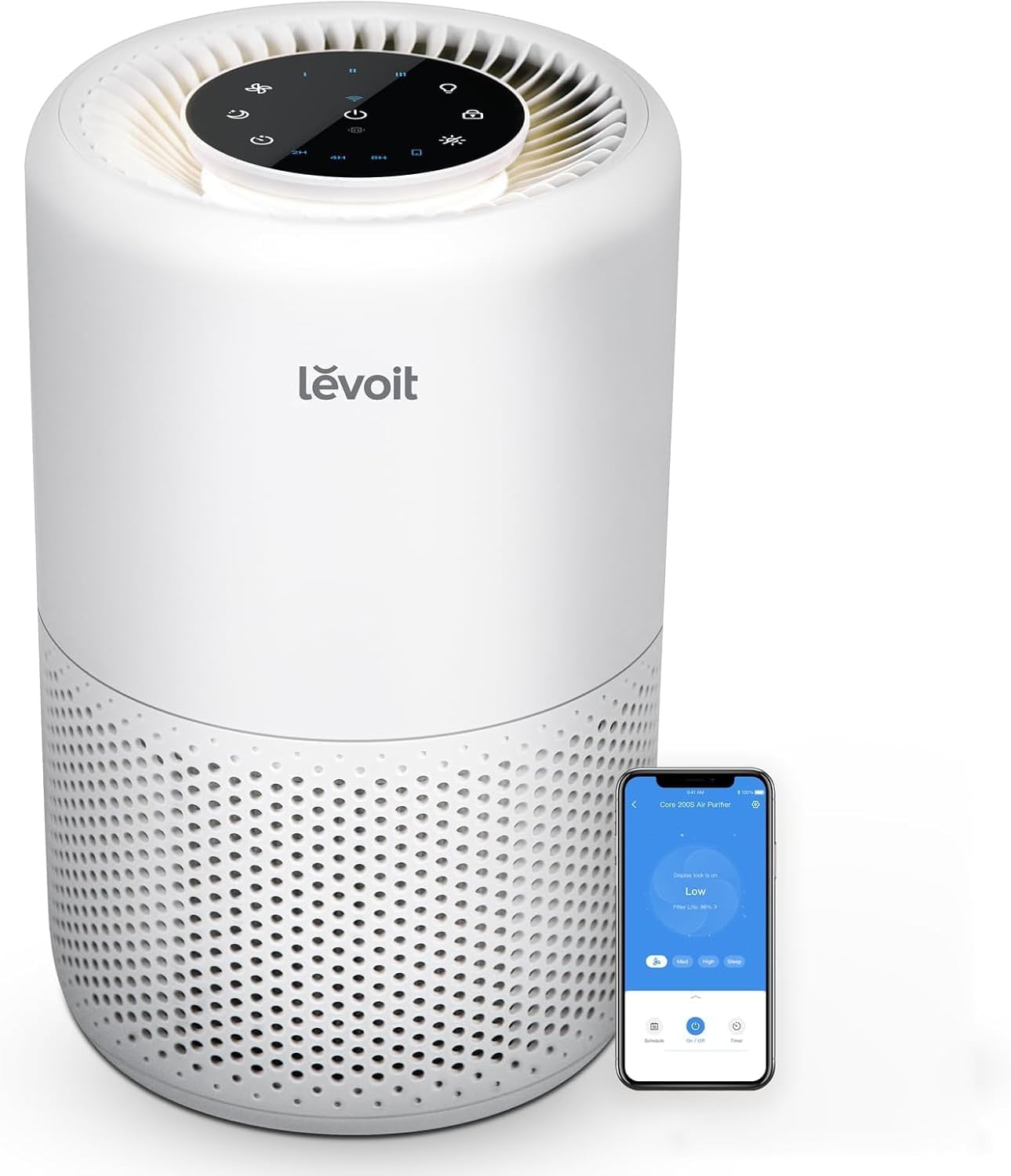
| Main filter efficiency | 99.97% of 0.1–0.3 microns |
|---|---|
| Coverage | 140 ft² (air refreshed 4.8×/hr) |
| Noise level | As low as 27 dB |
| Filter stages | 3-in-1 (pre-filter, activated carbon, HEPA) |
The Levoit Core 200S-P is a small-room HEPA air purifier intended to scrub dust, pollen, pet dander, and common household odors in bedrooms, nurseries, and apartments. It uses a 3-in-1 filter stack — pre-filter, activated carbon, and a main HEPA-grade filter rated to remove 99.97% of 0.1–0.3 micron particles — and pulls air through a 360° intake so placement is flexible. The unit is AHAM-verified for tested clean air delivery in rooms around 140 ft² and runs quietly, with sleep-mode noise as low as 27 dB and a display-off option for overnight use. Smart and voice controls let you monitor filter life and change fan speeds from an app or a voice assistant, which is convenient for hands-off maintenance. Trade-offs are its small coverage area and light-duty motor, so it is not intended for large open-plan spaces or heavy smoke removal, and replacement filter costs add to long-term ownership. For everyday dust control in modest rooms it is an effective, user-friendly choice.
Best for: Buyers who want a low-noise, easy-to-use HEPA purifier for bedrooms or small living spaces and prioritize tested performance and simple maintenance.
Less Ideal for: People needing high-capacity purification for large rooms, constant heavy particulate loads, or quick smoke removal should choose a larger, more powerful unit.
- True HEPA-grade main filter removes 99.97% of 0.1–0.3 micron particles
- 360° air intake offers flexible placement and steady airflow
- Quiet operation down to 27 dB for undisturbed sleep or nursery use
- Smart app and voice control with filter life monitoring for easy maintenance
- Designed for small rooms only and not suited to large open areas
- Replacement filters increase ongoing operating cost
Verdict: Choose the Core 200S-P when you want a quiet, AHAM-verified HEPA purifier that reliably reduces dust and pet dander in small rooms with smart controls for easy upkeep.
Choosing the Right HEPA Air Purifier for Dust: Key Factors to Consider
Filtration Efficiency and True HEPA Rating
A purifier's ability to remove dust hinges on its filter media. True HEPA filters are rated to capture at least 99.97% of particles 0.3 microns in diameter; performance at smaller and larger sizes also matters. Look for clear specifications about particle capture and independent test data where available.
High-efficiency filters will trap the fine dust and allergenic particles that ordinary filters miss. If you live in a high-dust environment or have allergy sufferers at home, prioritize purifiers with verified HEPA-grade media and low penetration rates for submicron particles.
Clean Air Delivery Rate (CADR) and Air Changes Per Hour
CADR or an equivalent airflow metric indicates how quickly a purifier can reduce particle concentrations in a room. A higher CADR shortens the time it takes to noticeably reduce airborne dust. Consider CADR ratings relevant to dust or smoke particles when comparing units.
Also evaluate expected air changes per hour for your room size. A purifier that is too small will struggle to keep dust levels down, while an oversized or noisy unit may be unnecessary for a small bedroom. Matching CADR to room volume gives a practical expectation of performance.
Coverage Area and Room Placement
Manufacturers usually specify a coverage area based on a target number of air changes per hour. Think about the rooms you intend to run the purifier in and confirm that the unit can handle those square footage recommendations at recommended ceiling heights.
Placement affects performance. Units with intake all around or upward-throw outlets tend to mix air more effectively in open rooms, while compact designs may do better in smaller, enclosed spaces. Consider where you can place the purifier for unobstructed airflow and minimal obstruction from furniture.
Maintenance, Filter Lifespan, and Replacement Costs
Filtration performance declines as filters load with dust. Check expected filter lifetime under typical home conditions and how easy it is to replace filters. Some designs use multiple-stage filtration with prefilters that extend HEPA life by trapping larger particles.
Calculate the practical upkeep commitment: frequency of prefilter cleaning, cost and availability of replacement HEPA filters, and whether the unit uses proprietary cartridges. Lower ongoing costs and easy access to replacements make daily ownership simpler and keep performance consistent.
Noise and Fan Speed Flexibility
Consistent operation is key to controlling dust, so noise levels at common fan speeds are a real consideration. Look for models that offer quiet night modes for bedrooms and higher-speed settings for rapid cleanup after activities that stir dust.
Fan control granularity allows you to balance noise with performance. Units with timer functions or automatic mode based on particle sensors can reduce the need to manually adjust settings while maintaining acceptable background noise.
Additional Features and Usability
Extras like particle sensors, auto modes, remote controls, and clear filter-life indicators improve day-to-day usability. A reliable particle sensor helps the purifier adapt to spikes in dust from cleaning or open windows.
However, extra features should not replace solid basic filtration performance. Prioritize core capture efficiency and airflow, then look for conveniences that match your household routine and preferred control style.
Match Purifier Size to the Room, Not the Box
Room volume, not the physical dimensions of the unit, determines whether a purifier can keep dust levels down. Check the stated coverage area and the CADR for dust or smoke particles, then match that to your room square footage and ceiling height. A unit that lists coverage for a 300-square-foot room will act very differently in a 150-square-foot bedroom.
When in doubt, choose a unit rated slightly larger than your room and run it on a lower speed. This gives better air mixing and reduces runtime at max fan speed, which can extend filter life and keep noise manageable.
- Calculate room volume: square feet times ceiling height.
- Aim for at least 4 to 5 air changes per hour for allergy-prone spaces.
- Place the intake unobstructed and avoid corners that trap stale air.
Pre-Filters and Multi-Stage Systems Help With Dust Load
A washable pre-filter captures larger dust and hair, preventing premature loading of the HEPA element. If your household produces a lot of visible dust, a multi-stage approach can extend the effective life of the main HEPA filter and maintain airflow performance longer.
Consider units where the pre-filter is easy to remove and clean without tools. That makes periodic maintenance quick and reduces downtime when the purifier needs attention.
- Washable pre-filters cut maintenance costs and waste.
- Electrostatic or activated carbon stages can help with odors but do not replace HEPA for dust capture.
Using Sensors and Auto Modes to Keep Dust Low
Built-in particle sensors let a purifier adjust fan speed automatically when dust levels rise, such as after vacuuming or cooking. Auto modes maintain lower average particle counts without constant manual control, which is useful for continuous dust suppression.
Be aware that sensors vary in quality. Units with visible numeric readouts or independent validation of sensor responsiveness offer clearer feedback about actual indoor air conditions.
- Use auto mode for continuous operation with minimal adjustment.
- Run a higher manual speed briefly after dust-producing activities for rapid cleanup.
Noise Management for Nighttime Use
If you plan to run a HEPA air purifier in a bedroom overnight, noise levels at the lower fan settings matter. Look for models with measured decibel ratings or user-facing quiet modes designed for sleeping environments.
Some units trade airflow for near-silent operation, so verify that low-noise settings still provide adequate air changes for your room. A unit that is barely audible but cannot move enough air will not keep dust levels consistently low.
- Check low-speed dB ratings and customer experiences for long-term use.
- Consider scheduling higher speeds during the day and quiet modes at night.
Maintenance Best Practices to Preserve Performance
Regularly clean or replace pre-filters and follow the manufacturer-recommended schedule for HEPA replacements. In dusty homes, check filters more frequently; visible dust on the pre-filter is a cue to clean it. Neglecting filter maintenance reduces capture efficiency and increases fan strain.
Keep air intake and outlet areas clear and consider occasional vacuuming around the unit to prevent secondary dust buildup. Maintaining a consistent runtime, rather than sporadic bursts, usually yields better long-term dust control.
- Inspect pre-filters monthly in high-dust environments.
- Log filter changes to maintain consistent performance.
How We Chose the Best HEPA Air Purifier for Dust
We focused on attributes that directly affect a HEPA air purifier's ability to remove dust in real-world home use. Primary evaluation criteria included measured particle-capture efficiency at submicron sizes, clean air delivery rate relative to common room sizes, and filter grade and lifespan under typical household dust loads. We also prioritized airflow design and placement flexibility because those influence how effectively a unit circulates air in living rooms, bedrooms, and open-plan spaces. Practical usability was another filter: straightforward controls, maintenance access, and replacement filter availability matter for long-term satisfaction. Noise output across fan speeds was considered since continuous operation is often required to control dust. Units with unverified or ambiguous HEPA claims and those lacking clear filtration specs were excluded. In short, we picked purifiers that combine documented particle removal, suitable coverage for typical room sizes, reasonable upkeep, and acceptable noise and airflow characteristics.
Our full evaluation process is outlined in our review methodology.
FAQ
How often should I run a HEPA air purifier to control dust?
Often you should run the purifier continuously or for long daily periods to keep dust levels low. Continuous operation at a moderate fan speed usually yields better long-term results than intermittent, high-speed bursts.
Will a HEPA purifier remove dust from surfaces as well as the air?
A HEPA purifier only cleans the air; it reduces the amount of dust that eventually settles on surfaces by removing airborne particles. Regular cleaning of surfaces is still necessary for visible dust removal.
Do I need a purifier with a high CADR for a small bedroom?
Not necessarily. For a small bedroom choose a unit rated for that room size and aim for sufficient air changes per hour. Oversized CADR provides faster cleanup but can increase noise and energy use.
How do pre-filters affect HEPA filter life?
Prefilters trap larger particles and hair, reducing the load on the HEPA element and extending its service life. Regular pre-filter cleaning is an inexpensive way to keep the HEPA filter functioning efficiently longer.
Are particle sensors reliable for dust detection?
Particle sensors are useful but vary in sensitivity and calibration. They are good at indicating relative changes, such as spikes after cleaning, but absolute readings may differ between units.
Final Verdict
Prioritize verified HEPA filtration and a CADR suited to your room volume when choosing a purifier for dust control. Consider maintenance demands and filter availability, because ongoing filter care determines real-world performance over time. Balance noise and airflow to match daytime cleanup needs and nighttime comfort. With those tradeoffs weighed, you can pick a unit that keeps airborne dust down while fitting your living spaces and maintenance routine.