
Note: This article contains affiliate links. If you click on these links and make a purchase, we may earn a small commission at no extra cost to you. This helps support our research and content. Read our full affiliate disclosure here.
If wildfire haze, indoor cooking, or tobacco smoke is compromising your home's air quality, a HEPA air purifier for smoke can make a measurable difference. The right unit captures fine particles that cause irritation and reduces the persistent smell that follows heavy smoke events. This guide shortlists seven top HEPA air purifiers for smoke and explains why each type of unit might fit different room sizes and use patterns. We evaluated filtration capability, room coverage, and usability to help you pick a purifier that matches your space and habits. Read on for practical buying guidance and what to expect from properly sized HEPA filtration.
Top Picks at a Glance
| Best Overall The best all-around choice for most situations | Winix 5510 Air Purifier |  |
| Best Quality Built to a higher standard if you want something more solid | AirDoctor AD3500 Air Purifier |  |
| Best Value The sweet spot between price and what you get | MOOKA B-D02L Air Purifier |  |
| Best Budget The cheapest option that still gets the job done reliably | FULMINARE H13 HEPA Air Purifier |  |
| Top Rated A top-rated pick with lots of positive feedback | ECOSELF HAP603 Air Purifier |  |
| Most Popular A crowd favorite that many people choose with confidence | Levoit Core 300-P |  |
| Best Seller A high-volume bestseller chosen again and again | Levoit Vital 200S-P Air Purifier |  |
Winix 5510 Air Purifier

| Item model number | 5510 |
|---|---|
| AHAM verified coverage | 1,882 sq ft in 1 hr |
| True HEPA particle capture | 99.99% to 0.01 microns |
| Smart features | WiFi / Alexa / Google Home compatible |
| Noise (slowest speed) | 23.5 dB |
The Winix 5510 is a large-room air purifier built around a 4-stage filtration system that combines a washable pre-filter, True HEPA filter, advanced carbon odor filter, and PlasmaWave technology to tackle smoke, pet dander, and household odors. It is typically placed in living rooms or open-plan areas where fast air turnover matters; AHAM-verified coverage and high CADR-style performance let it clean very large rooms quickly while its smart sensors and Auto Mode adjust fan speed based on real-time air quality. The unit also supports the Winix Smart App and voice assistants for remote control, and it automatically switches to a near-silent Sleep Mode in the dark for overnight use. Practical benefits include strong smoke and VOC reduction from the carbon stage, clear LED air quality feedback, and washable pre-filtering that extends HEPA life. Expect routine filter replacements and the usual noise increase at higher speeds when tackling heavy smoke events, and PlasmaWave is marketed to reduce pollutants but is not a substitute for filtration.
Best for: Buyers who want a strong, automated purifier that cleans large living spaces quickly and provides app control and air quality feedback without needing constant adjustment.
Less Ideal for: People needing a truly portable or ultra-compact unit for small bedrooms or travel should consider smaller, quieter models instead.
- Four-stage filtration including True HEPA for submicron particles
- Advanced carbon filter to reduce odors and some VOCs
- Smart Sensors with Auto Mode for hands-off adjustments
- Winix Smart App and voice assistant control for remote monitoring
- Washable pre-filter helps prolong HEPA filter life
- Higher fan speeds can be noticeably louder than Sleep Mode
- Requires periodic HEPA and carbon filter replacements to maintain performance
Verdict: A powerful, smart-capable HEPA purifier that removes smoke and odors from very large rooms while offering automated sensing and remote control.
AirDoctor AD3500 Air Purifier

| Model | AD3500 |
|---|---|
| Coverage (1 hour) | Up to 2,520 ft2 |
| Particle capture | 99.99% at 0.003 microns |
| Filtration stages | Pre-filter, Activated Carbon, UltraHEPA |
The AirDoctor AD3500 is built for large spaces and heavy pollutants like smoke and VOCs. It uses a three-stage system—pre-filter, premium activated carbon, and AirDoctor UltraHEPA—to capture particles down to 0.003 microns and reduce gases and odors, which makes it practical for kitchens, living rooms, and rooms affected by wildfire or cigarette smoke. The unit includes PM2.5 sensors and an AirDoctor Halo display that show real-time air quality and an Auto Mode that adjusts fan speed and triggers Boost when pollution spikes. Coverage claims are strong, with rapid cleaning rates for up to 2,520 square feet in an hour, and fan controls include a timer, filter indicator, and four speeds for flexible operation. Filters are replaceable and the carbon and UltraHEPA elements have recommended service intervals. Trade-offs are its physical size and weight compared with smaller purifiers and the need to buy genuine replacement filters on a set schedule for best results.
Best for: Buyers who prioritize measurable, high-performance filtration for smoke and chemical odors in large rooms and want automatic monitoring and powerful purification rather than a small portable unit.
Less Ideal for: People seeking a lightweight, ultra-compact bedroom purifier or those who need a very low-cost, no-maintenance solution should consider smaller or simpler models instead.
- Extremely fine UltraHEPA filtration captures particles down to 0.003 microns for high-effectiveness against smoke and fine ash.
- Large coverage area with rapid room-cleansing rates suitable for whole rooms and open-plan spaces.
- Premium activated carbon/VOC stage reduces gases, odors, and wildfire smoke components.
- Auto Mode with PM2.5 sensors and Halo display provides live feedback and automatic fan adjustments.
- Relatively large and heavy compared with compact purifiers, which may limit placement options.
- Requires periodic purchase of genuine replacement filters to maintain third-party tested performance.
Verdict: Choose the AD3500 when you need a proven, high-capacity purifier that rapidly clears smoke and airborne chemicals from large rooms.
MOOKA B-D02L Air Purifier
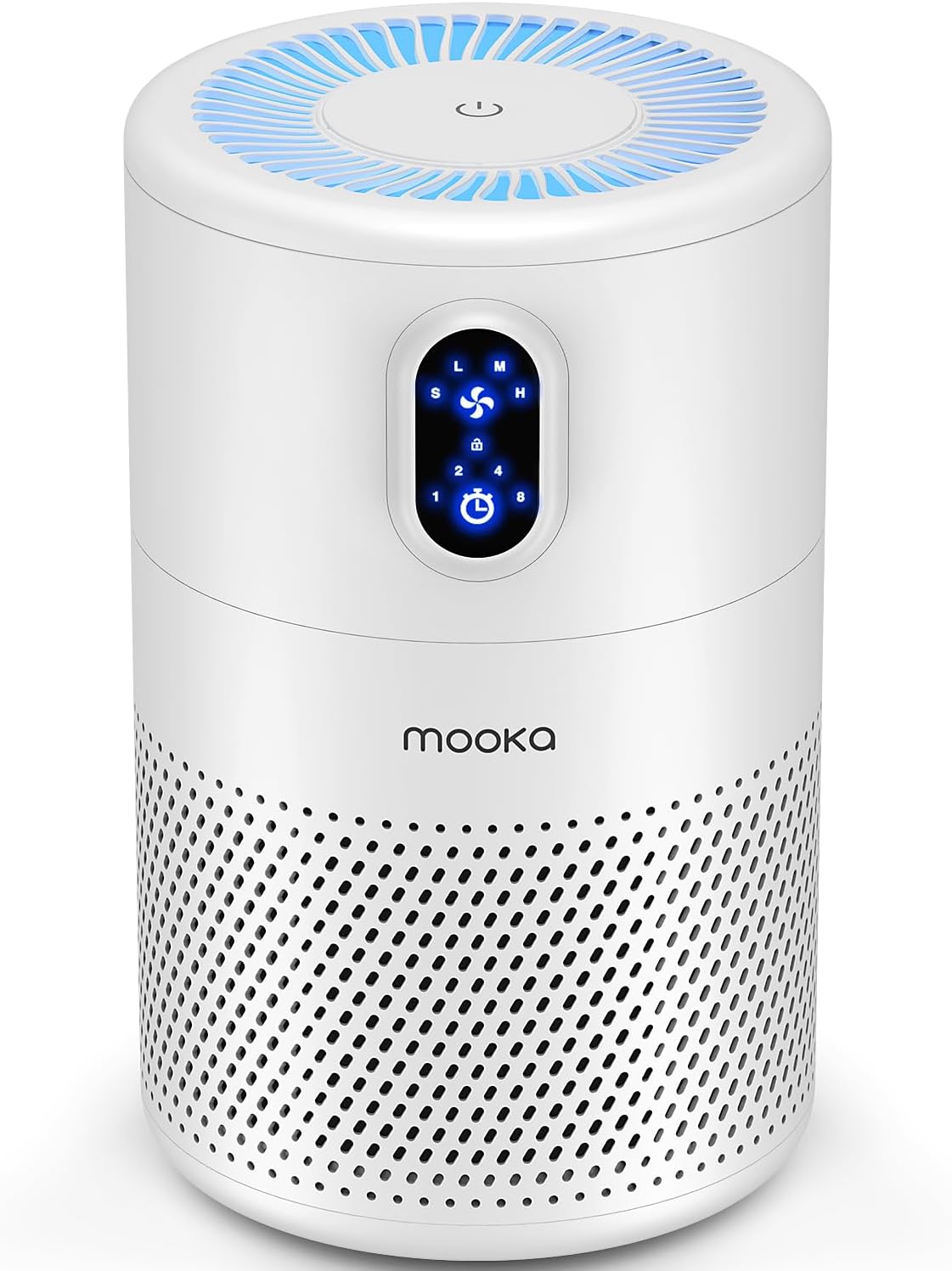
| Coverage | Up to 1,076 sq ft |
|---|---|
| Filter type | H13 True HEPA + activated carbon |
| Noise level | As low as 20 dB (sleep mode) |
| Timer settings | 1/2/4/8 hours |
The MOOKA B-D02L uses a three-stage system — pre-filter, H13 True HEPA, and activated carbon — to remove smoke, pollen, pet dander, dust, and odors from indoor air, and the brand rates it for coverage up to 1,076 sq ft (with faster air changes in smaller rooms). It runs quietly thanks to a brushless motor with a sleep mode and offers four fan speeds, four timer settings, a child lock, and a soft night light that can be disabled. Filter life is expected at about 3 to 6 months depending on conditions, and replacement filters are sold separately. The unit is energy efficient and intended for continuous use without much noise disruption, making it suitable for bedrooms or living areas during smoke events. Limitations are typical for compact purifiers: effectiveness depends on room layout and placement, and the stated maximum coverage assumes ideal conditions so performance will be lower in very smoky or open-plan spaces; recurring filter replacements add to operating cost.
Best for: Buyers who prioritize effective particulate and odor removal in living spaces and want a quiet, energy-conscious purifier they can run overnight or during smoke events.
Less Ideal for: Not the best choice for whole-house removal in very large or open-plan homes where a higher-capacity or multiple-unit approach is required.
- H13 True HEPA plus activated carbon captures particles down to 0.3 microns and reduces odors
- Rated coverage up to 1,076 sq ft with faster air changes in smaller rooms
- Ultra-quiet operation with a low-noise sleep mode suitable for bedrooms
- Multiple timers, four fan speeds, and child lock for flexible, safe daily use
- Actual smoke-clearing speed depends heavily on room size, layout, and source strength
- Filters need replacement every 3–6 months, creating ongoing cost
Verdict: A quiet, energy-efficient H13 HEPA purifier well suited for improving air during smoke episodes in single rooms or medium-sized spaces.
FULMINARE H13 HEPA Air Purifier

| Filter type | H13 HEPA |
|---|---|
| Recommended room size | Up to 215 ft² / 20 m² |
| Noise level (low) | ~24 dB |
| Timers | 2, 4, 8, 10, 12 hours |
The FULMINARE H13 is a small, portable air purifier built around an H13 true HEPA filter and a 360-degree air outlet that the maker says refreshes air up to five times per hour in spaces up to about 215 sq ft. It is intended for bedroom or office use and pairs simple controls with an independent night light and five timer settings so you can run it on a schedule while you sleep. The unit emphasizes low-noise operation, claiming sound levels near 24 dB in sleep mode, which makes it suitable for light sleepers. Practical benefits include straightforward placement thanks to its compact footprint, filter-based removal of particles like pet dander and smoke, and a plug-in power design that avoids battery swaps. Limitations are its coverage ceiling of roughly 20 m², which means larger living rooms or open-plan areas will need a larger unit or multiple purifiers, and the filter requires periodic replacement to maintain performance. The design is basic but functional for buyers who need a quiet, budget-friendly HEPA option for bedrooms and small rooms.
Best for: Buyers on a modest budget who need a quiet, easy-to-use HEPA purifier for a bedroom or small room and prioritize low noise and portability over large-room coverage.
Less Ideal for: People who need high-capacity purification for large living rooms, open-plan spaces, or heavy smoke conditions should choose a larger, higher-CADR purifier instead.
- H13 true HEPA filter for high-efficiency particle removal
- 360° air outlet with claimed 5x/hour refresh rate in rooms up to 215 sq ft
- Very quiet sleep-mode operation around 24 dB
- Independent night light and multiple timer options for scheduled use
- Compact and portable plug-in design easy to place in bedrooms or offices
- Rated coverage limited to about 215 sq ft so not suited for large open areas
- Requires regular filter replacements to sustain filtration performance
Verdict: A quiet, budget-friendly H13 HEPA purifier that works well for bedrooms and small rooms where low noise and simple scheduled operation matter most.
ECOSELF HAP603 Air Purifier

| Model | HAP-603 |
|---|---|
| Coverage | Up to 2400 ft² (seller-stated) |
| Noise level | 22 dB (Sleep Mode) |
| Filter type | H13 True HEPA |
The ECOSELF HAP603 is a large-room air purifier built to pull particulates from big living spaces up to the seller-stated 2400 ft² using a 2X-power filtration approach and an H13-grade HEPA stage that captures fine particles. It is typically used in living rooms, bedrooms, or open-plan areas affected by smoke, pet dander, and odors; the PM2.5 display and infrared sensor let the unit automatically ramp fan speed when air quality worsens. Practical benefits include a very quiet 22 dB sleep mode for nighttime use, a timer and child lock for hands-off operation, and an aromatherapy slot for mild scenting. Users should plan for filter replacements from the manufacturer to keep performance high, and expect the purifier to be a substantial presence in a room given its large-room airflow focus. While the listing emphasizes large-area coverage and rapid purification cycles, buyers who need compact bedroom-only units or explicit CADR numbers may find those details missing from the product description.
Best for: Buyers who prioritize reliable, continuous smoke and particle removal across large living spaces and want a quiet, sensor-driven purifier that manages itself most of the time.
Less Ideal for: People seeking a small, portable bedroom-only purifier or those who need explicit CADR and lab-tested airflow figures for exact performance comparisons should look elsewhere.
- H13 True HEPA filtration to capture 99.97% of fine airborne particles
- Real-time PM2.5 display and infrared sensor for automatic fan adjustment
- Very low-noise 22 dB sleep mode suitable for nighttime use
- Large coverage claim with frequent air turnover for living areas
- Timer, auto mode, and filter indicator simplify hands-off operation
- No manufacturer CADR figures listed to quantify cleaning speed
- Replacement filters are recommended to be OEM for best performance which adds ongoing cost
- Listing does not include detailed room-by-room performance data
Verdict: Choose the ECOSELF HAP603 if you need a quiet, sensor-driven HEPA purifier built to handle smoke and fine particles across very large rooms.
Levoit Core 300-P

| Filter Type | 3 in 1 Filtration |
|---|---|
| Noise Level | 24 db |
| Wattage | 56 watts |
| Particle Retention Size | 0.3 micron |
| Floor Area | 1073 square_feet |
The Levoit Core 300-P is a small, user-friendly HEPA air purifier built to clear smoke, pollen, pet dander, and odors in bedrooms and living spaces. It uses a three-stage filter (pre-filter, HEPA-grade media, and activated carbon) driven by a 56W motor with a CADR that refreshes a 222 ft² room multiple times per hour and can circulate air in larger spaces at a lower rate. The unit offers touch controls, a sleep mode that drops noise to about 24 dB, a timer and indicator lights that can be turned off for undisturbed nights. Practical benefits include portability, AHAM verification and certifications for U.S. indoor use, and a clear recommendation to use genuine Levoit replacement filters for best performance. Limitations to note are the lack of smart/auto mode on this model so fan speed must be adjusted manually, and filter replacements are a recurring cost and need changing every 6 to 8 months for peak performance.
Best for: Buyers who prioritize proven performance and social proof want a compact, certified purifier that reliably reduces smoke and fine particulates without needing app control.
Less Ideal for: Users who need built-in smart/auto air-quality adjustments or those who want a purifier sized for continuous whole-house cleaning should look elsewhere.
- Certified AHAM performance with documented CADR suitable for smoke and dust removal
- H13-grade HEPA filtration removing down to 0.1–0.3 micron particles at 99.97% efficiency
- Very quiet Sleep Mode around 24 dB for bedroom use
- Portable compact design and touch controls make it easy to move and operate
- Does not include smart connectivity or automatic air-quality sensing
- Requires regular replacement of official filters every 6–8 months
Verdict: A proven, AHAM-verified compact HEPA purifier that quietly and effectively reduces smoke and fine particles for buyers who value verified performance and strong customer feedback.
Levoit Vital 200S-P Air Purifier

| Floor Area | 1875 square_feet |
|---|---|
| Filter Type | 3-Stage Filter |
| Noise Level | 27 db |
| Particle Retention Size | 0.1 micrometer |
| Wattage | 51 |
The Levoit Vital 200S-P is a whole-room air purifier built to handle large spaces and common indoor pollutants including smoke, dust, pollen, and pet dander. It uses a three-stage filter stack with a washable pre-filter plus an activated carbon layer to capture particles and reduce odors, and its AHAM-verified CADR numbers make its performance measurable for smoke, dust, and pollen. Typical use is in living rooms, bedrooms, or open layouts where you want fast air turnover; the unit supports app control and on-device buttons and reports air quality so you can monitor conditions and run the fan as needed. Noise is quiet on low settings at around 27 dB, and the 51 W power draw is modest for a large-room purifier. Important limits to note are regular filter replacements for sustained performance and that activated-carbon capacity will dictate how long it keeps heavy smoke or VOC odors from lingering before needing a specialized filter change.
Best for: Buyers who prioritize reliable, independently verified smoke and particle removal and want a low-noise, easy-to-monitor purifier for large rooms.
Less Ideal for: People needing a compact travel or personal purifier or those who want a unit specifically tuned for industrial chemical removal rather than general VOCs and smoke.
- High CADR ratings for smoke, dust, and pollen backed by AHAM verification
- Three-stage filtration with washable pre-filter and activated carbon for odor control
- App control and built-in air quality monitor for hands-off management
- Low noise operation (about 27 dB) suitable for bedrooms
- Activated carbon capacity may require frequent filter swaps during heavy smoke or VOC events
- Large-room performance requires adequate placement and clearance to reach rated coverage
Verdict: Choose the Vital 200S-P when you want an AHAM-verified, low-noise HEPA purifier that reliably clears smoke and airborne particles from large rooms.
Choosing the Right HEPA Air Purifier for Smoke: Key Factors to Consider
Filtration Stage and True HEPA Rating
A True HEPA filter captures at least 99.97 percent of particles down to 0.3 microns, which is vital for removing fine smoke particulate. Check whether the purifier specifies True HEPA performance and whether there are multiple filtration stages like pre-filters, HEPA, and activated carbon.
Multiple stages extend filter life and improve overall performance. A pre-filter traps larger debris, protecting the HEPA element, while a dedicated HEPA layer targets PM2.5 and smaller particles that penetrate deep into lungs. For persistent smoke problems, confirm the HEPA element is a genuine medical-grade or True HEPA rather than a lower-efficiency claim.
Activated Carbon and Odor Adsorption
Smoke carries volatile organic compounds and odor-causing molecules that HEPA media alone cannot trap. Activated carbon or other adsorption media are required to reduce the smell and some gaseous pollutants associated with smoke.
Consider the quantity and quality of carbon media. Thicker beds or specialized carbon treatments will generally adsorb more odor, but they add weight and may need more frequent replacement. If odor control is a priority, look for systems that clearly state carbon volume or inclusion of a dedicated gas-phase filter.
Room Size, CADR, and Placement
An air purifier must be sized to the room to be effective. CADR ratings indicate how quickly a unit can clean smoke, dust, and pollen from a space. Match the purifier's recommended coverage to the main area where smoke exposure occurs and allow higher capacity if you plan faster clearance or multiple occupants.
Placement affects performance. Position the unit centrally or along clear airflow paths and avoid cornering it or blocking intake and exhaust. In open-plan homes you may need a higher-capacity unit or multiple smaller units to achieve similar turnover.
Fan Speed, Noise, and Run Modes
Higher fan speeds increase air changes per hour and speed up smoke removal, but they also raise noise. Many purifiers offer multiple speeds, auto modes tied to particle sensors, and night modes that balance low noise with slower cleaning.
Consider how often you will run the purifier at high speed. If you expect repeated smoke events, a unit with a robust high-speed mode and a manageable noise profile is useful. For bedrooms, prioritize quiet operation and reliable low-speed performance for overnight use.
Filter Life and Replacement Practicalities
Filter replacement frequency affects both ongoing cost and sustained performance. Smoke-laden environments will shorten filter life, so check estimated hours or months of use, and whether pre-filters are washable to extend HEPA life.
Also check filter availability and how easy it is to replace filters without tools. Some units have filter-replacement indicators or subscription options for parts, which simplify maintenance. Consider the total cost of ownership when evaluating long-term smoke use.
Energy Use and Continuous Operation
Air purifiers often run for many hours during smoke events, so energy consumption matters. Look for units with energy-efficient motors and eco or low-power modes that reduce electricity draw while maintaining baseline air cleaning.
Some purifiers include scheduling features or smart controls that let you run high speeds when needed and conserve power otherwise. Consider whether you will run the purifier continuously and how that impacts monthly energy and filter costs.
How CADR Numbers Translate to Real Rooms
CADR, or Clean Air Delivery Rate, is the most practical single number for comparing how fast a purifier will reduce particulates in a space. Higher CADR means faster clearing for smoke particles. When evaluating units, use the CADR for smoke or fine particles to estimate how quickly the air will cycle in your room.
To estimate suitability, calculate your room volume and compare the purifier's recommended square footage. If you want rapid clearance after a heavy smoke event, choose a unit with a CADR that supports at least four to five air changes per hour for that space.
- Small bedroom: lower CADR acceptable for continuous overnight use.
- Living room or open plan: choose higher CADR or multiple units.
- Rapid clearance: prioritize high CADR and strong high-speed fans.
Managing Lingering Smoke Odors
Reducing the smell of smoke often requires both adsorption and source control. Activated carbon filters absorb many odor-causing compounds, but their effectiveness is finite and depends on carbon quantity and contact time. For stubborn odors, look for units that allow prolonged fan operation at moderate speeds to increase adsorption contact time.
Complement purifier use with ventilation when outdoor air quality permits. Opening windows briefly and running a purifier can help move trapped odors out of soft furnishings, which may hold smell longer than the air itself.
- Use carbon-heavy filters when odor is the main issue.
- Run moderate speeds for longer times to improve adsorption.
- Treat fabrics and curtains separately to reduce re-release of odors.
Sensor Accuracy and Auto Modes
Particle sensors enable purifiers to ramp up when smoke levels rise and conserve energy when air is clean. Not all sensors are equal, so look for units that report real-time particle counts or have trustworthy auto modes that respond quickly to visible smoke or spikes in fine particles.
Auto modes reduce user intervention but verify that the sensor responds to small smoke events and not only to heavy dust. A responsive sensor helps preserve filter life by increasing cleaning only when needed.
- Prefer visible particle readouts or clear air-quality indicators.
- Test auto mode responsiveness during mild smoke to ensure proper reaction.
- Combine sensor-based operation with scheduled runs during high-risk periods.
Installation, Portability, and Aesthetics
Think about where you will use the purifier most and whether you need portability. Tower-style units are easy to move between rooms, while larger console units often deliver higher CADR for big areas. Consider handle placement and overall weight if you plan to move the purifier frequently.
Aesthetic fit matters in shared living spaces. Many manufacturers offer neutral finishes that blend into modern interiors. Balance looks with performance; a compact, attractive unit is less likely to be sidelined than a bulky appliance that clashes with decor.
- Choose lighter units for multiroom use.
- Place units centrally in the room for best airflow.
- Check clearance recommendations to avoid blocked intakes.
Maintenance Tips for Smoke-Prone Homes
In homes with frequent smoke exposure, inspect filters more often than the manufacturer's baseline. Visible discoloration, reduced airflow, or longer recovery time after a smoke event indicate it is time to replace filters. Keep spare pre-filters or HEPA cartridges on hand if you expect repeated smoke incidents.
Clean external grilles and intakes regularly to prevent dust buildup that reduces efficiency. Follow recommended disposal procedures for used filters, and reposition the unit after furniture or layout changes to maintain optimal airflow paths.
- Check pre-filters every 1 to 3 months in smoke conditions.
- Replace HEPA or carbon elements per visual cues or hours used.
- Store replacement filters in a dry place to avoid degradation.
How We Chose the Best HEPA Air Purifier for Smoke
We focused on attributes that matter most when removing smoke and its odors from indoor air. Primary evaluation criteria were filtration effectiveness for fine particles, room coverage expressed as CADR or recommended square footage, and activated-carbon or odor-control capacity for reducing smoke smell. We also considered airflow and fan-speed options because these determine how quickly a purifier can cycle and clear smoky air, and user-friendly controls and maintenance requirements to keep the device operating reliably over time. Products that lacked True HEPA filtration or any meaningful odor-adsorbing stage were excluded. We favored units that provide clear performance specifications, replacement filter availability, and straightforward upkeep. Additional filters like pre-filters and washable components were noted as usability benefits. In short, the selection favors units that combine measurable particle removal, practical room coverage, and sustained odor-management performance.
Our full evaluation process is outlined in our review methodology.
FAQ
Will a HEPA air purifier remove smoke smell completely?
A HEPA filter removes particulate matter from smoke but does not remove gases or many odor molecules. Units that include sufficient activated carbon or gas-phase media can significantly reduce smoke smell, but complete removal depends on carbon quantity, exposure time, and whether fabrics or surfaces continue to emit odor.
How often should I replace filters if I use the purifier during wildfire season?
Filter life shortens with heavier smoke exposure, so expect more frequent replacements than normal. Check pre-filters monthly and HEPA or carbon elements based on visible discoloration or diminished airflow. Many users in smoky conditions replace HEPA elements every 6 to 12 months, but timing varies by usage.
Does room size really matter for smoke removal?
Yes. An undersized unit will run constantly and struggle to lower particulate levels effectively. Match the purifier's CADR or recommended square footage to your primary room and allow extra capacity if you need faster clearing or have open layouts.
Are built-in sensors reliable for detecting smoke?
Sensors vary in sensitivity. Many units detect fine particles and will ramp up when smoke appears, but some sensors respond better to dust or humidity. Look for products that provide particle readings or proven responsive auto modes rather than relying solely on vague indicator lights.
Can I run a purifier continuously during heavy smoke events?
Yes. Continuous operation at higher fan speeds clears smoke faster. Monitor filter condition and noise tolerance, and consider energy use. Running at moderate speeds for longer periods can also help maintain cleaner air with less noise.
Final Verdict
When choosing a HEPA air purifier for smoke, prioritize True HEPA filtration combined with a meaningful activated-carbon stage for odor control and gas adsorption. Make sure the unit's CADR or recommended room coverage matches your primary living spaces, and prefer models with responsive fan speeds and reliable sensors for automated performance. Balance tradeoffs between speed and noise, and plan for shorter filter life in smoke-prone periods by checking filters more frequently. With the right combination of filtration, coverage, and maintenance, you can substantially reduce smoke particles and improve indoor comfort during and after smoke events.