
Note: This article contains affiliate links. If you click on these links and make a purchase, we may earn a small commission at no extra cost to you. This helps support our research and content. Read our full affiliate disclosure here.
If you need a cooktop that combines powerful ventilation with refined surface cooking, a high-end downdraft cooktop can deliver both clean air and precise heat where an overhead hood is not practical. These units pull smoke and odors down through the cooktop so you can place cookware in the center of an island or under low ceilings without a bulky hood overhead. Choosing the right high-end downdraft cooktop matters because vent performance, burner layout, and control responsiveness determine everyday cooking comfort and long-term kitchen cleanliness. This guide reviews six shortlisted high-end downdraft cooktops that represent the best combinations of venting power, burner quality, and build materials. We evaluate each option across ventilation effectiveness, cooking performance, ease of cleaning, and installation considerations to help you pick the right unit for your layout. Read on for the feature breakdowns and the practical tradeoffs to consider.
Top Picks at a Glance
| Best Overall The best all-around choice for most situations | Bertazzoni Induction XT 36" Cooktop |  |
| Best Quality Built to a higher standard if you want something more solid | Elica Nikola Tesla Flux ENF436BL |  |
| Best Value The sweet spot between price and what you get | GASLAND Downdraft Electric Cooktop |  |
| Best Budget The cheapest option that still gets the job done reliably | Hobsir 30 Inch Downdraft Cooktop |  |
| Top Rated A top-rated pick with lots of positive feedback | Hobsir 36 Inch Downdraft Cooktop |  |
| Most Popular A crowd favorite that many people choose with confidence | Cooksir 30-Inch Electric Cooktop |  |
Bertazzoni Induction XT 36" Cooktop

| Number of Heating Elements | 4 |
|---|---|
| Power Source | Induction |
| Additional Features | Downdraft Exhaust |
| Control Type | Digital Touch |
| Voltage | 115 volts |
The Bertazzoni 36" Induction XT combines four induction cooking zones with a center downdraft vent to give a streamlined, built-in cooking surface that removes smoke and odors without an overhead hood. It uses a smooth glass ceramic top and touch digital controls with nine power levels, so heat is responsive and surface cleanup is quick; induction also speeds boiling and offers precise simmering. The center 400 CFM ventilation pulls air down through the middle of the cooktop which helps in kitchens where installing a wall or island hood is impractical. Installation is drop-in style for countertop integration and the unit runs on standard 115-volt power. Expect the unit to serve everyday and more ambitious cooking well, though the downdraft layout can be less effective with very high-heat wok cooking or large pots that sit away from the center vent. The glass surface is attractive but, like all smooth tops, benefits from careful cookware selection and gentle cleaning to avoid scratches.
Best for: Buyers seeking a clean, built-in induction cooktop with integrated ventilation for kitchens where an overhead hood is impractical and who value responsive heating and a streamlined look.
Less Ideal for: Homes that need maximum high-heat extraction for heavy wok use or very large pots should consider a powerful dedicated hood instead.
- Responsive induction heating with precise control across nine power levels
- Integrated center downdraft ventilation removes smoke and odors without an overhead hood
- Smooth glass ceramic surface is easy to wipe clean
- Top touch digital controls provide a modern, streamlined interface
- Downdraft vent may struggle with very high-heat or off-center cooking compared with a full-height hood
- Glass cooktop requires care to avoid scratches and abrasive cleaners
Verdict: Choose this Bertazzoni if you want a high-end 36-inch induction cooktop with built-in downdraft ventilation for a sleek, hood-free kitchen installation.
Elica Nikola Tesla Flux ENF436BL

| Number of Heating Elements | 4 |
|---|---|
| Power Source | Corded Electric |
| Fuel Type | Electric |
| Heating Element | Induction |
The Elica Nikola Tesla Flux ENF436BL combines a four-zone induction cooktop with a built-in downdraft ventilation system, aimed at cooks who want powerful cooking performance without a separate hood. It uses glass ceramic surface and induction heating for fast, responsive temperature control and precise simmer-to-boil performance, and the downdraft pulls steam and smoke down through the cooktop to keep sightlines clear in open kitchens. The unit includes automatic shut-off and a safety lock for peace of mind during busy use, and its 36-inch width gives room for multiple pans. Practical downsides are its weight and installation complexity compared with countertop units and the need to plan ducting or exhaust routing for the downdraft; there is also no detailed control layout or power ratings listed which buyers will want to confirm for professional-level frying or wok work. For cooks replacing a range hood in a modern layout the Nikola Tesla Flux delivers the core performance and integrated ventilation expected from a high-end downdraft induction cooktop.
Best for: Buyers who prioritize high-performance, responsive induction cooking and want built-in downdraft ventilation for a clean open-kitchen aesthetic.
Less Ideal for: Shoppers needing a plug-and-play countertop solution or those who cannot accommodate the professional installation and exhaust routing a downdraft cooktop requires.
- Integrated downdraft ventilation combines ventilation and cooktop in one unit
- Induction heating provides fast, responsive temperature control
- Four heating zones accommodate multiple pans simultaneously
- Glass ceramic surface is easy to wipe clean and looks high-end
- Built-in safety features include automatic shut-off and safety lock
- Heavy and likely requires professional installation and duct planning
- No explicit power ratings or detailed control specs provided in the listing
Verdict: Choose the Nikola Tesla Flux if you want a high-end 36-inch induction cooktop with built-in downdraft ventilation for powerful, responsive cooking without a separate hood.
GASLAND Downdraft Electric Cooktop
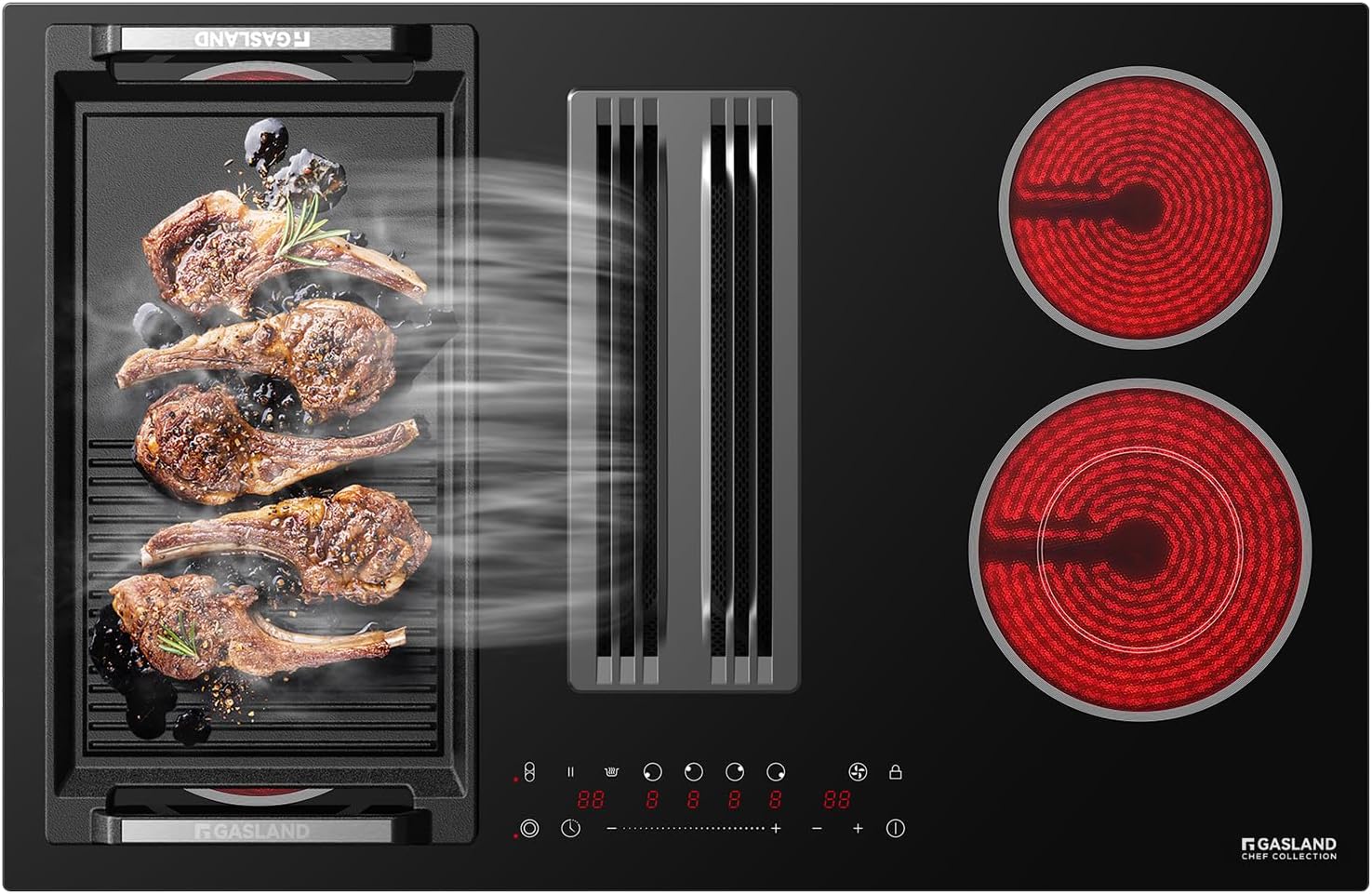
| Number of Heating Elements | 4 |
|---|---|
| Control Type | Touch |
| Voltage | 220 volts |
| Wattage | 7400 watts |
| Additional Features | Downdraft Exhaust, Sync Element, Warm Setting |
This GASLAND downdraft cooktop combines a glass ceramic surface with four radiant heating elements and a built-in downdraft exhaust so you can cook without an overhead hood. Typical use is island or open-plan cooking where the 3-speed downdraft (up to 330 CFM) pulls smoke and steam down and out, while the smooth cooktop surface wipes clean after spills. The bridge element and dual-ring burner add flexibility for griddles and odd-shaped cookware, and slide touch controls plus a 99-minute timer make adjustments straightforward. Safety features include child lock, hot-surface indicator, overheat protection, and auto shutoff. Practical maintenance is helped by removable dishwasher-safe grease filter, grate, and a removable drip pan. Expect the unit to require a 220V connection and some cabinet cutout planning for the downdraft ducting; the touch controls and glass surface can show fingerprints and need careful cleaning to avoid scratches. For buyers prioritizing a streamlined island installation and flexible cooking zones, this delivers strong functionality in a compact package.
Best for: Buyers who want a clean, island-friendly cooktop with built-in ventilation and flexible cooking zones while prioritizing practical performance and easy maintenance.
Less Ideal for: Those who need a simple plug-in or low-voltage retrofit solution or who prefer gas cooking and open overhead ventilation should look elsewhere.
- Integrated downdraft ventilation removes smoke and steam without an overhead hood
- Bridge element and dual-ring burner allow use of griddles and varied cookware sizes
- Smooth glass ceramic surface is easy to wipe clean
- Dishwasher-safe grease filter and removable drip pan simplify maintenance
- Multiple safety features including child lock, hot-surface indicator, and auto shutoff
- Requires 220V wiring and space planning for downdraft installation
- Glass ceramic surface is prone to fingerprints and can scratch if not cleaned carefully
Verdict: A practical high-end downdraft cooktop that frees you from a hood while giving flexible cooking zones and easy maintenance for island or open-plan kitchens.
Hobsir 30 Inch Downdraft Cooktop

| Number of Heating Elements | 4 |
|---|---|
| Wattage | 6000 watts |
| Additional Features | Downdraft Exhaust |
| Control Type | Digital Touch |
| Voltage | 220 volts |
This Hobsir 30-inch downdraft cooktop pairs a frameless glass ceramic surface with a built-in ductless downdraft extractor, letting you install a ventilated cooktop where an overhead hood is impractical. The cooktop offers four radiant elements (two 1200W and two 1800W) delivering up to 6000W total, nine power levels, a 99-minute timer, pause function and a child safety lock so it can handle everything from rapid boiling to gentle simmering. The downdraft motor is rated to move up to 496 m3/h and uses a removable dishwasher-safe grease filter for easier maintenance in ductless setups. Installation is drop-in style for a standard 30-inch cutout and the touch controls keep the surface smooth and easy to wipe clean. Expect the practical benefit of saving overhead space and a clean integrated look, but note this is a ductless extractor so it conditions and recirculates air rather than removing it outside, which can be less effective for heavy smoke or large quantities of cooking fumes. The unit runs on 220V and is best suited where external venting is not an option.
Best for: Buyers looking to free up overhead space and achieve a clean, integrated cooktop and ventilation solution in kitchens where running ductwork is impractical or not allowed.
Less Ideal for: Those who cook with very high smoke production or need maximum extraction performance should choose a cooktop tied to external ducting instead.
- Integrated downdraft extractor eliminates need for overhead hood
- Four ceramic radiant burners with mixed 1200W and 1800W elements for flexible heat
- Touch controls with 9 power levels, timer, pause and child lock for precise, safe use
- Dishwasher-safe removable filter simplifies cleaning for the ductless venting system
- Ductless recirculation is less effective than true external venting for heavy smoke
- Requires 220V electrical supply which may need professional wiring
Verdict: Choose this unit if you want a built-in 30-inch electric cooktop that combines cooktop power with a space-saving downdraft extractor for ductless installations.
Hobsir 36 Inch Downdraft Cooktop

| Number of Heating Elements | 4 |
|---|---|
| Additional Features | Downdraft Exhaust |
| Heating Element | Ceramic |
| Control Type | Digital Touch |
| Wattage | 7535 watts |
This Hobsir 36-inch cooktop combines a smooth glass-ceramic surface with a built-in ductless downdraft extractor, letting you install a cooktop without an external hood. It offers four cooking zones (including a dual-ring burner and a large rectangular BBQ zone that can act as a griddle) and variable power settings to handle everything from low simmer to high-heat searing. The touch controls provide nine power levels plus timer, pause, and a safety lock, while the removable washable filter makes the downdraft upkeep straightforward. The cooktop accepts all cookware types because it is radiant ceramic rather than induction, and the flat surface wipes clean easily after spills. Important limitations are the ductless design, which relies on the internal filter capacity and airflow (rated up to about 496 m3/h) rather than venting outdoors, and the need to plan for a 220V hardwired installation and the specified cutout dimensions for drop-in fitting. For buyers wanting a streamlined island install with flexible cooking zones and easy cleaning, this unit delivers a lot of capability in a compact package.
Best for: Buyers seeking a built-in cooktop that keeps kitchen sightlines clean and prefers a reliable, easy-to-maintain appliance with versatile cooking zones for everyday and high-heat cooking.
Less Ideal for: Homes that need full outdoor venting for heavy commercial-level smoke or kitchens that cannot provide a 220V hardwired connection should consider other vented solutions.
- Integrated downdraft extractor eliminates need for external venting
- Four versatile burners including a dual-ring and large BBQ/griddle zone
- Smooth glass-ceramic surface is easy to clean and works with any cookware
- Digital touch controls with 9 power levels, timer, pause, and safety lock
- Ductless downdraft depends on the internal filter and recirculation so it will not move air outdoors
- Requires 220V installation and a compatible cutout for drop-in mounting
Verdict: A powerful, all-in-one 36-inch electric cooktop with built-in downdraft and versatile burners for buyers who want a streamlined, reliable island installation.
Cooksir 30-Inch Electric Cooktop
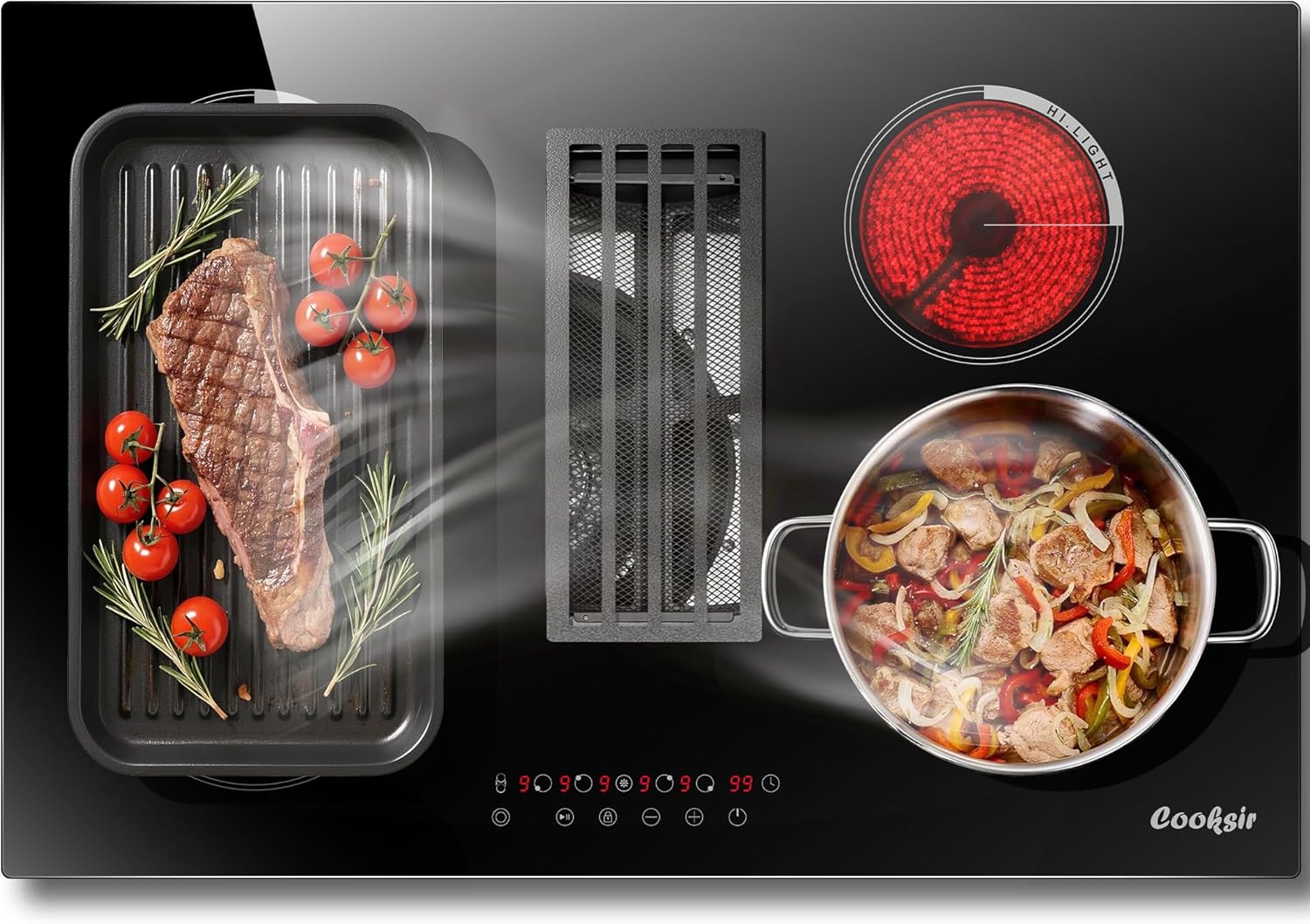
| Number of Heating Elements | 4 |
|---|---|
| Wattage | 7400 watts |
| Voltage | 220 volts |
| Heating Element | Radiant |
| Additional Features | Automatic Shut-Off, Downdraft Exhaust, Hot Surface Indicator, Safety Lock, Timer |
This Cooksir 30-inch electric cooktop combines a four-zone ceramic cooktop with a built-in ductless downdraft so you do not need a separate hood or ductwork. It delivers 7400W total cooking power with a dual-ring burner for flexible heat and a high-output bridge-style burner for large pans, while the 135W recirculating downdraft filters fumes and returns cleaned air to the room. Controls are touch-based and the unit includes practical safety features such as a child lock, timer, residual heat indicators and automatic shutoff. Installation is drop-in and the manufacturer provides flexible cut-out guidance to fit standard 30-inch openings, which simplifies replacing an existing cooktop. Expect the usual limitations of a ductless system: recirculation will reduce odors less effectively than a vented hood and the fan/filter will need periodic cleaning or filter replacement. For kitchens where running ductwork is difficult, this integrated unit offers a sleek, space-saving alternative with solid cooktop power.
Best for: Buyers who want a streamlined, built-in cooktop with strong heating zones and a self-contained ventilation solution for kitchens where adding ductwork is impractical.
Less Ideal for: Cooktops for homes that can run external ducting and need the highest possible odor and smoke removal should consider vented hood solutions instead.
- Integrated ductless downdraft eliminates need for external ductwork
- High total cooktop power with dual-ring and bridge burner for flexible cooking
- Touch controls with safety features including child lock, timer, and residual heat indicators
- Glass ceramic surface is compatible with all flat-bottomed pans and is easy to wipe clean
- Ductless recirculation typically removes grease and odors less effectively than a vented external exhaust
- Requires 220V hardwired installation which may need an electrician
Verdict: Choose this cooktop when you need a powerful 30-inch built-in stove with an integrated ductless downdraft to avoid installing external ductwork.
Choosing the Right High-End Downdraft Cooktop: Key Factors to Consider
Venting Performance
How well the downdraft system captures smoke and odors affects kitchen air quality and cooking comfort. Look for units that provide strong airflow close to the cooking surface and maintain suction across different burner locations.
Venting performance also ties to noise and duct routing. A powerful fan is effective only if noise remains acceptable for daily use and if the available duct path can support the airflow. Consider whether the cooktop offers variable fan speeds, boost modes, and whether it supports recirculation with good filtration when ducting is limited.
Burner Layout and Heat Control
The arrangement and responsiveness of burners determine how well you can manage multiple pots and pans simultaneously. High-end downdraft cooktops should offer a mix of high-BTU burners for searing and lower-output burners for simmering with precise modulation.
Also evaluate how controls are positioned relative to the downdraft intake so that heat and steam do not interfere with performance. Consistent ignition, predictable flame curves, or smooth induction power steps matter for technique-driven cooking and for quickly adapting between heat levels.
Surface Material and Cleaning
Surface finish influences both durability and daily upkeep. Materials like sealed stainless steel, durable enamel, or tempered glass each clean differently and resist staining to varying degrees.
Consider how accessible spill-prone areas are for wiping and whether burner grates or caps are easy to remove. Downdraft inlets should be designed for straightforward cleaning because grease can accumulate at the intake. Removable filters or easily accessible grease trays reduce long-term maintenance time.
Installation and Ducting Options
Install flexibility affects whether a chosen cooktop will work in your kitchen layout. Some downdraft systems require vertical or horizontal duct paths with minimum lengths and specific clearances. Others offer recirculation kits for installations where ducting is impractical.
Verify clearance needs for cabinetry and nearby walls, whether the unit supports direct-vented or converted recirculation modes, and what service access is required for the fan and motor. Installation costs and complexity are often driven by duct routing choices and the need for professional electrical or gas connections.
Noise Level and Fan Control
Noise affects how comfortable cooking feels, especially with an island cooktop facing living spaces. The perceived loudness of a downdraft system depends on fan design, speed settings, and whether the system uses external in-line or remote blowers to reduce sound near the cooktop.
Look for clear decibel figures at different speeds, multiple fan stages, and options for a night or quiet mode. A slightly lower airflow at a much lower noise level can be preferable if you frequently work in open-plan living areas.
Serviceability and Long-Term Reliability
High-end units should be serviceable without major disassembly. Accessible fan mounts, replaceable filters, and straightforward electrical or gas connections reduce downtime and long-term ownership cost.
Check whether common wear parts like blower motors and filter elements are user-replaceable and whether the design allows for routine maintenance tasks. Durable components and clear access points help ensure the cooktop continues performing well for years.
Downdraft Vs. Overhead Venting: When Downdraft Makes Sense
Downdraft cooktops are most useful when an overhead hood is impractical due to ceiling height, island placement, or aesthetic constraints. They provide a low-profile ventilation solution that integrates with the cooktop surface and keeps sight lines clear.
Consider a downdraft if you need a clean island aesthetic, have limited vertical clearance, or want to avoid a hood that dominates the room. Keep in mind that downdraft systems pull air horizontally or downward, so optimal performance requires thoughtful placement of pots and pans relative to the intake.
- Best for islands and low ceilings
- Keeps sight lines open
- Requires attention to pot placement for ideal capture
Ducting Choices: Ducted, In-Line, and Recirculating Options
Ducted installations generally provide the best extraction because they move air outside the home. If you can route a straight, appropriately sized duct, you will typically get stronger airflow and lower noise at the cooktop.
When external ducting is not feasible, in-line blowers or recirculating kits with high-quality filters are alternatives. In-line blowers move the fan away from the cooktop to reduce noise, while recirculating setups clean air through charcoal and grease filters and return it to the room.
- Ducted: best airflow and odor removal
- In-line blower: quieter at the cooktop
- Recirculating: flexible but requires filter maintenance
Matching Burner Types to Cooking Styles
Think about how you cook. If you sear and stir-fry frequently, prioritize higher-output burners and durable grates that withstand heavy pans. For slow-simmering or delicate tasks, small, low-output burners with precise control are important.
Some high-end units balance several burner sizes and may include dual-ring burners or bridge elements that allow larger cookware to be evenly heated. Ensure the layout supports the typical number and size of pans you use simultaneously.
- High-BTU burners for searing
- Low-BTU burners for simmering
- Bridge or dual elements for large cookware
Maintenance Tips to Keep the Downdraft Working Well
Regular maintenance preserves suction and extends component life. Wipe surfaces after cooking to prevent grease buildup and clean or replace filters on the schedule recommended by the manufacturer. Grease collection trays should be checked and emptied regularly.
Inspect duct runs for obstructions and confirm fan mounts stay secure. If your unit has an in-line blower, ensure access panels are unobstructed for occasional cleaning and service. Keeping fan blades and filters clean has a direct impact on both airflow and noise.
- Wipe spills promptly
- Clean or replace filters regularly
- Inspect ducting and fan access annually
Design and Integration Considerations
A high-end downdraft cooktop should integrate with your countertop and cabinetry both visually and functionally. Consider trim options, control placement, and whether the unit will sit flush or require a reveal. The visual finish should match adjacent appliances for a cohesive look.
Think through countertop cutout dimensions, access for electrical or gas hookups, and how the cooktop height will interact with nearby backsplashes or seating. Small differences in placement can affect comfort and ventilation efficiency.
- Confirm countertop cutout and trim details
- Consider control placement for comfort
- Coordinate finishes with adjacent surfaces
How We Chose the Best High-End Downdraft Cooktop
We focused on premium downdraft cooktops that prioritize both extraction performance and high-quality cooking surfaces. Our selection process emphasized vent capacity under realistic island and low-hood conditions, burner output and modulation for everyday and high-heat cooking, and durable surface materials that stand up to heavy use. We applied a few practical filters. We excluded units without integrated downdraft systems or those that relied solely on external hood assistance. We also excluded models with limited serviceability or unclear vent routing options. The final short list favors units with measurable airflow rates at reasonable noise levels, reliable ignition and simmer performance, and accessible service panels for maintenance. Key evaluation criteria included venting effectiveness in confined installations, burner layout and heat control, surface material and ease of cleaning, installation flexibility and ducting options, and overall build durability. These criteria reflect the real tradeoffs buyers face when adding a high-end downdraft cooktop to an island or compact kitchen.
Our full evaluation process is outlined in our review methodology.
FAQ
Do downdraft cooktops vent as well as a traditional hood?
Downdraft systems can be very effective in many layouts but typically require careful placement and sufficient ducting to match the best overhead hoods. In constrained installations they may perform similarly if ducting and fan capacity are optimized, but overhead hoods usually have an advantage in raw capture efficiency for very tall smoke plumes.
Can I install a downdraft cooktop on an island?
Yes. Downdraft cooktops are commonly chosen for islands because they remove the need for an overhead hood. Ensure you can route ducting or use an in-line blower or recirculation kit as required by the installation and that there is service access below the countertop.
How noisy are downdraft ventilation systems?
Noise varies by fan design, speed setting, and whether the blower is mounted remotely. In-line or remote blowers reduce sound at the cooktop, while built-in fans can be louder at high speeds. Look for published decibel figures and multi-speed options to find a balance that suits your living space.
What maintenance do downdraft cooktops need?
Routine cleaning of the surface and downdraft inlet is important to prevent grease buildup. Replace or clean filters per the manufacturer's schedule and inspect ducting periodically. Accessible grease trays and removable filters make maintenance quicker and help preserve airflow.
Is recirculation a good option if I cannot duct outside?
Recirculation can be a practical compromise when outside ducting is impossible. Quality charcoal and grease filters are essential for odor control, but recirculation will not remove heat or moisture from the home as effectively as external venting.
Final Verdict
When choosing a high-end downdraft cooktop, prioritize venting effectiveness and burner control because those two factors most directly affect cooking comfort and kitchen air quality. Balance airflow needs against acceptable noise levels and the practicalities of duct routing in your space. Also weigh maintenance ease and installation flexibility. If you can accommodate proper ducting or an in-line blower, you will generally get better long-term performance. Focus on the combination of vent power, durable surface materials, and a burner layout that matches how you cook to make a confident selection.