
Note: This article contains affiliate links. If you click on these links and make a purchase, we may earn a small commission at no extra cost to you. This helps support our research and content. Read our full affiliate disclosure here.
If you cook rice frequently and want nearly foolproof results, a high-end Japanese rice cooker can transform your routine. These models are designed to take the guesswork out of timing and temperature so you get consistent texture whether you are making sushi rice, short-grain, or mixed-grain blends. This guide covers seven shortlisted, top-rated Japanese rice cookers that excel in control, consistency, and durability. We evaluated them across practical criteria such as rice texture consistency, advanced cooking programs, build quality, and ease of care. Read on to understand which features matter most and which cooker fits your kitchen and cooking style.
Top Picks at a Glance
| Best Overall The best all-around choice for most situations | Iwachu Gohan Nabe 410-720 |  |
| Best Quality Built to a higher standard if you want something more solid | Vermicular Musui–Kamado |  |
| Best Value The sweet spot between price and what you get | Tiger JBV-A10U Rice Cooker |  |
| Best Budget The cheapest option that still gets the job done reliably | Toshiba Mini Rice Cooker TRCS02 | 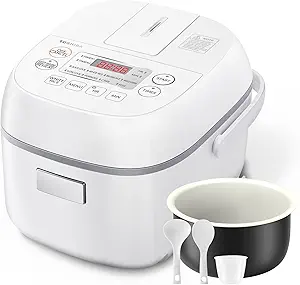 |
| Top Rated A top-rated pick with lots of positive feedback | Zojirushi NP-HCC10XH Rice Cooker |  |
| Most Popular A crowd favorite that many people choose with confidence | Zojirushi Neuro Fuzzy NS-ZCC10 |  |
| Best Seller A high-volume bestseller chosen again and again | Tiger JNP-1800 10-Cup Rice Cooker |  |
Iwachu Gohan Nabe 410-720

| Material | Cast Iron |
|---|---|
| Capacity | 1.5 cups |
| Wattage | 500 watts |
| Voltage | 120 volts |
The Iwachu Gohan Nabe is a small, handcrafted cast iron pot made for cooking traditional Japanese rice and mixed rice dishes. Used on a stovetop, its heavy iron construction and tight-fitting lid retain heat and steam for even cooking, while the lid's textured underside helps redistribute condensation back onto the rice to produce glossy, separate grains. It is best suited for making takikomi gohan or everyday rice for one to two people, and the built-in rim channel helps contain boil-overs. Because it is cast iron, it offers excellent heat retention and durability but requires hand washing and some care to avoid rust. At 1.5 cups capacity and 500 watts-equivalent performance on standard 120 V setups, it is compact and intentionally simple—there are no electronic controls or nonstick coatings, so cooking relies on stove skill rather than presets. For buyers who value authentic materials and a long-lived, traditional rice pot, this delivers a tactile, high-quality cooking experience; casual users expecting convenience features may find it less forgiving.
Best for: Buyers who prioritize authentic, high-quality materials and traditional stovetop rice cooking for small households and enjoy hands-on control over the process.
Less Ideal for: People who want automated, large-capacity rice cookers or low-maintenance, dishwasher-safe cookware should consider other options.
- Cast iron construction provides excellent heat retention and long-term durability
- Tight-fitting heavy lid with textured underside returns condensation for evenly cooked, glossy rice
- Built-in rim channel helps prevent spills during boil-over
- Handcrafted in Japan for authentic traditional design and finish
- Requires hand washing and maintenance to prevent rust
- Small 1.5-cup capacity limits servings to about two people
- No electronic controls or automated cooking features
Verdict: Choose this pot if you want an authentic, handcrafted cast iron rice cooker that produces traditional, restaurant-style rice for one to two people.
Vermicular Musui–Kamado

| Capacity | 3.9 quarts |
|---|---|
| Power Source | Corded Electric |
| Material | Cast Iron |
| Voltage | 120 volts |
The Vermicular Musui–Kamado pairs a finely machined enameled cast iron pot with a three-dimensional induction base to deliver very precise, even heat and waterless cooking that concentrates flavors. You use it like an all-in-one countertop multicooker: set the Kamado's temperature and let the airtight Musui lid lock in steam for rice, braises, steam-roasts, sous-vide style cooks, or searing on the stovetop before finishing in the pot. Notable features include the sub‑0.01 mm precision lid seal that preserves moisture, sidewall plus base induction heaters for uniform heat distribution, and a dedicated rice mode; the set also includes a cookbook and measuring cups. Practical benefits are restaurant-level texture and clarified flavors from low-water techniques, consistent results across different recipes, and the ability to replace several single-purpose appliances. The main limitations are the need for hand washing and careful handling of heavy cast iron, and the unit's specialist focus means it is overkill for users who only want a basic, low-cost rice cooker.
Best for: Serious home cooks seeking precision and flavor who want a single high-end appliance that delivers restaurant-style rice and waterless techniques across multiple cooking methods.
Less Ideal for: Casual cooks who prioritize low cost, minimal upkeep, or a lightweight, simple plug-and-play rice cooker.
- Exceptional precision temperature control with three-dimensional induction heating for even results
- Tight machined lid seal enables waterless cooking and concentrates natural flavors
- Versatile multicooker functions replacing rice cookers, slow cookers, sous‑vide, and more
- Comes as a complete set with enameled cast iron pot, induction base, cookbook, and measuring cups
- Requires hand washing and careful drying to maintain enameled cast iron
- Heavy cast iron pot can be cumbersome to move and handle
Verdict: Buy this if you want a premium, precision-focused Japanese multicooker that elevates rice and waterless cooking to professional-level results.
Tiger JBV-A10U Rice Cooker

| Capacity | 5.5 cups |
|---|---|
| Wattage | 672 watts |
| Power Source | Corded Electric |
| Keep-Warm | Up to 12 hours |
The Tiger JBV-A10U is a micom-controlled rice cooker designed for everyday households that want precise, hands-off rice and simple one-pot meals. You load rice into the nonstick inner pot, add water per the included measuring cup, place the BPA-free tacook tray with vegetables or protein on top, choose one of four automated settings (plain, brown, slow cook, steam), and the cooker monitors temperature to finish both components together. The 1.0 mm aluminum inner pot with a fluorine coating resists scratching and the 12-hour keep-warm holds cooked rice ready for later meals. Practical extras include a spatula, measuring cup, recipe book, and a cooking plate for steaming. Expect reliable, consistent rice and the convenience of synchronized steaming, but note the unit is a countertop appliance that requires hand washing for some parts and uses corded electric power. Its footprint and 5.5-cup capacity suit families but will be limiting for very large gatherings.
Best for: Buyers who prioritize dependable, hands-off rice cooking and like the convenience of steaming a simple main or vegetable alongside rice to save time and clean-up.
Less Ideal for: Large households or those who regularly cook rice for big gatherings should consider a higher-capacity model or a commercial-style cooker.
- Tacook synchronized cooking tray lets you steam a second dish while rice cooks
- Micom temperature control for consistent results across rice types
- 12-hour automatic keep-warm keeps rice ready without overcooking
- Scratch-resistant fluorine-coated inner pot for easier cleaning and durability
- Includes useful accessories: spatula, measuring cup, recipe book
- Hand wash recommended for some components rather than dishwasher safe
- 5.5-cup dried rice capacity may be small for very large households or parties
Verdict: Choose the Tiger JBV-A10U if you want a reliable, micom-controlled Japanese rice cooker that also steams a second dish for efficient, everyday meal prep.
Toshiba Mini Rice Cooker TRCS02
| Capacity | 3 cups |
|---|---|
| Wattage | 460 watts |
| Power Source | Corded Electric |
| Voltage | 110 volts |
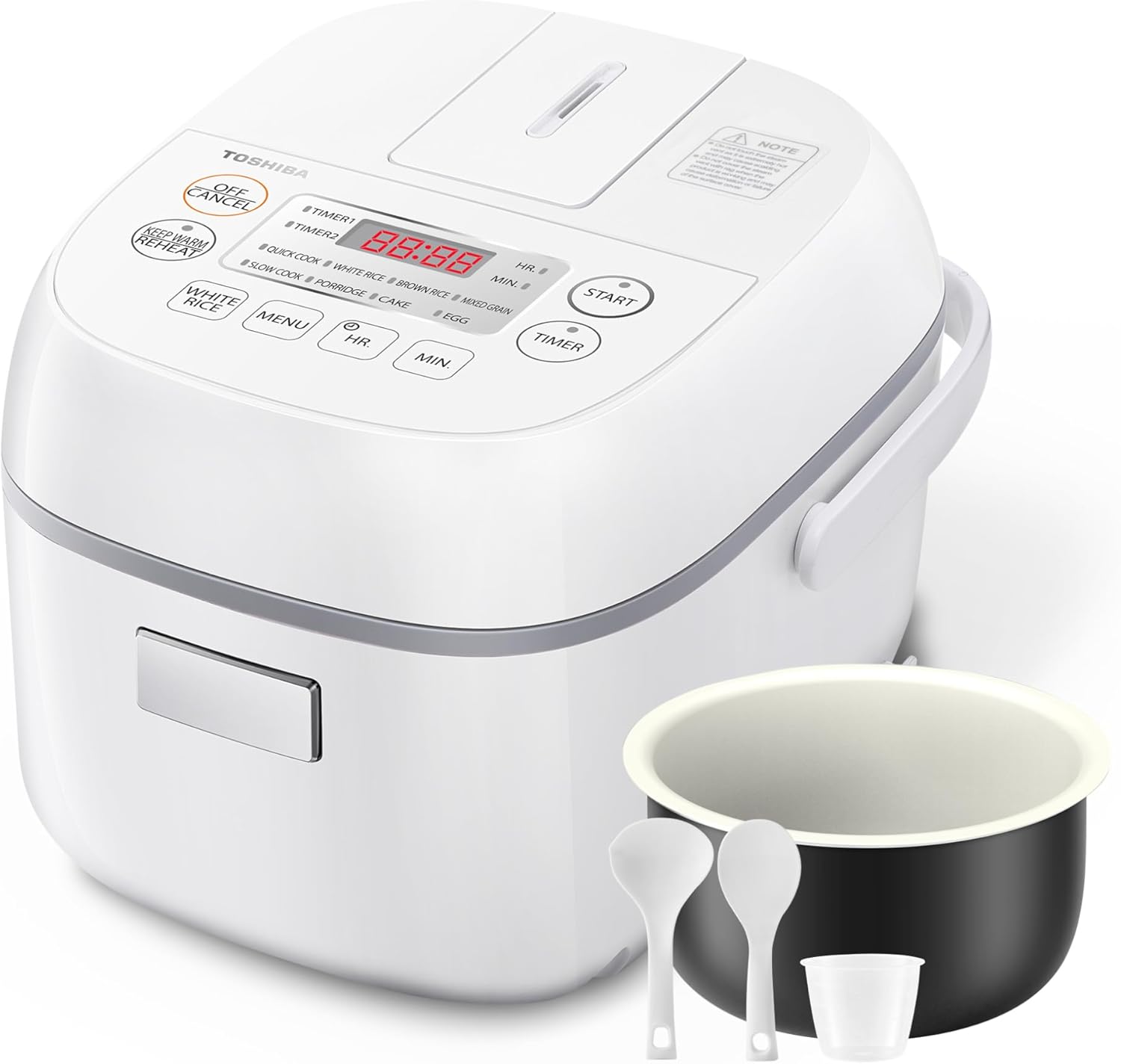
The Toshiba Mini Rice Cooker is a compact, budget-friendly cooker that uses 3D fuzzy logic to adjust time and temperature across eight preset programs for rice, grains, steaming, slow cooking, porridge, and more. It is typically used by one to three people who want consistent rice without babysitting the pot: add rice and water, pick a program or set the 24-hour delay, and the unit handles cooking and switches to keep-warm automatically. Notable features include one-touch operation, a removable nonstick inner pot, detachable steam vent and power cord for easier cleaning and safety, plus included measuring cup and spatula. Practical benefits are reliable fluffy rice for varied grain types, flexible scheduling with the delay timer, and multi-function cooking in a small footprint. Important limitations are the small 3-cup uncooked capacity that limits batch size, hand-wash recommended care for the inner pot, and relatively basic controls compared with high-end Japanese models that offer more advanced cooking profiles and premium finishes.
Best for: Buyers prioritizing a low-cost, space-saving cooker that still delivers reliably cooked rice and a handful of multi-function presets for everyday use.
Less Ideal for: Those seeking a premium, high-capacity Japanese rice cooker with advanced multi-stage cooking profiles, stainless-steel inner pots, or professional-grade controls should look at higher-end models.
- 3D fuzzy logic and eight preset programs for consistent results across rice types
- Compact footprint suited to small kitchens or singles
- Delay timer and auto keep-warm for flexible meal timing
- Removable steam vent and detachable cord improve cleaning and safety
- 3-cup uncooked capacity limits servings for larger families
- Inner pot is not dishwasher-safe and requires hand washing
Verdict: If you want an affordable, compact cooker that uses fuzzy logic and presets to produce reliable rice without a big countertop investment, this Toshiba Mini is a smart pick.
Zojirushi NP-HCC10XH Rice Cooker

| Capacity | 5.5 cups |
|---|---|
| Wattage | 1.2 KW |
| Power Source | Corded Electric |
| Voltage | 120 volts |
The Zojirushi NP-HCC10XH is a high-end 5.5-cup induction heating rice cooker designed to deliver consistent, restaurant-quality rice at home. It uses IH (induction heating) with a triple heater arrangement to circulate heat from the bottom, sides, and lid, which helps produce even cooking across white, brown, sushi, porridge, and quick-cook settings as well as specialty brown rice modes. The clear-coated stainless exterior and black spherical nonstick inner pan make cleanup straightforward while the orange LCD and timer let you set delayed or extended keep-warm periods for convenient meal timing. Practical benefits include reliable, repeatable results for different rice types, healthy cooking options for brown and GABA rice, and an automatic keep-warm that maintains serving temperature. Limitations are the modest 5.5-cup capacity that may be small for larger families and the unit's weight and footprint, which require a stable counter spot and occasional hand-washing of the inner pan and accessories.
Best for: Buyers who prioritize consistent, repeatable rice results and a reliable, durable cooker for everyday use will appreciate this model.
Less Ideal for: If you need large batch capacity or an ultralight, countertop-minimal appliance, this compact 5.5-cup heavy unit is not the best choice.
- Induction heating with triple heater for even, consistent cooking.
- Multiple menu settings covering white, brown, sushi, porridge, and quick rice.
- Automatic and extended keep-warm functions preserve serving temperature.
- Durable stainless steel exterior with a coated nonstick inner pan for easier cleaning.
- Includes measuring cup, spatula, and spatula holder so you have necessary accessories.
- 5.5-cup cooked capacity may be insufficient for large households.
- Requires hand washing for care and is relatively heavy compared with basic models.
Verdict: Choose the NP-HCC10XH if you want a dependable, high-end induction rice cooker that delivers consistent results across a wide range of rice types.
Zojirushi Neuro Fuzzy NS-ZCC10
| Capacity | 5.5 cups |
|---|---|
| Wattage | 680 watts |
| Power Source | Corded Electric |
| Voltage | 110 volts |
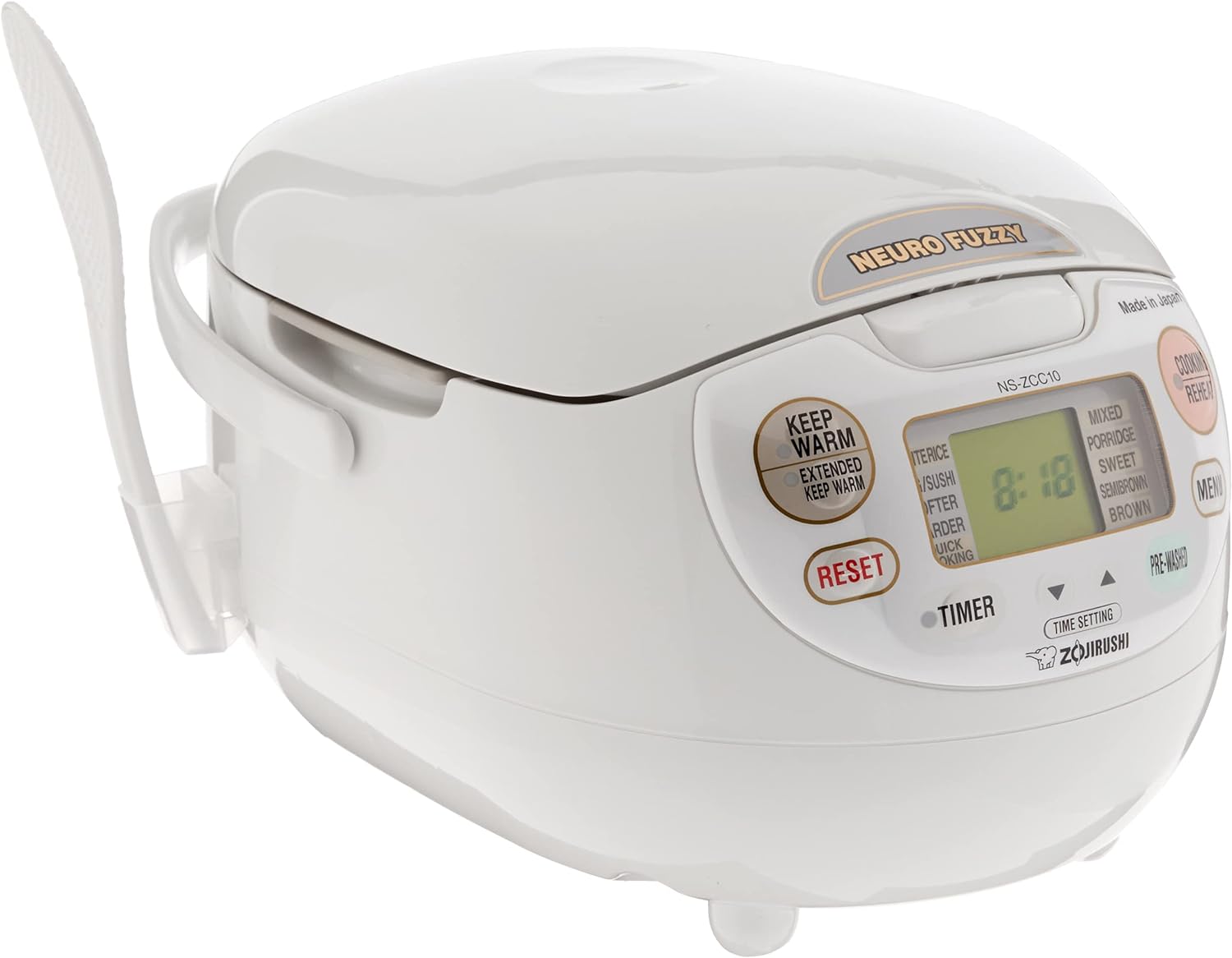
The Zojirushi NS-ZCC10 is a compact Neuro Fuzzy rice cooker and warmer that automates rice preparation with multiple cooking menus and a programmable timer. Designed for everyday use, it handles white, sushi, mixed, porridge, semi-brown and brown rice plus rinse-free and quick cook modes, and its spherical nonstick inner pan promotes even heating. Controls are easy to read on the LCD and the unit includes practical extras like two measuring cups, a rice spatula with holder, a retractable power cord and automatic keep-warm, extended keep-warm and reheat cycles. The delay timer and audible finish indicator make it convenient for planning meals, and the detachable inner lid simplifies cleaning. At 680 watts the cooker heats quickly for its size, but the 5.5-cup uncooked capacity keeps it best suited to small households or couples rather than large families. The appliance is solidly built and focuses on consistent, repeatable rice cooking rather than gimmicks, making it a reliable choice if you want precise results from a compact Japanese-style cooker.
Best for: Buyers who prioritize consistent, restaurant-quality rice and value proven engineering and broad user endorsement will appreciate this compact, reliable Japanese rice cooker.
Less Ideal for: Those who regularly cook large batches or need a family-size cooker should consider models with higher uncooked capacity.
- Advanced Neuro Fuzzy logic for fine temperature and timing adjustments
- Multiple preset menus covering white, brown, porridge, quick and rinse-free rice
- Spherical nonstick inner pan for even heating and consistent texture
- Useful extras included: measuring cups, nonstick spatula, spatula holder and retractable cord
- Programmable delay timer and automatic keep-warm/extended keep-warm/reheat cycles
- 5.5-cup uncooked capacity may be small for larger households
Verdict: Choose the NS-ZCC10 when you want a compact, veteran Japanese rice cooker that reliably delivers consistent results using Neuro Fuzzy cooking logic.
Tiger JNP-1800 10-Cup Rice Cooker
| Capacity | 2.4 liters |
|---|---|
| Wattage | 305 watts |
| Power Source | Corded Electric |
| Voltage | 120 volts |
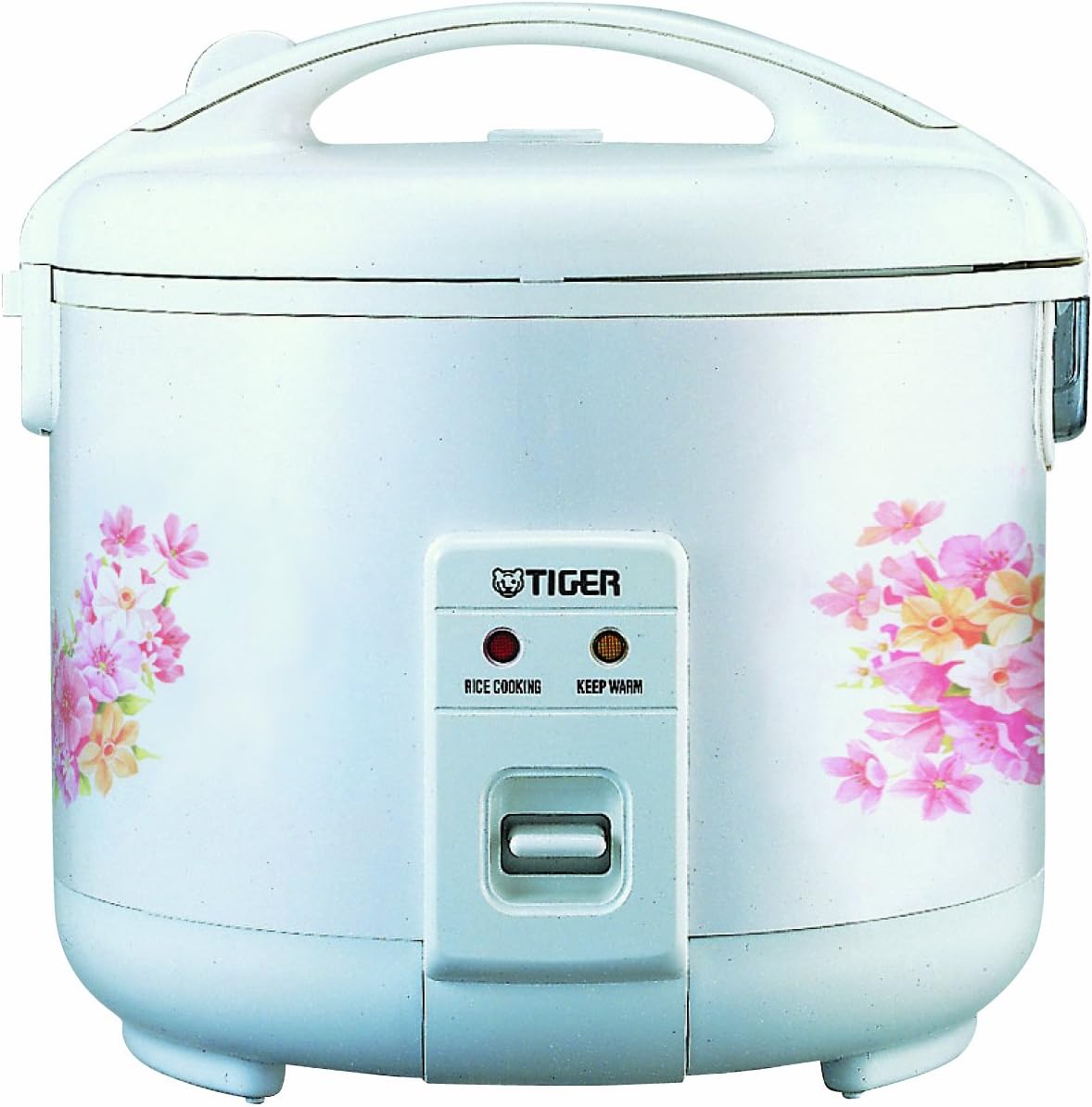
The Tiger JNP-1800 is a straightforward 10-cup rice cooker and warmer designed for reliable everyday use. You fill the inner nonstick pot using the included measuring cup, press the single control, and the unit cooks rice then automatically switches to a keep-warm mode that can hold rice for up to 12 hours. Practical touches include a removable, washable steam vent, a spatula and measuring cup, and a retractable power cord for neater storage. At 305 watts it uses modest power and the stainless-steel lid and plastic body are easy to wipe clean, though the inner pan is hand-wash recommended to preserve the nonstick coating. This model focuses on simplicity rather than advanced fuzzy-logic cooking programs, so it does not offer multiple cooking modes or programmable settings; users who want precise texture tuning or specialized functions will need a higher-end model. For buyers who value dependable, no-fuss rice cooking and a trusted Japanese brand, this delivers consistent results and easy maintenance.
Best for: Buyers who prioritize a dependable, low-risk appliance that consistently cooks rice with minimal setup and fuss for everyday family use.
Less Ideal for: Users who want precise texture control, multiple cooking programs, or high-end fuzzy-logic features should consider more advanced models instead.
- Automatic keep-warm that engages after cooking and holds rice up to 12 hours
- Nonstick inner pan that simplifies serving and cleanup
- Includes measuring cup and spatula so you can start cooking right away
- Removable, washable steam vent and retractable power cord for easier maintenance and storage
- Single one-touch control with no advanced cooking modes or fuzzy-logic adjustments
- Inner pan requires hand washing to protect the nonstick surface
Verdict: Choose this Tiger if you want a reliable, easy-to-use Japanese 10-cup rice cooker that consistently delivers cooked rice with minimal effort.
Choosing the Right High-End Japanese Rice Cooker: Key Factors to Consider
Heating Method
The heating method determines how evenly and quickly a rice cooker can bring rice to the right temperature. Induction heating systems tend to offer finer, faster temperature control than basic hot-plate elements, which helps create uniformly cooked rice and better browning for certain recipes.
For home cooks, the heating method affects not only final texture but also consistency across different grain types and batch sizes. If you plan to cook both short-grain and long-grain rice or use the cooker for porridge and slow-simmered dishes, prioritize models with more advanced heating control.
Cooking Algorithms and Sensors
High-end rice cookers use advanced algorithms and multiple sensors to adjust heat and timing as rice absorbs water. These systems detect temperature and sometimes humidity to change power output during key phases like initial boil and steaming, which reduces undercooked centers and soggy exteriors.
Understanding algorithm sophistication matters because it determines how hands-off you can be. Better control systems will adapt to minor differences in water, ambient temperature, or rice age, producing reliable results without repeated tweaks.
Program Variety and Customization
Look for a range of programs that match how you cook. Essential modes include white rice, brown rice, sushi, porridge, and mixed-grain settings. More advanced units offer adjustable firmness settings, quick-cook options, and custom memory presets so you can dial in preferred textures.
Program variety matters when you use rice cookers for multiple roles beyond plain rice, such as steaming vegetables or making slow-cooked dishes. Customization lets you fine-tune outcomes for different recipes and repeat those results consistently.
Inner Pot Construction
The inner pot material and thickness influence heat distribution and durability. Thick, heavy pots retain heat better and promote even cooking, while nonstick coatings simplify cleanup but vary in longevity and scratch resistance.
Consider whether the inner pot is replaceable and the quality of the coating. A sturdy, well-finished pot reduces hotspots and minimizes sticking, which matters for both daily convenience and the long-term cost of ownership.
Capacity and Batch Flexibility
Capacity affects how much rice you can prepare in a single cycle and how efficiently the cooker uses energy. Choose a size that matches your typical batch so you do not overcook tiny amounts or struggle to fully cook very large pots.
Batch flexibility is important if you alternate between single-person meals and family-sized dishes. Some high-end models maintain consistency across a wide range of fill levels, which is beneficial if you expect variable meal sizes.
Maintenance and Cleaning
Ease of cleaning determines how often you will use the cooker and how much effort is required after each meal. Removable lids, dishwasher-safe inner pots, and simple vent assemblies make routine cleaning faster and reduce odor buildup.
Maintenance also includes descaling or checking gasket condition on models with sealed lids. A design that simplifies cleaning encourages regular use and preserves flavor by preventing residue buildup over time.
Why Japanese Rice Cookers Are Different
Japanese rice cookers emphasize precise temperature management and repeatability. Many models use specific heating methods and algorithms refined for regional rice varieties, which leads to better texture control and consistent results.
Beyond rice, these cookers often include programs tailored to local dishes such as sushi rice, porridge, and mixed-grain blends. The design focus is reliability and nuanced control rather than simply high power or large capacity.
- Focus on texture and repeatability
- Specialty cooking programs for rice varieties
- Advanced heat control options
How Capacity Affects Daily Use
Choosing the right capacity ensures efficient energy use and good results. Small pots heat faster and are ideal for one or two people, while larger pots let you cook for a family but may require longer heating cycles to achieve uniform doneness.
- Match capacity to your typical meal size
- Consider future needs if you frequently host
- Smaller batches dry out faster; adjust water ratios accordingly
Maintenance Tips to Keep Performance Consistent
Regular cleaning of the inner pot, steam vent, and detachable lid parts prevents flavor transfer and preserves heating efficiency. Follow recommended care instructions for nonstick coatings to avoid scratching and premature wear.
Periodically inspect seals and valves for residue or mineral buildup. Simple maintenance extends the life of a high-end unit and keeps cooking algorithms working as intended.
- Wash inner pot after each use
- Clean steam vent and gasket weekly
- Avoid abrasive scrubbers on coated surfaces
Using Advanced Modes Effectively
Advanced cookers include modes like 'sushi,' 'mixed grain,' and 'porridge' that tweak timing and temperature phases. Learn when to use these preset modes versus manual adjustments to achieve the texture you want.
If a model offers firmness settings or custom memory, experiment with small batches and document your preferred water ratios and settings. That practice helps you replicate results reliably for different rice types.
- Start with manufacturer water ratios, then adjust
- Use test batches to set custom preferences
- Keep notes on settings for each grain type
Energy Use and Kitchen Footprint
High-end models with induction heating may use more power during peak cooking but can be more efficient overall due to shorter or more precise cycles. Consider where the cooker will sit on your countertop and whether venting or steam output is compatible with your kitchen layout.
Smaller units are easier to store and move, while larger models are heavier and better kept in a fixed spot. Plan for daily handling and storage when choosing a size and design.
- Check power draw against your kitchen circuits
- Account for steam output in placement
- Consider counter space and storage needs
How We Chose the Best High-End Japanese Rice Cooker
We focused on attributes that matter for high-end rice cookers designed to deliver restaurant-level rice at home. Key evaluation dimensions included rice texture consistency, which measures how well a cooker produces uniform results across grain types and batch sizes; cooking algorithm sophistication, referring to temperature control, fuzzy logic, or induction heating that affects doneness and mouthfeel; available cooking programs and versatility for white rice, brown rice, porridge, and specialty settings; build quality and materials that influence heat retention and long-term reliability; and ease of cleaning and maintenance, including inner pot coatings and detachable components. Products were selected from models that offer advanced temperature control or induction-style heating and robust program sets. We excluded basic, entry-level cookers and units lacking precise temperature control or essential safety features. The final list favors machines that balance repeatable results with user-friendly operation and durable construction.
Our full evaluation process is outlined in our review methodology.
FAQ
Can a high-end Japanese rice cooker handle different rice types?
Yes. These cookers typically include settings for short-grain, long-grain, and brown rice. Advanced temperature control and specialized programs help adapt to different absorption rates and textures.
How often should I clean the inner pot and steam vent?
You should wash the inner pot after every use and wipe the steam vent and detachable lid components weekly. Regular cleaning prevents residue buildup and maintains consistent cooking performance.
Do advanced cookers require special water ratios?
They usually provide recommended water ratios for each mode, but slight adjustments are common depending on rice age and desired firmness. Test small batches to dial in the ideal ratio for your preferences.
Are induction-style rice cookers worth it?
Induction heating often delivers more precise temperature control and better consistency, especially for large or mixed batches. Whether it is worth it depends on how much you value nuanced texture and repeatability.
Can I use a high-end rice cooker for steaming or slow cooking?
Many high-end models include steam or slow-cook programs. They can handle simple steaming tasks and some braised dishes, but performance varies by unit and available program options.
Final Verdict
When choosing a high-end Japanese rice cooker, prioritize consistent rice texture and the sophistication of the cooking algorithm. Heating method, inner pot construction, and program versatility are the biggest drivers of repeatable results. Balance capacity and maintenance needs against how you cook daily. If you value precision and cook rice frequently in different styles, invest in a model with advanced temperature control and a robust set of programs to achieve reliably excellent rice.