
Note: This article contains affiliate links. If you click on these links and make a purchase, we may earn a small commission at no extra cost to you. This helps support our research and content. Read our full affiliate disclosure here.
If you need freezer capacity without sacrificing style or countertop space, a high-end small freezer can deliver dependable cold storage in a compact footprint. You want consistent temperatures for long-term food preservation, intuitive controls, and efficient operation so the unit fits easily into a kitchen, apartment, or secondary storage area. This guide highlights seven shortlisted high-end small freezers that meet those priorities and explains the features that matter most for everyday use. Below we cover performance, energy use, temperature control, and build quality to help you pick the right compact freezer for your space.
Top Picks at a Glance
| Best Overall The best all-around choice for most situations | BODACIOUS 5.0 Cu Ft Chest Freezer |  |
| Best Quality Built to a higher standard if you want something more solid | Summit SCFF1842KS Built-In Freezer |  |
| Best Value The sweet spot between price and what you get | Kismile Chest Freezer BD-80 |  |
| Best Budget The cheapest option that still gets the job done reliably | 5 SUNDAY LIVING 3.5 Cu.ft Chest Freezer |  |
| Top Rated A top-rated pick with lots of positive feedback | PLENTORA Chest Freezer B80 |  |
| Most Popular A crowd favorite that many people choose with confidence | Whynter CUF-112SS Mini Freezer |  |
| Best Seller A high-volume bestseller chosen again and again | Frostorm Mini Fridge BC-90 3.2 Cu Ft |  |
BODACIOUS 5.0 Cu Ft Chest Freezer

| Capacity | 5 cubic feet |
|---|---|
| Wattage | 58 watts |
| Voltage | 110 volts |
| Door Orientation | Top |
| Specification Met | ETL |
This BODACIOUS 5.0 cu ft chest freezer is a small, energy-efficient unit meant to add freezer capacity without a lot of fuss. It operates at under 40 dB, so it is quiet enough for apartments or offices, and the manufacturer lists an annual consumption that works out to very low daily electricity use. Typical use is simple: top-opening chest access with a single removable shelf or basket for organizing bulk items, a fast-freeze mode to protect fresh items, and a built-in drain for easier defrosting. The compact footprint fits tight spaces while still offering meaningful storage for families, meal preppers, or small shops. Notable conveniences include a hidden handle for a cleaner look and ETL specification compliance. Trade-offs are the chest style itself, which requires bending to access contents and can be less space-efficient for frequent, quick-access needs, and a single shelf limits internal organization compared with upright models. Overall this is a practical, quiet small freezer if you want extra frozen storage without high running costs.
Best for: Buyers who want a quiet, energy-conscious supplemental freezer for a small household, apartment, or business that needs reliable bulk storage rather than frequent door access.
Less Ideal for: People who need instant upright-style access, extensive internal organization, or who frequently retrieve single items throughout the day.
- Very low noise operation under 40 dB suitable for living spaces
- Low power consumption with modest daily/annual energy use
- Compact footprint that fits small kitchens, garages, or offices
- Fast-freeze function for preserving freshness and a built-in drain for easier defrosting
- Top-open chest design requires bending and is less convenient for frequent access
- Limited internal shelving and organization options
Verdict: Choose this compact chest freezer if you want quiet, energy-efficient extra frozen storage in a small footprint.
Summit SCFF1842KS Built-In Freezer

| Capacity | 2.7 cubic feet |
|---|---|
| Wattage | 346 kwh |
| Door Orientation | Reversible |
| Voltage | 115 volts |
| Number Of Shelves | 4 |
The Summit SCFF1842KS is a compact built-in undercounter freezer aimed at buyers who need reliable cold storage in tight kitchens. It delivers frost-free operation for low-maintenance use and a digital thermostat for straightforward temperature control. The 2.7 cubic foot interior is organized with four adjustable chrome shelves, so you can stack frozen goods or pull shelves to fit taller items, and the front-breathing design lets it install flush under counters. The black stainless steel wrapped door is fingerprint resistant and gives the unit a refined look while the sealed back and level legs simplify cleaning and installation. Energy usage is listed at 346 kWh/year and the unit uses R600a refrigerant for efficient cooling. Trade-offs are its small capacity compared with full-size freezers and the built-in orientation means buyers must plan for proper ventilation and integration; it also weighs around 90 pounds, so moving and installation require effort. For a high-end small freezer that balances appearance, frost-free convenience, and built-in fitment, this model is a strong choice.
Best for: Buyers who need a premium-looking, low-maintenance undercounter freezer for a small kitchen or secondary location and prioritize reliable frost-free performance and precise temperature control.
Less Ideal for: Those who need bulk frozen storage, frequent large-item freezing, or a portable/free-standing solution for variable locations.
- Frost-free operation reduces manual defrosting and maintenance
- Digital thermostat offers precise temperature control
- Adjustable chrome shelves allow flexible interior organization
- Black stainless steel door with fingerprint resistance gives a high-end appearance
- Limited 2.7 cu. ft. capacity may not suit users needing large frozen storage
- Built-in installation requires planning for ventilation and professional fitting
Verdict: A compact, high-end undercounter freezer that delivers frost-free convenience and precise temperature control for space-conscious buyers seeking a built-in solution.
Kismile Chest Freezer BD-80

| Capacity | 3.2 cubic feet |
|---|---|
| Door Orientation | Top |
| Number Of Shelves | 1 |
| Installation Type | Freestanding |
The Kismile BD-80 is a small chest freezer intended for apartments, dorms, or kitchens that need extra frozen storage without taking much floor space. It holds 3.2 cubic feet and uses a 7-grade adjustable thermostat that ranges roughly from 6.8 F to -7.6 F so you can pick between gentle cooling and deeper freezing for meats or breast milk. Two removable baskets make organizing smaller items easy and the balanced hinge allows the top lid to stay open at set angles for loading. Practical touches include a convenient water drain for defrosting and indicator lights that show power and run status. The unit is designed to be energy efficient with a stated daily consumption of about 0.68 kWh and runs under 40 dB, which keeps it unobtrusive in living spaces. Limitations are its modest capacity and chest layout, which can make access to lower items less convenient than an upright freezer, and the temperature range may not reach very low deep-freeze settings used for long-term storage of some specialty items.
Best for: Buyers who want a space-efficient, energy-conscious secondary freezer to store extra groceries, meal prep portions, or breast milk without the footprint of a full-size unit.
Less Ideal for: Large families or anyone who needs deep long-term storage at very low temperatures or frequent access to items buried at the bottom.
- Compact 3.2 cu ft capacity fits tight spaces like dorms, offices, or small kitchens
- Seven-step adjustable thermostat allows selecting milder or colder setpoints
- Two removable baskets for easy organization of small items
- Built-in drain speeds defrosting and cleanup
- Low noise operation under 40 dB suitable for shared living areas
- Chest design makes accessing items at the bottom less convenient
- Temperature range tops out around -7.6 F, which is not as cold as some larger freezers
Verdict: A practical, space-saving chest freezer that delivers adjustable cooling and low-noise, energy-efficient operation for buyers optimizing small-space frozen storage.
5 SUNDAY LIVING 3.5 Cu.ft Chest Freezer

| Capacity | 3.5 cubic feet |
|---|---|
| Wattage | 58 watts |
| Voltage | 120 volts |
| Door Orientation | Top |
| Number Of Shelves | 1 |
This compact chest freezer is designed to add extra frozen storage where space is limited. It offers 3.5 cubic feet of capacity behind a top-opening lid and includes a removable storage basket to keep smaller items accessible. A seven-level thermostat lets you set temperatures between about -7.6 and -22.2 F so you can tune the unit for ice cream, meats, or long-term storage, and the advertised 58 W compressor is reasonably efficient for a small freezer. The unit is freestanding and built with a stainless-steel style lid and a quiet running compressor that the listing says stays under 40 dB, which makes it suitable for a garage, dorm, or kitchenette. Practical downsides are its modest internal organization and limited size, which means it will not replace a full-size freezer, and its simple mechanical controls lack advanced features like alarms or smart monitoring. Installation requires standing the unit upright for 24 hours before use.
Best for: Buyers who need an inexpensive, space-saving freezer to store seasonal bulk items, frozen meals, or overflow from a primary fridge and who prioritize quiet, simple operation.
Less Ideal for: Households that require large-capacity freezing, extensive internal shelving, or advanced monitoring features should look at larger or higher-end models instead.
- Compact 3.5 cu.ft capacity fits small spaces
- Seven-level temperature control spanning roughly -7.6 to -22.2 F
- Removable basket for easier organization of small items
- Advertised quiet operation suitable for near-living areas
- Low power draw with a 58 watt compressor
- Limited interior organization beyond a single basket
- No advanced features such as alarms, locks, or digital display
- Capacity too small to replace a full-size freezer
Verdict: A budget-friendly, compact chest freezer that delivers quiet, adjustable freezing for small spaces and basic overflow storage.
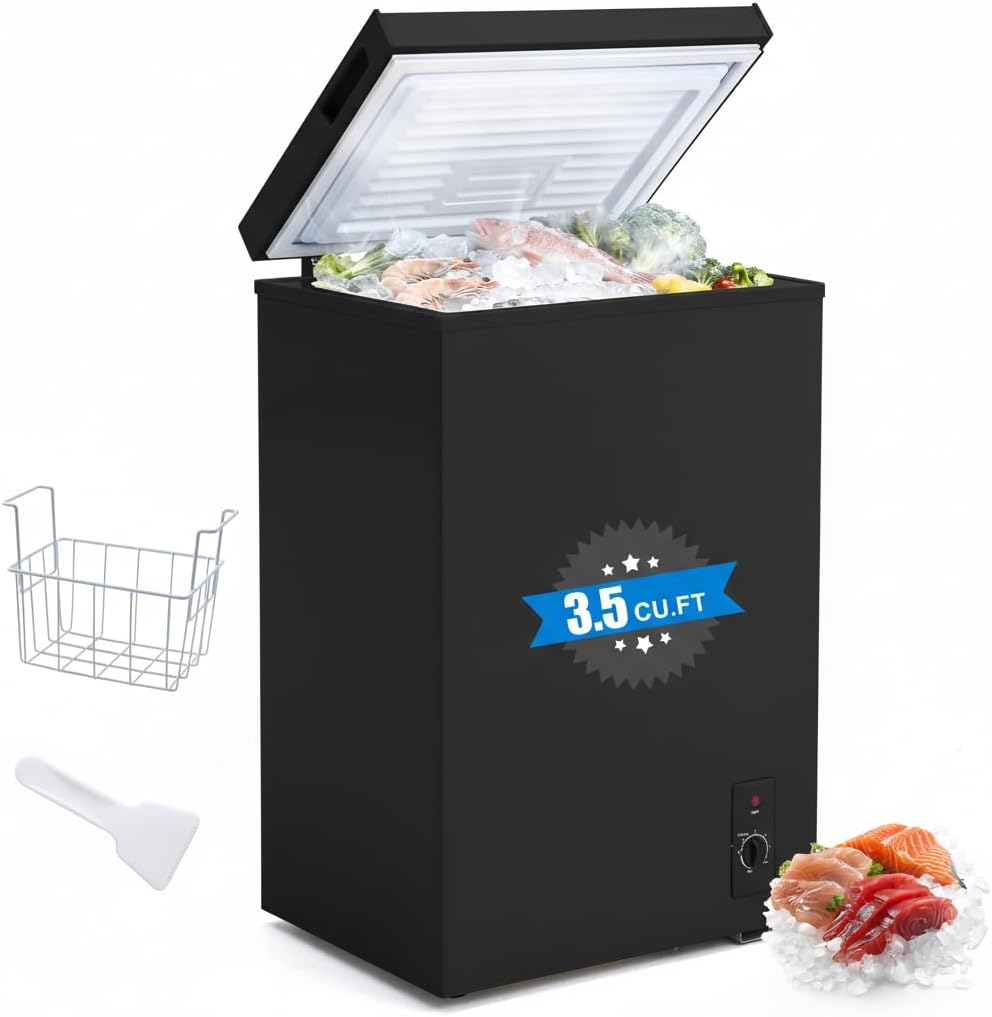
PLENTORA Chest Freezer B80
| Capacity | 3.5 cubic feet |
|---|---|
| Voltage | 110 volts |
| Number Of Shelves | 1 |
| Specification Met | ETL |
The PLENTORA Chest Freezer B80 is a compact top‑opening chest freezer designed for households that need dependable secondary frozen storage. Its 3.5 cubic foot interior and removable wire basket make it easy to organize bulk groceries, meats, and prepared meals, while the fast‑cooling R600a compressor brings contents down quickly and runs quietly under 40 dB. Seven-level temperature control lets you dial in anything from soft freeze to deep freeze for long-term storage, and the included ice shovel is a practical touch for routine maintenance. The unit is freestanding and has a modest footprint that fits apartments, garages, or kitchens where space is limited. On the downside the warranty is limited to six months and there is only one shelf option, so long-term service and storage flexibility are considerations if you expect heavy, continuous use. For buyers prioritizing reliable cooling in a small package, this freezer offers straightforward performance without unnecessary complexity.
Best for: Buyers who want a dependable, no-frills secondary freezer for extra frozen storage and value quiet, energy-efficient cooling in a compact footprint.
Less Ideal for: Users who need heavy-duty commercial use, advanced storage customization, or an extended factory-backed warranty should consider larger or higher-end models.
- Compact 3.5 cu ft capacity suitable for apartments and as a secondary freezer
- Fast‑cooling R600a compressor that runs quietly (below 40 dB)
- Seven-level temperature control for precise freezing from soft to deep freeze
- Removable wire basket and top-opening layout for simple organization and access
- Limited warranty period of six months
- Only a single shelf/basket configuration limits internal organization options
Verdict: Choose the PLENTORA B80 if you need a reliable, quiet, energy-efficient small chest freezer that delivers precise temperature control in a compact footprint.
Whynter CUF-112SS Mini Freezer

| Capacity | 1.1 cubic feet |
|---|---|
| Wattage | 79 watts |
| Door Orientation | Reversible |
| Number Of Shelves | 1 |
| Specification Met | Energy Star |
The Whynter CUF-112SS is a small upright freezer designed to add dedicated frozen storage in tight spaces like kitchens, offices, garages, or basements. It uses a compressor-driven cooling system and a mechanical thermostat that lets you set temperatures between about -11°F and 10.4°F, and airflow is fan-circulated for more even cooling. Storage is straightforward: a removable, slide-out wire shelf creates flexible organization for items such as ice cream, frozen meals, or breast milk, and the unit includes a cylinder lock and two keys for secure access. The stainless-steel door and recessed handle keep the footprint neat while the reversible hinge gives placement flexibility. Energy Star rating and low 79-watt power draw help keep running costs down. Expect manual defrosting, which is simple but requires occasional maintenance, and the 1.1 cubic-foot capacity is best for single-person households or as a secondary freezer rather than primary family storage.
Best for: Buyers who prioritize a compact, efficient secondary freezer with secure storage and proven user satisfaction, and who want a reliable unit for small-scale frozen items in tight spaces.
Less Ideal for: People who need large-capacity primary freezers or a no-maintenance frost-free model should consider larger upright or chest freezers instead.
- Compact upright design fits small spaces and maximizes vertical storage
- Removable slide-out wire shelf for flexible organization
- Reversible door and recessed handle allow flexible placement
- Cylinder lock with two keys for secure storage
- Energy Star rated with low power consumption (79 watts)
- Manual defrost requires routine maintenance
- Small 1.1 cu ft capacity limits the amount of frozen food you can store
Verdict: A compact, energy-efficient mini upright freezer with secure locking and flexible placement that works well as a reliable secondary freezer for small-space living.
Frostorm Mini Fridge BC-90 3.2 Cu Ft

| Capacity | 3.2 cubic feet |
|---|---|
| Freezer Capacity | 0.35 cubic feet |
| Defrost System Type | Automatic |
| Voltage | 115 |
The Frostorm BC-90 is a compact 3.2 cu ft refrigerator with a 0.35 cu ft upright freezer compartment that serves as a basic cold-storage solution for vegetables, drinks, and quick-freeze items. It uses an easy mechanical thermostat (1–5) and automatic defrost to maintain steady cooling, while adjustable glass shelves and door bins help organize produce and smaller containers. The dedicated freezer reaches subfreezing temps suitable for ice and short-term frozen goods but is not sized for bulk freezing. Energy use is modest at about 0.6 kWh per day, so running costs are low. The reversible door lets you install it to suit tight layouts, and ETL certification addresses safety concerns. Limitations include a small fresh-food area compared with full-size fridges and a compact freezer that is best for ice and short-term storage rather than long-term preservation of big batches of vegetables. Noise and precise temperature uniformity may vary with placement and the simple dial control does not offer digital precision.
Best for: Buyers who want a reliable, simple mini fridge to keep a modest amount of fresh produce chilled and occasionally freeze small items in a bedroom, office, or dorm without fuss.
Less Ideal for: If you need to store large quantities of vegetables long term or require precise temperature control for delicate produce, a larger refrigerator with a full-size crisping drawer and digital controls would be a better choice.
- Dedicated internal freezer compartment for ice and quick freezing small items
- Adjustable glass shelves and door bins for flexible organization
- Reversible door for placement flexibility in small spaces
- Automatic defrost and simple mechanical thermostat for easy operation
- Relatively low energy use (~0.6 kWh/day) for cost-conscious daily running
- Freezer volume is small and not suitable for long-term bulk freezing
- Mechanical dial lacks precise digital temperature control
Verdict: A compact, energy-efficient mini fridge with a small internal freezer that reliably chills and stores a modest amount of vegetables and makes ice with minimal fuss.
Choosing the Right High-End Small Freezer: Key Factors to Consider
Capacity and Interior Layout
Capacity dictates how much food you can store and how items are organized. Small freezers often trade cubic feet for a compact footprint, so look closely at usable interior volume rather than overall exterior dimensions.
Interior layout matters for everyday convenience. Removable baskets, adjustable shelves, and clear compartment dividers make it easier to separate meats, prepared meals, and ice packs. A confusing or cramped layout can make it hard to access older items and increases the risk of forgotten food. Consider how you will load and rotate stock and choose a configuration that fits your typical frozen items.
Temperature Control and Accuracy
Accurate temperature control preserves food quality and reduces freezer burn. Look for units with precise thermostats, digital displays, or external temperature probes that allow you to confirm setpoints. Tight temperature tolerance also helps when you add a warm load or after a power interruption.
Fast cold recovery is part of this factor. A well-insulated cabinet plus a responsive compressor or cooling mechanism restores the set temperature quickly after door openings or loading. Slower recovery increases the risk of partial thawing and refreezing, which degrades texture and flavor.
Energy Use and Operating Cost
Because compact freezers run continuously, energy consumption directly affects lifetime operating cost. Choose models with good energy ratings, efficient compressors, and effective insulation to keep electricity use low. Energy-efficient designs also tend to generate less heat into the surrounding space, which matters in small kitchens or enclosed rooms.
Pay attention to standby features and smart modes. Some premium small freezers include eco settings or adaptive defrost cycles that reduce runtime without compromising food safety. When comparing units, look at annual energy use estimates rather than only rated power draw to get a more realistic picture of long-term cost.
Defrost Type and Maintenance
Defrost method affects convenience and performance. Manual defrost models may achieve lower temperatures more easily but require periodic thawing to remove ice buildup. Frost-free or auto-defrost systems reduce maintenance but can slightly raise energy use and occasionally dry out stored items.
Consider the time and effort you are willing to invest in upkeep. Easy-to-remove interior components, accessible drain channels, and clear manufacturer guidance on defrost intervals simplify maintenance. Regular cleaning and proper airflow inside the freezer also prolong lifespan and maintain optimal cooling.
Noise Level and Placement
Noise matters when a freezer will sit near living spaces, open-plan kitchens, or bedrooms. Compressors, fans, and vibration against cabinetry can create distracting hums. Look for spec-sheet decibel ratings and user-reported noise behavior when available.
Placement affects perceived noise. Isolating the unit on vibration-absorbing feet, ensuring proper clearance for airflow, and avoiding tight cabinetry without ventilation can reduce noise and improve cooling efficiency. If silence is a priority, prioritize units explicitly designed for low-vibration, quiet operation.
Durability and Warranty Support
Long-term reliability reduces the chance of spoilage and replacement expense. High-end small freezers should feature durable compressor components, corrosion-resistant interiors, and high-quality seals. Check for robust door hinges and gasket design because small leaks quickly undermine thermal performance.
Warranty terms and customer service responsiveness matter for peace of mind. A clear warranty for sealed system components and a reasonable labor window indicate manufacturer confidence. Even without brand names, prefer units that specify warranty coverage and easy access to replacement parts.
Where to Put a Small High-End Freezer
Placement influences performance as much as unit selection. Pick a location with stable ambient temperature, away from direct sunlight and heat sources like ovens or dishwashers. Limited clearance around the cabinet restricts airflow and can force the compressor to work harder.
If you plan to install the freezer under a countertop or inside cabinetry, ensure the manufacturer's minimum ventilation clearances are met. In small apartments, think about access for service and how the door swing interacts with nearby fixtures. A well-placed compact freezer will run quieter and last longer.
- Allow recommended clearance on all sides for ventilation
- Avoid placing near heat-producing appliances
- Choose a level surface and consider vibration-damping feet
- Ensure door swing does not block walkways or cabinets
Maximizing Storage in a Compact Footprint
Organizing a small freezer efficiently makes a big difference in usability. Use stackable, freezer-safe containers and label contents with dates to prevent forgotten items. Thin, stackable trays are useful for flat-packed items like soups or sauces that freeze well and save vertical space.
Consider a simple inventory routine: rotate older items to the front and defrost or use partial contents before adding more. Using baskets for like items keeps frequently accessed foods within easy reach and reduces time spent with the door open.
- Use stackable containers and uniform packaging
- Label and date everything to reduce waste
- Group similar items together in baskets or bins
- Freeze flat for quicker thawing and space savings
Understanding Quiet Operation Claims
Manufacturers may advertise low decibel levels, but real-world noise depends on installation and room acoustics. Hard floors and reflective surfaces can amplify compressor hum. Vibration transfer to cabinets or counters often causes the most irritating noises.
If quiet operation is essential, look for units with rubberized mounting points, balanced compressors, and variable-speed fans. When placing the freezer, use anti-vibration pads and ensure it sits level to minimize resonance.
- Check for vibration-damping features
- Use anti-vibration pads under the unit
- Locate on a stable, level surface away from reflective surfaces
Energy-Saving Habits for Small Freezers
Beyond choosing an efficient unit, daily habits reduce energy use. Avoid frequent or prolonged door openings, and keep the freezer at the recommended temperature rather than colder than necessary. Grouping new groceries together before loading can cut down on warm-air intrusion.
Maintain door gaskets and seals, and keep condenser coils clean when accessible. Periodic checks and simple upkeep preserve efficiency and prevent the compressor from running excessively to compensate for losses.
- Set temperature to manufacturer-recommended range
- Reduce door openings and pre-bag items before loading
- Keep condenser area clean and gaskets tight
- Defrost as recommended to maintain efficiency
When to Choose Frost-Free Versus Manual Defrost
Frost-free models reduce maintenance by automatically preventing ice buildup, which is convenient in busy households. However, they can cycle more frequently and may slightly dry out frozen food over long periods. Manual defrost units are simple and often deliver excellent cold performance, but they require scheduled thawing.
Match the defrost style to your tolerance for maintenance and the types of food you store. If you freeze large volumes for long-term storage, manual models sometimes offer better static temperatures. If convenience matters most, a frost-free system minimizes hands-on upkeep.
- Frost-free: low maintenance, may cycle more frequently
- Manual defrost: potentially lower temps, needs scheduled thawing
- Consider food type and storage duration when choosing
How We Chose the Best High-End Small Freezer
We focused on attributes that matter for compact, high-end freezers and applied strict editorial filters to create this list. We prioritized consistent temperature control and cold recovery because those determine how well frozen food holds quality over time. Energy efficiency and regulatory ratings were weighed heavily to minimize ongoing operating costs for small units that run 24/7. Build quality and insulation performance were included to assess durability and how well a freezer maintains temperature when opened. Controls and user interface were evaluated for clarity and practical features such as adjustable thermostats, alarms, and interior lighting. Noise levels and vibration were considered to ensure suitability for kitchens, living areas, and small apartments. We excluded budget or entry-level compact freezers and any models that lack reliable temperature readouts or modern safety features. Units that do not offer adequate defrosting options, poor energy ratings, or flimsy construction were filtered out. The final shortlist reflects a balance of thermal performance, efficiency, user controls, and long-term reliability for buyers seeking a premium compact freezer.
Our full evaluation process is outlined in our review methodology.
FAQ
How cold should a small freezer be set for long-term storage?
Aim for around 0 degrees Fahrenheit for long-term storage since that temperature preserves quality while minimizing freezer burn. A reliable thermostat or external thermometer helps confirm the setpoint and detect fluctuations.
Are compact high-end freezers noisy in apartments?
Noise varies by model and installation. Premium compact units often include quieter compressors and vibration isolation, but placement, room acoustics, and surface mounting can affect perceived noise. Use anti-vibration pads and maintain clearance to reduce sound.
Can I install a small freezer under a countertop?
Some compact freezers are designed for under-counter installation but require specific ventilation clearances. Confirm the unit's clearance recommendations and ensure proper airflow to avoid overheating and reduced cooling efficiency.
How often should I defrost a manual small freezer?
Defrost when frost buildup exceeds roughly a quarter inch or according to manufacturer guidance. Frequent defrosting prevents insulation loss from ice accumulation and keeps the unit running efficiently.
Does a small freezer cost a lot to run?
Operating cost depends on energy efficiency and usage patterns. High-efficiency compressors and good insulation reduce electricity use. Keeping the unit well-maintained and avoiding frequent door openings also lowers running costs.
Final Verdict
Choosing a high-end small freezer comes down to balancing precise temperature control, efficient operation, and the right interior layout for your storage habits. Prioritize units with accurate thermostats, good insulation, and user-friendly controls if you store perishable or long-term frozen items. Consider noise and placement constraints if the freezer will sit near living spaces, and pick the defrost style that matches your tolerance for maintenance. By focusing on temperature stability, energy use, and build quality, you can select a compact freezer that delivers premium performance in a small footprint and provides reliable cold storage for years to come.