
Note: This article contains affiliate links. If you click on these links and make a purchase, we may earn a small commission at no extra cost to you. This helps support our research and content. Read our full affiliate disclosure here.
If you want oven-level control, consistent results, and modern connectivity, a high-end smart oven can transform how you cook. These units combine precise temperature management, advanced modes, and app integration to help you roast, bake, and reheat with fewer surprises. Choosing the right high-end smart oven matters because differences in temperature accuracy, rack configuration, and smart features change how reliably you hit recipes and how smoothly the oven fits into your kitchen routine. This guide shortlists the top high-end smart ovens and outlines the technical and practical details you should weigh. Our picks were selected for real-world cooking performance, smart capabilities, and build quality. Read on for the evaluation criteria and buying factors that will help you choose the best fit for your kitchen.
Top Picks at a Glance
| Best Overall The best all-around choice for most situations | Ninja Double Oven DCT451 | 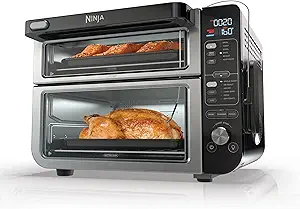 |
| Best Quality Built to a higher standard if you want something more solid | Samsung 30" Smart Double Wall Oven |  |
| Best Value The sweet spot between price and what you get | Tovala Smart Oven Pro |  |
| Best Budget The cheapest option that still gets the job done reliably | Nuwave Bravo Pro Smart Oven 21QT |  |
| Top Rated A top-rated pick with lots of positive feedback | Breville Smart Oven Air Fryer Pro BOV900BSS |  |
| Most Popular A crowd favorite that many people choose with confidence | Breville Smart Oven Pro BOV845BSS |  |
Ninja Double Oven DCT451

| Wattage | 1800 watts |
|---|---|
| Control Type | Knob Control |
| Power Source | Corded Electric |
| Number of Shelves | 2 |
| Capacity | 12 liters |
The Ninja Double Oven DCT451 packs two usable ovens into one countertop unit, letting you run the top Rapid Oven for quick snacks and the bottom Convection & Air Fry Oven for larger roasts or air-fried foods. The FlexDoor physically separates the cavities so you can cook different dishes at different temperatures, and FlavorSeal minimizes flavor crossover when both ovens are running. The built-in Smart Cook System uses a leave-in thermometer to monitor internal temperatures and Smart Finish can sync both ovens to complete at the same time, which is handy for full meals. The unit covers a wide set of functions—12 cooking modes across the two cavities—so it handles everything from pizza and baking to air frying and dehydrating. At 1800 watts and a family-sized capacity able to fit a 12-inch pizza or 6 pounds of wings, it is clearly aimed at households that want oven versatility without using a wall oven. Trade-offs are typical countertop-oven ones: it is sizable on a counter and heavier than smaller toaster ovens, but for buyers wanting two independent ovens and smart temperature control in one footprint, it delivers a flexible, time-saving solution.
Best for: Buyers who want a versatile, high-end countertop oven that replaces back-to-back cooking with two independent cavities and smart temperature control for family meals.
Less Ideal for: People with very limited counter space, light cooks who only need a small toaster oven, or those who prefer a built-in wall oven setup.
- Two independent oven cavities via FlexDoor let you cook different foods at different temperatures simultaneously
- Smart Cook System with leave-in thermometer and Smart Finish can synchronize cook times and monitor internal temps
- Bottom convection oven includes air fry and multiple cooking functions for versatility
- FlavorSeal technology reduces flavor crossover between the two ovens
- Family-sized capacity fits a 12-inch pizza and up to about 6 lb of wings
- Large and relatively heavy for a countertop unit, which may limit placement
- Consumes 1800 watts, so it needs a suitably rated circuit
Verdict: Choose the Ninja Double Oven DCT451 if you want two true ovens, smart temperature monitoring, and air-fry capability in a single countertop appliance that speeds up family meal cooking.
Samsung 30" Smart Double Wall Oven

| Heating Method | Convection |
|---|---|
| Fuel Type | Electric |
| Installation Type | Built-In |
| Wattage | 9300 |
| Capacity | 5.1 cubic feet |
This Samsung 30" Smart Double Wall Oven pairs dual convection with a Steam Cook option and Wi‑Fi control to accelerate cooking while keeping results moist inside and crisp outside. It is built as a 5.1 cu ft double oven intended for large roasts, multi-dish holiday meals, and frequent home entertaining, with two convection fans to promote even browning across racks. SmartThings connectivity and voice assistant support let you monitor and adjust time and temperature remotely, and illuminated digital-analog controls simplify selecting compatible modes. Practical touches include a glide rack for easier heavy dish handling, fingerprint-resistant stainless finish, and a self-clean cycle for maintenance. Trade-offs are typical for a high-power built-in unit: installation requires 240V wiring and professional fitting, and the large size is not suited to small kitchens or occasional cooks who do not need dual ovens. For performance-focused home cooks this oven speeds up multi-rack baking and adds flexible steam-assisted techniques, but expect a significant installation footprint and higher power requirements.
Best for: Home cooks who prioritize fast, even multi-rack performance and advanced cooking modes and want smart remote control for busy, high-volume meal prep.
Less Ideal for: Renters, occasional cooks, or anyone without 240V wiring and space for a large built-in unit should consider smaller single ovens or countertop options instead.
- Dual convection with two fans promotes faster, more even cooking across multiple racks
- Steam Cook adds controlled moisture timing for crisp exteriors and tender interiors
- Large 5.1 cu. ft capacity fits big roasts and multiple casserole dishes
- Wi‑Fi and voice control via SmartThings allow remote monitoring and basic adjustments
- Self-clean cycle and glide rack improve day-to-day convenience and cleanup
- Requires 240V hardwired installation and professional fitting
- Large built-in footprint makes it unsuitable for small kitchens
Verdict: Choose this oven if you want a high-capacity, performance-focused built-in with dual convection, steam-assisted cooking, and smart remote control for serious home cooking.
Tovala Smart Oven Pro

| Wattage | 1525 watts |
|---|---|
| Control Type | Touch Control |
| Power Source | AC adapter |
| Number of Shelves | 1 |
The Tovala Smart Oven Pro is a versatile 6-in-1 countertop convection oven that pairs steam capability with air fry, bake, broil, toast, and reheat functions and is controlled via a smartphone app. It is typically used as an all-in-one replacement for a toaster oven and small countertop appliances, using presets or scanned barcode instructions from Tovala meals and many packaged groceries to automate cooking. Notable features include a built-in barcode scanner, WiFi app control for remote start and presets, a dedicated air-fry basket and sheet tray, and a steam function for moister results. In real-world use the oven produces crisp air-fried items and noticeably better texture on steamed breads and seafood, while the app-driven presets simplify reheating and multi-step cooks. Practical benefits are consolidation of several appliances into one, included accessories for immediate use, and hands-off cooking with the Tovala ecosystem. Important limitations are reliance on the app and scanned presets for the easiest experience, a relatively large footprint compared with basic toaster ovens, and that some advanced users may prefer manual control for fine-tuning.
Best for: Buyers who want a single smart countertop oven that replaces multiple appliances and value automated, app-driven cooking workflows to save time and reduce fiddling.
Less Ideal for: People who prefer simple manual controls, minimal smart features, or need a very compact toaster oven for tight countertops.
- Six cooking modes including steam plus air fry for versatile meal types
- Integrated barcode scanner and WiFi app for automated, hands-off cooking
- Includes air fry basket, sheet tray, and oven mitt to use immediately
- High power output (1525 watts) for quick preheat and crisping
- App and barcode workflow are central to the experience, which may not suit users who prefer manual controls
- Relatively large and heavier than basic toaster ovens, taking more counter space
Verdict: If you want a high-end smart countertop oven that consolidates air fry, steam, and convection cooking into a single app-driven appliance, this is a top practical choice.
Nuwave Bravo Pro Smart Oven 21QT

| Capacity | 21 quarts |
|---|---|
| Wattage | 1800 watts |
| Temperature range | 50-450°F |
| Control Type | Touch Control |
| Number of preset functions | 10 |
The Nuwave Bravo Pro Smart Oven is a 21‑quart countertop toaster oven that combines air fry and convection oven functions into one 1800W unit. It is used for everything from toasting and air frying to baking, broiling, reheating, dehydrating, and cooking frozen foods, with 10 preset programs and adjustable top/bottom heater balance for more controlled results. The oven's upgraded Ultra‑Fast convection system and three selectable fan speeds promise quicker, more even cooking across layers and reduced oil use when air frying. Touch controls and included accessories — air fry basket, enamel pan, rack, and crumb tray — make everyday use straightforward, and tempered glass door and dishwasher‑friendly parts simplify cleanup. Expect a learning curve dialing in heater ratios for specialty items like thick pizzas, and the unit is relatively heavy for its size which affects portability; counter space needs should be considered. For buyers seeking a versatile, faster alternative to a conventional toaster oven, the Bravo Pro delivers strong functionality in a compact package.
Best for: Buyers who want a single versatile countertop oven that speeds up cooking and crisps food like an air fryer while staying within a modest budget-minded purchase approach.
Less Ideal for: Those who need a lightweight, ultra-compact toaster oven to move frequently or who prefer a completely hands-off smart appliance with extensive app integration and automation.
- Wide 10‑function program set covering air fry, bake, broil, toast, dehydrate and more
- Upgraded high‑speed convection with three fan speeds for faster, more even cooking
- Adjustable top and bottom heater power for targeted browning and pizza customization
- Includes useful accessories (air fry basket, enamel pan, rack, crumb tray) and touch controls for easy operation
- Relatively heavy for a countertop unit which reduces portability
- Requires some experimentation to optimize heater ratios for specialty cooking
Verdict: If you want fast, versatile countertop cooking with strong air‑fry and convection performance at a budget-friendly midrange, the Bravo Pro is a compact all‑in‑one choice.
Breville Smart Oven Air Fryer Pro BOV900BSS

| Wattage | 1800 watts |
|---|---|
| Control Type | Knob Control |
| Power Source | Corded Electric |
| Temperature Range | 80-480 °F |
| Capacity | 1 cubic feet |
The Breville Smart Oven Air Fryer Pro is a countertop convection oven that combines a large interior with dedicated air-fry and dehydrate modes for versatile cooking. It uses the Element iQ system with five quartz heating elements and a two-speed convection fan to direct heat precisely, which helps reduce cook times and deliver more even browning. Typical uses include toasting, roasting a whole turkey, baking cookies or pizza, air frying fries, and dehydrating multiple trays at once; the oven accepts 9×13 pans and can hold up to four dehydration trays. Controls are a mix of knobs and an LCD display, and the oven includes useful accessories such as racks, a roasting pan, pizza pan, and a mesh basket. Practical benefits are consistent results from the smart heating algorithm, large capacity that replaces several appliances, and versatile presets that simplify common tasks. Trade-offs are the unit's substantial countertop footprint and 1800 W power draw, which require ample space and a dedicated outlet, and the learning curve for dialing in custom times and temperatures compared with simpler toaster ovens.
Best for: Buyers who prioritize high-performance cooking and want one countertop appliance to handle roasting, baking, air frying, and dehydrating for family-sized meals.
Less Ideal for: Those with very small kitchens, limited counter space, or who need a lightweight travel-friendly toaster oven should consider smaller models instead.
- Element iQ system with 5 quartz elements for even, targeted heating
- Super convection fan with two speeds for faster, crispier air frying
- Large 1 cubic foot interior fits 9 slices of toast, a 14 lb turkey, or 9×13 pans
- Includes multiple accessories: pizza pan, roasting pan, racks, and mesh basket for dehydrating/air frying
- 13 preset cooking functions plus LCD for easy selection and monitoring
- Large footprint and heavy unit that requires significant counter space
- High power draw (1800 W) may limit simultaneous use with other heavy appliances
Verdict: Choose this oven if you want a high-performance, large-capacity countertop unit that reliably air fries, roasts, bakes, and dehydrates with precise, convection-driven results.
Breville Smart Oven Pro BOV845BSS

| Wattage | 1800 watts |
|---|---|
| Capacity | 0.49 cubic feet |
| Control Type | Knob Control |
| Number of Shelves | 1 |
The Breville Smart Oven Pro is a roomy countertop convection toaster oven designed to replace multiple appliances for everyday baking and roasting. It uses the Element iQ system with five independent quartz elements and an internal fan to concentrate heat where needed, which shortens cook times and promotes even browning. Typical uses include baking cookies or small pizzas, toasting bread, roasting a chicken, and slow-cooking stews using the dedicated slow-cook mode. The oven includes 10 preset functions, an LCD for clear status and preheat indication, an interior light, and a set of practical accessories including a baking pan, broiling rack, pizza pan, and wire rack. At 1800 watts it heats up quickly and the convection mode can reduce baking times substantially. Trade-offs are its countertop footprint and weight, which require counter space and limit portability, and it lacks touchscreen or smart-home connectivity for remote control. For home bakers who want reliable, consistent results across a range of tasks, it performs very well.
Best for: Home bakers who prioritize consistent, reliable baking results and want a single countertop appliance that handles baking, roasting, toasting and slow cooking without fuss.
Less Ideal for: Those who need a very compact, lightweight toaster oven for small kitchens or who require smart-home connectivity and remote control features.
- Element iQ with five quartz elements for targeted, even heating
- Convection fan reduces cook time and improves browning
- Includes versatile preset functions for baking, roast, pizza, cookies and slow cook
- Comes with useful accessories: enamel baking/broiling racks and a pizza pan
- LCD display and interior light make monitoring and timing easy
- Large countertop footprint and relatively heavy compared with small toaster ovens
- No Wi-Fi or app control for remote operation
Verdict: Buy this if you want a dependable, high‑performance countertop oven that delivers consistent baking and roasting results across many functions.
Choosing the Right High-End Smart Oven: Key Factors to Consider
Temperature Accuracy and Calibration
Accurate temperature control is essential for consistent results, especially for baked goods and recipes with narrow temperature windows. Ovens with reliable thermostats and factory calibration reduce the need for manual adjustments.
Look for ovens that allow user calibration or report internal temperature via the app. A unit that maintains set temperatures within a small margin will prevent overbrowning or undercooking and makes recipe timing more predictable.
Heat Distribution and Convection Performance
Even heat distribution affects how uniformly food cooks across racks. Convection fans, the placement of heating elements, and cavity shape all influence airflow and browning.
Assess whether a model offers true convection modes and adjustable fan settings. Strong convection can shorten cook times and improve browning, but overly forceful airflow can dry delicate items, so variable settings are helpful for versatility.
Smart Connectivity and Automation
Connectivity lets you preheat remotely, receive cook alerts, and use guided recipes that adjust time and temperature automatically. For a high-end kitchen, seamless integration with your smart hub or phone can save time and reduce guesswork.
Consider the responsiveness of the mobile app, support for scheduling and remote monitoring, and whether the oven exposes meaningful telemetry like actual cavity temperature. Security and firmware update policies matter for long-term reliability.
Cooking Modes and Programmability
A high-end smart oven should offer a range of practical modes such as true convection, broil, bake, proof, and specialized preset programs for common dishes. Programmability for multi-step recipes and timed sequences increases flexibility.
Evaluate whether modes are intuitive to use and whether presets can be customized or saved. Advanced automation should simplify routine tasks without locking you out of manual control when you need it.
Interior Layout and Capacity
Usable capacity is about more than liters or cubic feet. Rack positions, telescoping racks, and overall cavity shape determine whether you can fit large roasting pans, multiple sheet pans, or tall dishes simultaneously.
Count practical rack levels rather than advertised volume, and consider whether accessories like roasters or steam pans are compatible. Ease of loading and door clearance also influence how convenient the oven is in daily use.
Build Quality, Materials, and Insulation
Durable materials, quality gaskets, and solid door construction contribute to energy efficiency and long-term performance. Good insulation keeps exterior surfaces cooler and helps the oven maintain temperature with less cycling.
Check for robust knobs or controls, corrosion-resistant interiors, and serviceable parts. A well-built chassis and effective insulation reduce heat loss and noise while improving the appliance lifespan.
Installation and Kitchen Fit
High-end smart ovens often come in wall-mount or built-in configurations, so measuring cabinet openings and ensuring proper ventilation is critical. Confirm electrical requirements and clearance dimensions before purchase to avoid installation delays.
Consider whether the unit requires a professional installer and whether it fits existing cabinets and trim. Reversible door clearance and the direction of the hinge can affect how the oven functions in tight kitchens.
- Measure cavity height, width, and depth against manufacturer specs
- Verify dedicated circuit or power requirements
- Plan for ventilation and clearance around the oven
Oven Controls and User Interface
Controls range from physical dials to glass touchscreens with integrated displays. For regular cooking, tactile controls can be faster, while touchscreens may offer richer guidance, timers, and recipe steps.
Assess whether the interface exposes essential settings without navigating deep menus. For smart ovens, check that the app mirrors core controls and provides clear status updates when you are away from the kitchen.
- Look for intuitive layout with clear feedback
- Ensure basic functions are accessible without the app
- Prefer interfaces that show actual vs set temperature
Maintenance and Cleaning
Ease of cleaning is an everyday consideration. Self-clean cycles, catalytic liners, and removable racks simplify maintenance, but each method has tradeoffs in time, smell, and energy use.
Check whether internal surfaces are easy to wipe down and whether racks are dishwasher-safe. For ovens with steam or moisture features, follow recommended maintenance to prevent odors or scale buildup.
- Self-cleaning cycles require high-heat intervals and occasional residue removal
- Removable, heavy-duty racks are easier to clean
- Accessible light and interior corners reduce blind spots when wiping
Safety Features and Childproofing
High-end ovens include safety features such as automatic shutoff, cool-touch doors, and child locks. These features reduce risk during long bakes or when children are nearby.
Look for clear error reporting and interlocks that prevent operation when doors are not sealed. For smart models, ensure remote controls have safeguards to prevent accidental activation.
- Automatic shutoff after extended inactivity
- Child lock for control panel and app access
- Door sensors and secure latching
Energy Use and Long-Term Costs
Energy consumption depends on insulation quality, the efficiency of heating elements, and how quickly the oven reaches and holds temperature. Better insulation and precise control reduce overall energy use for frequent cooks.
While energy ratings vary, choosing a well-insulated oven with efficient heat distribution typically lowers running costs. Consider how often you will use high-temperature functions like self-cleaning, which spike energy use temporarily.
- Insulation and gasket quality affect standby losses
- Convection cooking often reduces time and energy per dish
- Regular maintenance preserves efficiency over time
How We Chose the Best High-End Smart Oven
We focused on features and performance that matter most for serious home cooks buying a high-end smart oven. Key evaluation criteria included temperature accuracy and heat distribution, which determine how evenly dishes cook across racks; smart platform integration and remote control, which affect convenience and recipe guidance; cook modes and automation, which enable consistent results for baking, roasting, and specialty techniques; build quality and materials, because durable construction and quality insulation influence long-term reliability and energy efficiency; and interior layout and capacity, since usable rack positions and cavity size shape what you can cook at once. We prioritized ovens with documented temperature stability and multiple, practical cooking modes rather than novelty features. Connectivity was judged on responsiveness, available automation, and safety controls rather than branding of the app. We excluded products that lack basic temperature calibration, omit necessary safety interlocks, or have restricted venting that prevents standard installation. The final shortlist balances measurable cooking performance with smart features and long-term usability.
Our full evaluation process is outlined in our review methodology.
FAQ
Are smart oven features reliable for everyday cooking?
Smart features are generally reliable for routine tasks like remote preheating and timers, but responsiveness depends on the oven's network stability and app quality. Use manual controls as a backup when the network is unavailable.
Do high-end smart ovens require special electrical hookups?
Many high-end built-in ovens need a dedicated circuit and specific voltage. Check the installation specifications and consult a qualified electrician to ensure compatibility with your kitchen wiring.
Can I use a smart oven without connecting it to the internet?
Yes. Most smart ovens retain full basic oven functionality without network access. Smart features such as remote monitoring and guided recipes will be unavailable until you connect the unit.
How important is convection for a high-end smart oven?
Convection is important for faster, more even browning and for cooking multiple racks simultaneously. Variable convection settings increase versatility for delicate items that may not tolerate strong airflow.
How often should I calibrate the oven temperature?
Calibration frequency depends on usage, but checking accuracy every few months or after moving the oven is sensible. Many smart ovens allow user calibration via the interface or app to fine-tune set temperatures.
Final Verdict
When choosing a high-end smart oven, prioritize temperature accuracy, even heat distribution, and the smart features you will actually use regularly. Interior layout, build quality, and serviceability determine how the oven performs for large roasts or multi-sheet pan baking. Balance automated convenience against the need for manual control and durable construction. Focus on measurable performance and practical connectivity so you end up with an oven that reliably fits your cooking style and kitchen workflow.