
Note: This article contains affiliate links. If you click on these links and make a purchase, we may earn a small commission at no extra cost to you. This helps support our research and content. Read our full affiliate disclosure here.
Picking the right home air quality monitor matters because the device you choose determines how reliably you spot problems and how simple it is to act on them. Whether you want to track particulate levels from cooking, spot rising volatile organic compounds after a renovation, or monitor humidity and CO2 for healthier sleep, a clear, accurate monitor changes how you manage your indoor environment. This guide shortlists the top Home Air Quality Monitor options and explains the criteria that matter, from sensor accuracy to reporting and ongoing maintenance. Read on for focused guidance that helps you pick a monitor suited to your living space and lifestyle.
Top Picks at a Glance
| Best Overall The best all-around choice for most situations | Temtop LKC-1000S+ 2nd |  |
| Best Quality Built to a higher standard if you want something more solid | BREATHE Airmonitor Plus BTL40001 |  |
| Best Value The sweet spot between price and what you get | LifeBasis Air Quality Monitor LSAM003 |  |
| Best Budget The cheapest option that still gets the job done reliably | Temtop S1 Air Quality Monitor | 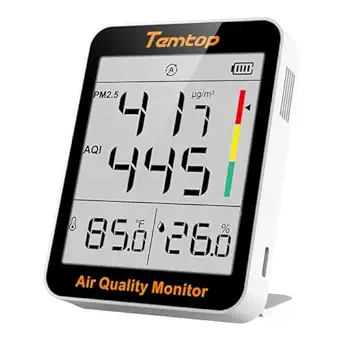 |
| Top Rated A top-rated pick with lots of positive feedback | Aranet4 Home CO2 Monitor |  |
| Most Popular A crowd favorite that many people choose with confidence | Amazon Smart Air Quality Monitor |  |
| Best Seller A high-volume bestseller chosen again and again | GoveeLife Smart Air Quality Monitor H5106 |  |
Temtop LKC-1000S+ 2nd

| Battery Capacity | 3000mAh |
|---|---|
| Battery Life | 6-8h after full charged |
| PM2.5 Measuring Range | 0-999 μg/m³ |
| HCHO Measuring Range | 0-2 mg/m³ |
| Input | DC5V/1A |
The Temtop LKC-1000S+ 2nd is a handheld air quality monitor designed for home and small office use that combines particle counting with gas sensing and environmental readouts. You get continuous PM2.5 and PM10 readings from a laser particle sensor, formaldehyde and TVOC detection via electrochemical sensing, and temperature and humidity measurements, all presented on an easy-to-read display with color-coded AQI. It stores up to three months of data with adjustable logging intervals and can export logged data to a PC over USB for basic spreadsheet review; the unit runs on a 3000 mAh rechargeable battery for several hours of cordless operation. The device is built around consumer-grade sensors that Temtop says were lab-tested for strong linearity, so it is useful for trend spotting, indoor source identification, and tracking changes during activities like cooking or cleaning. Expect the usual limits of non-laboratory detectors: readings can be influenced by interfering gases and nearby alcohol-based products, and the battery life is finite when many sensors are active. For balanced home monitoring this unit gives a broad, usable picture of indoor air quality with straightforward data export.
Best for: Homeowners and small-office users who want a single, portable device to track particles, formaldehyde, VOCs, and basic environmental trends and who value easy data export for periodic review.
Less Ideal for: Professionals needing laboratory-grade measurements for compliance or precise VOC speciation should choose specialized instrumentation instead.
- Measures multiple factors in one device: PM2.5, PM10, HCHO, TVOC, temperature, humidity, and AQI
- Adjustable data logging intervals with up to three months of onboard storage
- USB data export for basic Excel review
- Rechargeable 3000 mAh battery for portable use and up to several hours per charge
- Clear color-coded AQI display for at-a-glance assessment
- Consumer-grade gas sensors can be affected by interfering substances like alcohol or cleaning products
- Battery life is limited when multiple sensors and logging are active
Verdict: A versatile, portable monitor that gives balanced, multi-parameter home air quality tracking with easy data export for practical trend analysis.
BREATHE Airmonitor Plus BTL40001

| Sensors measured | CO2, PM1, PM2.5, PM10, TVOC, HCHO, Temperature, Humidity |
|---|---|
| CO2 sensor type | NDIR |
| Data history | Up to 90 days (app) |
| Connectivity | 2.4 GHz Wi-Fi, app with CSV export |
| Power source | USB-C (corded) with rechargeable battery |
The BREATHE Airmonitor Plus is a multi-sensor indoor air quality monitor built for hands-on tracking and analysis. It continuously reports CO2 using a professional-grade NDIR sensor (±50 ppm), laser-measured particulates (PM1, PM2.5, PM10), TVOC, formaldehyde, temperature, and humidity on a color display and via the Breathe Tech app. Typical use cases are monitoring bedrooms, home offices, classrooms, or kitchens to see how occupancy, cooking, or cleaning affect air quality. The app pairs over 2.4 GHz Wi-Fi, stores up to 90 days of data with CSV export for trend analysis, and supports configurable alerts. The Gen 2 unit adds a rechargeable battery for up to six hours of portable use, while continuous monitoring is possible when plugged into USB-C power. Practical benefits include professional CO2 accuracy, combined gas and particle sensing in one compact device, and long-term data for performance-focused users. Limitations to note are its short built-in battery for extended unplugged use and reliance on the app and Wi-Fi for full remote functionality.
Best for: Buyers who prioritize accurate, multi-parameter air measurements and want durable historical data for performance-driven analysis and mitigation planning in homes, offices, or classrooms.
Less Ideal for: Users who need long-duration battery-only outdoor monitoring or who prefer a purely offline device without app or Wi-Fi dependence should look elsewhere.
- Professional-grade NDIR CO2 sensor with stated ±50 ppm accuracy
- Simultaneous measurement of CO2, PM1/2.5/10, TVOC, and formaldehyde for comprehensive monitoring
- App stores up to 90 days of history and allows CSV export for deeper analysis
- Rechargeable Gen 2 battery enables up to 6 hours of portable monitoring and USB-C for continuous use
- Built-in battery only lasts several hours so it needs mains power for long-term monitoring
- Full remote features depend on 2.4 GHz Wi-Fi and the companion app
Verdict: For performance-minded buyers who want professional CO2 accuracy plus particle and gas tracking with 90-day history and data export, the Airmonitor Plus delivers comprehensive, analysis-ready indoor air monitoring.
LifeBasis Air Quality Monitor LSAM003

| Battery | 2500 mAh, rechargeable |
|---|---|
| Sensors | NDIR CO2, laser particle, semiconductor, photoelectric, temperature & humidity |
| Measurements | AQI, CO2, PM1.0/PM2.5/PM10, TVOC, HCHO, particles, temp & humidity |
| Charging | Type-C |
The LifeBasis air quality monitor is a compact, battery-powered device for spotting indoor pollution and tracking basic environmental conditions. It continuously displays AQI plus CO2, PM1.0/2.5/10, TVOC, formaldehyde, particle counts, temperature and humidity on an adjustable LCD with color-coded icons, and it sounds an alert when measurements exceed preset thresholds. The unit uses an NDIR CO2 sensor, laser particle sensor and multiple detectors to give faster, more responsive readings than cheap single-sensor meters, and the Type-C rechargeable 2500 mAh battery makes it easy to move around the house for spot checks or short-term monitoring. Its strengths are the broad set of measured parameters and clear visual cues, which help you quickly identify problems like high particulate levels or rising CO2 in occupied rooms. Limitations include modest continuous runtime of about 11 to 12 hours per charge and the lack of smartphone connectivity for remote logging or long-term graphing, so it is best used as an on-site diagnostic and everyday room monitor rather than a full-time smart logger.
Best for: People who want a practical, portable monitor to quickly diagnose indoor air issues and make immediate ventilation or filtration decisions without needing cloud features.
Less Ideal for: Users who need continuous, around-the-clock logging, remote alerts, or integrated smart-home data tracking should consider models with Wi-Fi and app support instead.
- Measures 11 parameters including AQI, CO2, PM1.0/2.5/10, TVOC and HCHO for broad air insight
- Color-coded LCD and audible alerts make unsafe readings easy to notice at a glance
- Uses NDIR CO2 and laser particle sensors for faster, more reliable detection than single-sensor units
- Portable with a 2500 mAh battery and Type-C charging for room-to-room checks
- Runs roughly 11–12 hours per charge, requiring regular recharging for continuous use
- No built-in Wi-Fi or app support for remote monitoring or long-term data logging
Verdict: A compact, sensor-rich monitor that lets practical buyers quickly detect and respond to indoor air problems without needing smart-home integration.
Temtop S1 Air Quality Monitor

| PM2.5 range | 0-999 µg/m³ |
|---|---|
| Temperature range | 14-140°F |
| Humidity range | 0-99.9% RH |
| Battery life | ≥20 days (A Mode), ≥60 days (Eco Mode) |
The Temtop S1 is a small, battery-powered indoor air quality monitor that displays PM2.5, AQI, temperature, and humidity on a simple segment screen. It is designed for quick spot checks around the home, nursery, or office and offers two operating modes: a real-time A mode and an energy-saving Eco mode that extends standby to around 60 days. The unit uses a miniature laser particle sensor for PM2.5 readings and a digital temp/humidity sensor for faster, more accurate environmental comfort data than many basic hygrometers. Controls are minimal—just two buttons—and a three-color indicator provides at-a-glance air quality alerts. Practical benefits include true portability, several placement options including a magnetic attachment, and long battery life that avoids frequent charging. Limitations are a basic non-touch segment display with no app connectivity or CO2/VOC detection, so it is best for particulate-focused monitoring rather than comprehensive indoor air analysis.
Best for: Buyers who want an affordable, portable way to monitor particulate air quality and basic comfort metrics around the house or on the go and who prioritize long battery life and simplicity.
Less Ideal for: Those who need a comprehensive indoor air monitor with CO2, VOC sensing, app integration, or detailed logging for health-sensitive environments should consider higher-end models.
- Monitors PM2.5 and reports AQI for particulate-focused tracking
- Long battery life up to 60 days in Eco mode for portable use
- Compact and versatile placement including stand, mount, or magnetic attachment
- Simple two-button interface and three-color alert makes readings easy to interpret
- Does not measure CO2, VOCs, or formaldehyde so it is not a full-suite IAQ detector
- Basic segment display lacks app connectivity, graphs, or historical data
Verdict: A budget-friendly, portable PM2.5 and comfort monitor that delivers long battery life and simple, reliable spot checks for home use.
Aranet4 Home CO2 Monitor

| Measures | CO2, temperature, humidity, pressure |
|---|---|
| Sensor type | NDIR CO2 sensor |
| Battery | 2 AA batteries (included) |
| Data history | Up to 90 days in app |
The Aranet4 Home is a compact, battery-powered indoor air quality monitor that reports CO2, temperature, relative humidity, and atmospheric pressure in real time using an NDIR CO2 sensor and an easy-to-read e-ink display. It is designed for portable, cable-free use around the home, office, or classroom and runs on two AA batteries with up to four years of life, so you can set it and forget it. The color-coded display and prominent CO2 reading make it simple to see when ventilation is needed, and an optional buzzer adds an audible alert for high CO2 events. Pairing with the free smartphone app provides up to 90 days of stored history and basic trend graphs for identifying recurring air quality issues. The unit favors long-term reliability and measurement accuracy over touchscreen bells and whistles, but it lacks built-in Wi-Fi or real-time cloud syncing and does not include advanced analytics on the device itself. For buyers focused on dependable, low-maintenance monitoring, the Aranet4 delivers precise readings and long battery life with straightforward, practical features.
Best for: Buyers who prioritize dependable, factory-quality CO2 measurements and long, low-maintenance operation for homes, offices, or classrooms where reliable alerts and simple historical data matter most.
Less Ideal for: Users who need instant cloud streaming, smart-home integration, or advanced on-device analytics should look for models with Wi-Fi and richer software features.
- NDIR CO2 sensor for accurate and reliable CO2 readings
- E-ink display and color coding for low-power, easy-to-read status
- Up to 4 years of battery life on two AA batteries for low maintenance
- Free smartphone app with up to 90 days of data history and simple trend graphs
- No built-in Wi-Fi or continuous cloud syncing from the device
- Limited on-device analytics and user interface beyond basic alerts
Verdict: A straightforward, reliability-first CO2 monitor that delivers precise measurements and multi-year battery life for low-maintenance home air quality monitoring.
Amazon Smart Air Quality Monitor

| Monitors | PM2.5, VOCs, CO, humidity, temperature |
|---|---|
| Connectivity | Alexa app integration |
| Alerts | Push notifications and Echo announcements |
The Amazon Smart Air Quality Monitor is a compact plug‑in sensor that measures five indoor air factors—PM2.5, volatile organic compounds, carbon monoxide, humidity, and temperature—and surfaces an easy to read color LED plus detailed scores in the Alexa app. Set it up by plugging it in and linking to the Alexa app, then use real‑time push notifications or Echo announcements to know when air quality changes. The monitor also supports Routines so you can automate compatible devices like air purifiers, dehumidifiers, or fans when thresholds are crossed, and it shares temperature and humidity data with the Amazon Smart Thermostat for zone comfort automation. The device is best for people already in the Alexa ecosystem because reporting, alerts, and historical data live in the Alexa app rather than a standalone monitoring platform. It is simple to use and helpful for spotting spikes in particulates or VOCs, but users who need laboratory‑grade measurements or platform‑agnostic logging should look for specialized monitors with independent apps and exportable data.
Best for: Buyers who prioritize simple, voice‑centric monitoring and already use Alexa devices and the Alexa app for smart home controls and alerts.
Less Ideal for: Users who need independent, research‑grade readings, multi‑platform data access, or advanced logging and exportable measurement files.
- Monitors five key indoor air metrics including PM2.5, VOCs, CO, humidity, and temperature
- Integrates with Alexa for voice updates, Echo announcements, and push notifications
- Color‑coded LED provides an at‑a‑glance air quality indication
- Supports Routines to automate compatible air purifiers, fans, and dehumidifiers
- Air quality data and alerts are tied to the Alexa ecosystem rather than a standalone app or open data export
Verdict: If you use Alexa and want an easy, plug‑in monitor that alerts you and automates air‑control devices, this is a convenient, voice‑first choice.
GoveeLife Smart Air Quality Monitor H5106

| PM2.5 Accuracy | ±15 µg/m³ (0–100 µg/m³) / ±15% (100–1000 µg/m³) |
|---|---|
| Temperature Accuracy | ±0.54°F |
| Humidity Accuracy | ±3% |
| Response Time | 2 seconds |
| Included Components | Air quality monitor, Type-C cable |
The GoveeLife H5106 is a compact, powered air quality monitor that tracks PM2.5, temperature, and humidity and shows results on an LED display with selectable clock and brightness modes. It updates readings every two seconds, which helps catch short-term spikes in particulate levels, and uses an onboard LED indicator to communicate four air quality levels at a glance. The monitor connects over 2.4 GHz Wi‑Fi or Bluetooth so you can view live and historical data in the app and export up to two years of stored readings for review. It also integrates with GoveeLife appliances to trigger purifiers, humidifiers, or fans when thresholds are crossed. Important practical limits are that it requires a constant power connection and does not include a battery, and the PM2.5 accuracy is modest at ±15 µg/m3 which is typical for consumer sensors but not lab-grade. Setup needs the app and 2.4G Wi‑Fi, and the sensor should be kept clear of obstructions for best accuracy.
Best for: Buyers who want a reliable, easy-to-read indoor monitor that provides frequent updates, remote logging, and simple automation to reduce uncertainty about home air quality.
Less Ideal for: Users who need laboratory-grade particulate measurements or battery-powered portable monitoring for use away from a power outlet.
- Fast 2‑second refresh for near real‑time readings.
- Measures PM2.5, temperature, and humidity together for fuller indoor context.
- Wi‑Fi and Bluetooth remote monitoring with data export and up to two years of storage.
- Simple LED display with night/bright modes and quick quality-level indicators.
- Can automate other GoveeLife appliances when set thresholds are reached.
- No internal battery so it must remain plugged in.
- PM2.5 sensor accuracy is consumer-level (±15 µg/m3), not lab-grade.
Verdict: Choose the H5106 if you want a steadily powered, app-connected monitor that delivers fast, logged PM2.5, temperature, and humidity readings and can automate other GoveeLife devices.
Choosing the Right Home Air Quality Monitor: Key Factors to Consider
Which Pollutants It Measures
Different home air quality monitors track different sets of pollutants, and the set you need depends on your household's risks. Particulate matter (PM2.5 and PM10) is critical if you live in an area with wildfire smoke, heavy traffic, or frequent indoor cooking. Carbon dioxide monitoring matters for assessing ventilation in densely occupied rooms. Volatile organic compounds matter after painting, new furniture, or when cleaning chemicals are used.
Choosing a monitor that measures the pollutants relevant to your concerns means you will get actionable data rather than noise. Check whether the unit reports numeric values for each pollutant, not just a vague index, and whether it distinguishes between particle sizes and types of gases.
Sensor Accuracy and Technology
Sensor type and stated accuracy determine how much you can trust readings. Optical particulate sensors are common for PM measurements; look for units that specify particle size detection and sensitivity. Metal-oxide semiconductor sensors are often used for VOCs but can drift over time and be influenced by humidity. Electrochemical sensors are typical for gases like CO or NO2 and usually offer better selectivity.
Understand that household monitors vary in calibration and lab-level accuracy. A monitor with higher-quality sensors or an option for calibration will give you readings that better reflect real conditions, which matters if you plan to use data to change ventilation, filtration, or behavior.
Reporting, Alerts, and Data Access
How a monitor communicates readings affects how useful it is every day. Clear on-device displays let you get an immediate sense of current conditions, while color-coded indicators and numerical readouts help prioritize action. Mobile apps and cloud reporting add history and trend views, which are useful for spotting intermittent problems or validating that changes you made had an effect.
Consider what alerts the unit provides and how they are delivered. Push notifications for high pollutant events, scheduled reports, or threshold-based alarms help you respond quickly. Also evaluate whether the device stores data locally in case of connectivity loss and whether export options exist for long-term tracking.
Installation, Placement, and Portability
Placement influences the quality of measurements. A monitor should be positioned in breathing zones away from immediate pollution sources like stoves or open windows to reflect typical indoor exposure. Some units are small and portable for room-to-room checks, while others are designed for a permanent tabletop or wall-mounted installation.
Think about whether you need battery-powered portability, a compact footprint for small rooms, or a stable mount for continuous monitoring. Ease of setup, including whether the device needs an app for initial configuration, also affects how quickly you can start using it effectively.
Maintenance, Calibration, and Sensor Lifetime
Sensors age and can drift, so consider ongoing maintenance needs. Some monitors require periodic calibration or sensor replacement to retain accuracy. Others provide automatic self-calibration or firmware updates to compensate for drift. Filtered particulate sensors may need occasional cleaning to avoid blockages that skew readings.
Review the expected sensor lifetime and whether replacement parts or calibration services are available. Lower maintenance burden is valuable if you want a set-and-forget device, while more involved upkeep can be acceptable if you require higher long-term accuracy.
Connectivity, Privacy, and Ecosystem Integration
Connectivity choices affect convenience and privacy. Wi-Fi or Bluetooth connectivity enables mobile alerts and cloud-based trends, while some units offer local-only displays for users concerned about sending data off-device. Integration with smart home systems or HVAC controls can allow automated ventilation or filtration responses when thresholds are exceeded.
Decide whether you want cloud features, third-party integrations, or a local-first device. Check privacy policies and whether data is stored anonymously if that matters to you.
How Readings Translate to Action
A monitor is only useful if its numbers lead to real changes. Understand common thresholds for PM2.5, CO2, and VOCs and decide beforehand what corrective steps you will take. For example, opening windows, running an air cleaner, or reducing sources such as cooking or chemical use are typical responses.
Pay attention to duration as well as peak readings. Short, high spikes may be managed differently than sustained elevated levels. Look for devices that report both current values and time-weighted averages to help you choose whether immediate action or longer-term ventilation improvements are required.
- Use short-term peaks to identify sources and immediate fixes.
- Use hourly or daily averages to evaluate ventilation effectiveness.
- Set alert thresholds that match your household sensitivity or health needs.
Setting Up Monitors for Accurate Results
Place monitors at breathing height and away from walls, direct airflow, and combustion sources. In bedrooms, position the device where you spend most time but not directly on a nightstand that traps heat. In open-plan spaces, central placement provides a good compromise.
Allow a new unit to stabilize after powering on and follow manufacturer guidance on warm-up and calibration routines. If you plan to compare readings to other sources, synchronize measurement intervals and note environmental conditions like humidity that can affect some sensors.
- Keep 1 to 2 meters from windows and cooking surfaces during baseline readings.
- Avoid placing the monitor behind objects or inside cabinets.
- Recheck placement if you get unexpected or erratic readings.
Using Monitors with Ventilation and Filtration
Air quality monitors inform how and when to run ventilation or filtration. Use monitors to decide whether to open windows, run exhaust fans, or increase air cleaner speeds. Some setups can automate actions using integrations; if automation is not used, simple rules based on threshold values are effective.
Remember that opening windows can improve or worsen indoor air depending on outdoor conditions. Check outdoor air quality before switching to outdoor ventilation when you rely solely on the monitor's indoor readings.
- Use monitor trends to schedule filtration cycles during high pollution periods.
- Combine particulate and VOC readings to decide between ventilation and source control.
- Consider CO2 readings to manage occupancy and fresh air exchange.
Interpreting VOC and Gas Sensor Readings
VOCs and some gas sensors often report in large index numbers rather than precise concentrations. These readings are useful for spotting relative changes after activities such as cooking or painting, but they can be influenced by humidity and temperature. Treat VOC alerts as prompts to increase ventilation or remove the pollution source.
For gases with health-based exposure limits, like carbon monoxide, look for monitors that use dedicated electrochemical sensors and provide specific concentration readouts when possible. If a device only offers a relative VOC index, use it as a trigger to investigate rather than a definitive health measure.
- Use VOC spikes to identify off-gassing events and ventilate promptly.
- Rely on dedicated gas sensors for life-safety gases rather than general VOC sensors.
- Cross-check suspicious readings with another measurement method if health is a concern.
Long-Term Monitoring and Trend Analysis
Long-term data shows whether interventions are effective and helps identify recurring problems tied to seasons, activities, or occupants. Choose a monitor that stores sufficient history or exports data for offline analysis. Daily and weekly trends can reveal patterns invisible in single readings.
Use trend data to validate investments in filtration or insulation and to fine-tune schedules for ventilation. If you track data over months, you can correlate indoor air quality to weather, maintenance tasks, or changes in household behavior.
- Look for exportable logs or cloud history for multiweek analysis.
- Monitor both raw numbers and time-weighted averages to understand exposure.
- Use trends to justify upgrades or changes to ventilation strategy.
How We Chose the Best Home Air Quality Monitor
We narrowed candidates by looking at the measurements and features that actually matter for making home air decisions. Primary evaluation criteria included sensor accuracy and range, since correct readings are the point of the device. We also prioritized reporting and alerting capabilities, because timely, understandable data determines whether you can act. Usability and setup were assessed to ensure everyday operation is intuitive for nontechnical users. Durability and long-term upkeep were considered, including sensor drift, calibration needs, and replacement options. Finally we checked connectivity and data access, favoring devices that present readings clearly on-device and via companion apps or local displays. We excluded devices that only measure one trivial parameter or that lack any documentation on sensor types. Units intended solely for industrial or outdoor use were filtered out. The remaining picks all offer the core metrics homeowners need, transparent sensor specifications, and practical interfaces for monitoring and alerts.
Our full evaluation process is outlined in our review methodology.
FAQ
Do home air quality monitors need calibration?
Often they require periodic calibration or benefit from factory recalibration to maintain accuracy. Some consumer units include self-calibration routines, while higher-accuracy sensors may need professional calibration intervals specified by the manufacturer.
Can a single monitor represent an entire house?
Usually not. Air quality varies between rooms and with activities, so use a central monitor for general trends and additional spot checks in problem areas like kitchens or bedrooms for detailed assessment.
Are VOC readings reliable for health decisions?
VOC indices are useful for detecting changes and sources but can lack specificity. For health-critical decisions, rely on dedicated sensors for particular gases or consult a professional measurement if concentrations seem dangerous.
How often should I check the monitor data?
Check current readings when you perform activities that generate pollution and review trends weekly to monthly. Set alerts for threshold breaches so you do not need to constantly monitor the display.
Will humidity or temperature affect readings?
Yes, humidity and temperature can influence certain sensor types, especially metal-oxide and optical particle sensors. Choose a monitor that compensates for environmental conditions or interpret readings with those factors in mind.
Final Verdict
When choosing a Home Air Quality Monitor, prioritize the pollutants you need to track and the sensor accuracy required to make decisions. Balance reporting and connectivity preferences against privacy and maintenance needs. Expect tradeoffs between a simple, low-maintenance unit and one that offers more sensor detail and exportable data. In most homes, a monitor that measures particles, VOCs, and CO2 with clear reporting and minimal upkeep will provide the best day-to-day value. Use trends and alerts to guide ventilation and filtration choices, and pick a device whose upkeep and interface match how you plan to use it.