
Note: This article contains affiliate links. If you click on these links and make a purchase, we may earn a small commission at no extra cost to you. This helps support our research and content. Read our full affiliate disclosure here.
If you run a 3×3 grow tent, keeping relative humidity steady can make the difference between healthy seedlings and stressed, slow-growing plants. A purpose-suited humidifier helps you maintain target humidity bands during vegetative and bloom cycles while minimizing nighttime swings that invite mold. This guide shortlists the top humidifiers for 3×3 grow tent setups and explains the practical features that matter for tent growers. We evaluated control precision, usable runtime, tank capacity, and maintenance needs to surface models that suit compact cultivation spaces. Read on to find the right balance of accuracy and convenience for your tent.
Top Picks at a Glance
| Best Quality Built to a higher standard if you want something more solid | AC Infinity CLOUDFORGE T5 |  |
| Best Value The sweet spot between price and what you get | Spider Farmer SF-HD 5L Humidifier |  |
| Best Budget The cheapest option that still gets the job done reliably | Riecin Portable Mini Humidifier |  |
| Top Rated A top-rated pick with lots of positive feedback | AC Infinity CLOUDFORGE T3 |  |
| Most Popular A crowd favorite that many people choose with confidence | VIVOSUN AeroStream H05 5L Humidifier |  |
| Best Seller A high-volume bestseller chosen again and again | ROSEKM 4.5L Cool Mist Humidifier |  |
AC Infinity CLOUDFORGE T5

| Capacity | 9 liters |
|---|---|
| Operation Mode | Automatic |
| Power Source | Ultrasonic |
| Control Method | App |
| Runtime | 80 hours |
The AC Infinity CLOUDFORGE T5 is a plant-focused humidifier designed to deliver precise humidity control in grow tents and small grow rooms. It offers a 9 L reservoir and an EC ultrasonic vaporizer with 10 mist/heat levels plus warm and cool vapor modes, letting you tune output for seedlings, veg, or flowering. Built-in VPD and humidity automations, programmable timers, app control and a hideable backlit display make scheduling and monitoring straightforward, while the heated warm-mist mode improves efficiency in colder environments. The unit also includes an advanced light-spectrum water purification system to reduce tank contaminants and an auto-start with backup memory for reliability. Trade-offs are its 100 W power draw and a design focused on plant use rather than whole-house humidification, and some users may find setup and app-based controls require a short learning curve.
Best for: Growers who prioritize precise environmental control and automated VPD/humidity schedules for a 3×3 tent and want tight, repeatable humidity management for performance results.
Less Ideal for: Casual users who need a simple room humidifier for living spaces or those who prefer a lower-power, maintenance-free option.
- Precise 10-level mist and heated/cooling vapor modes for fine humidity control
- 9-liter tank supports long runtimes up to about 80 hours between fills
- VPD automation and app control simplify maintaining optimal plant humidity profiles
- Built-in water purification system helps reduce mineral and microbial buildup
- 100-watt power consumption may be high for some small tent setups
- Designed specifically for grow-room use rather than general household humidification
Verdict: If you need precision VPD and programmable humidity control for a 3×3 grow tent, the CLOUDFORGE T5 delivers focused, performance-oriented humidification.
Spider Farmer SF-HD 5L Humidifier

| Capacity | 5 liters |
|---|---|
| Control Method | App, Remote, Touch |
| Other Special Features | Adjustable Humidity Control, Auto Shut Off, Humidistat, Quiet, Remote Control, Removable Tank, Timer |
| Power Source | Corded Electric |
| Runtime | 48 minutes |
The Spider Farmer SF-HD is a cool-mist humidifier designed for targeted humidity control in small grow spaces and bedrooms. It offers four mist levels and precise humidity setpoints from 35% to 95% in 5% increments, and an upgraded temperature and humidity probe lets the unit automatically cycle to hold a target level while running quietly at or below 35 dB. The unit can be controlled by app, remote, or touch and supports integration with Spider Farmer controllers or power strips for remote scheduling and adjustments. Practical features for grow tents include a Y-shaped vapor outlet and extendable hoses so you can route moisture directly into a 3×3 tent without placing the tank inside, plus top-fill access and a 24-hour timer for unattended operation. Limitations to plan for are the stated 48-minute runtime figure in the spec block, which likely refers to a particular setting rather than continuous operation on low, and you should verify refill frequency under your tent's transpiration load. The SF-HD is a quiet, app-ready option when you need controlled, hose-fed humidity for a small grow space.
Best for: Growers who prioritize precise, programmable humidity control and want to route mist into a small tent while keeping the humidifier outside the tent for cleaner setup and easier refills.
Less Ideal for: Large-scale or high-transpiration grows that need a documented long continuous runtime or a specified coverage area, and users who need a heater or warm-mist function.
- Precise humidity control with 5% increment setpoints and automatic humidistat
- App, remote, and touch control for convenient scheduling and remote adjustments
- Y-shaped outlet and extendable hoses for directed humidification into tents
- Quiet operation rated at or below 35 dB suitable for enclosed grow spaces
- Top-fill tank and 24-hour timer for easier refills and unattended runs
- Runtime listed as 48 minutes in specs may be misleading for continuous use and depends on chosen output level
- No explicit airflow or coverage-area spec provided to predict performance under heavy transpiration loads
Verdict: A quiet, app-controlled 5L humidifier with extendable hoses that makes targeted humidity control into a 3×3 grow tent simple and convenient.
Riecin Portable Mini Humidifier
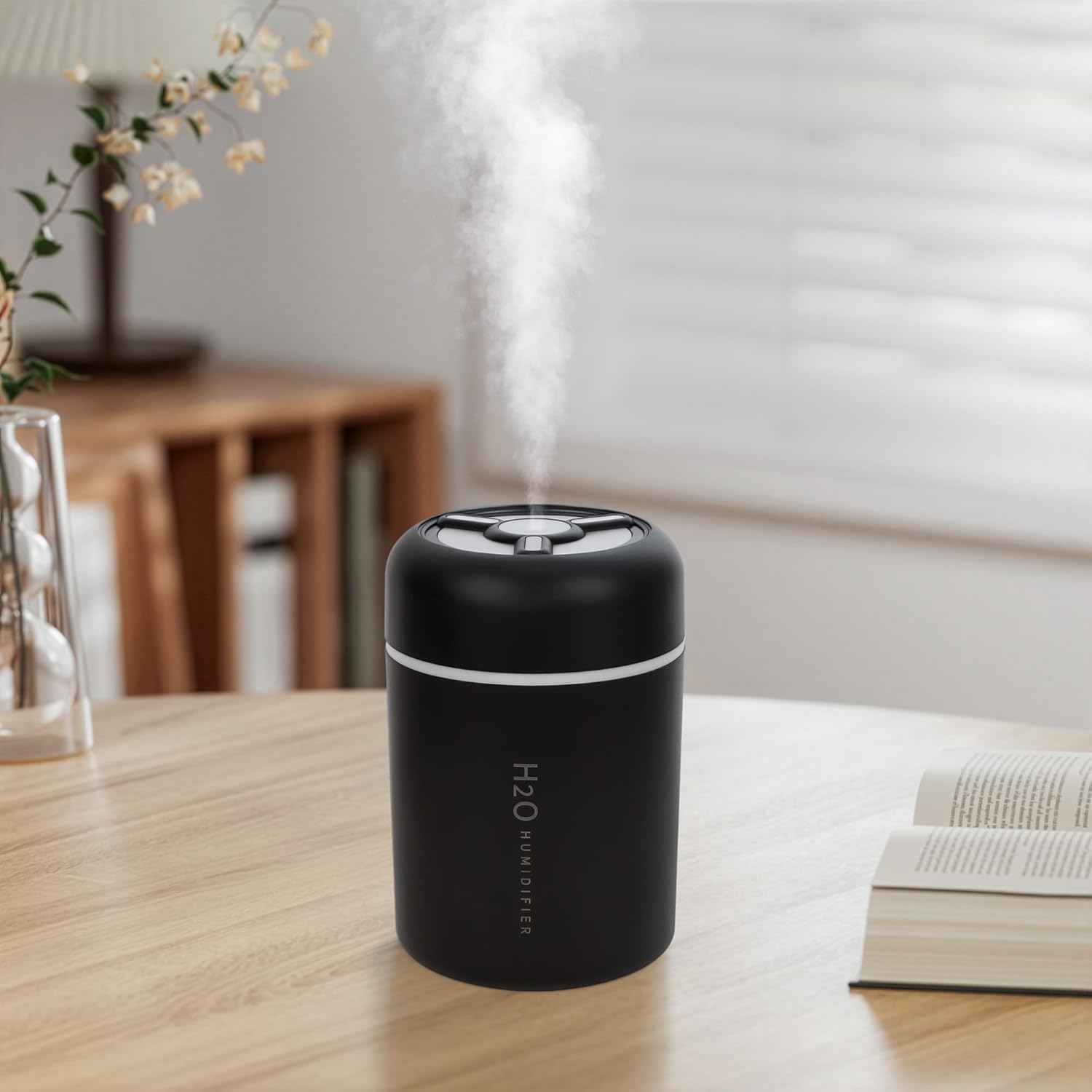
| Capacity | 300 ml |
|---|---|
| Power Source | USB Power Supply |
| Runtime | 4 hours (continuous), 8 hours (intermittent) |
| Filter Type | Cotton Swab Filter Element |
This small USB-powered humidifier is built for short-duration, personal use in bedrooms, offices, cars, or similarly sized enclosures like a 3×3 grow tent. It holds 300 ml of water and offers two spray modes — continuous (about 4 hours) and intermittent (about 8 hours) — driven by ultrasonic technology that claims a quiet 26 dB operation. One-button controls and a separate long-press for lighting keep operation simple, and the unit turns off automatically when water runs low. The vivid cycling LED gives a soft night-light effect and the included cotton-swab filter element is easy to replace. Practical benefits include portability, USB power for flexible placement, and low-noise performance that will not disturb sleeping areas or sensitive plants. Limitations are obvious: the small tank and short runtime mean frequent refills or external timed power for continuous tent humidity, and precise humidity control or hygrometer integration is not included, so maintaining stable RH in a grow tent will require monitoring and possibly pairing with a separate humidistat or larger capacity device.
Best for: Buyers who need an inexpensive, portable humidifier to add short bursts of humidity to a small enclosed space and prefer simple plug-and-play operation without extra setup.
Less Ideal for: People who need continuous, long-duration humidity control or precise automated RH regulation for larger or tightly controlled grow setups should consider larger-capacity or hygrometer-integrated units instead.
- Compact and highly portable for small spaces or travel
- USB power lets you run it from a controller, power bank, or light timer
- Two spray modes extend runtime or increase output as needed
- Auto shut-off protects the unit when water runs low
- Very quiet ultrasonic operation suitable for bedrooms or tents
- Small 300 ml reservoir requires frequent refilling for continuous use
- No built-in humidity control or sensor for automated RH management
Verdict: A budget-friendly, portable humidifier that delivers quiet, short-run misting for very small spaces or temporary use in a 3×3 grow tent when paired with external humidity monitoring.
AC Infinity CLOUDFORGE T3

| Capacity | 4.5 liters |
|---|---|
| Output Rate | 240 ml/h |
| Wattage | 24 Watts |
| Control Method | App |
| Runtime | 45 hours |
The AC Infinity CLOUDFORGE T3 is a plant-focused ultrasonic humidifier built to manage humidity inside a small grow tent. It holds 4.5 liters and uses a next-gen vaporizer to deliver up to 240 ml per hour while running on 24 watts, and it includes extendable tubing and a sensor probe to route moisture directly to plants or canopy zones. Smart features include VPD and humidity triggers, scheduling, and app-based control plus UIS platform integration for automated activation and alerts. The unit also offers a hidable backlit display, leak-resistant sealing, and backup memory so settings persist through power interruptions. In practice it provides fine-grained humidity control for a 3×3 tent when you need steady set-and-forget operation, though the 240 ml/h output and 4.5 L tank mean it will require refilling every couple days under high-demand conditions. Hose routing gives precise placement but adds a small amount of setup and cleaning effort. Overall it emphasizes stable, programmable humidity management for plant spaces rather than raw high-output continuous misting.
Best for: Growers who prioritize steady, programmable humidity control and automation for a 3×3 tent and want reliable, repeatable results with minimal daily intervention.
Less Ideal for: Users needing very high continuous mist output for larger or heavily transpiring environments or those who want a completely maintenance-free, disposable-style unit.
- Targeted moisture distribution via extendable tubing for precise canopy placement
- App control with VPD and humidity triggers enables automated, data-driven operation
- Leak-resistant seal and backup memory reduce maintenance and downtime after power interruptions
- 10-level vaporizer output provides fine-grained adjustments to match plant needs
- Output rate (240 ml/h) may be modest for very high-transpiration setups
- Requires occasional cleaning of tubing and probe to maintain performance
Verdict: A precise, automation-ready humidifier that delivers reliable, targeted humidity control for a 3×3 grow tent.
VIVOSUN AeroStream H05 5L Humidifier

| Capacity | 5 liters |
|---|---|
| Operation Mode | Ultrasonic |
| Floor Area | 150 square_feet |
| Filter Type | Carbon |
| Runtime | 3 hours |
The VIVOSUN AeroStream H05 is a 5‑liter ultrasonic humidifier aimed at growers who need steady, automated humidity management in compact spaces. It uses an external temperature and humidity probe for fine 1% resolution control and supports VPD monitoring through the VIVOSUN app, which lets you set targets, run recipes, and switch between Auto, Manual, or Cycle modes. Practical features include a flexible hose and vapor outlet for in‑tent or external placement, a top fill opening and opaque tank to limit light and buildup, and a phantom mode to turn off the display so plants are not disturbed. The unit is Wi‑Fi enabled and integrates with the VIVOSUN Smart Grow System for synchronized schedules. Expect quiet ultrasonic operation and a low‑water alert, but runtime listed as 3 hours suggests higher mist settings will require frequent refills in continuous use. For growers needing remote control and precise environmental feedback in a 3×3 grow tent, this unit delivers focused, plant‑friendly humidity control with a few practical maintenance considerations.
Best for: Growers who prioritize precise, automated humidity and VPD control for a small grow tent and want remote app control and recipe scheduling to simplify environmental management.
Less Ideal for: People who need very long unattended runtime or those who prefer a purely mechanical device without Wi‑Fi and app dependencies.
- Precise humidity control with 1% resolution and external probe for accurate readings
- Wi‑Fi and app integration with VPD monitoring and grow recipes for remote automated control
- 5 liter tank plus vapor outlet and flexible hose for adaptable placement inside or outside a tent
- Phantom mode and opaque tank reduce light exposure to plants and help keep the interior cleaner
- Quiet ultrasonic operation suitable for small grow spaces like a 3×3 tent
- Runtime listed as 3 hours may require frequent refills under continuous high output
- No explicit filter replacement schedule or parts availability details provided
Verdict: A plant‑focused, Wi‑Fi smart humidifier that gives growers tight VPD and humidity control for 3×3 tents with flexible placement and remote recipe management.
ROSEKM 4.5L Cool Mist Humidifier

| Capacity | 1.2 gallons |
|---|---|
| Runtime | 18 hours |
| Runtime (low) | 40 hours |
| Output | 250 ml/h |
| Power | 18 watts |
This ROSEKM humidifier is a straightforward cool-mist unit built for continuous bedroom or small-room use and it can also serve a 3×3 grow tent when you need stable humidity without fuss. The 4.5L tank supports long runtimes and the unit offers three mist levels plus an auto mode that uses a built-in humidity sensor to adjust output automatically. Controls are touch-based with a simple one-touch power/mist cycle, a digital display for current humidity, and programmable 1–12 hour timers for scheduled shutoff. Practical features include an auto shut-off on low water, a low-noise operation under 26 dB for undisturbed environments, and a cleaning brush to ease maintenance. It is filter-free, runs at low wattage, and provides up to 250 ml/h output on high, which is adequate to raise and maintain humidity in a small sealed tent but may require careful placement and airflow management for even distribution. The unit is not designed for adding nutrients or oils, and like most ultrasonic cool-mist units it needs regular cleaning to prevent mineral buildup.
Best for: Growers who prioritize predictable, low-maintenance humidity control in a small sealed tent and want a quiet unit that can run safely overnight with automatic adjustments.
Less Ideal for: Those running larger or heavily ventilated grow spaces that need very high output or who require nebulized nutrient delivery through the humidifier.
- Large 4.5L tank for long runtimes and fewer refills
- Auto mode with built-in humidity sensor for hands-off humidity control
- Quiet operation below 26 dB suitable for night use
- Auto shut-off when water is low for safe unattended operation
- No filter means minerals can deposit without distilled water or regular cleaning
- Output may be insufficient for rapid humidity swings in ventilated or larger grow setups
Verdict: A low-noise, large-tank cool-mist humidifier with auto humidity control that provides simple, reliable humidity management for a small 3×3 grow tent.
Choosing the Right Humidifier for 3X3 Grow Tent: Key Factors to Consider
Humidity Control Accuracy
Precise control matters because small tents amplify humidity swings. A humidifier with an accurate built-in humidistat or compatibility with an external controller makes it easier to hold the target relative humidity band for seedlings, vegetative plants, or flowering cycles.
Without fine control, the unit may overshoot or undershoot frequently, forcing you to intervene manually. Accurate setpoints also reduce the risk of condensation on walls or canopy surfaces, which can lead to mold or pest issues.
Runtime and Tank Capacity
Tank size determines how often you need to refill, which affects daily maintenance time. For a 3×3 grow tent, you want enough runtime to cover at least the core dark or light cycle so you are not refilling multiple times per day.
Consider how often you can realistically check the tent and whether you plan to automate refills. Larger tanks reduce refill frequency but add weight and footprint; balance capacity with how you place and service the unit in the tent.
Mist Output and Coverage
Output rate and how the mist is distributed affect whether humidity is uniform across the canopy. A unit that produces a controlled, adjustable output helps you avoid localized wet spots while achieving the needed ambient RH.
Look for adjustable nozzles, directional output, or simple fan-assisted dispersion. For compact tents, too high an output can cause condensation; too low a rate will not move humidity into the canopy evenly.
Ease of Cleaning and Maintenance
Humidifiers can become breeding grounds for mold and bacteria if not cleaned regularly. Choose designs with accessible tanks, removable components, and serviceable filters or wicks to make routine cleaning quick and effective.
Regular maintenance reduces odor, prevents mineral buildup, and extends the device lifespan. Consider whether the unit requires distilled water, special filters, or frequent part replacements that add ongoing cost and effort.
Control Integration and Automation
Integration with external controllers, timers, or standalone hygrometers lets you automate humidity schedules and log environmental changes. For growers who change RH targets between veg and bloom, automation reduces manual adjustments and human error.
Check for units that accept external humidity probes or have dry-contact inputs for basic environmental controllers. Networked or smart features can be handy but should not replace reliable local control for critical setpoints.
Noise Level and Airflow Interaction
Noise matters when the tent is in a living area, and the humidifier's airflow can interact with inline fans and intake patterns. Quieter units reduce disturbance and are less likely to disturb microclimates inside the tent.
Also consider whether the device creates direct airflow that might dry leaf surfaces or cause uneven distribution when combined with the tent's ventilation. A balance of low noise and appropriate airflow keeps the environment stable without introducing hotspots.
Sizing Output for a 3X3 Canopy
Calculating the right output starts with understanding canopy density and target relative humidity. A lightly planted tent at vegetative RH targets needs less sustained output than a densely packed tent during early flowering when transpiration increases.
Work from your target RH and the tent volume rather than raw unit wattage. Adjustability is more useful than raw maximum output because it lets you dial back when plants transpire less or when the room outside the tent contributes humidity.
- Estimate tent volume and note that humidity change rate increases with plant transpiration.
- Choose units with adjustable output so you can tune delivery through growth stages.
- If you use multiple light cycles, aim for runtime that covers the longer cycle between checks.
Placement and Distribution Tips
Position the humidifier so mist disperses across the canopy without directly wetting leaves. A corner placement with a short directional nozzle or a small circulation fan helps distribute humidity evenly.
Avoid placing the unit directly under lights or heater elements. Check how the tent's intake and exhaust pattern move air and place the humidifier where it benefits the canopy rather than being exhausted immediately.
- Mount or elevate small units to avoid accidental spills and to improve mist circulation.
- Use a short oscillating fan on low to even out pockets of humidity if needed.
- Keep sensors and probes away from direct mist streams to get accurate room readings.
Water Quality and Mineral Management
Water quality affects maintenance and the cleanliness of mist. Hard water leaves mineral residue that clogs nozzles and creates white dust on leaves, which can be a contaminant issue in a closed tent.
If mineral buildup is a concern, plan for either distilled or filtered water, or choose a humidifier with replaceable wicks or an easy-to-clean ultrasonic plate. Regular descaling and tank rinses prevent long-term performance loss.
- Use filtered or distilled water when possible to reduce mineral deposits.
- Rinse tanks and components regularly according to manufacturer guidance.
- Have a simple descaling routine for parts that contact water.
Automation and Sensor Placement
Automating humidity control improves repeatability. If the humidifier has a built-in humidistat, validate its reading with a separate calibrated hygrometer positioned at canopy height. This prevents discrepancies between the unit's sensor and actual tent conditions.
For external sensors, mount them inside the tent at plant level, away from direct mist and airflow. This placement offers a truer reading of what the plants experience and helps the humidifier respond appropriately.
- Verify built-in sensors against a separate hygrometer before relying on automatic control.
- Mount probes at canopy height and away from direct mist streams.
- Use simple timers or controller relays to coordinate humidifier cycles with lights and fans.
Cleaning and Hygiene Best Practices
Establish a cleaning schedule that fits your watering and maintenance cycle. For most humidifiers in close-canopy use, a weekly quick rinse and a monthly deeper clean with a mild descaling agent keeps components clear and sanitary.
Inspect rubber seals, wicks, and the base for biofilm or residue. Replace consumable parts per the maintenance schedule to avoid efficiency loss and contamination risks.
- Empty and dry tanks between uses if you run intermittent cycles to reduce microbial growth.
- Disinfect surfaces with plant-safe cleaning agents when residue appears.
- Keep spare wicks or filters on hand to avoid downtime during part replacements.
How We Chose the Best Humidifier for 3X3 Grow Tent
We focused on criteria that directly affect the environment inside a 3×3 grow tent and the daily workflow of a tent grower. First, control precision: accurate humidistats and fine adjustment save time and reduce humidity swings that stress plants. Second, runtime and tank capacity: units that run through light/dark cycles without frequent refills are more practical for regular care. Third, output and distribution: sufficient mist output and options for adjustable nozzles or fans ensure even coverage across a small canopy. Fourth, maintenance and cleaning: easy-to-disassemble water paths and accessible filters reduce downtime and mold risk. Fifth, integrations and automation: compatibility with external hygrometers, timers, or environmental controllers improves repeatability in a tent setup. We excluded devices intended only for open-room humidification with very high floor footprint or impractically high output for a 3×3 tent. We also screened out models lacking basic humidity control or those with documented difficult cleaning that raises contamination risk. The final selection prioritized balanced combinations of control accuracy, consistent runtime, appropriate output for a compact canopy, and straightforward upkeep.
Our full evaluation process is outlined in our review methodology.
FAQ
How often should I run a humidifier in a 3×3 grow tent?
It depends on target RH and plant transpiration. Many growers run humidifiers to maintain a set RH continuously, with the unit cycling on and off via a humidistat. If you must refill daily, consider a larger tank or automation to cover full light or dark cycles.
Can I use tap water in my humidifier inside the tent?
Tap water often contains minerals that leave deposits and increase cleaning. Using filtered or distilled water reduces mineral buildup and keeps nozzles and sensors cleaner, though it may not be strictly required for short runs.
Will a humidifier increase the risk of mold in my tent?
Excessive or uneven humidity can raise mold risk. Controlled, even humidity that avoids condensation on leaves and walls reduces mold chances. Proper placement, good airflow, and accurate control help mitigate this risk.
Where should I place the humidity probe in a 3×3 tent?
Place the probe at canopy height and away from direct mist streams or vents. That location provides the most representative reading of what plants experience and helps the humidifier respond appropriately.
Are ultrasonic humidifiers safe for closed grow tents?
Ultrasonic units are effective in small tents because they produce fine mist with low energy. However, they can transfer minerals into the air if tap water is used. Regular cleaning and appropriate water quality reduce associated issues.
Final Verdict
For a 3×3 grow tent, prioritize accurate humidity control, enough runtime to cover your longer cycles, and a delivery method that distributes mist evenly without wetting foliage. Tradeoffs typically involve tank size versus footprint and the level of automation you want. Choose a unit that matches your maintenance cadence and integrates with your tent's airflow and controllers. When you balance control precision, serviceability, and appropriate output, you can maintain stable RH bands that support healthier growth and lower contamination risk.