
Note: This article contains affiliate links. If you click on these links and make a purchase, we may earn a small commission at no extra cost to you. This helps support our research and content. Read our full affiliate disclosure here.
If you struggle with nasal congestion, dry sinuses, or allergy-related irritation, the right humidifier can make daily life noticeably easier. A targeted humidifier for allergies and sinus helps maintain stable indoor humidity, so mucous membranes stay hydrated and inflamed airways calm down. You want a unit that delivers the right amount of moisture without adding dust, noise, or maintenance hassle. This guide profiles seven shortlisted humidifiers that suit allergy and sinus relief, focusing on precise humidity control, quiet operation, and ease of cleaning. Read on to understand the key features that matter and which specs to prioritize before you buy.
Top Picks at a Glance
| Best Overall The best all-around choice for most situations | Levoit Neo Classic 450 |  |
| Best Quality Built to a higher standard if you want something more solid | BLUEAIR Premium Smart Humidifier 3.5L |  |
| Best Value The sweet spot between price and what you get | Homvana H101 Humidifier |  |
| Best Budget The cheapest option that still gets the job done reliably | AZEUS 2.8L Cool Mist Humidifier |  |
| Top Rated A top-rated pick with lots of positive feedback | Pure Enrichment HUME Sense 2-Gal |  |
| Most Popular A crowd favorite that many people choose with confidence | AquaOasis Cool Mist Humidifier AO-101 |  |
| Best Seller A high-volume bestseller chosen again and again | Levoit Classic 160 Humidifier |  |
Levoit Neo Classic 450

| Capacity | 4.2 liters |
|---|---|
| Runtime | 42 hours |
| Operation Mode | Ultrasonic |
| Runtime Noise | 21-26 dB |
| Wattage | 24 watts |
The Levoit Neo Classic 450 is a top-fill ultrasonic humidifier built to provide steady cool mist for bedrooms and medium to large rooms. It uses an easy top-fill design and a 4.2 L tank to run up to 42 hours in sleep mode, which reduces the need for frequent refills overnight. The unit is aimed at quiet use cases with a documented sleep-mode noise level around 21 dB and a blue-light-free night light with two brightness settings for darker rooms. Practical touches include a detachable sink and water tank cover that are dishwasher-safe under recommended conditions, plus an aroma chamber for occasional essential oil use. For allergy and sinus relief it offers continuous humidification over a wide coverage area, but buyers should follow recommendations to use distilled water to minimize white dust and perform regular cleaning to avoid mineral buildup or mold. The humidifier is touch-controlled and runs at 24 W, making it simple to operate but it does not include an integrated hygrometer or air filtration features.
Best for: Buyers who want a low-noise, long-running bedroom humidifier that is easy to fill and clean and delivers steady cool mist for overnight allergy or sinus relief.
Less Ideal for: People who need automatic humidity control or integrated air filtration should look for models with a built-in hygrometer or combined purifier functionality.
- Large 4.2 L tank provides up to 42 hours of runtime in sleep mode, reducing refills
- Top-fill and detachable parts make refilling and cleaning easier, with some components dishwasher-safe
- Very quiet operation (around 21 dB) suitable for bedrooms and nurseries
- Covers up to about 432 ft², allowing humidification of medium to large rooms
- No built-in humidistat, so you need a separate hygrometer to target specific humidity levels
- Ultrasonic units can produce white dust if hard water is used, so distilled water is recommended
Verdict: A quiet, long-run top-fill humidifier that simplifies overnight humidity boost for allergy and sinus comfort.
BLUEAIR Premium Smart Humidifier 3.5L
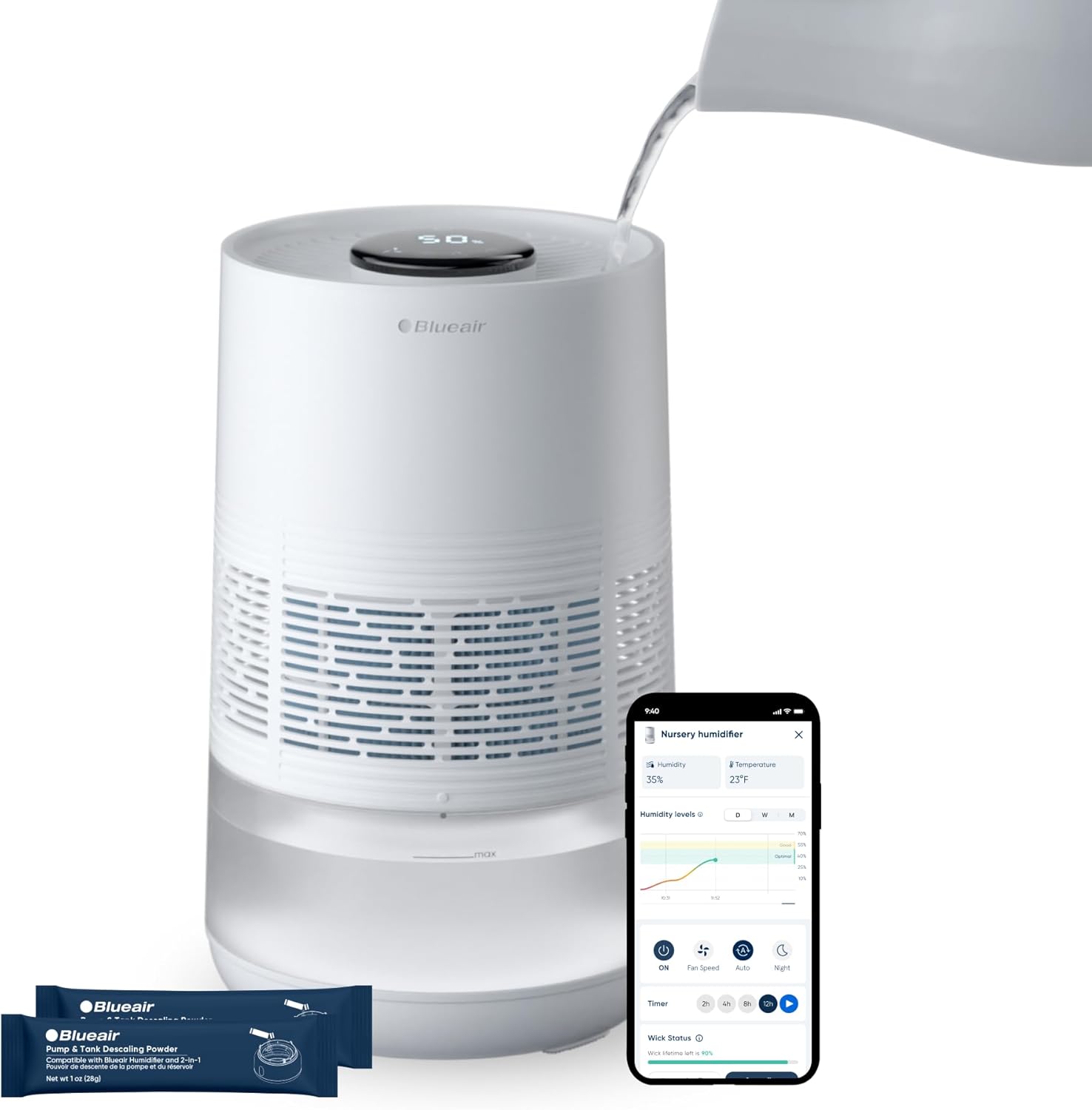
| Capacity | 3.5 liters |
|---|---|
| Floor Area | 500 square_feet |
| Operation Mode | Evaporative |
| Control Method | App, Touch |
| Runtime | 48 hours |
The BLUEAIR Premium Smart Humidifier is an evaporative unit built to raise indoor humidity in larger rooms up to about 500 sq ft while minimizing dust and residue. It uses a wick filter with an anti-microbial coating and 360° InvisibleMist technology to trap minerals and pollutants before releasing moisture, which helps reduce white dust common with ultrasonic units. The 3.5 L top-fill tank supports up to 48 hours of runtime in night mode and is dishwasher-safe for easier cleaning. Smart features include app and touchscreen controls, AutoHydrate mode to maintain target humidity, a UV-integrated water pump that recirculates water to limit bacterial growth, and a quiet night mode for bedrooms. Practical limitations are that it is an evaporative wick-based design so humidity output depends on room airflow and ambient conditions, and the wick filter requires periodic replacement to maintain performance. For allergy and sinus relief it delivers cleaner-feeling moisture without sticky residue, but you should follow the maintenance schedule to avoid microbial buildup.
Best for: Buyers who prioritize clean, residue-free humidity and reliable overnight performance for allergy or sinus relief and want smart controls to maintain steady indoor humidity.
Less Ideal for: People wanting instant visible steam or very high localized humidity in small areas should consider alternative technologies designed for rapid spot humidification.
- Wick filter with anti-microbial coating reduces minerals and white dust compared with ultrasonic units
- 360° InvisibleMist and evaporative operation produce non-sticky, residue-free moisture
- Top-fill 3.5 L tank and dishwasher-safe parts make refills and cleaning straightforward
- App, touchscreen, AutoHydrate, and night mode give precise, convenient control for sleep environments
- UV-integrated water pump with recirculation lowers risk of stagnant-water bacterial growth
- Performance depends on room airflow and ambient conditions so output is not a fixed steam-like mist
- Requires regular wick filter replacement to sustain filtration effectiveness
Verdict: Choose this humidifier if you want smart, evaporative humidification that delivers clean, non-sticky moisture for large rooms and sleep-focused allergy relief.
Homvana H101 Humidifier

| Capacity | 3.6 liters |
|---|---|
| Floor Area | 161 square_feet |
| Operation Mode | Ultrasonic |
| Control Method | Touch |
| Power Source | Corded Electric |
The Homvana H101 is a top-fill ultrasonic cool-mist humidifier designed for bedroom or medium-room use. It holds 3.6 liters and uses a top-loading removable tank and a wide 5.3-inch opening that makes refilling and cleaning quick and low-mess. The unit runs quietly thanks to a claimed SilentSpray mode under 23 dB and includes a display-off sleep mode for overnight use. A built-in aroma pad lets you add a few drops of essential oil so the device doubles as a mild diffuser, and touch controls plus an auto shut-off add safety and convenience. The product lists a carbon filter and a runtime specification; in practice you should expect several nights of operation between fills depending on output setting. Important limitations are that the runtime field here is listed as 36 minutes which appears inconsistent with tank capacity and likely refers to a specific setting or mislabeling, so check actual run times for your needs, and the unit is corded and set up for 240V operation which may matter for some buyers. For allergy and sinus relief it provides cool-mist humidification and easy cleaning, but users should maintain the tank and filter regularly to avoid mineral or bacterial buildup.
Best for: Buyers who prioritize low-maintenance, easy refilling and quiet overnight operation for a bedroom or medium living space and want a simple humidifier that also offers light aromatherapy.
Less Ideal for: Those needing hospital-grade humidification, precise digital humidity control for severe allergies, or portable cordless operation should look at alternative models tailored to clinical or travel use.
- Top-fill removable 3.6L tank with wide opening for easy refills and cleaning
- Very quiet operation with display-off sleep mode suitable for overnight use
- Built-in aroma pad adds mild aromatherapy without a separate diffuser
- Touch controls and auto shut-off improve safety and user convenience
- Carbon filter for basic filtration of impurities in water vapor
- Runtime listed as 36 minutes is inconsistent with tank size and may be unclear to buyers
- Rated voltage at 240 volts may require attention for regions using different mains voltages
Verdict: A practical, easy-to-clean cool-mist humidifier that delivers quiet overnight humidity and simple aromatherapy for bedroom and medium-room allergy relief.
AZEUS 2.8L Cool Mist Humidifier

| Capacity | 2.8 liters |
|---|---|
| Operation Mode | Ultrasonic |
| Filter Type | Microporous filters or Wick |
| Power Source | Corded Electric |
| Control Method | Touch |
The AZEUS 2.8L cool mist humidifier is an ultrasonic tabletop unit aimed at restoring humidity in bedrooms, nurseries, and small offices. It breaks water into fine mist via an atomizer and distributes it through 360 degree rotating double nozzles, with a maximum mist output listed at about 250 ml/hour. The 2.8 liter tank supports extended runtime so you can run it through the night without frequent refills, and the unit has an auto shut-off and low-water indicator for safety. Controls are simple with a touch panel and a dial for adjusting mist volume, and the manufacturer advertises a very quiet operation around 28 dB. The humidifier can use microporous filters or a wick, which helps if you want basic particulate capture ahead of the mist. Practical limits include modest coverage—suitable for single rooms rather than whole houses—and a basic feature set without built-in humidistat or app control, so you will need to monitor humidity separately if targeting allergy and sinus relief. For a budget-oriented, no-frills humidifier that runs quietly overnight, this model delivers usable performance.
Best for: Buyers on a tight budget who need a quiet, easy-to-use bedroom or nursery humidifier that runs overnight without frequent refills and offers simple manual control.
Less Ideal for: People who want precise automatic humidity control, smart features, or a unit sized for whole-house or multiple-room coverage should consider higher-end models instead.
- Large 2.8 L tank supports long runtime and fewer refills
- Ultrasonic atomizer with 360 degree rotating nozzles for even mist distribution
- Auto shut-off and low-water indicator for safer unattended use
- Advertised very quiet operation (about 28 dB) suitable for bedrooms
- No built-in humidistat or automatic humidity control
- Coverage and mist output are best for single rooms, not whole-home use
Verdict: A straightforward, budget-friendly ultrasonic humidifier that quietly extends overnight runtime with a large tank for basic allergy and sinus relief in single rooms.
Pure Enrichment HUME Sense 2-Gal

| Capacity | 2 gallons |
|---|---|
| Floor Area | 600 square_feet |
| Operation Mode | Ultrasonic |
| Other Special Features of the Product | Auto Shut Off |
The HUME Sense is a large-capacity top-fill humidifier designed to run for days on a single fill and manage indoor humidity automatically. It uses ultrasonic operation and offers both warm and cool mist with three output levels, a humidity sensor with an Auto mode (settable between 40% and 75%), and timers plus a Sleep Mode for low-noise overnight use. The top-fill tank and included cleaning brush make refills and maintenance straightforward, while the antibacterial tank and UV light help reduce microbial growth in the water. Color Choice lighting and an aromatherapy pad let you add gentle scent to a room. Practical limits include its footprint for smaller bedside tables and the need to use and clean distilled or treated water periodically to avoid mineral buildup; warm mist also uses more energy than cool mist. For allergy and sinus relief the steady humidity control and UV/antibacterial features support cleaner mist and longer continuous runtime for consistent nasal comfort.
Best for: Buyers who prioritize steady, low-maintenance humidity control for allergy and sinus symptom relief and want a humidifier that runs for days without frequent refills.
Less Ideal for: People who need a very compact bedside unit or who prefer a strictly cool-mist ultrasonic unit with minimal energy use should consider smaller or single-mode alternatives.
- Large 2-gallon top-fill tank provides up to 4.5 days runtime between refills
- Built-in humidity sensor with Auto mode keeps target humidity consistent
- Offers both warm and cool mist with three output levels for flexible relief
- Antibacterial tank and UV light reduce microbial growth for cleaner mist
- Aromatherapy tray and color light options add comfort features for bedrooms and nurseries
- Physically larger footprint may not fit small nightstands or crowded desks
- Requires regular cleaning and proper water choice to avoid mineral buildup
Verdict: Choose the HUME Sense if you want reliable, long‑run automatic humidity control with antibacterial and UV features to support allergy and sinus comfort.
AquaOasis Cool Mist Humidifier AO-101

| Capacity | 2.2 liters |
|---|---|
| Operation Mode | Ultrasonic |
| Runtime | 26 hours |
| Power Source | Corded Electric |
| Wattage | 24 watts |
The AquaOasis AO-101 is a straightforward ultrasonic cool-mist humidifier built for overnight and everyday use in bedrooms, nurseries, or offices. It holds 2.2 liters of water for up to about 26 hours of runtime and uses a touch control and an analogue knob to set mist output. The 360-degree rotating nozzle helps direct moisture where you need it while the unit runs quietly enough for sleep or baby rooms and includes auto shut-off when the tank empties. Because it is filter-free the unit avoids replacement-filter costs, though users should follow cleaning guidance to prevent mineral buildup or bacteria growth, and distilled water is recommended. The simple controls and included cleaning brush make maintenance and operation easy, but this is a single-room cool-mist device without humidistat or heated steam, so humidity must be monitored separately for allergy-sensitive households. For buyers who want a low-noise, long-running humidifier with easy fill and directed mist, the AO-101 is a practical, no-frills option.
Best for: Buyers looking for a quiet, easy-to-use cool-mist humidifier for nightly use in bedrooms or nurseries who prioritize long runtime and simple controls guided by user reviews and practical reliability.
Less Ideal for: People who need whole-house humidification, precise automatic humidity control, or warm-mist/steam humidification should consider different models.
- Large 2.2L tank provides up to about 26 hours of continuous runtime on a single fill
- Whisper-quiet ultrasonic operation suitable for bedrooms and nurseries
- 360-degree rotating nozzle for targeted mist direction
- Filter-free design eliminates replacement-filter costs
- No built-in humidistat so you must monitor room humidity separately
- Recommended regular cleaning and distilled water to avoid mineral deposits and microbial growth
Verdict: A quiet, long-running cool-mist humidifier that delivers easy overnight relief for dry air in bedrooms and nurseries.
Levoit Classic 160 Humidifier

| Capacity | 2.5 liters |
|---|---|
| Operation Mode | Ultrasonic |
| Runtime | 25 hours |
| Runtime Noise | 26–28 dB |
| Control Method | Touch / knob |
The Levoit Classic 160 is a compact top-fill ultrasonic humidifier intended for bedrooms, nurseries, and home offices. Its 2.5 liter tank and low-setting runtime of up to 25 hours make it convenient for overnight use, and the wide top opening simplifies filling and weekly cleaning. Mist output is controlled by a single knob and directed with a 360 degree nozzle, so you can quickly adjust humidity where you need it. The unit runs very quietly at roughly 26–28 dB and has an auto shut-off float with a red indicator when water runs low, which helps prevent dry running. It uses a pre-filter sponge to trap impurities, but it does not have a built-in humidistat or automatic humidity control so you must monitor room humidity separately. Also avoid using essential oils and use distilled water to reduce mineral dust. For buyers who prioritize straightforward, low-noise humidification for allergy or sinus relief, this model provides reliable basic performance with easy maintenance.
Best for: A cautious buyer who wants a simple, quiet humidifier that is easy to fill and maintain for overnight allergy or sinus symptom relief in small to medium rooms.
Less Ideal for: People who want automatic humidity control, integrated humidity sensing, or essential-oil diffusion should consider other models with those features.
- Top-fill tank and wide opening make filling and cleaning fast and spill-free
- Long low-speed runtime up to 25 hours supports overnight use without refilling
- Very quiet operation (26–28 dB) suitable for light sleepers and nurseries
- Auto shut-off with low-water indicator reduces risk of running dry
- Includes pre-filter sponge and cleaning brush to help manage impurities and maintenance
- No built-in humidistat or auto-humidity control so you must monitor humidity manually
- Can produce mineral "white dust" if tap water is used; distilled water recommended
- Not compatible with essential oils which limits aromatherapy use
Verdict: Choose the Levoit Classic 160 if you need a quiet, easy-to-fill humidifier that delivers reliable overnight moisture and simple maintenance for allergy and sinus comfort.
Choosing the Right Humidifier for Allergies and Sinus: Key Factors to Consider
Humidification Accuracy and Controls
Accurate humidity control matters because both under-humidifying and over-humidifying can worsen nasal congestion and sinus inflammation. Look for units with adjustable humidistats or precise percentage targets so you can maintain relative humidity in the recommended range for comfort.
Digital controls, built-in hygrometers, and a reliable automatic shutoff when the target is reached reduce manual intervention and prevent excessive moisture that could promote mold growth. For allergy and sinus relief, the ability to set a target (for example between 40 and 50 percent) and have the unit hold it steady is more important than raw output alone.
Noise Level and Nighttime Use
Many people with sinus issues run humidifiers overnight to keep airways moist while sleeping. Excessive fan or motor noise can disrupt sleep and counteract the benefits of better breathing. Choose models with low decibel ratings, quiet fan blades, or special night modes that reduce noise output.
Also consider whether the unit's sound is continuous or intermittent. A steady low hum is often less disruptive than variable fan speeds or periodic rattles. If you are a light sleeper, prioritize whisper-quiet performance and user reports about nighttime acceptability.
Filtration, Mineral Management, and Water Quality
Mineral-laden tap water can produce visible white dust with ultrasonic units and may leave deposits inside the tank. For allergy sufferers, airborne particulates and mineral dust are undesirable. Look for humidifiers with demineralization cartridges, compatible filters, or a recommendation to use distilled water.
Some evaporative models naturally limit mineral release because the filter traps particles. Regularly replacing filters or cartridges and following water-quality guidance reduces the chance of emitting irritants that could aggravate allergies and sinus issues.
Ease of Cleaning and Sanitization
Humidifiers that are difficult to clean are more likely to harbor bacterial or mold growth, which can worsen respiratory symptoms. Choose designs with wide openings, removable tanks, and simple access to internal surfaces for routine cleaning.
Consider how often the manufacturer recommends deep-cleaning procedures and whether replacement parts are easy to install. Units with fewer crevices and dishwasher-safe components lower the time and effort required to keep the device sanitary.
Output Capacity and Room Coverage
Coverage matters because a unit that is underpowered for your room size will not maintain target humidity and may run constantly without effect. Check the rated square footage or output capacity and choose a humidifier with a comfortable margin above your room size for consistent results.
Higher output models are useful for larger living rooms or open-plan spaces, while smaller bedside units are adequate for bedrooms. Also account for ceiling height and typical seasonal dryness—colder months often require more output to reach the same relative humidity.
Controls, Automation, and Runtime
How a humidifier fits into your daily routine depends on its control options. Timers, programmable schedules, and built-in sensors reduce the need for frequent adjustments. Longer runtime between refills is useful if you prefer to set it and forget it overnight.
Battery-backed memory and simple restoration of presets after power outages are practical touches. Evaluate whether the control layout is intuitive, whether remote or app control is offered if you want it, and whether automation features align with how you will use the unit most often.
Choosing Between Ultrasonic and Evaporative Technologies
Two common humidification methods are ultrasonic and evaporative, and each has tradeoffs relevant to allergy and sinus relief. Ultrasonic units create a fine mist with very little noise and low energy use. However, they can spread minerals from tap water unless paired with a demineralization cartridge or used with distilled water.
Evaporative systems use a wick or filter and a fan to move air through a moist medium. They are less likely to emit mineral dust because the wick traps particulates, but the fan can be louder and filters need periodic replacement. Consider which tradeoffs you are willing to manage—noise versus mineral management—when deciding on a technology.
- Ultrasonic: quiet, high mist density, may need distilled water or cartridges.
- Evaporative: naturally limits mineral output, requires wick/filter replacement, can be noisier.
- Personal preference, water quality, and noise sensitivity should guide the choice.
Placement and Room Setup for Best Results
Placement affects how evenly humidity distributes and how effectively the unit relieves sinus symptoms. Position the humidifier on a raised, level surface away from walls and electronics to allow unobstructed airflow. In bedrooms place it about 3 to 6 feet from the bed so the mist can reach you without causing wet spots on bedding.
Avoid placing units directly on wood surfaces unless a waterproof mat is used. In larger open areas, a central location provides the most even coverage. Also factor in airflow patterns from HVAC vents which can speed distribution or create dry pockets.
- Keep the unit off the floor and away from walls.
- Place 3–6 feet from sleeping areas for bedside comfort.
- Avoid directing mist onto furniture or electronics.
Maintenance Routines That Keep Symptoms Down
A regular cleaning schedule is the most effective way to prevent humidifiers from becoming a source of irritants. Empty and dry the tank daily, rinse and refill with fresh water, and perform a weekly deep clean following manufacturer guidelines. Use appropriate disinfectants or vinegar solutions as recommended.
Track filter and cartridge replacement intervals and keep spare parts on hand to avoid lapses. Poor maintenance can negate any benefit the humidifier provides by introducing allergens or microbial growth into the air.
- Daily: empty, rinse, and refill the tank.
- Weekly: deep clean and sanitize internal surfaces.
- Monthly or per schedule: replace filters and cartridges.
When to Use a Humidifier with Other Allergy Strategies
A humidifier is one tool among several for managing allergies and sinus issues. Use it alongside air filtration, bedding hygiene, and reducing indoor irritants for the best results. Humidifiers help by maintaining mucosal hydration but do not remove pollen or pet dander from the air.
If you are using allergy medications or nasal rinses, a stable indoor humidity often improves comfort, but it is not a substitute for medical treatments. Coordinate humidifier use with other measures like regular vacuuming, HEPA filtration in living spaces, and reducing indoor dust sources.
- Use humidifiers to complement, not replace, air cleaning and hygiene practices.
- Avoid over-humidifying, which can worsen mold and dust mite growth.
- Regularly assess indoor humidity with a separate hygrometer for best results.
Using Distilled or Filtered Water: Pros and Cons
Switching to distilled water eliminates most mineral deposits and white dust from ultrasonic humidifiers, reducing the need for demineralization cartridges. Distilled water also lowers the risk of mineral buildup inside the tank and vapor path.
The downside is the recurring cost and the need to source distilled water. If tap water is used, pick models that include mineral cartridges or easy-to-replace wicks and plan for more frequent cleaning to manage deposits.
- Distilled water reduces mineral dust and internal scaling.
- Tap water requires cartridges or more frequent cleaning.
- Balance convenience, ongoing cost, and maintenance when deciding which water to use.
How We Chose the Best Humidifier for Allergies and Sinus
To build this list we prioritized features that directly affect sinus comfort and allergy management. Primary evaluation criteria included humidification accuracy and coverage, which determine whether a unit can maintain a target indoor humidity level without swings that worsen congestion. We tested spec sheets and real-world reports for quietness and fan design, since noise influences whether a unit can run overnight. Filtration and particle management were assessed for their role in preventing irritants from circulating with the mist. Ease of cleaning and maintenance was another key filter because bacterial or mineral buildup can worsen symptoms if not addressed. Lastly we considered controls and automation, such as adjustable humidistats and scheduling, for consistent daily use. Units were excluded if they lacked basic humidity control, were advertised as single-use novelty items, or required excessive daily maintenance. We focused on practical, user-oriented features rather than marketing claims. The resulting picks balance real-world usability, measurable humidifying performance, and sanitary operation for people prioritizing allergy and sinus relief.
Our full evaluation process is outlined in our review methodology.
FAQ
How humid should my home be to help sinus congestion?
Aim for a relative humidity between about 40 and 50 percent. That range keeps mucous membranes hydrated without encouraging mold growth or dust mites. Exact comfort can vary, so monitor symptoms and adjust within that band.
Will a humidifier make mold or dust mites worse?
Over-humidifying can increase mold and dust mite activity. Consistently keeping humidity below about 50 percent and maintaining good cleaning habits helps avoid those problems. Use a hygrometer and automated humidistat to reduce risk.
Is distilled water necessary for allergy-friendly humidifier operation?
Distilled water reduces mineral dust and internal scaling, which is particularly helpful for ultrasonic units. It is not always required if the unit includes a demineralization cartridge or if you choose an evaporative model, but distilled water simplifies maintenance.
How often should I clean my humidifier to keep allergies under control?
Emptying and rinsing the tank daily and doing a weekly deep clean is a good baseline. Replace filters and cartridges on the schedule recommended by the manufacturer to prevent microbial growth and mineral buildup.
Can I run a humidifier all night if I have sinus issues?
Yes, running a properly sized, quiet humidifier with an accurate humidistat overnight is common for sinus relief. Ensure the unit is well-maintained and set to a safe target humidity to minimize mold risk.
Final Verdict
Prioritize controllable features that directly affect breathing comfort when picking a humidifier for allergies and sinus. Accurate humidistats and appropriate output for your room size should come first, followed by quiet operation and manageable maintenance. Decide between ultrasonic and evaporative technologies based on water quality and noise tolerance, and plan a cleaning routine that prevents mineral and microbial buildup. Focus on matching coverage, controls, and upkeep to how you will actually use the device. That approach helps you get measurable, lasting relief while minimizing the tradeoffs that can create new irritants.